Introduction
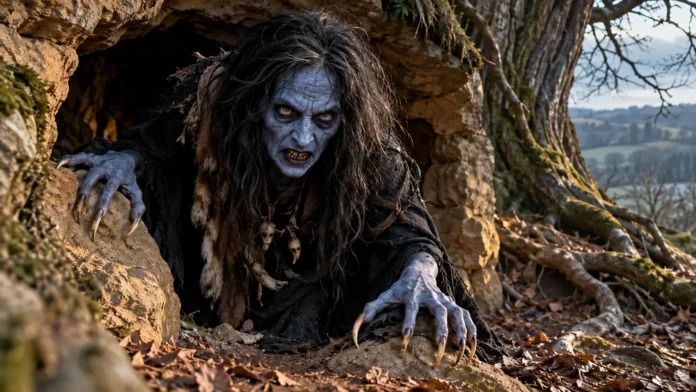
Black Annis is a bogeywoman from the folklore of Leicestershire, England, especially associated with the Dane Hills west of Leicester. Tradition places her in a cave called Black Annis’s Bower, where she waits for wandering children and livestock after dark.
Stories portray her as a predatory hag rather than a witch with a detailed biography. She attacks children and lambs, drinks blood, flays victims, and keeps their skins.
Parents reportedly used her name to frighten children away from dangerous places and nighttime wandering.
Her legend remains unusually tied to a real landscape. Historical records preserve the name Black Anny’s Bower Close, while later poems, newspaper letters, antiquarian works, and folklore collections gradually expanded the creature’s appearance, habits, cave, and reputation throughout Leicestershire.
Modern retellings sometimes identify Black Annis with ancient Celtic goddesses, prehistoric religion, or forgotten pagan rites. Those theories remain speculative.
The strongest evidence instead shows a regional English bogey figure whose documented form developed through eighteenth and nineteenth-century local tradition.
History/Origin
The earliest firm written evidence connected with Black Annis comes from eighteenth-century property records. Two deeds from 1764 refer to land near Leicester as Black Anny’s Bower Close, proving that the name was already attached to the landscape before later literary descriptions appeared.
Those deeds do not explain who Black Anny was, nor do they mention child-eating, blue skin, claws, or supernatural powers. They establish the place-name, but the terrifying figure familiar today becomes much clearer through poetry, newspaper correspondence, and nineteenth-century folklore collecting.
John Heyrick supplied the first influential literary portrait in his 1797 poem about Black Annis’s Bower. He places her beneath an oak near a rocky cave and describes disappearing sheep, threatened children, monstrous talons, blue features, and human skins worn around her body.
“Vast talons, foul with human flesh, there grew / In place of hands, and features livid blue.” (On a Cave Called Black Annis’s Bower, John Heyrick, 1797.)
Nineteenth-century accounts continued reshaping the legend. One 1842 description called her a savage woman with great teeth and long nails who devoured human victims, while later Leicester newspaper correspondence recorded childhood warnings about venturing onto the Dane Hills near her bower.
One historical theory connects the legend with Agnes Scott, a late medieval anchoress associated with the Leicester area and buried at Swithland. The resemblance between Agnes and Annis makes the proposal interesting, but surviving evidence cannot prove that the folkloric monster originated from her memory.
Claims that Black Annis preserves an ancient goddess such as Anu, Danu, or the Cailleach appeared much later. Similarities between female hags across traditions can inspire comparison, but they do not demonstrate an unbroken religious lineage connecting Iron Age belief directly to Leicestershire folklore.
Name Meaning
The name appears in several historical and folkloric forms, including Black Annis, Black Anna, Black Anny, and Cat Anna. The 1764 property deeds use Black Anny, while John Heyrick’s 1797 poem uses Black Annis, the form that eventually became standard.
Annis was also an English personal name related to Agnes, which makes an ordinary human-name origin possible. However, no surviving source proves that the folkloric name developed from one specific woman, and linguistic resemblance alone cannot establish the proposed connection with Agnes Scott.
The meaning of “Black” remains equally uncertain. It may describe her frightening character, appearance, or reputation, or simply distinguish the legendary name from an ordinary personal name.
The historical sources do not preserve a definitive explanation for the adjective.
Because the earliest evidence records a place-name rather than an origin story, attempts to decode Black Annis as a hidden theological title remain speculative. The safest interpretation treats Black Annis as the traditional name of a local monster whose etymology cannot be reconstructed securely.
Appearance
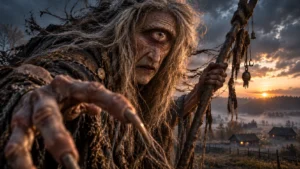
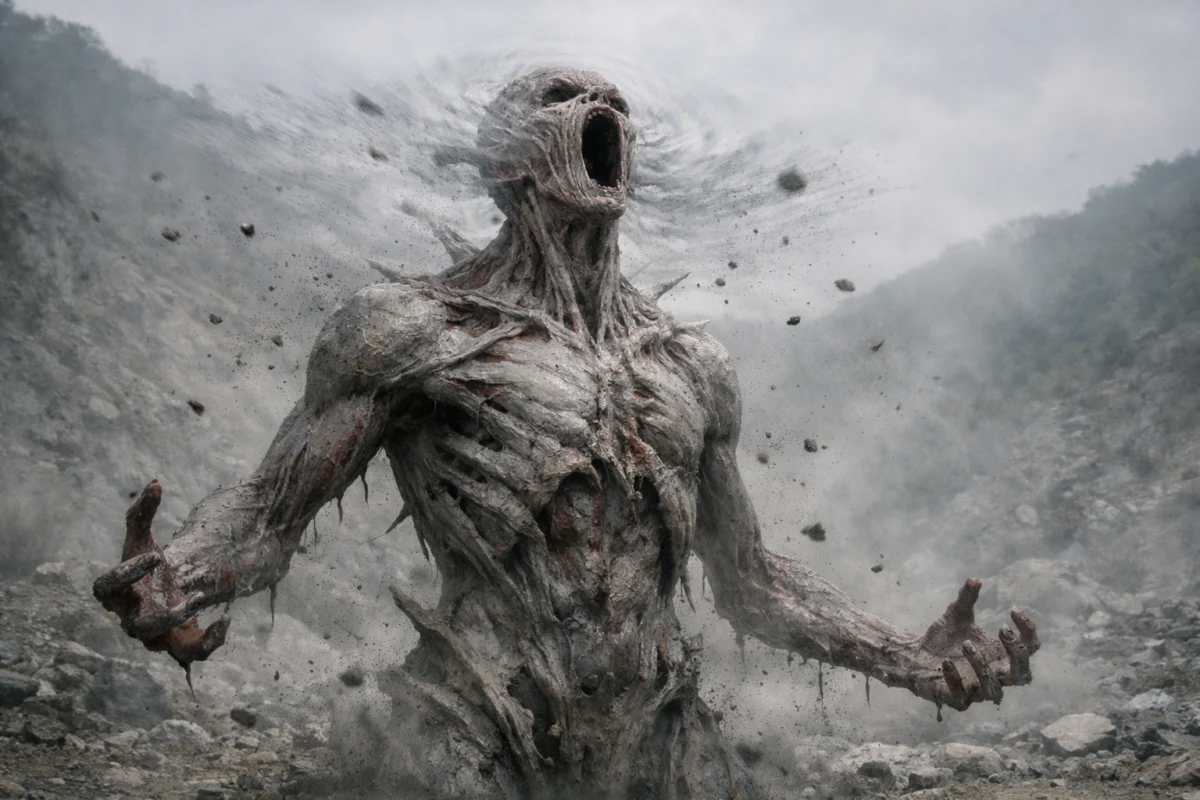
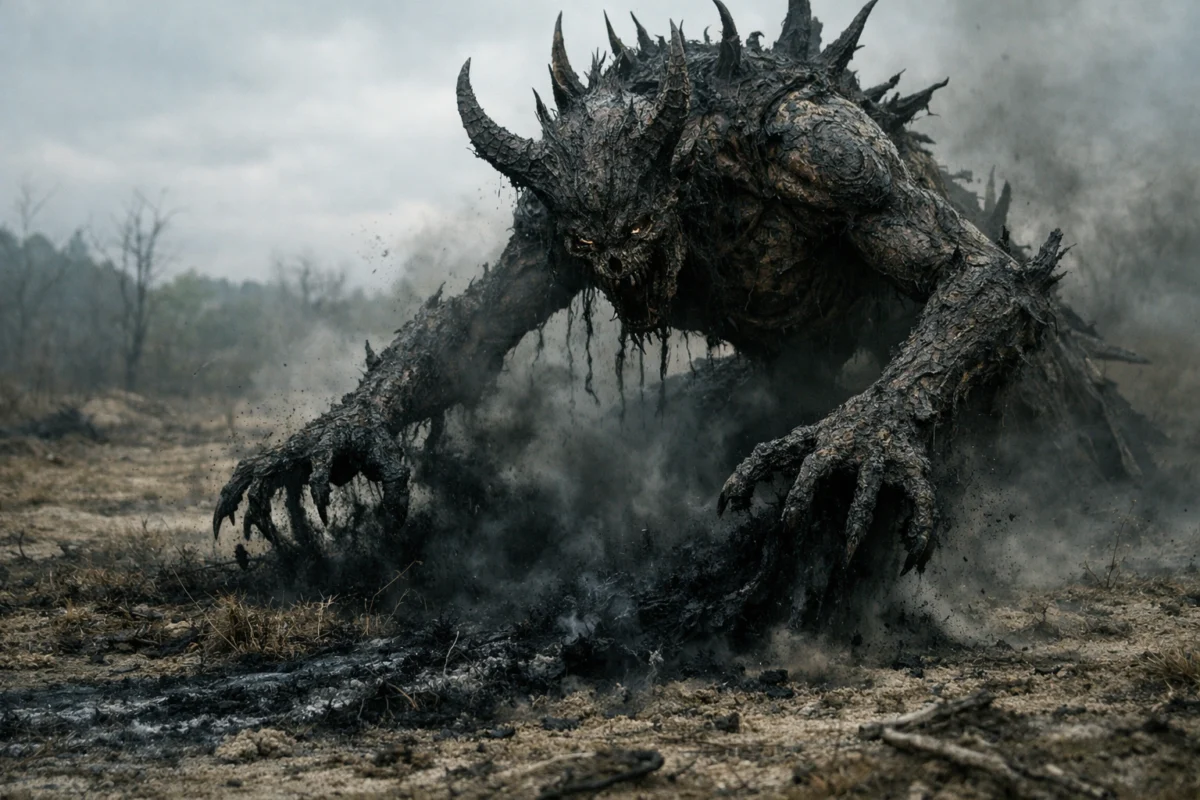
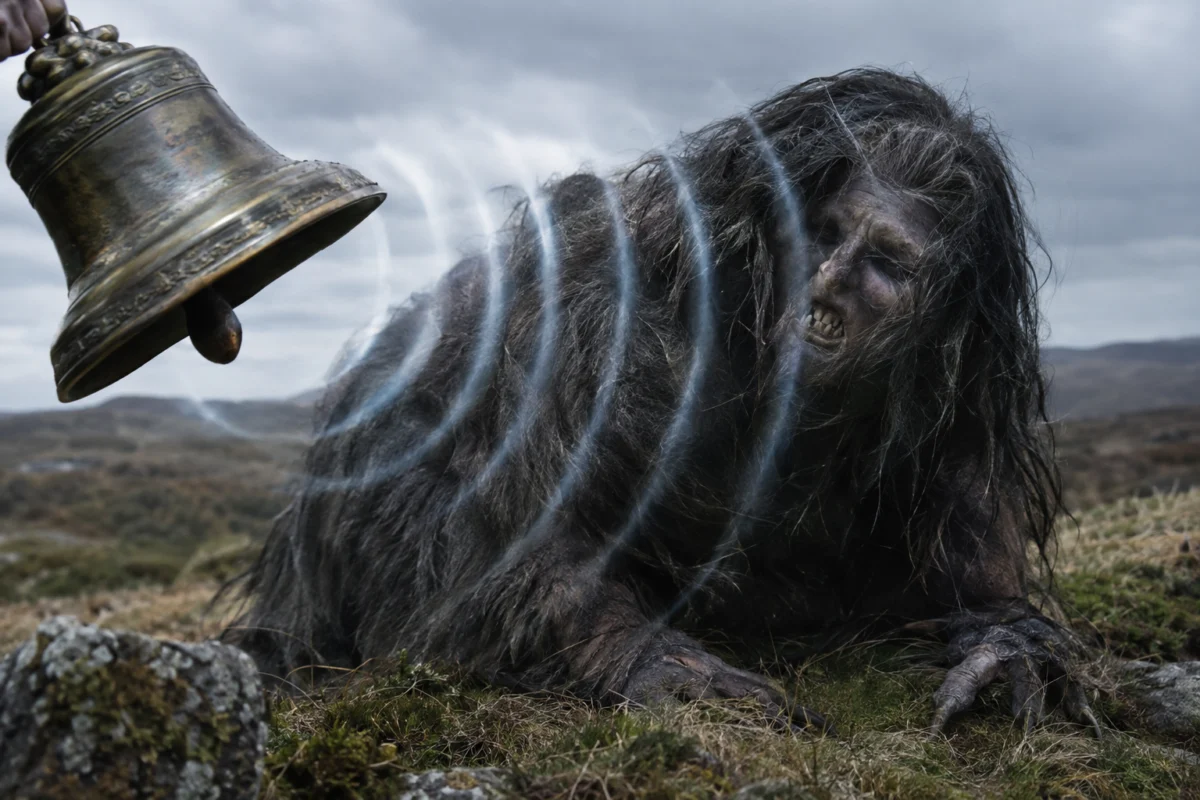
Black Annis is usually imagined as a terrifying woman with an unnaturally colored face and enormous claws. Heyrick describes her features as livid blue and replaces ordinary hands with talons, while later accounts add great teeth, long nails, and a savage expression.
The claws do more than make her frightening. Later tradition credits them with killing prey and even carving her bower directly from the sandstone hillside.
This physical connection between body and landscape makes the cave feel like something created by the monster herself.
“Little children, who went to play on the Dane Hills, were assured that she lay in wait there, to snatch them away to her bower.” (Leicester Chronicle, 1874.)
Human skins form another disturbing part of her appearance. Heyrick describes skins wrapped around her waist, while later folklore says she hung flayed skins near the cave to dry.
Clothing, trophies, and evidence of previous attacks therefore merge into one threatening visual image.
Not every modern characteristic deserves equal weight. Single-eyed portraits, metallic claws, and elaborate demonic anatomy appear inconsistently across later retellings.
The best-supported image remains simpler: a blue-faced predatory hag with huge talons, fierce teeth, and associations with human skins.
Background Story
Black Annis has no surviving birth story, divine genealogy, or single canonical adventure. Her background centers instead on a place: the Dane Hills and a sandstone cave called her bower, traditionally shaded by an old oak overlooking paths used by nearby communities.
The basic narrative casts her as an ambush predator. Children wandering too far and shepherds losing young animals become potential victims.
Some traditions place her among the oak branches before an attack, combining the behavior of a human hunter with something more animalistic.
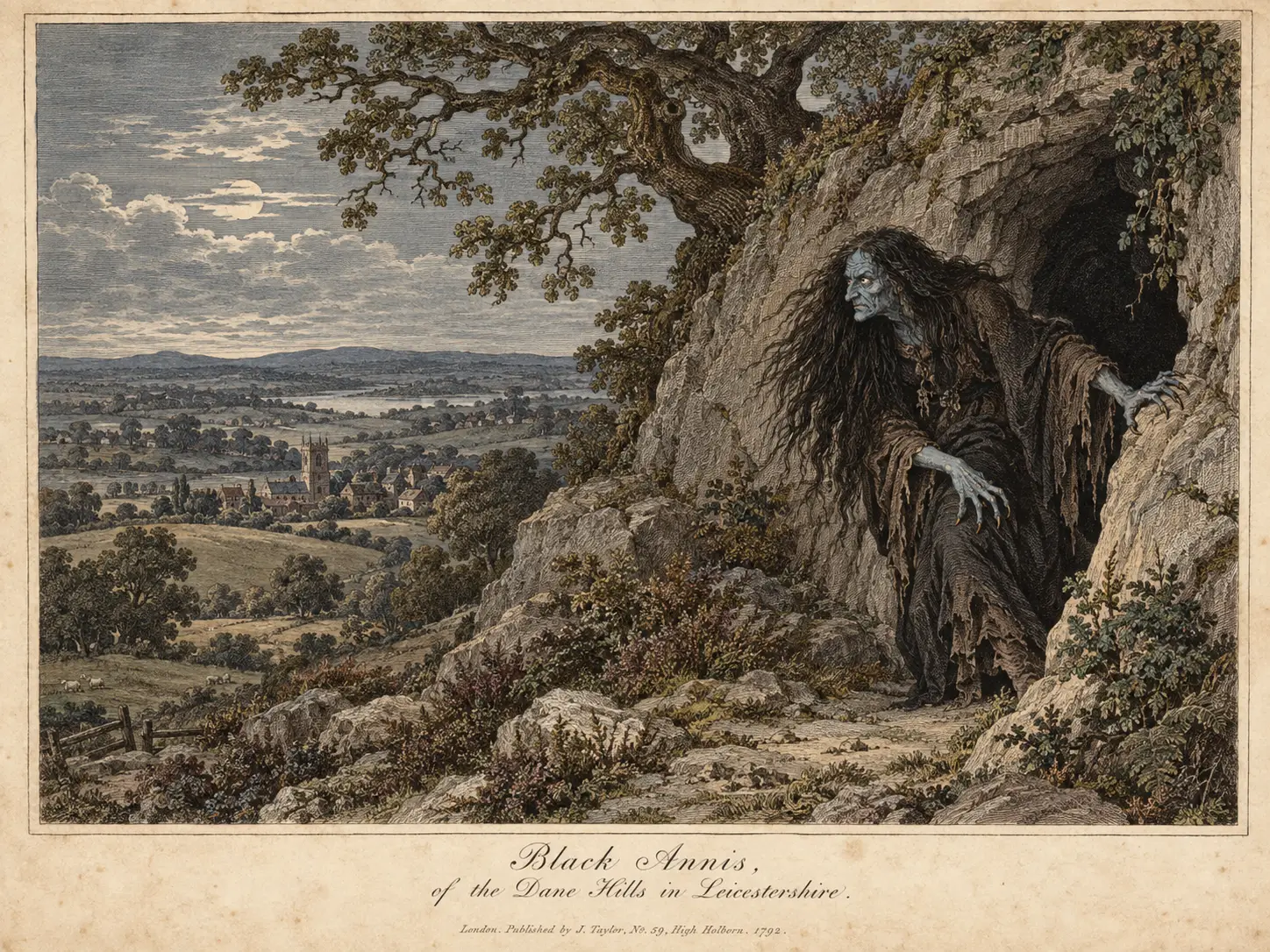
After capturing victims, Black Annis supposedly dragged them into the cave, killed them with her claws, drank their blood, and removed their skins. The bower therefore becomes both home and slaughter place, explaining why the surrounding landscape itself gained a frightening reputation.
Later traditions extended her territory beyond the Dane Hills. Cat Anna was said to haunt Leicester Castle, with an underground passage supposedly linking the castle to the bower.
Such additions show how local legends can expand geographically without developing one fixed mythology.
The creature also worked as a practical childhood warning. Adults could invoke Black Annis when children wandered too far, stayed outside after dark, or approached isolated ground.
The story transformed ordinary concerns about safety into a memorable threat rooted directly in local geography.
Famous Folklore Stories
The Monster of the Green
John Heyrick’s 1797 poem presents Black Annis as a terror whose presence changes everyday life around Leicester. Shepherds discover young animals missing from their flocks, while children stop wandering freely through the countryside because the feared creature has made the surrounding ground dangerous.
Heyrick then shifts attention from livestock to families. Mothers mourn vanished children, while local people know the source of their fear but hesitate to confront it.
Black Annis becomes less a hidden rumor than a threat everyone recognizes yet nobody feels prepared to challenge.
“The Shepherd griev’d to view his waning flock, / And trac’d the firstlings to the gloomy rock.” (On a Cave Called Black Annis’s Bower, John Heyrick, 1797)
The poem intensifies the horror by describing her body and the remains of earlier victims. Her monstrous hands, unnatural complexion, and human skins make the evidence of her violence visible, suggesting that anyone entering the bower would immediately understand what had happened there.
Rather than giving a heroic hunter credit for defeating her, Heyrick makes Time itself end her reign. The choice is unusual for monster folklore.
Black Annis disappears because every terror eventually passes, leaving relief behind but no victorious champion to claim her destruction.
That ending also gives the poem the quality of a local memory rather than an adventure tale. The monster belongs to a frightening former age, while Heyrick’s readers stand safely afterward, able to look back upon the fear that once dominated the neighboring countryside.
The Three Children and Black Annis
The version Ruth Tongue published in 1970 came from a Leicester evacuee who told her the story in December 1941. Three children are sent to collect firewood as daylight fades, even though they know Black Annis comes out only after darkness.
The children hear a suspicious snuffling sound and use a naturally holed witch-stone to look for its source. Through the opening they see Black Annis approaching.
Unable to run quickly with their bundles, they drop the gathered wood and race toward home.
“Black Annis lived in the Danehills. She was ever so tall and had a blue face and had long white teeth.”
(Forgotten Folk-Tales of the English Counties, Ruth Tongue, 1970, recorded December 1941)
Black Annis charges after them but crashes into the abandoned bundles, cutting her legs badly. The delay gives the children a brief advantage.
After tending her wounds, however, she resumes the pursuit and catches them just as they reach their cottage door.
Their father emerges carrying an axe and strikes Black Annis directly in the face. Wounded, she turns back toward her cave, crying out about blood.
At that exact moment, Christmas bells begin ringing across the countryside, adding a religious sound to her defeat.
According to the tale, Black Annis collapses and dies before reaching safety. Unlike older warnings in which children simply vanish, this story gives its young characters an escape, a protective father, and a final supernatural weakness that closes the encounter decisively.
The Easter Monday Hunt at Black-Annis’ Bower
John Throsby recorded a very different tradition in his 1791 history of Leicester. On Easter Monday, the mayor, civic officials, and townspeople gathered at Black-Annis’ Bower Close for a public hunt combining ceremony, sport, seasonal celebration, and local civic spectacle.
By Throsby’s account, the event no longer involved pursuing a live hare. Instead, organizers soaked a dead cat in aniseed water and dragged it behind a horse across the ground, creating a scented trail that a waiting pack of hounds could follow.
“In the greatest harmony the Spring was welcomed.” (The History and Antiquities of the Ancient Town of Leicester, John Throsby, 1791)
Spectators watched from raised ground as the dogs took up the trail and horsemen raced after them through fields, fences, and rough passages. The route eventually entered Leicester itself, carrying the noise and excitement of the mock hunt through the town.
The dragged cat finally reached the mayor’s door, where the chase ended. Afterward, the mayor entertained his friends, turning the strange procession into a civic social occasion.
Throsby describes young and old attending together and welcoming spring in unusually theatrical fashion.
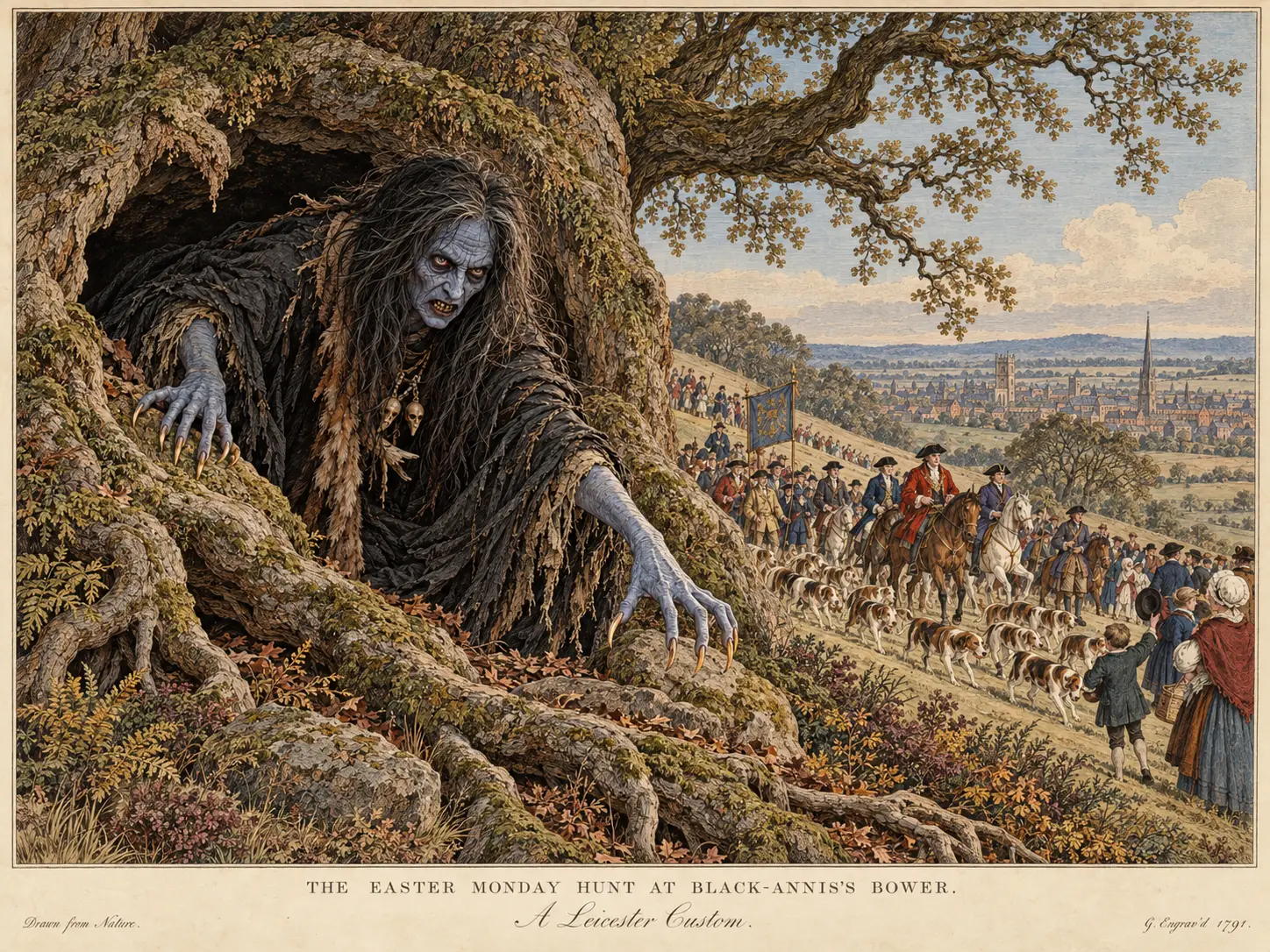
The custom does not prove that worship of Black Annis ever took place. Its importance lies in the location and name.
A real communal Easter event became attached to Black-Annis’ Bower Close, helping the legendary landscape remain part of Leicester’s public memory.
The three traditions above were checked against Heyrick’s 1797 poem, Tongue’s documented 1941 oral account published in 1970, and Throsby’s 1791 description of the Leicester Easter custom.
Cultural Impact
Black Annis became one of Leicestershire’s most recognizable folklore figures because her legend attached supernatural danger to a specific local landscape. Generations could connect stories about wandering children, nighttime threats, and strange countryside with an actual place lying just beyond Leicester.
Her name also survived as part of Leicester’s regional identity after the Dane Hills changed through urban development. Local history projects, heritage events, storytellers, musicians, and artists continue using Black Annis when presenting the city’s distinctive folklore to new audiences.
Unlike legendary kings or heroic ghosts, Black Annis represents the frightening side of local heritage. Her continued popularity shows how communities can preserve disturbing stories without maintaining literal belief, transforming an old childhood warning into a recognizable symbol of place and cultural memory.
Similar Beasts
Jenny Greenteeth
Jenny Greenteeth is an English water hag said to lurk beneath ponds, canals, and rivers, dragging children into the water. Like Black Annis, she functions as a frightening female bogey figure used to warn children away from dangerous places.
Rawhead and Bloody Bones
Rawhead and Bloody Bones is an English bogey figure associated with frightening disobedient children. Although its appearance varies widely, its role closely parallels Black Annis by turning parental warnings about wandering, misbehavior, and nighttime danger into supernatural threats.
Grýla
Grýla is an Icelandic giantess who descends from the mountains and preys upon troublesome children. Like Black Annis, she combines an isolated wilderness home, monstrous female appearance, and child-eating reputation with a strong role in traditional behavioral warnings.
Baba Yaga
Baba Yaga is a Slavic supernatural hag who lives beyond ordinary society and may threaten, test, or occasionally assist visitors. Her predatory reputation, frightening old-woman form, isolated dwelling, and associations with endangered children create clear thematic similarities.

Cailleach
The Cailleach is a powerful hag figure found across Gaelic traditions, particularly in Scotland and Ireland. Her ancient appearance, connection with wild landscapes, supernatural strength, and later comparison with Black Annis make her a useful parallel, though their traditions remain distinct.
Religion/Ritual
No dependable evidence shows that Black Annis received organized worship, sacrifices, priesthood, or a formal religious cult. Later writers sometimes interpreted her as a surviving pagan goddess, but those claims depend mainly on comparison with other hag figures rather than contemporary evidence.
The Easter Monday gatherings held at Black Annis’s Bower Close complicate the picture without proving religious devotion. Historical descriptions present communal recreation, mock hunting, civic participation, and seasonal celebration, not ceremonies directly addressed to Black Annis as a supernatural being.
Modern Pagan and occult writers have sometimes reinterpreted Black Annis as a crone goddess or manifestation of older female divinities. Such interpretations belong to modern religious creativity and comparative mythology rather than securely documented beliefs from eighteenth or nineteenth-century Leicester folklore.
Scientific or Rational Explanations
Black Annis fits the broader social role of the bogey figure, a frightening imaginary being used to discourage risky behavior. A monster waiting outside after dark offered parents a memorable way to warn children against wandering through isolated countryside without supervision.
The physical landscape may have strengthened those warnings. Uneven ground, caves, abandoned workings, woodland, livestock, and poor nighttime visibility could make the Dane Hills genuinely hazardous.
Giving those dangers a face transformed ordinary environmental risks into a story children could immediately understand.
Another possibility involves accumulated historical memory. Stories about real residents, unusual local characters, crimes, accidents, and old place-names can merge across generations.
The proposed connection with anchoress Agnes Scott remains unproven, but it demonstrates how communities repeatedly search for historical people behind supernatural legends.
Modern Cultural References
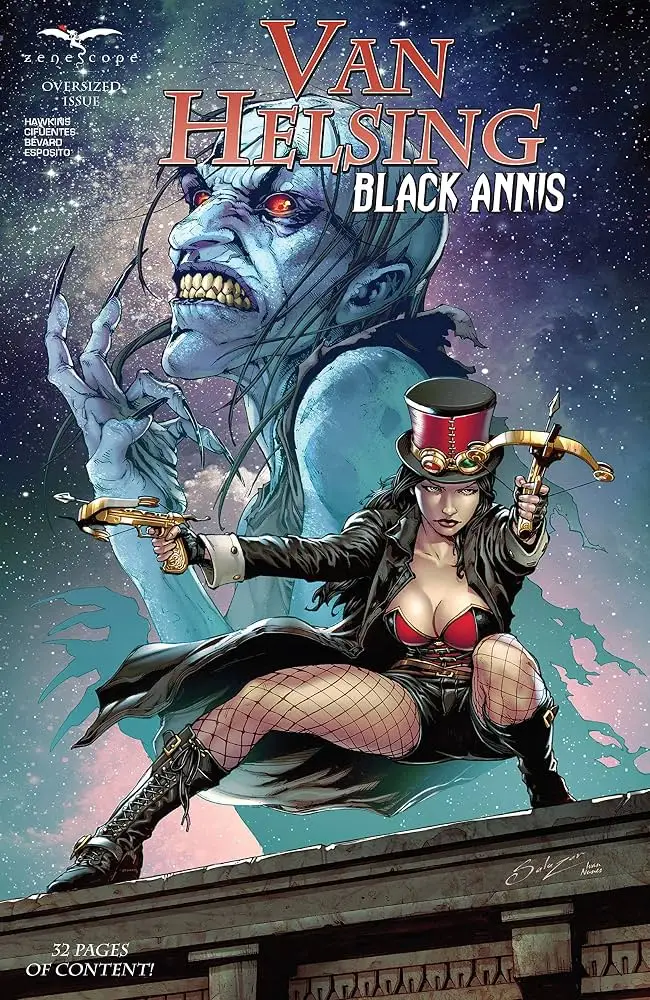
Van Helsing: Black Annis – Zenescope Entertainment, 2021 – Comic Book
This standalone Van Helsing story sends monster hunter Liesel Van Helsing after a creature targeting children across New York.
Zenescope explicitly identifies the threat as Black Annis and adapts her traditional reputation as a feared child-snatcher into contemporary supernatural horror.
Van Helsing: Black Annis, Zenescope Entertainment
Machiavelli: Guardian of Paris – Michael Scott, 2020 – Fantasy Short Story
Michael Scott brings Black Annis into the world of The Secrets of the Immortal Nicholas Flamel.
Set during the French Revolution, the story portrays her arriving in Paris to exploit the Terror and spread further death, placing Machiavelli directly against her.
Machiavelli: Guardian of Paris, Penguin Random House
Black Annis – Karliene, 2023 – Song
Singer-songwriter Karliene devoted this dark folk song directly to the Leicestershire legend.
Its imagery preserves recognizable elements of the folklore, including the child-hunting hag, her talon-like hands, the oak associated with her bower, and warnings to protect children from her.
Black Annis by Karliene
Black Annis – Man the Barricades Ltd, 2025 – Video Game
This first-person horror puzzle game openly bases its antagonist on the Black Annis legend.
Set at the fictional Lone Oak College in Leicester, players investigate disappearances, the Dane Hills tradition, and the history of the creature while trying to survive the night.
Black Annis on Steam
Black Annis – Witchdoors, 2026 – Animated TV Episode
Episode four of the fantasy series Witchdoors is titled “Black Annis.”
The short animated episode follows Sossana after she passes through the mysterious Witchdoors again and encounters Black Annis, bringing the English folklore figure directly into a contemporary fantasy television story.
Witchdoors: Black Annis, IMDb
Black Annis Morris – Leicester, founded around 1982 – Morris Dance Group
This Leicester women’s Morris side deliberately took its name from the city’s famous folklore figure.
The group performs Cotswold Morris in summer and Fenland Molly dancing in winter, keeping the name Black Annis visible within Leicester’s living folk and festival culture.
Black Annis Morris official website
Conclusion
Black Annis endures because her legend combines a memorable monster with a precise geographical identity. Blue skin, enormous claws, a cave, an ancient oak, missing children, and the Dane Hills create an unusually concentrated image that remains recognizable centuries later.
The historical evidence also demonstrates how folklore develops rather than remaining fixed. Place-names, poetry, newspaper traditions, childhood warnings, civic customs, and oral storytelling each contributed different details, gradually producing the Black Annis familiar from modern accounts of English folklore.
Today she has moved far beyond the frightened children of old Leicester. Books, songs, games, television, dance, and local heritage continue reinventing her, while the original legend remains anchored to the landscape that first gave the blue-faced hag her home.
Further Reading
County Folk-Lore: Leicestershire & Rutland by Charles James Billson, The Folklore Society, 1895.
The most important early scholarly collection for Black Annis, preserving historical reports, local traditions, poetry, and nineteenth-century testimony.
Google Books: Leicestershire & Rutland
Forgotten Folk-Tales of the English Counties by Ruth L. Tongue, Routledge & Kegan Paul, 1970.
Contains the important Leicester oral tale recorded from an evacuee in 1941, preserving living twentieth-century Black Annis tradition.
Google Books: Forgotten Folk-Tales of the English Counties
An Encyclopedia of Fairies by Katharine Briggs, Pantheon Books, 1976.
A major folklore reference work summarizing Black Annis alongside British bogeys, hags, spirits, and related supernatural traditions.
Google Books: An Encyclopedia of Fairies
The History and Antiquities of the Ancient Town of Leicester by John Throsby, 1791.
An important primary historical source for Leicester, including the Easter Monday custom associated with Black Annis’s Bower Close.
Schulich-Woolf Rare Book Collection: Throsby’s History of Leicester
The Triumph of the Moon: A History of Modern Pagan Witchcraft by Ronald Hutton, Oxford University Press, 1999.
A major academic study useful for evaluating later claims connecting Black Annis with pagan survival and Agnes Scott.
Oxford Academic: The Triumph of the Moon
Black Annis and Dane Hills, Story of Leicester, Leicester City Council.
A reliable local-history overview covering the Dane Hills, Black Anny’s Bower Close, Heyrick’s poem, and Leicester traditions.
Story of Leicester: Black Annis and Dane Hills