Introduction
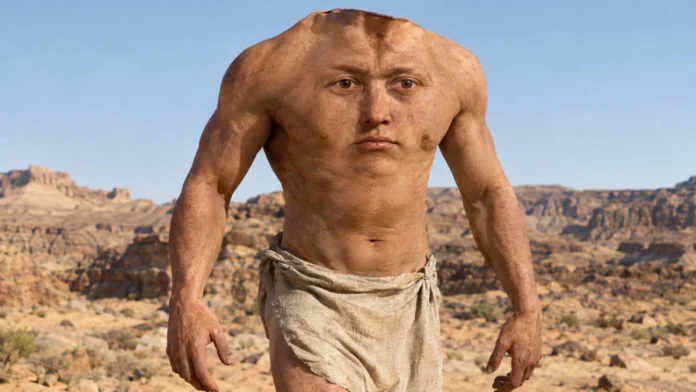
The Blemmyes are a legendary headless people whose faces occupy their chests. They belong to the geographical marvels of classical literature, where accounts of distant African regions combined descriptions of unfamiliar populations with reports of extraordinary human bodies and animals.
Their defining feature is not a severed or concealed head, but a different bodily arrangement: a humanlike torso bearing facial features below the shoulders. Ancient descriptions vary in detail, and the earliest surviving account relevant to this tradition mentions chest-positioned eyes rather than a complete face.
The name also belongs to a real historical population of Egypt’s Eastern Desert, between the Nile Valley and the Red Sea. These human communities are documented through texts and archaeology.
Their existence provides no evidence for the extraordinary anatomy attributed to their legendary namesakes.
Understanding the Blemmyes therefore requires separating a literary figure from a historical people. Their importance lies partly in that overlap: an identifiable population’s name became attached to an enduring image of bodily difference, transmitted through ancient geographical writing and later illustrated traditions.
History/Origin
An early surviving account of headless people appears in Herodotus’s Histories, written in the fifth century BCE. In Book 4.191, a description of Libya includes people without heads whose eyes are situated in their chests.
They are called Akephaloi, not Blemmyes.
Herodotus attributes this information to Libyans rather than presenting it as something he personally witnessed. That qualification matters: the passage preserves a reported marvel, not an eyewitness anatomical description.
How and Wells’s commentary likewise draws attention to the distance between the author and the claim.
Several centuries later, Pomponius Mela explicitly connects the Blemmyes name with the headless form. His De chorographia, composed around 43–44 CE, describes the Blemyis as lacking heads and having their faces on their chests.
This is a clear early Roman witness to the named legendary figure.
The two passages establish a sequence, but not a complete history of transmission. The headless-people motif is attested before its explicit association with the Blemmyes name.
They do not establish exactly when, why, or through whose reporting that association first arose.
Alongside this literary development, historical Blemmyes belonged to the Eastern Desert’s human populations. Specialist research treats them as an ensemble of tribes rather than a fantastic species.
Documentary and archaeological evidence must therefore be read separately from descriptions of chest-faced inhabitants of remote lands.
Hélène Cuvigny’s edited volume Blemmyes: New Documents and New Perspectives brings ostraca and desert records into this discussion. Such evidence also shows why names require care: labels for nomadic groups changed across periods and languages, complicating attempts to identify every ancient reference with one unchanging population.
Name Meaning
Blemmyes, also encountered as Blemmyae or Blemyes, is the name shared by the historical population and the legendary people. Its underlying etymology is not securely established by the evidence assembled here.
It should not simply be translated as “headless people.”
The Greek Akephaloi does have that descriptive meaning: “headless ones.” It identifies an anatomical condition rather than supplying a demonstrated ethnic identity.
Consequently, Herodotus’s use of Akephaloi establishes an early form of the motif, but does not establish that he called these beings Blemmyes.
Another descriptive label, Sternophthalmoi, is rendered “chest-eyes” in the classical-source compilation maintained by the Theoi Project. The term highlights the relocation of sight to the torso.
It is useful for describing the figure, but it does not explain the origin of the ethnic name.
These names should therefore remain distinguishable even when discussing related imagery. Akephaloi emphasizes the missing head, Sternophthalmoi emphasizes the eyes’ position, and Blemmyes carries a historical population name into the marvel tradition.
Treating all three as interchangeable translations would erase that important difference in meaning and use.
Appearance
The best-supported legendary form is a humanlike body without a head, with facial features situated on the chest. The body remains recognizably human in its basic organization.
Its extraordinary quality comes from relocating the face rather than combining human anatomy with an animal’s head or limbs.
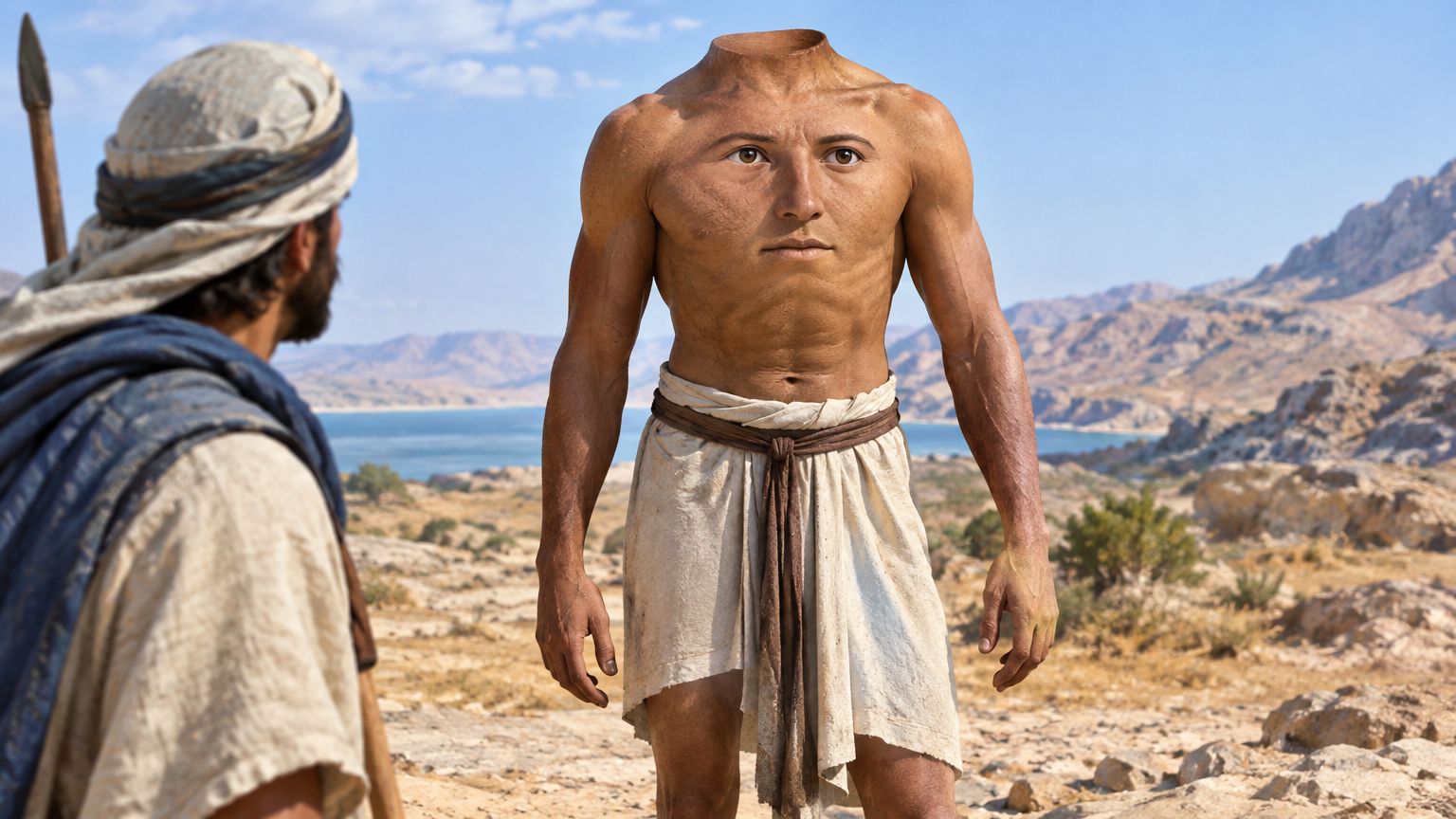
The earliest relevant description is more limited than many later images suggest. Herodotus specifies headlessness and eyes in the chest; he does not provide a detailed arrangement of every facial feature.
A fully organized chest-face should therefore not be attributed to that passage alone.
Mela’s wording supplies the broader description of faces on the chest. This supports the familiar image of a face occupying the upper torso, rather than two isolated eyes beneath an otherwise ordinary neck.
Nevertheless, his brief geographical notice is not a detailed anatomical account.
The source tradition also preserves variation in where the eyes appear. Some descriptions place them on the shoulders rather than the chest.
That arrangement is a related variant, not a reason to replace the chest-faced form that is explicitly supported by the early Roman account.
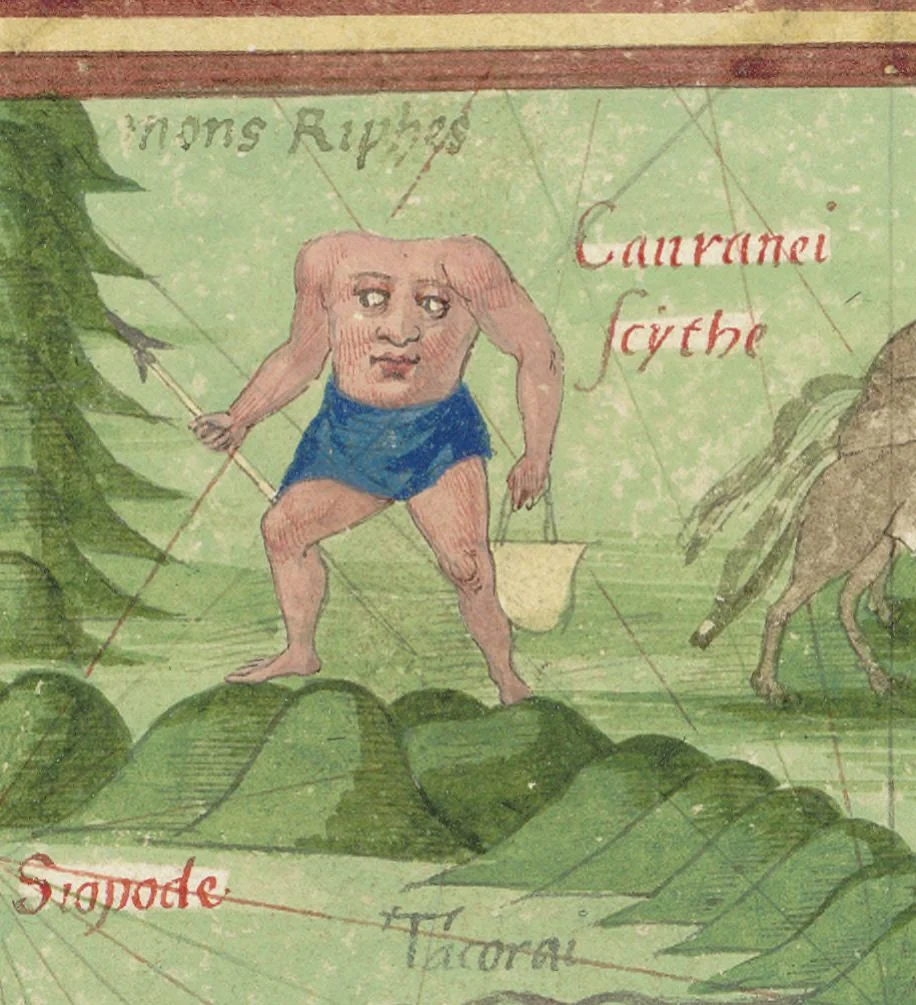
Later illustrations made these short descriptions visually concrete, arranging recognizable facial features across the torso. The figure appears in medieval illustrative traditions and in the Nuremberg Chronicle of 1493.
Such images demonstrate how artists interpreted the motif, but their additional details should not automatically be projected backward into ancient accounts.
No elaborate costume or equipment is necessary to identify the legendary form. Its essential visual features are the absent head and displaced face.
Equally, this appearance belongs to the literary marvel: it must not be used as an anatomical reconstruction of the historical Eastern Desert population.
Background Story
The Blemmyes do not emerge from the surviving evidence through a single creation story or a sustained heroic adventure. Their principal ancient setting is geographical description.
They are introduced as inhabitants of distant regions, where unusual bodies help characterize places beyond the writer’s direct experience.
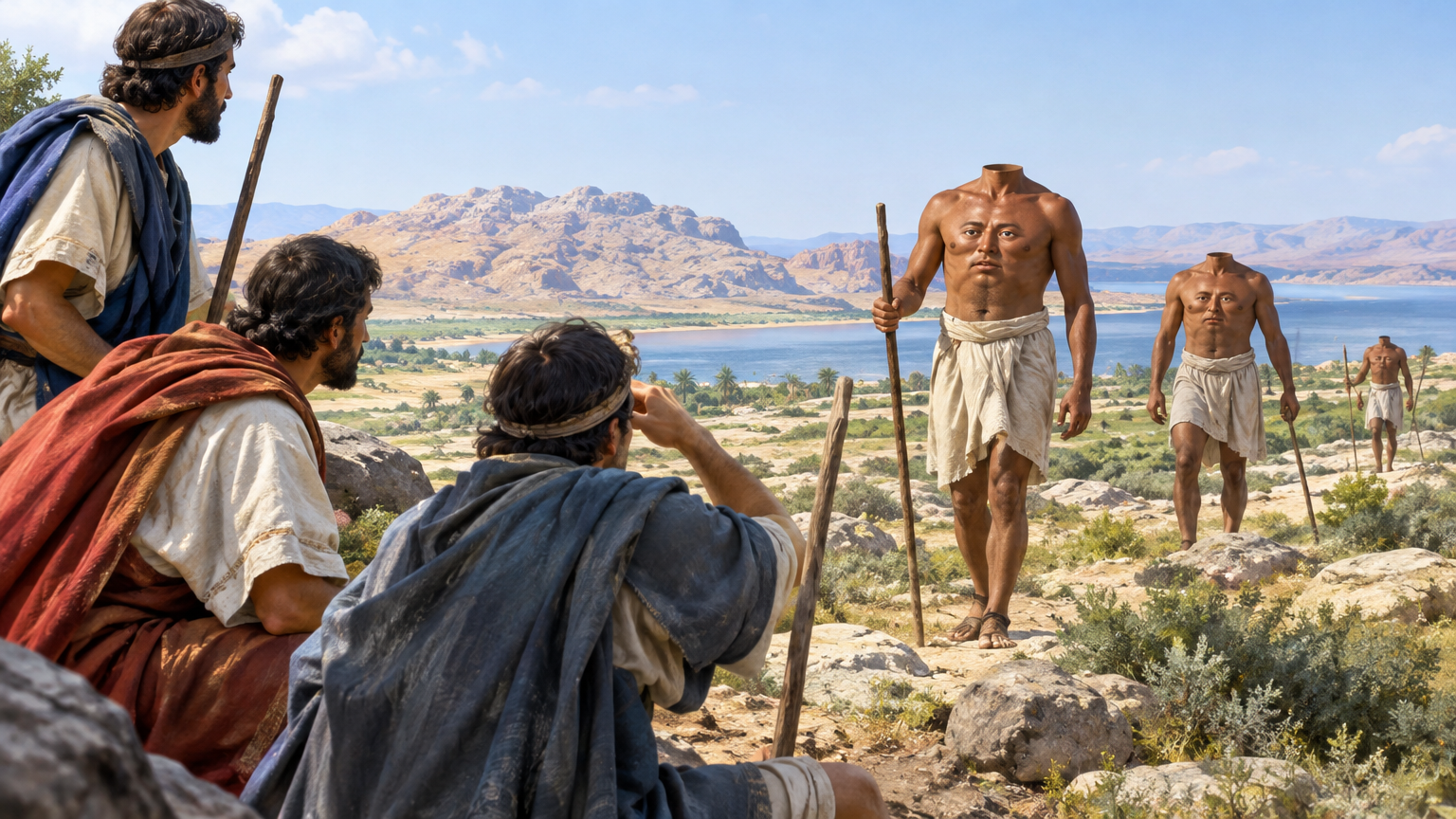
In Herodotus, the headless people occur among reported Libyan wonders, alongside other extraordinary inhabitants, including dog-headed people. Their placement makes them part of a larger description of unfamiliar life.
The passage offers a catalogue of marvels rather than an encounter with an individually named headless character.
Mela likewise places the Blemyis within an account that includes satyrs and Aegipans, treating these as distinct extraordinary beings. This literary neighborhood matters: the headless people belong to a world described through both geographical categories and inherited wonders, not to a separate, fully developed mythology.
The connection with a historical population adds another layer. Names for real communities could circulate within writing that also transmitted fantastic claims.
Here, the shared name demands careful interpretation, but it does not reveal a documented moment when an ordinary ethnographic description became the chest-faced legend.
The surviving material consequently supports a background of reported distant peoples, repeated geographical description, and later visual adaptation. The figure’s symbolic force comes from its recognizable human form reorganized in an impossible way.
Beyond that, assigning a specific moral, religious purpose, or cultural anxiety would exceed the evidence.
Famous Folklore Stories
The surviving evidence supplies brief descriptions and recurring geographical motifs rather than authenticated named folktales. There is no established protagonist, quest, or defining encounter in this record.
The most useful distinction is between the early report of headless people and later accounts attaching the Blemmyes name to them.
Headless People in Distant Libya
In Herodotus’s Histories, the headless people belong to a description of distant Libya containing extraordinary inhabitants and animals. Their eyes occupy their chests.
The passage presents a reported population, not an individual monster encountered and defeated by a hero.
The report is explicitly attributed to Libyans rather than presented as something Herodotus personally witnessed. This framing matters: the earliest recovered version already preserves distance between the writer and the extraordinary claim.
It should not be rewritten as an eyewitness encounter.
These people are called Akephaloi, meaning headless ones, rather than Blemmyes. Their importance here is as an early example of the anatomical motif.
Treating the passage as a fully developed Blemmyes story would erase a significant difference between the Greek and later Roman evidence.
Chest-Faced People Among African Marvels
In Pomponius Mela’s De chorographia, the name Blemyis is explicitly attached to people without heads whose faces occupy their chests. This is a geographical description rather than a sustained adventure, but it establishes the combination of name and anatomy central to the later legendary figure.
The surrounding account includes other extraordinary beings, including satyrs and Aegipans. The recurring pattern is a catalogue of distant wonders: unfamiliar regions contain inhabitants whose bodies depart from ordinary human expectations.
No shared expedition or interaction between these beings is narrated.
Other classical versions vary the arrangement, including eyes placed on the shoulders rather than the chest. These differences belong to the transmission of the motif.
They do not establish separate adventures, transformations, or stages in the creature’s life, none of which the supplied evidence documents.
Cultural Impact
The Blemmyes helped make bodily difference a feature of imagined distant geography. Their distinctive anatomy offered a compact way to represent a marvelous population.
Readers did not need an elaborate narrative to recognize the central idea: people whose faces occupied an unexpected part of the body.
The figure subsequently appeared in medieval bestiaries and map illustrations. In those settings, the chest-faced body could carry the descriptive content of a written passage into a readily recognizable image.
Its visual identity was therefore more stable than any particular story attached to it.
A depiction in the Nuremberg Chronicle of 1493 provides a specific late medieval example. It demonstrates the continued circulation of the headless human figure long after the classical descriptions, although the image itself does not authenticate the anatomy or establish an independent encounter tradition.
That persistence also creates a historical problem. The memorable image can overshadow the real people who bore the Blemmyes name.
The historical Eastern Desert population must be studied through its own documentary and archaeological evidence, not treated as the human counterpart of a monstrous illustration.
Modern scholarship helps restore that distinction. Hélène Cuvigny’s edited volume Blemmyes: New Documents and New Perspectives examines ostraca, desert records, and changing population names.
This documentary approach separates questions about actual communities from questions about the survival of a literary marvel.
Similar Beasts
Monopod

The Monopod, also called a Sciapod, is a legendary one-legged humanoid in Greek and Roman writing. Its enormous foot serves as shade while it rests in distant lands.
Like the Blemmyes, it belongs to classical traditions of extraordinary human anatomy. The comparison concerns geographical marvels, not a shared origin or identical body plan.
Kishi
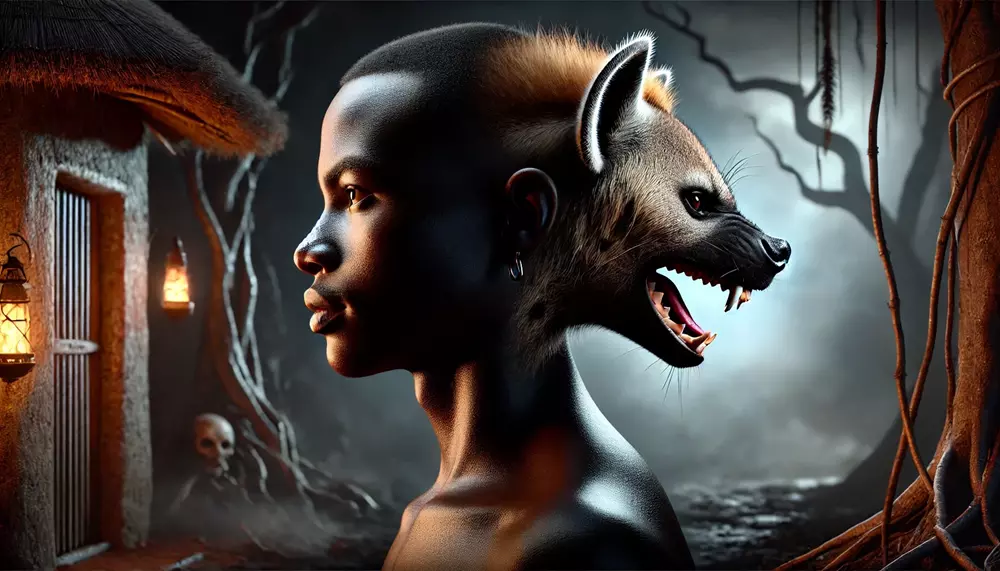
The Kishi is a two-faced demon in Angolan folklore. It presents a handsome human front while concealing a hyena face behind, using its attractive appearance to lure victims.
Both figures rearrange familiar facial anatomy, but their narrative roles differ sharply. The Kishi is a deceptive predator; comparable behavior is not established for the Blemmyes.
Cynocephali
The Cynocephali are legendary dog-headed people who appear in classical descriptions of remote regions. Their defining feature combines a broadly human body with an animal head rather than removing the head altogether.
They offer a close contextual parallel to the Blemmyes: both make unusual anatomy characteristic of an entire distant population, while remaining distinct legendary peoples.
Scientific or Rational Explanations
The strongest explanation begins with the character of the evidence: these are transmitted descriptions, not anatomical observations supported by physical remains. A text can establish that a claim circulated without establishing that the people it describes existed in the reported form.
Herodotus’s attribution of the headless-people report to Libyans is particularly important. How and Wells’s commentary emphasizes this distancing.
The passage preserves hearsay within geographical writing, so it provides evidence for an ancient report rather than an independently verified sighting or examination.
Changes between accounts also require attention. Eyes on the chest, a complete chest-mounted face, and eyes on the shoulders are related but nonidentical descriptions.
Their variation supports studying how the motif was transmitted; it does not justify reconstructing a single precise biological organism.
A historical interpretation can also examine the association between remoteness and extraordinary bodies. These accounts place unusual inhabitants among other regional wonders.
That literary arrangement helps explain how the figure functioned, although it cannot identify the particular event or misunderstanding that first produced the claim.
Archaeological and written evidence offers a separate way to investigate the historical Blemmyes. Specialist research documents Eastern Desert communities and changing names across periods and languages.
Such evidence clarifies human history, but the overlap in naming does not substantiate the legendary chest-faced anatomy.
No specific naturalistic cause for that anatomy is established by the strongest sources supplied here. Explanations involving posture, clothing, misidentification, or physical abnormality would therefore remain speculative.
The defensible conclusion concerns a documented literary tradition, not a demonstrated biological anomaly or an identified zoological species.
Modern Cultural References
The Headless Blemmyes
podcast episode A dedicated episode about the Blemmyes, describing their headless form and examining accounts of them.
(omny.fm)
Blemmyes: The Ancient Race of Headless Men, 2025
podcast episode 2025 A dedicated episode exploring the Blemmyes and their chest-faced depiction.
(spreaker.com)
Baudolino, novel 2000
novel 2000 Eco’s fictional narrative includes Blemmyes among the legendary peoples encountered in Baudolino’s travels.
The novel’s publication is documented by WorldCat; creature-specific inclusion is supported by the search result for the novel’s account.
(search.worldcat.org)
Blemmyes | A4 Print
artwork A purchasable print depicting a Blemmyes in a creative scene inspired by medieval woodcut artwork.
(midorigreencrafts.bigcartel.com)
Conclusion
The legendary Blemmyes belong to a tradition of geographical marvels: people imagined without heads, their facial features transferred to the torso. Their importance lies less in a single adventure than in the persistence of this striking bodily arrangement across descriptions and images.
The surviving accounts do not establish a unified mythology, an origin story, or a ritual tradition. Instead, they show how brief reports of distant peoples could acquire lasting authority and become recognizable figures in later art and storytelling.
That legacy requires a clear distinction between literary wonder and human history. The historical Blemmyes of Egypt’s Eastern Desert were real people, not evidence for the extraordinary anatomy attached to their name in classical writing.
Likewise, the earlier Akephaloi report should not be mistaken for an early use of the Blemmyes name. Read with these distinctions intact, the figure illustrates how unfamiliar places became settings for imagined human difference, while its continued creative reuse demonstrates the enduring appeal of an immediately recognizable visual paradox.
Further Reading
Herodotus commentary, Book 4, Project Gutenberg
Includes the early Akephaloi report and scholarly commentary on its hearsay framing and interpretation.
(gutenberg.org)
Blemmyae (Blemmyes), Theoi Project
Convenient compilation of cited classical passages, transliterations, and later descriptive labels; use alongside primary texts rather than as independent evidence.
(theoi.com)
Blemmyes: New Documents and New Perspectives, Institut Français d’Archéologie Orientale / JSTOR
Edited scholarly volume presenting ostraca, archaeological evidence, and discussion of historical names and populations in Egypt’s Eastern Desert.
(jstor.org)
Blemmyes, The Encyclopedia of Ancient History / Wiley
Specialist overview of the historically documented Eastern Desert population, helping separate it from the legendary headless figure.
(onlinelibrary.wiley.com)
De chorographia, Book 1, Read Ancient Texts
Provides Pomponius Mela’s Latin passage and translation explicitly describing the Blemyis as headless with faces on their chests.
(readancienttexts.com)