

Introduction
Medea is a princess and enchantress in ancient Greek mythology, central to the adventures of Jason and the Argonauts. A daughter of King Aeëtes of Colchis and the Oceanid Idyia, she belongs to a divine-descended royal family rather than a category of mythological beasts.
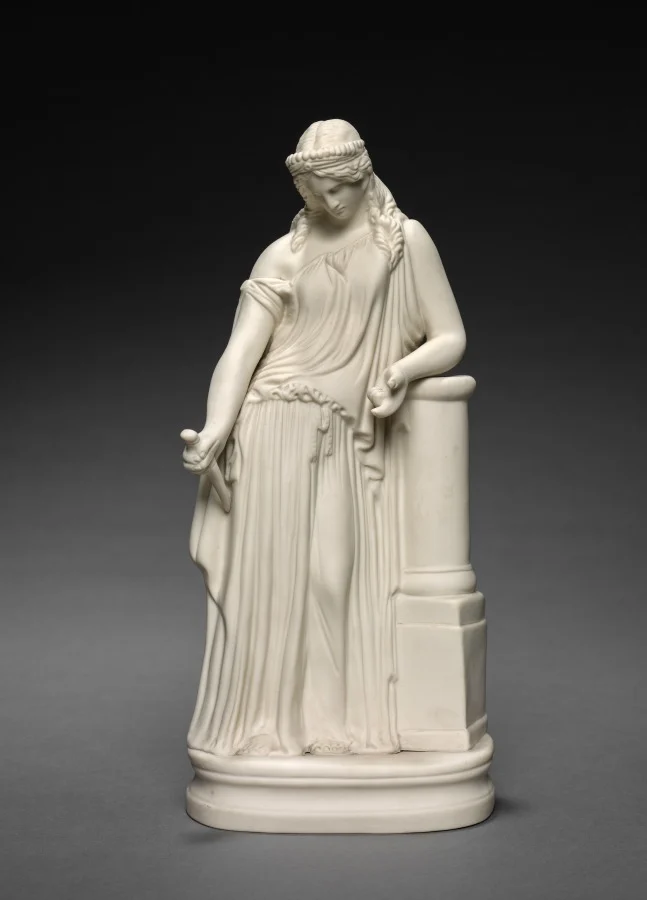
Through Aeëtes, Medea is a granddaughter of Helios, the sun god. Her knowledge of magical drugs makes possible achievements that Jason cannot accomplish alone, especially the winning of the Golden Fleece.
The successful hero therefore depends upon a woman whose assistance carries dangerous obligations.
Her best-known later story concerns the collapse of their marriage in Corinth. In Euripides’ tragedy, Jason’s proposed marriage to a king’s daughter provokes Medea’s devastating revenge, culminating in her murder of their children.
Other ancient traditions give substantially different accounts of those deaths.
Medea consequently combines roles that resist a simple moral classification: royal daughter, indispensable helper, displaced wife, mother, and killer. Her significance lies partly in the tension between her extraordinary power and her vulnerability within the households and political communities through which her stories move.
History/Origin
The earliest surviving literary attestation of Medea occurs in Hesiod’s Theogony, conventionally dated around 700 BCE. This genealogical poem names her parents and connects her with Jason, their marriage, and their son Medeius.
It does not present the familiar Corinthian tragedy in its later dramatic form.
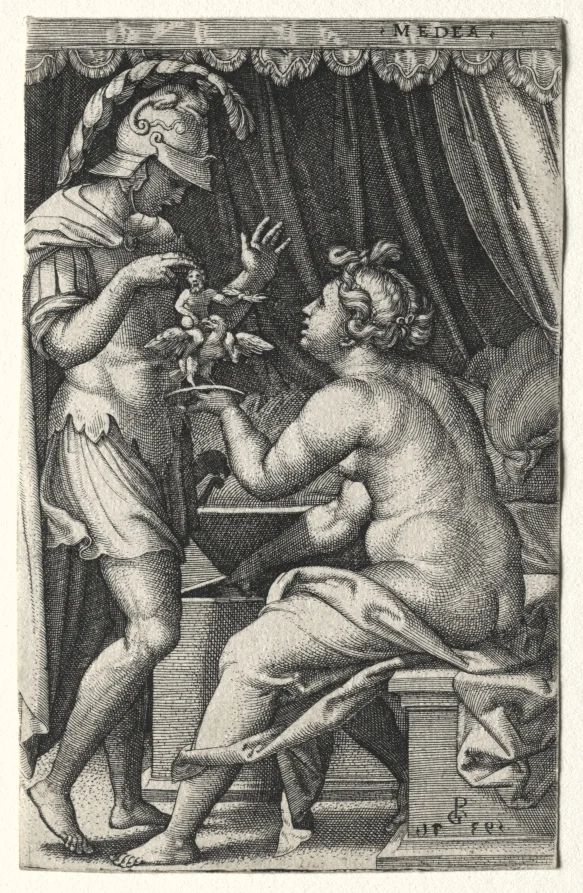
This early appearance establishes that Medea belonged to Greek myth well before the surviving classical plays. It does not identify a single moment when her story originated.
The earliest written evidence preserves an existing narrative connection, not necessarily the beginning of the tradition itself.
Colchis, her homeland, lay at the eastern end of the Black Sea, in what is now western Georgia. Within Greek storytelling, the voyage there takes the Argonauts far from familiar communities.
Medea’s local knowledge becomes essential to their survival and the success of their expedition.
Pindar’s fourth Pythian Ode, composed in 462 BCE, offers an important pre-Euripidean treatment of the Argonautic story. Euripides’ Medea, first performed in 431 BCE, shifts attention to Corinth, making the broken marriage and Medea’s deliberate killing of her children the center of the drama.
Corinthian traditions were not uniform. Some connected Medea with local kingship and the sanctuary of Hera Acraea; others attributed the children’s deaths to Corinthians.
The historical introduction to Gilbert Murray’s translation of Medea surveys these alternatives, showing why the tragedy cannot stand for the entire ancient tradition.
In the third century BCE, Apollonius of Rhodes developed Medea’s Colchian story extensively in the Argonautica, emphasizing love, hesitation, magical expertise, and complicity. His poem is later than Euripides’ play, although it narrates earlier events in her mythic life.
Literary chronology and narrative chronology must therefore remain distinct.
Name Meaning
The Greek name is Μήδεια, commonly transliterated as Mēdeia or Medeia. Medea is its familiar Latinized form and the spelling most often used in English.
These forms refer to the same mythological figure, rather than to separate regional beings or different stages of her story.
The conventional explanation connects the name with Greek vocabulary concerning counsel, planning, or devising. Renderings such as “the planner” express this association, although they should be understood as explanatory glosses.
The precise derivation is less secure than a simple dictionary-style translation might suggest.
This association suits Medea’s narrative role: she devises protections, escapes, and destructive stratagems. Nevertheless, a name’s apparent suitability to a character is not independent proof of its origin.
Her actions can illuminate the traditional interpretation without establishing exactly how or when the name developed.
A different interpretation appears in Gocha Kuchukhidze’s study of Medea and Colchis, which proposes a lunar meaning, “Moon Goddess.” This is a modern scholarly hypothesis, not an established translation.
It should not displace the conventional counsel-and-planning explanation or redefine Medea as a securely documented lunar deity.
Appearance
Medea has the bodily form of a human woman. Her divine ancestry and magical abilities do not make her an animal hybrid or a physically monstrous being.
The ancient narratives offer no single authoritative combination of hair color, eye color, complexion, stature, or facial features.

Her life stage depends on the episode. The Colchian narrative presents a royal daughter confronting desire and divided loyalties, while the Corinthian tragedy presents an established wife and mother.
These narrative roles matter more to her characterization than any fixed numerical age or standardized physical portrait.
Magical substances provide more securely grounded visual identifiers than bodily traits. Herbs, ointments, and vessels can evoke the preparations with which she assists Jason or performs other extraordinary acts.
Such objects belong to particular actions, however, rather than constituting permanent equipment carried in every ancient account.
Other recognizable objects likewise require their proper narrative setting. A cauldron belongs to the rejuvenation deception involving Pelias and his daughters.
The poisoned clothing belongs to the Corinthian revenge, where it is delivered to Jason’s intended bride; it is not Medea’s customary dress or a harmless royal ornament.
At the conclusion of Euripides’ tragedy, Medea appears beyond Jason’s reach in a chariot supplied by Helios. This striking stage image expresses divine assistance and separation from ordinary human restraint.
It is specific to that dramatic ending, not evidence that flight defines her appearance throughout Greek mythology.
Background Story
Medea’s background brings together heroic adventure, divine genealogy, and the dangerous possibilities of specialized knowledge. Jason’s quest appears to celebrate male heroic achievement, yet its decisive successes depend on her assistance.
This dependence complicates the relationship between the publicly honored hero and the woman who enables his victory.

Her family places her within a wider mythic network of extraordinary powers. Aeëtes and Circe belong to the lineage of Helios, while Medea’s magical practice also connects her with Hecate.
These relationships situate her expertise within divine and familial traditions rather than presenting it as an unexplained personal talent.
The substances associated with Medea cross the boundary between protection and destruction. The knowledge that safeguards Jason can also facilitate deception and killing.
The Pelias episode develops this ambiguity through a promise of renewed youth that instead brings death, making apparent restoration the instrument of catastrophe.
Conflicting family obligations shape the escape from Colchis. In Apollodorus’ account, Medea kills and dismembers her brother Absyrtus to delay pursuit.
In Apollonius’ poem, she draws him into an ambush where Jason kills him. Both versions make departure inseparable from violence against her birth family, but distribute responsibility differently.
The Corinthian tragedy relocates these tensions into marriage, exile, and political dependence. Medea has left her homeland, while Jason seeks advancement through another royal marriage.
Her vulnerability as a foreign woman and her insistence on the obligations created by their shared past give the conflict its social force.
Local Corinthian traditions add another background, linking the children’s deaths with communal responsibility and rites associated with Hera. These traditions prevent a straightforward reading of every episode as preparation for Euripides’ ending.
Medea’s familiar characterization emerged from overlapping heroic, civic, and dramatic narratives, not one continuous authoritative biography.
Famous Folklore Stories
Medea’s best-known narratives survive in Greek epic, tragedy, and mythographic collections rather than as a single, consistent folktale. The descriptive headings below identify documented episodes, not original traditional titles.
Their differences matter, especially where ancient authors assign responsibility for a death differently.
Helping Jason Obtain the Golden Fleece
In the Argonautic tradition, Jason’s success depends on Medea’s knowledge. She supplies magical assistance that enables him to face the trials imposed by her father, Aeëtes, and helps him obtain the Golden Fleece.
Heroic achievement therefore rests partly on the intervention of the king’s daughter.
Apollonius of Rhodes develops this episode at length in the Argonautica, composed in the third century BCE. His Medea must negotiate conflicting attachments to Jason and her own household.
Helping the visitor becomes a decisive betrayal of family, with consequences extending beyond the acquisition of the fleece.
The Death of Absyrtus
The escape from Colchis brings another rupture within Medea’s family: the death of her brother Absyrtus. In the version preserved by Apollodorus, Medea kills and dismembers him, using the scattered remains to delay their pursuing father while the fugitives continue their journey.
Apollonius gives a substantially different account. Medea draws Absyrtus into a meeting, and Jason kills him in an ambush while she turns away.
Both versions implicate her in her brother’s death, but they distinguish direct killing from participation in a planned betrayal.
The Deception of Pelias’ Daughters
At Iolcus, Medea turns the promise of rejuvenation into a weapon against Pelias. She persuades his daughters that dismemberment and boiling with her drugs can restore an aged body to youth.
Their attempt to renew their father’s life instead brings about his death.
The episode makes apparent healing knowledge frighteningly ambiguous. Pelias’ daughters act because they believe restoration is possible, while Medea controls the demonstration and its interpretation.
The story concerns deception through expertise, not simply violence: those attempting to help become the instruments of a fatal outcome.
The Corinthian Tragedy
In Euripides’ Medea, first produced in 431 BCE, Jason intends to marry the daughter of Creon, king of Corinth. Medea retaliates with deadly gifts that kill the bride and Creon.
She then kills her own children and escapes, leaving Jason without his intended marriage or descendants.
This is the most influential tragic version, but not the only ancient explanation of the children’s deaths. Other Corinthian traditions assign their killing to the Corinthians.
These accounts must remain distinct: they change Medea’s responsibility and the relationship between family catastrophe and the community’s guilt.
Cultural Impact
Medea’s enduring importance comes partly from the tension between indispensable helper and dangerous avenger. Her intelligence enables Jason’s achievement, yet the same capacity for planning later threatens households and rulers.
Reducing her to a generic evil witch obscures the dependence of heroic success on her assistance.
The Corinthian tragedy gives particular force to questions of marriage, displacement, and unequal power. Medea is both a wronged wife and the perpetrator of devastating violence.
The drama allows recognition of her vulnerability without making that vulnerability an adequate justification for her actions.
Euripides’ treatment became so influential that its plot can overshadow the wider ancient tradition. The alternative accounts of the children’s deaths reveal how much cultural memory depends on literary survival and reception.
The familiar child-killing mother should not be projected unchanged into every earlier or local narrative.
Later adaptations carried the story into different artistic forms. Luigi Cherubini’s opera Medea, dating to 1797, drew on the tragedy, and Maria Callas became closely associated with its title role.
Christa Wolf’s Medea: Stimmen appeared in 1996, continuing the myth’s modern literary reinterpretation.
Similar Beasts
Morgan le Fay

Morgan le Fay is an enchantress of Arthurian literature whose roles vary between texts. She may appear as a healer, royal relative, otherworldly ruler, or dangerous opponent.
Like Medea, Morgan combines supernatural knowledge with an unstable reputation. Their resemblance concerns magical expertise and changing literary characterization, not a demonstrated common origin.
Baba Yaga

Baba Yaga is a witch of Slavic folklore, widely recognized for her extraordinary magical powers and her dwelling, a hut standing on chicken legs, within her distinctive storytelling tradition.
Her strongest connection with Medea is the narrative authority of a powerful female magician. Medea, however, belongs to Greek royal and heroic narratives, not Baba Yaga’s folklore.
Circe
Circe is a Greek enchantress associated with potent drugs and transformation. In some traditions she is Medea’s aunt, making their relationship genealogical as well as thematic within Greek mythology.
Both figures possess knowledge that can alter another person’s fate. Circe provides a close comparison for Medea’s magical expertise without being another name for her.
Religion/Ritual
Medea’s magic belongs within a world of divine relationships, ritual actions, and powerful substances. Ancient literary portrayals connect her with drugs and appeals to supernatural powers.
These scenes establish her mythological abilities, but they do not document procedures performed by a historical woman named Medea.
Hecate belongs to this magical sphere as a distinct goddess, not as Medea’s alternate identity. Her association with Medea is especially relevant to literary invocations of divine assistance.
Such invocations should be understood within their particular texts rather than assembled into a universal ritual system.
Corinthian tradition also connects the children’s deaths with expiatory observances at the sanctuary of Hera Acraea. The historical introduction to Gilbert Murray’s The Medea of Euripides discusses these rites alongside competing local narratives.
Here the religious concern is communal responsibility and purification, not simply Medea’s personal sorcery.
Scientific or Rational Explanations
Medea calls for historical and literary interpretation rather than zoological explanation. She is a woman in Greek mythology, not an unidentified animal or a creature known through sightings.
The central questions concern how her narratives developed and what different communities and authors made them mean.
The surviving disagreements suggest that no single account can serve as a straightforward biography. Absyrtus’ death and the Corinthian catastrophe change between versions.
Comparing those differences is more useful than trying to reconstruct one supposedly factual sequence by combining incompatible episodes from separate works.
A social reading of Euripides’ play can examine the insecurity of a foreign woman whose marriage and protection are threatened. This is an interpretation of the drama’s conflicts, not a diagnosis of a real person.
Medea’s speeches and choices belong to a deliberately constructed tragic situation.
Historical approaches also explore the connection between Greek storytelling and Colchis. Gocha Kuchukhidze’s Medea’s Myth and Historical Realities offers a modern Georgian interpretation of that background.
Such reconstructions remain hypotheses; the geographical setting alone does not establish a historical Medea or verify the events attributed to her.
The Corinthian ritual evidence offers another interpretive route: stories about the children may have explained obligations of expiation within the community. Nevertheless, the relationship between narrative and observance is not automatically clear.
A rite associated with a myth does not prove that the narrated killing occurred.
Modern Cultural References
Medea, opera (1797)
Luigi Cherubini’s opera adapts the Corinthian tragedy for the musical stage. Its portrayal of Medea draws on Euripides, with later performances documented by the Greek National Opera.
(nationalopera.gr)
Medea: Stimmen, novel (1996)
Christa Wolf’s novel offers a modern literary retelling of the ancient myth. It places Medea at the center of a narrative adaptation rather than a reference account.
(search.worldcat.org)
Conclusion
Medea belongs to Greek mythology as a royal woman and practitioner of magic, not as an animal or cryptid. Her importance rests on the tension between indispensable helper and destructive avenger: the knowledge that enables Jason’s success also gives her power beyond the domestic and political limits imposed upon her.
Across the Argonautic and Corinthian traditions, loyalty, displacement, betrayal, and vengeance shape her changing role. These connections make her more complex than either a simple villain or an uncomplicated victim, without diminishing the violence attributed to her.
Her story also demonstrates why myth cannot always be reduced to one authoritative plot. Euripides’ treatment of the children’s deaths became exceptionally influential, but other ancient accounts preserve different responsibilities and meanings.
Keeping those variations visible allows the tragic heroine, the magical helper, and the figure connected with Corinthian ritual to remain distinguishable. Later opera and fiction extend this history of reinterpretation rather than settle it.
Medea’s lasting cultural force lies in the difficult questions her stories raise about power, belonging, family obligation, and the consequences of revenge.
Further Reading
Euripides, Medea, Scaife.perseus
Euripides’ tragedy depicts Jason’s intended new marriage, Medea’s revenge against the bride and Creon, the killing of her children, and her departure.
Other ancient accounts preserve different versions.
(scaife.perseus.org)
Medea
Encyclopedia Mythica offers a concise mythology entry that can help with background framing and comparison for Medea.
(pantheon.org)
Medea
Wikipedia provides a broad overview and a useful reference trail for Medea, but it works best as a starting point rather than a final authority.
(en.wikipedia.org)
Apollonius of Rhodes, Argonautica; ancient passages indexed in Medea in the Ancient Sources, Greekmythology
Medea gives Jason magical aid in meeting Aeëtes’ trials and helps him take the Golden Fleece.
The details and sequence are developed differently across ancient accounts. Documented folklore.
(greekmythology.com)
Apollodorus, Library; Apollonius of Rhodes, Argonautica, summarized with source references, Greekmythology
In Apollodorus’ version Medea kills and dismembers her brother to delay pursuit.
In Apollonius’ version she lures him to a meeting, where Jason kills him while she turns.
(greekmythology.com)
Medea, nationalopera.gr
opera 1797 The opera is based on Euripides’ tragedy and has a documented performance history, including the Greek National Opera’s productions.
(nationalopera.gr)
Medea: Stimmen, search.worldcat.org
novel 1996 A modern literary retelling of the Medea myth; the publication record identifies the novel and its 1996 edition.
(search.worldcat.org)
The Medea of Euripides, University of Illinois Library, Brittle Books
An edition with a substantial historical introduction that discusses the myth’s development and variant Corinthian traditions.
(brittlebooks.library.illinois.edu)