Introduction
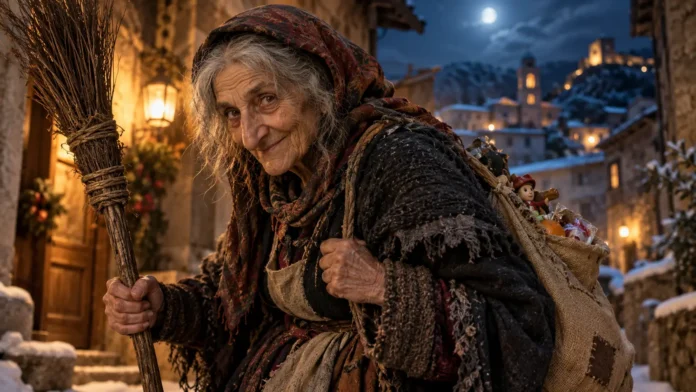
La Befana is the Italian folkloric personification of Epiphany and one of Italy’s best-known seasonal gift-bringers. Imagined as an elderly woman, she visits children on the night of January 5–6, bringing the Christmas holiday season to its traditional Epiphany conclusion.
Her familiar task is to leave sweets and small presents for well-behaved children, while naughty children may receive coal. Stockings, a broom, and a sack of gifts make her recognizable, combining the appearance of an ordinary old woman with an extraordinary nighttime journey.
Although frequently called a witch in English, Befana is primarily a benevolent visitor rather than a threatening supernatural enemy. Her identity belongs to household storytelling and seasonal celebration, but regional traditions also represent her through costumed performers, communal festivities, and old-woman effigies.
Her name securely connects her with Epiphany; her more distant origins are less certain. Christian legends, local performance traditions, and interpretations of winter customs have all shaped her image.
These strands help explain her complexity without establishing that she was originally one particular ancient goddess.
History/Origin
The clearest starting point for Befana’s history is the relationship between the January 6 feast and its popular personification. In Italian Christian tradition, Epiphany commemorates the Magi’s visit to Jesus.
Befana’s gift-giving belongs to this festive setting, although her customs extend beyond the biblical narrative.
The historical record preserves several expressions of the figure rather than one original story. Household gifts, public noise-making, theatrical appearances, and effigies could all belong to the Epiphany season.
Their coexistence makes it misleading to reconstruct the entire tradition from the familiar children’s legend alone.
James George Frazer’s 1913 volume of The Golden Bough provides an important early published account of these customs, drawing partly on earlier Italian folklore scholarship, including Giuseppe Pitrè’s work from 1881. It documents Befana celebrations but does not establish their earliest beginnings.
In villages of Tuscan Romagna, a Twelfth Night procession reportedly involved bells, horns, and kitchen utensils. The celebration culminated in burning an old-woman effigy made from rags and tow.
This was a regional public representation of Befana, distinct from the visitor imagined entering children’s homes.
Frazer interpreted such activities as possible survivals of pre-Christian witch-expulsion rites. That explanation belongs to his comparative theory, not to the directly documented custom itself.
The procession and effigy are historical evidence; their supposed descent from a particular ancient ritual remains a hypothesis.
More recent ethnographic discussion emphasizes the continuing variety of Befana traditions. Kerry Noonan’s review of Steve Siporin’s The Befana Is Returning cautions against reducing them to the polished Magi story.
Local singing and performance traditions preserve dimensions that a single explanatory legend cannot encompass.
Name Meaning
Befana is a popular Italian development of Epifania, the name of Epiphany, through Latin epiphania. The underlying Greek term concerns manifestation or appearance.
In its Christian setting, it refers to the revelation of Christ, giving the folkloric name a clear connection to the feast.
The word’s meanings extend beyond the visiting woman. Italian usage can employ befana for the festival itself and for gifts associated with it.
The same word therefore links a calendar occasion, its personification, and the presents exchanged or discovered during its celebration.
Treccani’s dictionary records this linguistic relationship directly. Francesca Rigotti’s discussion in Doppiozero likewise follows the connection through popular forms of the feast’s name.
These explanations ground the name in language and usage, rather than deriving it from the supposed name of an ancient supernatural being.
The article la simply means “the,” while la vecchia means “the old woman,” a descriptive expression associated with her appearance. Epifania should not automatically be treated as a separate personal alias: it primarily names the feast from which Befana’s familiar designation developed.
Appearance
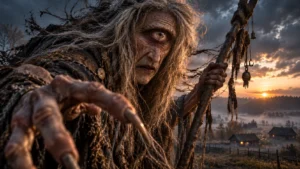
Befana’s representative form is an elderly human woman, not an animal, hybrid monster, or separate supernatural species. Age is central to her recognizable image.
She is conventionally portrayed as unattractive but kindly, allowing an uncanny appearance to coexist with a generous role in children’s celebrations.
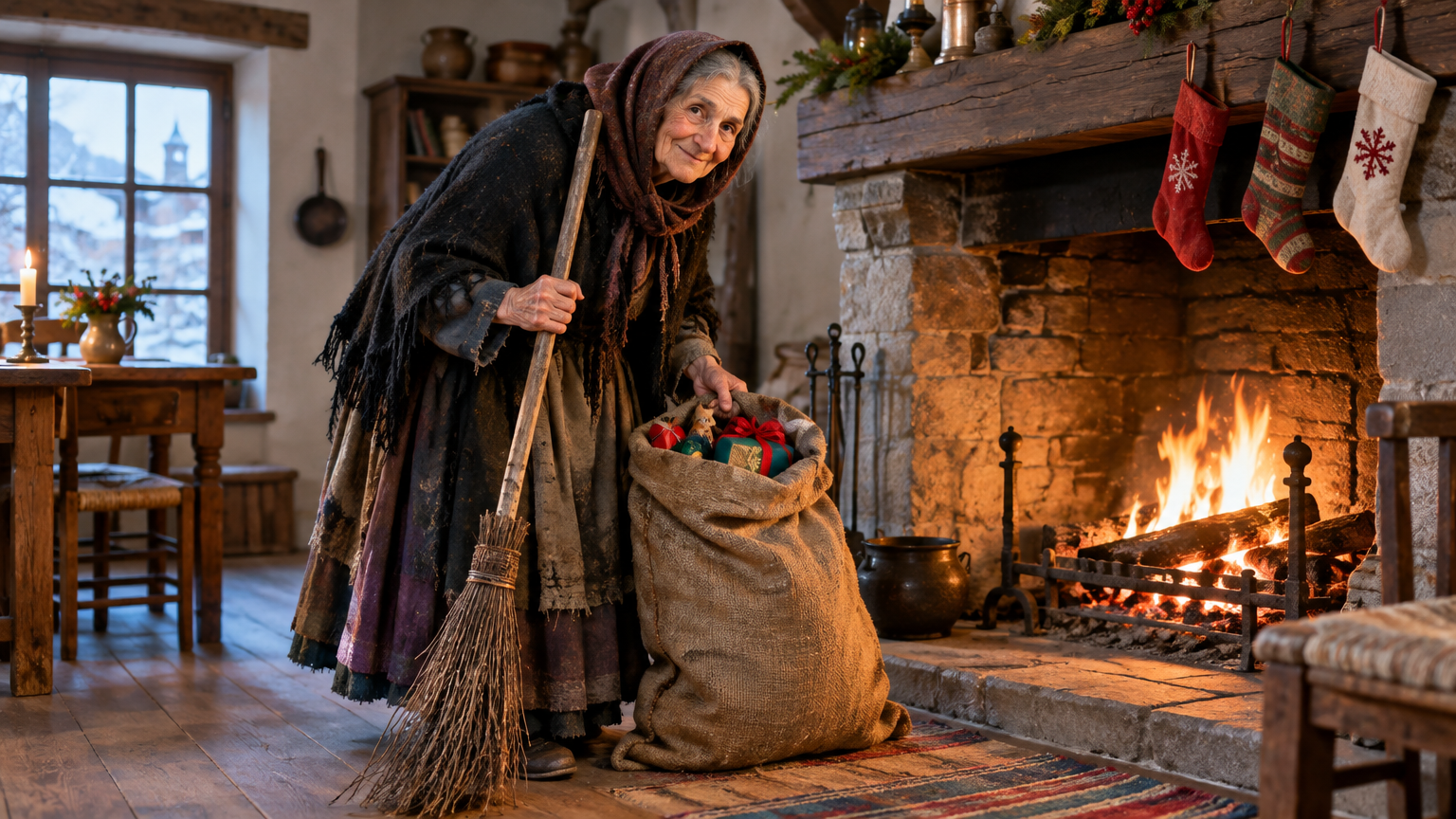
Her clothing is generally plain, worn, or slightly ragged, suggesting a humble domestic figure rather than a royal or divine visitor. The tradition does not require one fixed costume.
The old woman’s overall presentation matters more than any universal color, garment, or decorative accessory.
A broom is among her most familiar attributes, particularly in contemporary portrayals of her nighttime travels. It connects the household implement with supernatural movement.
This witchlike imagery is recognizable, but it should not obscure her principal function as the bearer of Epiphany gifts.
A sack or bag of presents reinforces that function. Stockings containing sweets, gifts, or coal place her within the household setting, often near a fireplace.
These objects explain who she is through what she brings and where children expect to discover the results of her visit.
Public festive representations can look different from household illustrations. A masked performer may embody Befana, while the Tuscan Romagna custom recorded by Frazer used a rag-and-tow old-woman effigy.
These are forms made for particular celebrations, not evidence that her usual body was imagined as a doll.
Her appearance therefore combines continuity with flexibility: an old woman remains the central image, while costume and presentation vary with context. A gift-bearing visitor, a costumed village figure, and a burnable effigy express different aspects of the tradition without becoming interchangeable descriptions.
Background Story
Befana developed within the meeting of Christian festival time and popular seasonal customs. Epiphany supplied a date and a religious framework, while domestic gift-giving and communal performance gave the celebration additional forms.
Her background is consequently broader than a single narrative explaining why she visits children.
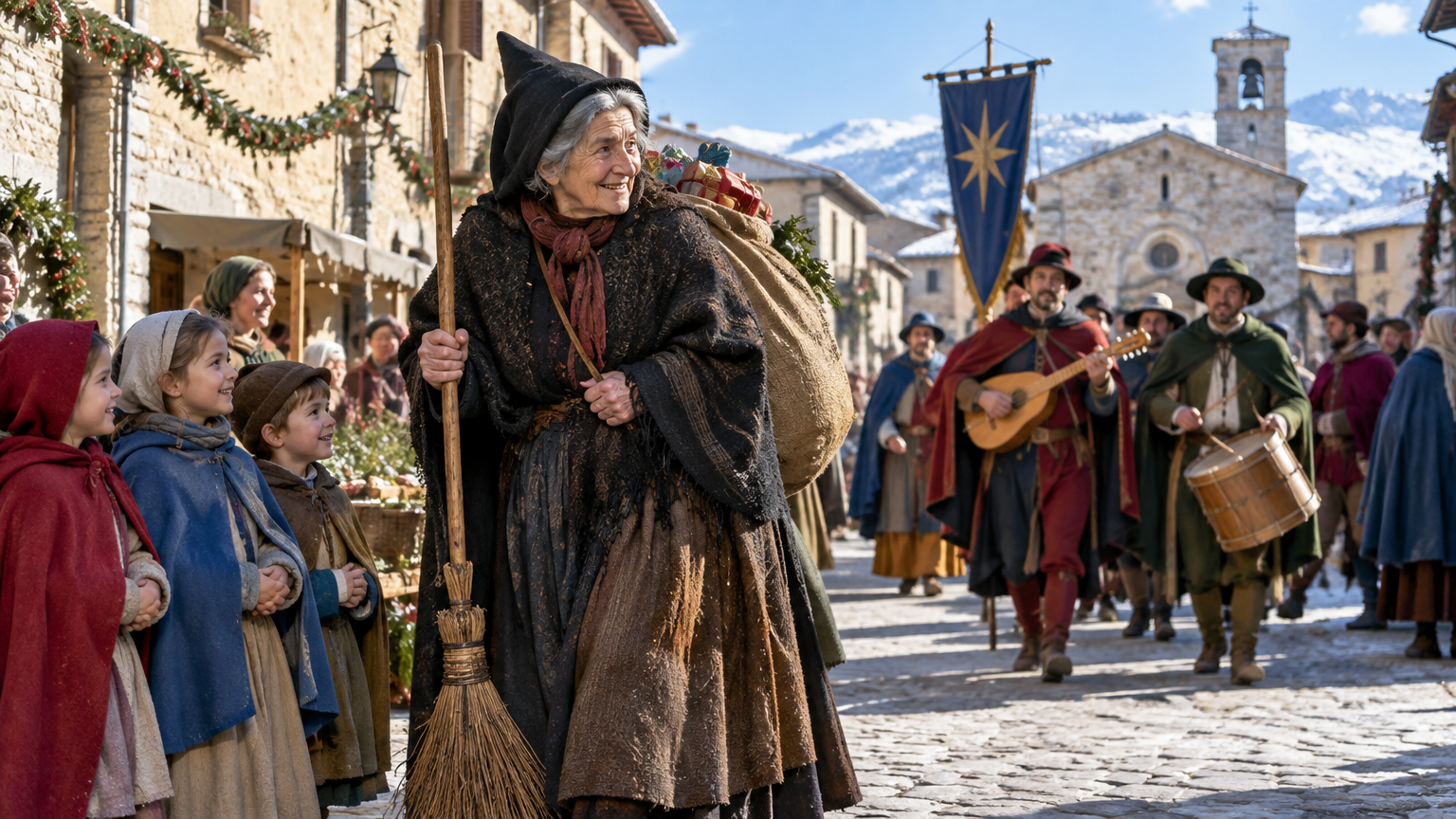
The Magi provide the strongest narrative bridge between the Christian feast and the old woman. In a widely circulated legend, they ask her for directions to the Christ child and invite her to accompany them.
She remains behind because she wants to finish her housework.
After regretting that decision, she tries to follow but cannot catch up. Her subsequent gifts to children become part of an ongoing search for the child she missed.
The episode explains her annual generosity through a missed opportunity and the desire to make amends.
This legend gives familiar domestic activity a religious consequence: ordinary work delays an extraordinary journey. It also connects the Magi’s gifts with Befana’s presents.
It is a meaningful explanation within the tradition, but not an authenticated account of how the historical customs first began.
Other expressions place greater emphasis on communal participation than on her imagined journey. Singing, costumed appearances, processions, and effigies bring Befana into public space.
They show how a seasonal figure can organize relationships among households and neighbors as well as expectations between adults and children.
Her contrasting qualities help sustain that range of meanings. She is old yet returns each year, outwardly unlovely yet generous, and domestic yet capable of supernatural travel.
These contrasts offer a useful interpretation of her appeal without requiring an unproven identity as a surviving agricultural goddess.
Famous Folklore Stories
La Befana’s folklore is not organized around a stable cycle of formally titled tales. Its best-documented narratives are recurring explanations of her Epiphany journey and regional performances in which the old woman appears through costumes, songs, processions, or an effigy.
The Old Woman Who Declined to Accompany the Magi
In a widely circulated encounter narrative, the Magi stop at an old woman’s home while seeking the Christ child. They ask for directions and invite her to accompany them, but she remains behind, commonly because she wishes to finish her housework.
Regretting her refusal, she later sets out with gifts but cannot find the travelers or the child. She consequently visits other children and leaves presents while continuing her search.
This is a popular explanatory legend, not an authenticated title or the proven historical origin of the custom.
The Befana Effigy in Tuscan Romagna
An early twentieth-century account describes a different narrative expression in villages of Tuscan Romagna. Participants moved through the community on Twelfth Night, making noise with bells, horns, and kitchen utensils before burning an old-woman figure made from rags and tow.
This episode belongs to communal seasonal performance rather than to a conventional folktale. The effigy represented Befana, but it should not be confused with the benevolent household visitor found in children’s gift traditions.
The two forms demonstrate how sharply regional portrayals could differ.
Cultural Impact
La Befana helped make Epiphany a domestic and child-centered celebration as well as a Christian feast. Her expected nocturnal visit connected the festival calendar with household anticipation, gifts, sweets, stockings, and judgments about conduct during the preceding year.
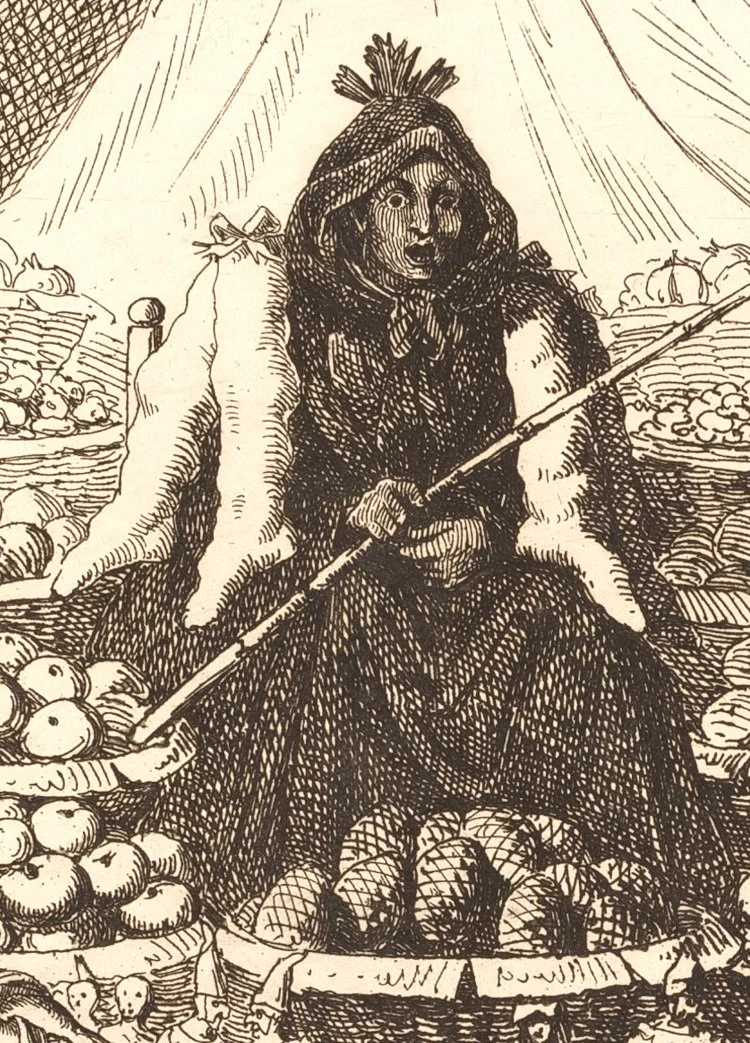
The figure also supported public forms of celebration. Regional traditions included songs, masked or costumed performers, noisy processions, and old-woman effigies.
These customs did not follow one national script, and the household gift-bringer was only one expression within a varied festive landscape.
Her mixture of benevolence and mild threat gives the tradition moral flexibility. Sweets reward good behavior, while coal marks misbehavior in many familiar versions.
The contrast communicates social expectations through humor and ritualized suspense rather than presenting Befana simply as a frightening witch.
Visually, her worn clothing, old age, broom, and gift sack transformed an unglamorous elderly woman into a recognizable bearer of seasonal abundance. That combination distinguishes her from majestic saints and youthful fairies while allowing performances to range from affectionate comedy to unsettling masquerade.
Modern retellings often emphasize the polished story of her missed journey with the Magi. Specialist study of regional festivals warns that this explanation can obscure participatory traditions such as Befanata performance, in which community visits, disguise, music, and exchange matter more than a single origin story.
Similar Beasts
Cailleach Bheur

Cailleach Bheur is a winter hag of Celtic and Scottish tradition, associated with storms, frost, stone, and seasonal transformation. Her aged female form personifies winter’s severity and cyclical power.
Like La Befana, she joins female old age with winter symbolism. Unlike the Italian gift-bringer, however, her defining role concerns landscape and weather rather than Epiphany gifts.
Read more about Cailleach Bheur
Baba Yaga

Baba Yaga is a powerful witch-like woman from Slavic folklore who inhabits a hut on chicken legs. Tales portray her variably as threatening, testing, knowledgeable, or unexpectedly helpful.
Both figures use the uncanny image of an elderly supernatural woman. Baba Yaga belongs to broader wonder-tale traditions, whereas La Befana has a fixed Epiphany-season gift-giving function.
Fairy Godmother
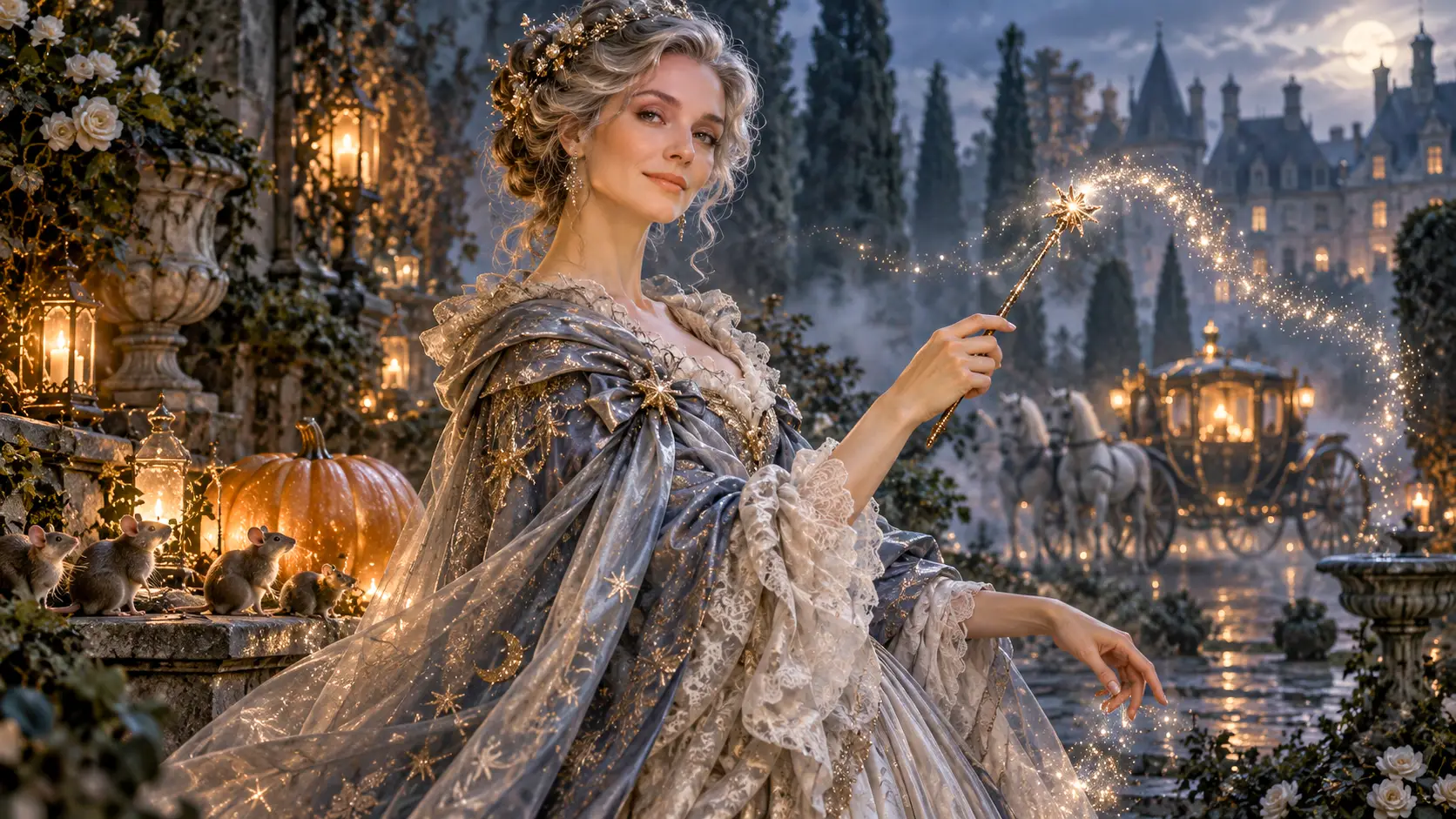
The Fairy Godmother is a benevolent supernatural helper best known from literary fairy tales, including Charles Perrault’s version of Cinderella. She assists a deserving young person through transformative enchantment.
Her protective generosity resembles La Befana’s benevolent treatment of children. The difference is narrative function: the Fairy Godmother intervenes within a tale, while Befana annually personifies a festival.
Read more about Fairy Godmother
Saint Nicholas
Saint Nicholas is a Christian saint whose feast traditions developed a strong association with children and winter gift-giving. His folkloric forms vary across European regions and later influenced additional seasonal visitors.
He is La Befana’s closest comparison in social function, but not her male counterpart or source. Their customs belong to distinct feast days, legends, and regional histories.
Religion/Ritual
La Befana is attached to Epiphany on January 6, the Christian feast commemorating the manifestation of Christ and, in Western tradition, the visit of the Magi. Her customary arrival during the preceding night places domestic folklore inside that religious calendar.
The connection does not make every Befana custom an official Christian observance. The tradition combines the feast’s sacred setting with popular practices involving children, gifts, disguise, songs, food, and communal entertainment.
Its balance between these elements differs considerably by region.
Historical regional celebrations could involve performers moving through a settlement while producing loud sounds with horns, bells, or household objects. In some Tuscan Romagna communities, the procession culminated in burning an old-woman effigy identified as Befana, creating a public seasonal rite distinct from private gift-giving.
James George Frazer interpreted such noise-making and burning as possible survivals of a pre-Christian witch-expulsion ceremony. That proposal remains conjectural.
The documented ritual is evidence for a regional custom, but it does not prove that La Befana was originally a pagan goddess, witch, or agricultural spirit.
Scientific or Rational Explanations
La Befana is best understood as a folkloric personification and ritual character rather than an empirically verifiable supernatural visitor. Her appearances are sustained through stories, gifts placed by adults, costumed performers, effigies, and shared expectations tied to a recurring calendar date.
Linguistic evidence offers the clearest explanation of her identity. The name developed as a popular form of Epiphany and could refer to the feast, its personified old woman, or the gifts exchanged during it.
This progression can explain the figure without requiring descent from one ancient deity.
From an anthropological perspective, personifying a festival makes an abstract date socially active. An imagined visitor gives children a memorable explanation for gifts and consequences, while adults gain a playful means of teaching generosity, patience, and behavioral expectations within the household.
The opposition between sweets and coal can be interpreted as symbolic moral classification. Both objects make approval or disapproval visible, but the ritual remains manageable and often humorous.
The practice turns household discipline into a seasonal drama rather than evidence of supernatural reward and punishment.
Public disguises and processions serve a different social purpose. A masked Befana permits neighbors to enact the festival collectively, while songs, visits, noise, and exchanges temporarily alter ordinary social interactions.
Effigy burning may similarly mark seasonal closure, although its meaning cannot be assumed identical everywhere.
Proposed pagan origins remain possible areas of comparison, especially where winter female figures, agricultural symbolism, or expulsion rites overlap. However, resemblance does not establish direct descent.
The Epiphany name, Christian calendar setting, and documented regional customs provide firmer evidence than attempts to assign Befana one definitive ancient identity.
Modern Cultural References
La Befana vien di notte, film 2018
film 2018 A fantasy-comedy film portrays its schoolteacher protagonist as the Befana by night.
(netflix.com)
La Befana vien di notte 2 – Le origini, film 2021
film 2021 A released prequel about the origins of the Befana; RaiPlay confirms its theatrical release on December 30, 2021.
(raiplay.it)
Jollyland, Season 2, Episode 1: “Out for Revenge”, 2021
podcast episode 2021 This fictional audio-drama episode includes La Befana as a voiced character and gives her a role in the story.
(podcasts.apple.com)
Conclusion
La Befana endures because she joins several dimensions of Italian Epiphany culture in one memorable figure. She is at once a benevolent elderly visitor, a distributor of sweets or coal, a character in Christianized legend, and a presence within regionally varied seasonal performances.
These forms should not be reduced to a single origin story. The household gift-bringer, the masked performer, and the ceremonial effigy represent connected but distinct expressions of a changing tradition.
Her strongest historical identity is that of an Italian personification associated with Epiphany, not a demonstrably surviving ancient goddess. Proposed pagan origins may illuminate possible comparisons, but they remain interpretations rather than settled history.
La Befana’s lasting symbolic power instead comes from her position at the close of the Christmas season, where age, generosity, judgment, regret, and renewal meet. Modern films, animation, books, and audio drama continue reshaping that flexible inheritance for new audiences.
Further Reading
The Golden Bough, third edition, vol. 9, James George Frazer, Project Gutenberg
A historical account of regional Epiphany customs, including a noisy Tuscan Romagna procession and the burning of a Befana effigy.
Its proposed pre-Christian connections require caution.
Source
Review of Steve Siporin’s The Befana Is Returning: The Story of a Tuscan Festival, Kerry Noonan, Journal of Folklore Research Reviews
An introduction to ethnographic research on Befanata performances and regional celebrations, highlighting dimensions of the tradition that the familiar Magi legend does not fully explain.
Source
Befana, Treccani Vocabolario
An Italian dictionary entry documenting the name’s relationship to Epiphany and its uses for the festival, the old-woman personification, and associated gifts.
Source
La Befana, Francesca Rigotti, Doppiozero
A discussion of the linguistic connection between Befana and Epiphany, alongside the familiar image of the old woman associated with the feast.
Source
La Befana, Wikipedia
A general overview of Befana’s legends, appearance, customs, and later representations. Useful for orientation and following references, rather than as the final authority on disputed origins.
Source