Introduction
Krampus is a frightening companion or counterfigure to St. Nicholas in Austrian and Bavarian Advent customs. Usually appearing around December 5, the eve of St.
Nicholas Day, he threatens punishment while the saint examines children’s conduct, offers praise, or distributes gifts.
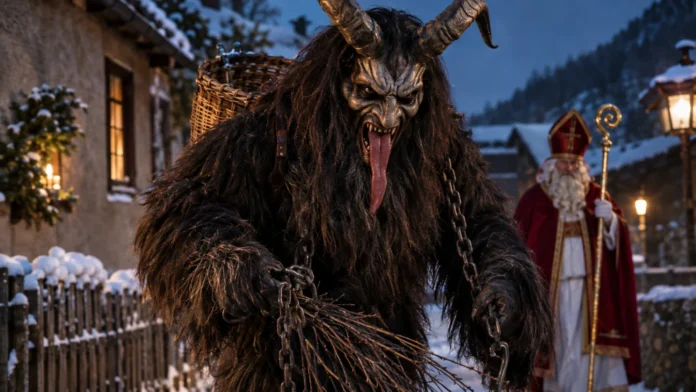
His familiar appearance is horned, shaggy, and devil-like, usually represented by a masked performer rather than a creature with fixed anatomy. Chains, a birch switch, and sometimes a basket make his threatening purpose visible during household visits and public appearances.
The tradition belongs to a varied Alpine landscape of seasonal characters. Local names, costumes, and performances differ, and Krampus should not simply be equated with Perchten, the figures associated with another group of winter customs.
Their histories overlap without becoming identical.
Krampus matters both as a figure of childhood discipline and as a continuing form of communal performance. His documented history reaches into early modern Austria, but his exact beginnings remain uncertain.
Claims that he survives directly from an ancient pagan religion exceed the available historical evidence.
History/Origin
The clearest historical starting point is the St. Nicholas visiting custom, not an independently documented ancient monster. Viennese evidence assembled by the Wien Museum reaches back to the seventeenth century, when the saint and his frightening companion appeared together in household visits.
The Austrian National Library places the custom’s development broadly around the Counter-Reformation period while leaving its precise origin unresolved. This situates Krampus within an early modern Christian cultural setting, but it does not establish one invention date, birthplace, or unbroken line of development.
A possible connection with children’s-bishop customs in the mid-seventeenth century appears in the Wien Museum’s historical discussion. That suggestion concerns the development of seasonal performances around St. Nicholas.
It remains a proposed connection rather than a securely established account of Krampus’s creation.
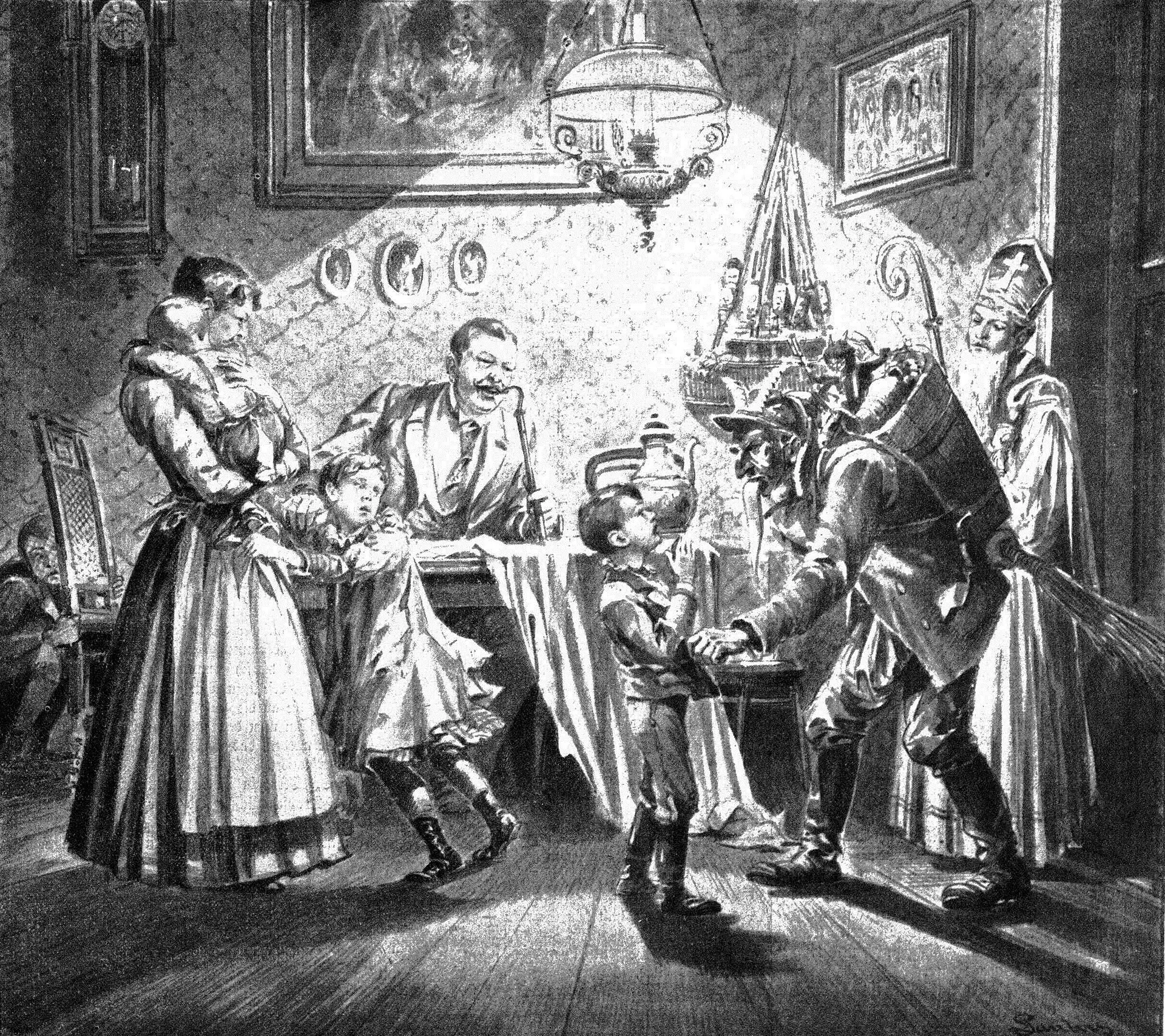
By the nineteenth century, the threatening visitor was clearly recognizable in urban descriptions. An 1881 account in the Viennese Morgen-Post, preserved in the museum’s discussion, presents St.
Nicholas arriving with a horned, hairy companion equipped to frighten children. It provides a particularly detailed historical portrait.
The name’s wider prominence developed later than these earlier visits. Research by Matthäus Rest and Gertraud Seiser connects its growing popularity in the late nineteenth century with postcard culture.
Printed circulation helped spread a recognizable Krampus image beyond the settings of particular local performances.
Krampus and Perchten customs also became entangled through regional practice and later interpretation. Folklorist Ulrike Kammerhofer-Aggermann emphasizes the role of nineteenth- and twentieth-century local historians and amateur researchers in conflating different forms.
Similar masks therefore do not, by themselves, establish a single ancient origin.
Name Meaning
The name Krampus is especially associated with Austrian German. Its geographical usage is clearer than its ultimate derivation: it names a familiar threatening figure in the St.
Nicholas season, but there is no securely established literal meaning that explains every feature of the character.
Duden tentatively connects Krampus with Krampen, a word associated with a hook or iron implement. The qualification matters.
This is a proposed linguistic relationship, not a proven derivation, and it should not be converted into a definite claim that Krampus means “claw.”
The historical spelling Grampus occurs in the Viennese material discussed by the Wien Museum. Kramperl is another regional form or diminutive.
These variations belong to the figure’s linguistic history, but differences in spelling alone do not demonstrate separate supernatural identities or different origins.
Bartl and Klaubauf also occur as regional names for related local forms, rather than universally interchangeable synonyms. Duden’s definition through Knecht Ruprecht supplies a functional comparison with another Nicholas companion; it does not make their costumes, regional histories, or customary performances identical.
Appearance
Krampus commonly appears as a shaggy, horned humanoid with a demonic or beast-like face. In customary performance, this appearance is created through a mask and costume.
The result is a threatening human-shaped visitor, not a consistently described animal species with universally agreed physical characteristics.
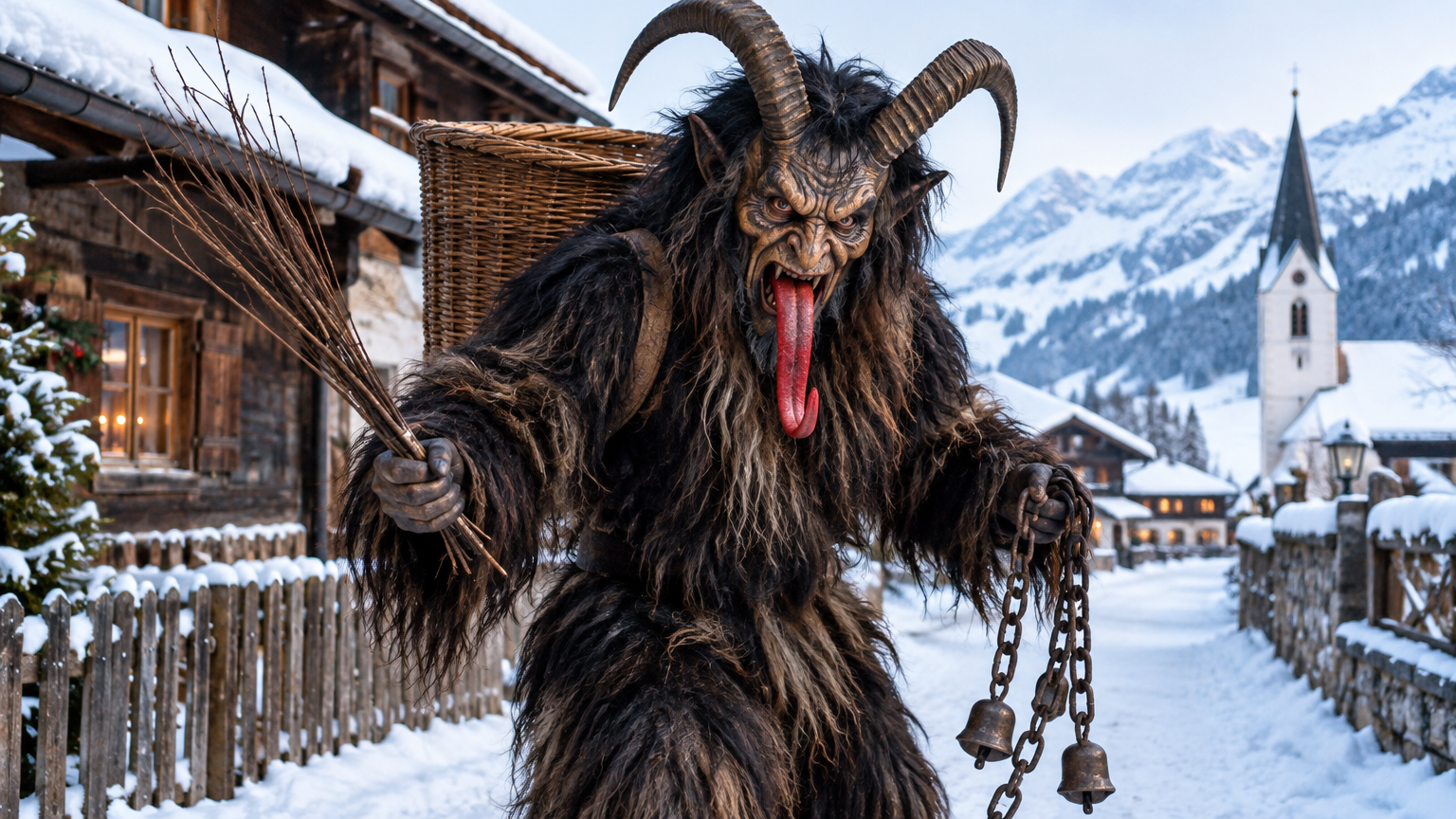
A particularly vivid regional portrait comes from the 1881 Morgen-Post account quoted by the Wien Museum. It compares the visitor to both a bear and a goat, combining shaggy hair with horns.
This comparison describes that historical representation rather than prescribing every Krampus costume.
The same account gives him a long red tongue reaching down to his chest. Together with the horns and hair, the exaggerated tongue intensifies his grotesque appearance.
It is a documented feature of this Viennese description, but should not be treated as mandatory everywhere.
His equipment is as important as his face. A rattling chain announces and accompanies the threat, while a birch switch represents punishment.
The back basket in the Viennese account provides another frightening possibility: carrying away children accused of laziness, poor lessons, or bad behavior.
The shaggy, dark figure also creates a visual contrast with St. Nicholas in episcopal dress. Regional variations alter the masks, proportions, and presentation, while retaining a threatening presence.
Resemblance to Perchten costumes must be interpreted cautiously, since shared visual elements do not erase differences in customary setting.
Background Story
Krampus’s background is chiefly a relationship and a recurring situation, rather than a continuous personal biography. He enters the St.
Nicholas visit as the threatening counterpart to a rewarding saint. His purpose becomes intelligible through their contrasting actions before the children gathered to receive them.
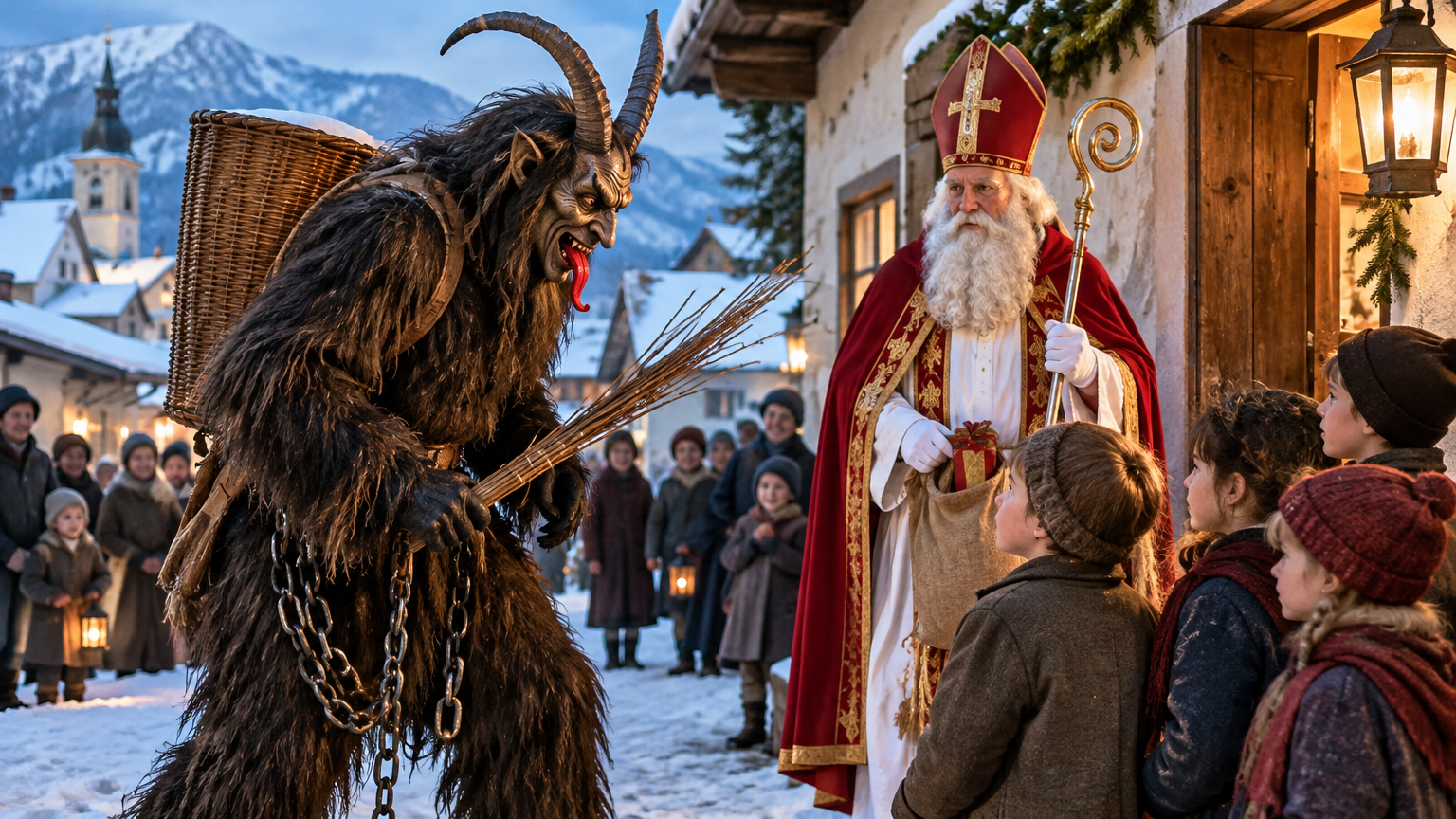
The encounter turns judgments about conduct into a dramatic event. Praise and gifts occupy one side of the visit; threats and punishment occupy the other.
Krampus gives a frightening physical presence to consequences that might otherwise remain ordinary instructions from parents or other adults.
The basket makes this mechanism especially clear. In the historical Viennese description, it becomes a threat of removal from the household for children who behave badly or neglect their lessons.
The documented motif concerns intimidation during a visit, rather than a developed account of another supernatural world.
His devil-like appearance belongs within this Christian seasonal framework, but appearance alone does not supply a theological biography. The documented custom establishes his relationship to St.
Nicholas more clearly than any independent origin story. It also explains why his threatening actions accompany an occasion of reward.
Broader winter masking traditions helped shape the setting in which such figures circulated. Nevertheless, Advent Krampus customs differ from Perchten customs associated with the Raunächte, the midwinter nights around Christmas and Epiphany.
Regional borrowing and later conflation explain overlap without requiring that both traditions began as one.
Later circulation through postcards and changing public performances added further layers to the character. Krampus consequently combines household discipline, grotesque imagery, local custom, and increasingly shared representations.
His background is best understood as a developing cultural tradition rather than the preserved biography of an ancient deity.
Famous Folklore Stories
Krampus survives especially through performed encounters and recurring threats rather than a single canonical adventure. A Viennese newspaper account preserves a detailed household episode; the headings below describe documented motifs, not authenticated titles of traditional folktales.
The Threatening Companion at the Door
An 1881 account in the Morgen-Post, preserved by the Wien Museum, recalls St. Nicholas arriving with a horned, shaggy companion resembling both bear and goat.
This is a description of a customary encounter, not a separately named wonder tale.
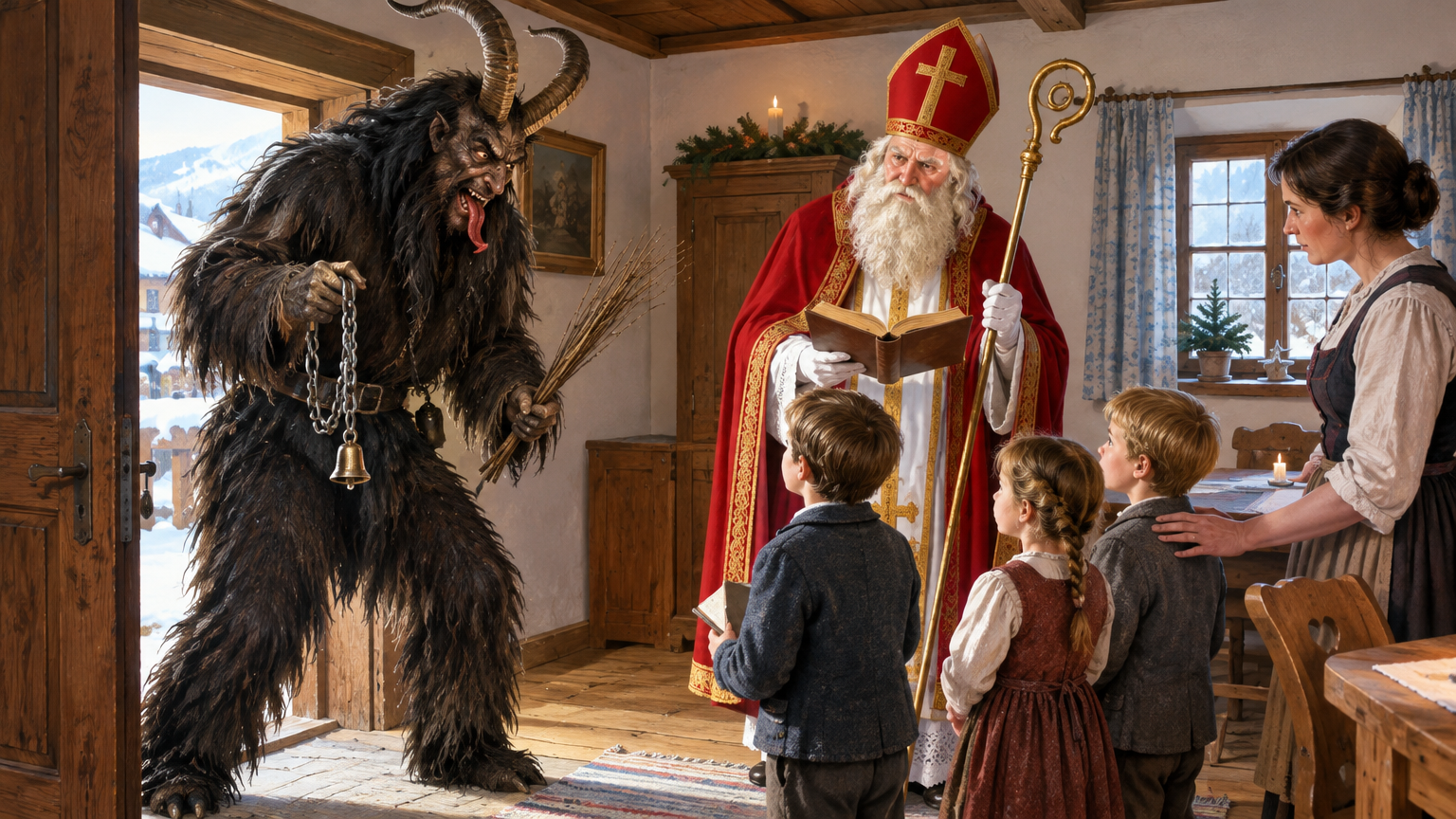
The encounter pairs the saint’s moral authority with Krampus’s intimidation. St. Nicholas assesses the children, while his companion rattles a chain and brandishes a birch switch.
The threat concerns recognizable household expectations, including good behavior and attention to lessons, rather than a heroic quest.
The Basket and the Threat of Removal
In the same Viennese account, Krampus carries a basket on his back and uses it to threaten naughty or lazy children with being taken away. The container gives the warning a visible form: punishment appears as something the visitor could immediately carry out.
The account documents a threat within a staged household visit, not an actual abduction or a complete narrative about a child’s subsequent fate. It therefore supports the carry-away motif without establishing a universal destination, underworld journey, or fixed ending for Krampus stories.
Cultural Impact
Historically, Krampus made adult expectations tangible through costume, noise, and threatened punishment. His partnership with St. Nicholas divided a disciplinary encounter between approval and fear.
The frightening visitor could reinforce lessons already taught within the household, giving ordinary rules the force of a seasonal performance.
This educational role also attracted criticism. Intimidating children and threatening or administering physical punishment raised questions about the custom’s value.
Krampus therefore belongs not only to festive heritage but also to changing debates about childhood, obedience, and the acceptable limits of adult authority.
Postcard culture helped circulate the name and image beyond individual local performances. Its importance increased in the late nineteenth century, when a reproducible visual figure could become familiar to people who had never experienced the particular household customs or regional forms behind it.
Contemporary public runs shift attention toward collective spectacle. A household visit addresses particular children, whereas a procession presents frightening figures to a wider audience.
These settings coexist, but their purposes and relationships with spectators should not be treated as identical.
Modern scholarship also examines Krampus as a vehicle for local identity. Rest and Seiser’s study of Austrian practice treats its contemporary expansion through the lens of identity politics.
This is an analysis of present-day cultural activity, not evidence that every current performance preserves an unchanged ancient rite.
Similar Beasts
Perchta
Perchta belongs to a distinct body of winter traditions associated with the Raunächte and Perchten customs. Regional histories have sometimes merged these traditions with other frightening seasonal figures.
The overlap with Krampus is historical and regional, not proof of identity. His St. Nicholas setting remains an important distinction from Perchta and Perchten traditions.
Père Fouettard
Père Fouettard is a threatening companion of St. Nicholas in French-speaking regional traditions. His role centers on punishment or warnings directed toward children whose conduct fails expected standards.
He offers a close functional comparison with Krampus: both contrast with the saint’s rewarding role. That shared arrangement does not make their regional traditions interchangeable.
Oni

Oni are monstrous beings in Japanese folklore, associated with immense strength, frightening appearances, punishment, and misfortune. They belong to a different cultural and religious setting from Alpine Advent customs.
The comparison concerns their terrifying humanoid form and punitive associations. It does not establish shared origins or make Oni counterparts of St. Nicholas’s seasonal companion.
Black Annis

Black Annis is a blue-faced hag of Leicestershire folklore, feared for seizing wandering children and lambs. Her threatening presence belongs to a landscape legend rather than an Advent household visit.
Her child-seizing reputation resembles Krampus’s threat to carry children away. Unlike Krampus, however, she is not defined by a disciplinary partnership with a rewarding saint.
Jenny Greenteeth

Jenny Greenteeth is an English water spirit said to drag people beneath the surface of ponds and rivers. Her stories warn about dangerous water rather than failures of household obedience.
Like Krampus, she illustrates how a frightening figure can give warnings memorable force. The resemblance concerns cautionary function, not appearance, seasonal observance, or historical descent.
Read more about Jenny Greenteeth
Religion/Ritual
Krampus custom centers on the eve of St. Nicholas Day, usually December 5. In household visits, the frightening companion appears within a Christian seasonal framework: the saint assesses conduct and offers praise or gifts, while Krampus supplies the threat of punishment.
The performance depends on contrasting roles rather than evidence of worship directed toward Krampus. The saint’s episcopal appearance and the companion’s shaggy, devil-like costume establish opposing visual identities.
Chains, switches, and, in the Viennese account, a basket make the threatening role immediately legible.
Public Krampus runs provide another documented setting, but they should not be used as a template for every locality. Regional forms vary, and names such as Bartl or Klaubauf may designate related local figures rather than universally interchangeable versions of one standardized character.
The Austrian National Library distinguishes Advent Krampus customs from Perchten observances associated with the Raunächte around Christmas and the turn of the year. Historical overlap does occur, but shared masks or frightening appearances do not establish a single ritual tradition or a proven pre-Christian origin.
Scientific or Rational Explanations
Krampus is documented as a folkloric character and a role enacted by human performers, not as a zoological species. Masks, costumes, props, and organized appearances explain the observable encounters without requiring a literal horned creature or a scientifically verified supernatural being.
A social interpretation begins with the household visit itself. The saint’s approval and Krampus’s threats turn expectations about behavior into a memorable encounter.
This interpretation follows the documented disciplinary setting; it does not require a claim that frightening children was universally effective or harmless.
Historical explanation also requires separating the age of particular evidence from the age claimed for the whole tradition. Viennese records reaching into the seventeenth century establish an early documented setting.
They do not, by themselves, demonstrate continuity from antiquity or identify a precise original ceremony.
Specialist folklore research explains some apparent unity through later classification and borrowing. Ulrike Kammerhofer-Aggermann’s discussion traces how regional forms were reshaped and conflated, including through nineteenth- and twentieth-century local history writing.
Similar-looking figures may consequently reflect interaction and reinterpretation rather than one unchanged ancestral being.
The contemporary custom is best understood as changing cultural practice. Postcard circulation, public performance, and local identity all help explain its visibility.
These processes need not make the tradition inauthentic, but they caution against treating present popularity or elaborate costumes as measurements of historical antiquity.
Modern Cultural References
Krampus, film (2015)
Michael Dougherty’s horror-comedy follows a family threatened by supernatural forces after a child rejects Christmas. Krampus becomes its central antagonist, adapting seasonal punishment into cinematic horror.
(universalpicturesathome.com)
Krampus!, comic series (2013–2014)
Brian Joines and Dean Kotz’s comic follows a mission to recover the stolen power of the Santa Clauses.
Krampus takes the unexpected role of its hero.
(imagecomics.com)
Krampus: Shadow of Saint Nicholas, graphic novel (2015)
This official companion to the film presents three interconnected horror tales involving Krampus and Christmas spirits.
It expands the adaptation’s fictional mythology rather than documenting Alpine custom.
(legendary.com)
The Krampus, video game (2024)
Horrid Vision LLC’s horror game follows children attempting to escape a supernatural pursuer.
Krampus supplies that threat, with playable settings including the creature’s workshop within the game.
(store.steampowered.com)
The Krampus Game, video game (2026)
Gaming Limited’s multiplayer folklore brawler features playable Krampus characters in parade and battle modes.
It turns the masked seasonal figure into a participant in competitive play.
(store.steampowered.com)
Jollyland: “Episode 1 Out for Revenge”, podcast episode (2025)
This fictional audio-drama episode from The Vocalizers brings winter folklore into an entertainment narrative.
Its synopsis pairs Krampus with Hans Trapp in a plot to capture children.
(podcasts.apple.com)
Conclusion
Krampus is best understood through his relationship with St. Nicholas and the communities that perform their contrasting roles.
Gifts, judgment, fear, and threatened punishment belong to the same seasonal encounter, making the horned figure more than an isolated Christmas monster. His shaggy costume and threatening props give visible form to expectations about children’s conduct, while local variations show that the tradition has never depended on one fixed appearance or a single authoritative story shared across the Alpine region.
The custom’s documented history deserves more weight than confident claims of an unbroken pagan survival. Its precise beginnings remain uncertain, and connections with Perchten require distinction rather than automatic identification.
At the same time, uncertainty about origins does not diminish its cultural importance. Household visits, public performances, and modern fictional adaptations reveal different uses of the same unsettling figure.
Krampus endures both as a regional Advent companion and as a flexible image through which communities and storytellers explore the threatening side of seasonal celebration.
Further Reading
Auf Teufel komm raus! Der Krampusbrauch in Österreich, Österreichische Nationalbibliothek
Library essay distinguishes Krampus from Perchten and summarizes the documented ritual forms and uncertain origins.
(onb.ac.at)
Kramperl, Perchten u. a. Drohgestalten, Forum Salzburger Volkskultur
Specialist folkloristic discussion of changing regional forms and the historical conflation of Perchten and Krampus traditions.
(brauch.at)
Krampus, Duden
Lexicographic entry for Austrian usage, definition, plural, and explicitly tentative etymology.
(duden.de)
The Krampus in Austria: A Case of Booming Identity Politics, Max Planck Society repository
Scholarly analysis of contemporary Krampus practice and the modern spread of the name and public tradition.
(pure.mpg.de)