Introduction
The Boto Cor-de-Rosa is an Amazonian folkloric encantado, a supernatural being associated with the river dolphin and its ability, within storytelling, to assume human form. The familiar pink dolphin is its principal animal identity, but the tradition encompasses more than one story or character type.
In the best-known version, an elegant young man dressed in white arrives at a riverside celebration. He dances, charms a woman, and disappears into the river before dawn.
His attractive appearance conceals an identity that belongs to the water rather than the human community.
Other accounts move beyond courtship to describe abduction, illness, an underwater realm, or intervention by a healer. These differences matter: the handsome festival stranger is a prominent expression of boto folklore, not a complete definition of everything Amazonian communities have told about the being.
The legend must also be distinguished from the living animal. The boto-cor-de-rosa, identified as Inia geoffrensis, is a real freshwater dolphin.
Human transformation belongs to folklore, through which encounters with river life become stories about desire, danger, kinship, and relations with an unseen world.
History/Origin
Boto beliefs have a nineteenth-century documentary history, but their beginnings remain uncertain. Written records establish that traditions circulated by the time they were recorded, not when they first developed.
Oral narratives may be older, and the familiar dolphin-seducer story need not preserve every feature of earlier tellings.
The tradition belongs to Amazonian folklore. Describing all its surviving elements as exclusively Indigenous, however, assigns a single origin to a varied body of stories.
Neither that exclusive attribution nor a proposed direct derivation from Greek dolphin beliefs is established by the available evidence.
João Barbosa Rodrigues’s Poranduba amazonense, published in 1890, is an important early collection of regional narratives. Its title dates the gathered material to 1872–1887.
These dates place the collection within the nineteenth-century record, but do not independently date a particular boto episode or identify the tradition’s earliest telling.
The elegant white clothing, concealing hat, and June-festival setting also require caution. Atlas Noctis, a modern folklore synthesis, interprets these as later Luso-Brazilian layers.
That interpretation should remain distinct from a demonstrated chronology: the familiar costume and festive setting cannot automatically be assigned to the earliest forms of the tradition.
Candace Slater’s 1994 study, Dance of the Dolphin: Transformation and Disenchantment in the Amazonian Imagination, examines transformation, seduction, festivals, and removal to an underwater city. Its broader narrative range shows why boto folklore cannot be reduced to a single romantic encounter.
The historical picture is therefore one of continuing retelling. Festival romances coexist with accounts of supernatural danger and underwater existence, without establishing one original plot or a uniform sequence of development across Amazonian communities.
Name Meaning
Boto-cor-de-rosa is a Portuguese descriptive name meaning “pink river dolphin.” Boto is commonly used for river dolphins, while cor-de-rosa means “pink,” literally “rose-colored.”
The name identifies the living animal; its supernatural significance comes from Amazonian storytelling rather than from the words themselves.

The shorter boto can refer either to a dolphin or to the transforming visitor of folklore. Context distinguishes an ordinary animal encounter from a story about an encantado.
The same vocabulary can therefore connect the river animal with a supernatural identity without making every mention of a boto a reference to a spirit.
Boto-vermelho, literally “red boto,” is another name associated with the dolphin and its folklore. This alternative name does not by itself establish a separate red creature with a fixed appearance or independent narrative tradition.
Uauyara also occurs in connection with boto traditions, but its use should not be assumed to match boto-cor-de-rosa in every account. Encantado, meaning “enchanted,” describes a supernatural category or condition, rather than an exclusive name for the boto.
Encante names an underwater realm in some narratives. These related terms distinguish the animal, the supernatural being, and its otherworldly setting rather than forming a list of exact synonyms.
Appearance
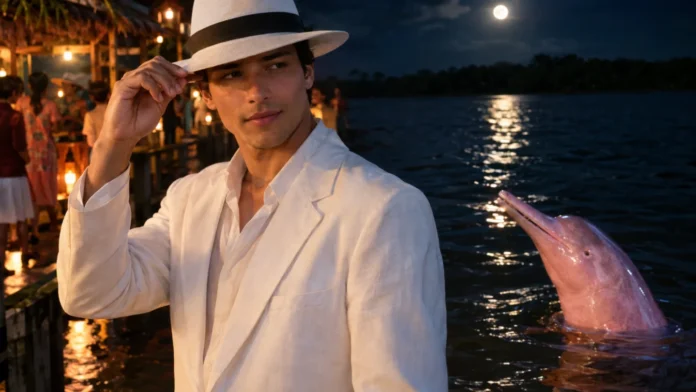
The boto’s most recognizable human appearance is that of a handsome, elegant young man wearing white clothing, often described as a suit. He can enter a riverside gathering as an apparently human stranger.
His appeal depends on looking socially convincing, rather than visibly monstrous.

A hat is another familiar feature of this depiction. In some popular retellings, it conceals the dolphin’s blowhole or nostrils, leaving a physical clue beneath the human disguise.
The detail is version-specific, and the descriptions should not be combined into one precise supernatural anatomy.
The hat creates a contrast within those versions: the stranger appears fully human, yet must conceal evidence of his aquatic identity. White clothing and elegant presentation belong to the festival-seducer image; they are not established requirements for every boto-associated encantado encountered in regional narratives.
In animal form, the figure is associated especially with the Amazonian pink river dolphin. This is an alternative form, not evidence for a standard half-human, half-dolphin body.
The familiar transformation story moves between dolphin and man rather than requiring both anatomies to remain visible together.
Setting helps make this appearance meaningful. A nighttime gathering beside the river places the polished visitor close to the water into which he will disappear.
Narratives centered on abduction, illness, or the Encante need not reproduce the same costume or emphasize the stranger’s beauty in the same way.
Background Story
The boto’s narrative background lies in the meeting of riverside human life and an aquatic world imagined as capable of human relationships. Transformation allows a being associated with the river to enter community spaces, while its eventual disappearance exposes the limits of that apparent familiarity.
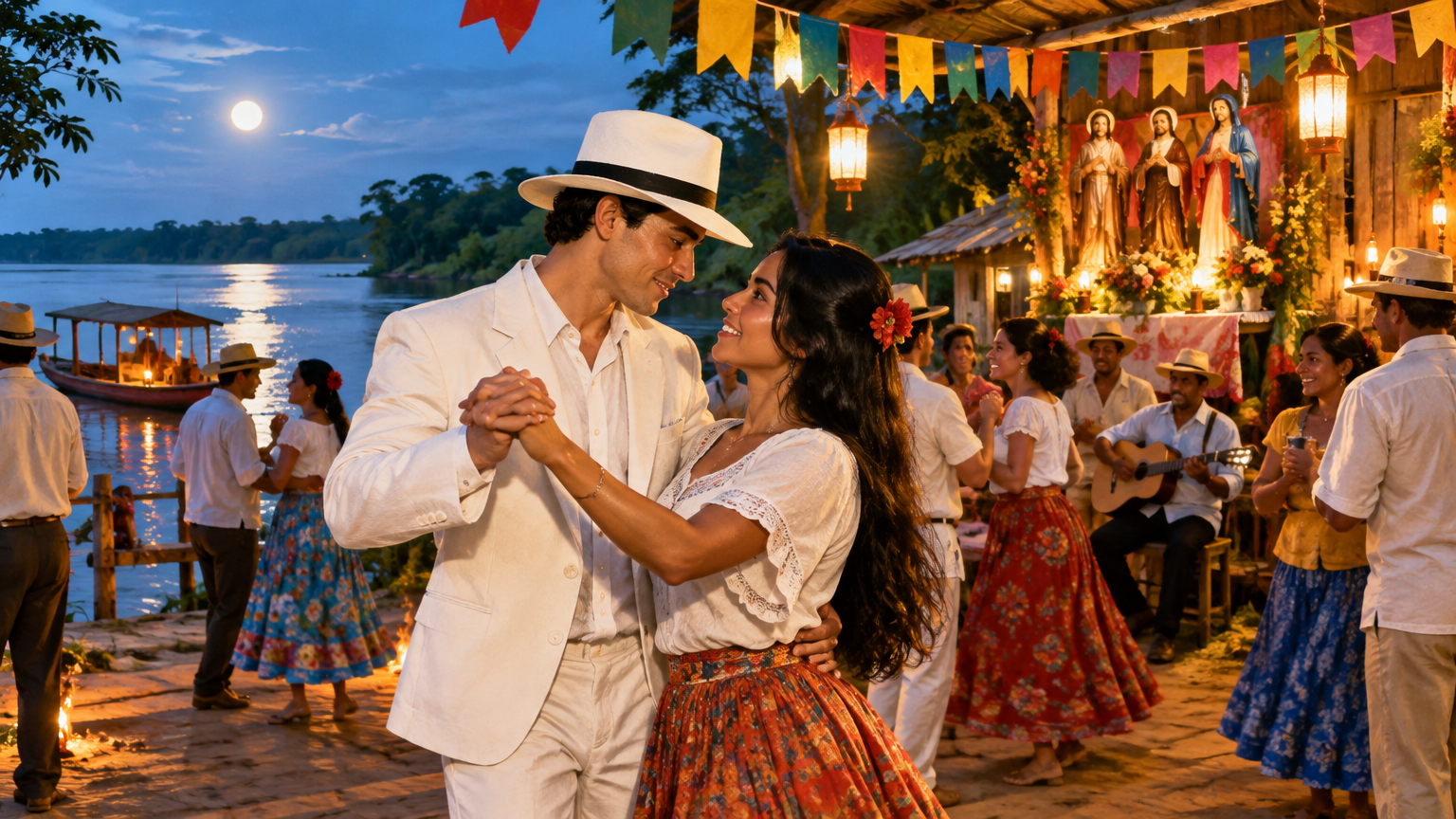
In the familiar dance episode, attraction crosses that boundary. A stranger joins the festivities, charms a woman, and returns to the river before dawn.
Some versions leave her pregnant. The episode connects an extraordinary encounter with lasting consequences inside the household and community.
The expression “son of the boto” belongs to this social dimension, explaining paternity that is unknown or unacknowledged. It should be understood as a folkloric attribution, not evidence about an individual’s parentage.
Nor does this usage establish the sole purpose or historical origin of dolphin narratives.
Other versions imagine a more sustained crossing into an underwater realm called the Encante. A person may be taken away rather than simply abandoned after an encounter.
Some accounts connect that removal with illness and a healer’s effort to restore the person to ordinary human life.
The festival setting adds another cultural layer. Certain tellings associate the encounter with June celebrations honoring Santo Antônio, São João, and São Pedro.
This places the supernatural visitor within a recognizable festive calendar, without making those celebrations the universal setting or proven starting point of the tradition.
These varied backgrounds resist a single explanation. Desire and uncertain paternity are central to some tellings; danger, illness, and relations with an underwater world shape others.
Together they reveal a flexible body of Amazonian folklore, rather than the biography of one named dolphin or one uniformly understood spirit.
Famous Folklore Stories
Boto narratives survive through recurring episodes and local variants rather than a single authoritative story. The headings below describe documented tale patterns, not established traditional titles.
The familiar festival encounter belongs alongside accounts of underwater enchantment, which give the figure a broader and sometimes more threatening role.
The stranger at the riverside dance
A widely circulated narrative begins with an elegant stranger joining a riverside gathering. Dressed in white and often wearing a hat, he dances with and charms a woman.
His appearance allows a supernatural visitor to pass, temporarily, as an ordinary participant in community life.
The stranger disappears into the river before dawn. In some versions, the woman subsequently becomes pregnant, while the father remains absent or unidentified.
The expression “child of the boto” connects this supernatural encounter with a recognizable social situation, although pregnancy is not the outcome of every boto narrative.
Some retellings make the hat a revealing detail: it conceals the dolphin’s blowhole or nostrils. This explanation belongs to particular versions of the human disguise, rather than a fixed anatomy shared by every account of the boto-associated encantado.
Abduction into the Encante
Another narrative pattern concerns removal into the Encante, an underwater realm associated with enchanted beings. Here, the encounter does not simply end with a stranger’s departure.
A person may be taken away, making separation from the human community central to the story.

A variant summarized by Atlas Noctis connects this removal with illness and a healer’s attempt to recover the affected person. These elements should remain version-specific: abduction, sickness, and intervention by a pajé do not form a mandatory sequence in every account.
Candace Slater’s specialist study, Dance of the Dolphin, also examines removal to an underwater city alongside transformation, festivals, and seduction. This wider narrative range matters because it prevents the well-known romantic stranger from becoming the sole definition of Amazonian dolphin folklore.
Cultural Impact
The boto gives the river a social presence within Amazonian storytelling. Water is not merely a backdrop for extraordinary events: it connects human settlements with beings capable of entering dances, forming relationships, or taking people elsewhere.
Familiar surroundings become places of uncertain boundaries.
The expression “son of the boto” has provided a way to speak about unknown or unacknowledged paternity. Its cultural significance lies partly in that indirectness, allowing an extraordinary father to occupy the place of someone whose identity or responsibility remains unresolved.
Modern critical discussion also asks what such explanations can conceal. Supernatural paternity may obscure abandonment or sexual violence in some circumstances.
That concern requires care: a folklore motif cannot establish what happened to any particular woman or child, nor justify dismissing their testimony.
Beyond oral storytelling, the legend has entered museum collections and visual art. Darlindo Oliveira’s 2015 balata sculpture Lenda do boto, held by the Museu de Folclore Edison Carneiro, provides a documented example of the narrative being interpreted through a physical artwork.
Modern scholarship treats dolphin stories as representations of Amazonian experience and conflict, not simply as picturesque beliefs. Slater’s 1994 study makes transformation and disenchantment part of that inquiry, encouraging attention to the relationships expressed through the stories as well as their supernatural events.
Similar Beasts
Iara

Iara is a Brazilian water-associated supernatural figure who enchants and draws humans into the water. Accounts can present her actions as protective or dangerous, rather than uniformly benevolent.
Her closest connection with the boto is the combination of aquatic setting and human attraction. She remains a distinct figure, not his female form or another name.
Kelpie

The Kelpie is a shapeshifting water spirit of Scottish folklore, familiar in horse form. Its stories involve luring people toward or into water, where an apparently approachable creature becomes dangerous.
Like the boto, it makes deceptive appearance central to a waterside encounter. Its horse guise and characteristic lure distinguish it from the boto’s human festival visitor.
Selkie

Selkies belong to Scottish and Irish folklore and move between seal and human forms by removing their seal skins. Their defining feature is transformation between an aquatic animal and a person.
This offers a close structural parallel to the boto’s dolphin-human transformation. The animals and mechanisms differ, and similarity alone does not establish a shared historical origin.
Näcken
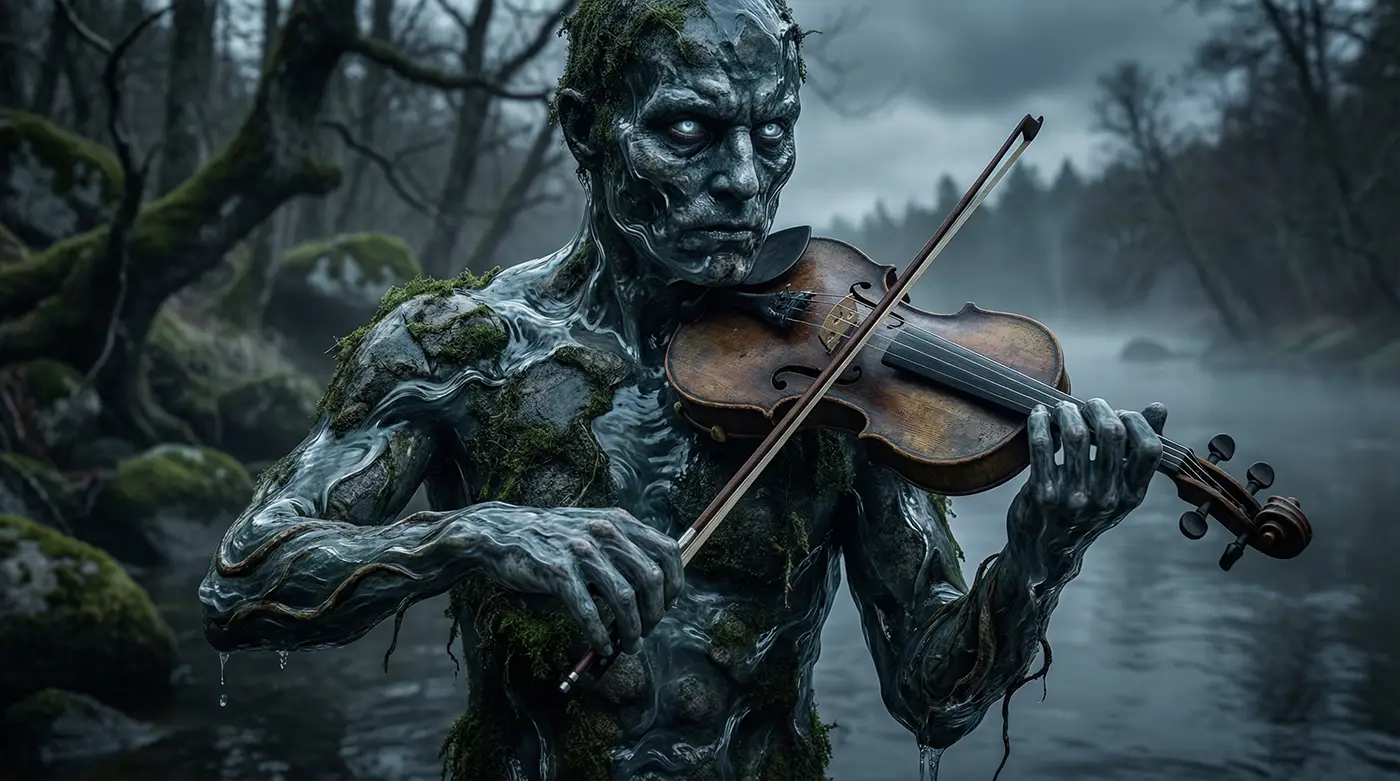
Näcken is a Scandinavian water spirit associated with enchanting music and shapeshifting. Its supernatural attraction makes it a useful comparison with beings whose appeal draws humans into dangerous encounters near water.
Both figures connect enchantment with an aquatic presence. Music is particularly characteristic of Näcken, whereas the familiar boto narrative emphasizes a stranger’s charm within a social gathering.
Religion/Ritual
Some boto stories unfold during June festivities honoring Santo Antônio, São João, and São Pedro. These Catholic celebrations provide a community setting for the supernatural encounter, rather than evidence of worship directed toward the boto.
The June setting belongs to particular tellings, not a universal calendar governing its appearances.
In certain accounts, the boto is an encantado associated with the Encante, an underwater realm. Encounters may bring illness or separation from ordinary human life, and a pajé, or healer, may attempt to recover the affected person.
Such narratives connect dolphin beliefs with healing and relations between human communities and supernatural beings, but do not establish a single ceremony or doctrine shared throughout Amazonia.
Atlas Noctis, a modern folklore synthesis, also reports food taboos associated with the boto and beliefs linking encounters with harm or illness. This offers limited evidence for regional prohibitions, not a general rule binding all Amazonian communities.
The evidence available here does not establish prescribed offerings or a detailed ritual sequence.
Scientific or Rational Explanations
The real pink river dolphin, identified here as Inia geoffrensis, is a freshwater cetacean. Transformation into a human belongs to folklore, not documented zoology.
Keeping those categories separate allows the animal’s natural history and the supernatural figure’s cultural significance to be understood without confusing them.
The existence of a real animal gives the legend a recognizable environmental foundation. It does not, by itself, explain the development of the human disguise, festival encounter, or underwater realm.
Those elements require historical and cultural interpretation rather than conclusions drawn solely from dolphin biology.
One social interpretation emphasizes uncertain paternity. The supernatural father offers a narrative explanation where a human father is unknown, absent, or unacknowledged.
This helps explain one use of the tradition, but it does not prove that all boto stories originated to serve that purpose.
Accounts involving illness, disappearance, or removal to the Encante suggest a broader field of concerns. They can be interpreted as ways of expressing danger and disruption through relations with supernatural beings.
Such readings are analytical possibilities, not medical explanations or proof of particular historical events.
The tradition’s documented variation also argues against a single origin theory. Nineteenth-century attestations establish that relevant beliefs circulated by that period, not when they began.
Neither an exclusively Indigenous origin nor direct derivation from Greek beliefs can be treated as settled on the available evidence.
A careful explanation therefore distinguishes several questions: what the animal is, what storytellers recount, and how those narratives function socially. No single answer replaces the others.
The boto can be a real dolphin, a supernatural character, and a subject of cultural interpretation without those categories becoming interchangeable.
Modern Cultural References
Ele, o Boto, film (1986)
Walter Lima Jr.’s feature film adapts the Amazonian legend for cinema. It portrays the Boto as a supernatural man whose encounters with women develop the familiar seduction motif.
(redeglobo.globo.com)
Cidade Invisível, television series (2021)
Created by Carlos Saldanha, this Brazilian fantasy series brings folklore figures into a contemporary mystery.
The mysterious appearance of a pink river dolphin helps launch its supernatural investigation.
(about.netflix.com)
Lenda do boto, sculpture (2015)
Darlindo Oliveira’s balata sculpture belongs to the Museu de Folclore Edison Carneiro collection.
The work represents the boto legend through a tangible, three-dimensional interpretation of the folkloric subject.
(artsandculture.google.com)
Chapeuzinho Vermelho e o Boto-Cor-De-Rosa, children’s fiction (2020)
Cristina Agostinho and Ronaldo Simões Coelho relocate Little Red Riding Hood to the Amazon.
Illustrated by Walter Lara, their adaptation introduces the Boto into the protagonist’s journey.
(mazzaedicoes.com.br)
O Boto Cor-de-Rosa que Não é Mais Rosa, children’s fiction (2021)
Rosália Caldas Sanábio de Oliveira’s children’s story addresses threats to the Amazon biome.
Its Boto-centered perspective gives the dolphin character a narrative voice within an environmental story.
(editorabagai.com.br)
Lendas & Batalhas: Boto Cor de Rosa card, game (2020)
This card game incorporates Brazilian folklore figures into playable encounters and rules.
Its Boto Cor de Rosa card translates the legendary character into a distinct game element.
(lendasebatalhas.com.br)
Conclusion
The Boto Cor-de-Rosa belongs to a varied Amazonian tradition of encounters between human communities and supernatural river beings. As a boto-associated encantado, it crosses the boundary between animal and human worlds, most famously through the elegant stranger at a riverside gathering.
That familiar image remains important without defining every account. Stories involving the Encante, illness, abduction, or rescue reveal a broader narrative range, while the real pink river dolphin remains distinct from the transforming figure of folklore.
The tradition’s enduring force lies in the connections it draws among rivers, desire, danger, kinship, and the unseen. Its nineteenth-century documentary record does not settle its deeper origins, and no single explanation accounts for every local telling.
Contemporary film, television, sculpture, and children’s fiction demonstrate its continuing adaptability rather than a fixed canonical form. Understanding the Boto therefore means holding together its recognizable transformation motif, the differences among regional narratives, and the social consequences that stories can carry.
Further Reading
Mundo Educação, Mundoeducacao.uol.com
In a widely circulated version, an elegant man in white attends a riverside gathering, dances and charms a woman, then vanishes into the river before dawn. Some tellings.
(mundoeducacao.uol.com.br)
Atlas Noctis, Atlasnoctis
A variant summarized in a modern folklore synthesis describes an encantado taking a person into the underwater Encante; some versions include illness and a healer’s attempt to bring.
(atlasnoctis.com)
Cidade Invisível, about.netflix.com
television series 2021 Netflix’s official announcement identifies the mysterious appearance of a boto-cor-de-rosa as part of the Brazilian fantasy series.
(about.netflix.com)
Lenda do boto, artsandculture.google.com
sculpture 2015 A documented balata sculpture in the collection of the Museu de Folclore Edison Carneiro depicts the boto legend.
(artsandculture.google.com)
Cidade Invisível, “Queria muito que você estivesse aqui”, netflix.com
television episode 2021 The first episode centers on the mysterious appearance of a pink river dolphin, and the series portrays the Boto as a supernatural character.
(netflix.com)
Ele, o Boto, redeglobo.globo.com
film 1986 This feature film explicitly retells the Boto legend, portraying the supernatural figure as a man who seduces women.
(redeglobo.globo.com)
Chapeuzinho Vermelho e o Boto-Cor-De-Rosa, mazzaedicoes.com.br
published fiction 2020 A published children’s narrative reimagining Little Red Riding Hood in the Amazon, where the protagonist encounters a Boto Cor-de-Rosa.
(mazzaedicoes.com.br)
O Boto Cor-de-Rosa que Não é Mais Rosa, editorabagai.com.br
published fiction 2021 A children’s story told through the Boto’s perspective, giving the character a narrative role while addressing threats to the Amazon biome.
(editorabagai.com.br)