Introduction
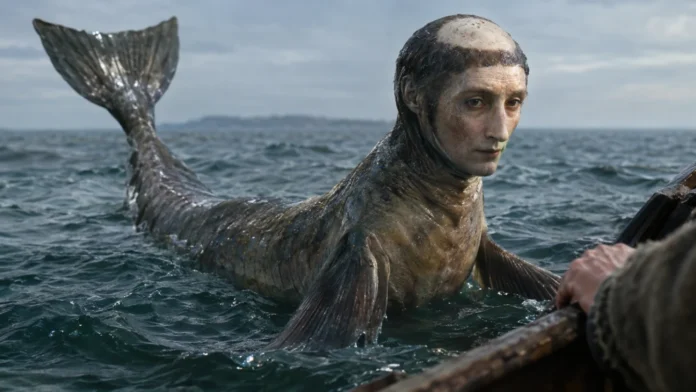
The Sea Monk is a monk-like marine monster recorded in medieval and Renaissance European natural history. Its defining feature is an uncanny resemblance to a religious figure, especially a tonsured monk, combined with the body or general character of a fish.
Two strands of its history need to remain distinct. Medieval writing describes a predatory creature that attracts people traveling at sea and then devours them.
A later, much-publicized report concerns an unidentified marine specimen associated with the Øresund, between Denmark and Sweden.
The Øresund creature became familiar through sixteenth-century descriptions and illustrations rather than a surviving specimen available for examination. Its appearance varied as reports circulated, and the naturalists who published those accounts did not provide firsthand confirmation of the animal they represented.
The Sea Monk therefore belongs both to sea-monster tradition and to the history of attempts to understand unfamiliar animals. Its documentary history is substantial, but that does not establish a real species behind it or make every account part of one consistent legend.
History/Origin
The tradition begins before the famous Danish-associated report. In their 2005 historical review, Charles Paxton and Robert Holland identify a reference to fish resembling monks in Alexander Neckam’s writing from the late twelfth or early thirteenth century.
This establishes a medieval background for the comparison.
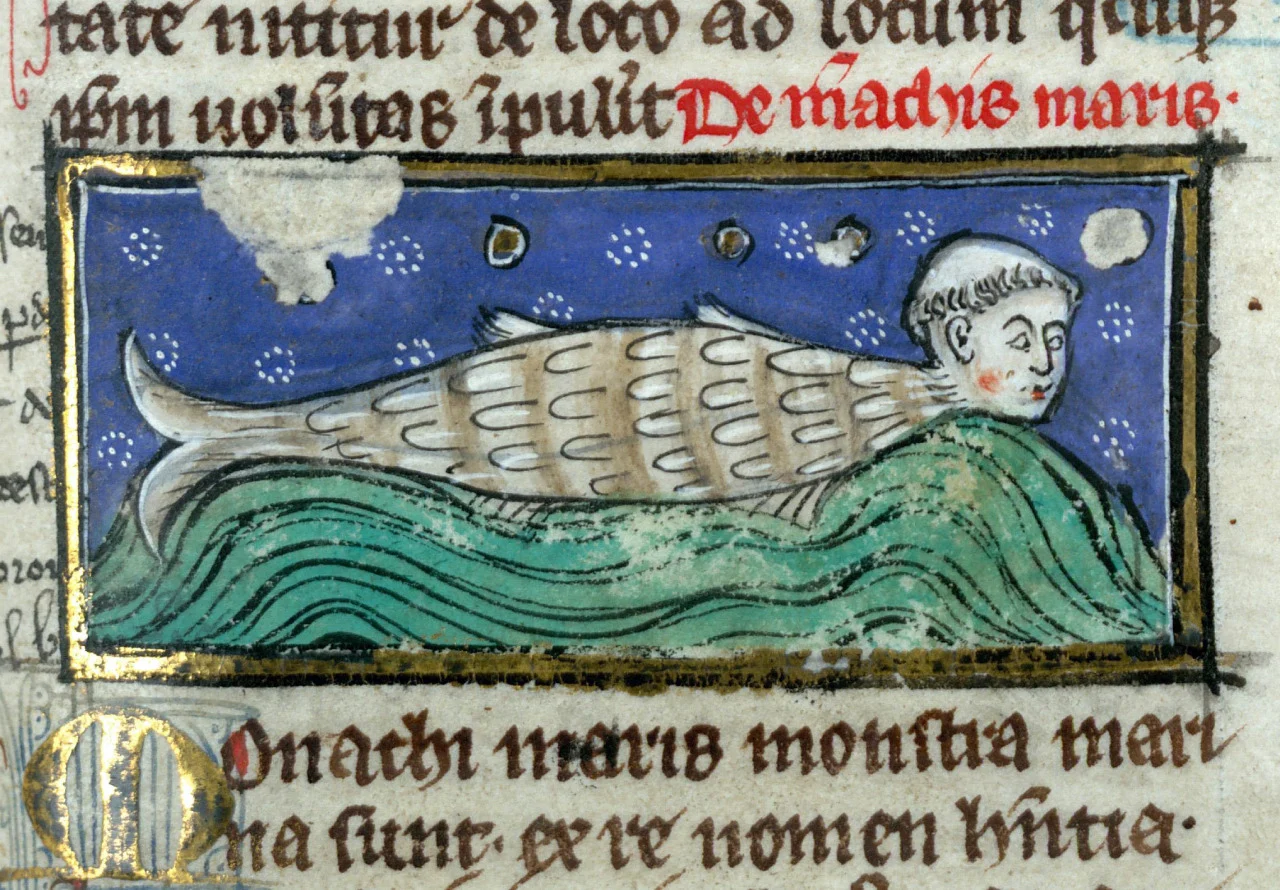
A fuller account appears in the thirteenth-century De Animalibus of Albertus Magnus. There, the monachus maris is a fish associated with British waters.
Its monk-like appearance accompanies dangerous behavior: it attracts seafarers, draws them underwater, and consumes them.
This medieval material matters geographically as well as chronologically. The Sea Monk was not originally an exclusively Danish creature, nor did its entire tradition begin with a Renaissance discovery.
British waters already provided a setting for a monk-like marine predator centuries before the Øresund report circulated.
The best-known later episode concerns a creature reportedly obtained in the Øresund. Paxton and Holland reconstruct its date as probably 1546, while acknowledging conflicting dates in the surviving accounts.
That year is a scholarly conclusion drawn from inconsistent evidence, not an undisputed date supplied by every early writer.
During the following decade, the creature entered the publications of European naturalists, including Pierre Belon, Guillaume Rondelet, and Conrad Gesner. Rondelet’s Libri de Piscibus Marinis, published in 1554, placed the Sea Monk within an illustrated treatment of marine life rather than a separate collection of fairy tales.
These publications helped establish the familiar Renaissance image, but publication did not resolve the original event. The accounts reviewed by Paxton and Holland are not firsthand.
The secure historical development is the circulation of a reported specimen through natural-history books, not the demonstrated discovery of a monk-shaped species.
Name Meaning
The Latin forms Monachus maris and Monachus marinus both mean “sea monk.” Their grammar differs slightly: maris means “of the sea,” while marinus means “marine.”
In either form, the name identifies the being through a comparison with a monk, not through a precise zoological classification.
Another descriptive expression, piscis monachi habitu, means a fish with the appearance or dress of a monk. The wording makes the comparison explicit.
What attracted attention was a marine creature’s supposed resemblance to familiar human clothing or bodily features, rather than evidence of an actual religious identity.
The tonsure was especially important to that resemblance. A pale area on the head, bordered by a darker ring, could suggest the shaved crown and surrounding hair associated with monks.
Other representations made the comparison through a cowled or robe-like outline.
The historical English form “monk-fish” belongs to this vocabulary of resemblance. It should not be treated as proof that the legendary being was identical to an animal carrying a similar common name today.
Shared names can preserve comparisons without establishing biological continuity.
Appearance
The most consistent feature is the combination of a monk-like head or upper outline with a fish-like marine body. Beyond that general arrangement, the tradition has no single fixed anatomy.
Medieval verbal descriptions and Renaissance pictures emphasize different features and should not be assembled into one supposedly authoritative portrait.
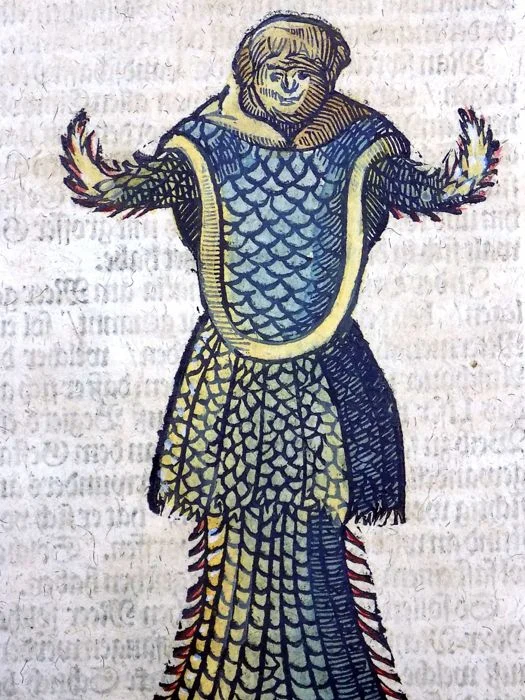 Illustration from 1669 of the “sea monk”, based on an original woodcut from 1558. This creature was possibly based on a specimen of giant squid (Architeuthis dux) or angelshark (Squatina squatina).
Woodcut from folio leaf (33 x 22.5 cm)., by Conrad Gessner. (Source · Public domain)
In the medieval description, the head bears a pale area surrounded by a dark ring, producing the impression of a tonsure. This is a visual resemblance within the creature’s body.
It does not require the being to wear an actual hood, robe, or other manufactured garment.
Renaissance representations of the Øresund creature make the resemblance more overtly human or clerical. A monk-like head rises above a body interpreted as fish-like, sometimes creating the impression of a figure dressed in aquatic clothing.
The image combines recognizable human features with an unfamiliar marine form.
The details nevertheless vary between illustrations and written accounts. The form and placement of fins, the outline of the head, and the shape of the lower body do not agree consistently.
These differences are central to the problem of identifying the reported specimen, rather than minor decorative variations.
A picture can document how the Sea Monk was imagined without accurately recording the anatomy of the animal behind a report. The surviving images therefore support a historical monk-like appearance, but not a confident reconstruction of the Øresund specimen.
Neither a giant squid nor an angelshark should replace that uncertainty as its established form.
Background Story
The Sea Monk’s background lies in the overlap between descriptions of animals and stories about the dangers of the sea. Its medieval form turns a familiar human appearance into a threat.
Something recognizable at the surface conceals a creature capable of pulling a traveler into an unfamiliar environment.
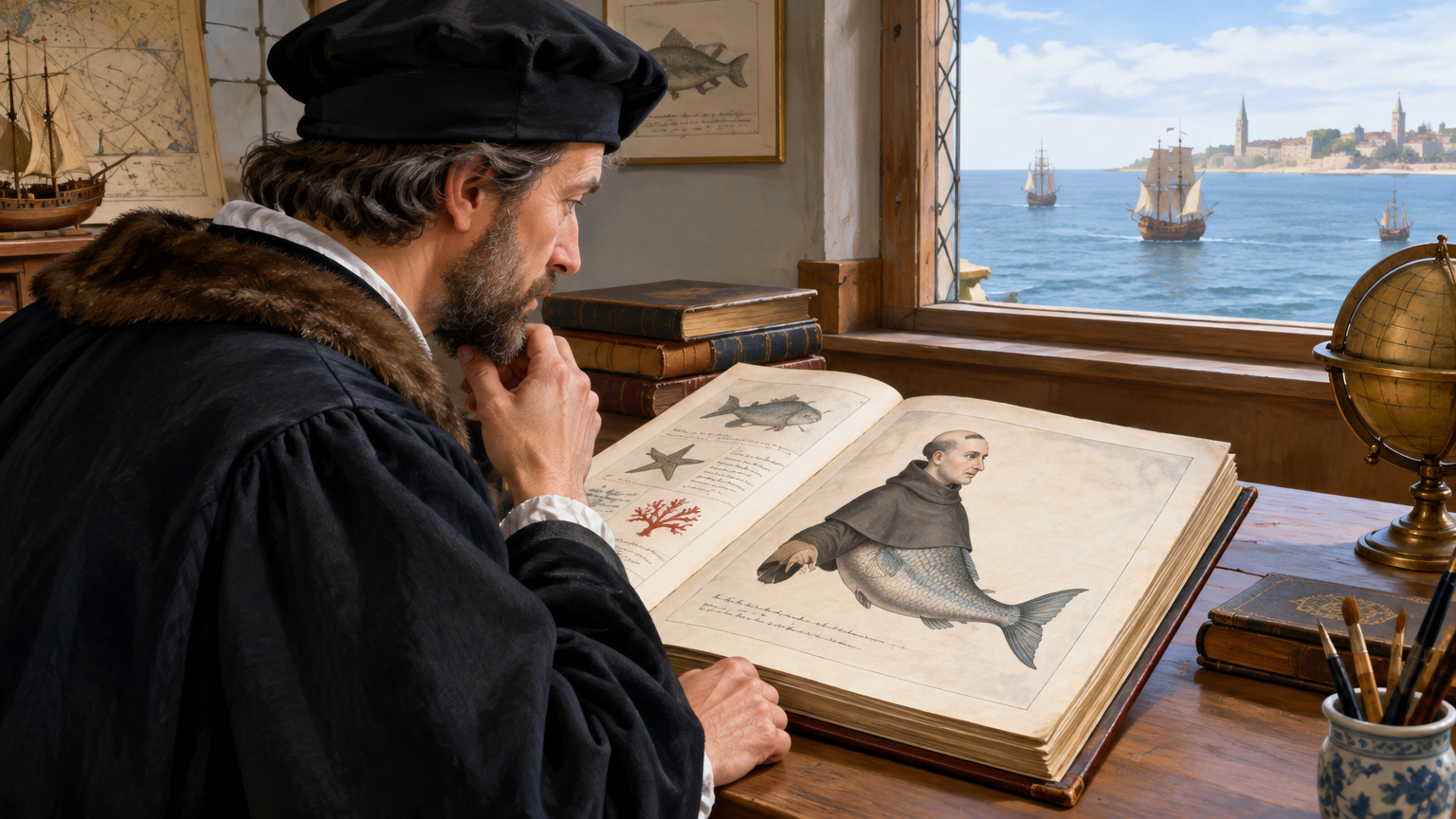
In the account preserved by Albertus Magnus, attraction precedes attack. The creature draws people toward it before taking them underwater and eating them.
This behavior belongs specifically to the medieval predatory account; it should not automatically be assigned to the reported sixteenth-century Øresund specimen.
The Renaissance episode developed in a different setting: the gathering, comparison, and publication of information about marine life. Reports of unusual animals could reach readers through descriptions and pictures even when the original specimen was unavailable.
The Sea Monk entered that process alongside creatures that naturalists could observe more securely.
Its placement in works such as Rondelet’s marine natural history is consequently important. The creature was presented as a claim about the natural world, not simply as a fictional character.
Familiar religious imagery supplied a vocabulary for describing an unfamiliar shape, while illustration gave that comparison a more definite visual form.
The related Sea Bishop shows that clerical resemblance extended beyond this one creature, although the two remained distinct figures. For the Sea Monk, the surviving background is therefore not a continuous personal biography.
It is a history of a medieval predatory motif and a later specimen report brought together by a memorable resemblance.
Famous Folklore Stories
The surviving narratives fall into two different categories: a medieval account of a dangerous monk-like fish and a Renaissance report about an unusual captured specimen. The headings below describe these documented episodes; neither is an authenticated traditional folktale title.
The Monk-Like Fish That Lures Seafarers
In Albertus Magnus’s thirteenth-century De Animalibus, the monachus maris inhabits British waters and threatens people traveling at sea. Its resemblance to a monk belongs to a predatory narrative: the creature attracts human attention before dragging its victims underwater and consuming them.
The episode combines an apparently recognizable human feature with lethal animal behavior. Unlike a story about a transformed monk, it presents the being as a fish.
No named victim, religious transgression, or personal history is needed to explain its attack.
This medieval account should not supply missing behavior for the later Danish specimen. The shared monk comparison connects the traditions, but the surviving evidence does not establish that the creature reported from the Øresund was credited with the same man-eating habits.
The Reported Specimen from the Øresund
The famous Øresund episode is a reported encounter and capture account, not a named traditional folktale. It concerns a marine specimen associated with the strait between Denmark and Sweden, whose appearance was interpreted as resembling a monk and circulated through Renaissance descriptions and illustrations.
Paxton and Holland reconstruct the event as probably occurring in 1546, while acknowledging conflicting dates. Their examination also establishes an important limitation: none of the historical accounts they review provides a firsthand description that securely identifies the animal behind the report.
Its narrative significance differs from the medieval episode. Here the central event is the discovery of an extraordinary-looking creature rather than an attack on travelers.
The report became influential through its publication, although its circulation did not resolve what had actually been caught.
Cultural Impact
The Sea Monk entered Renaissance natural history alongside recognizable marine animals. Its inclusion shows that reports of extraordinary creatures could belong within the same investigative project as descriptions of ordinary fish, rather than occupying an entirely separate category of fantasy or entertainment.
Guillaume Rondelet’s Libri de Piscibus Marinis, published in 1554, provides an important example of that setting. The Sea Monk’s appearance in an illustrated marine-life book gave the report a place within learned discussion, even though publication could not substitute for direct examination.
Illustrations made the clerical resemblance especially memorable. A reader could recognize a monk-like figure without understanding the animal’s anatomy.
Differences between surviving depictions also show why these images are evidence for historical representation, not interchangeable anatomical records of a single securely identified species.
The monk comparison brought familiar human society into an unfamiliar underwater setting. Alongside the separate Sea Bishop, it made the ocean appear capable of producing counterparts to recognizable religious figures.
This visual relationship does not demonstrate that either creature had an established religious function.
Modern interpretation also considers the report’s political setting. The Edward Worth Library raises a possible political dimension to the Danish episode, but that remains an interpretation of its context, not proof of deliberate fabrication or a complete explanation of the tradition’s earlier medieval forms.
Similar Beasts
Sea Bishop
The Sea Bishop is a separate clerical-looking marine monster represented in Renaissance natural history. Its recognizable religious appearance makes it the closest visual and historical comparison to the Sea Monk.
Both project familiar ecclesiastical forms onto marine creatures. Nevertheless, the Sea Bishop is not an alternative name for the Sea Monk, and their accounts should remain distinct.
Kraken
The Kraken is a giant sea monster associated with Scandinavian waters and the danger of ships being overwhelmed by something beneath them. Its defining emphasis is immense size and destructive power.
It shares the Sea Monk’s marine setting and later zoological scrutiny. The resemblance does not establish a common identity, even when squid explanations enter the discussion.
Mermaid

The Mermaid combines human and fish features in an aquatic body. Across different traditions, that recognizable hybrid form offers a way of imagining encounters between human beings and the unfamiliar world beneath the sea.
The comparison is primarily visual: both can possess a human-like upper appearance and fish-like lower body. The Sea Monk’s specifically clerical resemblance distinguishes its historical imagery.
Kelpie

The Kelpie is a shapeshifting water spirit from Scottish folklore, commonly appearing as a horse and luring victims into water. Its deceptive appearance turns an apparently approachable creature into a danger.
This parallels the medieval Sea Monk’s attraction and destruction of travelers. It does not imply that the Sea Monk shapeshifts or shares the Kelpie’s freshwater setting.
Religion/Ritual
No specific ritual, offering, taboo, or observance centered on the Sea Monk is established by the consulted evidence. Its religious name describes an appearance resembling a tonsured or cowled monk; it does not, by itself, identify a sacred being or an object of worship.
The medieval predator is likewise not securely presented as a monk transformed through punishment. Reading its appearance as evidence of a curse, demonic impersonation, or monastic moral lesson would add a religious narrative that the documented account does not establish.
Scientific or Rational Explanations
Zoological explanations principally address the reported Øresund specimen, not the entire medieval Sea Monk tradition. Identifying an animal that might have inspired a Renaissance illustration would not demonstrate that the earlier account of a human-eating, monk-like fish described the same species.
In the nineteenth century, the Danish zoologist Japetus Steenstrup proposed a giant squid as the explanation. This remains an influential historical hypothesis, but it requires interpreting the surviving descriptions and images as altered representations of a cephalopod rather than straightforward records of its anatomy.
Paxton and Holland challenged that interpretation in their 2005 specialist study, proposing the angelshark, Squatina squatina, as a more plausible candidate. Their preference is a comparative judgment about the available evidence, not a confirmed identification of the lost historical specimen.
The principal obstacle is the evidence itself. Descriptions and illustrations do not agree completely, and the reviewed reports are not firsthand examinations.
Features emphasized because they resembled a monk may be less useful diagnostically than anatomical details that were omitted, altered, or inconsistently represented.
A manufactured curiosity is another proposed explanation. Modified dried sharks, skates, or rays, often discussed under the name Jenny Haniver, demonstrate how marine remains could acquire monstrous appearances.
Their existence makes fabrication conceivable, but does not establish that the Øresund specimen was such an object.
The most defensible conclusion separates the reported specimen from its representation. An unfamiliar animal, an altered object, and distortion during transmission remain possible explanations.
The surviving material documents how Europeans understood and pictured the Sea Monk more securely than it identifies the creature behind the Danish report.
Modern Cultural References
Sea Monks, webcomic (2016)
Humon’s comic combines illustrations with discussion of the creatures’ reported behavior. Its drawings draw on historical depictions, bringing the Sea Monk’s unusual appearance into contemporary webcomics.
(humoncomics.com)
Sea Monk, digital artwork
Diana Nock’s standalone drawing presents the Sea Monk as a folkloric marine monster. Its identification with Zealand, Denmark, connects the artwork to the creature’s famous Danish association.
(diananock.artstation.com)
Bishop Fish/Sea Monk, podcast episode (2019)
Andy and Art discuss clerical marine monsters on Mr. Bunker’s Conspiracy Time Podcast.
The episode includes research into the Sea Monk, although its title combines distinct traditions.
(music.amazon.com)
04. Schnapps-Fueled Disaster Episode, podcast episode (2020)
This Cryptid Currency episode discusses unusual creatures through a contemporary cryptid-podcast format.
Its description specifically includes the Sea Monk alongside the Missouri Monster, documenting another modern discussion.
(music.amazon.com.br)
1001 Nights: Nifty Fifty, podcast episode (2024)
This Myths and Legends episode retells a story from the Arabian Nights.
It calls a creature a sea monk and gives it a Cthulhu-like portrayal, a creative reinterpretation.
(podcasts.apple.com)
The House in the Ocean, published fiction (2026)
Kris_West’s horror story features a marine threat confronting its characters.
The narrative explicitly names that creature the Sea Monk, placing the figure within a modern fictional setting.
(nightscribe.co)
Conclusion
The Sea Monk belongs to a European tradition in which unfamiliar marine life acquired disturbingly human features. Its medieval form was a predatory, monk-like fish; its best-known Renaissance manifestation was a reported specimen from the Øresund.
These strands share a name and visual resemblance, but they should not become one continuous biography. Their importance lies in the meeting of inherited stories, uncertain observation, and images that made an unfamiliar creature recognizable through the familiar appearance of a monk.
The surviving record establishes the tradition more securely than it establishes any animal behind it. Giant squid, angelshark, and manufactured curios remain proposed explanations, not settled identities.
Nor does the clerical resemblance establish worship or a ritual surrounding the creature. What endures is the unsettling combination of human appearance and marine strangeness, preserved first in natural-history writing and now in comics, artwork, podcasts, and fiction.
The Sea Monk remains culturally recognizable precisely because its memorable image outlasts the uncertainty of its origins.
Further Reading
Paxton and Holland, “Was Steenstrup right? A new interpretation of the 16th century Sea Monk of the Øresund”, Cryptozoologicalreferencelibrary.wordpress
In the medieval account quoted by Paxton and Holland from Albertus Magnus’s De Animalibus, a fish called monachus maris is said to appear in British waters, lure people.
(cryptozoologicalreferencelibrary.wordpress.com)
Sea Monk, diananock.artstation.com
digital artwork A standalone cryptid/folkloric-monster drawing explicitly identified as a Sea Monk associated with Zealand, Denmark.
(diananock.artstation.com)
Bishop Fish/Sea Monk, music.amazon.com
podcast episode 2019 A dedicated episode discusses the Bishop Fish/Sea Monk, with a segment presenting research into the creature.
(music.amazon.com)
04. Schnapps-Fueled Disaster Episode, music.amazon.com.br
podcast episode 2020 The episode description says the hosts discuss the Sea Monk alongside the Missouri Monster.
(music.amazon.com.br)
1001 Nights: Nifty Fifty, podcasts.apple.com
podcast episode 2024 The episode retells a 1001 Nights story and describes its creature as a sea monk, portraying it as a Cthulhu-like monster.
(podcasts.apple.com)
The House in the Ocean, nightscribe.co
published fiction 2026 This published horror story names the Sea Monk as the sea creature threatening the characters; the story also names their boat the Monk, so the.
(nightscribe.co)
Was Steenstrup right? A new interpretation of the 16th century Sea Monk of the Øresund, Steenstrupia / University of St Andrews Research Portal
Peer-reviewed specialist study reviewing early accounts, chronology, illustrations, and competing zoological explanations.
(research-portal.st-andrews.ac.uk)
Sea Monk, Edward Worth Library, Mythical Creatures
Discusses medieval references, Renaissance depictions, proposed natural explanations, and the possibility that the Danish report had a political context.
(mythicalcreatures.edwardworthlibrary.ie)