Introduction
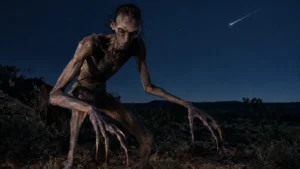
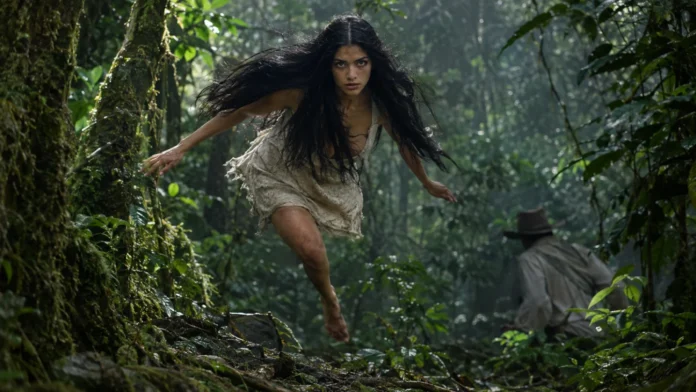
La Patasola is a dangerous, shape-shifting female being of Colombian folklore, associated especially with mountain forests. Detailed accounts from Tolima commonly represent her as a beautiful woman with one leg, although some allow her to appear in animal forms as well.
Her presence turns an encounter in the countryside into a threat. She may call from deep woodland, approach people, frighten children, or attack those who answer her cries.
In one collected narrative, she announces her dominion over the mountain and surrounding landscape.
The single leg is her most recognizable feature, but it does not belong to one universally accepted biography. Published traditions differ over her appearance, her victims, and whether she was once a human woman whose mutilation explains her later supernatural existence.
These differences make her more than a fixed monster with a standard origin. She belongs to a changing oral tradition in which wilderness, bodily transformation, danger, and protective speech take different forms.
Tolima’s collected accounts preserve that diversity particularly clearly.
History/Origin
The tradition’s beginnings cannot be dated precisely. The earliest printed collections identified in the available evidence are Cesáreo Rocha Castilla’s Prehistoria y folclor del Tolima, first published in 1959, and Misael Devia Morales’s Folclor tolimense, published in 1962.
Both record traditions rather than establish their first emergence.
Rocha Castilla’s material preserves more than one presentation of the being. An encounter attributed to Ricardo Rocha G. features Ñor Mica remembering a San Juan celebration interrupted by a beautiful, one-legged visitor.
A separate summary describes a witch-like figure capable of afflicting children.
Devia’s account supplies a different combination of elements: a predator inhabiting remote mountain forest, several possible bodily forms, and an origin involving a woman whose leg is severed and burned. This explanatory story should not be retroactively attached to every other recorded encounter.
The collections later reached readers through Eugenia Villa Posse’s Mitos y leyendas de Colombia, whose second volume reproduced the material in 1993. Their preservation together makes comparison possible without requiring the separate accounts to become episodes in a single continuous legend.
Later regional discussion preserves further alternatives. Alexander Prieto Osorno’s 2005 overview for Centro Virtual Cervantes includes a rebellious-daughter version involving a severed leg.
A contemporary Bogotá cultural summary instead recounts an unfaithful-wife version. Their differing family relationships materially change the meaning of the punishment.
Tolima therefore provides substantial documentation, not proof of an exclusive birthplace. Likewise, the dates of publication establish a recoverable written record, not the legend’s age.
The evidence does not justify assigning the entire tradition a definite pre-Columbian origin or one original plot.
Name Meaning
The Spanish name Patasola is commonly understood as “one-legged” or “single-footed.” It combines pata, a word used for an animal’s leg or foot and colloquially for a human limb, with sola, meaning “alone” or “single” in this construction.
The feminine article la accompanies the name in its familiar form, La Patasola. Written variants include Patasola and the separated Pata sola.
These spellings identify the same folkloric figure rather than establishing separate kinds of supernatural beings.
“One-legged woman” is a useful explanatory rendering, but it describes a recurring manifestation rather than translating a complete biography. The name itself does not say whether the limb was lost through violence, whether she was once human, or whether her condition needs an origin story.
That distinction matters because the collected traditions support different explanations and transformations. A severed leg belongs to particular narratives, while a single-legged appearance occurs without that explanation elsewhere.
The name remains recognizable even when an account allows her to assume a dog’s or cow’s form.
Appearance
The most representative human appearance is a beautiful woman with one visible leg. Beauty is explicit in the collected Tolima material, so an invariably hideous monster would misrepresent important versions.
Her extraordinary anatomy, rather than an ugly face, can reveal that an encounter is supernatural.

In Devia’s account, she advances by leaping on her single leg. This movement is an active part of her threatening presence, not evidence of helplessness.
The description gives the impossible body mobility, allowing the being to approach and attack within her mountain-forest setting.
Animal transformations are also documented in that account: she may appear as a large black dog with immense ears or as a large black cow. These are alternative manifestations of the Patasola, not accompanying animals, and should not be combined into a composite human-animal body.
Rocha Castilla’s material preserves another contrast. The San Juan encounter features a beautiful, one-legged woman, while a separate summary describes a blond, witch-like being.
Those details belong to distinct presentations; blond hair and a witch’s appearance are not necessary features of every Patasola.
A hoof-ending leg appears in the 2018 Colombian Sign Language adaptation produced by the Instituto Nacional para Sordos. It is a documented visual variant, but not a universal feature established by the earlier collections.
A representative description should therefore distinguish the recurrent single leg from its variable ending.
Background Story
The strongest background for the Patasola is the relationship between rural settlement and the surrounding mountain forest. In Devia’s account, her domain is remote woodland, contrasted with places marked by domestic animals, paths, and cultivation.
The landscape helps organize both the danger and the possibility of escape.
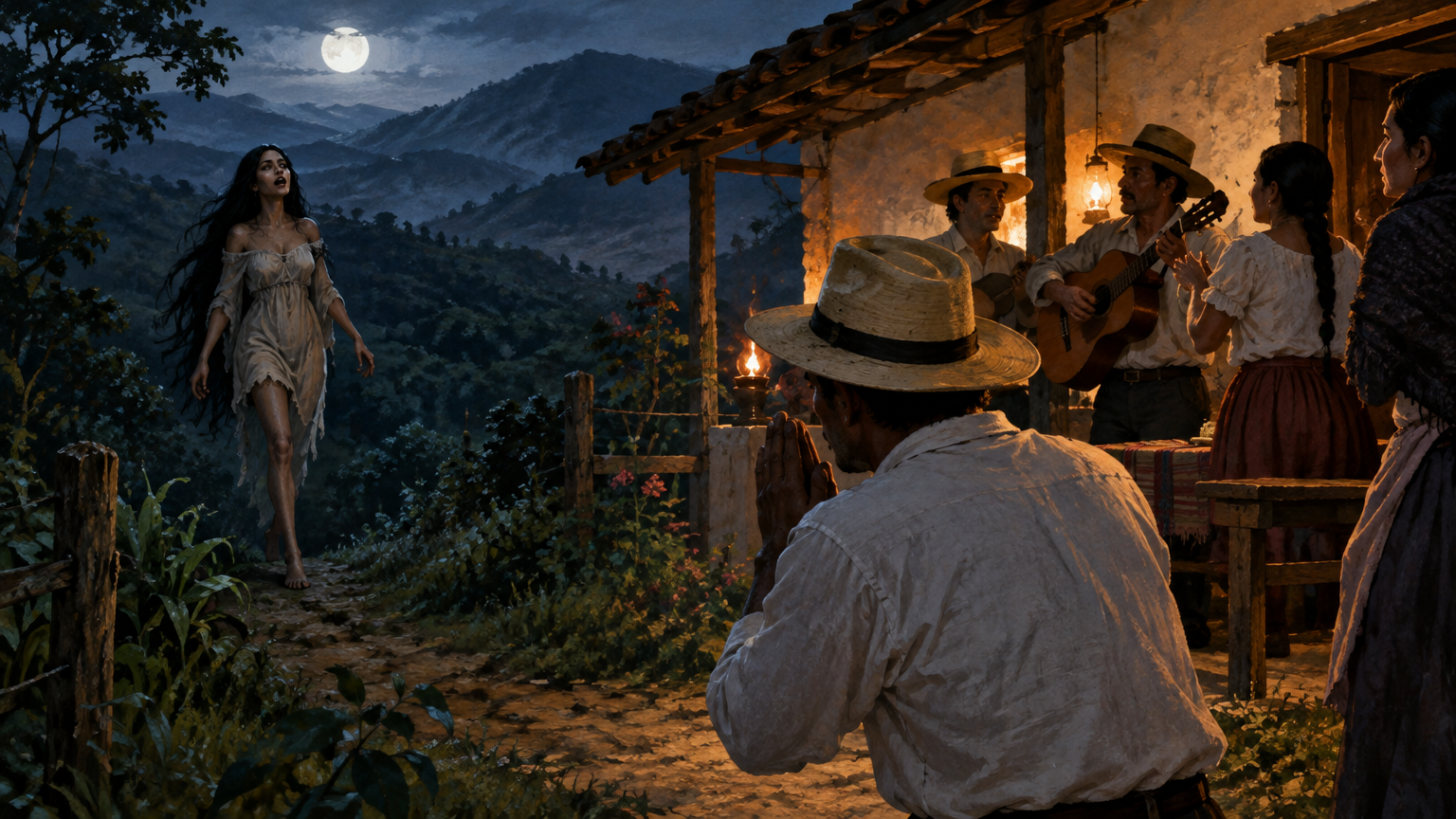
Sound makes that boundary especially threatening. A distant lament invites a human response, but answering draws the Patasola closer until an attack becomes possible.
Within this narrative, an apparently ordinary act of communication exposes the listener to a predator who may suck blood or devour the victim.
The San Juan encounter gives her a different relationship to place. She sings of the landscape as hers and approaches a house during a campesino celebration.
The episode brings a dangerous mountain presence close to communal life, while a protective prayer provides the means of resisting her approach.
Domestic authority supplies another context. Rocha Castilla’s separate summary connects her with frightening or afflicting disobedient children; mutilation stories instead connect her transformation with violence against a woman.
These versions support different readings of obedience and punishment, rather than one consistent moral lesson about female wrongdoing.
A 2022 study in the Journal of Analytical Psychology interprets the myth through feminine identity and exile. That is a modern interpretive approach, not proof of its historical origin.
It offers one way to examine the tension between a female figure’s exclusion and her frightening power beyond settled society.
Famous Folklore Stories
Collected Tolima narratives preserve distinct encounters with La Patasola rather than a single fixed storyline. The headings below describe documented episodes and motifs; they are editorial labels, not authenticated traditional tale titles.
Each account retains its own setting, dangers, and means of escape.
Ñor Mica’s San Juan encounter
In an encounter account preserved by Cesáreo Rocha Castilla and attributed to Ricardo Rocha G., Ñor Mica remembers a San Juan celebration interrupted by a supernatural visitor. A beautiful, one-legged woman appears and approaches the house where the celebration is taking place.
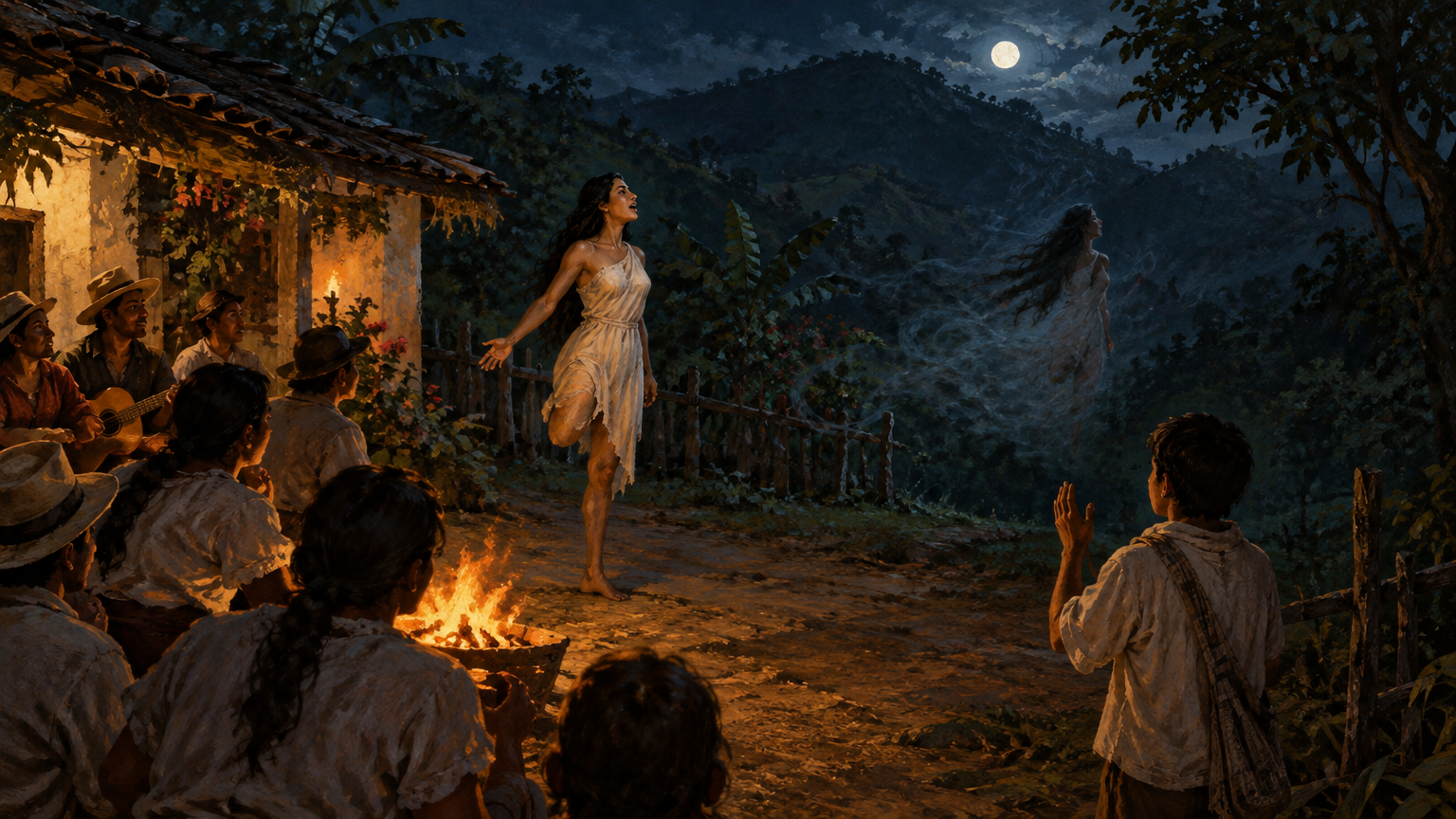
The Patasola sings of her dominion over the mountain and surrounding landscape. Her declaration makes the encounter more than an unexpected appearance: the countryside belongs to a dangerous presence whose authority extends beyond the forest.
The account does not require an explanation of her origins.
Juanito recites the protective oración del monte, after which the visitor disappears. The episode ends through remembered sacred speech rather than physical combat.
Although the collection has a publication history, the narrated encounter itself is undated and should not be assigned a historical year.
The forest cries and repeated replies
In Misael Devia Morales’s 1962 account, danger begins with a distant lament heard in the mountain forest. A person answers, and the cry comes nearer.
Repeated replies turn an apparently harmless exchange into an encounter with a predator that closes the distance.
The approaching being may appear as a beautiful one-legged woman, a large black dog, or a black cow. Her arrival can lead to an attack in which she sucks blood or devours the victim.
These transformations belong specifically to this collected version.
A protective prayer and escape among domestic animals offer possible defenses. The contrast between remote forest and inhabited surroundings is central to this encounter pattern.
Unlike Ñor Mica’s account, its narrative force comes from answering an unseen caller and thereby bringing danger closer.
Cultural Impact
La Patasola gives a recognizable supernatural form to the dangers of entering mountain forests. Her encounters organize the landscape into places of human familiarity and places where ordinary expectations fail.
A distant voice or attractive stranger can signal danger rather than companionship.
Her cultural role is not limited to threatening adult travelers. A separate summary in Rocha Castilla’s material associates her with frightening or afflicting disobedient children.
This version gives the figure a disciplinary function without making that function universal across the tradition.
Printed folklore collections helped preserve these differences while bringing regional narratives to wider readerships. Later overviews, including Alexander Prieto Osorno’s 2005 discussion, retain several forms and origin variants.
Their variety matters: the figure’s cultural continuity does not depend on an unchanged biography.
Contemporary heritage work also broadens access to the legend. INSOR’s 2018 Colombian Sign Language adaptation brings the narrative into a visual language, while Bogotá’s cultural institutions recognize La Patasola among Colombian oral-tradition figures.
These are documented forms of cultural transmission, not evidence of ancient practices.
Modern interpretation and entertainment reshape her significance in different ways. A 2022 analytical-psychology article examines feminine identity and exile, while the 2024 Colombian film La Patasola develops a revenge-centered story.
Both represent later engagements with the tradition rather than authoritative explanations of every earlier version.
Similar Beasts
Ghoul
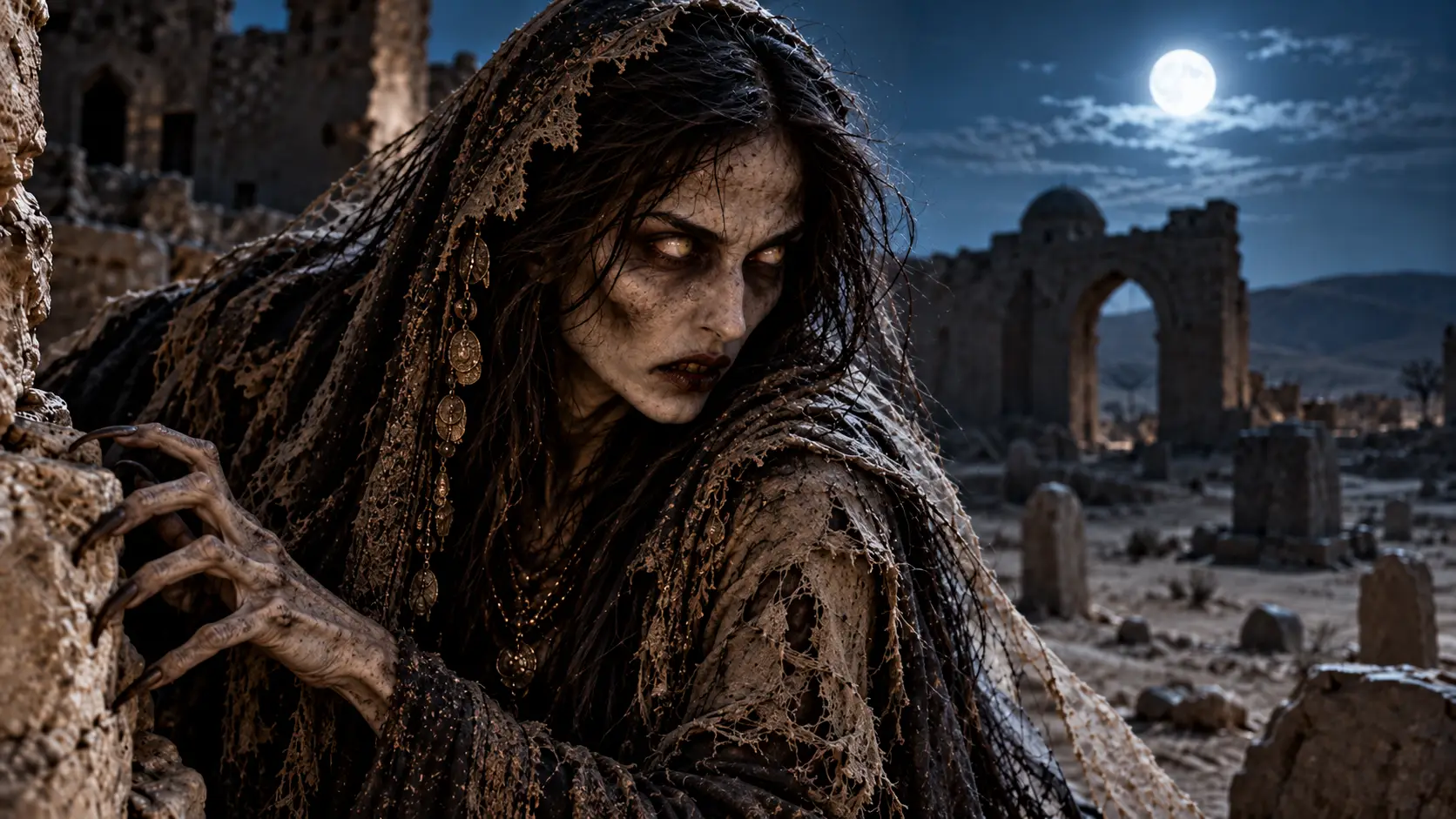
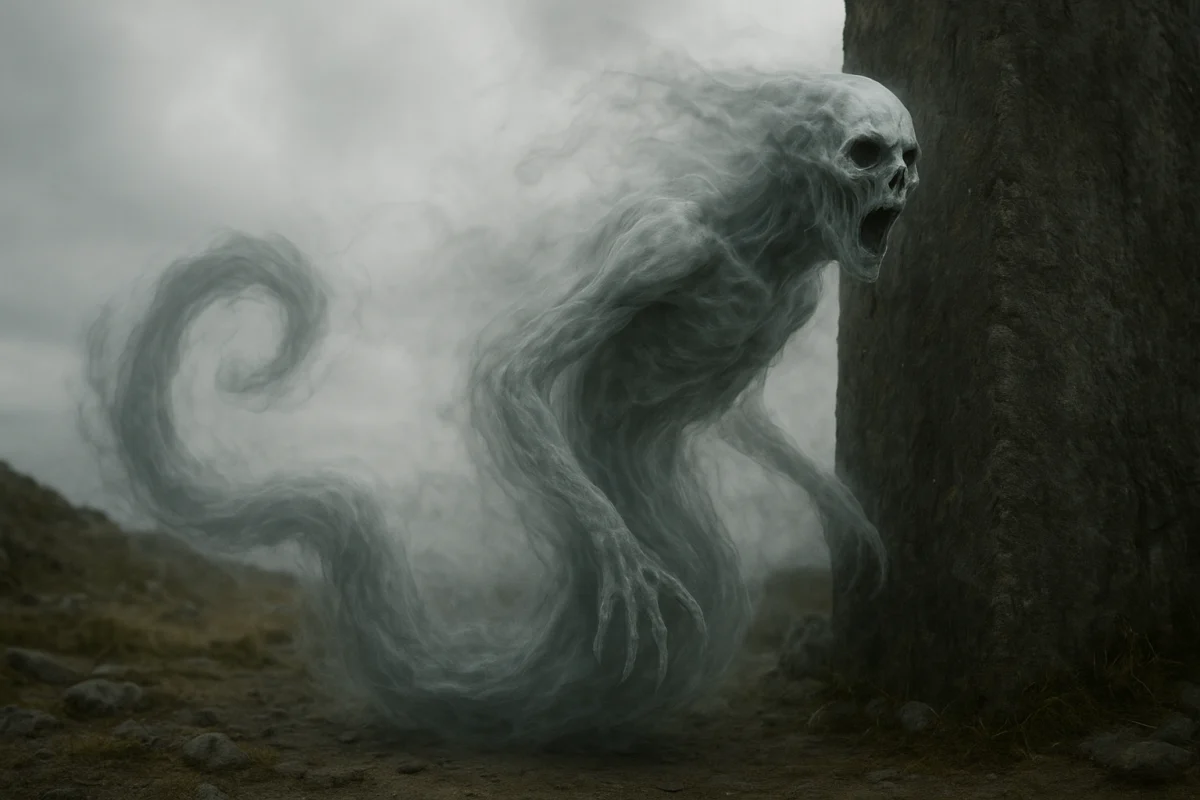
The ghoul of Arabic folklore is a supernatural danger associated with wilderness and isolated travelers. It may change shape, deceive people, and attack those it encounters.
Its strongest resemblance to La Patasola is the combination of remote habitat, deceptive appearances, and predation. This is a narrative parallel, not evidence of shared origins.
Kishi
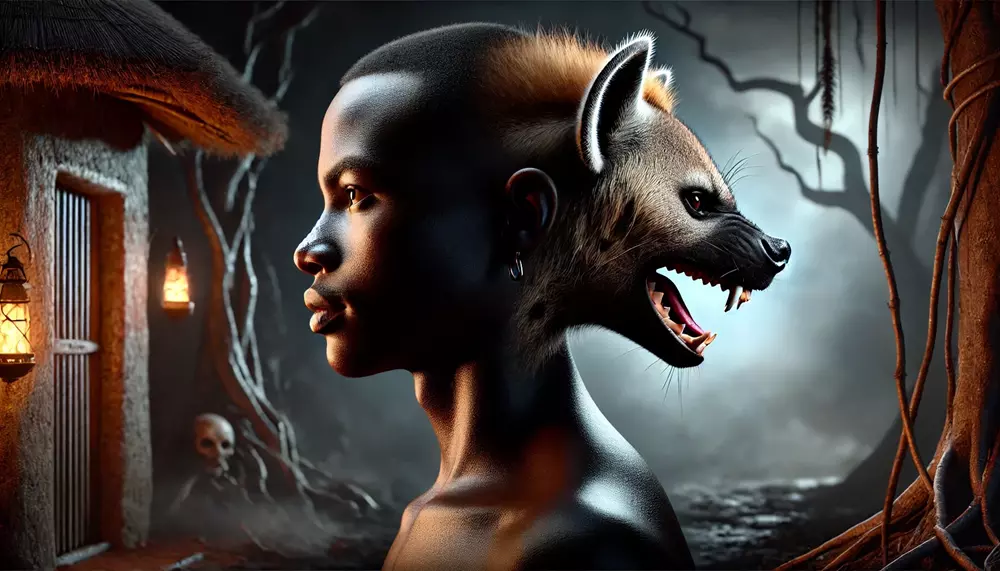
The Kishi of Angolan folklore presents a handsome human face while concealing a hyena visage behind it. Its charm attracts victims who face its devouring jaws.
Like the beautiful Patasola in predatory encounters, the Kishi makes attraction dangerous. Its two-faced anatomy, however, differs from her one-legged form and recorded animal transformations.
La Llorona

La Llorona is a ghostly woman associated with Mexican folklore, wandering near rivers and weeping for lost children. Her lament and dangerous encounters make her widely recognizable.
Her cries invite comparison with the Patasola’s forest lament. Their settings and narratives remain distinct, and the Patasola’s collected encounters do not universally involve lost motherhood.
La Muelona
La Muelona appears in Devia’s collection as a beautiful woman with enormous dentition who pursues and devours men. She is explicitly distinguished from the Patasola there.
Both figures combine feminine beauty with predatory danger. Their comparison is especially useful because it occurs within collected regional material, without treating them as interchangeable beings.
Religion/Ritual
Protective speech is directly documented in the Tolima accounts. In Ñor Mica’s encounter, the oración del monte drives the Patasola away.
Its effectiveness belongs to the narrated event; the record does not establish that every community used the same prayer.
Fear itself can threaten this defense because a frightened person may forget the necessary words. Remembering and speaking the prayer therefore becomes part of surviving the encounter.
The danger is answered through a learned verbal response rather than through an organized ceremony.
Devia’s version preserves another defensive utterance invoking an axe, corn cobs, and fire. These objects relate to that account’s story of amputation and burning.
The formula should remain attached to its particular narrative, not be presented as a universal Patasola invocation.
The San Juan celebration supplies a religious-calendar setting for one encounter, but it does not demonstrate a festival dedicated to the Patasola. The documented material concerns protection against a threatening being, not an established cult, priesthood, offering system, or formal communal worship.
Scientific or Rational Explanations
The available evidence establishes La Patasola as a documented folkloric being, not a scientifically verified organism. Collected testimonies reveal how encounters were narrated and understood.
They do not independently establish the physical existence of a one-legged woman capable of transforming into animals.
A social interpretation can examine how the stories distinguish dangerous forest from familiar inhabited space. In Devia’s account, domestic animals are associated with possible escape.
This contrast supports a reading about boundaries and security, but does not prove why the tradition first developed.
The child-frightening variant likewise permits an interpretation centered on behavioral instruction. A supernatural threat can give force to warnings about disobedience.
That reading fits the particular summary in which children are targeted; it cannot explain every encounter or replace the tradition’s other functions.
Psychological readings address symbolism rather than zoological identification. The 2022 study of feminine identity and exile offers a modern interpretive approach to the Patasola.
Such analysis may illuminate contemporary meanings, but it is not evidence that earlier storytellers consciously intended the same psychological framework.
Variation also limits any single rational explanation. A territorial visitor repelled by prayer, a shape-shifting forest predator, and a threat to children present different narrative problems.
Explaining them all as one misidentified animal or one historical incident would go beyond the available evidence.
Modern Cultural References
La patasola leyenda colombiana en LSC, Colombian Sign Language video adaptation (2018)
INSOR presents this adaptation of a Colombian legend in Colombian Sign Language. It portrays La Patasola as a beautiful, one-legged woman, bringing the story to Deaf audiences.
(bibliotecadigitaldebogota.gov.co)
Lola y la Patasola, short film (2013)
Directed by Harold Feria, this Colombian fiction short runs for 25 minutes. It reworks the Patasola legend within a contemporary narrative rather than presenting a collected encounter.
(cinecorto.co)
The Curse of La Patasola, horror film (2022)
AJ Jones directs a horror feature about two couples haunted by a supernatural presence. La Patasola becomes the central threat in a fictional adaptation of the legend.
(tv.apple.com)
La Patasola, horror feature film (2024)
Harold Trompetero and Paul Cataño direct this Colombian horror feature. Its Patasola pursues revenge connected to the loss of her son and leg, creatively reshaping traditional motifs.
(proimagenescolombia.com)
Conclusion
La Patasola is best understood as a dangerous female being of Colombia’s mountain forests, frequently recognizable by her single leg but never confined to one appearance or biography. The collected Tolima accounts preserve meaningful differences: a threatening forest predator, a beautiful visitor who claims the landscape, and a figure associated with fear and protective prayer.
Reading these versions alongside one another reveals a varied storytelling tradition, rather than fragments that must be assembled into a single supposedly definitive origin story.
Her symbolic force lies in the uneasy boundary between familiar human surroundings and a wilderness where appearances, voices, and ordinary expectations become unreliable. Beauty can conceal danger, while an encounter can test a person’s knowledge of protective words.
Modern films and accessible storytelling adaptations extend her cultural presence without replacing those regional records. Her continuing relevance rests both on that capacity for reinvention and on the distinctive Colombian traditions that give the figure her historical depth and local meaning.
Further Reading
Cesáreo Rocha Castilla, Prehistoria y folclor del Tolima, reproduced in Mitos y leyendas de Colombia, tomo II, Flacso.edu
In the account attributed to Ricardo Rocha G., Ñor Mica recalls that during a San Juan celebration a beautiful, one-legged Patasola appeared, sang of her dominion over the.
(flacso.edu.ec)
La patasola leyenda colombiana en LSC, bibliotecadigitaldebogota.gov.co
Colombian Sign Language video adaptation 2018 A specific institutional adaptation of the legend into Colombian Sign Language; the library record describes its central figure as a beautiful one-legged.
(bibliotecadigitaldebogota.gov.co)
La Patasola, proimagenescolombia.com
Feature film 2024 A Colombian horror feature that reimagines the figure as a vengeful being linked to the loss of her son and leg and to punishment of.
(proimagenescolombia.com)
The Curse of La Patasola, tv.apple.com
film 2022 A feature horror film whose plot centers on two couples haunted by La Patasola; the creature is also credited as a character/voice role.
(tv.apple.com)
La Patasola, tv.apple.com
film 2024 Colombian fiction-horror feature portraying La Patasola as the vengeful spirit at the center of the story; its theatrical release is recorded for November 7, 2024, and.
(tv.apple.com)
LA PATASOLA: From Beauty to Beast – The One-Legged Vampire of Columbia’s Jungle, podcasts.apple.com
podcast episode 2020 A dedicated episode segment about La Patasola, with a chapter timestamp and an episode page confirming it originally aired in July 2020.
(podcasts.apple.com)
“Bestiario latinoamericano (III). La Patasola”, Centro Virtual Cervantes
A Spanish-language regional folklore overview that discusses the Patasola’s forms, narrative variants, and Colombian context.
(cvc.cervantes.es)
“La Patasola del Tolima: formas y versiones”, Mitos de Colombia
Compares the Devia and Rocha Castilla records with other regional references and identifies where later retellings depart from collected accounts.
(mitosdecolombia.com)