Introduction
Chinawezi is a primordial female serpent in Lunda mythology, best documented in a creation narrative from the Kahemba region of Central Africa. Identified in that account as Chinaweshi or Tianza Ngombe, she governs the earth and its waters and is called the “mother of all things.”
Her counterpart is Nzashi, the lightning figure and her husband. Their division of the world establishes complementary domains: the serpent receives the earth and rivers, while Nzashi rules the sky and supplies beneficial rain.
Together, they connect terrestrial waters with the weather above.
Chinawezi also belongs to a genealogy that leads toward Lueji, a central figure in Lunda royal-origin traditions. Her significance therefore extends beyond explaining natural phenomena: the account connects the beginnings of the inhabited world with the ancestry of political authority.
The clearest baseline is this specifically Lunda mother-serpent, not a universal African water monster. Neighboring Chokwe traditions preserve related creator-serpents, but their names and genealogies differ.
Those parallels illuminate a regional mythological setting without making every serpent figure an interchangeable identity.
History/Origin
The strongest detailed account comes from a Lunda narrative collected by Roelandts in the Kahemba region and discussed by anthropologist Luc de Heusch in The Drunken King or the Origin of the State. It identifies the primordial serpent as Tianza Ngombe, or Chinaweshi.
This collected version supplies the relationships that distinguish her from other African serpentine beings.
De Heusch’s study first appeared in French in 1972, with an English edition published in 1982. These dates establish stages in the scholarly transmission of the account, not the beginning of the tradition.
Its original age cannot be established from the available documentation.
The narrative belongs to a setting in which cosmology and royal ancestry intersect. Its sequence moves from the primordial division of earth and sky toward descendants associated with Lueji.
Rather than presenting creation and political origins as unrelated subjects, it places them within a continuous chain of relationships.
That structure matters when interpreting the serpent’s antiquity. She is primordial within the story: her place precedes the ancestral figures through whom the narrative approaches human society.
This narrative position does not provide a calendar date for the tradition itself, but it explains why she carries authority as an originating mother.
Related Chokwe narratives contain creator-serpent figures named Yanvwa Ngombo and Chianza Ngombe. The specialist study The Disciple and Sorcery: The Lunda-Chokwe View preserves these comparisons alongside differing genealogical details.
They demonstrate regional variation rather than a single account repeated unchanged under different spellings.
The resemblance between these traditions is meaningful, but the differences are equally informative. A serpent’s name, descendants, and place in an origin sequence together establish its narrative identity.
Combining selected details from several versions would produce a fuller-looking story, but not a faithfully documented one.
Later reference works often compress this setting into a short description of a cosmic serpent ruling earth and water. Broader labels such as Luba-Lunda can obscure distinctions: the Luba figure Nkongolo, although relevant to regional comparisons, should not be treated as another name for Chinawezi.
The name also circulated in a 1998 Yale-New Haven Teachers Institute teaching unit on animal creatures and creation. That educational reception shows its movement into comparative mythology, while the collected Kahemba narrative provides the more detailed foundation for her identity and relationships.
Name Meaning
Chinawezi, Chinaweji, Chinaweshi, and Chinaweezi are written forms associated with this serpent figure in scholarship and later summaries. The detailed Kahemba account uses Tianza Ngombe alongside Chinaweshi, making that pairing especially important for understanding the identity behind the Chinawezi spelling.
A secure literal translation of these names is not established by the available evidence. The description “mother of all things” expresses the serpent’s primordial and genealogical role; it should not automatically be presented as the linguistic meaning of Chinawezi or Tianza Ngombe.
Similar-looking names in neighboring traditions require additional care. Chianza Ngombe and Yanvwa Ngombo occur in related Chokwe material, but resemblance alone cannot establish complete equivalence.
Their narrative setting and descendants matter as much as spelling when distinguishing one version from another.
Naming and translation therefore remain separate questions. Chinawezi is a reference spelling associated with Chinaweshi, while Tianza Ngombe is explicitly connected with her in the Kahemba account.
Claims about particular word roots or literal meanings remain uncertain.
Appearance
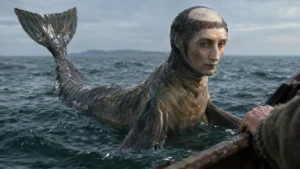
Chinawezi’s supported bodily form is that of a serpent. In the Kahemba narrative she is female, primordial, and maternal, but these qualities do not turn her into a human-serpent hybrid.
Her identity rests on serpentine form, cosmic authority, and ancestry rather than an elaborate physical description.
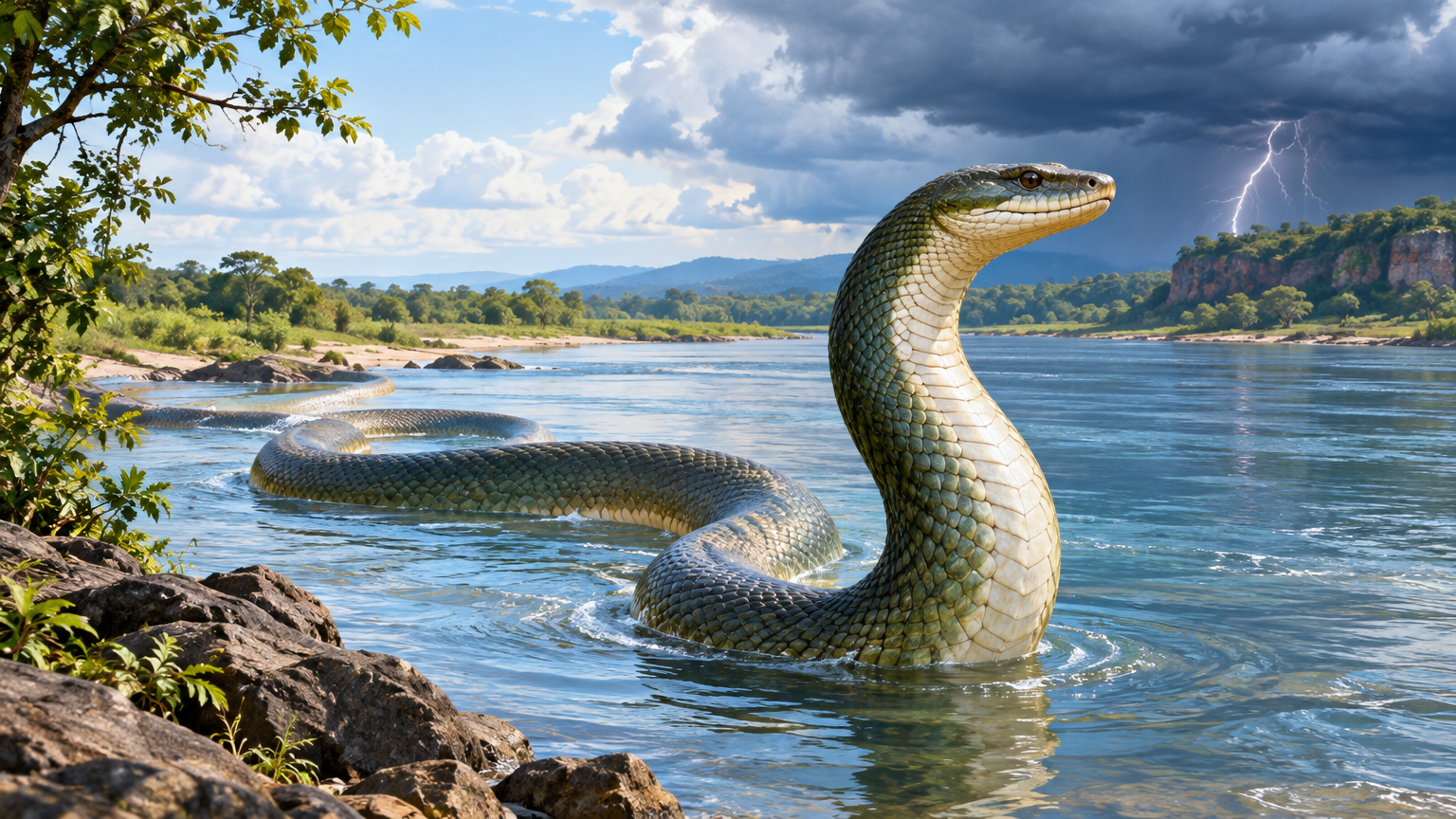
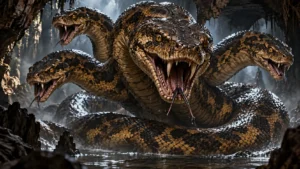
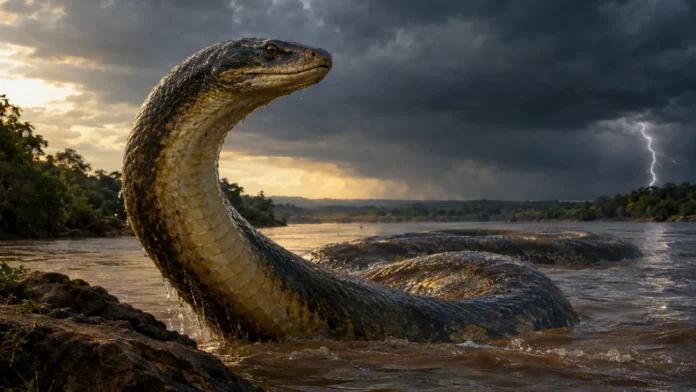
The documented descriptions provide no consistent measurements, coloration, markings, or detailed anatomy. They do not establish horns, wings, multiple heads, or a human torso.
Calling her a cosmic serpent describes her place in the world’s beginnings, not a precisely documented size or body pattern.
Earth and rivers provide her defining setting. These associations distinguish her from Nzashi, whose sphere includes the sky and rain.
The contrast is primarily cosmological: the account identifies which parts of the world each governs rather than describing two beings through matching visual portraits.
Her association with terrestrial waters is also broader than residence in a single pool or stretch of river. In the division of the world, rivers belong to her domain collectively.
Reducing her to an animal inhabiting one location would diminish the scale of her role, even though the narrative supplies no numerical measure of her body.
Her maternal role is expressed through relationships rather than physical features. She bears children whose descendants connect the primordial world with Lunda royal ancestry.
A feminine human face or other anthropomorphic detail is therefore unnecessary to convey the identity preserved in the narrative.
A restrained illustration could place a serpent beside or within a river, emphasizing her terrestrial and aquatic domain. Storm clouds might suggest the relationship with Nzashi, but would not establish wings or other atmospheric features on her body.
Such a scene would remain an interpretation, not evidence for a traditional portrait, particular species, or fixed artistic convention.
Background Story
Chinawezi’s background is the relationship between cosmic order, water, and descent. In the Kahemba account, she and Nzashi divide the world between them.
He receives the sky, including the sun, moon, Venus, and stars; she receives the earth and its rivers.
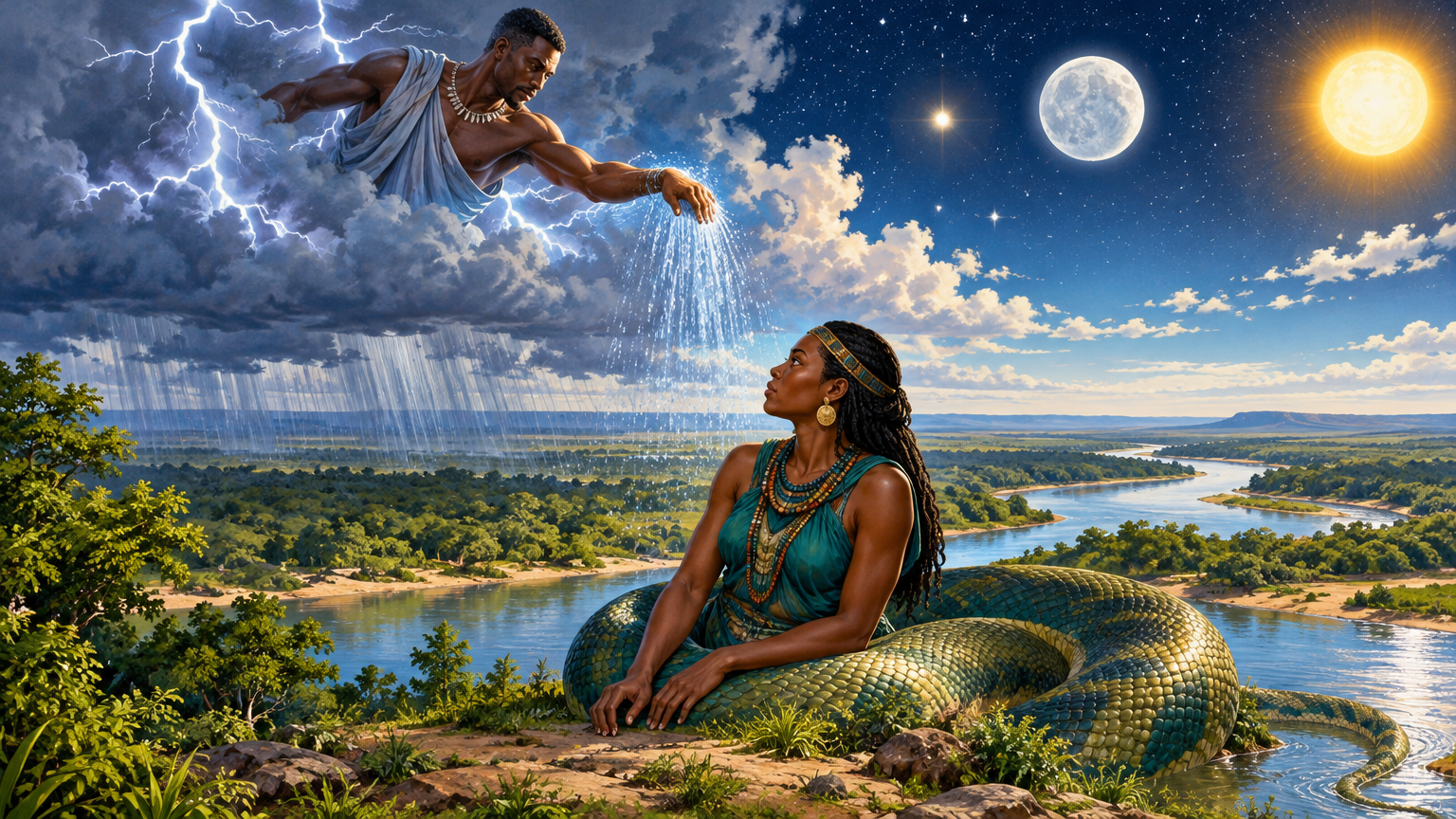
This division does not separate their powers completely. Nzashi’s urine becomes beneficial rain, while thunder is answered by swelling terrestrial waters.
Events overhead correspond with changes in rivers below, presenting weather and flowing water as connected expressions of primordial relationships.
The rain’s description is significant because the substance is explicitly beneficial. The episode should not be recast as the contamination of the serpent’s waters or an attack upon her territory.
Its emphasis is the relationship between the heavenly and earthly domains, not a battle between rival monsters.
The serpent’s motherhood extends this connection into genealogy. She bears Konde and Naweshi, whose union produces children including Lueji.
The movement from cosmic parents to later descendants gives the narrative a structure in which the origins of nature and the origins of a ruling lineage belong together.
Lueji later encounters the hunter Chibinda Ilunga at the confluence of two rivers. Water therefore remains present as the narrative moves toward royal origins.
The meeting connects the descendants of the primordial serpent with a figure central to Lunda traditions of political ancestry.
The confluence is a documented setting, but it need not be embellished with a submerged palace, a serpent apparition, or a supernatural trial. Chinawezi’s relationship to the later meeting is genealogical.
The account does not require her to emerge physically before the hunter for her ancestral importance to remain active.
This makes Chinawezi more than an isolated river monster or an adversary awaiting defeat. Her principal role is foundational: she holds a domain of the world and stands within an ancestral sequence.
The preserved account emphasizes relationships and origins rather than confrontation with a hero.
Related Chokwe creator-serpent narratives place this account within a wider regional field of ideas about beginnings and descent. Shared imagery supports comparison, but it does not establish a single original version or a demonstrable direction of borrowing between traditions.
Famous Folklore Stories
The clearest documented narrative is the Kahemba Lunda account recorded by Roelandts and presented in Luc de Heusch’s scholarship. Its episodes connect cosmic order with royal ancestry.
The headings below are editorial descriptions, not authenticated traditional tale titles.
The division of earth and sky
The primordial mother-serpent, named Tianza Ngombe or Chinaweshi in this version, shares the world with her husband Nzashi, the lightning figure. Their division establishes complementary domains: terrestrial waters belong to her, while the heavens and rain belong to him.
The sky includes the sun, moon, Venus, and stars. Rain is represented as Nzashi’s urine, a beneficial substance rather than pollution.
When thunder sounds, the rivers swell in response, connecting the serpent’s earthly domain with her husband’s activity above.
This is not a monster-slaying episode or a warning about an animal lurking underwater. Its central action establishes relationships between natural powers.
Chinawezi’s serpentine identity belongs to an account of how the inhabited world is organized and sustained.
The serpent’s descendants and Lueji’s lineage
The mother-serpent bears Konde and Naweshi, whose union produces descendants including Lueji. This genealogy carries the narrative from primordial beings toward the ancestral world associated with Lunda kingship.
Cosmic origins and human descent therefore form parts of the same account.
Lueji later meets the hunter Chibinda Ilunga at the confluence of two rivers. The meeting connects the ancestral genealogy with a royal-origin narrative, while retaining water as its setting.
It is not a separate documented encounter between the hunter and Chinawezi herself.
Cultural Impact
Chinawezi’s historical significance lies partly in the connection between ancestry and the natural world. The lineage associated with Lueji reaches back to a primordial mother whose domain encompasses earth and rivers, placing human authority within a larger cosmological order.
Within this narrative structure, genealogy does more than list successive generations. It joins different levels of existence: primordial powers, ancestral figures, and the origins of sovereignty.
The serpent’s motherhood supplies continuity between these levels, giving her a role that a simple classification as “water monster” would miss.
Her relationship with Nzashi also makes the natural world relational rather than a collection of isolated forces. Rain, thunder, earth, and rivers have distinct places, but they remain connected.
The same account that distinguishes their domains brings them into an ancestral partnership.
Neighboring Chokwe origin narratives preserve related creator-serpent figures, including Yanvwa Ngombo and Chianza Ngombe. Their differing names and genealogies reveal regional connections without establishing one uniform serpent tradition.
These differences preserve culturally situated ways of linking origins, descent, and authority.
Modern comparative scholarship has used these narratives to examine relationships between cosmology and kingship. De Heusch’s interpretation places the serpent within a wider discussion of royal symbolism, rather than treating her as an isolated curiosity in a catalogue of fabulous animals.
Broader educational treatments, including the Yale-New Haven Teachers Institute’s 1998 survey of mythic animals, have circulated Chinawezi’s name beyond specialist scholarship. Such reception makes the figure accessible to wider audiences, although compressed comparisons can leave out the genealogical relationships that explain her particular importance.
Similar Beasts
Nyami Nyami

Nyami Nyami is a river deity in Tonga tradition, associated with the Zambezi. Common depictions combine a snake’s body with a fish’s head, expressing the river’s protective and destructive power.
The comparison rests on serpentine form and authority over water. Nyami Nyami remains a distinct Tonga figure, not evidence that Chinawezi belongs to Tonga tradition.
Inkanyamba

Inkanyamba is a great water serpent in Zulu folklore, associated with storms and whirlwinds. Its combination of aquatic presence and atmospheric power makes it a useful comparison within African serpent traditions.
Both figures connect water with storm phenomena. Chinawezi’s Kahemba narrative, however, distinguishes her terrestrial waters from Nzashi’s heavenly domain rather than assigning every weather power to her.
Rainbow Serpent
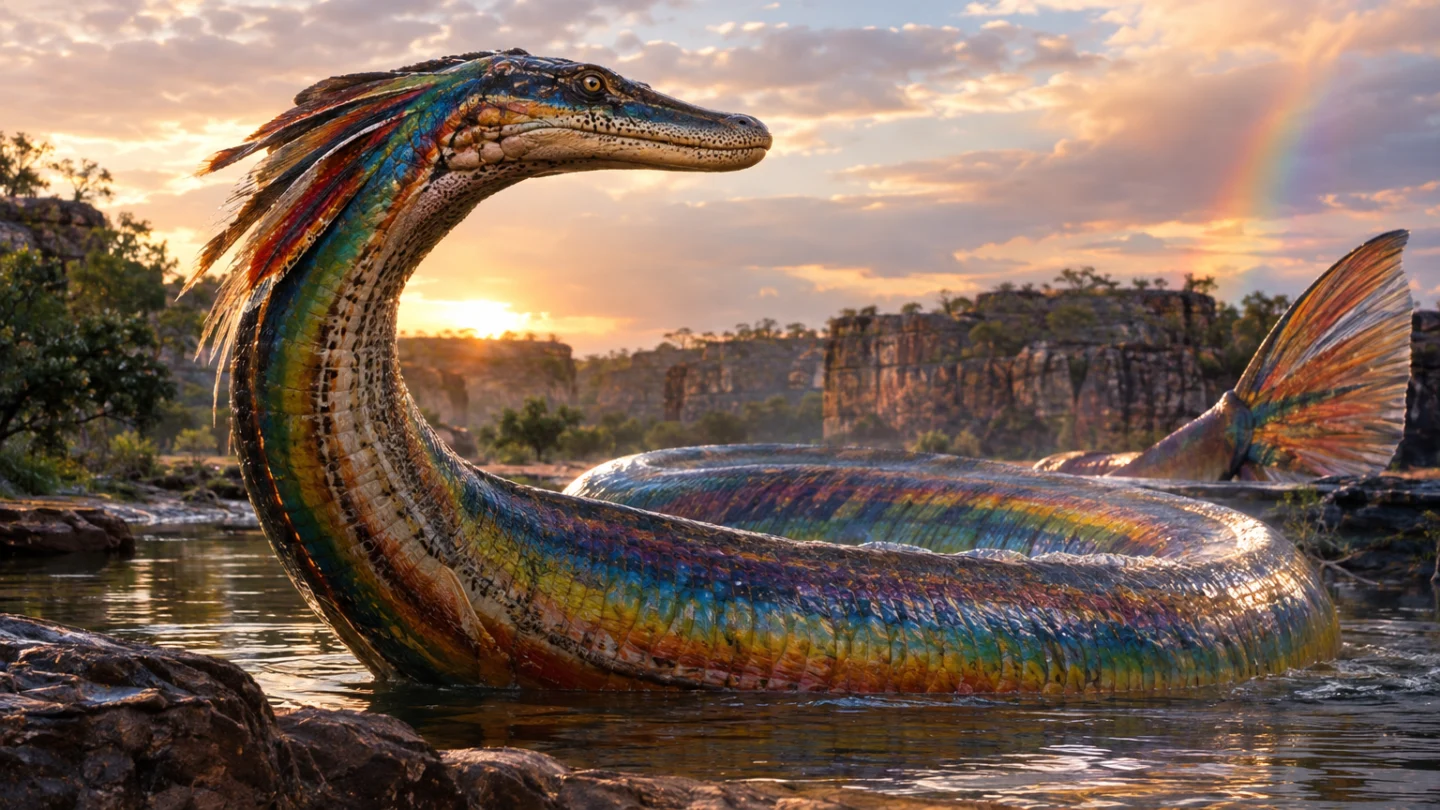
Rainbow Serpent traditions among Aboriginal Australian peoples connect powerful serpentine beings with water, fertility, and the shaping of landscapes. The term encompasses culturally distinct traditions rather than one universally identical figure.
The strongest parallel is cosmological: serpents help explain relationships between land, water, and life. This resemblance does not establish historical contact or a shared origin with Chinawezi.
Read more about Rainbow Serpent
Nkongolo
Nkongolo is a distinct Luba figure associated in specialist comparative discussion with the rainbow and aquatic serpent symbolism. His tradition provides a close regional comparison.
De Heusch compares the Luba and Lunda traditions through their symbolic relationships. That comparison does not make Nkongolo an alternative name for Chinawezi or erase their different narrative identities.
Religion/Ritual
The strongest ritual evidence concerns royal installation rather than a general household cult. In de Heusch’s interpretation of Lunda royal symbolism, the sovereign participates in the nature of the earth-associated serpent divinity named Chinaweezi.
This links kingship with a primordial power.
The term “chthonic,” used in this scholarly discussion, means associated with the earth or its depths. Here it helps distinguish the serpent’s domain from the celestial realm of lightning and rain.
It should not automatically be understood as meaning evil or demonic.
The relationship concerns the sovereign’s ritual identity, not a claim that the ruler literally becomes a zoological snake. It belongs to the symbolic connection between royal authority and the primordial world explored in de Heusch’s interpretation.
This evidence supports a historically reported connection between installation symbolism and the serpent. It does not establish a universal Lunda ceremony or demonstrate present-day practice.
The available material supplies no reliable basis for specifying offerings, prayers, sacred objects, or a ritual calendar.
Scientific or Rational Explanations
Chinawezi is best approached as a cosmological being rather than an unidentified animal. The documented narrative concerns the ordering of natural domains and ancestral descent, not observations from which a zoological species could be identified.
Cryptid explanations would therefore misclassify the evidence.
An environmental reading begins with the relationship between storms and rising rivers. Rainfall adds water to river systems through runoff and other processes; thunder accompanies storms but does not itself swell rivers.
The narrative expresses that relationship through interaction between personified cosmic powers.
The distinction between rain above and flowing water below gives the account an intelligible environmental structure. These are connected forms of water, yet they occupy different parts of the landscape and human experience.
Assigning them to related beings expresses both their separation and their dependence on one another.
This reading explains part of the story’s natural imagery, but not its entire meaning. The serpent also anchors a genealogy leading toward Lueji.
Reducing the account to an early explanation of rainfall would overlook ancestry and political authority, which are integral rather than incidental to its structure.
An anthropological interpretation can instead consider how cosmology and royal symbolism reinforce one another. De Heusch’s discussion connects the earth-associated serpent with sovereignty.
This is a scholarly reading of documented relationships, not proof that the narrative was deliberately invented to justify a particular ruler.
Nor does serpent imagery alone identify the animal species that inspired the tradition. Without descriptions of anatomy, behavior, or a particular observation, choosing a python or another snake would be speculation.
The mythic form can be recognized without converting it into a zoological identification.
Finally, the evidence has limits of transmission. The detailed Kahemba narrative reaches readers through a scholarly presentation of an earlier collection, while later summaries shorten it further.
Differences in names and genealogies may reflect regional or textual variation; they should not automatically be treated either as mistakes or as proof that every account describes the same being.
Modern Cultural References
The African Letter, Chinawezi, character
In this Harry Potter fanfiction, Chinawezi is a cosmic-serpent goddess whose name is given to narrator Nkuba Kabile’s younger sister.
The sister’s fascination with snakes is explicitly linked to her mythological namesake.
Source
Conclusion
Chinawezi is a primordial mother-serpent within the Lunda creation tradition documented for the Kahemba region. Associated in that account with the names Chinaweshi and Tianza Ngombe, she governs earth and terrestrial waters, while Nzashi governs the sky and rain.
Through the ancestry leading to Lueji, their cosmology joins the origins of the natural world to the origins of royal authority.
Her significance rests less on an elaborate physical description than on relationships between water, ancestry, and sovereignty. Related Chokwe narratives and comparisons with the Luba figure Nkongolo illuminate neighboring traditions without making their beings interchangeable.
Preserving those distinctions keeps Chinawezi rooted in the account that most clearly documents her.
Further Reading
Luc de Heusch, The Drunken King or the Origin of the State, Scribd
In the collected Lunda Kahemba account, Tianza Ngombe or Chinaweshi, the primordial mother-serpent, shares the world with Nzashi, the lightning.
He rules the sky and rain; she rules.
(scribd.com)
African Mythology A to Z, 2nd edition, PDF text hosted by The Cartwrights
Provides a concise reference summary identifying Chinawezi as the Lunda cosmic serpent governing earth and waters.
(calibre.thecartwrights.nz)