Introduction
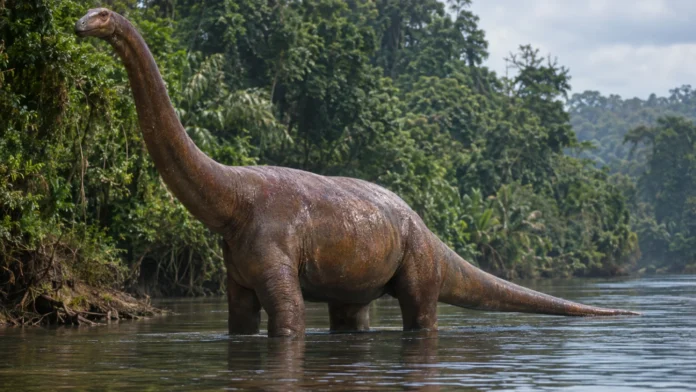
Mokele-mbembe is a feared, reportedly large river animal associated with the Congo Basin. Its best-preserved early description comes from local accounts collected during Captain von Stein zu Lausnitz’s 1913–14 expedition, particularly concerning the lower Ubangi and Sanga river region.
Those accounts described a smooth-skinned, grey-brown creature with a long, flexible neck and a body comparable in size to an elephant or hippopotamus. They survive through a quotation published in 1929, rather than through a verified zoological observation or an examined specimen.
The familiar identification as a surviving sauropod dinosaur belongs to the story’s later development. Modern retellings also emphasize the Likouala swamps and Lake Télé, whereas the early named account associated the animal principally with larger rivers and reportedly excluded the smaller Likualas.
Mokele-mbembe therefore matters both as a recorded riverine belief and as a subject of modern cryptozoology, the search for animals known chiefly through disputed reports. Its history shows how local testimony, expedition narratives, and prehistoric imagery can become intertwined without establishing a distinct animal species.
History/Origin
The beginnings of the local tradition cannot be securely dated. Its earliest recoverable named account concerns information gathered during the 1913–14 Likuala-Kongo expedition.
The date of collection establishes a historical reference point, not the age of the beliefs reported by informants.
A frequently cited predecessor appears in Liévin-Bonaventure Proyart’s 1776 account of Loango, Kakongo, and neighboring kingdoms. Missionaries reportedly encountered enormous claw-marked tracks beside a forest.
They did not see the animal, and the passage supplies neither the name Mokele-mbembe nor an identifying long-necked description.
That track report should not be treated as the first Mokele-mbembe sighting. Its connection to the later creature is retrospective and uncertain.
Combining the two creates an apparently continuous record that the surviving evidence does not actually demonstrate.
A separate influence came from animal dealer Carl Hagenbeck’s 1909 discussion of a supposed swamp monster in Rhodesia. He entertained a dinosaur interpretation of an animal characterized as partly elephant-like and partly dragon-like.
This report concerned another region and did not use the name Mokele-mbembe.
The earliest located printed use of the name appears in Wilhelm Bölsche’s 1929 book Drachen: Sage und Naturwissenschaft, quoting von Stein’s expedition report. The original manuscript has not been located, making Bölsche’s printed quotation the surviving basis for reconstructing that early account.
Later expeditions increasingly pursued a “living dinosaur” around Lake Télé. Herman Regusters’s report on his 1981 investigation documents this phase, while December 1981 reporting in Le Monde records the story’s prominence in Brazzaville.
Expedition claims and public attention helped consolidate the modern dinosaur-centered version.
Name Meaning
Mokele-mbembe is commonly translated as “one who stops the flow of rivers,” usually with the explanation that the expression comes from Lingala. This is a widely circulated interpretation, but its linguistic basis remains uncertain in the sources available for this account.
Herman Regusters’s report, published in 1982 after his 1981 expedition, records that gloss. It establishes that the translation circulated among investigators at that time; it does not, by itself, provide an independently verified analysis of the expression’s vocabulary or grammatical construction.
No confirming Lingala dictionary entry or detailed ethnographic explanation was identified in the reviewed source analysis. The responsible wording is therefore “commonly translated as,” rather than a categorical statement that the name literally means an animal capable of blocking a river.
Written forms include Mokèlé-mbèmbé, Mokéle-mbêmbe, and the unaccented Mokele Mbembe. Their differing accents and hyphenation should not be treated as evidence of separate creatures.
Nor can the familiar English translation establish a traditional power, behavior, or story absent from the recorded accounts.
Appearance
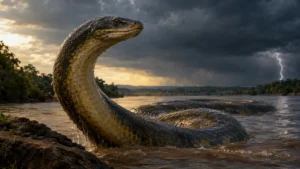
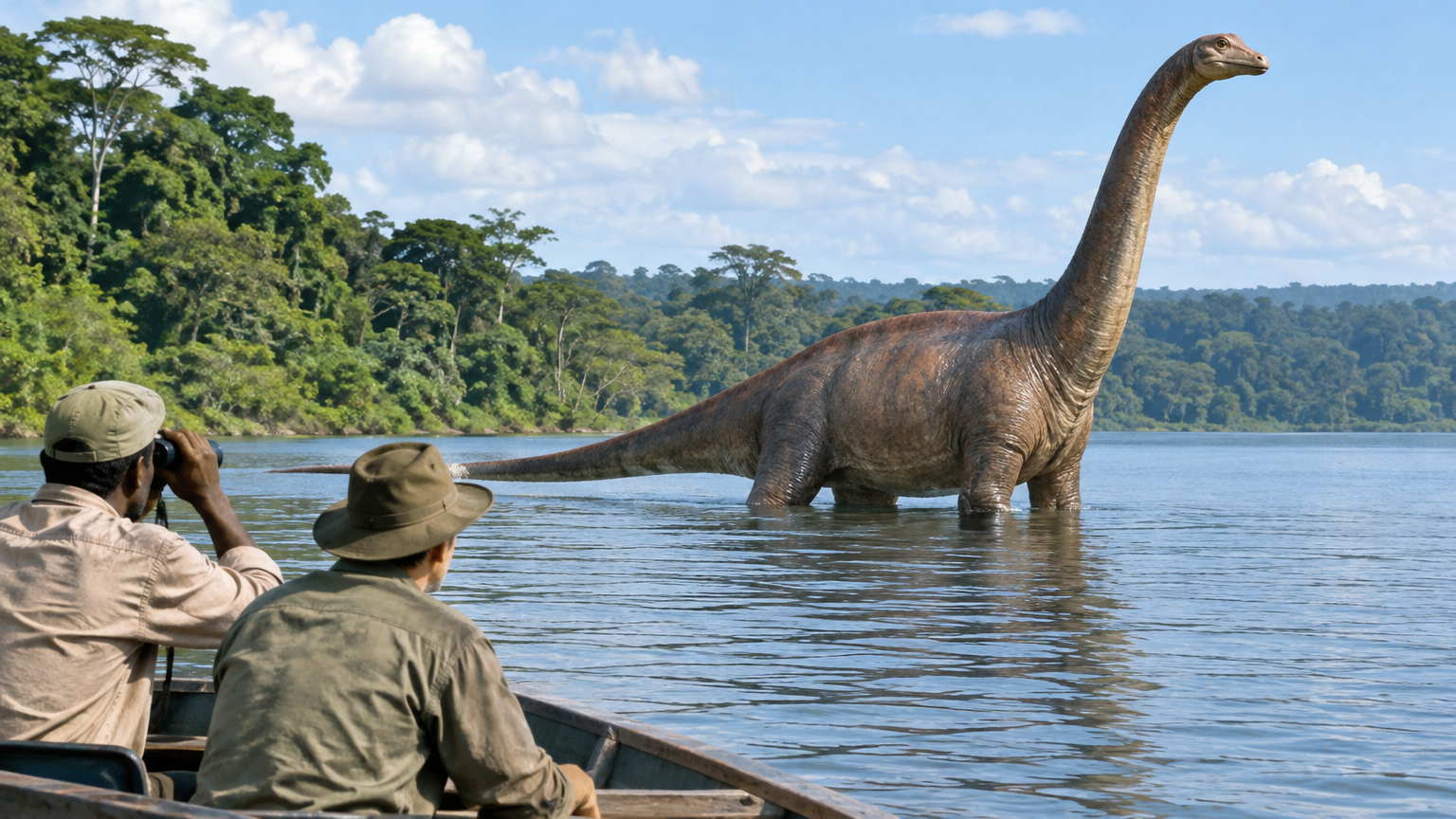
The earliest named description presents a large river animal rather than a clearly recognizable dinosaur. Informants whose accounts reached von Stein described grey-brown coloration and smooth skin.
Its reported bulk was compared with an elephant’s, or at least with that of a hippopotamus.
A long, flexible neck was a prominent feature, but the surviving description does not supply a complete anatomical reconstruction. Comparisons with familiar large mammals indicate an impression of size; they do not establish exact dimensions, bodily proportions, or a reliable zoological classification.
One striking detail was a single long tooth, alternatively described as a horn. That uncertainty belongs to the historical account itself.
It should remain visible in any description rather than being converted into a precisely positioned weapon or an unquestioned feature of every version.
Some accounts also supplied a long, powerful, alligator-like tail. Because this detail was not universal, it should not automatically be combined with every other reported trait.
The early material preserves variations in testimony, not a single standardized portrait assembled from a directly examined animal.
Later popular depictions commonly favor a small-headed sauropod silhouette. The small head is not specified in the earliest quoted description, and a flexible neck alone cannot establish dinosaur identity.
Loxton and Prothero’s skeptical treatment distinguishes the reported creature from the prehistoric interpretation subsequently built around it. That distinction leaves a substantial visual difference between the early testimony and the now-familiar dinosaur image.
Background Story
Mokele-mbembe has no securely documented personal biography or single origin narrative. Its early recorded background consists instead of reported habitat, feeding habits, and dangerous encounters.
These details place it within a riverine world rather than within a genealogical mythology of gods and monsters.
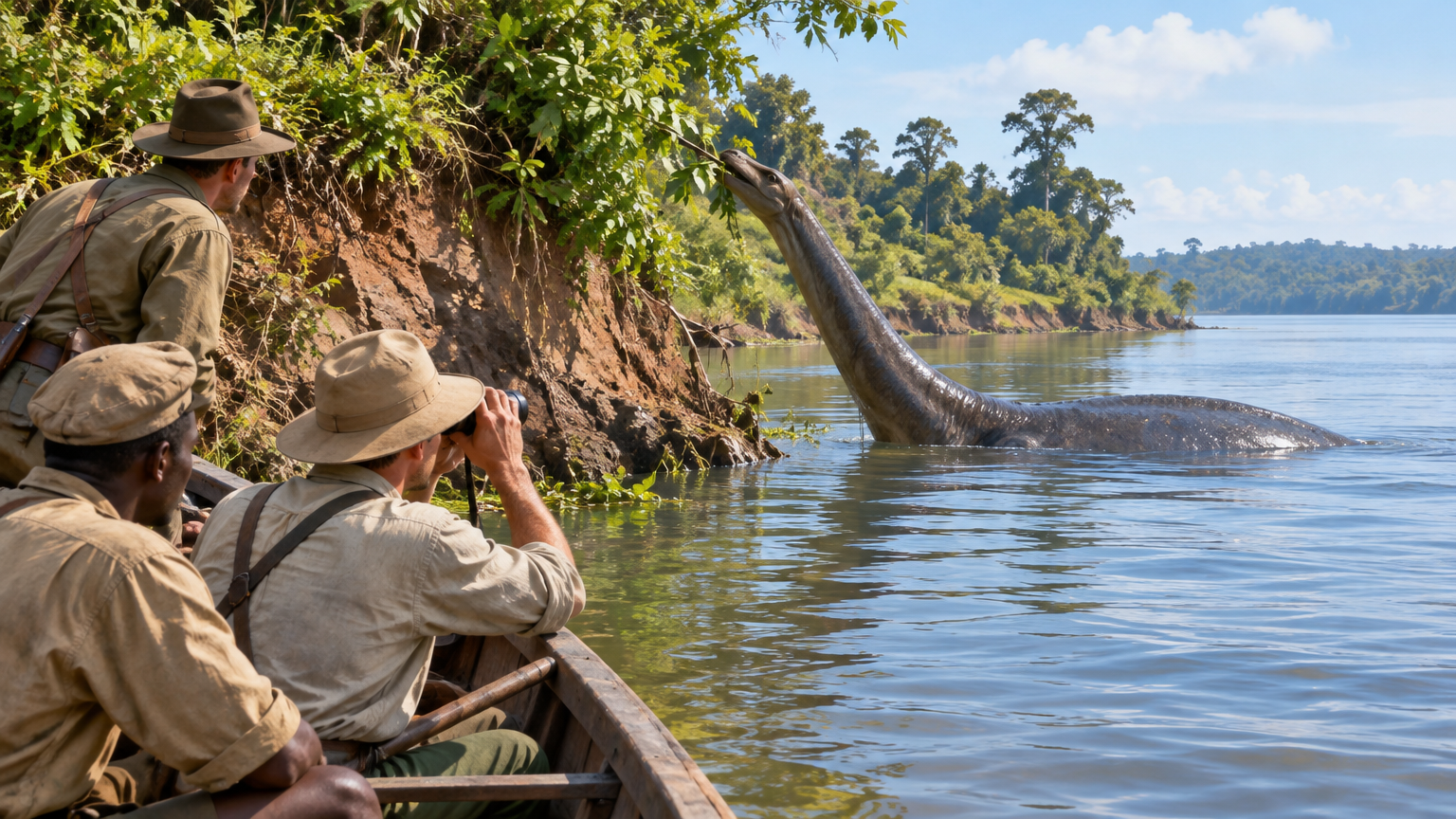
The animal was said to occupy deep river eddies and hollows in clay banks. Such locations make concealment central to the reported creature’s character: it belongs to water and bank cavities that observers cannot readily inspect, rather than to an openly visible terrestrial habitat.
It was reportedly vegetation-eating but nevertheless dangerous to people approaching by canoe. The early account alleged that it overturned boats and killed their occupants without eating them.
Within this description, its threat was therefore not ordinary predation, although the reason for the attacks was not established.
Geography is an important part of that background. Reports associated with the lower Ubangi and Sanga emphasized large rivers, while the early account said the creature was absent from the smaller Likualas.
Later concentration on Likouala swamps and Lake Télé represents a substantive change, not merely interchangeable place-naming.
Accounts gathered decades later added Lake Télé encounters and a reported killing, with conflicting dates and details. These belong to a later body of hearsay and expedition testimony.
They cannot simply be inserted into the earlier river account as episodes from one securely established tradition.
The modern figure emerged through interaction between these reports and outsiders’ expectations of prehistoric survival. Local testimony supplied descriptions and dangerous encounters; expedition writing and publicity increasingly organized them around a dinosaur hypothesis.
Keeping those layers distinct preserves the tradition’s historical complexity without turning interpretation into an original belief.
Famous Folklore Stories
Reported canoe attacks on the Sanga
The canoe attacks belong to a secondhand encounter account, not a folktale with an authenticated traditional title. In the report gathered during Captain von Stein zu Lausnitz’s 1913–14 expedition, people approaching the animal by canoe were said to risk a violent attack.
The creature allegedly overturned boats and killed their occupants without eating them. This distinction matters: the reported danger was not explained as hunting for human prey.
The same account presented the animal as a vegetation eater, despite its deadly behavior toward river travelers.
The surviving wording comes through Wilhelm Bölsche’s 1929 publication of von Stein’s report, rather than an available original expedition manuscript. It preserves a narrative of feared encounters on larger rivers, including the Sanga, but cannot establish that the attacks occurred as described.
The reported killing at Lake Télé
A later encounter narrative concerns an animal reportedly trapped and speared at Lake Télé. In versions collected through subsequent expedition accounts, people killed the creature and ate its flesh.
Those who consumed the meat were then said to have died.
The versions associated with Roy Mackal and Herman Regusters differ in chronology and detail. The alleged killing has been placed in the 1930s or the late 1950s.
These are competing reports of an episode, not independently verified records of a recovered animal.
The lethal-meat episode gives this narrative a different character from the canoe attacks: danger persists even after the animal’s apparent death. It should not, however, be converted into evidence of a formal food taboo, supernatural punishment, or an established ritual prohibition.
Cultural Impact
In the earliest named account, Mokele-mbembe appears chiefly as a feared presence in river travel. Its reported habit of overturning canoes gives the narrative an immediate human setting: people navigating waterways where an encounter with a powerful animal could be fatal.
Its later public identity shifted toward the possibility of a surviving dinosaur. Expeditions and their publicity helped turn varied reports into a recognizable cryptozoological subject.
This modern interpretation became more internationally familiar than the less standardized animal described in the early riverine account.
By December 1981, the story had attracted substantial attention in Brazzaville. Contemporary reporting in Le Monde documented its presence in newspapers, radio, television, and everyday conversation.
The excitement was therefore not confined to foreign expedition members or audiences outside the Republic of the Congo.
Herman Regusters’s report of his 1981 investigation, published in 1982, preserves another stage in that development. As an expedition account, it documents what a searcher reported and believed.
Its historical value does not depend on accepting its claims as zoological confirmation.
Modern skeptical scholarship examines how these reports became a dinosaur narrative. Daniel Loxton and Donald Prothero distinguish the accumulated stories from evidence for an undiscovered species.
That distinction allows Mokele-mbembe’s cultural history to be studied without treating either belief or disbelief as a substitute for evidence.
Similar Beasts
Loch Ness Monster

The Loch Ness Monster is a reported aquatic creature associated with Scotland’s Loch Ness. Its modern reputation rests on sightings and debate over the identity of an elusive lake inhabitant.
Both figures became prominent subjects of cryptozoology. Their comparison concerns modern monster reporting, not evidence that they share an origin or represent surviving prehistoric animals.
Read more about Loch Ness Monster
Nyami Nyami

Nyami Nyami is a Zambezi River deity in Tonga tradition, described with a snake’s body and a fish’s head. The figure embodies protection alongside the river’s destructive power.
The shared river setting makes comparison useful, but their identities differ substantially: Nyami Nyami is a deity, whereas the earliest Mokele-mbembe account reports a feared animal.
Mamlambo

Mamlambo belongs to South African river lore and is described through combinations of snake, fish, and crocodile features. Its mixed appearance places it among the region’s varied aquatic beings.
Both traditions resist reduction to a familiar zoological species. Their aquatic settings and variable descriptions invite comparison, without making Mamlambo a regional name for Mokele-mbembe.
The swamp monster reported from Rhodesia
Carl Hagenbeck’s 1909 account relayed a report from Rhodesia of a swamp creature characterized as half elephant and half dragon. He connected the report with a possible dinosaur.
This separate report helps explain the later dinosaur comparison. It did not use the name Mokele-mbembe and should not be merged with the Congo river accounts.
Religion/Ritual
An account concerning a 1983 expedition reports that village elders prayed to ancestors for the party’s safety before departure. This is evidence of a protective observance associated with that journey, not evidence that the animal itself received worship or offerings.
The available record does not establish a Mokele-mbembe-specific priesthood, festival, sacrifice, or prescribed ceremony. Likewise, the Lake Télé story about deaths after eating the animal cannot by itself demonstrate a religious prohibition.
Narrative danger and documented ritual practice are different kinds of evidence.
Scientific or Rational Explanations
No specimen or decisive physical evidence in the reviewed record establishes Mokele-mbembe as a surviving dinosaur. The existence of reports is secure; the existence of the proposed animal is not.
An expedition narrative can document testimony without providing the material needed to identify a species.
Historical comparison offers one explanation for the familiar dinosaur image. The Rhodesian report discussed by Hagenbeck and the later printed Congo account arose in different settings.
Bringing them together can make the combined description appear more consistent, and more dinosaur-like, than the separate reports warrant.
Geographical differences also complicate the idea of one continuous sighting tradition. The early named account emphasizes larger rivers, including the Ubangi and Sanga, and reports absence from the smaller Likualas.
Later searches and narratives concentrate on the Likouala region and Lake Télé.
Misidentification of known animals remains a plausible hypothesis, but it cannot be assigned as the explanation for every account. The surviving descriptions are often indirect and incomplete.
Without a securely documented encounter, choosing a particular familiar species would exceed what the evidence permits.
Transmission provides another possible source of change. An observation, a remembered encounter, an informant’s explanation, and a collector’s published account are not interchangeable.
Details may acquire new meanings as reports pass between speakers or are interpreted through expectations about prehistoric animals and unexplored habitats.
The unidentified tracks reported in 1776 illustrate the problem of retrospective identification. That passage neither names Mokele-mbembe nor describes a long-necked animal.
Treating it as an early dinosaur sighting would supply an identity that the original report does not establish, artificially extending the creature’s documented history.
Modern Cultural References
Swamp Monster of the Congo, TV 2011
television episode 2011 The episode description specifically names Mokele-mbembe and investigates reports of the creature in the Congo Basin.
(thetvdb.com)
Dinosaurs Live! Hunt for the Mokele-Mbembe [Part 1], 2023
podcast episode 2023 The episode’s published description says the hosts trek into the Congo in search of the Mokele-mbembe; Apple Podcasts lists it as episode 10, published March 6, 2023.
(podcasts.apple.com)
Episode 32: Mokele Mbembe, 2023
podcast episode 2023 This published episode is explicitly about the Mokele Mbembe, discussing accounts and searches for the creature; Apple Podcasts dates it April 16, 2023.
(podcasts.apple.com)
Conclusion
Mokele-mbembe is best understood first as a reported, feared river animal, not as an established surviving dinosaur. The earliest recoverable named account preserves secondhand descriptions associated with the lower Ubangi and Sanga region, while later narratives shift locations and sharpen the creature into a recognizable sauropod.
Keeping those layers separate preserves the tradition’s historical complexity. It also avoids treating uncertain translations, disputed episodes, and changing descriptions as parts of one fixed, universally shared account of an identifiable animal species.
The creature’s lasting significance lies in the meeting of riverine danger, reported encounters, expedition culture, and the appeal of undiscovered life. Canoe-attack narratives convey the threat associated with deep waterways; later searches and entertainment transform that threat into the promise of discovery.
Neither role requires accepting a living dinosaur as fact. Mokele-mbembe remains culturally compelling because its history shows how local reports can acquire new meanings as they pass through collectors, investigators, newspapers, fiction, television, and other international media.
Further Reading
Mokele Mbembe: The Congo Dinosaur, Columbia Scholarship Online
Columbia Scholarship Online provides additional contextual reading relevant to Mokele-mbembe.
(academic.oup.com)
Id1078112813
Id1078112813 provides additional contextual reading relevant to Mokele-mbembe.
(podcasts.apple.com)
Mokele-Mbembe: an investigation into rumors concerning a strange animal in the Republic of the Congo, 1981, CaltechAUTHORS / Munger Africana Library Notes
A contemporaneous expedition report documenting Herman Regusters’s claims and the name gloss as circulated in that period.
(authors.library.caltech.edu)
Le dinosaure du Congo, Le Monde
Contemporaneous reporting on the public and media attention to Mokele-mbembe in Brazzaville and the Likouala region.
(lemonde.fr)
Wilhelm Bölsche, Drachen: Sage und Naturwissenschaft, excerpt transcribed and translated, Twicetold
A 1913/14 expedition account, printed in 1929, reports that riverine people called a feared creature mokéle-mbêmbe.
It places the creature in deep river eddies and bank hollows and reports a plant diet, while acknowledging uncertainty about its nature.
(twicetold.org)