Introduction
A kallikantzaros is a supernatural being of Greek folk belief, especially associated with the Twelve Days between Christmas and Epiphany. The plural, kallikantzaroi, usually refers to a troublesome company rather than a single named monster with an individual history.
These beings can be mischievous, frightening, or grotesque, depending on the locality and the story. Their identity rests more securely on their seasonal appearance and interference with human life than on any universally recognized set of bodily features.
A prominent tradition places them underground for most of the year, cutting at a tree that supports the earth. At Christmas they abandon their work and emerge into the human world.
Other accounts concentrate instead on nighttime encounters and household disturbances.
Kallikantzaroi belong to a living body of seasonal folklore, not a fixed ancient pantheon. Collected legends, local customs, and later retellings preserve different versions.
Understanding those differences is essential to explaining why the beings can appear both threatening and comical.
History/Origin
The historical beginnings of the kallikantzaroi remain uncertain. Their best-supported context is Greek seasonal folk belief, documented through collected traditions rather than a single foundational narrative.
Connections with antiquity have attracted scholarly attention, but resemblance alone does not establish an unbroken line of descent.
An important early printed collection is Nikolaos G. Politis’s two-volume Παραδόσεις, published in 1904. It includes traditions categorized under kallikantzaroi within a much broader record of Greek supernatural belief.
Its importance lies in preserving collected accounts rather than imposing one comprehensive mythology.
The publication date provides a secure point in the documentary record, not a date of invention. Equally, it cannot establish that every recorded detail had survived unchanged for centuries.
Individual motifs and local descriptions need to be considered separately when reconstructing the tradition’s development.
J. C. Lawson examined kallikantzaroi in his 1910 study Modern Greek Folklore and Ancient Greek Religion. His comparisons connected the discussion with ancient satyrs, centaurs, and older revel customs.
These proposals belong to a scholarly search for survivals, not an established account of the beings’ origins.
Local evidence also preserves the tradition outside broad comparative theories. An Academy of Athens folklore record available through SearchCulture includes seasonal beliefs, customs, and a related chant.
Such material shows that kallikantzaroi circulated through spoken performance and household observance as well as storytelling.
Cypriot traditions form another important regional strand, represented in the Polignosi account. Their place within Greek-language folklore broadens the geographical picture without making every detail universal.
The historical record therefore supports a varied seasonal tradition more clearly than any single proposed ancient ancestor.
Name Meaning
The name appears in Greek as καλικάντζαρος or καλλικάντζαρος, with corresponding plural forms καλικάντζαροι and καλλικάντζαροι. English spellings include “Kalikantzaros” and “Kallikantzaros.”
These spelling differences should not be mistaken for evidence that the words identify separate kinds of creature.
Regional forms include σκαλικάντζαρος, καλκάντζαρος, and καλικάτταρος. Their variety belongs to the word’s history in local speech. It also makes a simple explanation based only on the most familiar modern spelling less reliable than it might initially appear.
The etymology is disputed. Published proposals connect the name with Greek words relating to beetles, centaurs, or footwear, but none should be presented as a settled literal translation.
These competing suggestions reflect different attempts to explain an already variable folk name.
The centaur proposal is especially liable to confusion with theories about ancient origins. A proposed linguistic connection does not prove that kallikantzaroi were originally centaurs, nor does it establish horse-like anatomy.
“Goblin” is a useful English comparison, but not a translation of demonstrated etymological meaning.
Appearance
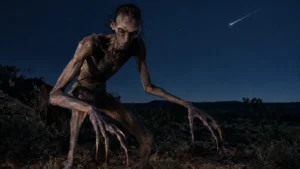
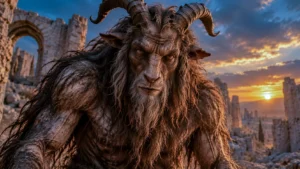
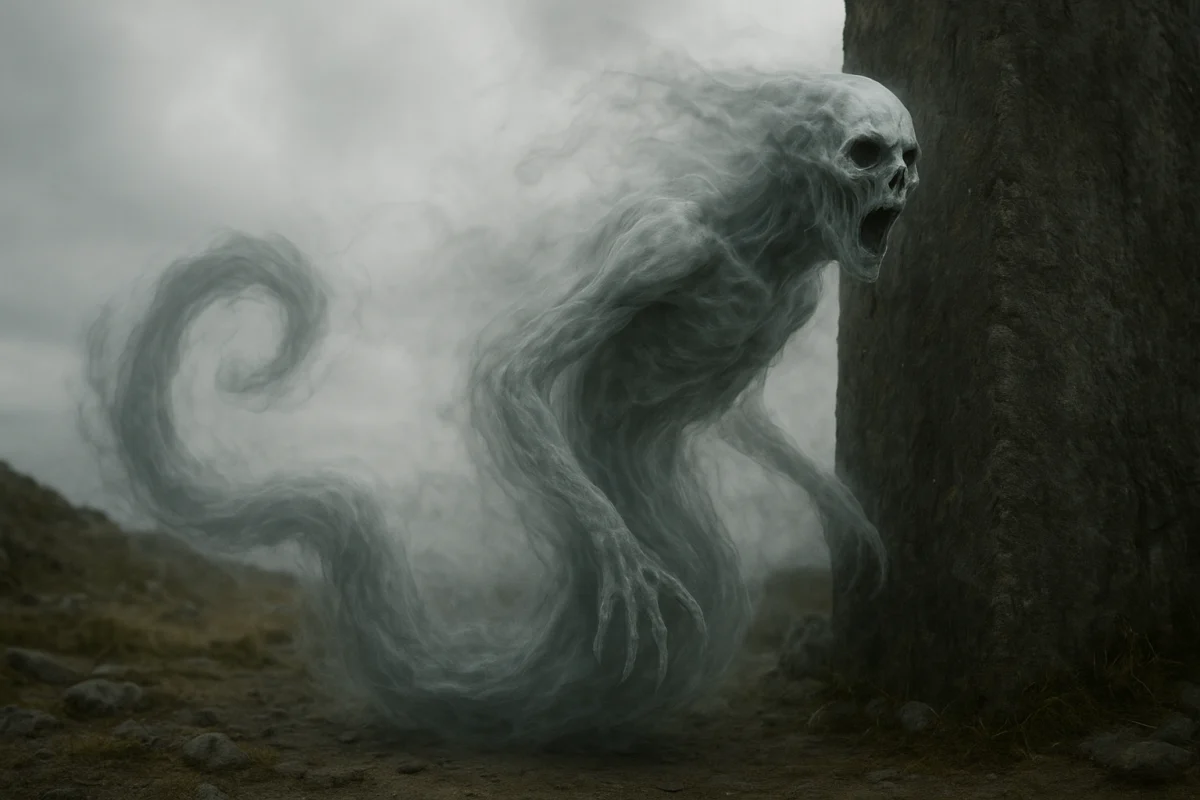
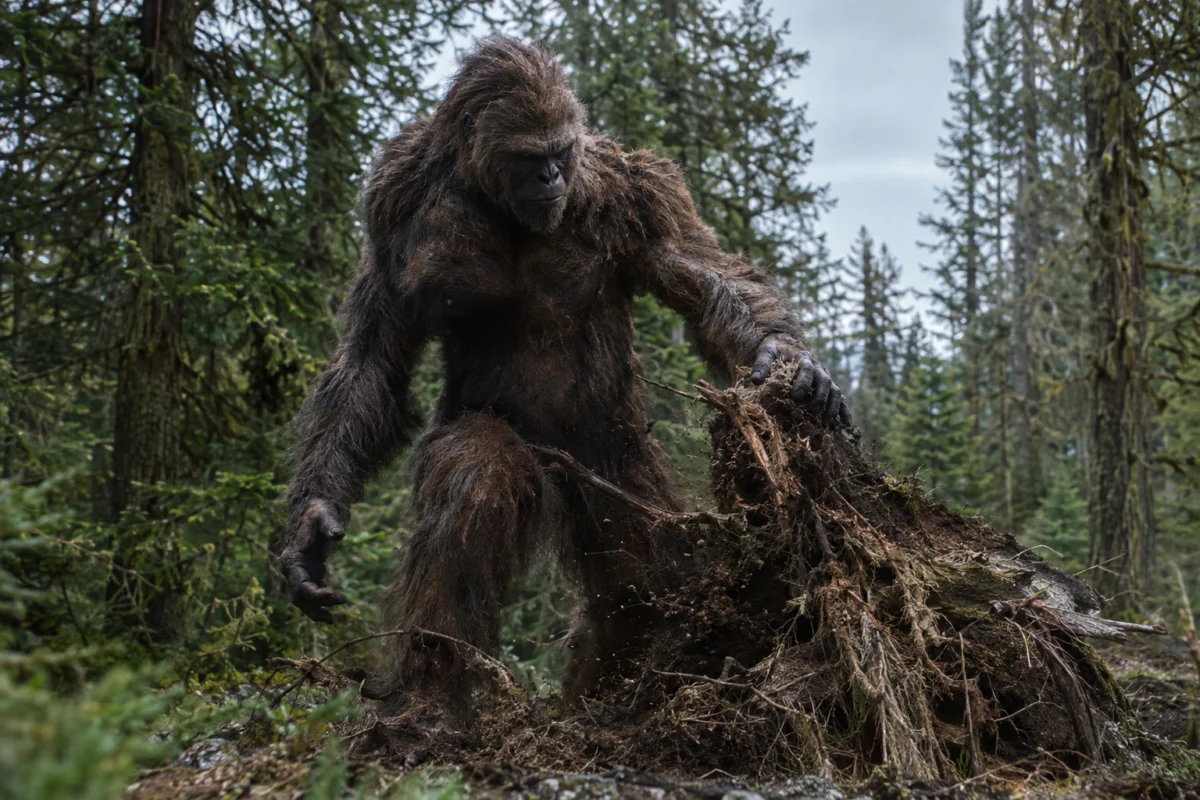
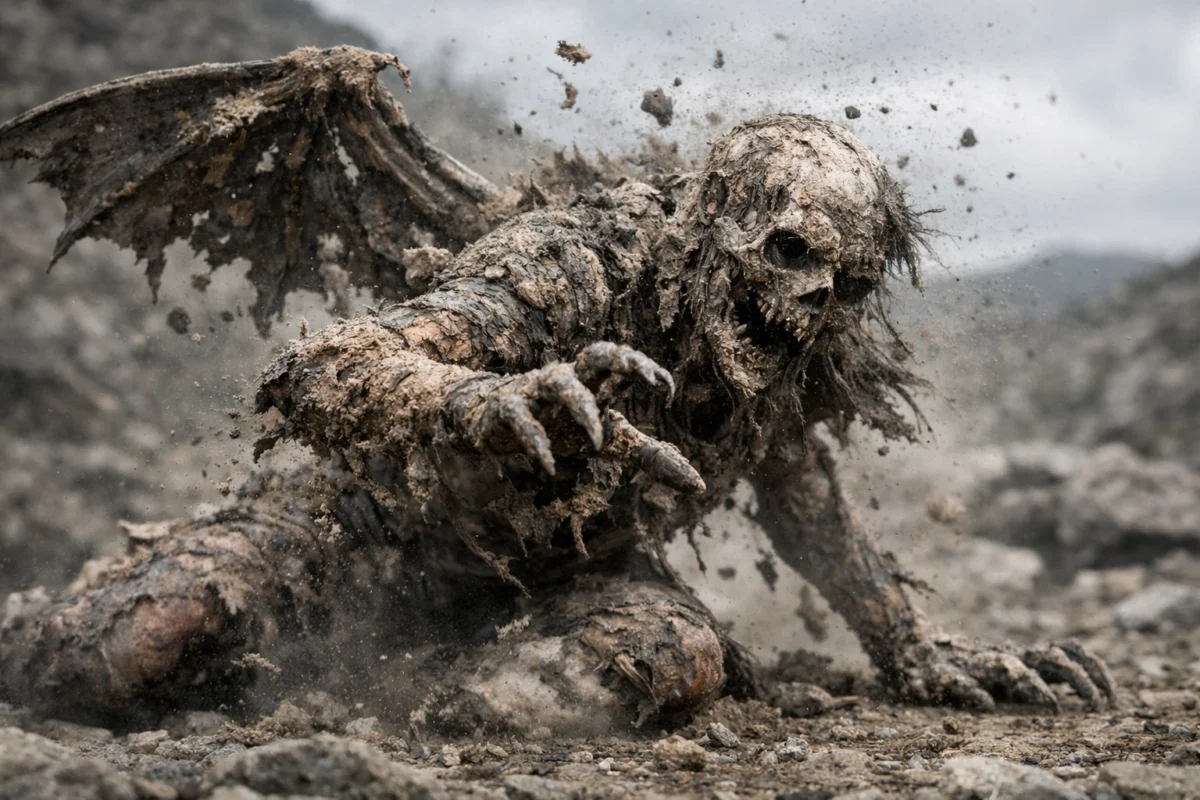
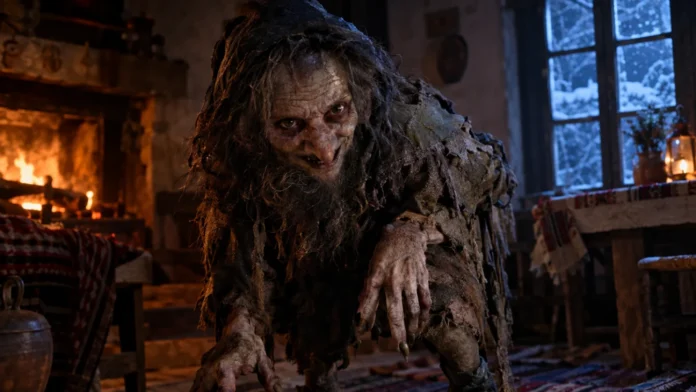
Kallikantzaroi are broadly humanoid supernatural beings, but their appearance changes among local accounts. Some are presented as misshapen or grotesque.
The collected tradition does not establish one consistent anatomy against which every depiction can be measured as correct or incorrect.
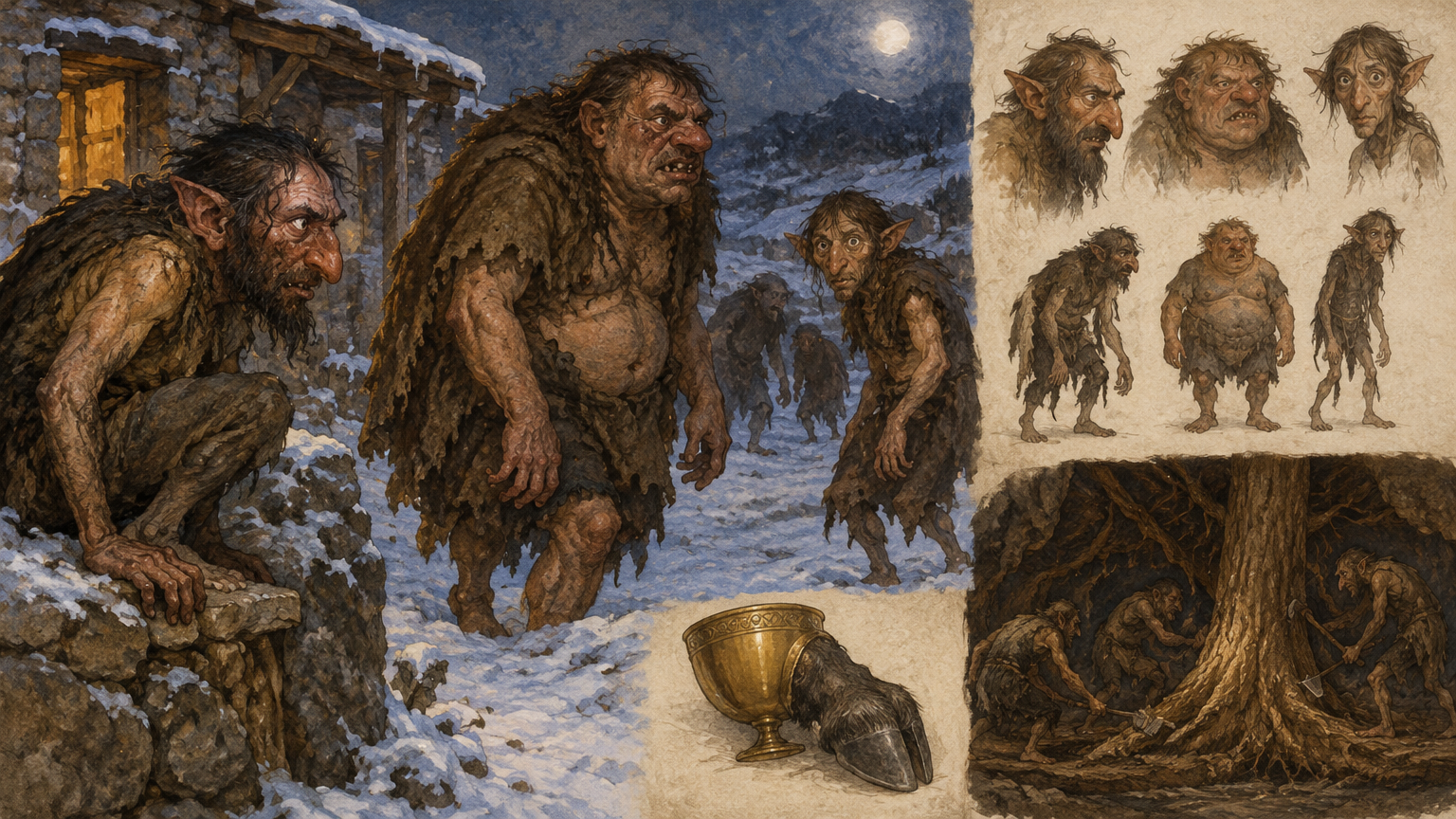
Their uncanny quality matters more than a standardized silhouette. A storyteller can make them frightening through bodily strangeness, while another account emphasizes their troublesome conduct.
These differences allow the same category of being to occupy both alarming encounter legends and more comic seasonal narratives.
“Goblin-like” is therefore best understood as a descriptive aid for English readers. It conveys a troublesome, roughly human-shaped supernatural presence without establishing a particular height, costume, or species.
A small, ragged figure in an illustration is an interpretation rather than a universal traditional portrait.
Animal imagery also requires attention to its narrative setting. In one recorded encounter, an apparently golden drinking cup proves to be a donkey’s hoof.
That detail concerns a deceptive object within the episode; it does not by itself establish that every kallikantzaros has hooves.
The underground tree-cutting motif supplies another recognizable image: a company of beings engaged in destructive labor beneath the earth. It identifies a particular narrative situation, not a compulsory physical form.
Their winter visitation remains a firmer identifying feature than horns, tails, or any single animal characteristic.
Background Story
The background of the kallikantzaroi is shaped by the meeting of seasonal storytelling, domestic custom, and the Christian festival calendar. Christmas and Epiphany mark the boundaries of their best-known period of activity.
Their temporary arrival gives supernatural disorder a recurring place within the year.
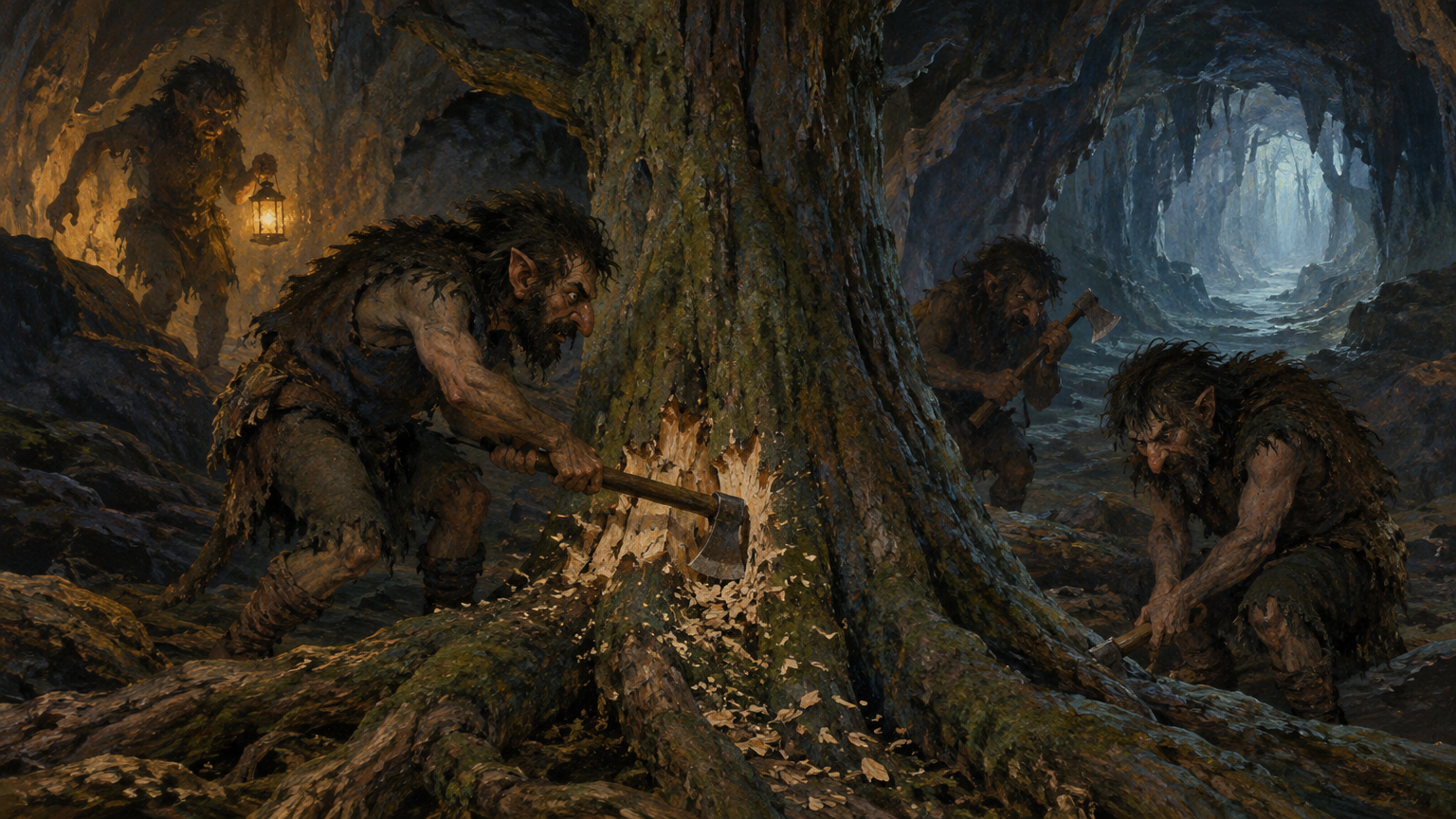
In the underground-tree narrative, the scale of that disorder becomes cosmic. The beings work at cutting a tree associated with the earth’s support, yet leave their task unfinished when Christmas draws them upward.
Their seasonal interruption prevents the destructive project from reaching its intended conclusion.
When they return below, the labor begins again. The episode gives the tradition a repeating structure rather than a final victory or defeat.
It connects a short period of disturbance among humans with an enduring threat beneath the ordinary world, without supplying an individual creature’s biography.
Other accounts operate on a smaller scale. The solitary traveler offered a golden cup encounters deceptive appearances rather than a visible threat to the earth.
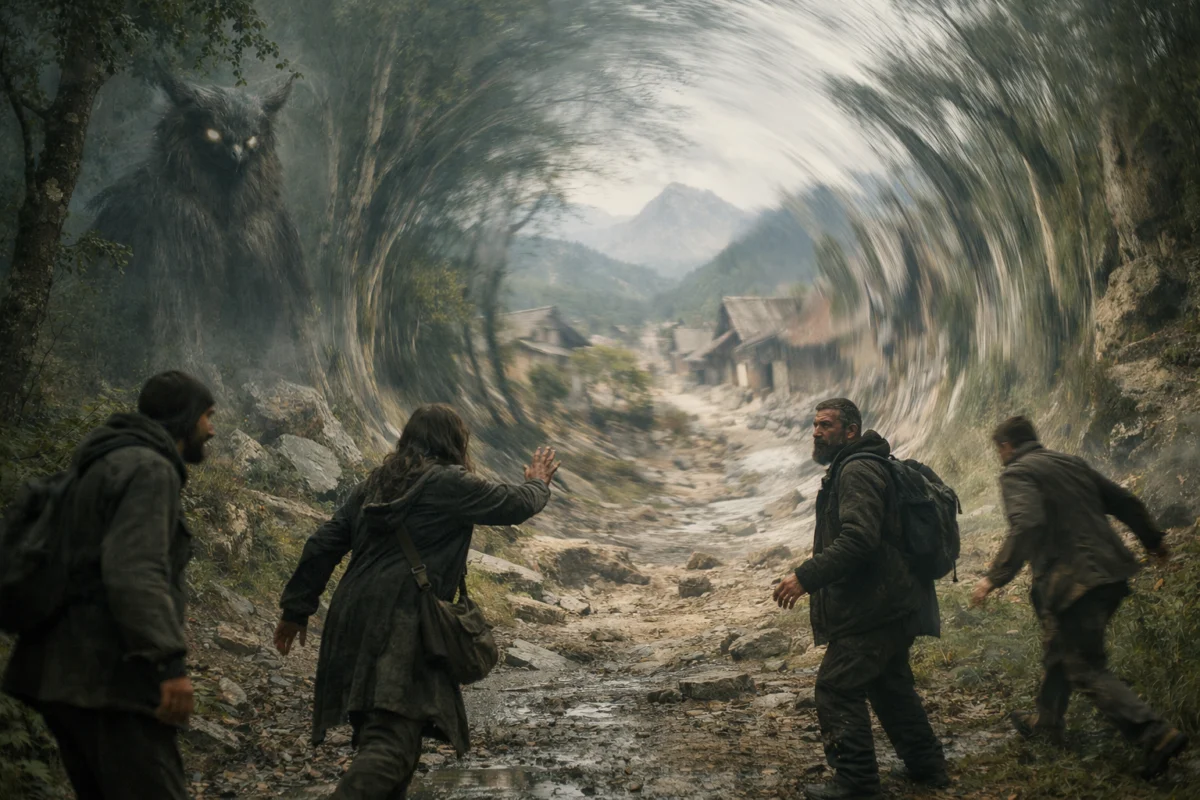
Such episodes place kallikantzaroi within the uncertainties of nighttime travel and unexpected meetings, independently of the underground story.
Household and village traditions provide a further setting. Local customs and chants connect the beings with communal responses to the Twelve Days.
In some accounts, their departure accompanies the blessing of waters or homes at Epiphany, giving seasonal religious observance a direct role in restoring order.
These strands should remain related but distinct. The tree-cutters, deceptive nighttime companions, and troublesome seasonal visitors need not all belong to one continuous plot.
Together they show how kallikantzaroi could express threats to the household, the traveler, and the wider world through different local narrative forms.
Famous Folklore Stories
Kallikantzaroi appear in recurring narrative episodes rather than a single authoritative story. The headings below describe documented motifs, not authenticated traditional tale titles.
Their different settings, beneath the earth and along a nighttime journey, show the range of encounters preserved in the tradition.
Cutting the Tree Beneath the Earth
In a well-known narrative, the kallikantzaroi labor underground to cut through a tree that supports the earth. Their destructive work threatens more than an individual household: the continued stability of the world depends on their failure to complete the task.
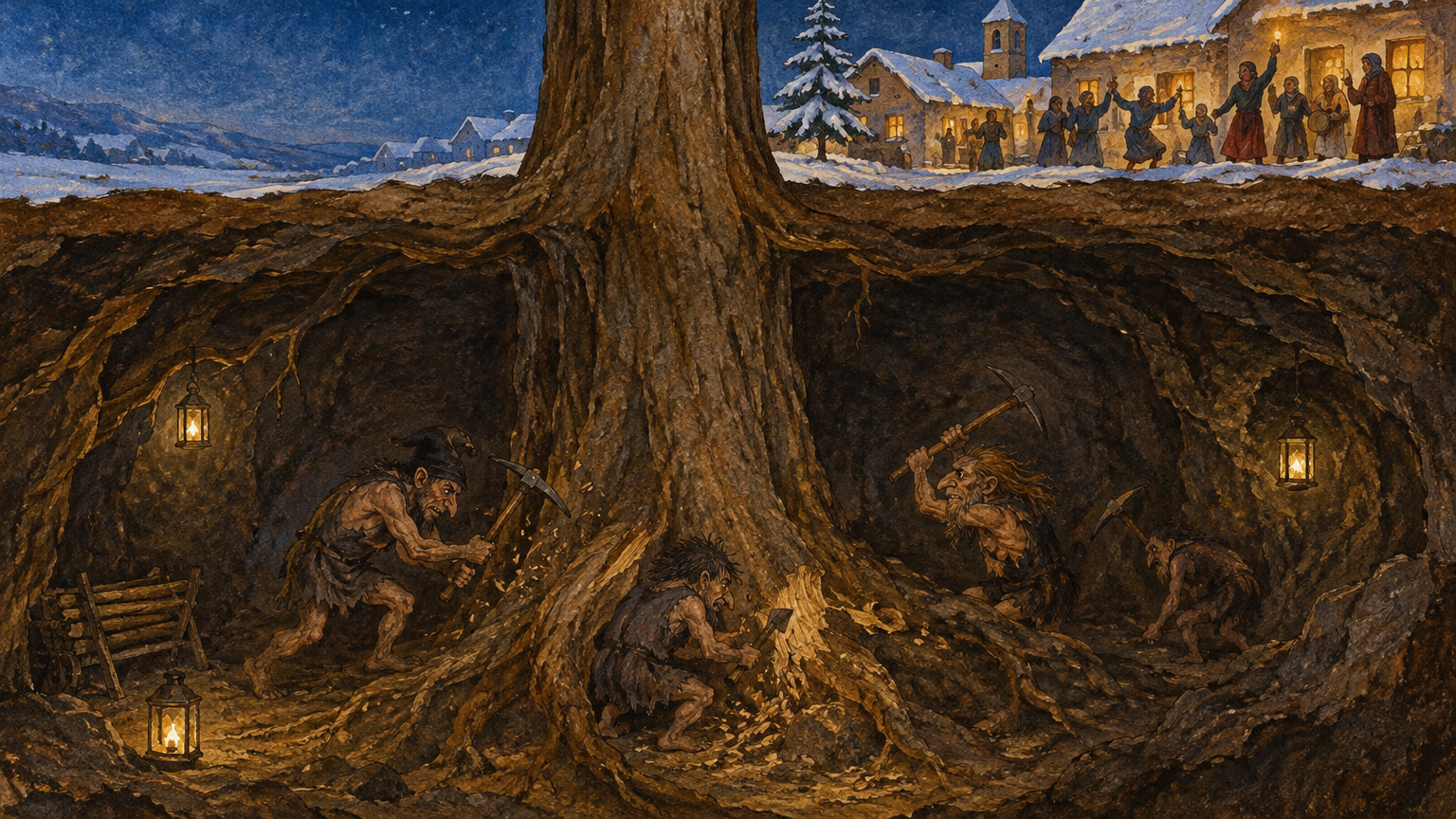
At Christmas, they abandon this labor and emerge into the human world. Their seasonal departure interrupts the threatened catastrophe.
When they are driven underground again at the end of the festive period, their work must begin anew, creating a repeating cycle rather than a final victory.
The episode connects a cosmic danger with the familiar holiday calendar. It is a prominent narrative, but not a universal explanation of every kallikantzaros encounter.
Traveler accounts and local household beliefs need not include either the supporting tree or its underground attackers.
The Traveler and the Apparent Golden Cup
A recorded encounter account concerns a solitary traveler approached by kallikantzaroi at night. They invite the traveler to drink from what appears to be a golden cup.
The apparently precious vessel proves instead to be a donkey’s hoof, exposing the deceptive character of the encounter.
The contrast between treasure and an animal remnant gives the episode its unsettling force. Read as a narrative motif, it makes an ordinary social gesture, offering a drink, unreliable.
The danger lies in accepting appearances during an encounter with unfamiliar supernatural beings.
This is an encounter narrative, not a verified folktale with a fixed traditional title. Its hoof detail belongs to the deceptive object in this particular episode; it should not be converted into evidence that all kallikantzaroi possess hooves or share one animal anatomy.
Cultural Impact
The kallikantzaroi give the Twelve Days a distinctive place in Greek seasonal storytelling. Christmas celebration and supernatural disturbance occupy the same interval.
The result is a festive season understood not simply as joyful, but also as a temporary opening for frightening or troublesome encounters.
Their cultural importance extends beyond their appearance. Stories locate disorder within recognizable experiences: traveling alone, receiving an invitation, or protecting the household.
Supernatural interference makes these familiar situations uncertain, bringing the extraordinary into everyday surroundings rather than confining it to a distant heroic world.
Regional variation is part of this inheritance. Different names, descriptions, and episodes allow communities to recognize the beings without requiring a uniform portrait.
Treating one modern illustration or one widely circulated story as definitive would obscure the local character of the collected traditions.
Nikolaos Politis’s 1904 collection preserved kallikantzaroi within a wider record of Greek folk traditions. Its importance is documentary: it allows later readers to encounter differentiated accounts.
The publication date establishes collected evidence, not the beginning of the beliefs or proof of their unchanged antiquity.
Modern children’s literature has also reshaped the tradition. Vangelis Iliopoulos’s 2008 story about a kind young kallikantzaros reworks the familiar underground-tree material.
This sympathetic characterization is a modern adaptation, demonstrating how a frightening seasonal figure can become a vehicle for a different moral perspective.
Similar Beasts
Trasgu
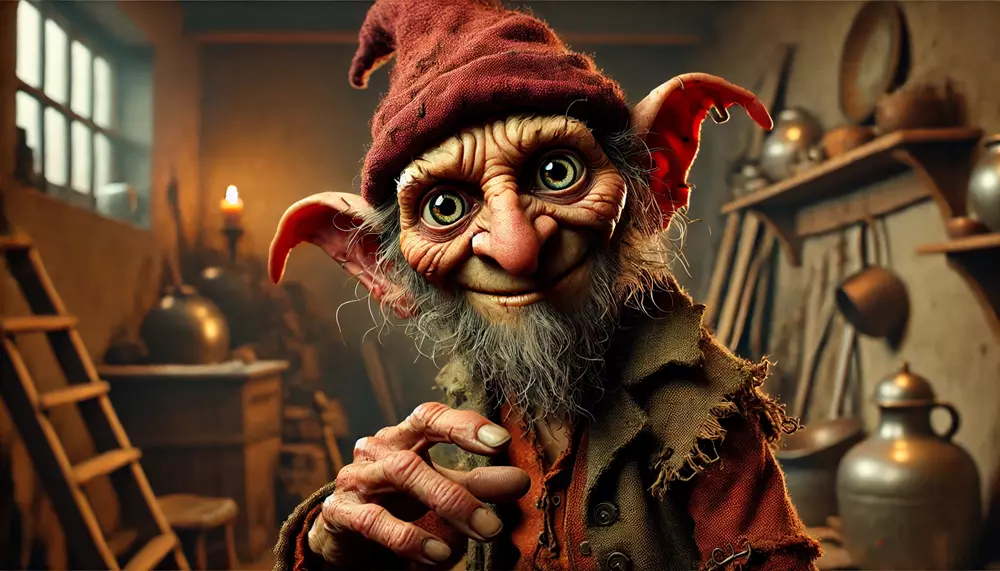
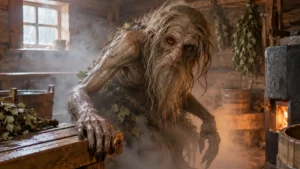
The Trasgu is a goblin-like figure in Asturian folklore, associated with domestic pranks. Its household setting makes it a useful comparison for supernatural mischief close to home.
Both figures can turn familiar domestic surroundings into places of disturbance. The comparison concerns narrative function, not a demonstrated common origin or identical seasonal calendar.
Tikoloshe
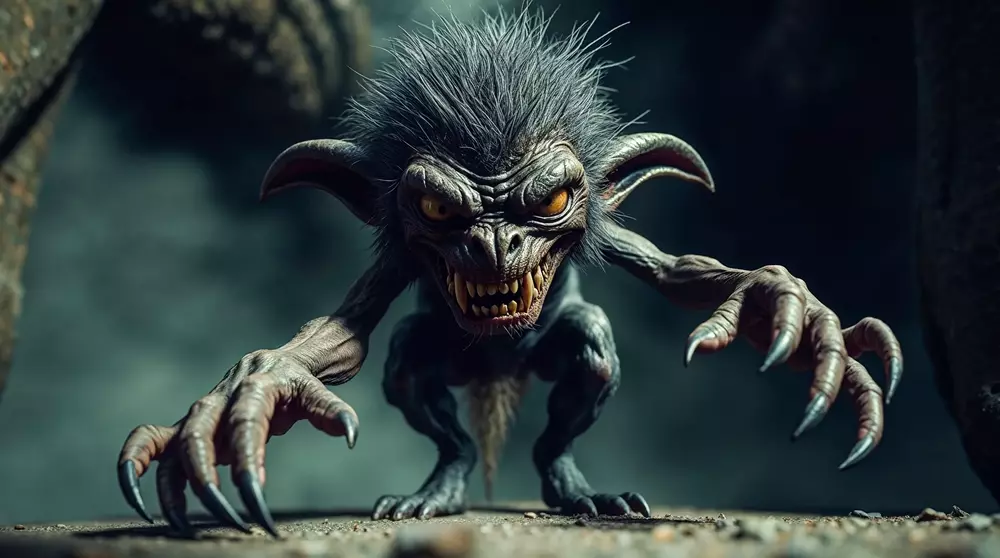
The Tikoloshe is a small, goblin-like being in Zulu folklore, associated with mischief and malice. It belongs to a distinct tradition of potentially threatening supernatural interference.
Its combination of troublesome behavior and frightening presence resembles the range of kallikantzaros portrayals. This is a functional comparison, not evidence of cultural transmission between traditions.
Leprechaun

The Leprechaun is a small fairy of Irish folklore, known for trickery and guarded gold. Encounters place humans in an uncertain relationship with an elusive supernatural figure.
The apparent golden cup offers a limited comparison through deceptive value. Kallikantzaroi, however, are not thereby treasure guardians, and their seasonal identity remains a significant difference.
Karakoncolos
The Karakoncolos is a seasonal bogey-being in Turkish folk tradition. It is a closer regional comparison than distant tricksters, although its identity should remain distinct from Greek kallikantzaroi.
Possible connections between the names have attracted scholarly discussion. Such connections do not establish that every local account describes the same being under interchangeable labels.
Religion/Ritual
The beings’ activity is commonly bounded by Christmas and Epiphany. In some accounts, their departure is connected with the blessing of waters or homes.
Christian seasonal observance therefore supplies an effective limit to their presence, rather than merely providing dates for their appearance.
The relationship between blessing and departure is especially important: the threatening visitors do not establish permanent control. Within these accounts, sacred action restores a boundary they temporarily crossed.
This describes a folk interpretation of the season, not a uniform statement of Christian doctrine.
A local folklore record preserved through the Academy of Athens and SearchCulture includes seasonal customs and an associated chant. Such material shows that the tradition was expressed through words and practices as well as stories, while remaining evidence for a particular local record rather than universal observance.
Scientific or Rational Explanations
The evidence concerns a documented tradition, not a scientifically verified creature. Rational investigation therefore asks how narratives developed, circulated, and acquired meaning.
Collected encounters establish that stories were recorded; they do not independently establish that the supernatural events within them occurred.
J. C. Lawson’s 1910 study explored relationships between modern Greek folklore and ancient religion. His comparisons involving satyrs, centaurs, and older revel customs belong to a historical survival theory.
They are proposals about continuity, not a demonstrated genealogy of the kallikantzaroi.
Similarities in behavior or grotesque appearance can suggest comparisons without proving descent. To establish direct continuity would require evidence connecting particular traditions across time.
A resemblance between an ancient figure and a later seasonal being cannot, by itself, supply that missing historical sequence.
A calendar-based interpretation focuses instead on the beings’ temporary freedom and eventual departure. Their stories can be read as dramatizations of disorder followed by restored boundaries.
This explains a narrative pattern without claiming that its original creators consciously designed one shared symbolic system.
Local variation also places limits on explanation. The underground laborers, deceptive nighttime visitors, and beings addressed through seasonal custom need not have developed through one mechanism.
A responsible interpretation preserves those differences rather than using a single theory to explain every account.
Modern Cultural References
Modern adaptations range from Greek children’s fiction to English-language documentaries and podcasts. These works offer different kinds of reception: some reshape the kallikantzaros into a fictional character, while others introduce audiences to the seasonal beliefs and stories surrounding the beings.
Ο ΚαλΟκάντζαρος σώζει το Καλικαντζαροχωριό, illustrated children’s book with audio CD (2008)
Vangelis Iliopoulos’s illustrated story features a kind young kallikantzaros. It reworks the familiar underground tree motif through a sympathetic protagonist rather than treating every member of the group as threatening.
(patakis.gr)
Fotinoula and the Christmas Goblin, fantasy novella (2020)
R.G. Fraser-Green’s novella takes place in modern-day Athens. Its kallikantzaros threatens to abduct a child, bringing the frightening side of Greek seasonal folklore into a contemporary fictional setting.
(fotapress.com)
Monstrum: “Why Do These Christmas Monsters Want To Destroy the World?”, documentary episode (2024)
Emily Zarka’s Monstrum episode introduces the kallikantzaroi to an English-language audience. It discusses their folklore and appearance, making these Greek Christmas beings the direct subject of a documentary presentation.
(pbs.org)
The Kallikantzaros, podcast episode (2025)
Julia Schifini and Amanda McLoughlin devote a Spirits episode to the creature. Released December 10, 2025, it discusses Greek Christmas goblin folklore for the show’s mythology and legends audience.
(podcasts.apple.com)
The Mischievous Kallikantzaros, podcast episode (2023)
Weird Distractions released this dedicated episode on December 24, 2023. Its Christmas Eve publication places discussion of the kallikantzaros within the holiday season most closely associated with the tradition.
(podbay.fm)
Conclusion
The kallikantzaros is best understood as part of a varied Greek folk tradition, not as a monster with one fixed appearance or biography. Its strongest shared association is with the interval between Christmas and Epiphany, when troublesome supernatural visitors enter human surroundings.
Underground labor, deceptive encounters, and household disturbances give that seasonal uncertainty memorable narrative forms. The famous tree-cutting episode belongs within this wider tradition, but it cannot stand for every local account or explain every feature attributed to the beings.
The tradition’s lasting importance lies in the relationship between seasonal celebration, household vulnerability, and the restoration of order. Collected accounts preserve differences that modern summaries can easily erase, while children’s stories and other adaptations show how readily the figure can acquire new roles.
Its historical origins and name remain disputed, without weakening its documented place in Greek folklore. Keeping those uncertainties visible allows the kallikantzaros to remain culturally specific while acknowledging the variety that has always characterized its recorded forms.
Further Reading
Polignosi, Καλικάντζαροι
A well-known account has the kallikantzaroi laboring underground to cut a tree that supports the earth. When Christmas arrives, they come to the surface before completing the task;.
(polignosi.com)
Ο ΚαλΟκάντζαρος σώζει το Καλικαντζαροχωριό, patakis.gr
illustrated children’s book with audio CD 2008 A publisher-listed Greek children’s story featuring a kind young kallikantzaros and the familiar underground tree motif.
(patakis.gr)
Monstrum: “Why Do These Christmas Monsters Want To Destroy the World?”, pbs.org
documentary 2024 A dedicated Monstrum episode about Kallikantzaros; PBS identifies the creature in the episode description and discusses its folklore and appearance.
(pbs.org)
The Kallikantzaros, podcasts.apple.com
podcast episode 2025 A dedicated episode on the Kallikantzaros, published December 10, 2025; the listing describes discussion of the Greek Christmas goblin folklore.
(podcasts.apple.com)
The Mischievous Kallikantzaros, podbay.fm
podcast episode 2023 A dedicated podcast episode about the Kallikantzaros, published December 24, 2023; its episode notes identify the creature as the subject.
(podbay.fm)
Fotinoula and the Christmas Goblin, fotapress.com
published fiction 2020 A published fantasy novella in which a Kallikantzaros is an antagonist who threatens to abduct a child; the publisher’s teaching resource identifies it as a.
(fotapress.com)
Μελέται περί του βίου και της γλώσσης του ελληνικού λαού: Παραδόσεις, Anemi Digital Library of Modern Greek Studies
Digital-library record for Politis’s early collection of Greek folk traditions, a foundational source for tracing collected variants.
(anemi.lib.uoc.gr)
Modern Greek Folklore and Ancient Greek Religion: A Study in Survivals, The Online Books Page, University of Pennsylvania
Bibliographic record for Lawson’s early discussion and comparative theories concerning kallikantzaroi.
(onlinebooks.library.upenn.edu)