
Summary
Kimbiji kia Malenda a Ngandu is a monstrous aquatic predator in the Angolan Kimbundu-language tale of Sudika-mbambi. The creature inhabits a river in the country of the dead, where it attacks livestock and becomes a formidable obstacle during the hero’s supernatural journey.
The earliest published account identifies Kimbiji with a great fish, while later retellings sometimes describe it as a crocodile. These portrayals reflect different interpretations of a creature whose physical appearance receives little explanation, rather than two independently documented monsters.
Kimbiji’s importance emerges through the fate of Sudika-mbambi, whom it swallows, and the intervention of his twin, Kabundungulu. Their encounter brings together predation, death, collective effort, and miraculous restoration, without establishing a fixed anatomy or an independent tradition of worship.
History and Origin
The earliest published account identified in this research appears in Héli Chatelain’s Folk-Tales of Angola, issued in 1894. Chatelain printed the story as the fifth narrative in his collection, placing a Kimbundu text beside a literal English translation and supplying linguistic notes.
Chatelain credited the narration to Jelemia dia Sabatelu and identified its language as the Mbaka dialect of Kimbundu. His notes, however, connected the story’s circulation particularly with the Mbamba, a community he located among the Ambundu of the Malanje district.
This distinction matters because language, place of collection, and the older affiliations of a folktale need not coincide. Chatelain believed the Mbamba had historical ties to the Kongo region, although his proposed origin remains a collector’s assessment rather than a proven genealogy.
The episode belongs to a longer heroic narrative involving twins, the hostile Makishi, and a journey below the living world. In Chatelain’s version, Kimbiji enters late in this sequence, after Sudika-mbambi has already passed difficult encounters and defeated another terrifying adversary.
“Kill me Kimbiji kia Malenda a Ngandu.”
This command, spoken by Kalunga-ngombe in Chatelain’s English translation, establishes the creature as a practical danger within the plot, not merely a decorative monster. Later writers, including Alice Werner in 1933, preserved the central account of capture, swallowing, and rescue.
Name Meaning
The fullest recorded name, Kimbiji kia Malenda a Ngandu, appears in Héli Chatelain’s 1894 collection of Kimbundu folktales. The shortened form Kimbiji kia Malenda refers to the same narrative creature, although omitting the final element removes an important connection with crocodile imagery.
Chatelain explained ki-mbiji as a large fish and identified di-lenda, singular of ma-lenda, as a particularly large river fish found around Malanje. His explanation establishes recognizable aquatic vocabulary, but does not provide a complete, authoritative translation of the entire compound name.
The Kimbundu dictionary based on Assis Júnior’s twentieth-century work adds another dimension. It records Málenda as a fish-rich tributary of the Kwanza River, while Málenda a Ngandu also designates a fabulous underworld river associated with dangerous aquatic creatures.
The word ngandu means crocodile, contributing another recognizable animal to the name. However, the presence of this term does not establish that Kimbiji possessed a crocodile’s head, skin, legs, or other physical characteristics.
The creature’s precise anatomy remains uncertain.
An Alternative Linguistic Interpretation
Comparative mythologist Wim van Binsbergen proposed a different reading in his 2010 study of African and Eurasian mythology. He tentatively interpreted Kimbiji as “Two-Persons?
” and associated the remaining name with crocodile scales, placing the creature within a broader comparative discussion.
These suggestions are not established translations of the Kimbundu expression. Van Binsbergen’s question mark signals uncertainty, while Chatelain’s linguistic notes and the later Kimbundu dictionary provide more direct evidence connecting the name with large fish and crocodiles.
An earlier speculative discussion by van Binsbergen also mentioned possible Swahili associations. That observation does not make the name Swahili or change the documented language of Sudika-mbambi.
The tale remains a Kimbundu-language account connected with Angolan oral tradition.
Appearance
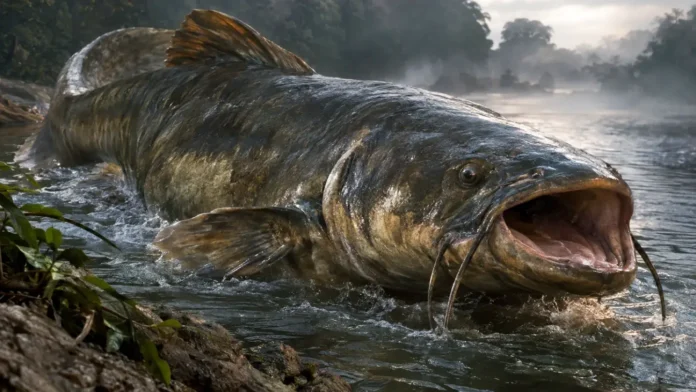
Kimbiji’s earliest documented description emphasizes its enormous size and extraordinary appetite rather than precise anatomy. The creature inhabits a river, seizes domestic animals, overpowers a capable hero, and swallows him.
Its strength exceeds what an ordinary fishing encounter could reasonably explain.
When Kabundungulu and his helpers finally capture Kimbiji, they haul it onto dry land and cut its body open. These actions establish a substantial physical creature, but the narrator does not describe its coloration, scales, fins, teeth, or proportions.
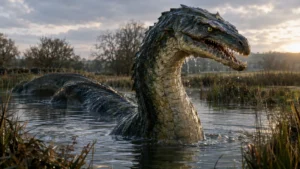
The language of great fish offers the clearest starting point for reconstructing its appearance. Nevertheless, no surviving description establishes a particular fish species, and modern illustrations cannot claim historical accuracy simply because they depict an enormous animal with recognizable aquatic features.
Fish, Crocodile, or Both?
Chatelain’s 1894 account and explanatory notes support a fish-centered interpretation. The name contains terminology associated with large river fish and crocodiles, yet the creature’s behavior and capture do not establish the exact relationship between those animals.
Alice Werner’s 1933 retelling preserves the identification of Kimbiji as a giant fish. Her narrative follows the essential events of Chatelain’s account without introducing a detailed crocodilian anatomy, illustrating how later storytellers could retain the creature’s fish identity.
Clyde W. Ford’s 1999 adaptation takes a different approach, explicitly identifying Kimbiji as a crocodile. Patricia Ann Lynch and Jeremy Roberts also use this interpretation in their 2010 mythology encyclopedia, describing a crocodile associated with the underworld abyss.
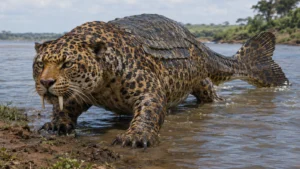
A third possibility appears in contemporary interpretations that combine features of fish and crocodiles. Such representations follow associations suggested by the name, but they remain artistic or scholarly reconstructions unless an independently documented traditional description establishes the combination.
These approaches should not be confused with separate versions of the original folktale. The documented narrative concerns one named predator, while the differences arise primarily through translation, interpretation, and later retelling.
No complete historical anatomical description resolves them.
For a visual reconstruction, the safest approach is a gigantic, threatening aquatic creature with a fish-like body and an otherwise restrained appearance. Crocodilian features may appear in a clearly identified alternative interpretation, rather than as established elements of the original account.
Background Story
Sudika-mbambi enters the world as an exceptional child, speaks at birth, and receives weapons and a life-linked kilembe plant. He leaves his younger twin, Kabundungulu, to watch that plant while he pursues enemies responsible for devastation in his family’s world.
After defeating hostile beings and marrying a woman he has rescued, Sudika-mbambi suffers betrayal from the supernatural companions called Kipalende. They send him into a deep pit, where he discovers a route leading toward Kalunga-ngombe’s country of the dead.
The ruler’s daughter has fallen into the hands of Kinioka kia Tumba, a serpent with multiple heads. Sudika-mbambi confronts the creature, withstands insects that attack him, defeats the serpent, and returns the young woman to her father after the victory.
Kalunga-ngombe then requires another service before granting the marriage. Kimbiji has been taking his goats and pigs from the river, making it a direct threat to the ruler’s household.
Sudika-mbambi asks for a suckling pig and prepares his fishing hook.
He throws the baited hook into the water and waits for the predator to take it. Kimbiji swallows the pig; the hero pulls against the creature’s enormous strength, loses his footing, and falls into the river where his opponent is waiting.
“Kimbiji kia Malenda a Ngandu swallows him.”
Far from that river, Kabundungulu sees his elder brother’s kilembe withered behind the house. The lifeless plant announces disaster before any messenger arrives.
He retraces Sudika-mbambi’s journey, passes into the country of the dead, and learns what swallowed his brother.
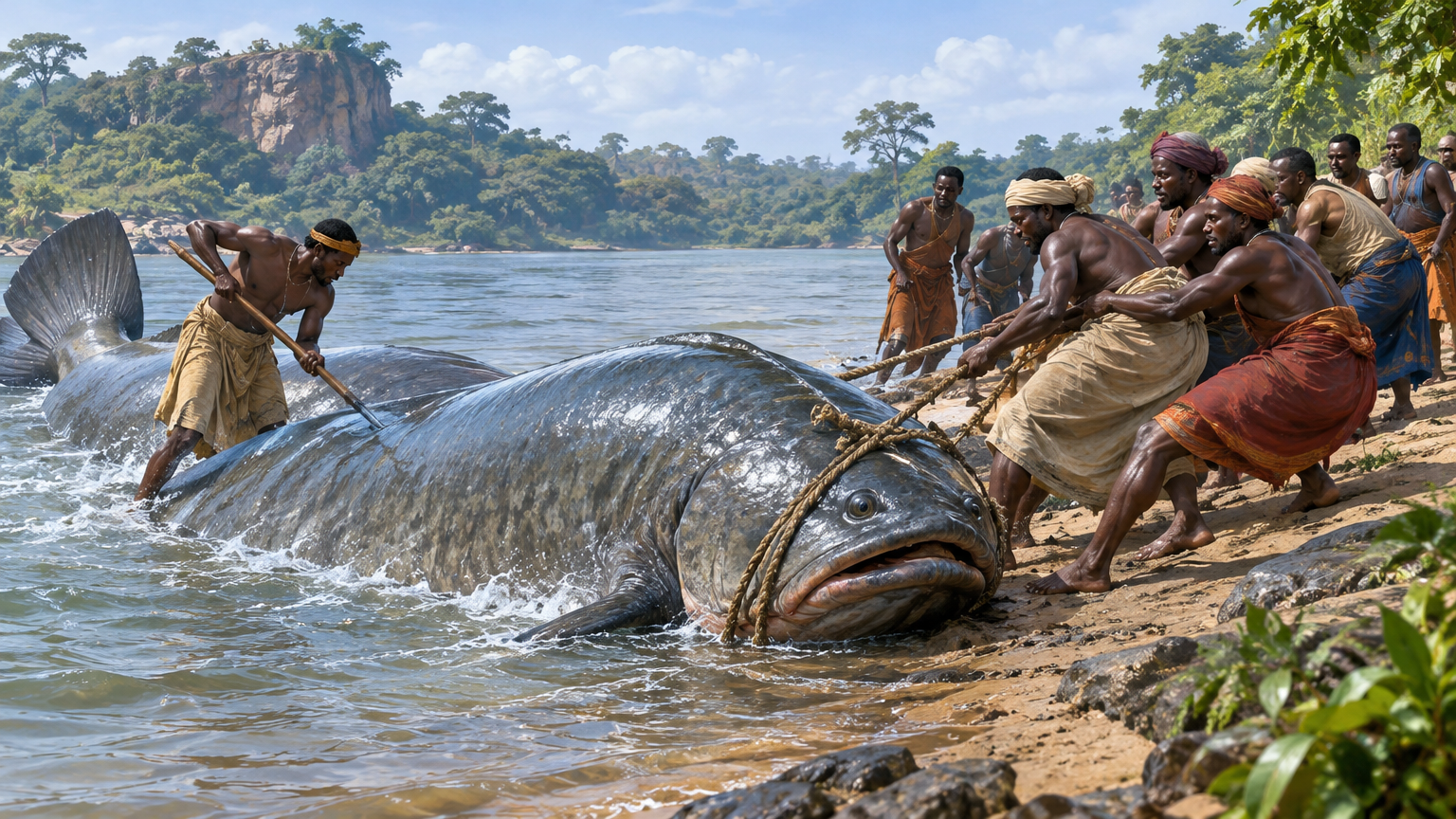
Unlike Sudika-mbambi, Kabundungulu does not try to overcome Kimbiji through individual force. He uses another baited hook, summons people to help pull, and brings the great fish onto dry ground, where he can finally cut its body open safely.
Inside, Kabundungulu discovers his brother’s bones. He gathers them together and calls the lost hero back to life, transforming the monster’s defeat into an act of restoration.
The fish’s end makes it possible for the twins to continue their journey home.
“My elder, arise!”
The brothers depart with Kalunga-ngombe’s daughter, but their return does not conclude the wider tale peacefully. Later conflict divides them, showing that Kimbiji’s defeat resolves one crisis without eliminating the human rivalries that drive the story beyond the underworld and home.
Famous Folklore Stories
The River That Claimed Kalunga’s Animals
In the country of the dead, Kalunga-ngombe faced a danger that threatened his household. Something enormous inhabited the river and repeatedly seized his livestock.
Neither goats nor pigs remained safe near the water, and the ruler wanted the mysterious predator destroyed.
The monster was Kimbiji kia Malenda a Ngandu, whose appetite had turned the river into dangerous territory. When Sudika-mbambi returned from rescuing Kalunga-ngombe’s daughter, the ruler presented another challenge, demanding that the hero confront the creature and stop its attacks.
“who keeps catching my goats and pigs.” (Folk-Tales of Angola, Héli Chatelain, Tale V, “Sudika-mbambi,” 1894, p. 93)
Sudika-mbambi requested a suckling pig and prepared a fishing hook. He intended to entice Kimbiji through its appetite rather than pursue it underwater.
The bait offered an apparently simple solution, drawing the beast toward an encounter on the hero’s terms.
Kimbiji took the bait, swallowing the pig as soon as it reached the hook. Sudika-mbambi attempted to haul the creature from the water, but its strength overwhelmed him.
Instead of capturing his opponent, he lost his footing and fell into the river.
The monster immediately swallowed him, ending a confrontation that had begun with confidence. Chatelain’s explanatory notes describe comparable crocodile-catching hooks made from crossed, sharpened wood, showing how the extraordinary episode incorporated a recognizable fishing technique into its supernatural setting.
The Brother Who Opened the Monster
Kabundungulu’s search led him first to the Kipalendes, the companions who had previously betrayed his elder brother. They denied knowing where Sudika-mbambi had gone, but Kabundungulu suspected their involvement and demanded that they uncover the grave they had concealed from him.
The younger twin entered the opening and followed the hidden road beneath the earth. Along the way, he encountered an extraordinary old woman who worked with her upper body while her lower body remained in the shade.
She directed him onward.
At Kalunga-ngombe’s dwelling, Kabundungulu finally received an answer to his questions. The ruler identified the monster responsible for his brother’s disappearance, revealing that the danger still remained in the river and that no ordinary search could recover the missing hero.
“Kimbiji has swallowed him.” (Folk-Tales of Angola, Héli Chatelain, Tale V, “Sudika-mbambi,” 1894, p. 95)
Kabundungulu requested a pig, baited his hook, and cast it into the river. When Kimbiji swallowed the hook, he called people to assist him.
Together, they dragged the enormous creature onto dry ground, accomplishing what his powerful elder brother could not.
The younger twin opened Kimbiji with his knife and discovered Sudika-mbambi’s bones inside. He gathered the remains, commanded his brother to rise, and witnessed his restoration.
The episode ends the monster’s threat while establishing Kabundungulu’s power to recover a life seemingly lost.
Cultural Impact
Kimbiji survives in published Angolan folklore through its place in a substantial heroic narrative, rather than through an independently documented tradition of monster worship. Its appearance illustrates how storytellers could transform recognizable environments and dangerous animals into obstacles of supernatural proportions.
The tale also demonstrates the importance of cooperation within its narrative world. An exceptional individual fails against the predator, while a second hero succeeds through collective effort.
This contrast offers a possible reading of communal strength without establishing a specific traditional moral.
Scholars have continued examining Sudika-mbambi through comparative mythology, narrative structure, and the preservation of African oral literature. These studies give Kimbiji a modest but identifiable literary legacy, even though the creature remains far less prominent than internationally familiar mythological monsters.
Similar Beasts
Kinioka kia Tumba
Another adversary within the Sudika-mbambi narrative, Kinioka is a many-headed serpent that holds Kalunga-ngombe’s daughter captive. Both creatures challenge the hero in the underworld, although Kinioka tests his combat abilities while Kimbiji defeats him through overwhelming physical strength.
Khodumodumo (Kammapa)
In Basotho folklore, Khodumodumo is an enormous swallowing monster that consumes entire communities. The hero Litaolane enters its body and frees its victims.
Like Kimbiji, the creature connects monstrous consumption with an extraordinary rescue, although the two narratives differ considerably.
Lingongole
Lingongole, a great water serpent recorded in traditions from western Zambia, shares Kimbiji’s association with dangerous waters and supernatural geography. Comparative scholar Wim van Binsbergen discusses these aquatic beings together, without establishing that they represent the same creature or tradition.
The Great Fish of Jonah
In the biblical Book of Jonah, a great fish swallows the prophet, who survives inside before returning to land. Both narratives use swallowing and release to explore extraordinary survival, although Jonah’s experience has a different theological purpose.
Religion and Ritual
Kimbiji belongs to a narrative situated within Kalunga-ngombe’s country of the dead. This supernatural setting connects its appearance with questions about mortality and the boundary between living and deceased people, but does not establish the creature as a deity or ancestor.
The surviving tale describes no offerings, shrines, initiation ceremonies, sacrifices, or protective practices dedicated to Kimbiji. Its role concerns a dangerous encounter and subsequent rescue.
Claims that Angolan communities worshipped the monster would therefore exceed the available historical evidence.
The life-linked kilembe and the restoration of a dead hero introduce supernatural elements deserving separate cultural investigation. However, neither proves that the monster belonged to an organized ritual system.
Kimbiji’s documented significance remains primarily within the tale’s symbolic geography and narrative action.
Scientific or Rational Explanations
Kimbiji’s name provides the strongest naturalistic clue. Chatelain identified elements referring to a large fish, a prominent river fish near Malanje, and the crocodile.
These terms suggest that familiar aquatic predators contributed to the creature’s imaginative identity, without identifying one biological species.
The fishing episode offers a more concrete connection with practical knowledge. Chatelain described crocodile-catching methods involving sharpened wooden hooks and animal bait.
Such techniques could produce dangerous struggles, particularly when a powerful animal resisted capture and pulled against the fishing line.
The swallowing of a human hero and the recovery of his bones through supernatural restoration belong to folklore rather than zoological observation. River dangers may help explain the imagery, but no evidence establishes an actual animal encounter as the historical origin of Kimbiji’s story.
Modern Cultural References
Kimbiji has received limited attention as an independent character in modern entertainment. Its documented appearances mainly occur in retellings of Sudika-mbambi, where authors preserve the episode while sometimes changing the creature’s classification, narrative emphasis, or intended audience.
The following examples reproduce or adapt the creature’s actual encounter with Sudika-mbambi. Academic comparisons, encyclopedic descriptions, and linguistic reference entries are excluded here because they analyze the tradition rather than presenting independent narrative adaptations.
The Hero with an African Face: Mythic Wisdom of Traditional Africa by Clyde W. Ford, Bantam Books, 1999.
Ford retells Sudika-mbambi’s underworld adventure, identifying Kimbiji as a crocodile and emphasizing the hero’s defeat and his brother’s extraordinary restoration of life.
Source: https://www.penguinrandomhouse.com/books/54400/the-hero-with-an-african-face-by-clyde-w-ford/
O Griot e as Narrativas de Tradição Oral na Sala de Aula by Márcia Helena do Nascimento and Nelson Martinelli Filho, Instituto Federal do Espírito Santo, 2021.
This Brazilian educational publication includes a Portuguese version of Ford’s Sudika-mbambi adaptation, preserving Kimbiji’s crocodilian identity and the rescue within classroom activities about African storytelling.
Source: https://educapes.capes.gov.br/bitstream/capes/701620/2/Produto%20Educacional%20-%20Marcia%20Helena%20final%20-%20Copia.pdf
Sudika-Mbambi and Kabundungulu: A Kimbundu Folktale of Courage, Betrayal, and the Division of Brothers by Ayomide Adekilekun, OldFolklore, undated.
This contemporary English retelling presents Kimbiji as a beast of the waters, retaining the brothers’ encounter and miraculous rescue without introducing a detailed crocodilian description.
Source: https://oldfolklore.com/africa/african-folktales/sudika-mbambi-and-kabundungulu-a-kimbundu-folktale-of-courage-betrayal-and-the-division-of-brothers/
Conclusion
Kimbiji kia Malenda occupies a distinctive place in Angolan folklore as an immense aquatic predator encountered in the country of the dead. Its significance rests on a documented heroic narrative, rather than an extensive collection of independent legends or supernatural powers.
The surviving evidence supports several interpretations of its identity. Chatelain’s terminology and Werner’s retelling favor a giant fish, while Ford and later authors emphasize crocodilian characteristics.
These differences reflect identifiable sources and interpretations, not necessarily competing traditional accounts.
Understanding Kimbiji therefore requires distinguishing what the original narrative establishes from what later writers propose. Its appearance remains uncertain, but its narrative role is clear: an overwhelming predator whose defeat allows an extraordinary rescue and restoration of life.
Further Reading
Folk-Tales of Angola by Héli Chatelain, American Folk-Lore Society, 1894.
The essential primary source containing the Kimbundu narrative, English translation, and original linguistic notes.
Source: https://archive.org/details/folktalesofangol00chat
Kimbiji, Kimbundu Dictionary, based on Assis Júnior, 1940s.
Defines Kimbiji as a large fish and provides examples from the original folktale.
Source: https://www.kimbundu.org/en/word/kimbiji
Málenda, Kimbundu Dictionary, based on Assis Júnior, 1940s.
Records geographical and mythological meanings, including an underworld river associated with dangerous aquatic creatures.
Source: https://www.kimbundu.org/en/word/malenda
Myths and Legends of the Bantu by Alice Werner, 1933.
Chapter VIII preserves a historical retelling of Sudika-mbambi and identifies Kimbiji as a giant fish.
Source: https://sacred-texts.com/afr/mlb/mlb10.htm
African Mythology A to Z, Second Edition by Patricia Ann Lynch and Jeremy Roberts, Chelsea House, 2010.
A modern reference work documenting the later crocodilian interpretation of Kimbiji within Sudika-mbambi’s adventures.
Source: https://www.infobasepublishing.com/Bookdetail.aspx?ISBN=1604134151&eBooks=0
The Continuity of African and Eurasian Mythologies by Wim van Binsbergen, New Perspectives on Myth, 2010.
Offers comparative interpretations of the monster’s name and discusses similarities with other regional aquatic beings.
Source: https://www.quest-journal.net/PIP/New_Perspectives_On_Myth_2010/New_Perspectives_on_Myth_Chapter9.pdf
A Milenar Arte da Oratura Angolana e Moçambicana by Susana Dolores Machado Nunes, CEAUP, 2009.
Examines Angolan narrative structures, including Sudika-mbambi’s confrontation with Kimbiji and his brother’s intervention.
Source: https://africanos.eu/images/publicacoes/livros_electronicos/EB015.pdf