Introduction
Makara is a legendary aquatic creature of South Asian religious traditions, known by a Sanskrit name and represented in Hindu, Buddhist, and Jain contexts. It is best understood as a water monster with variable forms, rather than a single animal with an established anatomy.
Some representations are distinctly crocodilian; others combine crocodile and fish features or introduce parts of land animals. These differences belong to the documented tradition itself.
The familiar elephant-trunk-and-fish-tail image is one representation, not a definition that applies to every Makara.
Its importance extends beyond its unusual appearance. Associated with water, fertility, and divine power, Makara appears as a deity’s vehicle and as an architectural ornament.
Its presence in religious art can be auspicious, despite the formidable jaws visible in some surviving images.
Early terracotta objects and later temple reliefs preserve different stages of this visual tradition. Together with Sanskrit vocabulary and religious literature, they reveal a creature whose aquatic identity remains recognizable even as its body, setting, and symbolic role change between particular works.
History/Origin
Makara imagery is securely documented in ancient Indian material culture, although the surviving evidence does not establish its ultimate origin. An early example is a terracotta object from Uttar Pradesh, probably Kaushambi, dated to the second or first century BCE and catalogued as a toy.
This object, now in the Metropolitan Museum of Art, combines crocodile and fish characteristics. Its early date matters: composite anatomy was already present in ancient Makara imagery, rather than being exclusively a late elaboration of an originally uniform crocodile form.
The early Buddhist artistic setting also associates Makara with nature deities. This connection helps explain why an aquatic monster could belong within sacred imagery without functioning simply as an enemy.
Its religious significance included the powers of the natural world, not merely predation.
By the Gupta period, Makara had a documented place in temple decoration. A terracotta relief preserved in the Ashmolean dates from the second half of the fourth to the first half of the fifth century CE.
Its animal body develops into ornamental vegetation.
A fifth- to sixth-century terracotta image of Ganga provides another chronological anchor. Here, Makara serves as the river goddess’s vehicle and is identified as a crocodile.
The image demonstrates that recognizably crocodilian forms continued alongside more overtly composite or ornamental treatments.
These examples establish a long visual history, but they should not be arranged into an inevitable progression from realistic animal to fantastic monster. Different forms served different settings.
Nor does Makara’s association with Varuna, a deity with Vedic roots, independently establish a precise Vedic origin for the creature.
Name Meaning
The Sanskrit word makara, written मकर, has a broader meaning than any single modern animal name. “Sea monster” or “aquatic monster” provides a useful starting point, while “crocodile” fits particular textual and artistic contexts.
The shorter spelling Makar also occurs in transliteration.
Monier-Williams’s Sanskrit-English Dictionary records competing identifications, including crocodile, shark, and dolphin. These alternatives show why translating the word requires attention to context.
They do not establish that every Makara image combines those animals, or that one identification explains the entire tradition.
A gloss meaning “that which harms human beings” appears in Swami Harshananda’s modern reference account. It should be treated as that account’s explanation, not as a settled historical derivation.
The documented range of meanings is firmer evidence than a seemingly definitive literal translation.
Makara also names the tenth sign of the zodiac, corresponding to Capricorn. This is a distinct astrological use of the same word.
A reference to Makara in a calendrical or astronomical setting therefore need not describe a mythological animal, a sculptural image, or a particular narrative.
Appearance
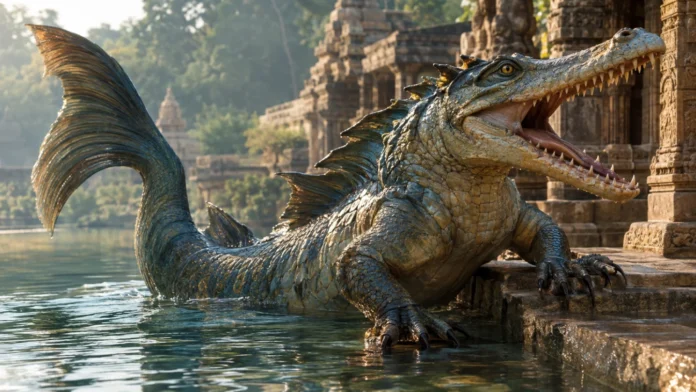
Makara’s most consistent physical characteristic is its aquatic identity, not a fixed arrangement of limbs and tail. Crocodilian jaws, fish-like hindquarters, animal foreparts, and ornamental vegetation occur in documented representations, but they should not all be assembled into one supposedly canonical creature.
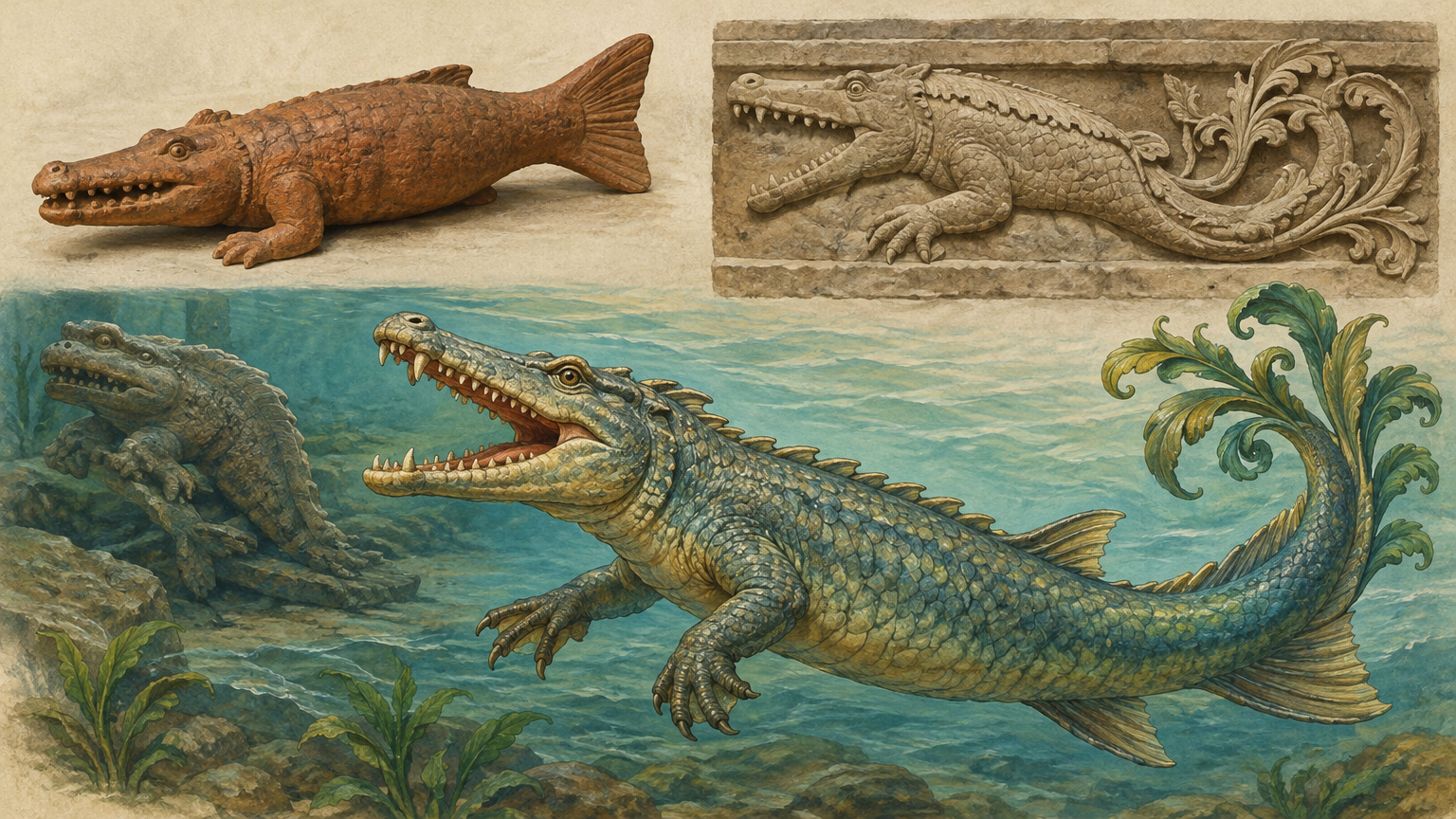
The early terracotta toy from Uttar Pradesh supplies a concrete crocodile-and-fish example. This combination brings together features of two aquatic animals without requiring an elephant trunk or antelope head.
It is a historically grounded form in its own right, rather than an incomplete version of another design.
The Gupta-period Ashmolean relief presents gaping jaws and forefeet, followed by a tail that transforms into curling vegetal scrollwork. Its anatomy passes directly into ornament.
In this example, the connection with water and fertility is expressed through both the animal and the plant forms.
Other images remain closer to a crocodile, including the Makara beneath Ganga in the fifth- to sixth-century terracotta sculpture. Such examples are important counterweights to modern illustrations that always emphasize hybrid anatomy.
A crocodilian appearance is part of the religious image tradition, not necessarily a departure from it.
Two reference accounts preserve further alternatives. W. J. Wilkins’s nineteenth-century description gives Varuna’s Makara an antelope head and forelegs with a fish body and tail.
Harshananda’s later account includes the elephant-trunk-and-fish-tail form. Each records a variant, rather than supplying missing parts of a universal anatomy.
Background Story
Makara’s background is chiefly a network of aquatic symbolism, divine associations, and artistic conventions, rather than a continuous personal biography. The surviving evidence presents a recurring kind of creature whose significance depends on its relationship to water, a deity, or an architectural setting.
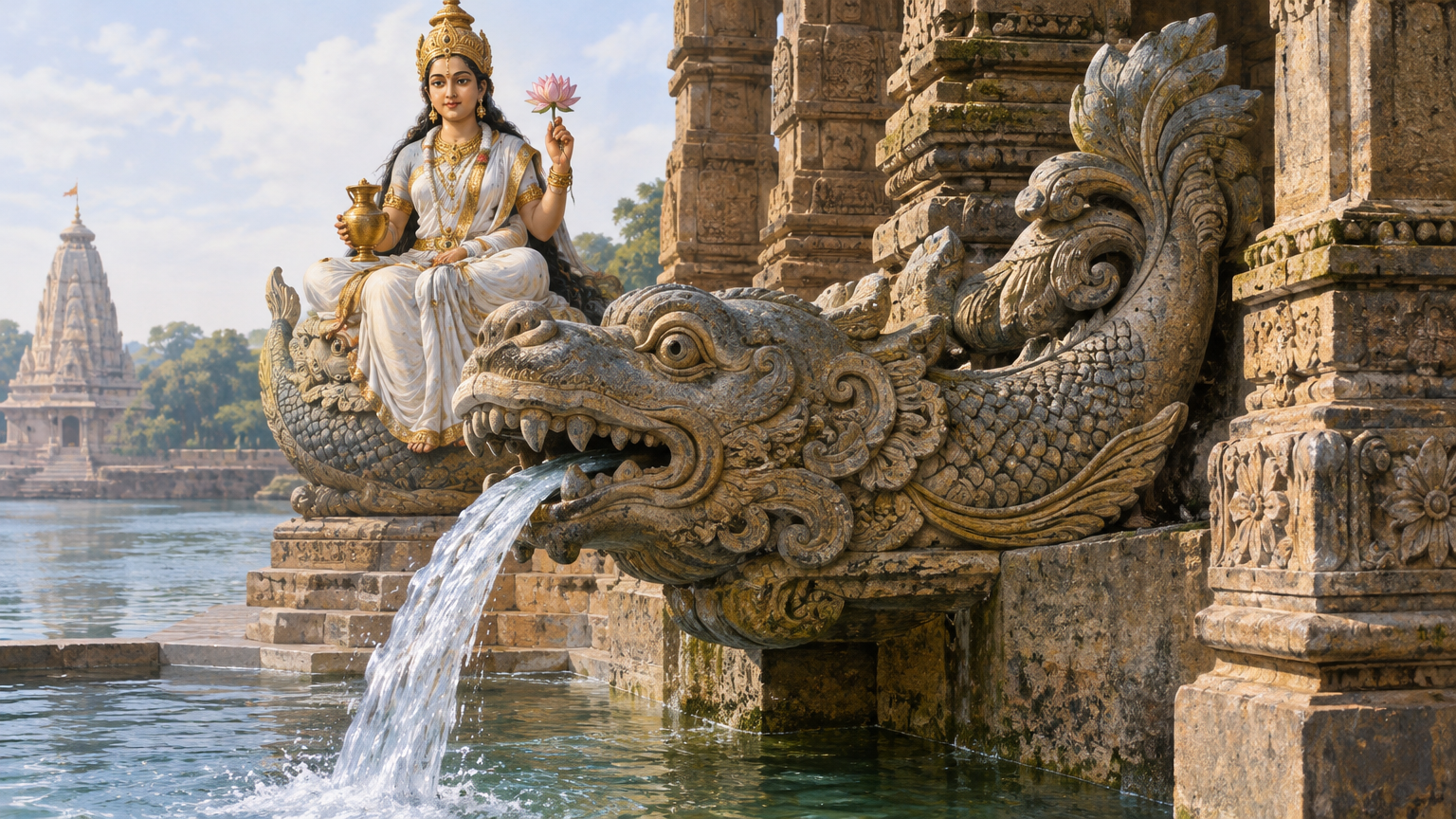
Water and fertility provide a particularly clear connection. The auspicious Makara of temple art can embody the productive qualities of water even when its jaws appear threatening.
The vegetal tail of the Gupta relief makes this association especially visible by joining aquatic animal imagery with growing forms.
As Ganga’s vehicle, or vāhana, Makara belongs to the imagery of the sacred river personified as a goddess. The relationship gives the creature a role beyond independent monsterhood: it becomes part of the visual expression of the deity and her watery domain.
Varuna’s association supplies another divine context, while early Buddhist connections with nature deities show that Makara imagery was not confined to one religious setting. A Makara-shaped temple waterspout documented by Bihar Museum also brings the aquatic creature into a practical architectural relationship with flowing water.
A related narrative requires a distinction. In the Bhāgavata Purāṇa’s account of Gajendra, a crocodile seizes the elephant king in a lake.
The prolonged struggle leads Gajendra toward divine help. The episode makes an aquatic predator central to a story of vulnerability and dependence.
However, the chapter calls the attacker grāha, rendered as crocodile, rather than establishing Makara as its proper name. Later summaries sometimes use Makara for this opponent.
That association belongs to the creature’s wider reception, but the narrative crocodile should not define every Makara image or divine vehicle.
Famous Folklore Stories
The Gajendra Episode (Gajendra Mokṣa)
Gajendra, king of the elephants, encounters a crocodile while entering a lake in the Bhāgavata Purāṇa. The animal seizes him, beginning a prolonged struggle.
His strength cannot secure his freedom, and the episode moves toward his appeal for divine help.
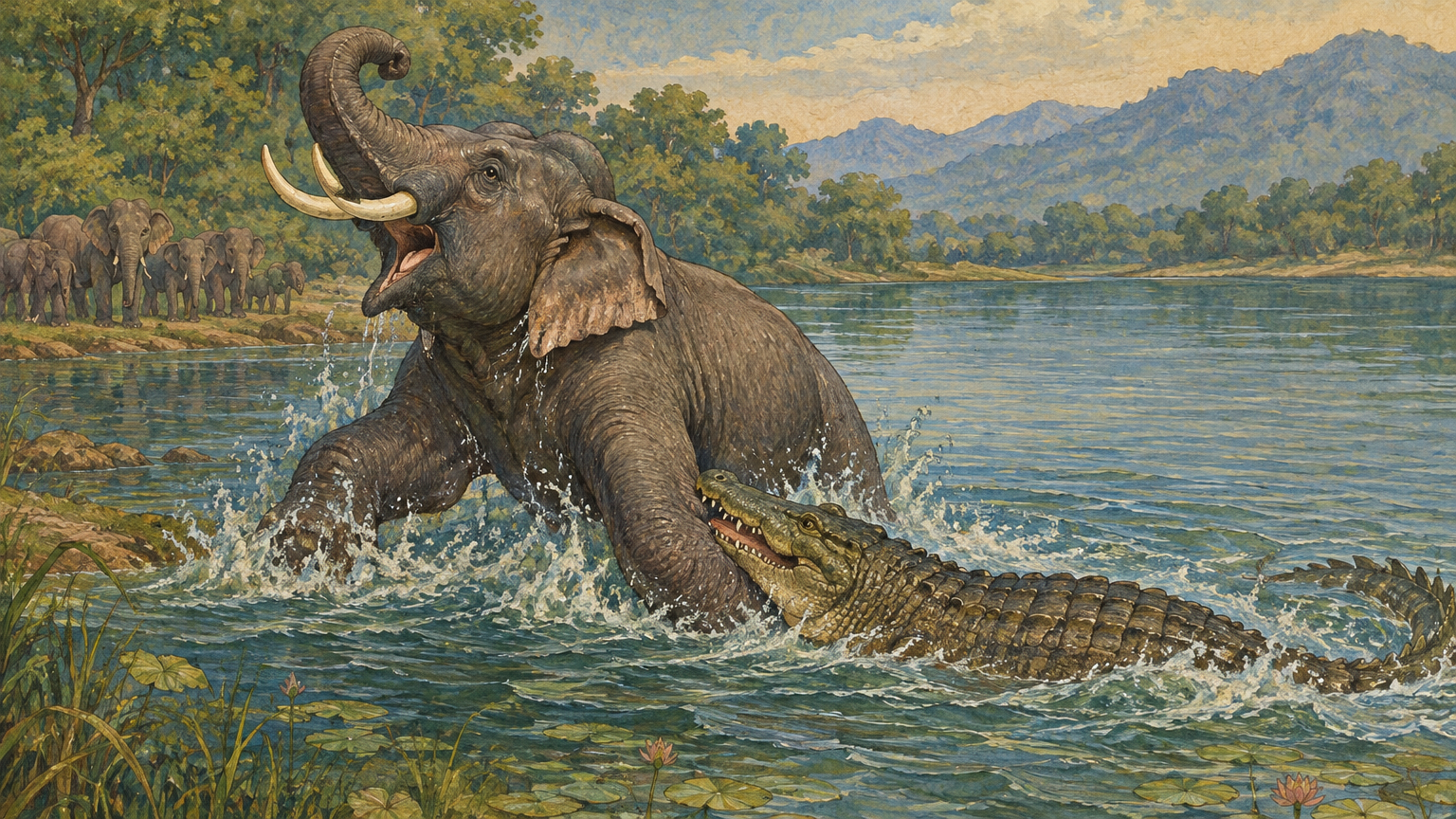
The distinction between this attacker and the wider Makara tradition matters. In the consulted Sanskrit chapter, the animal is called grāha and translated as crocodile.
Later summaries sometimes identify it as Makara, but that identification should not replace the wording of this particular account.
The episode therefore belongs here as a qualified narrative association, not as proof that every Makara is Gajendra’s opponent. Its threatening lake animal also contrasts with the auspicious aquatic creatures of temple sculpture, showing why narrative role and sculptural symbolism must remain distinct.
Varuna’s Aquatic Mount
Varuna seated upon a Makara is a documented religious motif rather than a separately titled folktale. The pairing connects the deity with a fabulous marine creature, making the animal’s aquatic character central to its role rather than presenting it as an independent story protagonist.
W. J. Wilkins’s 1882 account gives this mount an antelope’s head and forelegs, joined to a fish’s body and tail.
This particular description preserves a composite variant; it should not be substituted for the crocodilian forms documented in other religious images.
Cultural Impact
Makara’s cultural importance extends beyond storytelling into the visual organization of sacred buildings. Temple reliefs and architectural carvings made the creature a recurring expression of aquatic abundance.
Its significance depended on placement, accompanying figures, and artistic treatment, not merely on recognition of a fantastic animal.
A Gupta-period terracotta relief gives especially clear evidence of this relationship between form and meaning. Its Makara has open jaws and forefeet, while its tail becomes curling vegetal ornament.
The combination brings aquatic life and plant growth together within an auspicious image associated with water and fertility.
Architectural use could also unite symbolism with practical function. A Makara-shaped temple waterspout documented by the Bihar Museum channels water through the creature’s sculpted form.
Here, water is not simply represented by an animal emblem: it becomes part of the carving’s actual operation within the building.
The surviving material is not restricted to monumental sculpture. An early terracotta object catalogued as a toy, dated to the second or first century BCE, presents a crocodile-and-fish Makara.
Its small scale broadens the surviving record beyond temple reliefs, although its original handling and audience remain less certain.
Modern museum interpretation usefully distinguishes these individual objects instead of reconstructing one supposedly standard creature. Read together, the toy, temple plaque, deity image, and waterspout reveal a flexible visual tradition.
Their differences are evidence of Makara’s artistic range, not defects requiring a single corrected reconstruction.
Similar Beasts
Lóng (Dragon)
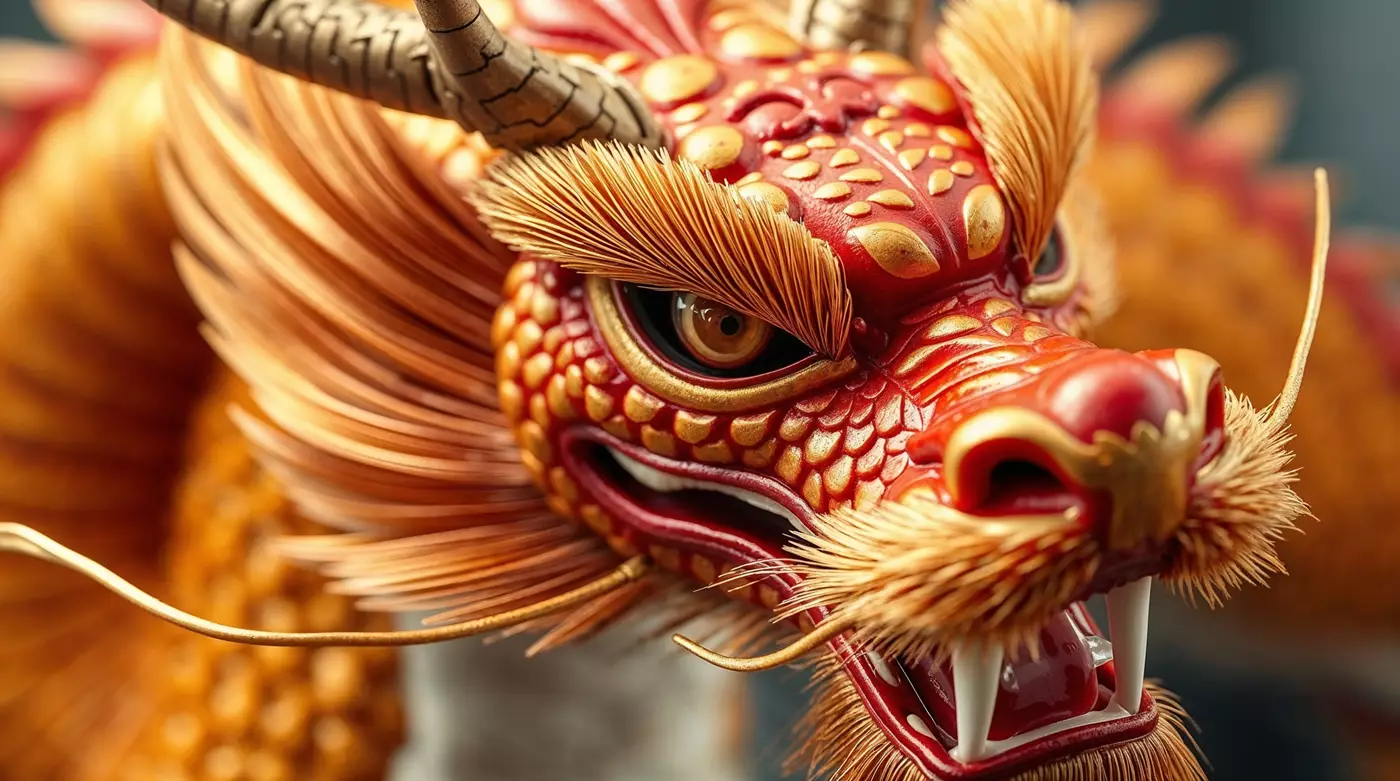
The Chinese Lóng is a supernatural dragon associated with water, storms, fortune, and celestial power. Its religious and symbolic importance extends beyond the role of a frightening monster.
Its strongest parallel with Makara is the connection between water and auspicious power. Neither shared symbolism nor an animal-like form establishes a common origin.
Rainbow Serpent
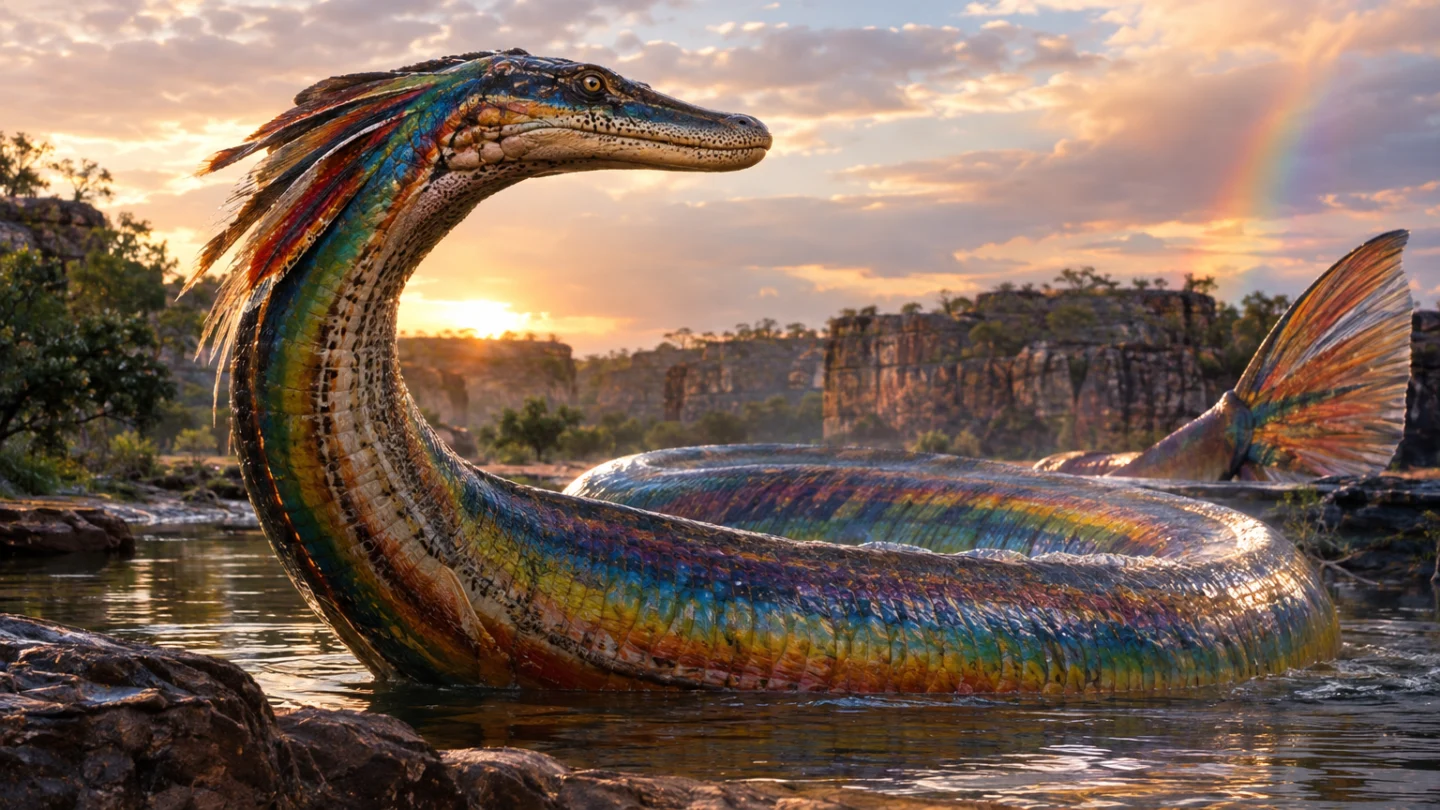
Rainbow Serpent traditions concern powerful beings associated with water, fertility, and the shaping of landscapes in Aboriginal Australian cultures. These traditions are diverse rather than one uniform mythology.
Water and fertility provide the comparison with Makara. The distinction is substantial: landscape-shaping creator roles should not be transferred to Makara’s documented sculptural and deity-associated forms.
Read more about Rainbow Serpent
Leviathan

Leviathan is an immense biblical sea creature whose portrayals include an armored, untamable being and a many-headed monster. Divine power contains or defeats it in different textual settings.
Both figures show how aquatic creatures can carry religious meaning beyond ordinary zoology. Leviathan’s associations with chaos contrast with Makara’s frequently auspicious role in temple art.
Yali
Yali is a distinct mythical creature represented in temple art. Its comparison with Makara is particularly relevant to architectural sculpture, where fantastic animal forms carry meaning alongside ornamental functions.
The Bihar Museum compares Yali imagery with a Makara waterspout carving. This is an architectural and visual relationship, not evidence that Yali is another Makara name.
Religion/Ritual
Makara serves as Ganga’s vāhana, or divine vehicle, in a fifth- to sixth-century terracotta image. The crocodilian creature helps identify the river goddess and expresses her aquatic association.
This is a documented iconographic relationship, rather than evidence of a separate cult devoted to the animal.
Other religious settings give Makara related but distinct roles. Varuna’s mount connects it with divine authority over waters, while early Buddhist art associates it with nature deities.
These examples establish a presence across religious contexts without requiring identical meanings or practices in every setting.
The available evidence establishes sacred imagery more securely than direct observance: it does not document Makara-specific offerings, taboos, or ceremonies. Makara also names Capricorn, the tenth zodiac sign, but that astrological usage must be distinguished from worship involving an image of the aquatic creature.
Scientific or Rational Explanations
Makara is best approached as a legendary aquatic creature represented through language, religious imagery, and artistic convention. The surviving objects establish that people depicted it, not that a corresponding composite species existed.
No zoological identification accounts for the full range of documented forms.
Historical vocabulary itself resists a single-species explanation. The Monier-Williams Sanskrit-English Dictionary records a broad marine-monster meaning alongside proposed identifications including crocodile, shark, and dolphin.
These alternatives demonstrate the word’s interpretive range; they are not observations establishing that all three animals contributed to its original conception.
Crocodilian comparisons are nevertheless well grounded in particular cases. Ganga’s terracotta vehicle is identified as a crocodile, and the early toy combines crocodile and fish features.
Such evidence supports recognizable animal elements without making the crocodile the exclusive explanation for every Makara image.
Other features make more sense as artistic composition than as anatomical description. A tail transformed into vegetal scrollwork joins creature and ornament within the same relief.
Interpreting that feature through water-and-fertility symbolism fits its documented context better than treating it as a misunderstood biological structure.
Architecture supplies another concrete explanation for the creature’s treatment. A waterspout must conduct water, and its sculpted aquatic form gives that function a meaningful visual setting.
This explains a particular use of Makara imagery, although it does not explain the origin of the whole tradition.
A careful interpretation therefore separates three questions: what a text calls an aquatic animal, how an artist constructs its body, and what the image does in its setting. Keeping these questions distinct preserves the evidence without reducing religious symbolism to zoology or turning artistic variation into biological speculation.
Modern Cultural References
Makara appears in contemporary fiction, folded-paper design, and digital art. These works adapt the legendary aquatic creature for different audiences and media; their individual designs should not be mistaken for a single traditional or universally accepted appearance.
Aru Shah and the End of Time, novel (2018)
Roshani Chokshi’s novel brings South Asian mythology into a contemporary fantasy adventure.
A large, blue crocodile-fish makara guards the entrance to the Court of the Sky.
(books.google.com)
The Makara: A Game-Design Model, artwork
Ramanujam Sudharsanan’s physical origami model presents a creature design through folded paper.
The work explicitly takes Makara as its subject, translating the aquatic being into three-dimensional form.
(aegisdigitalmuseum.kennesaw.edu)
Makara dance, artwork (2019)
Pich Toch’s digital artwork develops a visual concept around a Makara-inspired dance. It makes the creature an explicit subject of contemporary artistic interpretation rather than reference illustration.
(artsy.net)
Conclusion
Makara is best understood as a legendary aquatic creature whose identity accommodates several visual traditions, not as a monster with one fixed anatomy. Crocodilian forms and composite bodies both belong to its documented history.
Its associations with divine vehicles, temple ornament, water, and fertility explain why it matters beyond the category of a dangerous beast. Across these settings, the creature connects the animal world with religious symbolism, giving water a recognizable yet imaginatively transformed presence in sacred art.
That diversity also calls for careful distinctions. A particular sculpture’s features should not define every Makara, the crocodile in the Gajendra episode should not automatically become its universal narrative identity, and the zodiac name remains a related but separate usage.
The tradition’s strength lies in this range of meanings and representations. Early objects, temple imagery, and contemporary creative adaptations together show how an aquatic monster can remain culturally recognizable without acquiring a single standardized body or one definitive story.
Further Reading
W. J. Wilkins, Hindu Mythology, Vedic and Purānic, En.wikisource
A 19th-century account describes Varuna seated on a fabulous marine Makara, whose particular form has antelope head and forelegs and a fish body and tail.
This is a.
(en.wikisource.org)
Bhāgavata Mahā Purāṇa, Eighth Skanda, chapter 2, Vedic People edition, Vedicpeople
In the Bhāgavata Purāṇa account, a crocodile seizes Gajendra, king of the elephants, while he is in a lake.
After a prolonged struggle, Gajendra turns to divine help.
(vedicpeople.com)
The Makara: A Game-Design Model, aegisdigitalmuseum.kennesaw.edu
artwork A documented physical origami model depicts the Makara as a designed creature, rather than merely describing it in a reference entry.
(aegisdigitalmuseum.kennesaw.edu)
Makara dance, artsy.net
artwork 2019 A digital artwork explicitly depicts a Makara-inspired dance and identifies the creature as the subject of the visual concept.
(artsy.net)
Plaque with a makara, or aquatic monster, Ashmolean Museum
Documents a Gupta-period temple relief and explains its particular form and water-and-fertility symbolism.
(jameelcentre.ashmolean.org)
Ganga, National Museum, New Delhi, via Museums of India
Catalogues a 5th–6th-century terracotta Ganga image with Makara as her vehicle.
(museumsofindia.gov.in)
makara, Monier-Williams Sanskrit-English Dictionary, Sanskrit Dictionary
Provides historical lexicographic evidence for the broad marine-monster sense, recorded animal identifications, and zodiac usage.
(sanskritdictionary.com)