Introduction
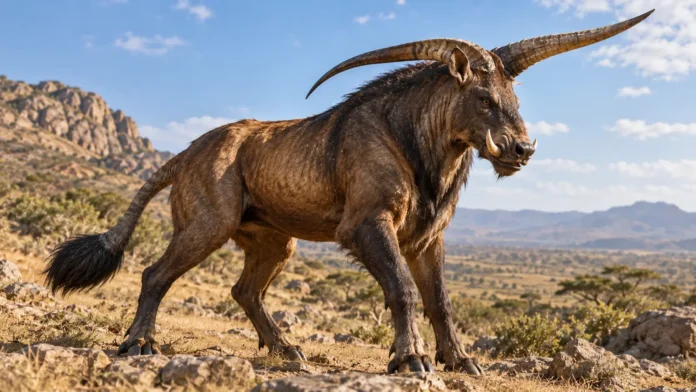
The yale is a legendary beast first documented in Roman natural-history writing as an animal reported from Ethiopia. Its earliest surviving description combines a hippopotamus-sized body, an elephant’s tail, boar-like jaws, and exceptionally long horns that could be moved independently during combat.
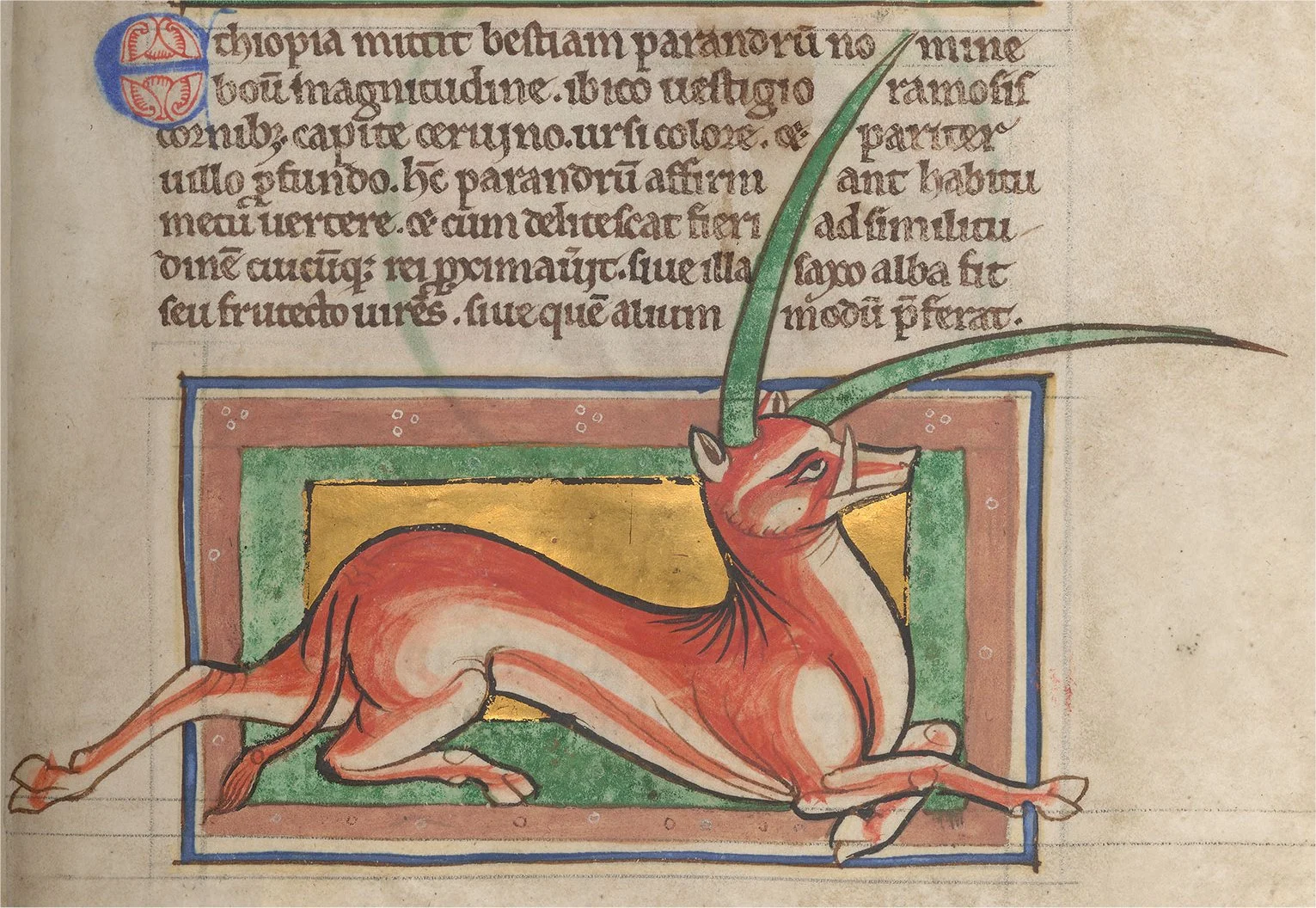
Known in Latin as the eale, it later entered medieval European bestiaries and heraldry. Its defining feature was not simply having horns, but controlling their position: one could face an opponent while the other remained held back, ready for use.
The creature’s appearance changed during transmission. Medieval accounts commonly reduced its size to that of a horse, while some altered its jaw anatomy.
These differences belong to distinct textual versions, rather than forming a single, consistent description shared across the tradition.
The yale therefore belongs primarily to the history of learned animal lore and its artistic adaptation. Ethiopia is its reported habitat in the earliest account, not proof of an independently documented Ethiopian folklore tradition or of an animal observed by the Roman author.
History/Origin
The earliest recovered account appears in Pliny the Elder’s Natural History, Book 8, section 73, written in the first century CE. The eale occurs among descriptions of animals associated with Ethiopia, within an extensive compilation concerned with the variety of the natural world.
This setting matters because the yale initially appears as a reported animal, not as a supernatural antagonist in a hero’s adventure. Its unusual anatomy and fighting behavior supply the substance of the entry.
Pliny’s description establishes the earliest textual baseline, without independently verifying the creature’s existence.
The animal subsequently passed into medieval bestiary literature. These books brought together descriptions of familiar and extraordinary creatures within a Christian framework of knowledge and interpretation.
The yale’s survival in this setting reflects the transmission of inherited animal lore rather than a newly documented encounter.
British Library Additional Manuscript 11283, dated about 1180, preserves a particularly useful comparison. Its yale is horse-sized and black, retaining the elephant’s tail and boar’s jaw.
The altered scale shows that medieval transmission could preserve distinctive features while changing other parts of the description.
An English bestiary dated about 1200–1210 also depicts the yale, as discussed in the Getty’s Book of Beasts exhibition material. This manuscript evidence demonstrates its visual as well as textual circulation: artists had to give visible form to the extraordinary movable horns.
The later heraldic tradition developed another setting for the animal. George C. Druce’s 1911 study, Notes on the History of the Heraldic Jall or Yale, compared manuscript and heraldic examples, treating their differences as evidence of historical development rather than a fixed zoological identity.
Name Meaning
The earliest securely documented name is the Latin eale, used in Pliny’s account. Yale is the familiar later English form, while jall also occurs in the historical naming tradition.
These forms identify the transmitted beast more securely than they explain its original meaning.
A proposed connection links yale with Hebrew yael, meaning “ibex.” This is an uncertain etymological interpretation found in later reference material, not an established derivation.
Resemblance between names does not by itself demonstrate how the word entered Latin or reached medieval European usage.
The proposed ibex connection must also remain separate from identification of the creature. Even if a linguistic relationship were demonstrated, it would not establish that Pliny intended an ordinary ibex.
His account combines several animal comparisons with the distinctive claim of independently movable horns.
Centicore is another name associated with the yale in medieval contexts, including a French-manuscript variant discussed by Druce. It is best understood here as part of the creature’s changing literary vocabulary, not as evidence for a universally accepted translation or a second, clearly separate species.
Appearance
In its earliest recorded form, the yale is a large quadruped comparable in size to a hippopotamus. That comparison establishes scale, not necessarily an exact hippopotamus-shaped body.
Its other principal features are an elephant-like tail, boar-like jaws, and a dark or tawny coloration.
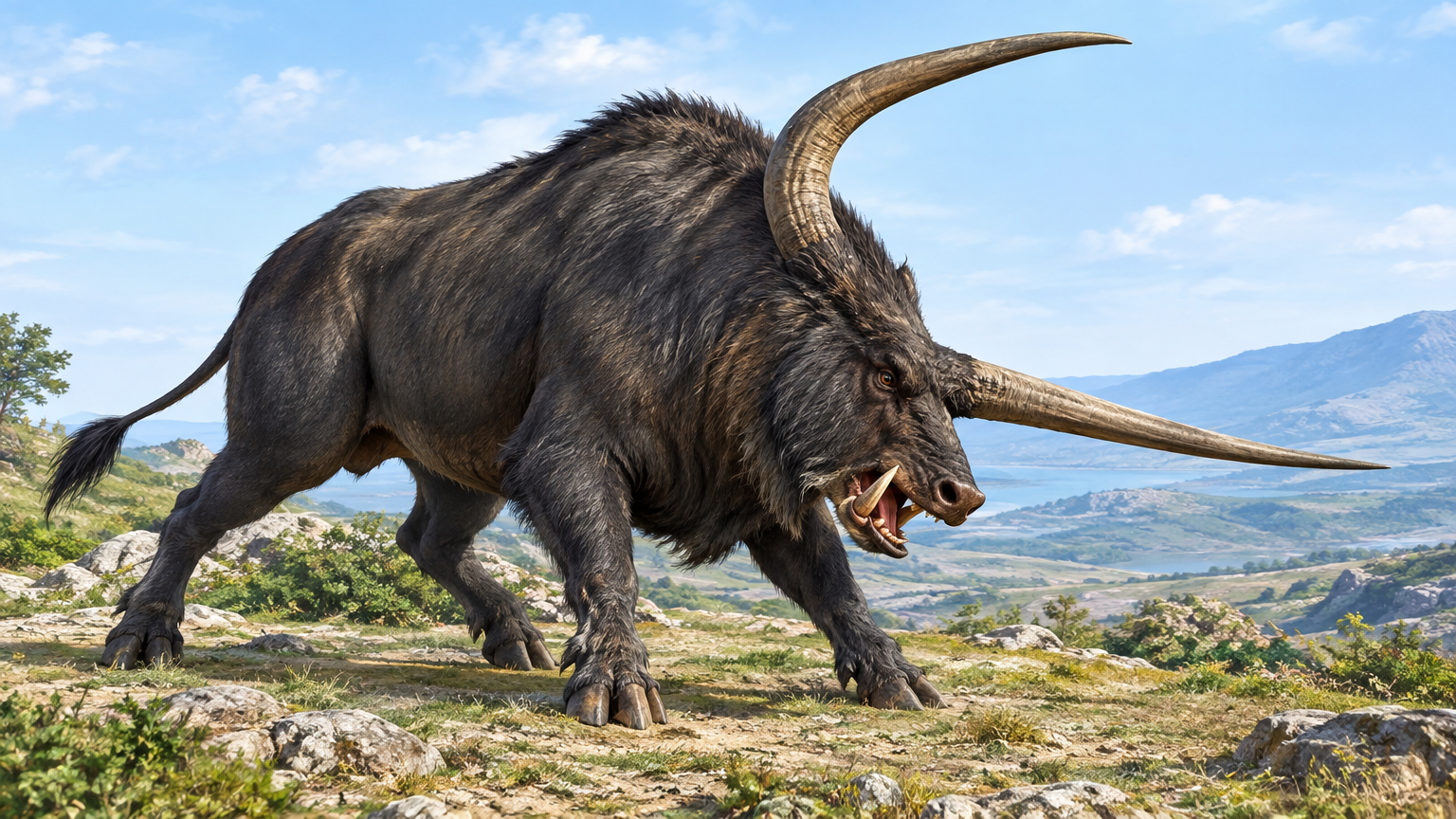
The horns are the decisive feature. They are exceptionally long and can be repositioned, allowing the animal to present them alternately or alter their angle during a fight.
Their mobility distinguishes the yale from an ordinary horned mammal and remains recognizable despite changes elsewhere in its anatomy.
The medieval account preserved in the manuscript of about 1180 describes a black animal the size of a horse. It retains the elephant’s tail and boar’s jaw, making this a recognizable adaptation of the older description rather than an entirely unrelated creature sharing its name.
Jaw anatomy was not consistent across medieval versions. The Rochester Bestiary transcription gives caprine, or goat-like, jaws, contrasting with the boar-like jaws in Pliny and the manuscript of about 1180.
That variant should not silently replace the earlier description or be treated as universal.
The fighting posture offers the clearest way to recognize the beast in an illustration: one horn is directed toward an adversary while the other is held back. This arrangement makes an unusual behavior visible, rather than merely adding ornamental horns to a generic animal body.
No single silhouette represents every period accurately. A reconstruction of Pliny’s beast should preserve its great size and composite anatomy; a medieval illustration may legitimately follow a horse-sized version.
Body shape, coloring, and jaw form require attention to the particular account being represented.
Background Story
The yale’s background is a history of animal knowledge moving between literary settings, rather than a personal biography. Its earliest account concentrates on bodily features and behavior.
There is no developed encounter narrative in that passage, and no named hero whose actions explain the creature’s origin.
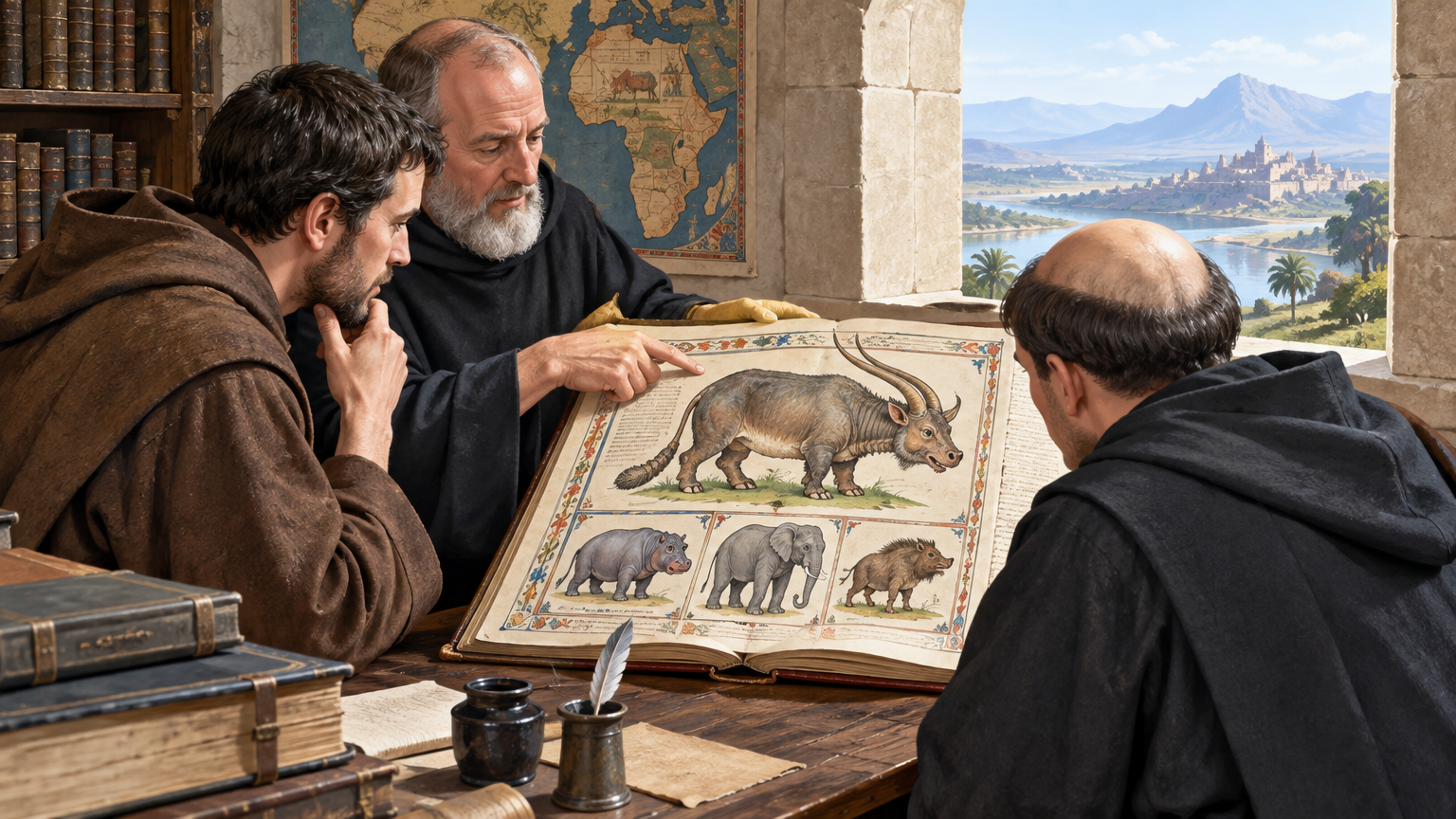
The description builds unfamiliar anatomy from familiar comparisons. Hippopotamus, elephant, and boar provide points of reference for imagining an otherwise unknown beast.
The resulting combination could be understood by readers without their having seen the animal, while its movable horns supplied an especially memorable distinguishing feature.
Its distant habitat also shaped its reception. Ethiopia functioned in the medieval imagination as a faraway setting for remarkable animals.
That literary geography helps explain the yale’s place among wonders, but it should not be mistaken for evidence that European illustrators possessed direct knowledge of its supposed environment.
Bestiary transmission gave the horn mechanism a compact explanation. The animal fought with one horn while protecting the other; if the active horn became blunted, the reserve could replace it.
This detail made the extraordinary anatomy intelligible through a practical account of how it functioned.
The Christian bestiary supplied a broader interpretive setting in which animals could carry moral and religious significance. However, that general framework does not justify assigning the yale a specific spiritual meaning without supporting text.
Its documented importance here rests on inherited description, memorable behavior, and manuscript representation.
Its later passage into heraldry changed the creature’s function again, from an animal discussed in a book to a recognizable emblem. Across these settings, the movable horns provided continuity, allowing a distinctive beast to survive even as its proportions, anatomy, and visual treatment changed.
Famous Folklore Stories
The yale’s surviving narrative material centers on its unusual fighting behavior rather than named folktales. The principal examples are a Roman natural-history description and a medieval bestiary passage.
The headings below identify documented motifs, not traditional titles or independent adventure stories.
Movable Horns in Combat
In Pliny’s first-century account, the eale can change the position of its long horns during a fight. It presents them alternately or angles them as circumstances require.
This ability distinguishes the animal more sharply than any encounter with a hunter, traveler, or legendary hero.
The passage is descriptive rather than dramatic: it supplies neither a named opponent nor a particular battle. Its interest lies in the animal’s reported control over its weapons.
The horns make an otherwise unfamiliar beast intelligible through a practical explanation of how it defends itself.
The Horn Held in Reserve
The bestiary preserved in British Library Additional Manuscript 11283, dated about 1180, gives the fighting motif a more specific purpose. The yale uses one horn while folding the other backward.
If the working horn becomes blunted, the protected horn can take its place.
This medieval version develops the explanation of alternating horns without becoming a complete folktale. Its memorable feature is the reserve weapon, kept ready against damage to the first.
Unlike an invented battle episode, the passage presents this behavior as a general characteristic of the animal.
Cultural Impact
The yale’s historical importance rests chiefly on its movement between natural-history writing, illustrated bestiaries, and heraldry. A reported animal of a distant region became part of Europe’s inherited repertoire of remarkable beasts, recognizable through an anatomical feature that ordinary animals did not possess.
Bestiary manuscripts gave the creature a visual presence as well as a written description. An English example dated about 1200–1210 includes the yale among its illustrated animals.
Such images are evidence of medieval representation, not records of artists observing a living specimen.
The changing body forms matter to this cultural history. The movable horns remained a recognizable feature even when proportions and other details varied.
The yale could therefore retain its identity across adaptations without acquiring the single, consistent anatomy expected in a modern zoological description.
Heraldry provided another setting for the beast’s survival. Its appearance there extended its significance beyond accounts of distant wildlife into emblematic representation.
The documented heraldic tradition should not, however, be reduced to an unsupported universal meaning such as courage, vigilance, or invincibility.
Modern scholarship examines these manuscript and heraldic forms together. George C. Druce’s 1911 study, Notes on the History of the Heraldic Jall or Yale, treats their relationship as a historical question.
Contemporary art-history interpretation likewise emphasizes the creature’s place within medieval ways of imagining the wider world.
Similar Beasts
Unicorn

The unicorn is a legendary one-horned animal whose tradition spans classical accounts and medieval adaptations. It became associated with purity and healing, meanings distinct from its unusual physical appearance.
Both creatures connect remarkable horns with inherited animal lore. The yale differs through its paired, movable fighting horns, rather than the unicorn’s defining single horn.
Shadhavar

The Shadhavar is a unicorn-like creature from Persian folklore whose horn produces beautiful, enchanting music. Its most distinctive feature is therefore an extraordinary sound-producing organ rather than ordinary animal behavior.
Like the yale, it makes a horn the center of its identity. The comparison is functional, not genealogical: musical enchantment differs from repositioning horns in combat.
Pard
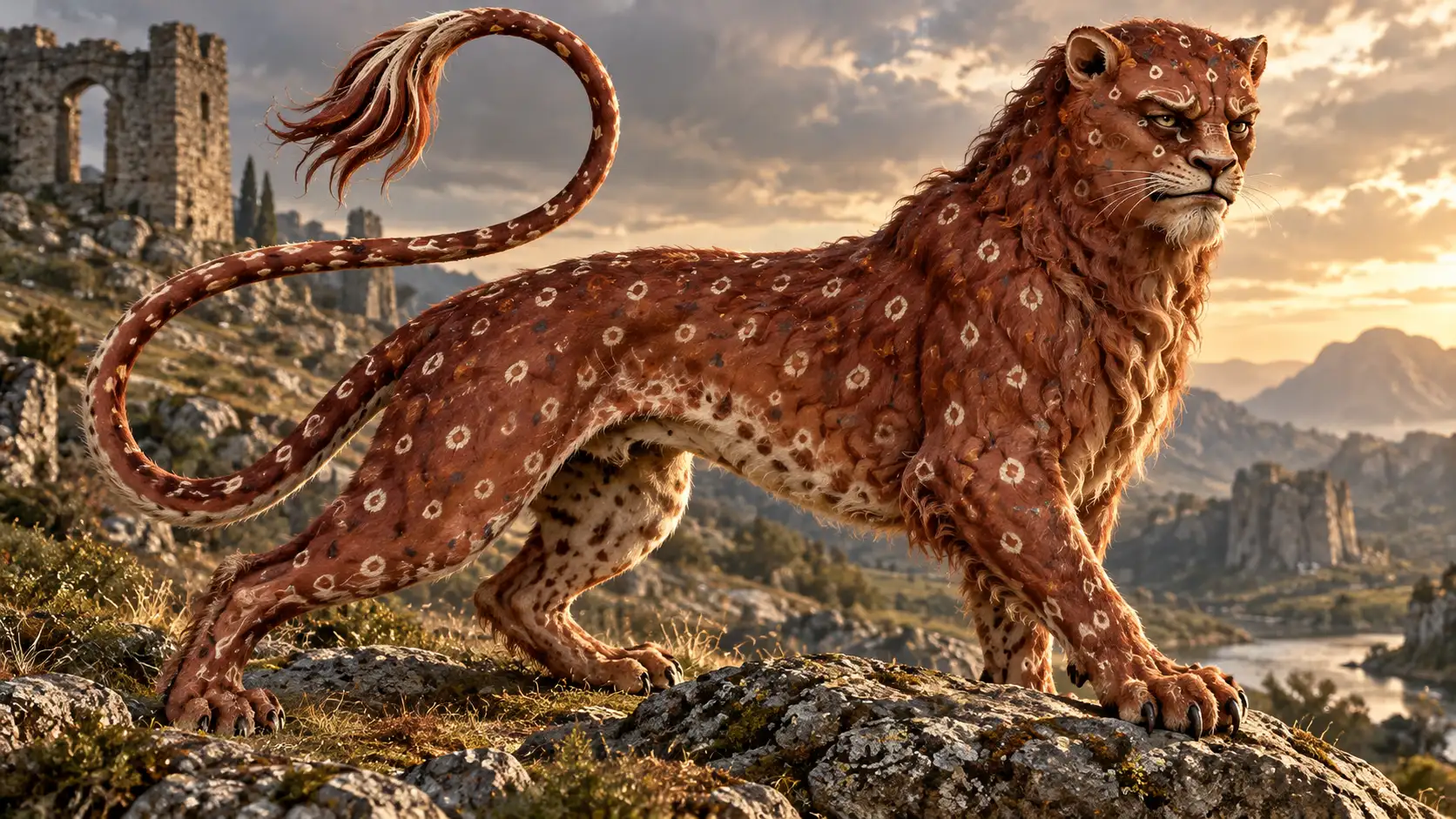
The pard is a swift, fierce feline of classical animal lore and medieval bestiaries, often associated with the panther or leopard. It belongs to an inherited vocabulary of exotic predators.
Its strongest connection with the yale is their shared natural-history and bestiary setting. The pard provides a useful contrast because extraordinary horn mechanics do not define it.
Parandrus
The parandrus is another remarkable animal described in the medieval bestiary manuscript that contains the yale. Its distinctive reported ability concerns camouflage-like changes, rather than the manipulation of fighting horns.
Both animals illustrate how bestiaries organized unfamiliar creatures around memorable properties. Their proximity in a collection does not make them variants of one legendary species.
Antelope
The antelope of medieval bestiary lore is described with long, sword-shaped horns. This literary animal should be distinguished from modern zoological accounts of the many species called antelopes.
Its horns invite comparison with the yale’s weapons, but the descriptions remain separate. Long or imposing horns alone do not establish the yale’s distinctive ability to reposition them.
Religion/Ritual
The yale appears within Christian bestiary literature, a genre that combined descriptions of animals with religious and moral interpretation. That setting explains its participation in a Christian literary culture, but does not by itself establish a specific religious meaning for its horns.
No yale-centered ritual, offering, festival, or taboo is documented in the supplied evidence. Its religious context is therefore best understood through the books that transmitted it, rather than through an inferred cult or a reconstructed practice of animal worship.
Scientific or Rational Explanations
The earliest recovered description belongs to Roman natural history, not to verified modern zoology. Ethiopia is its reported habitat.
That geographical attribution establishes where the ancient account located the beast, but it cannot independently demonstrate either the animal’s existence or a local tradition about it.
The anatomy also requires careful reading. Pliny uses familiar animals as points of comparison for size, tail, and jaws.
These comparisons explain an unfamiliar creature to readers; they do not establish that its description originated by deliberately combining separate animals into a fictional hybrid.
The movable horns present the clearest difficulty for literal identification. Matching the yale to an animal with a similar outline would leave its defining behavior unexplained.
Any proposed identification must address the reported movement of the horns, not merely the presence of horns themselves.
Differences between accounts make that task harder. Pliny’s hippopotamus-sized beast becomes horse-sized in the cited medieval bestiary, while jaw descriptions also vary across medieval versions.
These are textual differences to preserve, not measurements that can safely be averaged into one reconstructed animal.
George C. Druce concluded that identification with a real beast was not possible. That judgment is more restrained than selecting a modern species from a few resemblances.
Proposed zoological parallels may illuminate individual features, but none is established as the explanation for the whole description.
The clearest supported explanation concerns transmission rather than zoological identity. The yale persisted because texts, illustrations, and heraldic representations carried it forward while modifying details.
Its history can be studied securely as a history of descriptions and images, even though the animal behind the earliest report remains unidentified.
Modern Cultural References
The Poisoned King, series 2025
A modern reference item documented through arenaillustration.com. This source helps trace how Yale appears, is adapted, or is discussed in later culture.
(arenaillustration.com)
Conclusion
The Yale’s history connects Roman natural history with medieval bestiaries, manuscript art, and heraldry. Its earliest recovered description presents an animal reportedly living in Ethiopia, not a creature whose existence or geographical origin has been independently established.
Later versions changed its scale and anatomy while preserving its most distinctive feature: movable horns used alternately in combat. That continuity makes the Yale recognizable across accounts without requiring every description or image to represent one fixed, universal form.
Its cultural importance lies less in an elaborate cycle of adventures than in the survival of a striking animal description. The reserve horn gives the creature an image of adaptability and preparedness, although that interpretation should not be mistaken for a universally documented medieval moral.
Uncertain zoological identifications do not diminish its historical interest. The Yale remains a useful example of how inherited reports could become memorable artistic forms, heraldic figures, and, eventually, material for modern fantasy.
Further Reading
Pliny the Elder, Natural History, Book 8, section 73, Penelope.uchicago
Pliny reports an Ethiopian animal with long movable horns that it can present alternately or angle during a fight.
This is an animal description, not a titled traditional.
(penelope.uchicago.edu)
British Library Additional Manuscript 11283, excerpted by Fordham Medieval Sourcebook, Sourcebooks.web.fordham
A bestiary describes the yale fighting with one horn while folding back the other, so the second can take its place if the first is blunted. Documented folklore.
(sourcebooks.web.fordham.edu)
Notes on the History of the Heraldic Jall or Yale, Medieval Bestiary bibliography
Identifies George C. Druce’s specialist study of the Yale in manuscripts and heraldry, including its proposed relationship to Pliny’s account.
(medievalbestiary.bestiary.ca)
Book of Beasts: The Bestiary in the Medieval World, Yale, J. Paul Getty Trust
Discusses the Yale’s depiction and movable horns in an English bestiary dated about 1200–1210.
(getty.edu)