Introduction
Poludnitsa is a Slavic noon spirit associated especially with fields, agricultural work, and the dangers of remaining outdoors at midday. Usually represented as female and human-shaped, she threatens people who encounter her during an hour marked by restrictions on work.
Her identity is more consistent than her appearance. Across regional traditions, noon brings the possibility of a frightening encounter, but the visitor’s clothing, behavior, and victims differ.
Some accounts concern fieldworkers; others describe abduction.
In Slovak tradition, the spirit may torment people with questions or cause their deaths. In Warmia and Masuria, harvest-field encounters include riddles, fright, and abduction.
A recorded Russian northern account instead remembers several female poludnitsy arriving at noon.
These differences make Poludnitsa a regional folklore figure rather than a single character with a fixed biography. Her importance lies in the connection between everyday surroundings and supernatural danger: familiar fields and villages become threatening when the forbidden hour arrives.
History/Origin
Poludnitsa’s beginnings cannot be assigned a secure date. The documented tradition consists of regional beliefs, comparative descriptions, and collected narratives rather than an identifiable founding story.
Historical evidence establishes the circulation of noon-spirit beliefs, not one moment when the figure originated.
By 1898, N. F. Sumtsov’s entry in the Brockhaus and Efron Encyclopedic Dictionary presented poludnitsy as subjects of comparative folklore.
It discussed Slavic beliefs and gave particular attention to Lusatian and Czech traditions, preserving distinctions rather than a wholly uniform account.
The Lusatian material gives a notably precise period of danger: from twelve until two in the afternoon. During those hours, white-clad figures walk through fields and punish people working there.
This is a historical report of regional belief, not a directly transcribed encounter narrative.
A different kind of evidence survives from Shardomen in the Pinega area of the Russian North. An account recorded in 1984, later published in Olga Cherepanova’s 1996 collection, recalls female poludnitsy appearing at noon.
The contrast matters historically. The nineteenth-century summary emphasizes fieldwork restrictions, while the northern testimony describes several noon visitors.
These records demonstrate the breadth of the tradition, but do not establish a chronological transformation from one version into another.
N. I. Tolstoy’s specialist comparisons place Poludnitsa within a broader range of Slavic midday beings, including female and male forms.
The strongest historical picture is therefore a family of related noon beliefs, locally preserved and described, rather than a single ancient deity with an established cult.
Name Meaning
The secure association of the name Poludnitsa is with noon. That connection explains the figure’s central timing without requiring a more elaborate account of the word’s origin.
“Noon spirit” is consequently a useful English description of her role. It keeps attention on the feature shared by otherwise different accounts: an encounter at midday.
It does not imply that every community imagined the same woman or imposed identical restrictions.
The Russian form appears in Cyrillic as Полудница. Regional reference works use Poludnica for the Slovak figure and Południca for the figure documented in Warmia and Masuria.
These spellings should retain their regional context rather than become interchangeable labels for every recorded detail.
The available textual evidence supports the noon association more firmly than an extended etymology. The name alone cannot establish solar worship, a divine ancestry, or a particular costume.
Its clearest value is to identify the dangerous hour around which these beliefs gather.
Appearance
Poludnitsa generally has a human rather than an animal form. Female figures recur across the regional evidence, but their appearance is not standardized.
The most dependable identifying features are the midday setting and threatening encounter, not a fixed face, garment, or bodily feature.
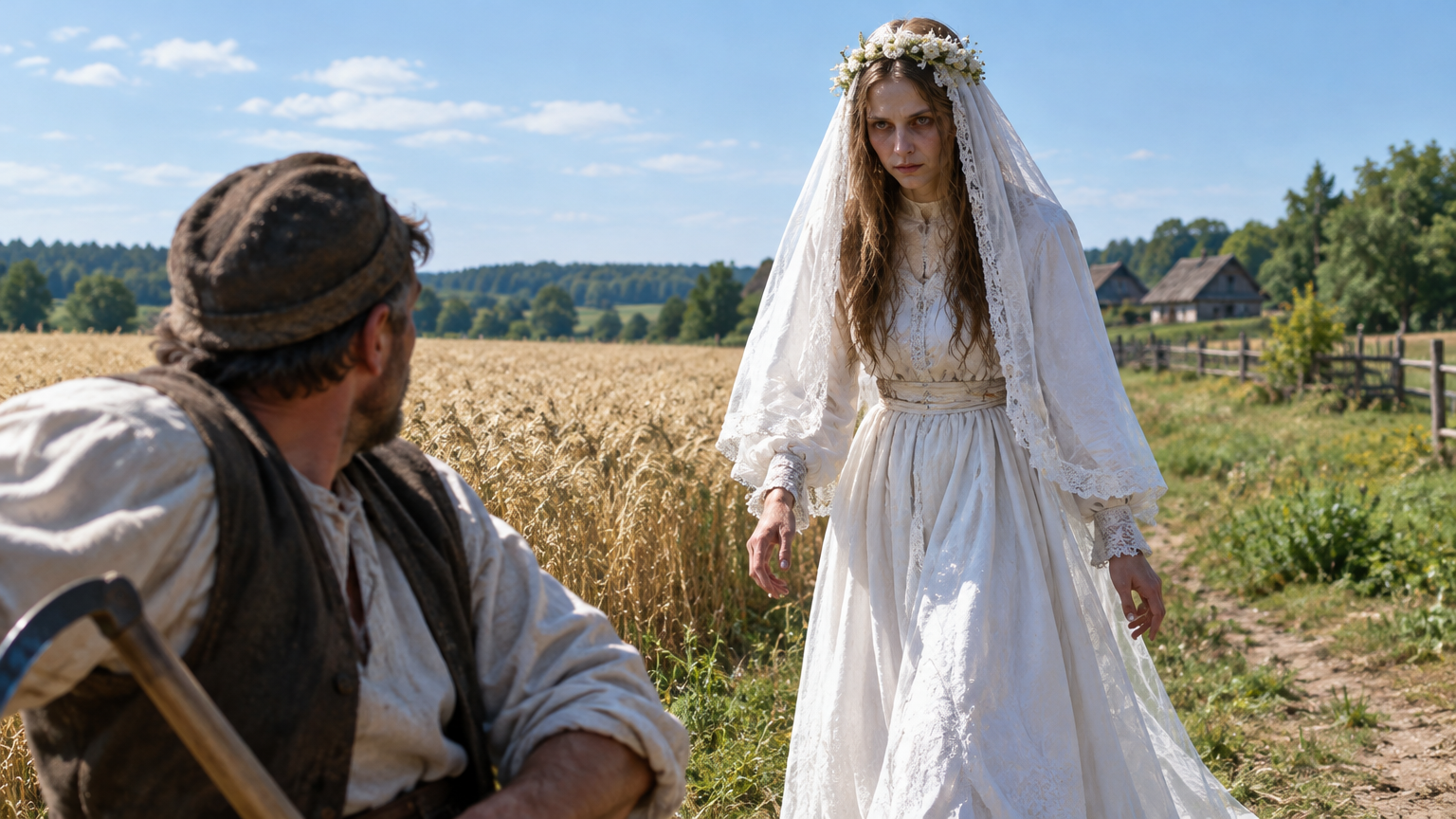
In the Lusatian beliefs summarized in 1898, the field-wandering figures wear white dresses. Their clothing belongs to that particular account, alongside the specified hours from noon until two.
It should not be extended automatically to Slovak or Russian northern descriptions.
Slovak forms include an old-fashioned bride and a barefoot woman covered in cloth. These are alternative local appearances, not necessarily parts of one costume.
Both maintain a recognizable human shape while giving the midday visitor an appearance distinct enough to be remembered.
The Pinega-area testimony offers a markedly different image: long-haired female figures with dark faces, described as scantily clothed. The narrator also remembers something in their hands without identifying it.
That uncertain detail does not support assigning them a particular weapon or agricultural tool.
Number varies as well as dress. The northern account speaks of several poludnitsy, whereas regional summaries often discuss the being in the singular.
A solitary woman in a field therefore represents one useful image, but not the full range of recorded appearances.
These descriptions are best understood as local forms of a related supernatural threat. Combining the Lusatian white dress, Slovak bridal appearance, and northern dark face into one supposedly traditional portrait would erase the differences that make the surviving accounts informative.
Background Story
Poludnitsa’s background lies in the organization of rural time and space. Agricultural work creates the setting for many encounters, while noon marks a boundary that workers should not cross casually.
The spirit gives that boundary a threatening human presence.
In the Lusatian account, punishment follows continued work during the prohibited midday interval. This makes the worker’s activity central to the encounter, rather than presenting danger as entirely random.
Questioning adds another dimension to the threat. In Slovak accounts, people may be tormented with questions or killed; Warmian and Masurian traditions include riddles.
The encounter can thus involve an intimidating exchange, not simply the sudden appearance of a frightening figure.
Harvest provides an especially important setting in Warmia and Masuria. There, the spirit appears in fields at noon and may frighten or abduct people.
The seasonal setting ties the danger to agricultural activity without establishing a universal rule that all poludnitsy appear only during harvest.
The Russian northern account describes several female visitors appearing at noon. Its collective appearance differs from the solitary figure familiar from other regional descriptions.
Taken together, these traditions connect midday with interrupted work and the need to withdraw from danger. Their shared background is a pattern of prohibitions and encounters, not a personal biography: Poludnitsa is defined chiefly by when she appears and what happens to those she meets.
Famous Folklore Stories
Poludnitsa survives in recorded local testimony and recurring encounter motifs rather than a single canonical narrative. The headings below describe documented regional material; they are not traditional tale titles.
Village visitors and spirits confronting fieldworkers belong to distinguishable versions of the noon danger.
Noon Visitors in Shardomen
In an encounter account recorded at Shardomen in the Pinega area in 1984, female poludnitsy appeared at noon.
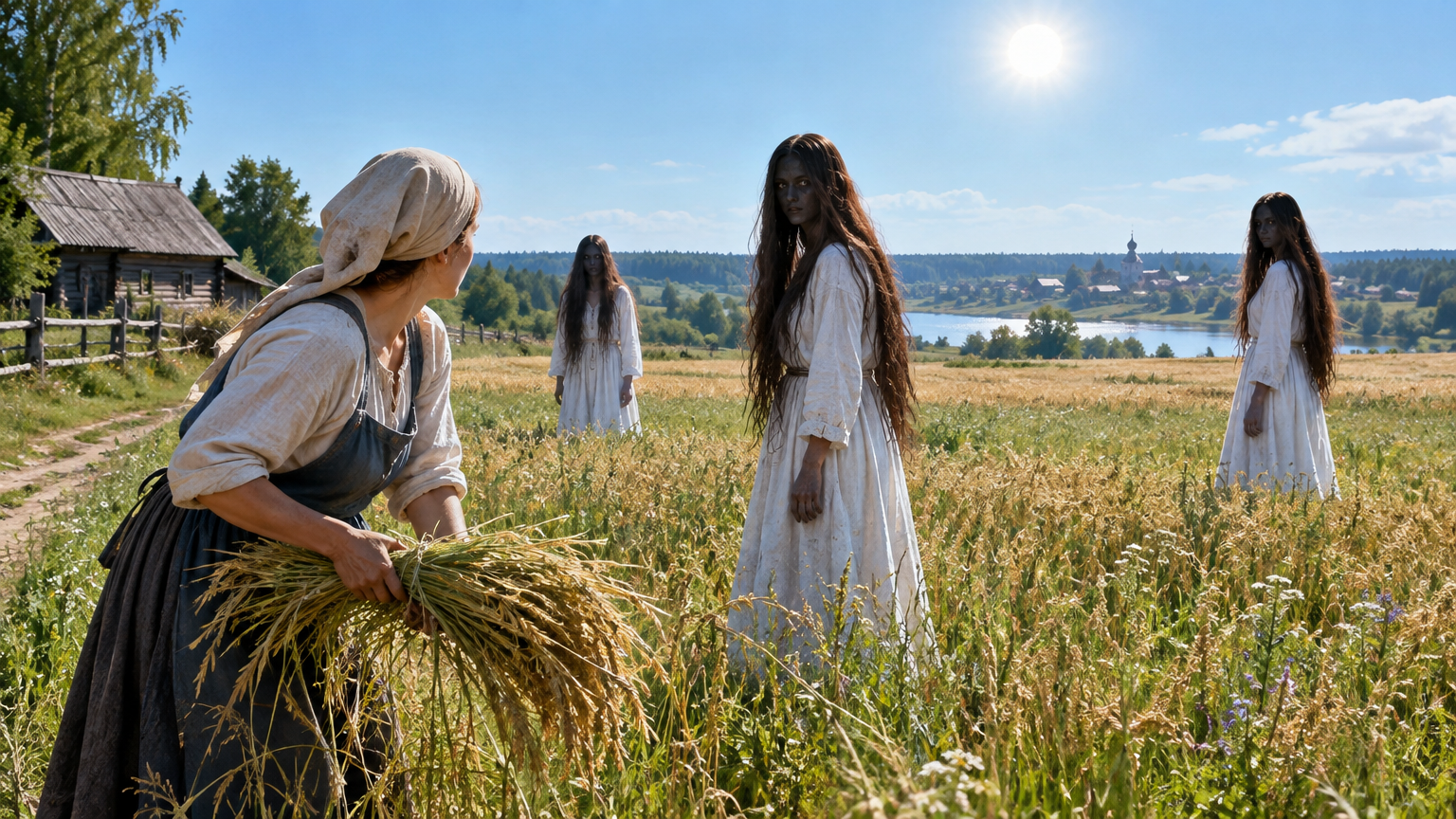
Preserved as text 229 in Olga Cherepanova’s Mythological Stories and Legends of the Russian North, this testimony describes several female figures, not one individual antagonist. Their long hair and dark faces belong specifically to this local account.
The surviving episode contains no named child, rescuing hero, or successful confrontation. Retelling it as a complete abduction-and-rescue adventure would add events that the recorded testimony does not supply.
Punishment for Working in the Fields
A Lusatian motif reported in the 1898 Brockhaus and Efron entry concerns noon spirits walking through cultivated fields in white dresses. Their dangerous period extends from twelve until two in the afternoon, when they punish people who continue working there.
This is a historical summary of reported belief, not a transcript of one complete folktale. It establishes the setting, prohibited activity, and threatened punishment, but supplies no named worker or detailed ending.
The white clothing and two-hour interval should remain attached to this regional version.
Cultural Impact
Poludnitsa gave a recognizable supernatural form to a boundary in the working day. Continuing an ordinary task at noon could become a dangerous violation of customary limits.
The threat was not always a physical attack. Slovak accounts include torment through questioning as well as death.
In Warmia and Masuria, harvest-time beliefs also associate the spirit with riddles, frightening encounters, and abduction. These variations made the danger locally recognizable without requiring an identical story.
Children were another important audience for warnings about the noon spirit. In Warmia and Masuria, the figure was used to threaten disobedient children.
As a warning figure, Poludnitsa could reinforce adult instructions through fear of consequences beyond ordinary punishment. This social function does not mean every narrator regarded her as an invented disciplinary device.
A remembered warning and a sincerely expressed supernatural belief can coexist.
Modern comparative scholarship treats these accounts as a varied belief complex. N. I. Tolstoy’s discussion includes differing regional names, functions, and both female and male noon spirits.
That breadth challenges the modern tendency to turn Poludnitsa into one standardized female monster.
Similar Beasts
Rusalka

Rusalka is a female spirit in Slavic folklore, associated with water and, in some traditions, the restless dead. Accounts describe dangerous attraction, while some also place rusalki dancing in fields.
The strongest comparison is their threatening female presence in familiar landscapes. A rusalka’s watery associations differ from Poludnitsa’s more defining connection with the noon hour.
Leshy

Leshy is a shapeshifting forest spirit in Slavic folklore. A guardian of woodland, he may confuse travelers and lead them astray, making familiar surroundings difficult to navigate.
Both figures make human activity subject to supernatural limits. Leshy’s defining territory is the forest, whereas Poludnitsa’s danger centers on midday, often in cultivated fields.
Vodyanoy

Vodyanoy is a Slavic water spirit associated with rivers and ponds. Stories emphasize his dangerous temper and the capture of unwary people who enter or approach his watery domain.
Like Poludnitsa, he turns an ordinary environment into a place of supernatural risk. His danger is primarily aquatic rather than tied to a particular midday interval.
Nočnica (polnočnica)
Nočnica, also called polnočnica in the supplied Slovak comparison, is a distinct night spirit associated with midnight. She is explicitly presented as a counterpart to the midday poludnica.
This is a particularly close structural parallel: each marks a dangerous hour. Their opposition concerns midnight and noon, not two interchangeable names for the same spirit.
Religion/Ritual
Avoiding fieldwork at noon is a behavioral response to the danger described in the Lusatian account. Such a prohibition should not automatically be classified as a formal ceremony or used to reconstruct an elaborate Poludnitsa ritual.
Scientific or Rational Explanations
An environmental interpretation begins with the recurring conjunction of noon, outdoor labor, and danger. A warning against remaining in fields could encourage a pause in work.
That practical effect is plausible, but it does not establish the original cause of the belief.
Heat illness is an understandable modern comparison for stories of harm during midday labor. Nevertheless, the documented accounts do not establish a medical diagnosis.
It would be misleading to identify every attack, death, or frightening encounter as a recorded case of heatstroke.
A social interpretation has firmer support in the figure’s documented use as a threat. Warnings about punishment could help regulate working hours and children’s movements.
This explains one function of the stories without explaining away all personal belief or reported experience.
The testimony also requires attention to how folklore is recorded. A narrative collected in 1984 establishes that an account was being transmitted then; it does not independently verify the supernatural event.
Conversely, its recording date does not establish when the local tradition first developed.
Regional comparison offers a more useful framework than a single diagnosis. Abduction, fieldwork prohibitions, and dangerous questioning share a midday association but differ in action and setting.
Poludnitsa is best understood as a variable folkloric expression of noon danger, not evidence of one objectively established phenomenon.
Modern Cultural References
Lady Midday (short film, 2022) – Lady Midday / Noonwraith, film
This short film draws on the Slavic Lady Midday, or Noonwraith, myth.
Lady Midday appears in the story of a young couple whose wedding is followed by tragic events.
Source
The Noonday Witch (Polednice, 2016), the Polednice’s supernatural shadow threatens a mother and daughter, film
In The Noonday Witch (Polednice, 2016), a mother returning to her husband’s village with her young daughter becomes entangled in a curse and faces a mysterious evil associated with the Polednice.
The film is a modern variation on Karel Jaromír Erben’s ballad of the same name.
Source
Wild Flowers (Kytice, 2000), “Polednice” ballad segment, film
In the “Polednice” segment of Wild Flowers (Kytice, 2000), the Polednice appears as a frightening old woman who comes to a household after a mother calls for her.
She wants the child and later leaves.
Source
The Noonday Witch (Polednice, 1999), experimental short-film adaptation, animated film
The Noonday Witch (Polednice, 1999) offers a contemporary interpretation of Erben’s “Polednice” ballad.
It depicts the mother of a mischievous child in a virtual futuristic kitchen while the traditional ballad is recited.
Source
Conclusion
Poludnitsa is best understood as a regional Slavic noon spirit, commonly female, whose significance rests on the dangerous midday hour and its restrictions. Fields, harvest work, questioning encounters, and threats to children recur across the evidence, but they do not combine into one authoritative biography.
Her clothing and appearance belong to particular accounts, not a universal design. Preserving those distinctions makes the figure more intelligible: she expresses related concerns through different local stories rather than embodying a single standardized myth.
Her symbolic force comes from making an ordinary time and familiar landscape potentially threatening. The field becomes a place where work has limits, while noon marks a moment requiring caution rather than confidence.
Recorded beliefs preserve that relationship between daily conduct and supernatural danger; modern fiction and film reshape it for different audiences. Poludnitsa’s lasting relevance therefore lies both in her unsettling presence and in the regional diversity that survives behind her increasingly recognizable name in contemporary cultural portrayals.
Further Reading
The Songs of the Russian People, as Illustrative of Slavonic Mythology and Russian Social Life
W. R. S. Ralston’s 1872 historical folklore survey has a direct section on Poludnitsa, describing Lusatian field encounters, questions about flax work, punishments, and a comparison with the noon sickness spirit.
Source
Lady Midday: The Personification of Noon in Folklore
A detailed reader-oriented overview of Lady Midday/Poludnitsa covers names, regional distribution, appearance, field-work prohibitions, encounters, and related spirits across Russian and West Slavic traditions.
Source
Мифологические рассказы и легенды русского севера, Полудница
Olga Cherepanova’s folklore-study passage reports collected North Russian accounts in which Poludnitsa appears at noon or in summer heat, threatens or abducts children, tickles victims, and punishes field work at noon.
Source
White Color in Mythological Texts of Slavonic Traditional Culture
Academic study specifically identifies poludnitsa as a Slavic personification of midday and discusses the symbolic role of her white clothing in folk demonology.
Source
Sorbian-Eastern Slavic Parallels from the Field of Folk Demonology
Peer-reviewed article by Aleksandr V. Gura compares Lusatian Sorbian and Eastern Slavic demonological traditions, specifically discussing Lady Midday/Noonwraith/Noon Witch and the similarities and regional histories of the figure.
Source
The Survival of the Neolithic Goddess in Polish Folklore, Myth, and Tradition
This University of Lethbridge thesis discusses Polish poudnica and Russian poludnitsa in a comparative chapter, describing midday heat, field and whirlwind associations, and punishments for working during her sacred hour.
Source
‘Nigh is the time of madness and disdain’: Folk Horror in The Witcher 3: the Wild Hunt
ethic: “Although she was a patron deity of agriculture, the poludnitsa was …
Source
Południca · Slavic noon-lady of the fields · Umbrarium
citeturn413957search3 [wordlim: 200] Crawled: today; The noon-lady or Lady Midday of Slavic agricultural folklore, said to appear in the fields at the hottest hour and punish or bewilder those who work through the dangerous heat.
Source