Introduction
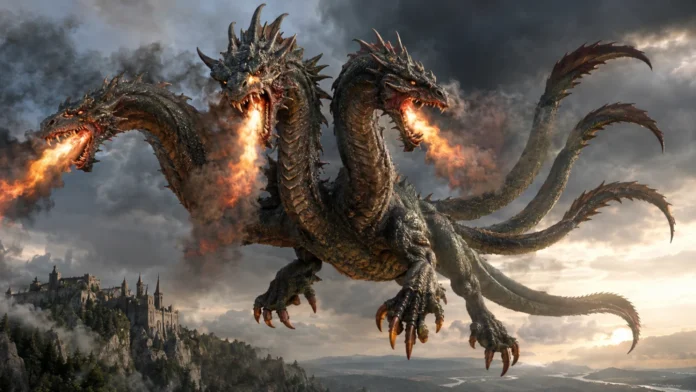
Zmey Gorynych is a supernatural serpent or dragon in Russian oral epic and wonder tales, best known as an opponent of Dobrynya Nikitich. Usually a dangerous adversary, the creature abducts people, threatens communities, and provides a formidable test of heroic strength.
The figure belongs to a variable storytelling tradition rather than a single authoritative mythology. Individual narratives differ in the serpent’s appearance, the people it carries away, and the circumstances of its defeat.
Even the name Gorynych is not used consistently across related serpent stories.
One well-attested Dobrynya narrative presents a flying monster with three heads, seven tails, fiery breath, and copper claws. Its conflict with the hero includes a broken promise and the rescue of captives, making the creature more than an obstacle overcome through physical force.
The safest starting point is therefore the serpent’s role within particular tales. Zmey Gorynych is not established here as a pan-Slavic deity or a creature with fixed anatomy, but as a recurring supernatural antagonist whose familiar image draws together several strands of folklore.
History/Origin
Zmey Gorynych’s documented background lies in oral storytelling preserved through collections and subsequent editions. Nineteenth-century records provide concrete historical anchors for the Dobrynya-and-serpent tradition, although the dates of recording do not establish when its stories first developed or entered circulation.
Scholarly notes published in 1974 identify a version recorded from Ivan Feponov on July 28, 1871. In this telling, Dobrynya’s mother warns and assists him.
Such details show how individual performances could give different emphasis to characters surrounding the central combat.
The collected tradition also varies in the rescued person, the number of encounters, and the battle’s details. These differences matter historically: the surviving material preserves multiple tellings, not merely imperfect copies of one recoverable original story with a single sequence of events.
A related strand appears in A. N. Afanasyev’s Russian folktale collection, published in 1855–1863. Tale 131, Frolka-siden, includes abducted royal daughters and successive encounters with five-, seven-, and twelve-headed serpents.
Its monsters belong to the wider serpent-tale tradition but are not specifically named Gorynych.
Regional material further complicates any simple origin narrative. The Great Ukrainian Encyclopedia discusses Kyiv serpent legends associated with the hero Kozhumyaka and describes one-headed early depictions alongside later multi-headed forms.
That regional account should remain distinct from the better-known Russian epic image.
These records establish a history of related but differentiated serpent narratives. They do not establish a single birthplace, an original head count, or a precise moment when Gorynych became a named character.
The historical picture is one of overlapping traditions preserved through particular tellers and collections.
Name Meaning
The Russian name is written Змей Горыныч, also appearing with a hyphen as Змей-Горыныч. English writing commonly renders it Zmey Gorynych, while Gorynych can stand alone.
Some recorded epic titles and variants identify the adversary simply as the serpent rather than using the full name.
The first element, zmey (змей), means “serpent.” In these narratives, however, it does not imply an ordinary snake.
Flight, multiple heads, claws, and fire make “dragon” an appropriate descriptive English term as well.
The derivation of Gorynych is less secure. One proposed explanation connects it with Russian gora (гора), meaning “mountain.”
The serpent’s association with the Sorochin Mountains in the Dobrynya rescue narrative fits a mountain-related interpretation, but a narrative setting alone cannot establish how a name developed.
A competing explanation connects the name with burning. The Pushkin Institute’s language-and-culture dictionary presents this fire-related interpretation, which accords with the serpent’s fiery appearance.
That correspondence likewise does not, by itself, demonstrate a historical linguistic derivation.
Mountain and fire should therefore remain proposed associations rather than definitive translations of Gorynych. The full name identifies a familiar folklore figure more securely than it reveals that figure’s origins.
Neither interpretation proves that all related serpent stories began with a mountain being or a fire being, or once shared a single meaning.
Appearance
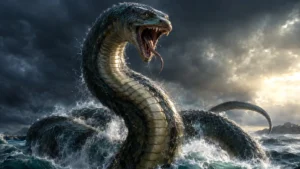
Zmey Gorynych’s appearance is best described through individual versions rather than a universal design. A prominent Dobrynya narrative presents a three-headed, seven-tailed serpent capable of flight.
This provides a concrete traditional image, but neither head count nor tail count defines every related monster.
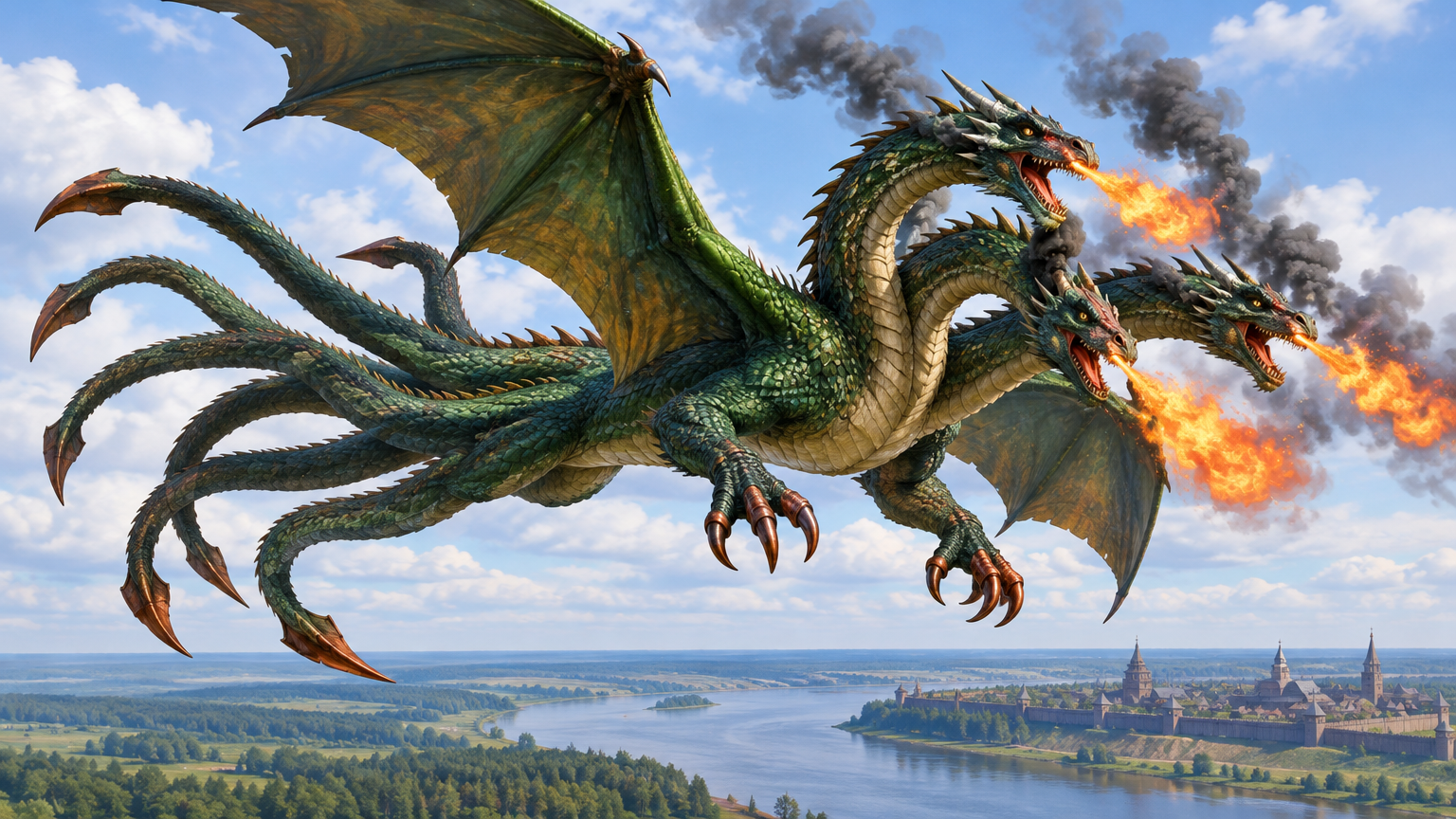
In the readable narrative preserved by Moscow State University’s Russian Tales and Byliny project, fire issues from the serpent’s nostrils and smoke from its ears. Copper claws complete the description.
Together, these details make the creature threatening through heat, movement, and bodily weapons.
A winged serpent body appears in the Pushkin Institute’s cultural summary, while the Dobrynya narrative securely establishes flight. Those are not identical descriptive claims: an airborne serpent need not have the same visibly articulated wings in every telling or in every illustration based on the tradition.
Explicit fiery wings occur in Afanasyev’s Frolka-siden, where a serpent carries away royal daughters. That tale’s five-, seven-, and twelve-headed opponents demonstrate the range of related imagery.
Their features should not all be transferred to Gorynych as though they described one individual.
The Kyiv account adds another contrast through its discussion of one-headed early depictions and the later familiar multi-headed form. Multiple heads remain central to the best-known Russian image, but regional evidence prevents treating that image as the only historically documented way to represent the serpent.
Background Story
The narrative background shaping Zmey Gorynych is the confrontation between a threatened human community and a supernatural captor. Abduction takes people beyond ordinary protection, while the hero’s journey carries him into the serpent’s territory.
Rescue restores what the monster has removed from human society.
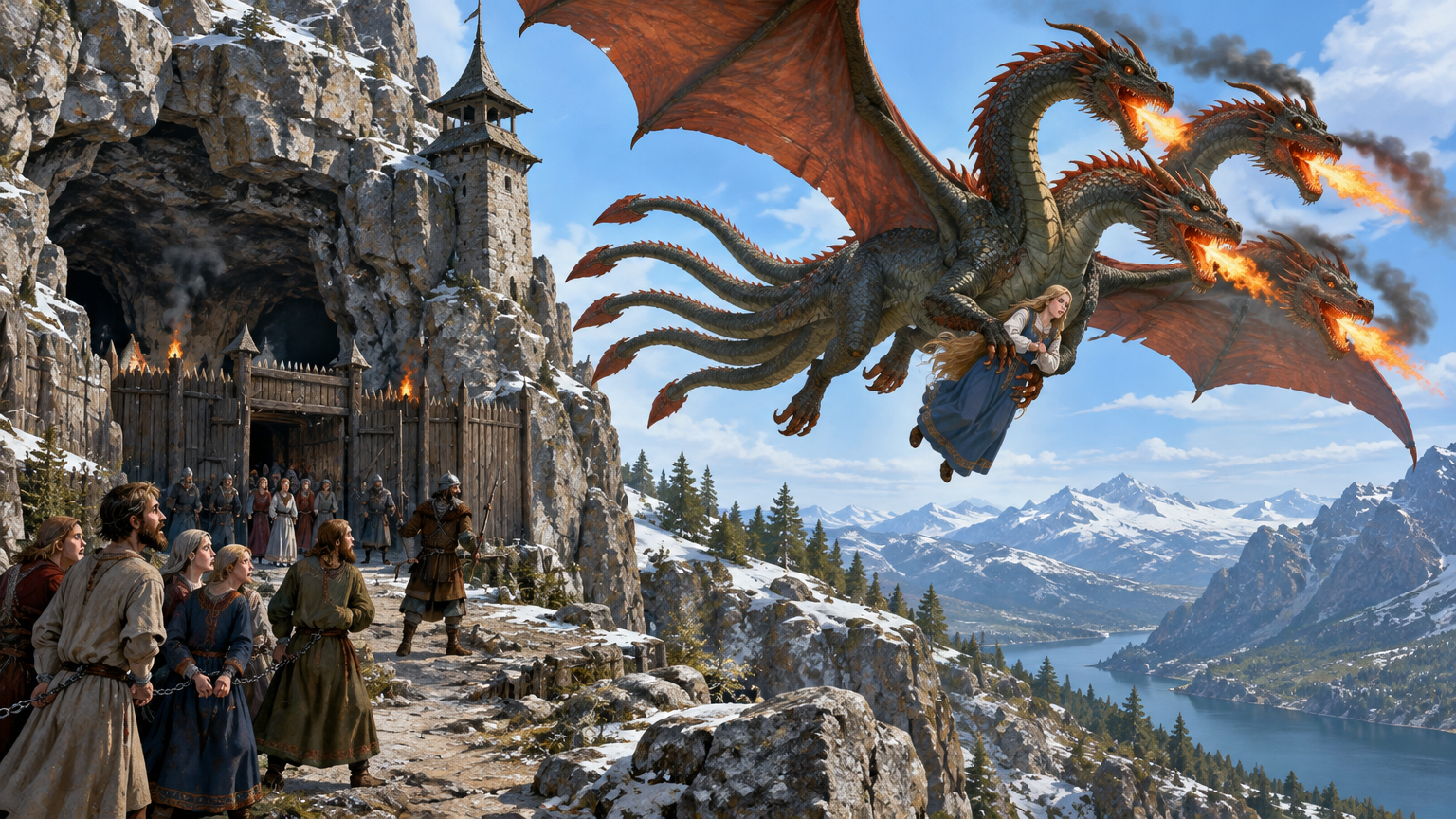
In the prominent Dobrynya version, this opposition also involves an agreement. Dobrynya initially spares the serpent after it promises not to raid Rus.
Its subsequent abduction of Zabava Putiatishna breaks that pledge, turning the renewed conflict into a response to betrayal as well as violence.
The serpent carries Zabava to the Sorochin Mountains, where its remote stronghold separates the captive from possible help. Dobrynya’s eventual victory releases other prisoners too.
The episode therefore gives the battle a communal consequence rather than limiting its importance to a duel between exceptional opponents.
The related wonder-tale pattern works somewhat differently. In Frolka-siden, the search for royal daughters leads to successive serpent adversaries with different head counts.
The repeated encounters place serpent combat within a larger rescue adventure, rather than the particular relationship between Dobrynya and his promise-breaking opponent.
Family assistance is another variable element of this narrative world. The Feponov version gives Dobrynya’s mother a role in warning and helping him.
Heroic success can thus depend on guidance and preparation, not simply on an isolated warrior’s ability to overpower a monster.
Read together, these patterns explain the figure’s flexibility without supplying an invented biography. Zmey Gorynych embodies captivity, danger, and violated security within heroic storytelling.
The recorded differences show how that role could accommodate changing victims, helpers, encounters, and settings while retaining a recognizable serpent adversary.
Famous Folklore Stories
Dobrynya and the Serpent
The best-known encounter belongs to the Dobrynya Nikitich epic tradition. In the version presented by Moscow State University’s Russian Tales and Byliny project, Dobrynya initially spares the serpent after it promises not to raid Rus.
The agreement establishes a temporary peace rather than ending the danger.
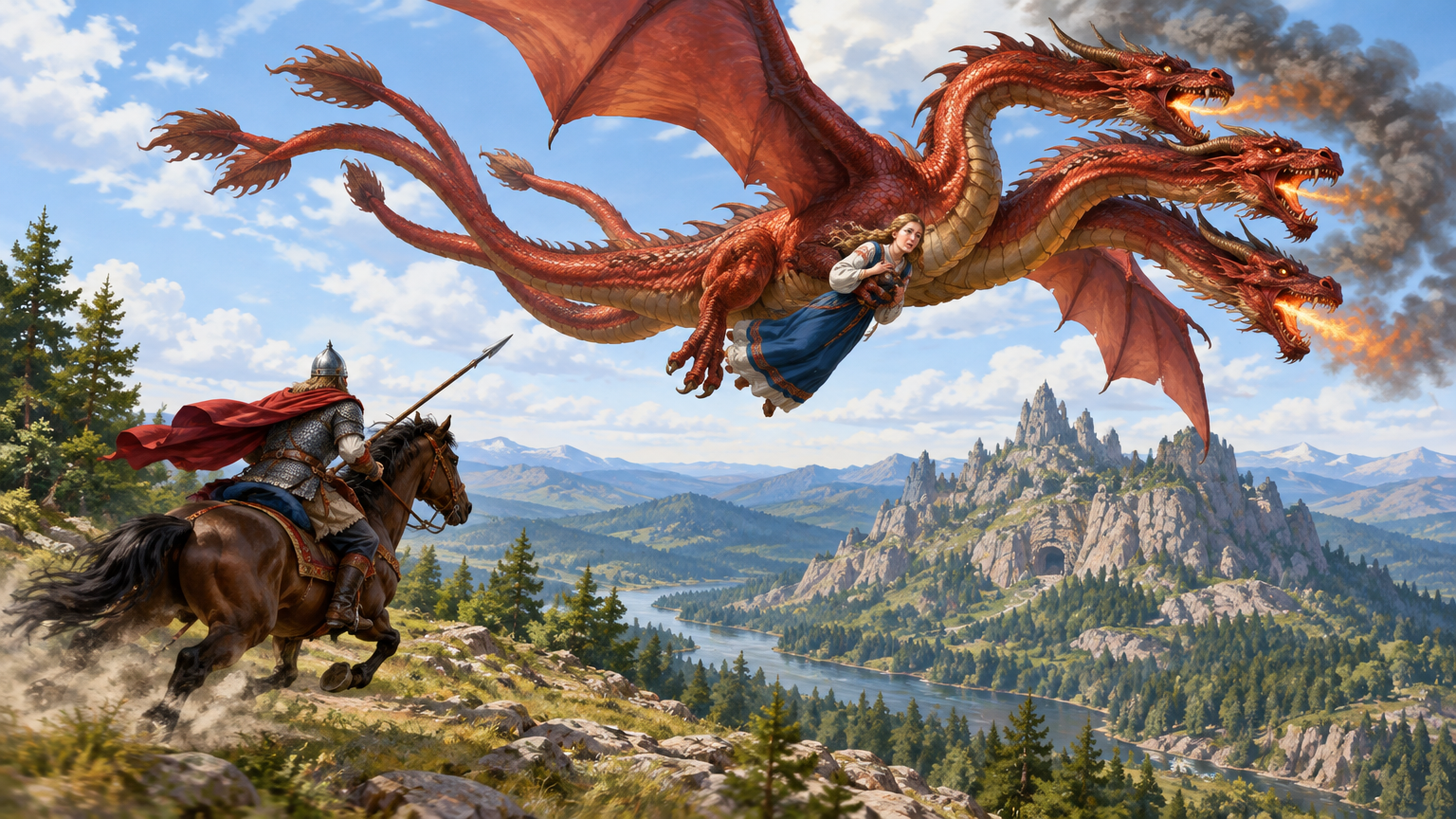
The serpent breaks its pledge by abducting Zabava Putiatishna and carrying her to the Sorochin Mountains. Dobrynya travels to its lair, defeats it, and releases captives.
His victory therefore repairs the consequences of a broken promise as well as overcoming a physically formidable enemy.
This is one version, not a definitive script for every performance. Scholarly notes document a separate account recorded from Ivan Feponov on July 28, 1871, in which Dobrynya’s mother warns and assists him.
Its distinctive details should not be silently added to the readable university narrative.
Frolka-siden: Related Multi-Headed Serpent Tales
Afanasyev’s tale 131, Frolka-siden, offers a related wonder-tale pattern rather than another securely named Gorynych adventure. Frolka and his companions search for abducted royal daughters.
The narrative includes flying serpents, and the abduction episode describes the daughters being carried away on fiery wings.
Frolka defeats successive serpents with five, seven, and twelve heads and helps recover the sisters. The increasing head counts organize the encounters into an escalating sequence.
Unlike a single standardized dragon design, this tale makes variation part of the story’s progression.
The distinction matters because these antagonists are called serpents, not specifically Zmey Gorynych. They demonstrate the wider narrative setting of multi-headed abductors and heroic rescues within Russian wonder tales.
They do not establish that every such serpent represents the same individual creature.
Cultural Impact
Zmey Gorynych gives heroic strength a social purpose: the enemy threatens people whom the hero must recover or protect. In the Dobrynya rescue narrative, freeing captives makes victory more than a contest between exceptional fighters.
The hero’s achievement restores people to the human community.
The broken agreement also gives the conflict a moral dimension. The serpent can negotiate and make promises, but its subsequent abduction exposes the failure of that settlement.
The episode contrasts Dobrynya’s initial mercy with the adversary’s renewed aggression, connecting heroic protection with the consequences of violated trust.
A specific literary reinterpretation appears in the illustrated 2024 collection Сказки Змея Горыныча (Tales of Zmey Gorynych). Its opening story portrays Gorynych choosing to become good.
Rather than making the serpent solely an enemy whose defeat restores security, this treatment makes his own moral choice part of the story. It demonstrates how a familiar folklore antagonist can acquire a sympathetic role in later fiction, without establishing benevolence as his original traditional identity.
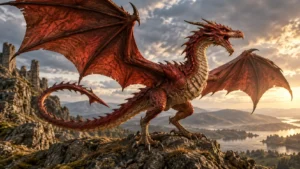
Illustration likewise gives a variable oral figure a particular visible form. Multiple heads, fire, and an extraordinary serpent body provide recognizable imagery, but no single design represents every recorded version.
Regional distinctions matter too: Kyiv serpent legends associated with Kozhumyaka have their own narrative settings and differences in depiction. They are not incomplete copies of the Dobrynya episode.
Scholarly study preserves the individual performances, collectors, and regional variants behind the familiar character. Language-and-culture teaching also uses Gorynych to introduce Russian storytelling traditions.
These educational uses and creative retellings serve different purposes: one helps readers understand the inherited material, while the other gives the serpent new roles.
Similar Beasts
Wyvern
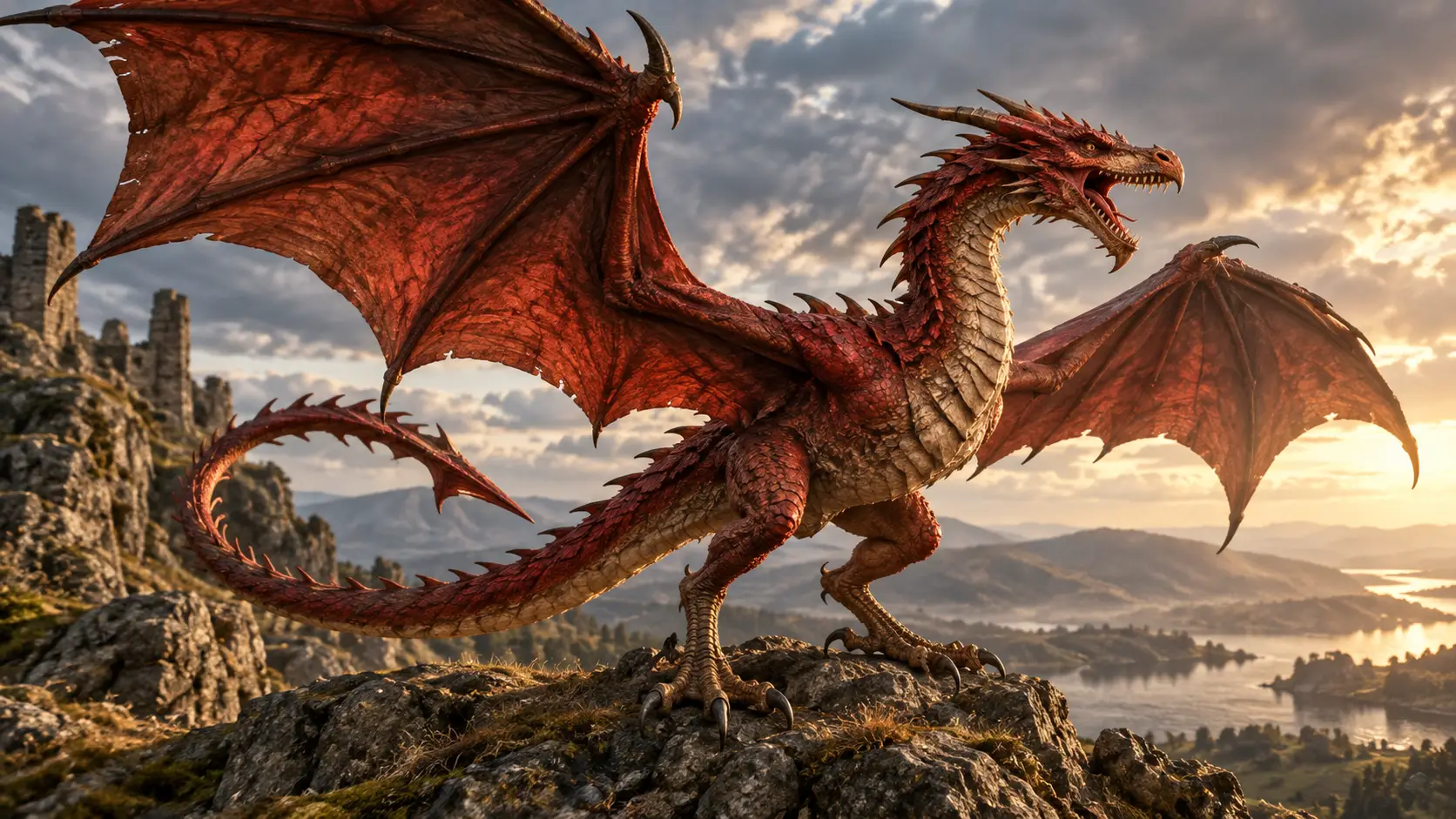
The wyvern is a dragon-like creature especially associated with European medieval heraldry. Its familiar form combines wings, two legs, and a barbed tail, although artistic designs vary.
Its resemblance to Gorynych is primarily visual. A heraldic body pattern differs from an oral epic adversary whose anatomy changes between narrative versions.
Drac

The Drac is a serpent-like dragon in Catalan folklore, associated with destructive power and stories of threatened villages and heroic saints. It belongs to a separate regional tradition.
Both figures can embody a danger confronted on a community’s behalf. That shared narrative function does not establish identical origins, anatomy, or religious significance.
Kinioka kia Tumba
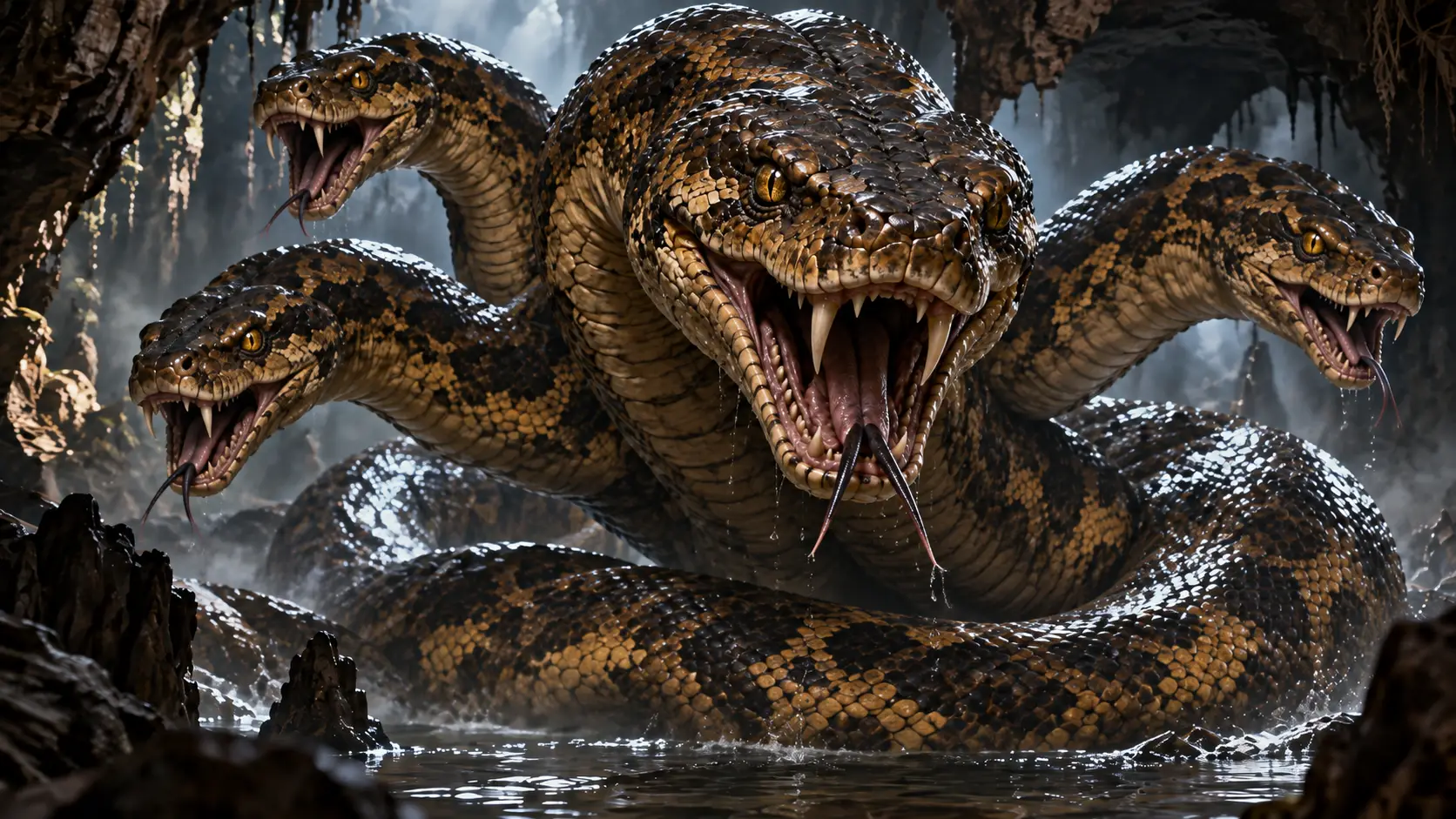
Kinioka kia Tumba is a giant serpent in an Ambundu heroic tale. It guards Kalunga-ngombe’s daughter and battles Sudika-Mbambi with insect swarms and repeatedly appearing heads.
The comparison concerns heroic combat and extraordinary heads. Its underworld setting and distinctive battle devices remain separate from the documented Dobrynya and Gorynych narrative.
Read more about Kinioka kia Tumba
Zmey Tugarin
Zmey Tugarin is a separate serpent-associated adversary in Russian epic tradition. The Pushkin Institute’s cultural dictionary distinguishes the Tugarin-serpent bylina from the narrative involving Dobrynya and the serpent.
Their proximity within Russian epic makes comparison useful, but serpent terminology alone cannot make Tugarin an alias or transfer Gorynych’s specific traits to him.
Scientific or Rational Explanations
The most securely grounded explanatory approach is historical and folkloristic rather than zoological. These records preserve narrated encounters, not independently observed animals.
Multiple heads, copper claws, flight, and fiery breath function within supernatural storytelling; the supplied evidence does not connect them to a documented biological species.
Comparison between versions helps explain why the creature lacks a fixed anatomy. Three heads appear in the readable Dobrynya narrative, while Afanasyev’s related tale supplies five-, seven-, and twelve-headed serpents.
This is evidence of narrative variation, not evidence that storytellers were classifying different natural animals.
Within Frolka-siden, the successive head counts can be read as a device for increasing difficulty. Each encounter enlarges the challenge facing the hero.
This interpretation follows the tale’s arrangement, but it should not be elevated into a universal explanation for every multi-headed serpent tradition.
The Dobrynya episode also permits a social reading centered on captivity, protection, and trust. Its plot explicitly links a broken promise to renewed abduction and eventual rescue.
These themes are demonstrable in the narrative without identifying the serpent with a particular historical invader or political event.
Finally, recording dates must be distinguished from dates of origin. The Feponov performance documents a version circulating in 1871; it does not date the invention of the story.
Collected texts provide firm historical witnesses, while the preceding development of individual motifs remains harder to reconstruct.
Modern Cultural References
Добрыня Никитич и Змей Горыныч, film 2006
Animated feature film; Zmey Gorynych is a portrayed character in the story, not merely a reference.
(ivi.tv)
Змей Горыныч, novel 2017
Published fantasy novel in which Zmey Gorynych is a central character and allies with the bogatyrs.
(ridero.ru)
Сказки Змея Горыныча, book 2024
published fiction 2024 Published illustrated story collection whose opening story portrays Zmey Gorynych as a character who chooses to become good.
(litres.ru)
Conclusion
Zmey Gorynych is best understood as a variable supernatural serpent or dragon of Russian epic and folktale, not a creature with one fixed anatomy or biography. His encounters with Dobrynya Nikitich give memorable form to the dangers of abduction, broken promises, and captivity, while the hero’s victory restores freedom and security.
Differences between recorded versions are therefore essential to understanding him: the familiar three-headed image represents a prominent form of the tradition, rather than a universal rule governing every serpent narrative.
His lasting cultural strength lies in the contrast between a recognizable monstrous adversary and a character adaptable enough to acquire different roles. Modern animation and fiction can retain his name and heroic associations while making him an ally or allowing him to choose goodness.
These transformations belong to later creative reception, not evidence for an original benevolent identity. Read alongside collected tales and scholarly commentary, they show how a formidable epic opponent continues to support new stories without erasing the diversity of older ones.
Further Reading
A. N. Afanasyev, Narodnye russkie skazki, tale 131, Ru.wikisource
Frolka and his companions search for abducted royal daughters.
Frolka defeats successive five-, seven-, and twelve-headed serpents and helps recover the sisters.
(ru.wikisource.org)
Russian Tales and Byliny, Moscow State University IRLC, Skazki.irlc.msu
In the readable version, Dobrynya first spares the serpent after it promises not to raid Rus.
The serpent breaks its pledge by abducting Zabava Putiatishna; Dobrynya journeys to its lair, defeats it, and frees captives. The page’s text describes the serpent as three-headed and seven-tailed, with fire, smoke, and copper claws.
(skazki.irlc.msu.ru)
“Dobrynya Nikitich and Alyosha Popovich,” scholarly notes, Fund of Electronic Resources on Russian Literature and Folklore (FEB)
Documents collectors, recording dates, regional versions, and variation in the Dobrynya-and-serpent bylina.
(feb-web.ru)
Змей Горыныч
Discusses the creature’s variable head counts, flight, name theories, abduction motif, Dobrynya narrative, and South Slavic serpent-expulsion rain custom; useful for comparing traditions, while its broad claims should be checked against cited folklore texts.
Source
Змей Горыныч, кто это
A reader-oriented discussion of the creature in the Dobrynya bylina, including the Sorochin Mountains, abduction, variable head counts, flight, and fire; it also summarizes folklorist Vladimir Propp’s approach to the serpent figure.
Source
Комментарии к фольклорным текстам
The commentary compares variants of “Dobrynya Nikitich and the Serpent,” noting that some northern recordings omit the first duel and that some versions call the adversary Zmey Gorynych.
Source
Трансформации фольклора в современной анимации России
Directly compares the animated Zmey Gorynych story with the bylina, identifying the Puchay River duel, the serpent’s surrender, and differences in character roles and narrative function.
Source
Сказки Змея Горыныча
published fiction 2024 Published illustrated story collection whose opening story portrays Zmey Gorynych as a character who chooses to become good.
Source