Introduction
Vetāla names a class of supernatural beings found in South Asian literary and religious traditions, particularly Sanskrit and Newar materials. Its identity changes with context: a vetāla may animate a corpse, serve within a ritual setting, or appear as another kind of fabulous being.
The best-known example belongs to the story cycle commonly called the Twenty-five Tales of a Vetāla. In its frame narrative, King Vikram repeatedly carries a corpse inhabited by a clever being that tells morally difficult stories and challenges him with riddling questions.
English readers have often encountered the figure as a “vampire,” especially through Richard Francis Burton’s nineteenth-century adaptation. That translation is convenient but inexact.
The vetāla does not consistently resemble the blood-drinking undead of European folklore, and blood drinking is not its defining characteristic.
The figure matters because it crosses boundaries between horror, wisdom literature, religious imagination, and entertainment. Rather than possessing one fixed mythology, vetālas accumulated different forms and functions as their stories circulated through Sanskrit texts, regional languages, ritual traditions, temple imagery, and later translations.
History/Origin
No single historical moment can be identified as the origin of the vetāla. The surviving evidence belongs to several literary and religious settings, suggesting that the category developed through overlapping beliefs about corpses, dangerous spirits, supernatural attendants, and powers associated with places beyond ordinary social order.
A major surviving literary witness is Somadeva’s Sanskrit Kathāsaritsāgara, or Ocean of the Streams of Story, composed around 1070 CE. Within this enormous collection appears the cycle conventionally known as the Vetālapañcaviṃśati, the Twenty-five Tales of a Vetāla.
Somadeva’s work provides a secure medieval landmark, not necessarily the beginning of the tradition. The cycle itself belongs to a wider history of framed storytelling in which one narrative contains many others, while repeated questions test judgment, ethical reasoning, and a ruler’s ability to interpret complicated conduct.
Vetālas also occur outside this famous narrative cycle. Sanskrit religious materials place them in settings involving cremation grounds, fierce divine powers, ritual service, and the pursuit of extraordinary abilities.
Specialist research additionally identifies references connected with Bhairava and sculptural figures at Hoysala temples.
The tradition continued beyond Sanskrit transmission. British Library catalogue records preserve evidence for two seventeenth-century Newari manuscripts, respectively titled Vetala and Betala.
One comprises 103 folios, demonstrating substantial narrative circulation in the Newar cultural world rather than a brief or isolated borrowing.
During the nineteenth century, Burton reshaped selected material for English readers as Vikram and the Vampire. First published in 1870, his work includes only eleven stories and openly reflects Victorian adaptation.
It influenced English-language perceptions but cannot represent every Sanskrit, Newari, or vernacular form.
Name Meaning
Vetāla is the Sanskrit name for the supernatural category rather than a personal name belonging to one individual creature. In narrative use, a particular being may be called “the vetāla,” while religious and literary texts also employ the term collectively for multiple beings with related functions.
Forms such as Betāla, Betāl, and Baitāl reflect the name’s movement through regional languages, scripts, pronunciation systems, and English transcription. Burton explicitly equated his spelling “Baital” with Vetāla, although his chosen word “vampire” imposed a European comparison upon it.
The title Vetālapañcaviṃśati combines the being’s name with a term meaning twenty-five, conventionally yielding “Twenty-five Tales of a Vetāla.” Betal Pachisi is a widely used vernacular title for the same tale-cycle tradition, not an alternative name for the creature alone.
A more specific original derivation should be treated cautiously because the available evidence securely establishes usage but not one universally accepted etymological explanation. Its practical meaning is clearest from context: it designates an uncanny being associated with corpses, liminal places, supernatural knowledge, or ritual power.
Appearance
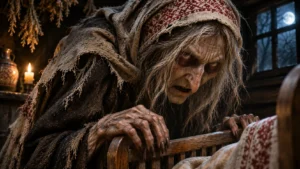
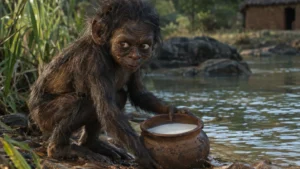
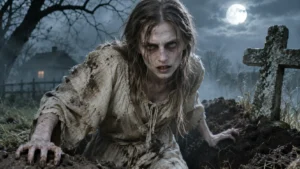
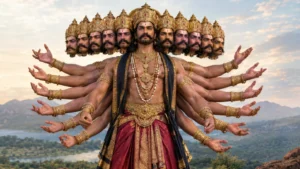
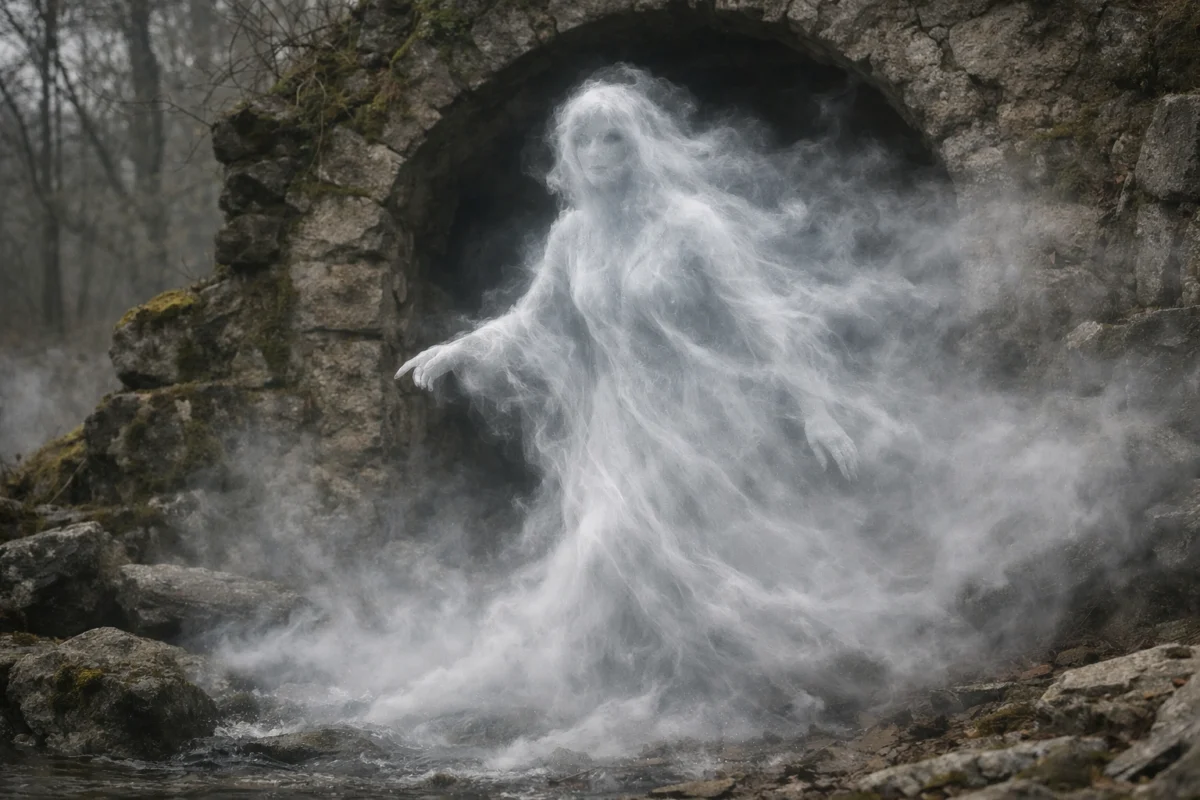
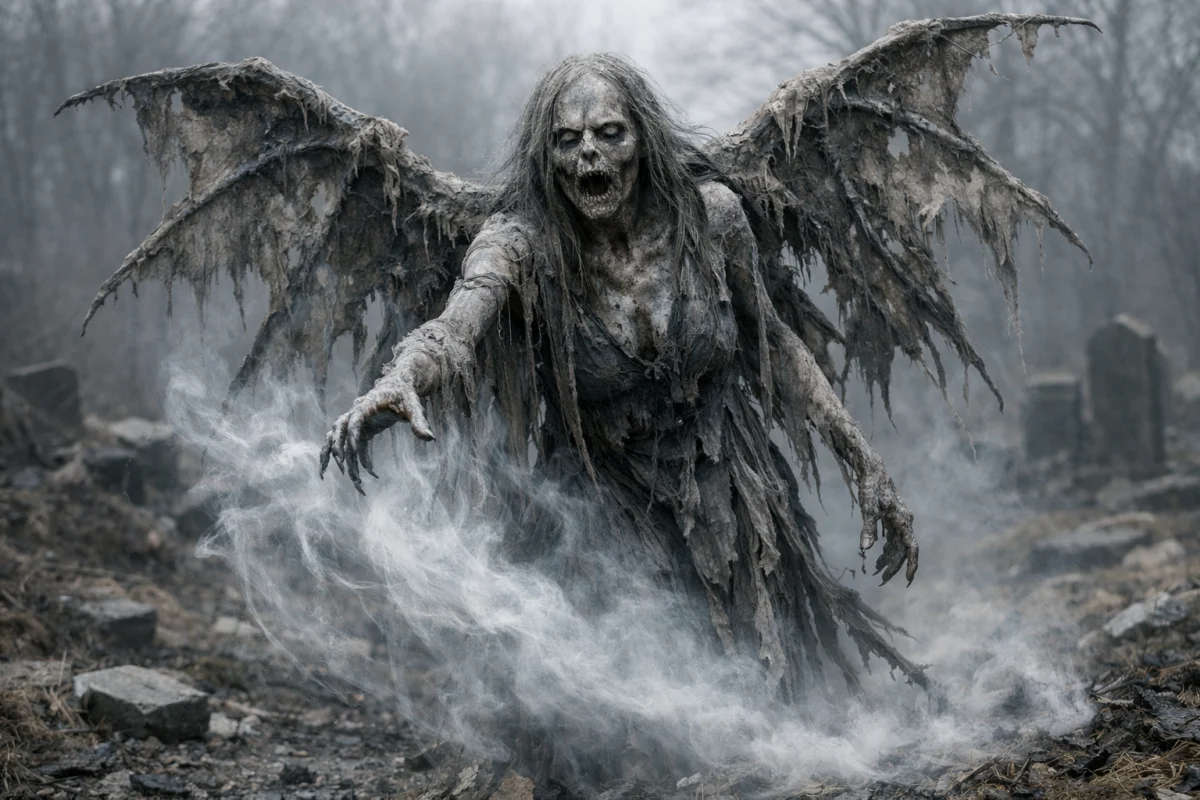
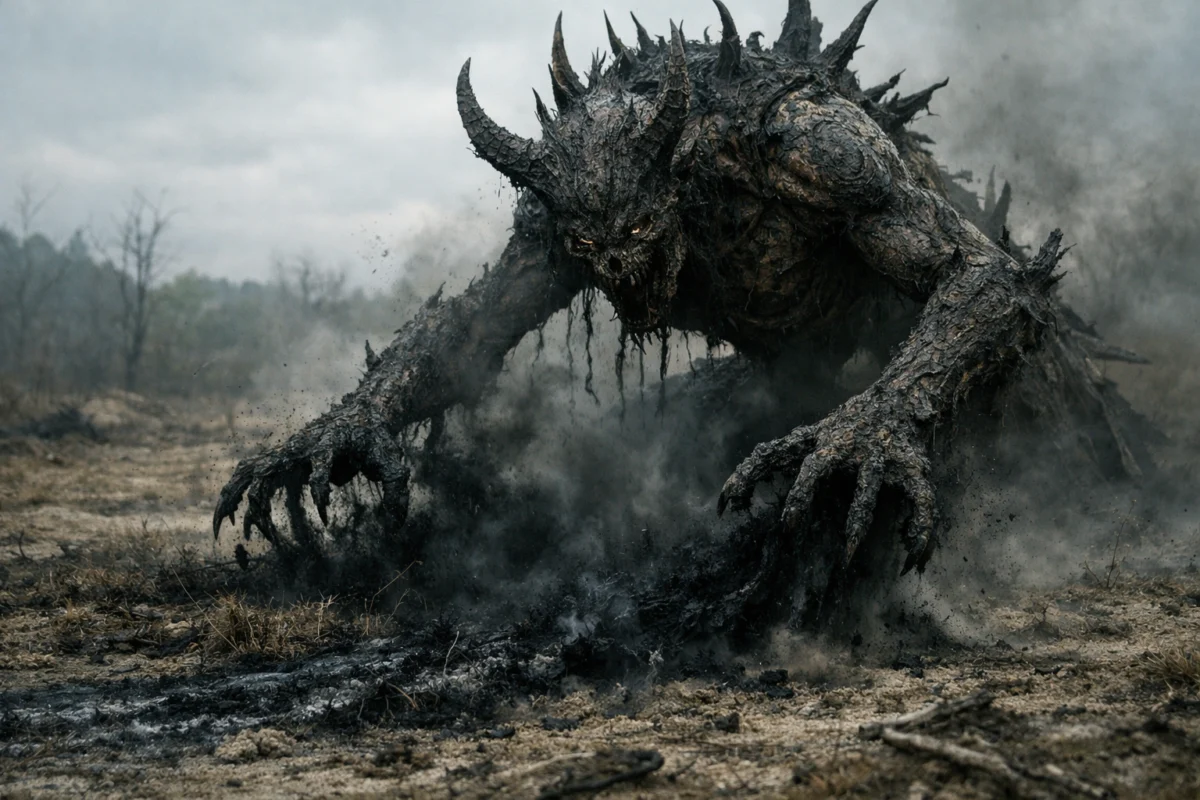
A vetāla has no single appearance shared by every literary and religious tradition. Its best-known visible form is an animated human corpse, but Sanskrit materials also present vetālas as supernatural servants and fabulous creatures with forms distinct from an ordinary dead body.
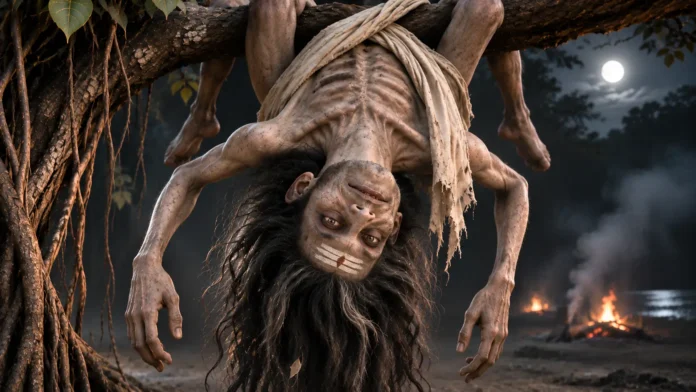
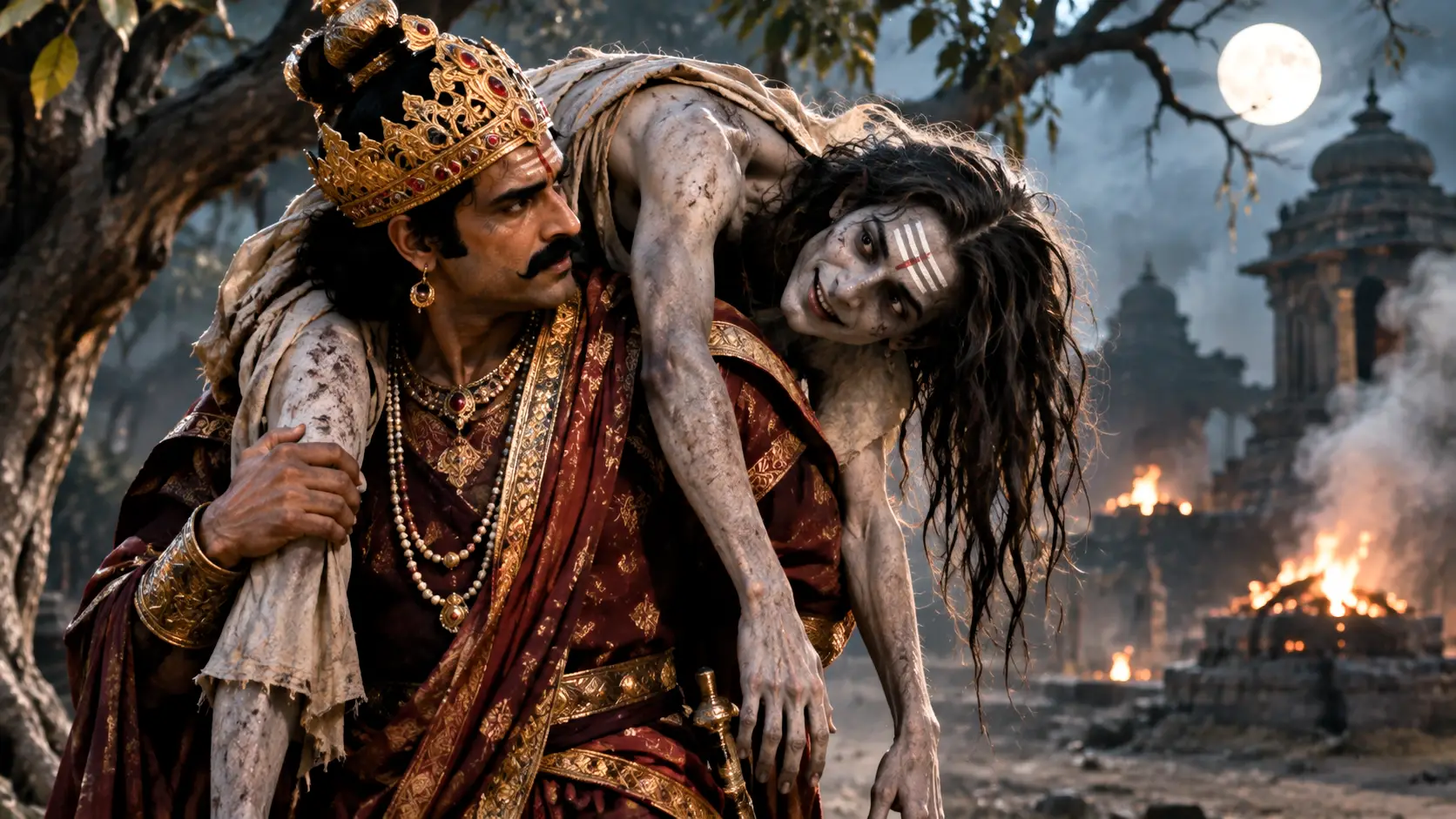
In the Vikram story cycle, the king encounters a corpse hanging in a tree and carries it away. A vetāla inhabits the body, speaks through it, and repeatedly returns to the tree during their contest of stories and questions.
The visible body in this episode is therefore an occupied corpse, not evidence that every vetāla has the same permanent anatomy.
Other Sanskrit religious and literary contexts broaden this picture. Vetālas may appear as servant-like beings or as fabulous creatures bearing distinctive bodily marks.
These forms should not all be reduced to corpse possession, nor should the features of one representation be treated as the appearance of the entire category.
Temple sculpture provides another setting for embodied representations. Two vetāla doorkeepers from a twelfth-century Hoysala temple are discussed in specialist research, alongside a Kashmirian hymn to Bhairava appearing as a vetāla.
These examples connect the figure with religious imagery beyond the familiar corpse-carrying narrative, without establishing one standard portrait for every region and period.
The most reliable description is consequently contextual: an inhabited human corpse in the famous tale cycle, with other supernatural forms in religious texts and art. Fixed fangs, aristocratic clothing, sunlight vulnerability, and obligatory blood drinking should not be assumed from the English label “vampire.”
That comparison does not supply a dependable physical description of the vetāla.
Background Story
The vetāla developed at the meeting point of religious ideas about dangerous liminal spaces and literary traditions of ingenious framed narration. Cremation grounds, corpses, fierce divinities, and supernatural power supplied one background, while courtly storytelling transformed the being into a sharp examiner of royal intelligence.
In the familiar frame, a religious practitioner sends King Vikram to retrieve a corpse from a tree in a cremation-ground setting. The corpse is occupied by a vetāla, whose repeated resistance turns an apparently physical task into a prolonged contest of speech, silence, knowledge, and obligation.
During each journey, the being tells a story ending in a difficult question. If Vikram knows the answer and remains silent, he risks punishment; when he answers correctly, the vetāla escapes and returns to the tree.
Repetition gives the cycle both narrative rhythm and intellectual structure.
The tales examine disputed duties, family relationships, sacrifice, loyalty, marriage, status, and justice. The vetāla therefore functions as more than an attacker.
It becomes an unsettling instructor whose puzzles expose contradictions in social rules and test whether a celebrated king can distinguish appearances from ethical substance.
Religious texts preserve a darker and more explicitly ritual background. Vetālas could be imagined within cremation-ground practices aimed at controlling perilous forces or obtaining extraordinary powers.
Connections with Bhairava, a fierce manifestation of Shiva, place some examples within a supernatural environment of death, transgression, protection, and mastery.
These strands should not be collapsed into a single biography. The riddling corpse-speaker, ritual servant, fabulous creature, and temple figure are related expressions of a broad category.
Their coexistence explains both the vetāla’s durability and the difficulty of translating it with one modern supernatural label.
Famous Folklore Stories
The best-known vetāla stories belong to a connected cycle in which a supernatural encounter contains a succession of shorter tales. Corpse retrieval, riddling questions, and repeated tests of royal judgment bind the stories together, although their selection and details vary between versions.
The Twenty-five Tales of a Vetāla
The Vetālapañcaviṃśati, or Twenty-five Tales of a Vetāla, survives in several versions, including the cycle incorporated into Somadeva’s eleventh-century Kathāsaritsāgara. Its nested storytelling places questions about loyalty, marriage, sacrifice, responsibility, and justice within a larger supernatural adventure.
The title does not mean that every surviving version contains an identical sequence. Different recensions and retellings alter individual stories, their arrangement, and sometimes the reasoning behind their conclusions.
Vikram and the Vetāla
In the familiar frame narrative, King Vikram undertakes to retrieve a corpse hanging in a tree. A vetāla inhabits the body and tells him stories while he carries it away.
Each story presents a difficult question that turns the journey into a test of judgment rather than strength alone.
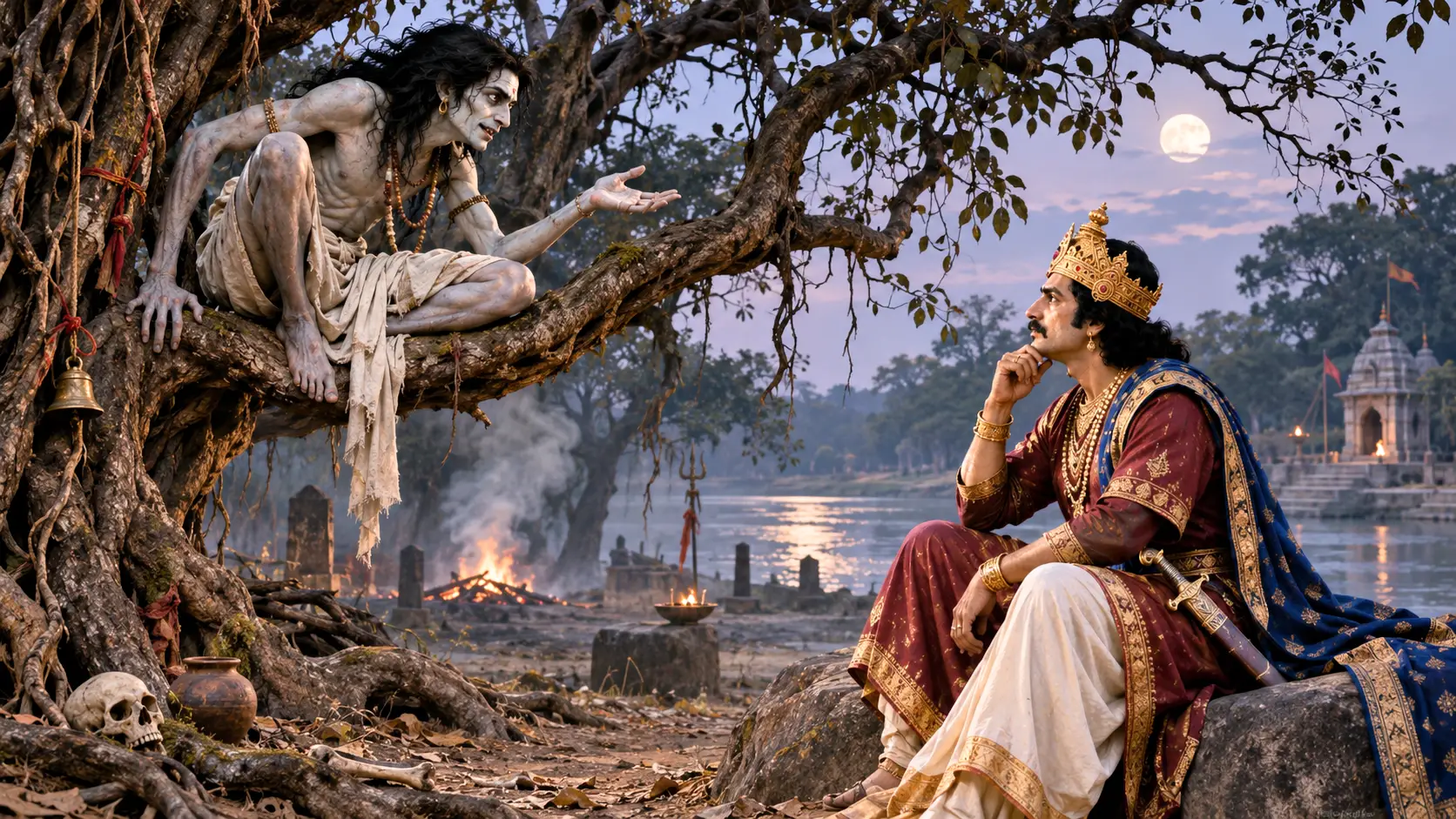
The king faces a trap: remaining silent when he knows an answer carries a threatened punishment, but answering allows the vetāla to escape and return to the tree. His repeated journeys create a contest between royal determination and a narrator whose strongest weapons are speech, knowledge, and delay.
The Three Young Brāhmans Who Restored a Dead Lady to Life
One documented tale concerns three young Brahmans associated with a woman’s restoration to life. Their competing claims involve a magical charm, the carrying of her bones to the Ganges, and ascetic devotion.
The supernatural event becomes a dispute over whose actions deserve recognition.
The episode illustrates the cycle’s characteristic movement from marvel to argument. Restoring life does not settle the story; it creates a problem about relationships and rightful claims.
Variants change the number of claimants and the judgment, showing why a single retelling cannot stand for the entire tradition.
Burton’s English Retelling
Richard Francis Burton’s nineteenth-century Vikram and the Vampire brought an abbreviated, freely adapted selection to English readers. It contains eleven tales, not the complete twenty-five-tale cycle.
Its Victorian style and use of “vampire” belong to that particular retelling and should not be mistaken for a complete Sanskrit version or a universal description of vetālas.
Cultural Impact
The Vikram and Vetāla cycle combines supernatural entertainment with questions about social obligation, kinship, truthfulness, and justice. Its stories turn extraordinary events into dilemmas, making the interpretation of human conduct as important as the marvels themselves.
Vikram’s encounters can be read as a portrayal of kingship grounded in judgment rather than physical strength alone. Carrying the inhabited corpse demands courage and persistence, but answering its questions requires careful reasoning.
The king’s authority is repeatedly tested through his ability to distinguish competing claims.
The vetāla reverses the apparent balance of power between captor and captive. Although carried by the king, it directs the storytelling and sets the questions that interrupt his task.
In this narrative, speech and knowledge give a dangerous supernatural being an authority that force cannot easily overcome.
Seventeenth-century Newari manuscripts titled Vetala and Betala document the figure’s place in Newar literary culture beyond Sanskrit transmission. These surviving witnesses establish circulation in another language, although their catalogue descriptions alone do not reveal how extensively individual stories were adapted.
Richard Francis Burton’s Vikram and the Vampire gave English readers an abbreviated Victorian adaptation containing eleven tales. Its use of “vampire” offered a familiar European comparison but narrowed a more varied South Asian supernatural category.
The witty corpse-inhabiting narrator of this retelling is one influential literary presentation, not a complete account of vetālas across religious and narrative traditions.
Similar Beasts
Vampire

The Vampire is an undead or revenant figure in European folklore, commonly associated with returning from death and consuming blood or vital essence from living victims.
Both beings can be linked with corpses and death, but the Vetāla is not consistently blood-drinking, making “vampire” an incomplete and potentially misleading translation.
Ghoul
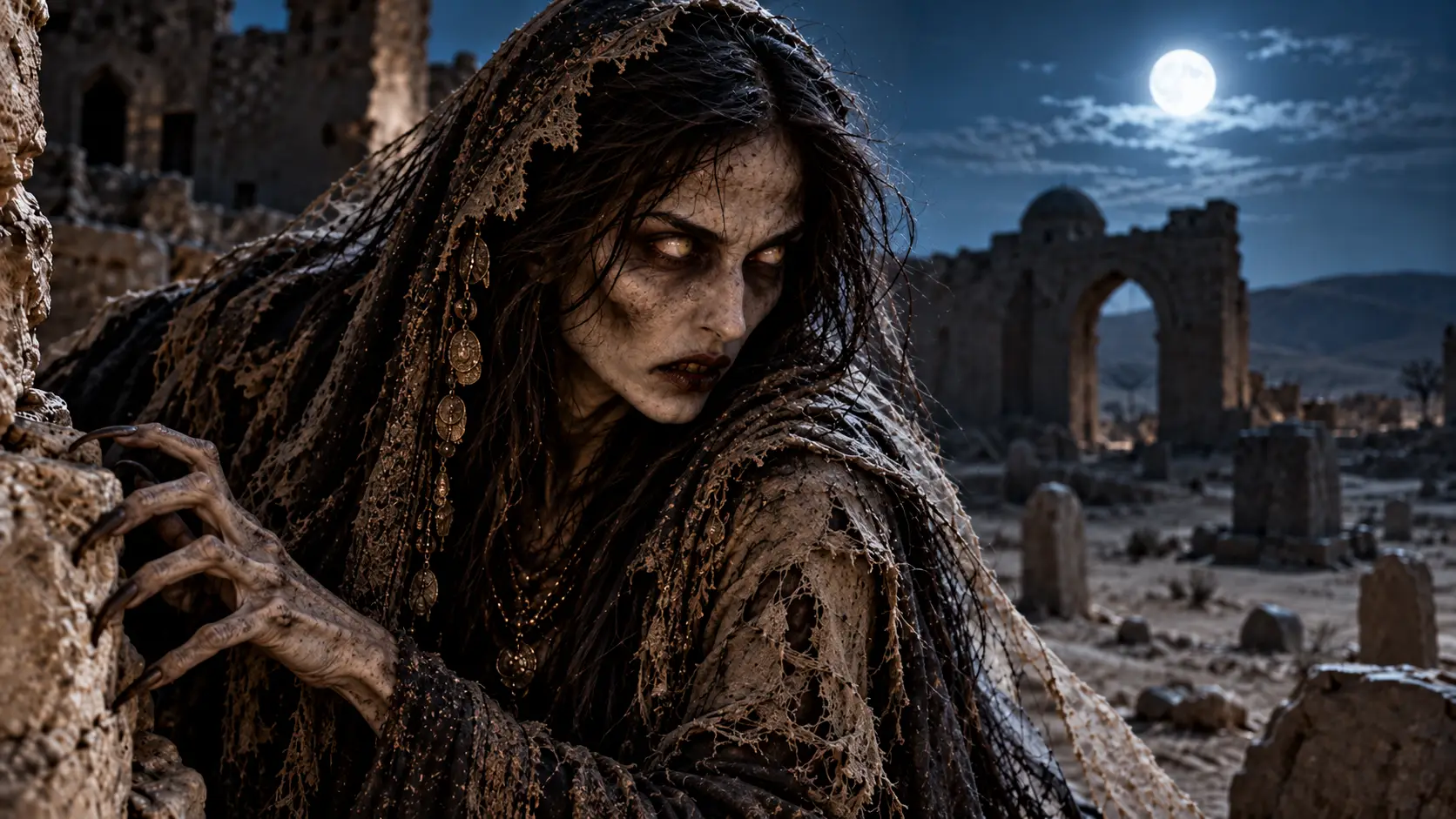
The Ghoul is a supernatural being from Arabic folklore associated with wilderness, deception, isolated places, and danger to travelers, sometimes appearing in changing or misleading forms.
Like the Vetāla, it occupies frightening spaces and resists one fixed appearance, but its wilderness ambush role differs from the Vetāla’s corpse and riddle traditions.
Yurei

Yurei are Japanese ghosts associated with the continuing presence of the dead, often expressing vengeance, sorrow, attachment, or duties that remain unresolved after death.
They resemble corpse-associated Vetālas through their connection with death, yet yurei are generally understood as human spirits rather than a varied class of fabulous beings.
Mazzikin
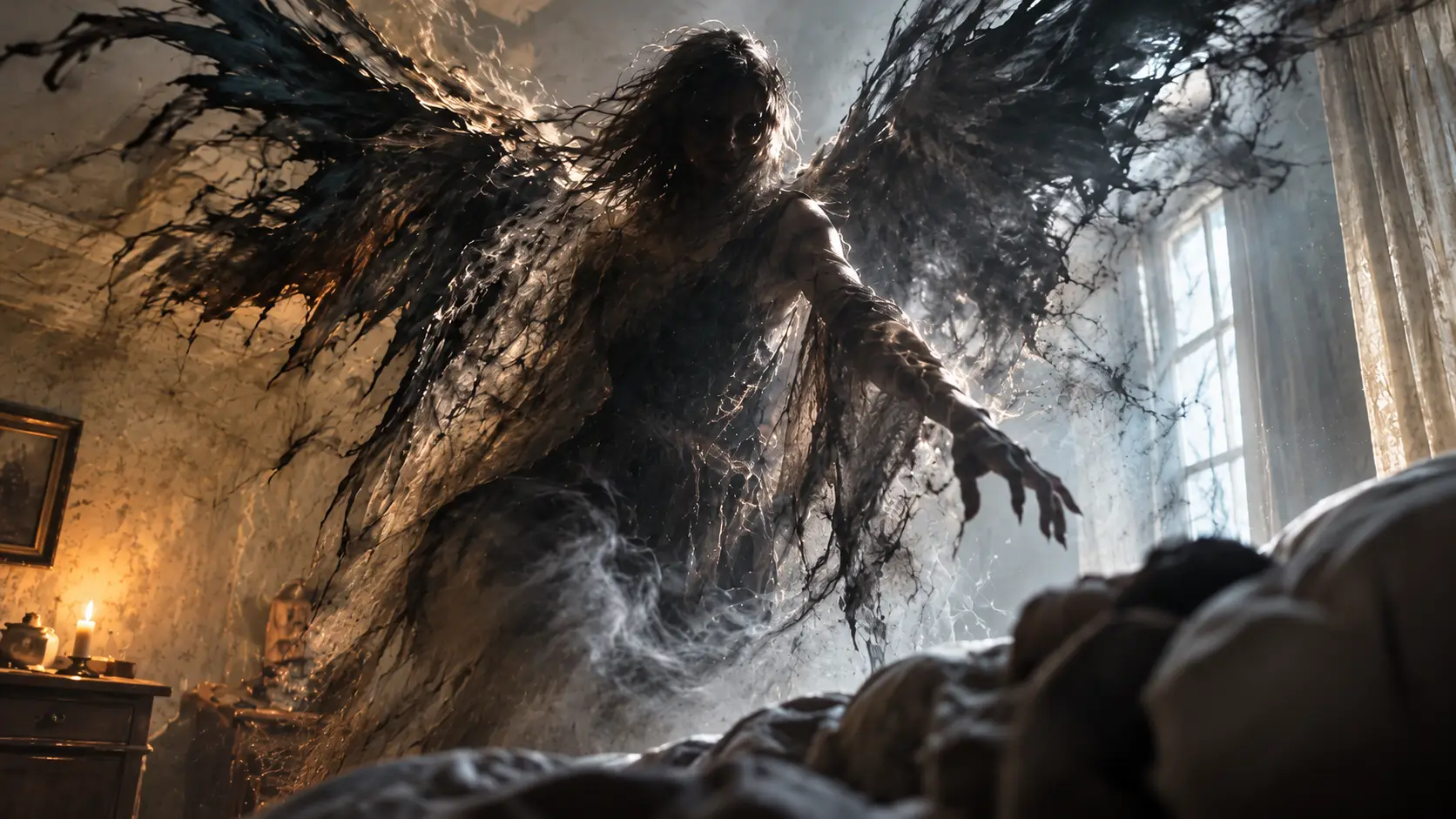
Mazzikin are harmful spirits in Jewish rabbinic tradition, usually unseen and connected with hidden dangers or disturbances rather than one consistent body or individual biography.
Their variable, spirit-like nature resembles the Vetāla’s unstable classification, although they lack the distinctive animated-corpse setting and riddling narrative role of the Sanskrit cycle.
Religion/Ritual
Vetālas were not confined to entertaining story literature. Sanskrit religious materials place them within tantric contexts involving cremation grounds, powerful supernatural beings, and attempts to acquire extraordinary abilities.
These settings differ substantially from the conversational narrator of the tale cycle.
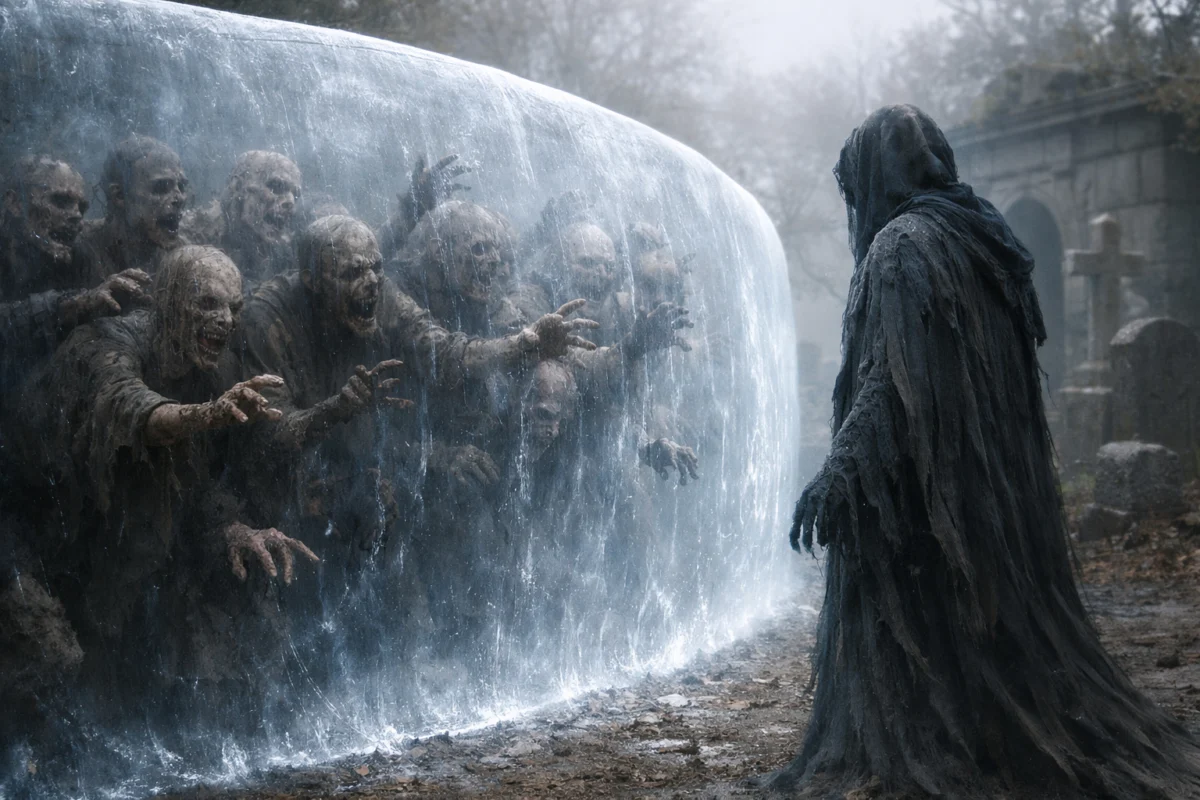
Cremation grounds held particular ritual significance as places where ordinary social boundaries met death, impurity, and transformative religious practice. Within this setting, a Vetāla could function as a dangerous presence, an entity to be controlled, or an instrument of specialized ritual power.
Specialist research also identifies Vetālas in material connected with Bhairava, a fierce manifestation of Shiva closely associated with death, terrifying places, and tantric practice. A hymn involving Bhairava and temple figures from the Hoysala cultural sphere broaden the evidence beyond narrative manuscripts.
This material does not support one universal “Vetāla ritual” practiced throughout South Asia. The evidence belongs to particular textual, tantric, and artistic contexts.
Literary corpse-carrying episodes should therefore not automatically be read as direct records of ordinary religious observance.
Scientific or Rational Explanations
There is no scientific evidence that Vetālas constitute a biological species or an observable form of postmortem animation. Their varied bodies, roles, and behaviors are better approached as products of religious imagination, literary development, and historically changing classifications of supernatural beings.
From an anthropological perspective, association with corpses may express the uncertain status of the dead before funerary and social boundaries are fully restored. A body imagined as inhabited by another presence gives narrative form to anxieties surrounding death, pollution, identity, and improper control.
The cremation-ground setting can likewise be interpreted through liminality. Such places stand outside routine domestic life while remaining essential to society’s treatment of death.
Stories and rituals locate extraordinary beings there because the landscape already carries danger, transformation, and restricted knowledge.
The repeated riddles require no medical or zoological explanation. They operate as a literary mechanism that delays the king’s task while presenting compact problems of logic and ethics.
The supernatural narrator makes abstract disputes immediate by attaching consequences to every answer.
Differences among Sanskrit, Newari, vernacular, and English presentations can be explained through textual transmission and adaptation. Copyists, compilers, translators, and retellers selected material for different audiences, producing variation without requiring a single original description from which every later account descended unchanged.
The label “vampire” illustrates how translation can reshape perception. European readers already possessed categories for animated corpses and predatory undead beings, so the familiar word offered a convenient comparison.
It also obscured servant-like, fabulous, ritual, and intellectually challenging forms documented in South Asian sources.
Modern Cultural References
Vikram Aur Betaal, Indian television series (1985–1986), DD National
Directed by Prem Sagar, this 26-episode series follows King Vikramaditya and Betaal through supernatural tales and moral riddles, bringing the traditional story cycle to Indian television audiences.
Source: https://www.sagarworld.com/vikram-aur-betal/
Vikram & Betal I, illustrated comic book (2012), Wilco Publishing House
This illustrated adaptation introduces younger readers to Vikram and the corpse-inhabiting Betal, preserving the familiar pattern of moral questions, royal answers, and the spirit’s repeated escapes.
Source: https://books.apple.com/us/book/vikram-betal-i/id1373597982
Vikram Vedha, Tamil crime thriller film (2017), directed by Pushkar and Gayathri
Inspired by Vikram-Betaal storytelling, the film replaces the supernatural encounter with a police officer and gangster whose conversations explore moral ambiguity through challenging stories and difficult choices.
Source: https://scroll.in/reel/842793/scroll_in
Vikram Betaal Ki Rahasya Gatha, Indian fantasy television series (2018–2019), &TV
Starring Aham Sharma as Vikramaditya and Makarand Deshpande as Betaal, this adaptation revisits the king’s supernatural encounters while introducing expanded adventures, mythological characters, and moral dilemmas.
Source: https://www.zee5.com/te/global/tv-shows/details/vikram-betaal/0-6-1080
Betaal, Netflix horror miniseries (2020), created by Patrick Graham
This horror adaptation reimagines the Betaal name through an ancient curse that releases a colonial officer and his undead soldiers, departing significantly from the traditional riddling storyteller.
Source: https://about.netflix.com/en/news/take-a-dangerous-step-into-the-tunnel-at-betaal-mountain-but-at-your-own-risk
Vikram and Betaal: Night of the Blood Moon, novel by Amit Juneja (2025), Ebury Press
This contemporary fantasy novel follows an entrepreneur confronting an ancient Betaal to save his wife, transforming the traditional cycle of supernatural riddles into a modern psychological ordeal.
Source: https://www.penguin.co.in/book/vikram-and-betaal/
Conclusion
Vetāla remains significant because it crosses boundaries that modern categories often keep separate. It can appear as a corpse-associated being, a fabulous creature, a ritual presence, or the challenging storyteller of the Vikram cycle.
These roles belong to different textual and religious settings rather than one fixed mythology. The familiar English label “vampire” captures only part of this range and can obscure the figure’s distinctive place within Indian and Newar traditions.
Across its varied forms, the Vetāla represents uncertainty made articulate. Its association with death and dangerous places inspires fear, while its riddles transform that fear into tests of judgment, speech, and moral reasoning.
Literary retellings, ritual materials, temple imagery, and Newari manuscripts demonstrate a tradition broader than any single story. Its lasting importance lies precisely in this adaptability: the Vetāla repeatedly unsettles boundaries between body and spirit, danger and instruction, silence and storytelling.
Further Reading
Vikram and the Vampire, Project Gutenberg
Accessible historical English retelling; its preface acknowledges an abbreviated selection and should be read critically as a Victorian adaptation.
(gutenberg.org)
EAP790/1/97: Vetala, British Library Archives and Manuscripts Catalogue
Catalogue record for a 103-folio Newari story manuscript about Vetala, dated 1600–1699.
(searcharchives.bl.uk)
Vetālas in Sanskrit Religious and Literary Texts, Acta Orientalia / Akademiai Kiado (article summary)
Specialist overview of Vetāla varieties, ritual roles, a Bhairava hymn, and Hoysala temple figures.
(growkudos.com)
Kathasaritsagara (the Ocean of Story), “Vetāla 2”, Wisdom Library
Provides a translated Vetāla-cycle tale and notes on story variants and motifs.
(wisdomlib.org)