Introduction
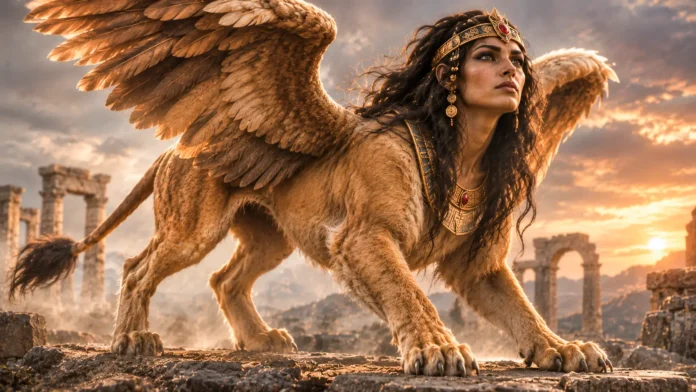
The Sphinx is a mythical hybrid creature combining the powerful body of a lion with the head of a human, sometimes accompanied by large feathered wings. Its earliest documented tradition originates in ancient Egypt before spreading throughout the Near East and Mediterranean.
Across different civilizations, the Sphinx acquired remarkably contrasting identities. Egyptian traditions associated it with royal authority, divine protection and solar power, while Greek mythology transformed it into a dangerous female monster whose extraordinary intelligence presented a deadly challenge to human beings.
Unlike many mythological creatures defined by a single narrative, the Sphinx encompasses several interconnected cultural interpretations. Its combination of human intelligence and animal strength expresses different ideas about authority, supernatural knowledge, protection and the dangers encountered when approaching sacred or forbidden places.
History/Origin
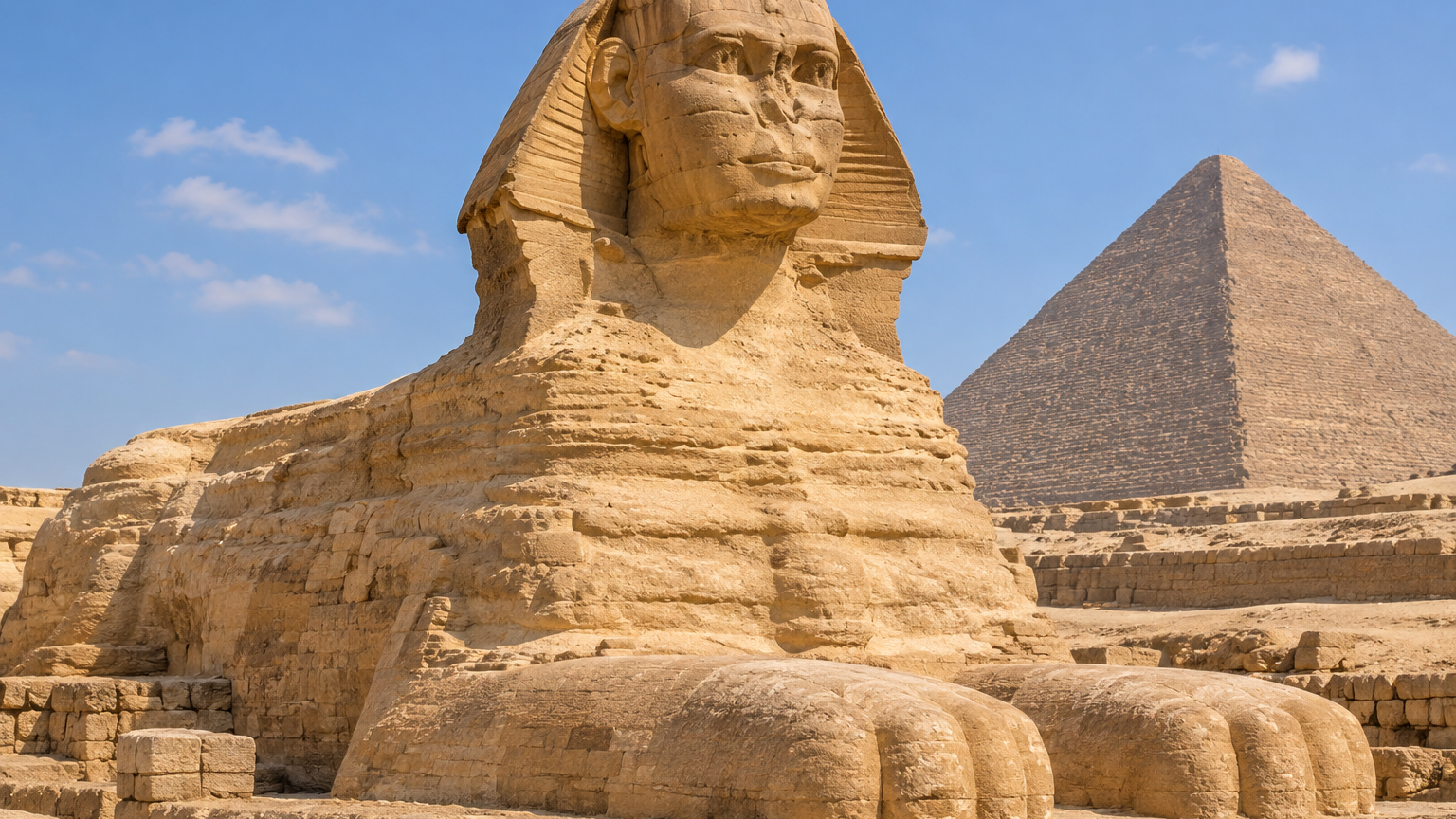
The earliest securely documented tradition of the Sphinx emerged during Egypt’s Old Kingdom, particularly the Fourth Dynasty. The Great Sphinx of Giza, carved directly from limestone bedrock during the third millennium BCE, represents the most monumental surviving example of this early tradition.
Archaeological research strongly associates the monument with Pharaoh Khafre, whose neighboring pyramid complex shares architectural and geological connections with the Sphinx and its temple. Although alternative royal attributions exist, the available archaeological evidence predominantly supports its construction during Khafre’s building program.
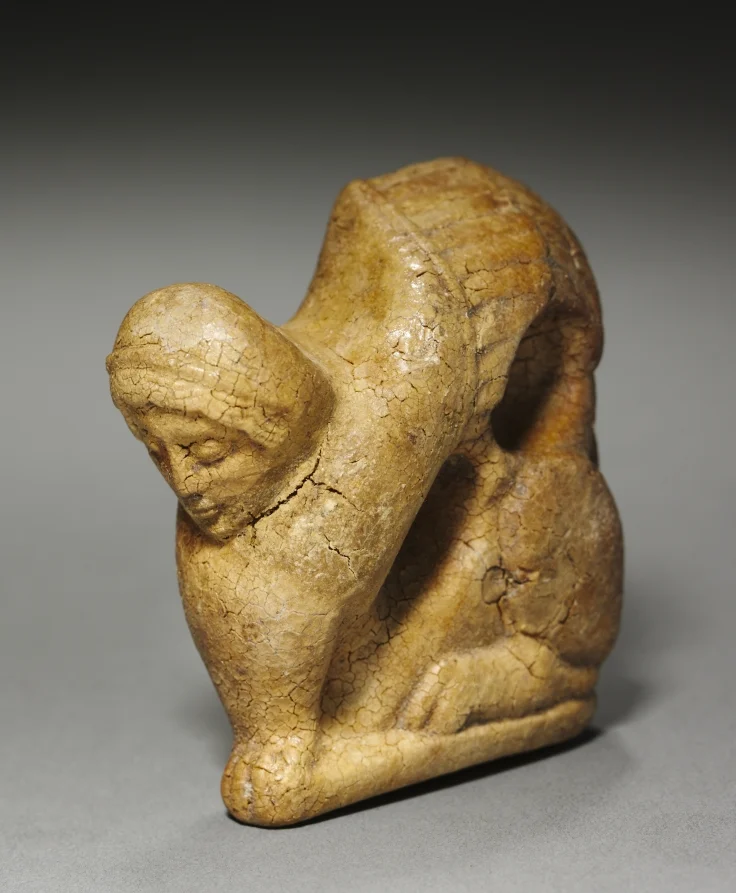
By the Middle Bronze Age, sphinx imagery had reached Anatolia and other parts of Western Asia. An eighteenth-century BCE ivory plaque, probably originating from Acemhöyük in central Anatolia, demonstrates how regional artisans incorporated Egyptian supernatural imagery into their own artistic traditions.
Sphinxes subsequently appeared in Minoan and Mycenaean art before becoming prominent within Archaic Greek culture. This transmission involved considerable artistic transformation, particularly through contact with Near Eastern traditions, which contributed to the development of winged sphinxes throughout the eastern Mediterranean world.
Among the earliest surviving Greek literary references appears in Hesiod’s Theogony, composed around 700 BCE. The poem identifies the Sphinx as a destructive supernatural creature associated with the inhabitants of Thebes, establishing its place within Greek mythology independently of its Egyptian symbolism.
“But Echidna was subject in love to Orthus and brought forth the deadly Sphinx which destroyed the Cadmeans.”
Theogony, Hesiod, lines 326-327, circa 700 BCE, translated by Hugh G. Evelyn-White, 1914.
In Different Cultures
Ancient Egypt
Egyptian sphinxes primarily represented the supernatural authority of kingship, combining recognizable royal features with the physical strength of a lion. Their presence within mortuary complexes and sacred environments expressed the ruler’s capacity to overcome enemies and maintain the established cosmic order.
During the New Kingdom, the Great Sphinx acquired a more explicitly divine identity as Horemakhet, meaning Horus in the Horizon. Pharaoh Amenhotep II established a nearby temple dedicated to this deity, strengthening the monument’s association with solar worship and divine authority.
Ancient Greece
Greek mythology transformed the Sphinx into a female supernatural monster associated particularly with the city of Thebes in Boeotia. Unlike its Egyptian counterpart, the Greek creature threatened human communities through deadly encounters, combining predatory behavior with exceptional intelligence and mastery of riddles.

Nevertheless, Greek culture also preserved protective interpretations of the creature. Archaic Greek sculptors frequently positioned sphinxes above funerary monuments, where they served as guardians of the dead. This dual identity demonstrates that the Greek Sphinx was not exclusively a malevolent supernatural being.
Hittite Empire
Hittite culture incorporated sphinxes into monumental architecture, particularly gateways controlling access to important settlements and ceremonial spaces. Their imposing presence at entrances suggests a protective function, connecting the creature with the symbolic defense of significant buildings rather than the Greek tradition of riddling.
The Sphinx Gate at Hattusa preserves evidence of this architectural tradition from the fourteenth or thirteenth century BCE. Related monumental sculptures at Alaca Höyük demonstrate that the Hittites incorporated sphinx imagery into more than one important settlement within their Anatolian territories.
Phoenician Culture
Phoenician artisans developed distinctive winged sphinxes that combined Egyptian royal symbolism with Near Eastern artistic conventions. These creatures frequently appeared on elaborately decorated ivory objects, incorporating royal headdresses, double crowns and decorative garments alongside extended wings and slender, carefully proportioned leonine bodies.
Their imagery sometimes formed symmetrical compositions, with opposing sphinxes positioned around stylized vegetation. Surviving examples also depict sphinxes trampling defeated figures, preserving associations with royal dominance while adapting Egyptian iconography to the luxury furnishings and artistic preferences of the ancient Near East.
Name Meaning
The English word Sphinx entered the language through Latin from the ancient Greek Σφίγξ (Sphínx). Greek sources also preserve the Boeotian form Φίξ (Phíx), which appears in Hesiod’s Theogony and reflects the creature’s particularly strong association with the region surrounding Thebes.
A traditional linguistic interpretation connects the Greek name with the verb σφίγγω (sphíngō), meaning to squeeze, bind tightly or strangle. According to this interpretation, the creature’s name means the strangler, reflecting its destructive relationship with the people of Thebes in Greek mythology.
Another proposed derivation connects the name with the Egyptian expression šsp ꜥnḫ (shesep ankh), meaning living image. Although this expression describes statues and sacred representations in Egyptian terminology, scholars continue debating whether it contributed directly to the development of the Greek name.
Appearance
The fundamental anatomy of the Sphinx combines leonine and human characteristics, although individual cultures developed distinct physical forms. Its quadrupedal body generally possesses powerful legs, pronounced muscular features, large paws and a long tail, while its head reflects different supernatural or royal identities.
Egyptian sphinxes generally appear without wings and frequently possess the recognizable facial features of a pharaoh, accompanied by royal headwear and a ceremonial beard. However, surviving sculptures representing Hatshepsut demonstrate that Egyptian sphinx imagery was not restricted exclusively to male rulers.
Greek sphinxes typically possess the head of a woman and the feathered wings of a bird. Ancient representations frequently show the creature seated upon its hind legs, with raised or curved wings extending above its leonine body and framing its human head.
“She had the face of a woman, the breast and feet and tail of a lion, and the wings of a bird.”
The Library, Pseudo-Apollodorus, Book III, 5.8, circa first or second century CE, translated by James George Frazer, 1921.
Egyptian and Near Eastern traditions also developed sphinx variants possessing animal heads. Ram-headed examples appear prominently within the sacred environment of Karnak, while falcon-headed sphinxes survive in ancient Near Eastern decorative art, reflecting the adaptation of leonine bodies to different supernatural identities.
Ancient representations ranged from miniature decorative objects to monumental architectural sculptures. Their surviving traces of colored pigments, precious metals and decorative inlays demonstrate that many sphinxes originally possessed considerably richer visual characteristics than the weathered stone surfaces familiar to modern audiences today.
Background Story
In ancient Egypt, the sphinx could embody the ruling pharaoh. The human head identified the ruler, while the lion’s body expressed the strength with which the pharaoh overcame enemies. On a surviving chair panel from the Eighteenth Dynasty, Thutmose IV appears as a sphinx trampling his foes. The inscription identifies him with the falcon god Horus: “Horus, the lord of might and action, trampling all foreign lands,” in the Metropolitan Museum of Art’s translation.
The Greek Sphinx belongs to a family of monsters. Hesiod’s Theogony links her birth to Orthus, the two-headed hound, while Pseudo-Apollodorus’s Library names Typhon and Echidna as her parents. In the Library, Hera sends the Sphinx against Thebes, and the creature takes up a position on Mount Phicium. The Muses teach her the riddle she puts to the Thebans.
After the Sphinx kills many Thebans, including Creon’s son Haemon, Creon promises the kingdom and marriage to the widow of Laius to whoever solves the riddle. His proclamation makes the challenge a matter of who will rule Thebes as well as how the city will escape the Sphinx.
Famous Folklore Stories
Oedipus and the Riddle of the Sphinx
In Pseudo-Apollodorus’s Library, Creon took charge of Thebes after the death of King Laius. The Sphinx settled on nearby Mount Phicium and challenged the Thebans with a riddle she had learned from the Muses.
The Thebans met repeatedly to puzzle out the answer. Each time they failed, the Sphinx seized and devoured one of them. The last of her victims was Creon’s son Haemon. Creon then promised the throne of Thebes and the hand of Jocasta, Laius’s widow, to anyone who could solve the riddle.
“What is that which has one voice and yet becomes four-footed and two-footed and three-footed?”
Pseudo-Apollodorus, The Library, Book III, 5.8, circa first or second century CE, translated by James George Frazer, 1921.
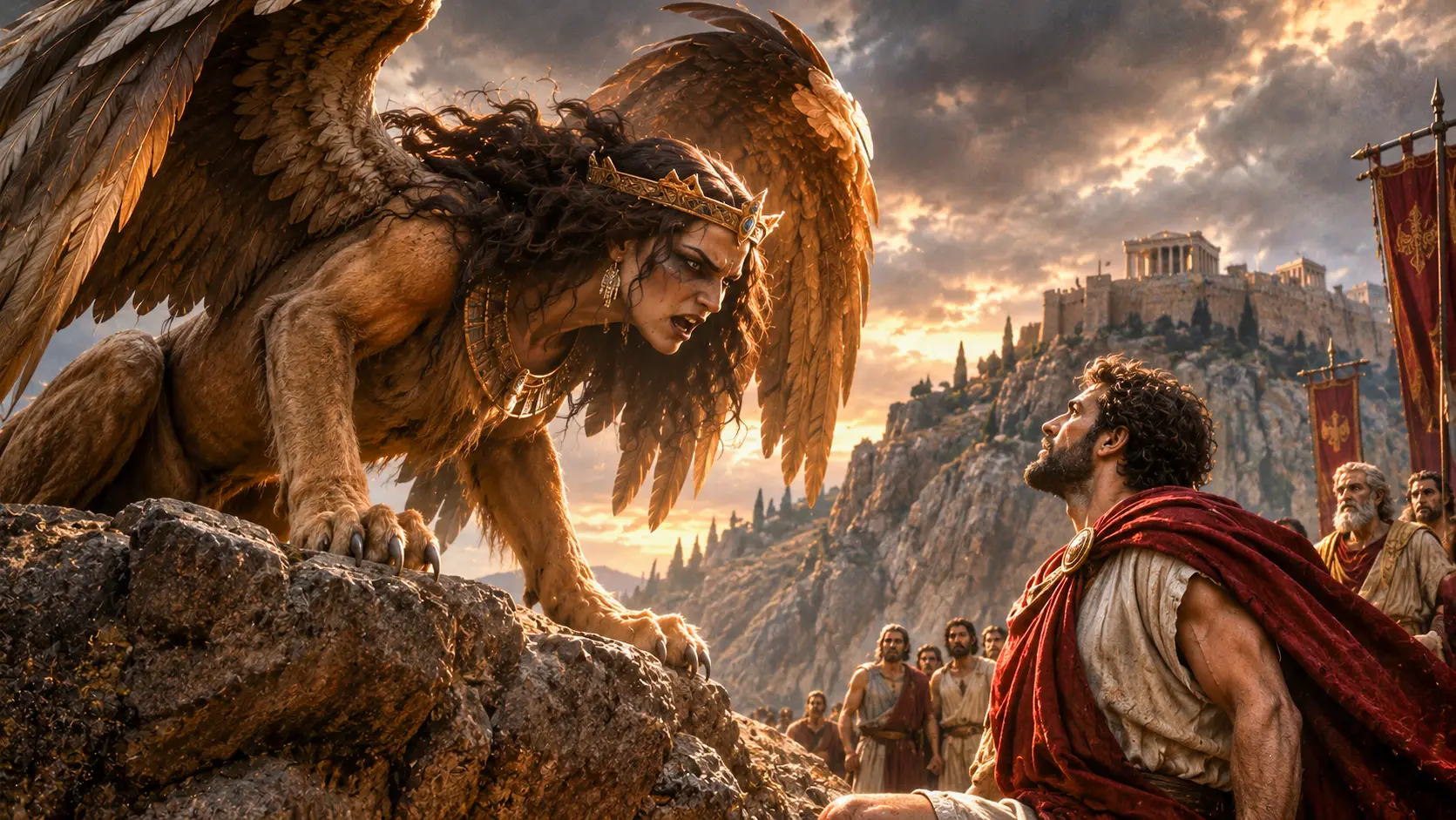
Oedipus realized that the riddle described a person at three stages of life: a baby crawls on hands and knees, an adult walks on two feet, and an older person uses a staff as a third support.
When Oedipus gave the answer, the Sphinx threw herself from the citadel. He took the throne and married Jocasta, not knowing she was his mother. In freeing Thebes, he had brought himself closer to fulfilling the prophecy he had tried to escape.
Thutmose IV and the Dream of the Great Sphinx
The Dream Stela of Thutmose IV recounts how the young prince hunted and practiced with weapons in the desert near Memphis. On one excursion he stopped at the Great Sphinx of Giza, rested in its shadow, and fell asleep in the midday heat.
In the dream, the god of the Sphinx addressed Thutmose as a father speaks to his son. He named himself Harmakhis, Khepri, Ra and Atum, and promised the prince rule over Egypt and the prosperity that came with kingship. Then the god told him what the desert had done to his monument.
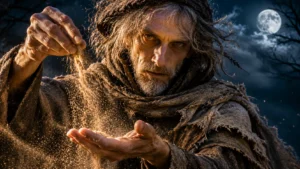
“The sand of the desert whereon I am laid has covered me. Save me.”
Dream Stela of Thutmose IV, Eighteenth Dynasty, circa 1400 BCE, lines 11–12, English translation published in Records of the Past, Second Series, Volume II, 1889.
The prince awoke and took the god’s words to heart. Damage to the inscription obscures its final passages. Archaeologist Christiane Zivie-Coche discusses excavated walls around the Sphinx that point to restoration work under Thutmose.
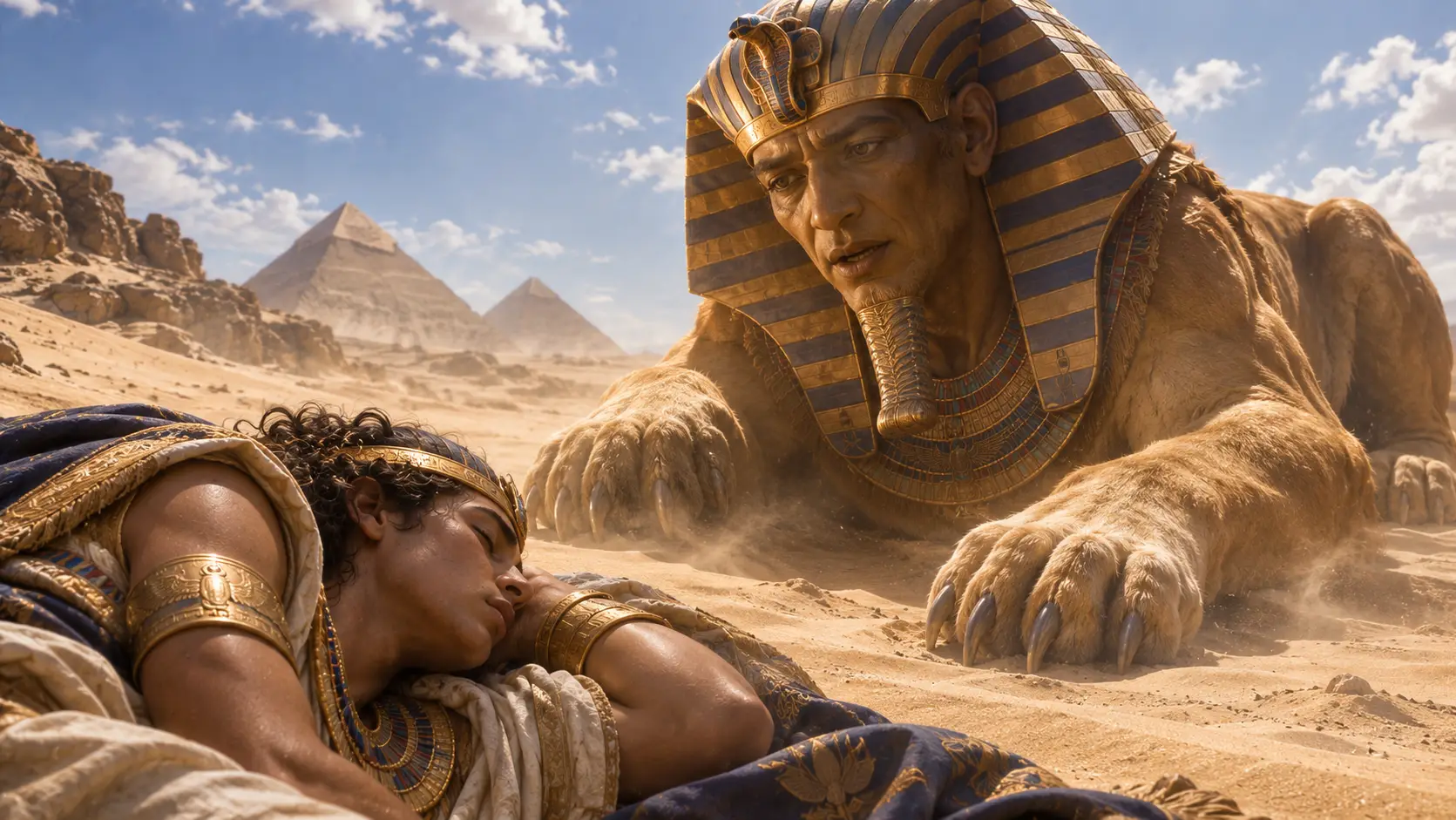
After taking the throne, Thutmose had the dream carved on a granite stela between the Sphinx’s forepaws. The inscription presents his kingship as the fulfillment of the god’s promise and the care of the monument as an act of devotion.
Cultural Impact
The Sphinx became a prominent emblem in ancient Mediterranean visual culture, appearing upon monumental sculptures, decorative objects and funerary architecture. Its recognizable combination of human and animal characteristics allowed artists to express complex ideas about supernatural authority through a single powerful figure.
European artists revived the Greek Sphinx during the nineteenth century, particularly through paintings exploring the confrontation between intelligence and danger. Gustave Moreau’s Oedipus and the Sphinx, exhibited at the Paris Salon in 1864, established the creature as an influential subject of Symbolist art.
The Sphinx also entered everyday language as a metaphor for secrecy, enigmatic behavior and intellectual mystery. This enduring association demonstrates how the Greek myth’s emphasis on riddles gradually developed into a broader cultural symbol, extending far beyond its original mythological context.
Similar Beasts
Lamasstu

The Lamasstu is a protective supernatural being from Mesopotamian mythology, commonly depicted with a human head, wings and a lion’s or bull’s body. Its monumental placement beside gateways closely resembles the protective function of Near Eastern sphinxes.
Read more about Lamasstu
Griffin
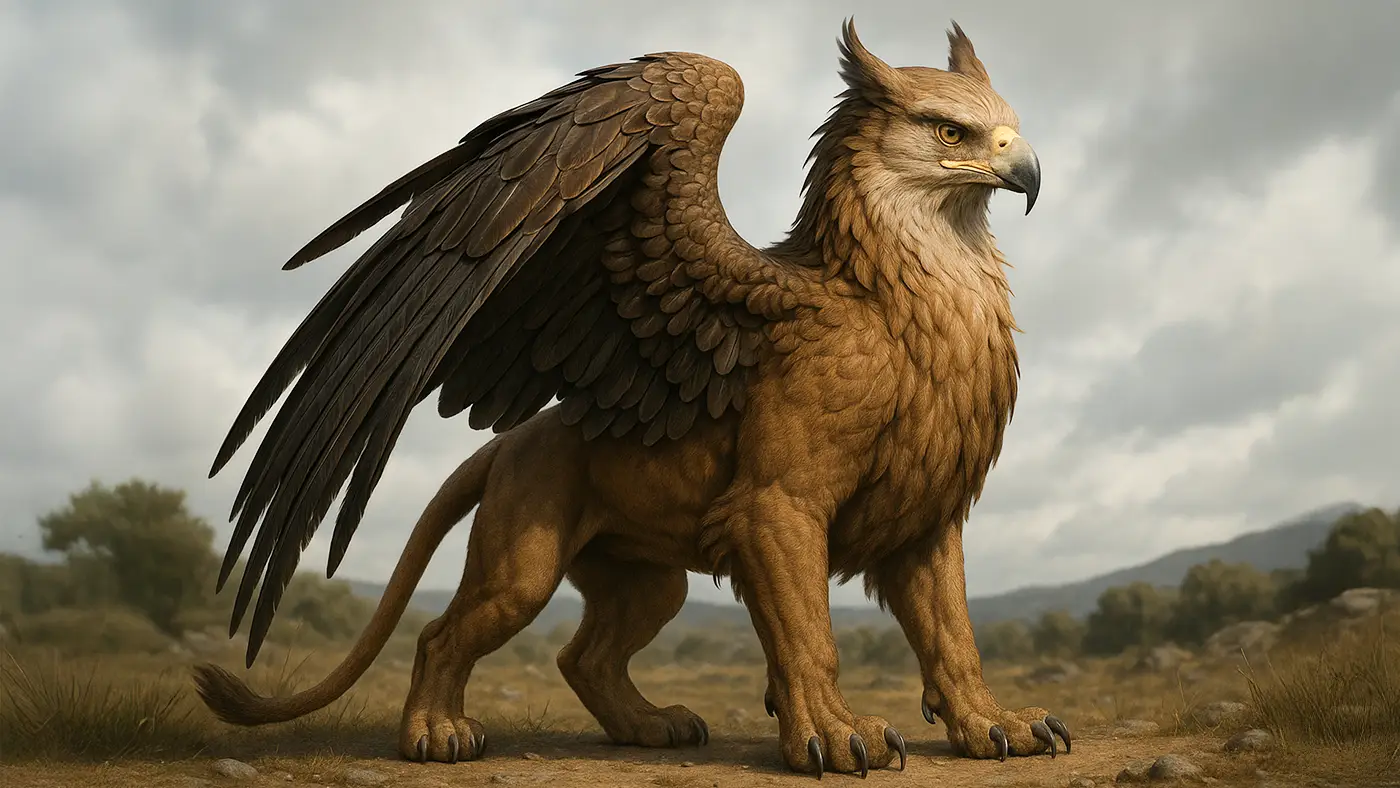
The Griffin combines the body of a lion with the head and wings of an eagle. Its powerful hybrid anatomy and associations with supernatural protection resemble the Sphinx, although it possesses a distinctly different mythological identity.
Read More about Griffin
Manticore

The Manticore is a legendary creature of Persian origin possessing a humanlike head, leonine body and dangerous tail. Its physical similarities to the Sphinx accompany a predatory nature particularly comparable to the threatening Greek interpretation.
Read more about Manticore
Chimera

The Chimera is a destructive Greek hybrid combining leonine, serpentine and goatlike characteristics. Its supernatural ancestry and combination of animal features connect it with the broader family of monsters to which Greek mythology assigns the Sphinx.
Read more about Chimera
Religion/Ritual
The Great Sphinx became an important focus of religious devotion during Egypt’s New Kingdom. The Dream Stela depicts Thutmose IV presenting offerings before the monument, providing evidence of ceremonial interaction with the divine presence that Egyptian worshippers associated with the statue.
Greek religious traditions also incorporated sphinx imagery into offerings presented at sacred sites. Around 560 BCE, the inhabitants of Naxos dedicated an impressive marble sphinx mounted upon a tall column at Delphi, demonstrating the creature’s significance within the sanctuary of Apollo.
Greek funerary monuments frequently employed sphinxes as protective figures associated with burial sites. Their presence above graves expressed supernatural guardianship, although archaeological evidence does not establish a separate religious cult devoted specifically to the monstrous Sphinx encountered by Oedipus in Greek mythology.
Scientific or Rational Explanations
Egyptologists interpret the Sphinx’s hybrid anatomy through the symbolic qualities ancient Egyptians attributed to lions. Combining the ruler’s recognizable human features with the strength and ferocity of a powerful predator provided an effective visual expression of political authority and supernatural protection.
Archaeological mapping at Giza has identified astronomical alignments connecting the Great Sphinx with Khafre’s pyramid complex. Researchers suggest these alignments reflect religious ideas concerning solar cycles and royal regeneration, providing a historical framework for understanding the monument’s placement within the surrounding landscape.
Geological studies also explain the monument’s distinctive weathering through differences between its natural limestone layers and prolonged environmental exposure. These findings demonstrate the importance of geological evidence when evaluating claims concerning the monument’s age, construction and physical transformation throughout its long history.
Modern Cultural References
The NeverEnding Story, directed by Wolfgang Petersen, 1984
Two monumental sphinxes guard the first gateway leading toward the Southern Oracle, confronting the young hero Atreyu with a supernatural test of courage and self-confidence.
Source: https://raisingchildren.net.au/guides/movie-reviews/neverending-story
Harry Potter and the Goblet of Fire, J. K. Rowling, Bloomsbury, 2000
A female-headed Sphinx guards a passage within the Triwizard Tournament maze, challenging Harry with a riddle and directly preserving the intellectual test associated with Greek mythology.
Source: https://www.harrypotter.com/features/5-standout-moments-of-the-triwizard-tournaments-third-task
Dungeons & Dragons, Monster Manual, Wizards of the Coast, 2014
Sphinxes appear as intelligent supernatural creatures possessing magical abilities and guarding sacred treasures, combining traditional associations with divine protection, intellectual challenges and formidable physical strength.
Source: https://www.dndbeyond.com/monsters/16917-gynosphinx
Assassin’s Creed Odyssey, Ubisoft, 2018
The Sphinx appears as one of the game’s principal mythological encounters, challenging players through riddles while integrating the creature into the fictional history of ancient Greece.
Source: https://www.ubisoft.com/en-ca/game/assassins-creed/news/3B4dol6lFFZ9w9rnepcMph/the-mythical-creatures-of-assassins-creed-odyssey-interview-with-the-development-team
Dragon’s Dogma 2, Capcom, 2024
A mysterious winged Sphinx challenges players through elaborate puzzles requiring observation, exploration and unconventional solutions, transforming the traditional Greek encounter into an interactive test of intelligence.
Source: https://www.pushsquare.com/news/2024/01/dragons-dogma-2s-sphinx-poses-compelling-gameplay-riddles-on-ps5
Magic: The Gathering, Foundations, Wizards of the Coast, 2024
The Curator of Destinies card depicts a traditional human-headed, winged Sphinx whose gameplay mechanics involve hidden information and difficult choices, reflecting the creature’s association with mystery.
Source: https://magic.wizards.com/en/news/making-magic/building-foundations-something-new
Conclusion
The Sphinx occupies a remarkable position within world mythology, embodying both the protective power of divine authority and the threatening consequences of supernatural knowledge. Its different cultural identities reveal how civilizations developed distinctive meanings from a recognizable combination of human and animal features.
Whether appearing as a sacred monument, a guardian of forbidden spaces or an adversary challenging human intelligence, the Sphinx continues to express humanity’s fascination with mystery. Its enduring significance lies in the relationship between physical strength, wisdom and the boundaries of human understanding.
Further Reading
Theogony, Hesiod, translated by Hugh G. Evelyn-White, 1914
One of the earliest surviving Greek literary sources concerning the Sphinx, documenting its supernatural ancestry and destructive relationship with the inhabitants of ancient Thebes.
Source: https://www.theoi.com/Text/HesiodTheogony.html
The Library, Pseudo-Apollodorus, translated by James George Frazer, 1921
Book III preserves the complete account of Oedipus confronting the Sphinx, including its physical appearance, supernatural ancestry, deadly riddle and eventual defeat by human intelligence.
Source: https://hcmc.uvic.ca/project/myths/APOL1-L3.html
The Stele of Thothmes IV, Records of the Past, Second Series, Volume II, edited by A. H. Sayce, 1889
An English translation of the original Egyptian Dream Stela, preserving the divine encounter between Thutmose IV and the Great Sphinx, including the promise of kingship.
Source: https://sacred-texts.com/book/records-of-the-past-2nd-series-vol-ii/text-3
The Dream Stela of Thutmosis IV, Kasia Szpakowska, PBS NOVA, 2010
An Egyptological interpretation of the Dream Stela examining its religious symbolism, historical circumstances, divine communication and significance in establishing the legitimacy of Thutmose IV’s royal authority.
Source: https://www.pbs.org/wgbh/nova/sphinx/stela.html
The Great Sphinx, Egyptian Ministry of Tourism and Antiquities
An official archaeological overview documenting the monument’s construction, association with Pharaoh Khafre, religious identity as Horemakhet and subsequent importance during Egypt’s New Kingdom.
Source: https://egymonuments.gov.eg/monuments/the-great-sphinx/
Mapping the Sphinx, Ancient Egypt Research Associates
Presents archaeological investigations into the Great Sphinx, its architectural relationships, potential solar alignments and restoration history, including evidence associated with the reign of Thutmose IV.
Source: https://aeraweb.org/mapping-the-sphinx/
Geology of the Sphinx, Ancient Egypt Research Associates
Examines the monument’s natural limestone composition, geological stratification and environmental deterioration, providing scientific context for evaluating its physical characteristics and archaeological dating.
Source: https://aeraweb.org/geology-of-the-sphinx/
Sphinx, Oxford Classical Dictionary, Oxford University Press
A scholarly overview of sphinx imagery across Egypt, Mesopotamia and the Mediterranean, examining its artistic development, geographical transmission and significance within ancient Greek culture.
Source: https://academic.oup.com/edited-volume/61673/chapter-abstract/550566435
Zur Herkunft des griechischen Wortes ΣΦΊΓΞ, Classica Cracoviensia, 2018
A linguistic study examining competing theories concerning the origin of the Greek word Sphinx, including proposed Egyptian, Greek and Sanskrit derivations and their respective uncertainties.
Source: https://journals.akademicka.pl/cc/article/view/887
Sphinx of Hatshepsut, Metropolitan Museum of Art, circa 1479-1458 BCE
An ancient Egyptian sculpture demonstrating the application of sphinx imagery to female pharaonic authority and the enduring association between leonine anatomy and the institution of kingship.
Source: https://www.metmuseum.org/art/collection/search/544442
Arm Panel From a Ceremonial Chair of Thutmose IV, Metropolitan Museum of Art, circa 1396-1386 BCE
An original Egyptian artifact depicting the pharaoh as a powerful sphinx overcoming his enemies, accompanied by hieroglyphic inscriptions connecting royal authority with the god Horus.
Source: https://www.metmuseum.org/art/collection/search/544826
Agreement Reached on the Sphinx of Hattusha, Staatliche Museen zu Berlin, 2011
Documents the archaeological provenance and dating of a monumental Hittite sphinx from the ancient capital of Hattusha, demonstrating its incorporation into important Anatolian architectural structures.
Source: https://www.smb.museum/en/whats-new/detail/agreement-reached-on-the-sphinx-of-hattusha/
Openwork Furniture Plaque with a Striding Sphinx, Metropolitan Museum of Art
An archaeological example of Phoenician-style ivory craftsmanship combining Egyptian royal headwear with Near Eastern winged sphinx imagery, illustrating the creature’s cultural transmission and artistic transformation.
Source: https://www.metmuseum.org/art/collection/search/324684
Marble Capital and Finial in the Form of a Sphinx, Metropolitan Museum of Art
An Archaic Greek funerary sculpture demonstrating the protective use of sphinx imagery in ancient burial monuments and its importance within the artistic traditions of Attica.
Source: https://www.metmuseum.org/art/collection/search/248501
The Stele and the Sphinx of the Naxians, Archaeological Site of Delphi, Hellenic Ministry of Culture
Documents the monumental sphinx dedicated by the inhabitants of Naxos at Delphi, providing archaeological evidence of the creature’s significance within ancient Greek religious and ceremonial environments.
Source: https://delphi.culture.gr/the-sphinix-of-the-naxians/
Oedipus and the Sphinx, Gustave Moreau, Metropolitan Museum of Art, 1864
An influential nineteenth-century painting reinterpreting the confrontation between Oedipus and the Sphinx, demonstrating the myth’s continuing importance within European painting and the development of Symbolist art.
Source: https://www.metmuseum.org/art/collection/search/437153