Introduction
The Bennu is a sacred bird of ancient Egyptian mythology that embodies the rising sun and its power to renew life. Closely associated with the city of Heliopolis, it usually takes the form of a heron and appears in Egyptian accounts of creation and the afterlife.
Egyptian funerary spells put the Bennu’s powers to personal use. The deceased could speak as the bird or take its shape, sharing in the vitality of the gods. The Bennu’s importance lay in what it could become and what it allowed others to become.
History/Origin
The earliest surviving evidence for the Bennu tradition comes from the Pyramid Texts of the Old Kingdom. Spell 600 places the creator’s first rising at Heliopolis and invokes that act to protect the king and his pyramid. The inscription records an existing belief rather than dating its beginnings.
The spell links the creator’s emergence with the benben and its sanctuary. Egyptologists differ on how explicitly it names the bird: James P. Allen reads the sanctuary name as the Benben Compound, while Foy Scalf understands the passage as describing the creator’s appearance in bird form.
By the Middle Kingdom, Coffin Texts spell 335 names the great Bennu of Heliopolis outright. The line belongs to a first person declaration of divine identity. Unlike the disputed wording of the older pyramid spell, this passage directly identifies its speaker with the bird.
“I am the great benu who is in Heliopolis”
Coffin Texts, anonymous, Middle Kingdom, spell 335, translated by Steven R. W. Gregory, 2022, p. 73, note 31
Scribes carried that declaration into spell 17 of the Book of the Dead, which preserved and reworked the earlier composition. The new setting gave the Bennu a lasting place in a funerary collection that circulated on papyrus and also appeared on tomb walls.
Heliopolis remained the bird’s principal cult center, but it was not the only Egyptian city to honor it. Heracleopolis venerated a form known as the large Bennu, and Edfu also had a Bennu cult. The bird’s religious reach extended beyond the city named in its best known declaration.
In the fifth century BCE, Herodotus recorded a Greek account of a sacred bird he called the phoenix, likewise associated with the Sun’s temple at Heliopolis. The setting and solar connection help explain the comparison, but his phoenix story does not describe the Egyptian Bennu’s life cycle.
The Egyptian tradition remained in use under Roman rule. A mummy breastplate made for a man named Hor preserves a shortened version of the old pyramid spell and names the House of the Bennu. A formula once inscribed for kings thus survived on a private burial object.
Name Meaning
The ancient Egyptian name is conventionally transliterated bnw. Benu and Bennu are English spellings of the same name. The Thesaurus Linguae Aegyptiae records the divine name in hieroglyphs and links it to a corresponding Demotic word glossed as ‘heron’ or ‘phoenix.’
One proposed origin for the name is the Egyptian verb wbn, meaning ‘to rise.’ The Global Egyptian Museum connects this interpretation with the benben, the sacred stone at Heliopolis that marked the creator’s first emergence. The proposed link fits the bird’s association with the first dawn.
Translations that use Benu-heron keep the Egyptian name and identify the bird’s familiar form. The rendering phoenix draws on a classical comparison. Rising from ashes belongs to the later phoenix tradition, not to the meaning of the Egyptian name.
Appearance
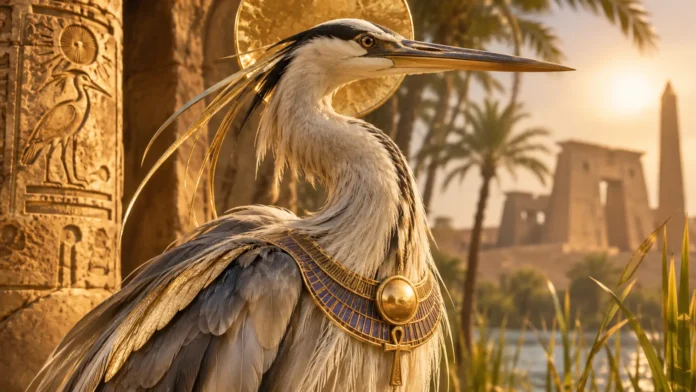
The Bennu’s familiar Egyptian form is a heron, with long legs, an elongated neck and a straight, pointed bill. The bird has a fully avian body. In funerary illustrations it can stand upright or draw its neck closer to its body, as a living heron does.
Older Egyptian writing points to a different silhouette. The Global Egyptian Museum identifies the bird associated with the Old Kingdom Pyramid Texts as a kind of wagtail and dates the heron form to the Middle Kingdom onward. The earlier species identification is less secure than the later heron imagery.
In the tomb of Nefertari, the Bennu takes the form of a grey heron in an illustration for spell 17. Other late funerary images have prompted comparisons with the purple heron as well. These identifications describe the birds that particular artists depicted, not a fixed species for the deity.
The papyrus of Ramose shows how closely an artist could observe the bird’s anatomy. Its spell 83 illustration gives the Bennu a sharp bill, a softly feathered chest and a delicately outlined body. The recognizable shape carries the image without the flames familiar from later phoenix art.
Background Story
In Heliopolitan theology, the Bennu could express the creative presence of Atum at the first emergence of land from the waters of Nun. The benben marked that emergence. The bird belonged to the moment when the creator first appeared, rather than serving merely as his companion.
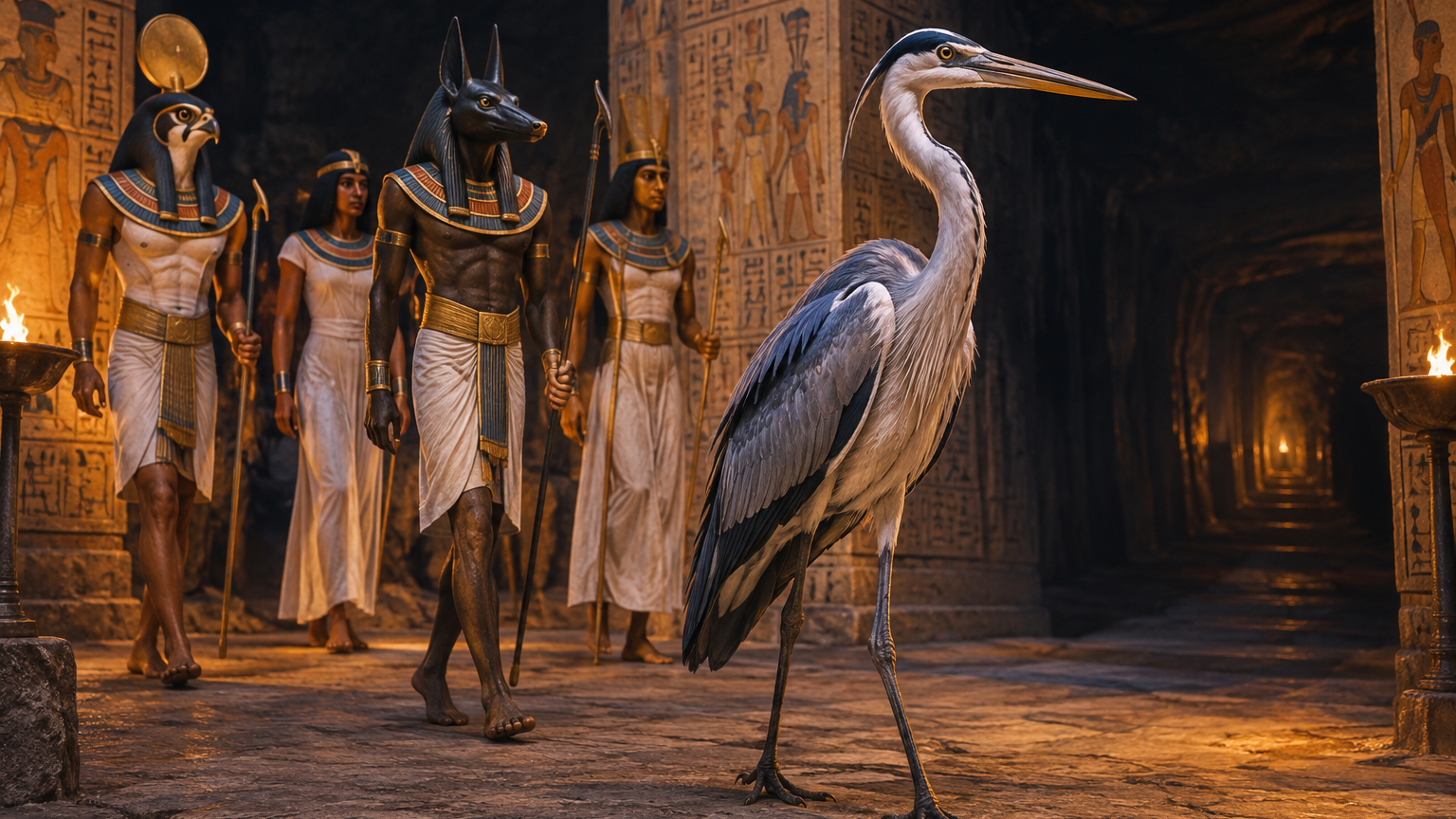
The Bennu also embodied the ba of Re. Often translated as soul, ba in this context refers to a way the god could manifest his power. Spell 29B gives that power a direction: the Bennu guides gods into the realm of the dead, from which they emerge again.
“I am the benu-bird, the soul of Re, who guides the gods to the netherworld from which they go forth.”
Book of the Dead, anonymous Egyptian funerary collection, New Kingdom tradition, spell 29B, translation published by Foy Scalf, 2012, p. 134
Spell 17 identifies the Bennu with Osiris at Heliopolis. Its commentary associates what exists with the god’s corpse, then offers another reading in terms of time and eternity, understood as day and night. The spell preserves both readings rather than requiring the speaker to choose between them.
The Bennu’s freedom of movement also mattered to the dead. The Coffin Texts associate the bird with passage through the underworld, and the Book of the Dead provides a spell for taking its form. The bird’s mobility offered a way to imagine continued agency after burial.
Ramose’s copy of spell 83 makes that transformation personal. The text names Ramose as the speaker and has him claim not only primeval flight but also the identity of Khepri, the rising sun. Ramose speaks the transformation in his own voice instead of asking the bird to carry him.
“I have flown up in primaeval time. I have become Khepri.”
Book of the Dead of Ramose, anonymous, thirteenth century BCE, spell 83.1, Fitzwilliam Museum English translation
Famous Folklore Stories
Nu and the Ferry of the Dead
In spell 122 of the Book of the Dead, a deceased official named Nu asks for a way into the underworld. His demand to be let in meets a series of questions. The voice confronting him wants to know who he is, where he is going and what name he bears.
Nu does not answer by repeating the title he held in life. Instead, he claims to belong among those who question him. He then shows that he knows more than the route he wants to take: he can name the boat and its equipment.
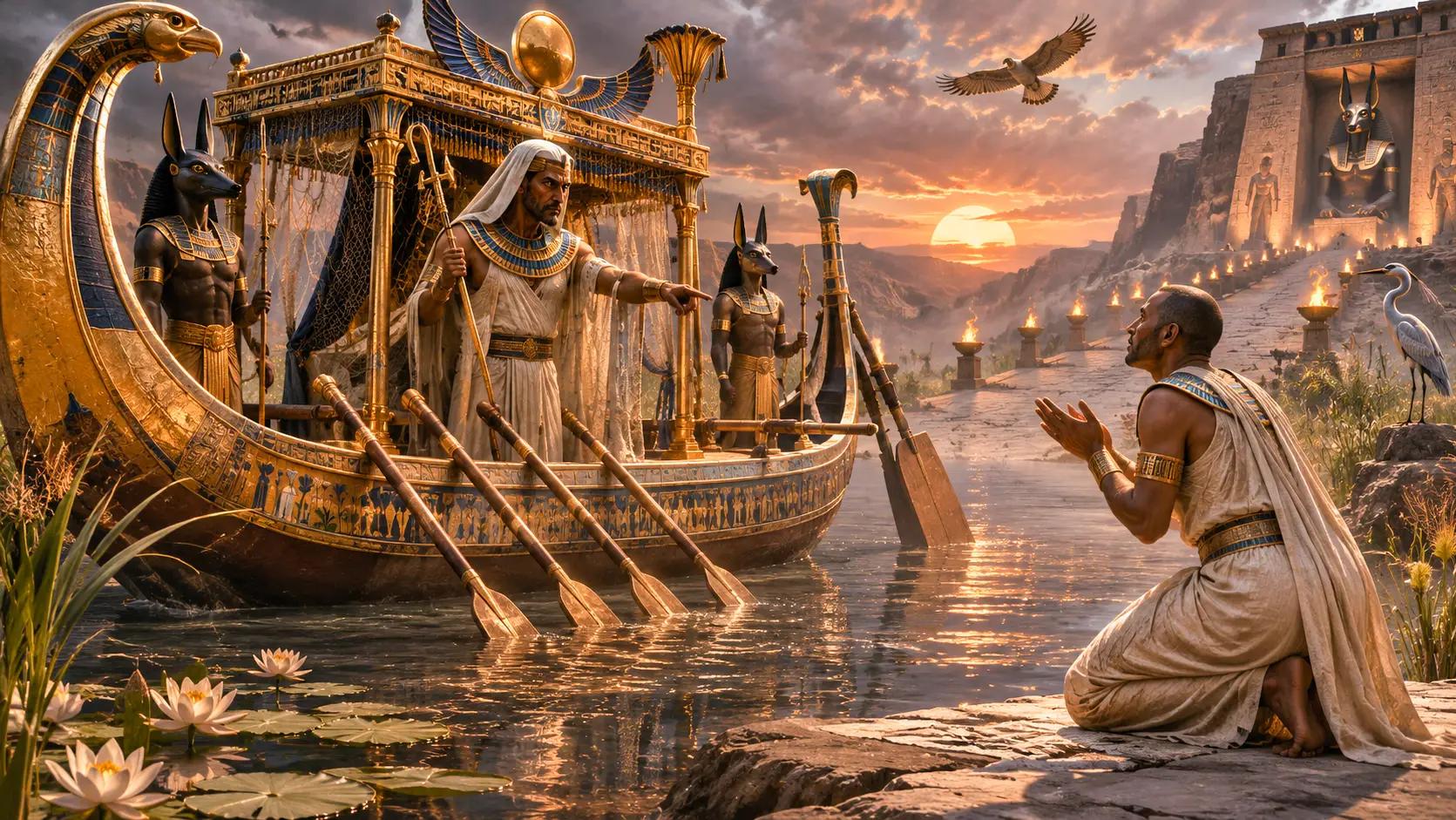
Nu calls his boat the Assembler of Souls. He goes on to name the oars, the bows and the rudder, then speaks of sailing onward to a pool. He also asks for milk, cakes, bread, drink and meat in the temple of Anubis.
The journey calls for a different form in each direction. Nu asks to go in as a hawk and come out like the Bennu and the Morning Star. The two birds are not opponents or companions. They are shapes in which the same traveler hopes to pass.
Nu closes by asking for a peaceful path into the West, for access to the lake of Osiris and for the chance to worship the god. The spell ends with that prayer. It gives Nu the words for reaching his destination rather than describing his arrival.
Cultural Impact
The painters of Ani’s Book of the Dead set the Bennu beside lions that mark the horizon. On the same sheet, Ani and his wife Tutu play senet, a game that could picture the journey into the next world. The scene gives that journey a celestial setting.
The same painting distinguishes the Bennu from other sacred birds rather than treating them as interchangeable. Ani and Tutu have human-headed bird forms above their tomb, while Isis and Nephthys attend the mummy as birds. The images give divine presence, personal survival and mourning separate figures.
The Bennu’s associations also reached monumental architecture through the benben. As the Metropolitan Museum of Art explains in its study of the New York obelisk, Egyptians used that name for the pyramid-shaped tops of obelisks, linking them with sacred stones associated with the solar god and his bird.
Similar Beasts
Phoenix
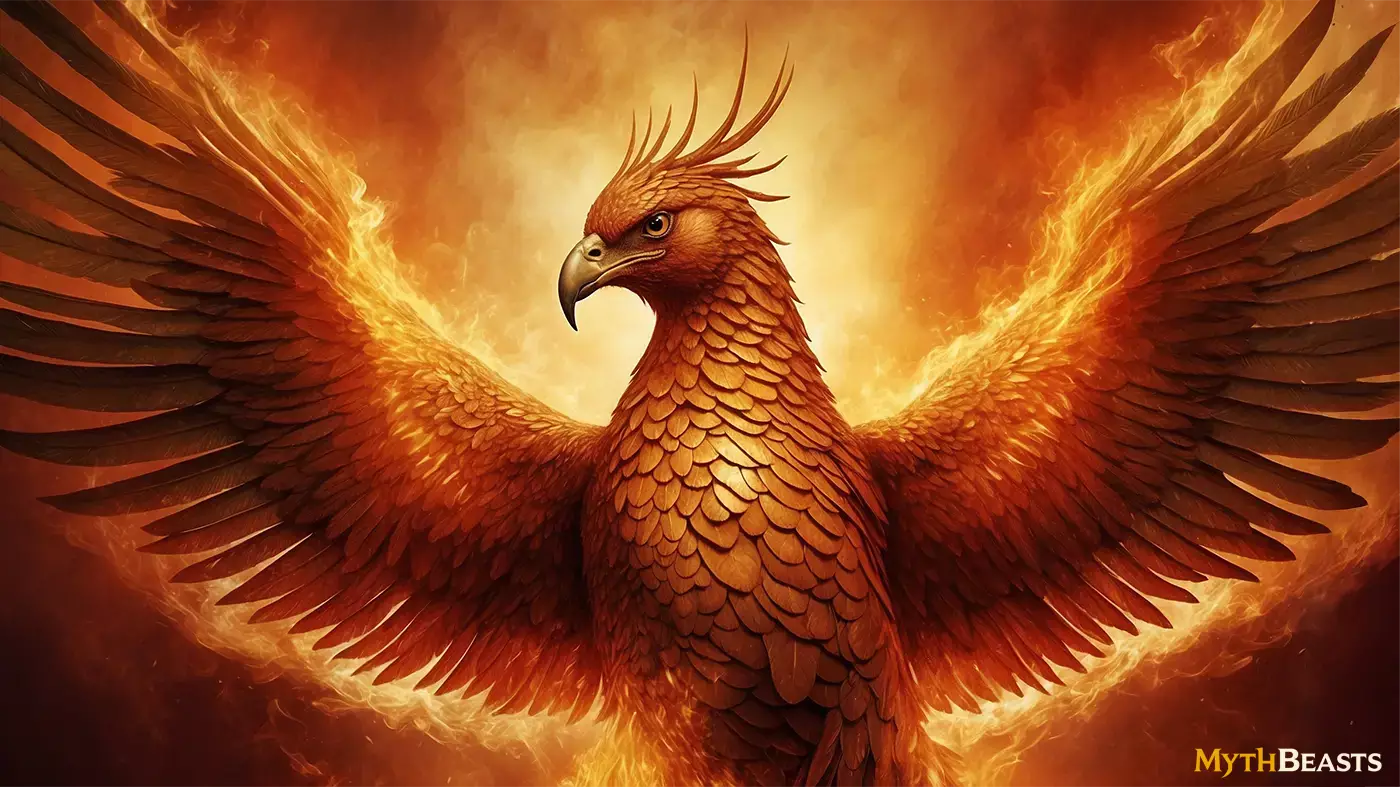
Herodotus’s phoenix is a sacred bird that carries its dead parent to the Sun’s temple at Heliopolis. It shares the Bennu’s solar sanctuary and association with the dead, but has its own story of filial burial.
Great Cackler
The Great Cackler is an Egyptian mythical goose associated with a cosmic egg and a cry at creation. Like the Bennu, it belongs to accounts of the world’s beginnings, but it has its own imagery and traditions.
Simurgh
In Ferdowsi’s Persian Book of Kings, the Simurgh rescues the abandoned infant Zal and raises him in her mountain nest. Like the Bennu, this bird makes continued life possible, but does so through foster care rather than funerary transformation.
Religion/Ritual
In spell 125, the deceased enters the hall of judgment and declares a purity equal to that of the great Bennu of Heracleopolis. The local bird serves as a standard of ritual purity. The speaker invokes that standing in the course of answering for earthly conduct.
The bird also appears on heart scarabs, an association the Global Egyptian Museum explains through traditions in which the Bennu emerged from the heart of Osiris. Its image on these objects puts that relationship to work in burial, where the heart mattered to the deceased’s vindication.
Egyptian makers also cast small bird amulets in glass. The Metropolitan Museum of Art identifies one Ptolemaic example as a probable Bennu and notes that makers could tie such images to particular spells. Mourners likely placed amulets of this kind between layers of mummy bandages.
Scientific or Rational Explanations
Grey herons offer an observable model for the Bennu of later Egyptian art. Researcher Pim de Klerk approaches the bird through the ancient perception of wetlands, placing its familiar heron form alongside traditions that locate it in trees of kinds that can grow near water.
Palaeontologist Ella Hoch reported unusually large prehistoric heron remains from the Persian Gulf and proposed the name Ardea bennuides after the mythical bird. She entertained the possibility of a connection, but the remains she discussed came from outside Egypt. The name commemorates the myth; it does not establish its source.
Hoch also pointed out that painters did not have to reproduce the proportions of the living world. A Bennu drawn large beside a worshipper might express sacred importance rather than record exceptional size. The pictures offer stronger evidence for a heron model than for an extinct giant species.
Modern Cultural References
Finnegans Wake, James Joyce, Faber and Faber, 1939
Joyce invokes the Bennu directly in a passage where solar rising, the phoenix and the coming dawn converge as Haun is urged onward.
(editura.mttlc.ro)
Cry of the Benu Bird: An Egyptian Creation Story, C. Shana Greger, Houghton Mifflin, 1996
In Greger’s illustrated retelling, the glowing Benu rises from the waters of Nun, dispels darkness and cries out at the beginning of time.
(www.abebooks.com)
Saint Seiya: The Lost Canvas, Volume 5, Masami Kurumada and Shiori Teshirogi, Akita Shoten, 2007
The manga gives the Bennu’s name to Kagaho, a Specter of Hades who breaks into Athena’s protected domain and faces Taurus Aldebaran in battle.
(www.akitashoten.co.jp)
Conclusion
The Bennu gave Egyptian ideas about renewal a form that could move between worlds. In Nu’s prayer, becoming the bird means being able to come out again. The hoped-for victory is not escape from the realm of the dead forever, but freedom to pass through it.
Further Reading
The Book of the Dead: An English Translation of the Chapters, Hymns, Etc., of the Theban Recension, E. A. Wallis Budge, Kegan Paul, Trench, Trübner & Co., 1901
Chapter 122 preserves Nu’s exchange at the threshold, his naming of the ferry and its equipment, and his prayer to emerge in the Bennu’s form.
(erenow.org)
The Ancient Egyptian Pyramid Texts, James P. Allen, SBL Press, 2015
Allen’s translation and glossary provide the Old Kingdom creation formula conventionally numbered spell 600 and explain his reading of the sanctuary as the Benben Compound.
(www.sbl-site.org)
Tutankhamun Knew the Names of the Two Great Gods, Steven R. W. Gregory, Archaeopress, 2022
Page 73, note 31, prints the transliteration and English translation of the great Bennu declaration in Coffin Texts spell 335 and points to the hieroglyphic edition.
(pure.coventry.ac.uk)
Between Heaven and Earth: Birds in Ancient Egypt, edited by Rozenn Bailleul-LeSuer, Oriental Institute of the University of Chicago, 2012
Foy Scalf’s contributions explain the Bennu’s solar and funerary roles, discuss its depiction in Nefertari’s tomb, and translate spell 29B on page 134.
(isac.uchicago.edu)
Book of the Dead Chapter 17, Digital Egypt for Universities, University College London
The Egyptian transliteration and English translation show how the funerary spell explains the great Bennu of Heliopolis through alternate readings involving Osiris and time.
(www.ucl.ac.uk)
Spell 83: Being Transformed into a Benu-Bird, Book of the Dead of Ramose, Fitzwilliam Museum
The museum displays Ramose’s painted Bennu beside a translation of the spell in which the deceased claims primeval flight and assumes the identity of Khepri.
(book-of-the-dead.fitzmuseum.cam.ac.uk)
bnw, Lemma d1728, Thesaurus Linguae Aegyptiae, Berlin-Brandenburg Academy of Sciences and Humanities
The Demotic dictionary entry records meanings corresponding to heron and phoenix and connects the term to the earlier divine name, preserving its Egyptian spelling.
(thesaurus-linguae-aegyptiae.de)
Phoenix, The Global Egyptian Museum
The glossary covers the bird’s possible name derivation, its associations with several Egyptian gods and the tradition linking its image to the heart of Osiris.
(www.globalegyptianmuseum.org)
The Histories, Book II, Herodotus, translated by A. D. Godley, Loeb Classical Library, 1920
Section 73 gives the Greek account of the phoenix at the Sun’s temple, allowing direct comparison between that bird’s burial story and Egyptian Bennu traditions.
(penelope.uchicago.edu)
Funerary Religion: The Final Phase of an Egyptian Tradition, Martin Andreas Stadler, The Oxford Handbook of Roman Egypt, Oxford University Press, 2012
Stadler examines the survival and adaptation of Egyptian burial compositions under Roman rule, including the recycling of an Old Kingdom formula on Hor’s mummy breastplate.
(academic.oup.com)
Trabajos de Egiptología, Volume 8, Lucía Díaz-Iglesias Llanos, 2017
Díaz-Iglesias Llanos examines the theology of Heracleopolis Magna and discusses the deceased’s claim in spell 125 to share the purity of the city’s great Bennu.
(riull.ull.es)
Papyrus from the Book of the Dead of Ani, British Museum, Nineteenth Dynasty
The British Museum’s illustrated record identifies the Bennu, horizon lions, human-headed birds and divine mourners in one funerary composition, showing how artists distinguished their roles.
(artsandculture.google.com)
The New York Obelisk or How Cleopatra’s Needle Came to New York and What Happened When It Got Here, The Metropolitan Museum of Art
This museum study explains the Egyptian vocabulary of obelisks and links the name of their pyramid-shaped tops to sacred stones associated with the solar god and the Bennu.
(resources.metmuseum.org)
Amulet Probably Depicting a Benu Bird, The Metropolitan Museum of Art, Ptolemaic Period
This cast glass amulet illustrates a probable Bennu identification and how the museum connects small funerary objects with protective spells and placement among mummy wrappings.
(www.metmuseum.org)
Zal in the Simurgh’s Nest, folio from a Shahnama by Abu’l Qasim Firdausi, The Metropolitan Museum of Art, circa 1330–1340
The manuscript painting and its catalogue entry recount the Simurgh’s rescue of Zal, a comparison that highlights how another mythical bird could preserve human life.
(www.metmuseum.org)
Reflections on Prehistoric Life at Umm an-Nar (Trucial Oman) Based on Faunal Remains from the Third Millennium BC, Ella Hoch, South Asian Archaeology 1977, 1979
Hoch’s original report describes large heron remains from the Persian Gulf, proposes a name honoring the Bennu, and discusses the difficulty of judging size from Egyptian paintings.
(cryptozoologicalreferencelibrary.wordpress.com)
The Concept of the Benu-Bird in Ancient Egypt, Pim de Klerk, Egyptology and Zoology Conference Abstracts, Charles University, 2025
De Klerk considers the Bennu in relation to wetlands, weighs the evidence for an extinct heron model, and distinguishes crying heron references from the Great Cackler tradition.
(cegu.ff.cuni.cz)
Tutankhamun Knew the Names of the Two Great Gods, Steven R. W. Gregory, Archaeopress, 2022
Page 73, note 31, gives the transliteration and English translation of the Bennu declaration in Coffin Texts spell 335 and refers to the hieroglyphic edition.
(pureportal.coventry.ac.uk)
Between Heaven and Earth: Birds in Ancient Egypt, edited by Rozenn Bailleul-LeSuer, Oriental Institute of the University of Chicago, 2012
Foy Scalf’s essay and catalogue entry for the Nefertari scene cover the Bennu’s appearance, solar identity, creation setting and funerary role, and give an English translation of spell 29B.
(oi-idb-static.uchicago.edu)
Book of the Dead Chapter 83, Digital Egypt for Universities, University College London
A transliteration and English translation from the Eighteenth Dynasty Papyrus Cairo 2512 supply an independent version of the formula for assuming the form of the Bennu.
(www.ucl.ac.uk)
Funerary Religion: The Final Phase of an Egyptian Tradition, Martin Andreas Stadler, The Oxford Handbook of Roman Egypt, 2012
Stadler translates the inscription on Hor’s mummy breastplate, identifies its reference to the House of the Bennu and traces its wording back to Pyramid Texts spell 600.
(archiv.ub.uni-heidelberg.de)
Mummy Bandage Cairo JE 7638, Mahmoud M. Ibrahim and Mykola Tarasenko, Bulletin de l’Institut français d’archéologie orientale, 2023
The authors identify the Bennu on an Egyptian mummy bandage and compare its heron form with illustrations accompanying spells 17 and 83 in several funerary papyri.
(www.ifao.egnet.net)