Overview of the Mesopotamian Period
Mesopotamia denotes a region between the Tigris and Euphrates, not one uniform historical period; its recorded societies span millennia, from early urban communities through Babylonian and Assyrian rule.
Sumerian, Akkadian, Babylonian, and Assyrian cultures contributed distinct languages, institutions, and religious traditions, making continuity alongside regional and chronological variation essential to interpreting Mesopotamian mythology responsibly.
Clay tablets, temple architecture, seals, and royal monuments preserve much of the evidence for supernatural beliefs, although these materials represent particular literate settings rather than every community equally.
Seasonal agriculture, unpredictable floods, and urban life made divine explanations culturally consequential; surviving sources connect cosmic order with practical concerns such as fertility, illness, protection, and legitimate authority.
Cultural and Religious Worldviews
Dominant Belief Systems
Mesopotamian religious systems were generally polytheistic, assigning divine powers to major cities, natural forces, and aspects of social life, though individual traditions changed across centuries and kingdoms.
People represented the cosmos as ordered through relationships among gods, humans, and other beings; surviving compositions express these ideas, without establishing that every person understood them identically.
Divination and omen literature treated unusual events as potentially meaningful signs from divine powers, providing structured interpretations rather than evidence that supernatural causes can be historically verified.
Role of Myth in Daily Life
Myths addressed questions of kingship, mortality, creation, and divine authority, offering culturally influential frameworks that cannot be reduced to simple records of everyday behavior or private belief.
Literary compositions could support institutional values by presenting divine approval as relevant to social order; the surviving evidence does not demonstrate uniform acceptance across the population.
Written prayers, incantations, and lamentations document religious responses to danger or distress, while their specialized settings prevent confident reconstruction of ordinary household practice from texts alone.
Mythological Beasts and Supernatural Entities
Common Types of Mythical Creatures
Mesopotamian sources describe protective hybrid figures combining human and animal features, including lamassu representations with human heads, wings, and the bodies of powerful animals.
Demons and harmful spirits appear in incantation texts as explanations for affliction or danger; their classification varies, so modern categories cannot always match ancient distinctions precisely.
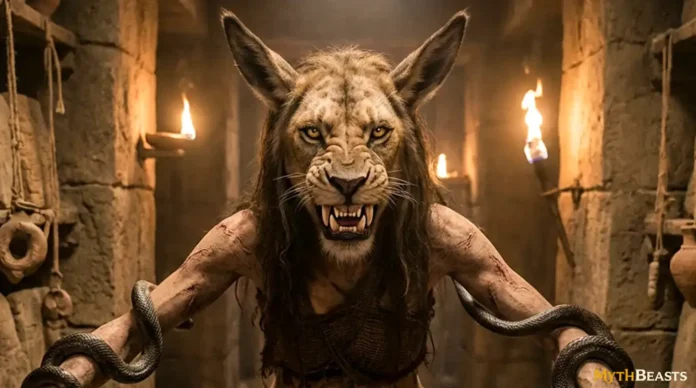
Serpentine beings, lions, bulls, and composite creatures occur in different textual or visual contexts, but shared animal features do not prove that all represented one creature category.
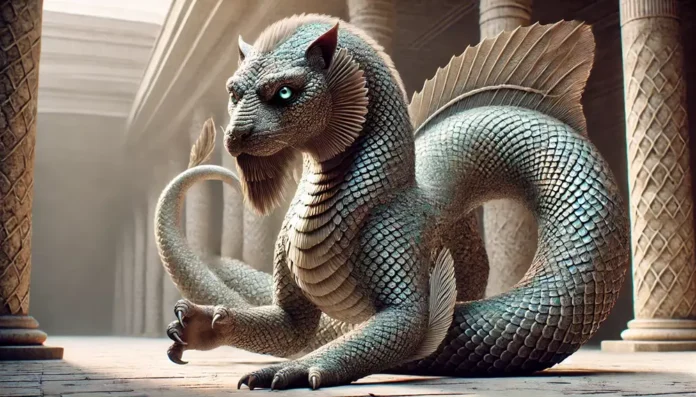
The mušḫuššu, a composite dragon associated especially with Babylonian imagery, is identifiable through visual conventions; its meanings should be established from specific contexts rather than generalized fantasy classifications.
Symbolism and Meaning
Hybrid bodies could make extraordinary power visible in art, joining familiar animal traits with human form; interpretation remains contextual because images do not explain themselves in surviving captions.
Protective figures at entrances marked thresholds as spaces requiring defense, a function supported by their placement in architecture rather than by a universal meaning for every creature.
Animal attributes could evoke strength, dangerousness, or divine association, yet those readings depend on particular inscriptions and settings instead of an invariant symbolic dictionary.
Folklore Traditions and Storytelling
Oral and Written Transmission
Oral performance almost certainly contributed to cultural transmission, but its exact forms are difficult to reconstruct because evidence survives chiefly through written compositions and archaeological contexts.
Scribes copied literary and religious works on clay tablets, preserving versions that could change through transmission; extant manuscripts therefore document textual histories, not necessarily original performances.
Inscriptions and reliefs communicated royal or religious claims through durable public forms, whereas their audiences and reception cannot be securely inferred from survival alone.
Regional Variations
Sumerian traditions often preserve distinct divine names and literary formulations from Akkadian compositions, although translation and adaptation created connections that complicate simple cultural boundaries.
Babylonian religious imagery centered prominently on the city’s patron god Marduk, whereas Assyrian royal contexts emphasized Aššur; this divergence shaped political religious presentation rather than every local story.
Regional variation also appears in divine epithets and local cult centers, so a creature’s meaning in one city cannot automatically represent beliefs throughout Mesopotamia.
Relationship Between Humans and the Mythical World
Fear, Protection, and Reverence
Protective beings were represented as defenses against harmful forces, particularly in architectural or amuletic contexts; these objects document practices, not a single standardized system of belief.
Incantation texts name threatening supernatural agents within healing or protective frameworks, showing that danger could be interpreted religiously without proving that every illness received such explanation.
Divine messengers and animal-associated beings occupy specific textual contexts, but evidence does not justify treating all mythical creatures as moral enforcers or direct communications from gods.
Influence on Art and Material Culture
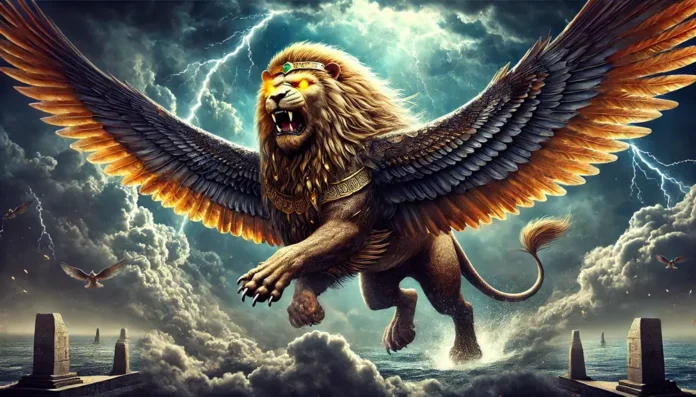
Monumental Assyrian palace entrances featured colossal human-headed winged bulls or lions, commonly identified as lamassu, whose placement expressed protection within royal architecture.
Cylinder seals depict divine, human, and composite figures in compressed scenes; interpretation depends on repeated motifs and archaeological context because images rarely provide complete narrative explanations.
Amulets and figurines bearing supernatural imagery attest to protective material practices, though an object’s intended function may remain uncertain without inscriptions or secure archaeological associations.
Transition and Legacy of the Mesopotamian Period
Mesopotamian languages and political institutions changed under successive empires, while cuneiform scholarship continued in some settings; continuity therefore involved preservation alongside substantial transformation.
Later neighboring cultures encountered Mesopotamian stories and motifs through contact and scribal transmission, but each proposed influence requires evidence rather than resemblance alone.
Mesopotamian supernatural figures should not be treated as unchanged ancestors of later religious beings; names, functions, and interpretations shifted across distinct historical traditions.
Historical Reliability and Interpretation
Most evidence comes from excavated tablets, inscriptions, images, and buildings, whose preservation is uneven; consequently, absence from surviving records cannot establish absence from historical belief.
Literary compositions reveal learned formulations and religious concepts, but they do not provide transparent transcripts of popular opinion or direct proof of supernatural events.
Scholars compare language, archaeological context, and imagery to interpret beings cautiously; uncertainty persists where texts are fragmentary, terms disputed, or visual identifications lack inscriptions.
Historical classification distinguishes documented representations from later interpretation: Mesopotamian is central here because the beings and evidence discussed belong to its societies, languages, and material record.