Introduction
The cockatrice is a legendary creature of medieval European tradition, especially familiar in English bestiary writing and literature. Reference works usually describe it as a rooster-and-serpent hybrid whose gaze or breath can kill, although historical accounts never establish one completely consistent form.
Its identity is closely entangled with the basilisk, an older legendary serpent. Medieval authors and translators sometimes treated the two names as equivalents, allowing descriptions of a small, deadly snake to coexist with images of a creature bearing a cock’s head and serpentine tail.
A widely repeated origin story explains this strange combination through an impossible birth: a cock lays an egg, which a toad or serpent incubates. The resulting monster brings together familiar animals in a form that overturns ordinary expectations about reproduction and danger.
The cockatrice matters less as a single fixed monster than as an example of how animal lore developed through translation, illustration, and inherited authority. Its history connects ancient serpent traditions with medieval accounts of nature, Christian symbolism, and later images of destructive looking.
History/Origin
The cockatrice’s historical background begins with the basilisk tradition rather than with an independently documented bird-monster. Classical natural history, including Pliny’s account, described the basilisk as a small serpent with extraordinary destructive powers.
Medieval writers inherited this dangerous animal and progressively reshaped its identity.
The scholarly study The Evolution of the Basilisk treats this changing tradition as a historical development. That approach is important: the medieval cockatrice was not simply an ancient creature renamed.
Its rooster associations and unusual hatching story represent developments within an older body of serpent lore.
Alexander Neckam’s late-twelfth-century account supplies an important medieval stage. Writing about the basilisk, he associates its birth with an egg laid by a rooster and incubated by a toad.
Later versions substitute a serpent as the brooding animal, preserving the abnormal birth while changing its participants.
Thirteenth-century encyclopedic writing helped transmit the creature’s reputed characteristics. Bartholomaeus Anglicus included the basilisk in his account of the natural world.
John Trevisa’s English translation, dated 1397, rendered basiliscus as cockatrice, providing a concrete example of how the two identities became linked in English.
Bestiaries and natural-history compilations placed such creatures alongside ordinary animals, drawing on earlier authorities rather than separating every report into modern categories of fact and fantasy. Their descriptions could also carry moral meanings, so the creature’s danger mattered both as an alleged natural property and as an interpretive image.
The tradition continued beyond the Middle Ages. Natural History, Lore and Legend, published in 1895, collected older claims and reported a Basel prosecution of a supposedly egg-laying cock in 1474.
This later account preserves the legend’s reputed social consequences, not evidence that the monster existed.
Name Meaning
The English word cockatrice came through Old French cocatris. Historical spellings include forms such as kokatris and koketrice, reflecting the variable spelling of medieval vernacular texts.
Despite its familiar opening syllable, the name cannot be explained simply as a compound referring to a cock.
Etymological accounts connect the French form with medieval Latin calcatrix, associated with a translation of Greek ichneumon, meaning tracker. This complicated linguistic history belongs to a world in which names for dangerous reptiles and their reputed animal enemies could become confused during transmission.
The resemblance to the English word cock nevertheless encouraged a rooster-based understanding of the creature. The egg-origin narrative fitted that association particularly well.
Linguistic resemblance and animal lore thus reinforced one another, even though the deeper derivation does not straightforwardly mean rooster-monster.
Basilisk has a different origin: Greek basiliskos means little king, echoed by Latin regulus. The older serpent’s royal designation was associated with its commanding danger and crest-like marking.
Medieval equivalence between basilisk and cockatrice joined two names with substantially different linguistic backgrounds.
Appearance
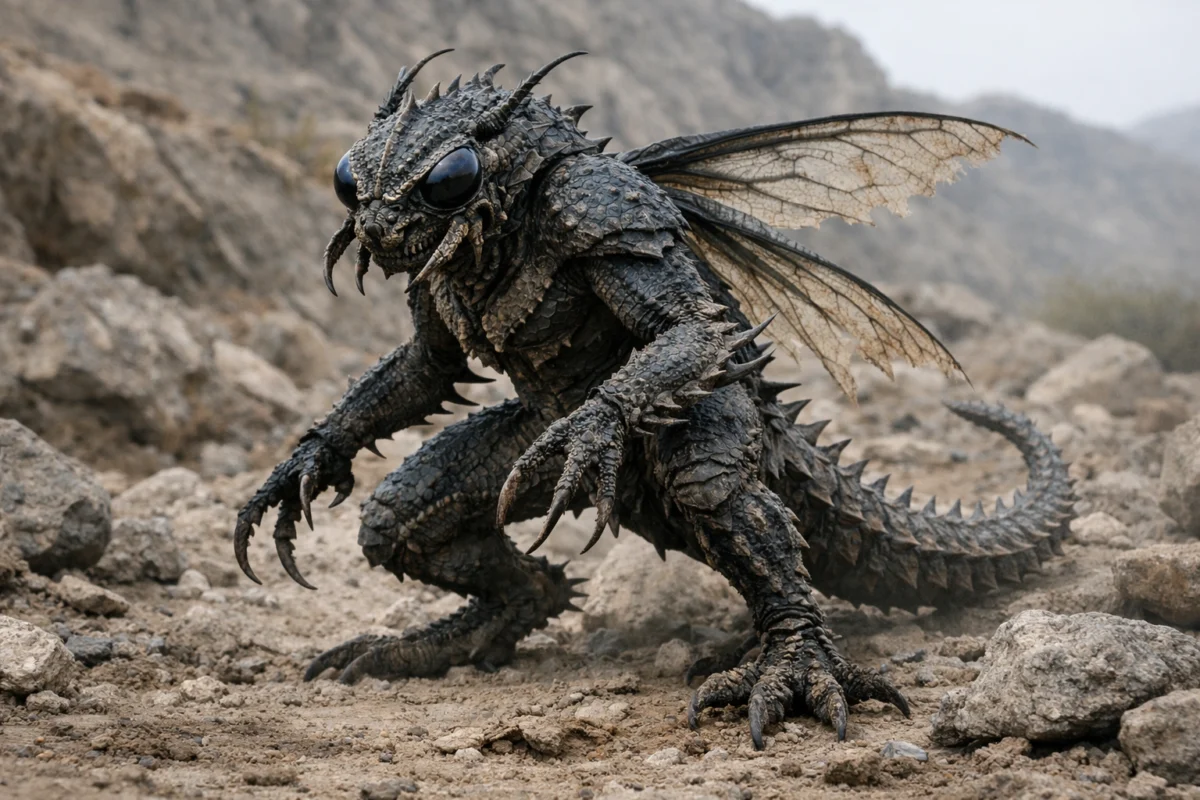
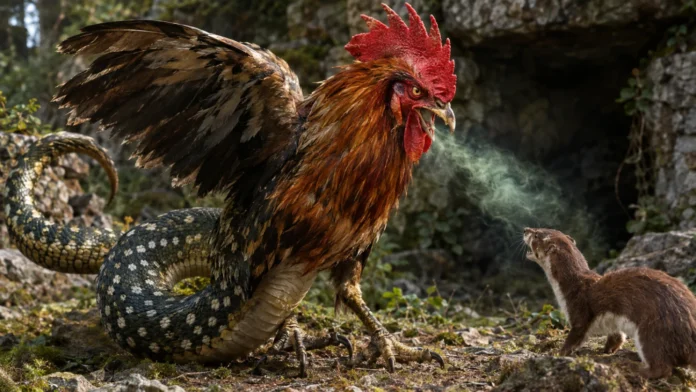
The familiar cockatrice combines a rooster’s head and upper body with a serpent’s lower body or tail. Its bird features distinguish it from an ordinary snake, while the reptilian portion makes the otherwise domestic animal threatening.
This recognizable hybrid is not, however, the only historical description.
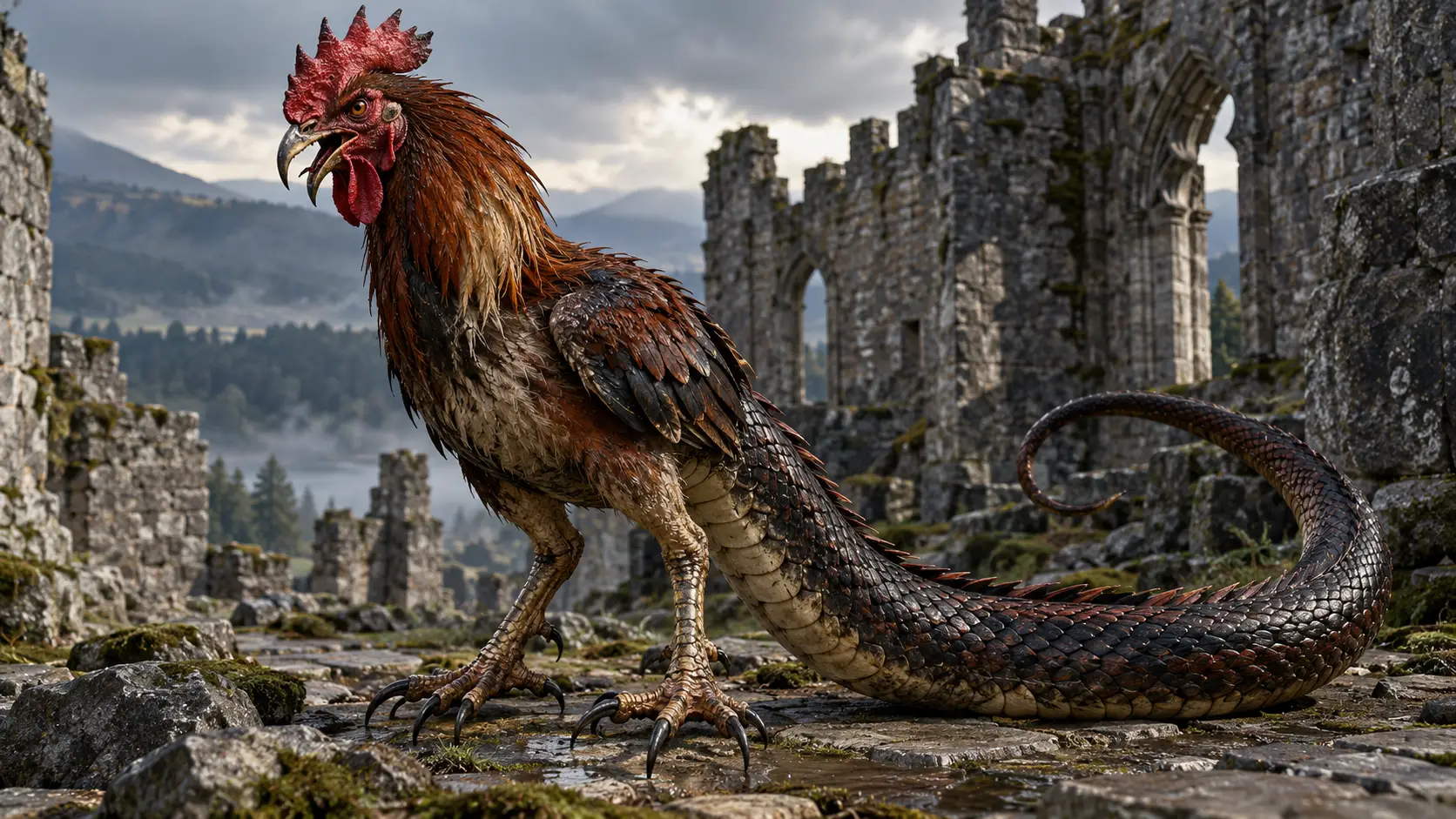
The later compilation Natural History, Lore and Legend specifically describes a cock’s head, neck, and breast joined to a serpent’s lower body. That account supports a strongly divided bird-and-snake form, rather than requiring the fully chicken-shaped body sometimes used in later artistic representations.
Other descriptions belong more clearly to the overlapping basilisk tradition. The Medieval Bestiary’s source excerpts attribute to Bartholomaeus Anglicus a creature half a foot long and marked with white spots.
These details describe that particular textual version; they are not universal measurements or coloring for every cockatrice.
Medieval representations also include a crested serpent, without a clearly recognizable rooster’s breast or neck. A crest could suggest the basilisk’s royal name, while a cock’s comb made the hybrid visually intelligible.
These related features should not be collapsed into a mandatory crown worn by every version.
Wings occur in heraldic and later artistic treatments, but they are not essential to all accounts. Nor should a spectacular body size be assumed: the small creature described by Bartholomaeus contrasts with imposing later images.
Historical recognition depends more on the bird-serpent combination and deadly reputation than on standardized proportions.
Background Story
The cockatrice emerged from the meeting of inherited serpent lore, medieval animal encyclopedias, and an abnormal-birth narrative. Its background is therefore a history of connected beliefs rather than a personal biography.
Different writers supplied compatible dangers without necessarily agreeing about the creature’s anatomy or origin.
The cock’s egg is the central narrative disturbance. A male domestic bird produces something it should not produce, and a toad or serpent completes the process through incubation.
The hybrid’s dangerous nature follows a birth that crosses both reproductive expectations and boundaries between familiar kinds of animals.
This structure helps explain the legend’s unsettling quality without establishing a single intended meaning. The household rooster, normally recognizable and manageable, becomes the source of an uncontrollable threat.
The brooding animal links that domestic setting to the dangerous serpent traditions already attached to the basilisk.
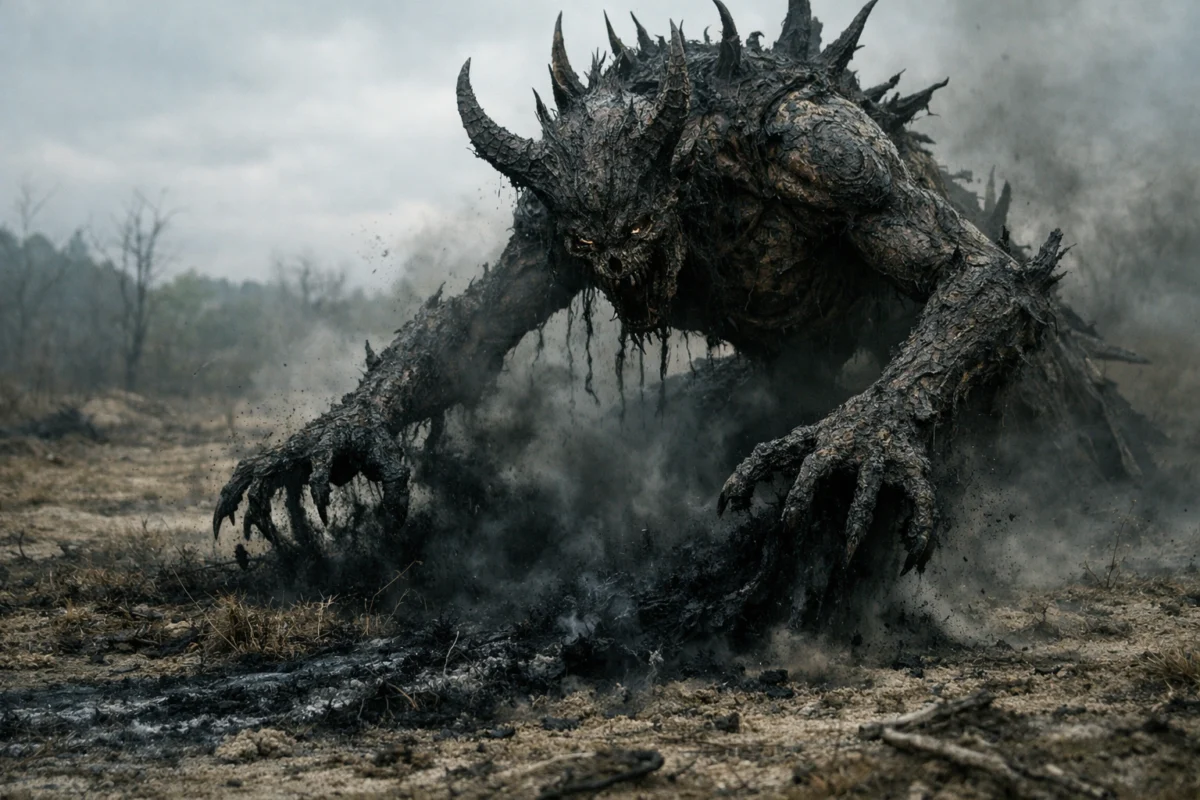
The creature’s powers likewise developed through overlapping accounts. Sources variously attribute death to its glance, breath, smell, hiss, venom, or touch.
These are alternative descriptions, not a securely defined collection of abilities possessed by every cockatrice. The recurring element is danger extending beyond an ordinary snakebite.
Bestiary accounts supply a counterweight through the weasel, the basilisk’s traditional opponent. The Medieval Bestiary records versions in which the animal pursues and kills the deadly creature in its den.
Some accounts also give a cock’s crow the power to overcome or kill it, complicating the rooster’s role.
Christian moral interpretation added another layer: the basilisk’s destructive nature could represent evil, while its defeat offered an image of evil overcome. Alongside this symbolism, translators preserved the creature as an alleged animal.
The cockatrice consequently occupied both explanatory natural history and morally interpreted storytelling.
Famous Folklore Stories
The cockatrice survives through bestiary episodes, reported incidents, and literary allusions rather than a single authoritative cycle of folktales. The descriptive headings below identify documented narrative material, not authenticated traditional story titles.
Several episodes belong to the closely overlapping basilisk tradition.
The Reported Cock Trial at Basel
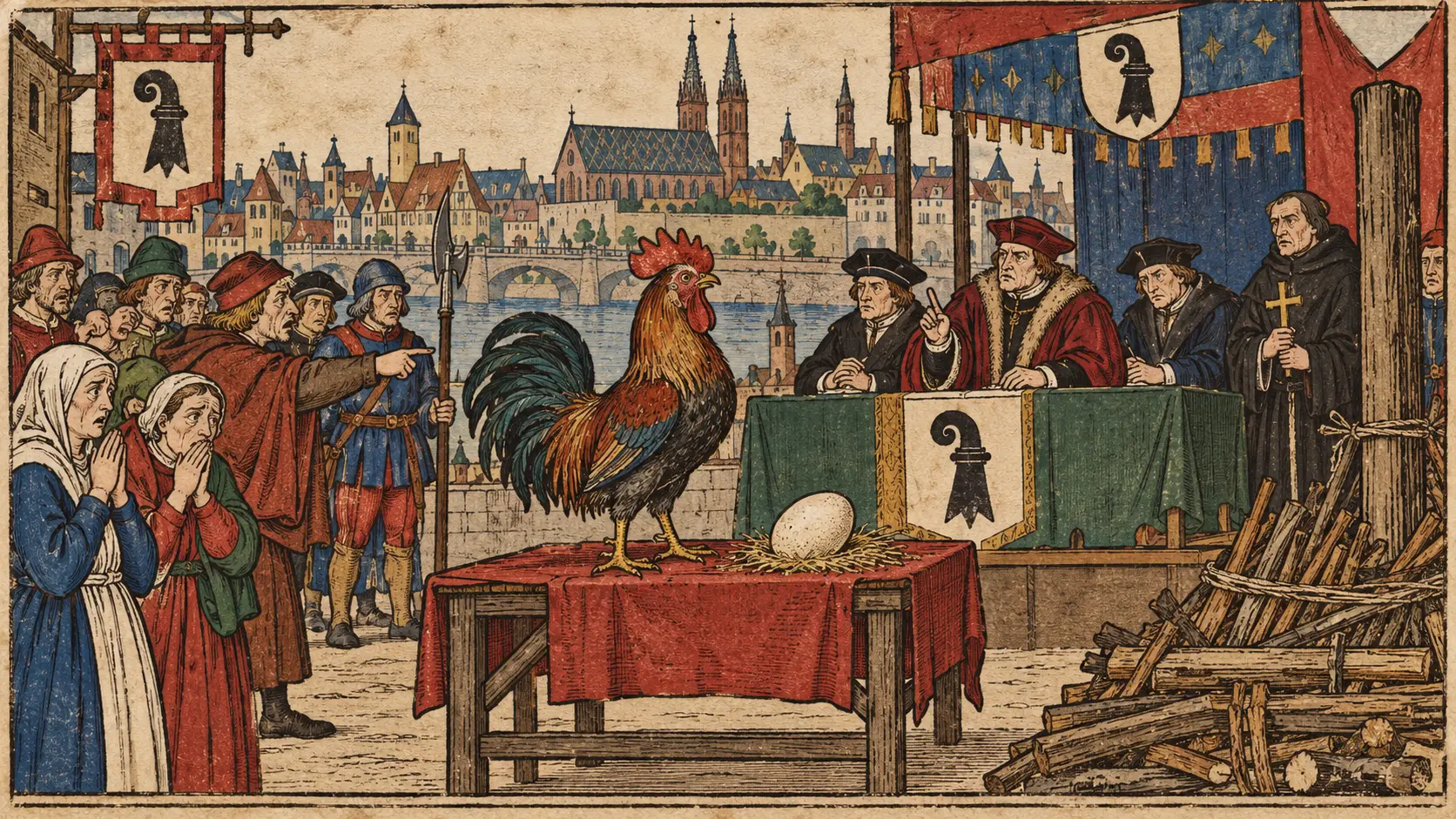
Natural History, Lore and Legend, published in 1895, recounts an incident assigned to Basel in 1474. A cock was accused of laying an egg from which a cockatrice might hatch.
According to this later account, the bird and egg were tried and burned in the marketplace.
This is a reported historical episode about fear of the creature, not an encounter with a hatched monster. Its narrative depends on the traditional claim that an apparently ordinary domestic bird could produce the beginning of a deadly, unnatural animal.
The distance between the alleged event and the nineteenth-century retelling matters. The account documents the circulation of a striking prosecution story, but it should not be treated as contemporary testimony establishing every detail, much less as evidence that a cockatrice existed.
The Weasel Confronts the Basilisk
Medieval bestiary accounts describe the basilisk lurking in a den and killing through its breath or gaze. A weasel is brought against it, pursues it into its hiding place, and kills it.
This recurring episode belongs to the shared basilisk-cockatrice tradition rather than an independently named cockatrice tale.
The episode supplies a counterweight to the monster’s seemingly overwhelming power: an ordinary animal can overcome an extraordinary danger. Accounts do not agree on every protective detail.
Rue and the crowing of a cock appear elsewhere among countermeasures, but should not be combined into one supposedly fixed narrative.
The Cockatrice in a Church Vault
A scholarly note accompanying the online edition of Thomas Browne’s Pseudodoxia Epidemica mentions an account recorded by Edward Topsell involving Leo IV and a cockatrice in a vault of a church dedicated to St. Lucia. This is a referenced encounter narrative, not a securely titled traditional folktale.
The available reference does not supply the full sequence of events. It establishes the association between a cockatrice, a church vault, and a religious figure, but does not justify adding dialogue, casualties, methods of defeat, or an elaborate miracle narrative.
Cultural Impact
In English literature, the cockatrice became shorthand for a look capable of destroying its target. Writers could invoke the creature without describing its anatomy or origin.
Its usefulness depended on readers recognizing a familiar connection between hostile sight, venom, and death.
Shakespeare uses this association in Romeo and Juliet, where Juliet invokes the cockatrice’s deadly eye while awaiting clarification of terrible news. The reference intensifies the danger of hearing what has happened; it is a figurative comparison, not an appearance by a monster within the play.
References in Richard III and Twelfth Night likewise show that the creature belonged to a recognizable dramatic vocabulary. These literary uses preserve the threatening gaze more clearly than a complete folklore narrative, allowing one attributed power to stand for the whole beast.
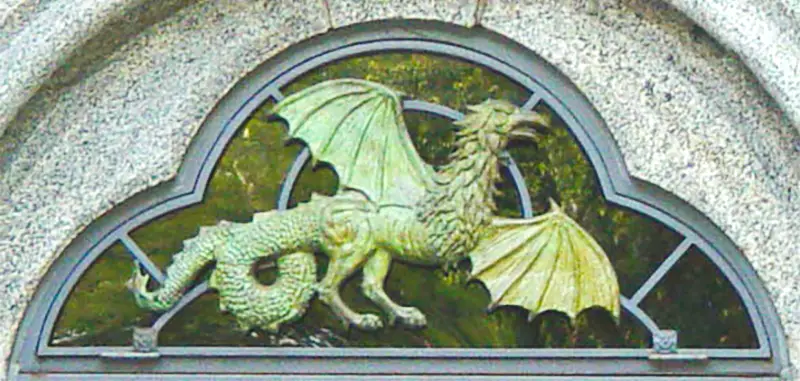
Heraldry gave the cockatrice a different kind of visibility. Its combination of cock and serpent features made it a distinctive emblem among composite animals.
Heraldic representation could emphasize a recognizable silhouette without requiring agreement about the creature’s birth, size, or precise means of killing.
Early modern natural-history writing also made the cockatrice a subject of argument rather than merely an inherited marvel. Modern scholarship, including The Evolution of the Basilisk, examines this changing textual tradition.
From that perspective, variations reveal historical adaptation rather than imperfect descriptions of one real species.
Similar Beasts
Basilisk
The basilisk is a legendary serpent associated with extraordinary venom and lethal sight. Its older serpentine identity provides an important distinction from the familiar cock-headed cockatrice form.
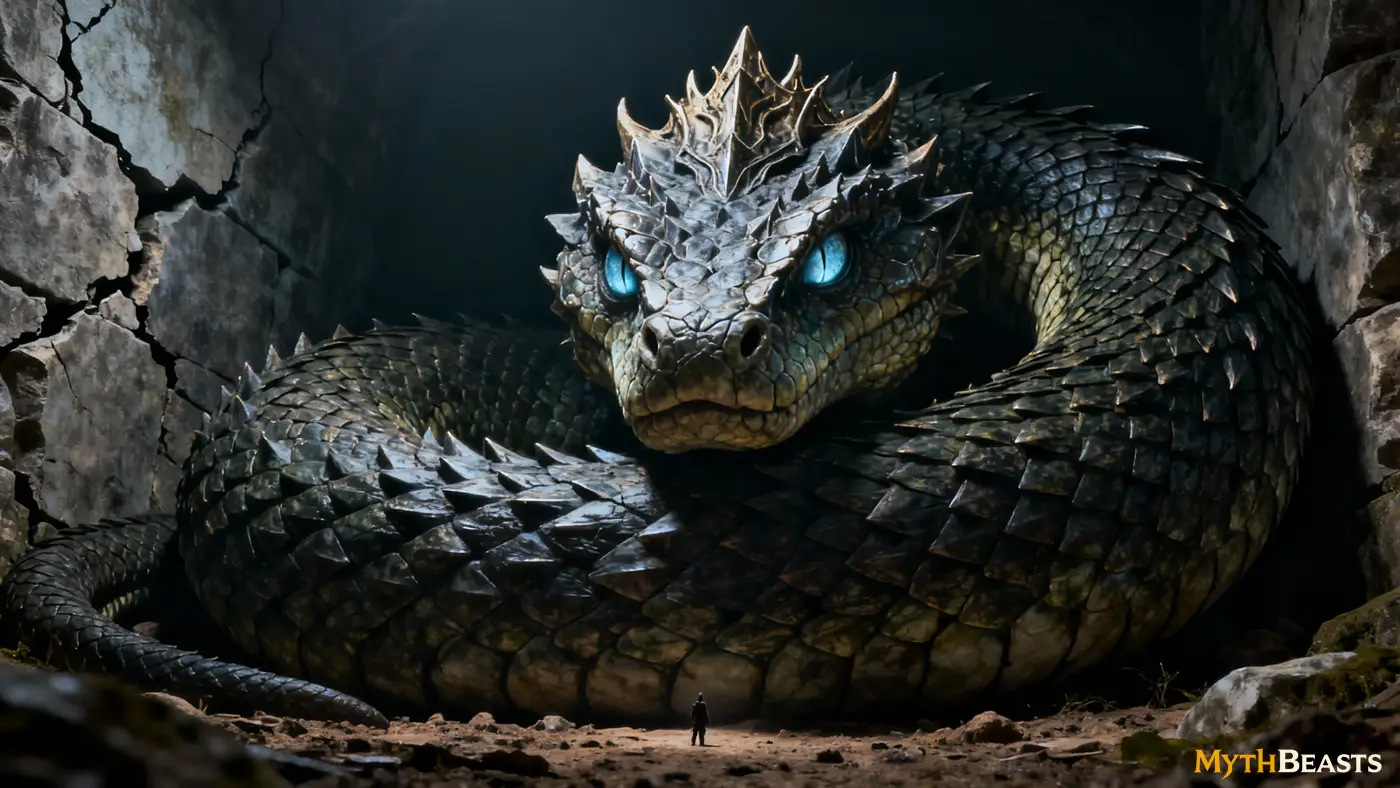
Medieval writers frequently merged the two. This comparison concerns their distinguishable historical forms, not two consistently separate species within a universally agreed mythology.
Read more about Basilisk
Medusa
Medusa is a figure of Greek mythology recognizable by serpentine hair and a gaze that turns viewers to stone. Her humanlike form differs fundamentally from the cockatrice’s animal body.

Both make looking dangerous, but their effects differ: Medusa’s petrification should not be substituted for the death attributed to the cockatrice in historical accounts.
Read more about Medusa
Cuelebre
Cuelebre is a dragon-like serpent in Asturian folklore, associated with guarding treasure in caves. It belongs to a guardian-monster tradition rather than the cockatrice’s bestiary accounts of lethal animal powers.
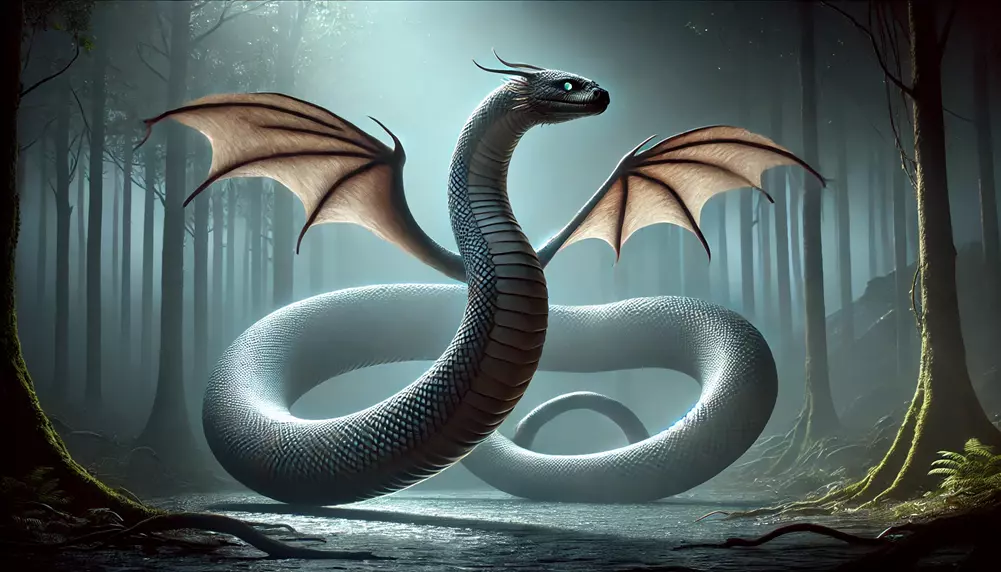
The comparison rests on threatening serpentine form and European monster traditions. Treasure guardianship is not established for the cockatrice and should remain specific to Cuelebre.
Read more about Cuelebre
Wyvern
The wyvern is a winged reptilian creature familiar in heraldry. Its conventional appearance lacks the cock’s head and other poultry features that distinguish a heraldic cockatrice.
Both belong to the visual vocabulary of heraldic monsters, but resemblance does not establish shared origins, identical powers, or a common egg-hatching narrative.
Religion/Ritual
Several early English Bible translations use “cockatrice” for venomous snakes. These passages require attention to translation: the English word does not necessarily mean that the biblical text describes a rooster-serpent hybrid.
Biblical usage and medieval monster anatomy should not be treated as interchangeable evidence.
Christian bestiary interpretation gave the related basilisk moral significance, including as an image of evil. Such readings explain how a deadly animal could serve religious instruction.
They document symbolic interpretation, however, rather than a distinct cult or established ceremonial practice devoted to the cockatrice.
The supplied record establishes no dedicated cockatrice ritual. Weasels, cock-crowing, and, in some accounts, rue belong to traditional protective lore.
Their appearance in texts does not by itself demonstrate that communities regularly performed a particular ceremony or followed a standardized method of protection.
Scientific or Rational Explanations
No zoological evidence supports the cockatrice as a real animal. Its composite anatomy, extraordinary reproductive origin, and lethal gaze belong to legendary natural history.
Historical descriptions are evidence for what writers transmitted or believed, not verified observations of an identifiable species.
Textual transmission offers a concrete explanation for some inconsistencies. John Trevisa’s English translation rendered basiliscus as cockatrice, linking names that carried overlapping descriptions.
Once terminology crossed languages, traits from serpent lore and cock-related narratives could circulate under the same English label.
This explanation is stronger than treating every description as an independent sighting. A crested serpent, a cock with a serpent’s tail, and a creature killing through breath or sight need not represent separate discoveries.
They can reflect selection and recombination within an inherited body of writing.
The rooster’s egg story is likewise a traditional claim, not an established reproductive mechanism. The Basel account shows how an alleged anomaly could be interpreted through that claim.
It does not establish who produced the egg or provide biological evidence for the monster said to threaten emergence.
Some later writers compared the weasel’s battle with the basilisk to real encounters between mongooses and cobras. This offers a possible natural analogy for an animal defeating a dangerous snake.
It does not prove that such encounters originated the motif or validate the cockatrice’s supernatural powers.
Thomas Browne’s skeptical treatment belongs to the history of questioning inherited animal lore. Modern interpretation similarly separates textual authority from observation: the cockatrice is well documented as a cultural creature, while its changing descriptions are better explained through transmission, symbolism, and literary adaptation than zoology.
Modern Cultural References
Modern portrayals adapt the cockatrice for children’s fiction, games, comedy, and visual art. These works do not preserve a single medieval model: some emphasize its monstrous hybrid body, while others reshape its dangerous powers or turn it into a speaking character.
Cockatrice in Magic: The Gathering
The cockatrice has appeared in Magic: The Gathering since the game’s original Limited Edition Alpha set in 1993.
The green Cockatrice card has flying and destroys most creatures that block it or are blocked by it, translating the legendary creature’s deadly nature into a combat mechanic. It was later reprinted in sets including Revised Edition, Fourth Edition, Fifth Edition, and Time Spiral Timeshifted.
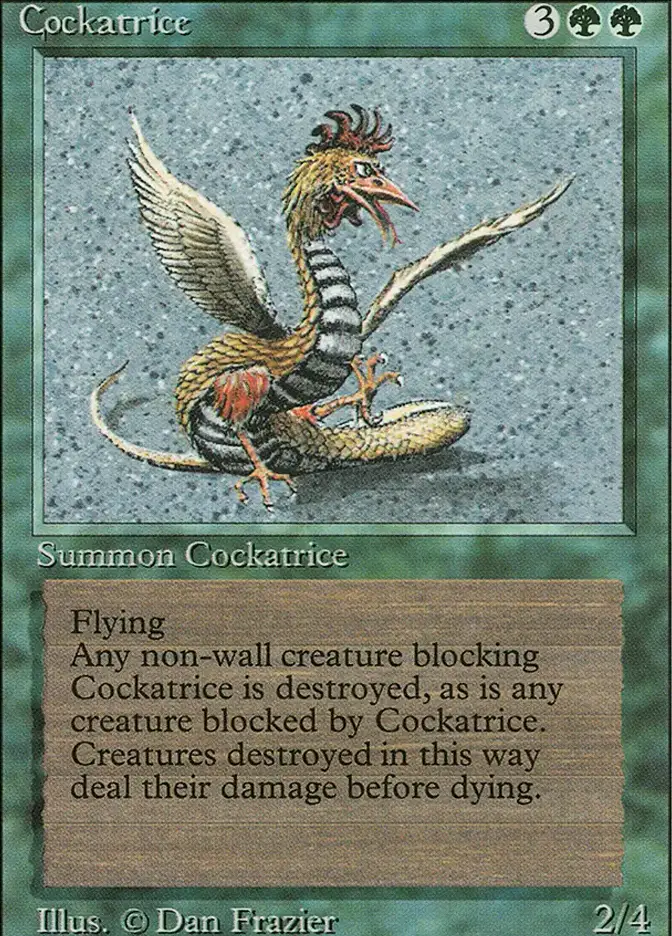
The game has also introduced variations such as Deathgaze Cockatrice in Magic 2014, which uses deathtouch, and Fleetfeather Cockatrice in Journey into Nyx, combining flying and deathtouch with additional monstrous abilities. These versions preserve the cockatrice as a dangerous bird-reptile hybrid while adapting its legendary killing power to different game mechanics. mtg.wtf
The Cockatrice Boys, children’s novel (1993)
Joan Aiken’s novel follows resistance to a monstrous invasion of England. Its publisher identifies invading cockatrices and the survivors’ Cockatrice Corps, placing the creature within modern fantasy fiction.
(us.macmillan.com)
Cockatrice, tabletop role-playing game creature (2014)
Wizards of the Coast includes the cockatrice among Dungeons & Dragons monsters.
This version combines bird, lizard, and bat features, with a petrifying bite rather than a universally lethal gaze.
(dndbeyond.com)
Season 2, Ep 40 – Cockatrice (w/ Laura Grey), podcast episode (2017)
Hello From The Magic Tavern presents a fictional conversation with Patti the Cockatrice.
Laura Grey performs the creature, translating a traditionally threatening monster into a speaking comedy character.
(podcasts.apple.com)
The Cockatrice, podcast episode (2022)
The Constant devotes this episode to the reported Basel rooster trial of 1474.
It connects modern historical storytelling with the fear that an unusual egg could produce a cockatrice.
(constantpodcast.com)
Stare Master, television episode (2011)
This My Little Pony: Friendship Is Magic episode features a cockatrice. Its appearance brings the legendary creature into children’s animation, rather than presenting it as a historical natural-history subject.
(tv.apple.com)
The Cockatrice, exhibited artwork (2016)
Jeremy Bastian’s artwork appeared in Arch Enemy Arts’ Imaginary Menagerie exhibition. The gallery lists the named cockatrice piece, documenting the monster’s continued presence in contemporary imaginative visual art.
(archenemyarts.com)
Conclusion
The cockatrice belongs to a documented but variable tradition, not to a single authoritative mythology. Its familiar rooster-and-serpent form, unnatural egg origin, and deadly powers developed through overlapping accounts of the basilisk, medieval natural history, translation, and later retelling.
Those connections explain why descriptions differ without making the creature’s cultural importance uncertain. The surviving evidence records how writers and readers imagined danger, interpreted animals, and gave memorable physical form to threats that ordinary experience could not explain.
Its symbolic force rests on the contrast between familiar appearance and extraordinary harm. A domestic bird becomes an impossible hybrid; looking, breathing, or approaching can become fatal in different accounts.
Literature and heraldry made that danger recognizable, while modern fiction, games, podcasts, and art continue to reinterpret it. Reading these versions alongside their historical sources preserves the distinction between medieval belief and later invention.
The cockatrice endures as an adaptable monster whose changing features reveal the history of its telling.
Further Reading
Natural History, Lore and Legend, F. Edward Hulme / Project Gutenberg, 1895
A later compilation of animal lore describing the cockatrice’s hybrid form and recounting the alleged Basel cock trial of 1474.
Its retelling documents the legend’s transmission, not the monster’s existence.
Source
The Evolution of the Basilisk, Cambridge University Press
A scholarly discussion of the basilisk tradition and its medieval development, useful for understanding the historical overlap between basilisk and cockatrice.
Source
Basilisk: Source Excerpts, The Medieval Bestiary
Historical source excerpts include a translated account attributed to Bartholomaeus Anglicus, describing the creature’s lethal breath and gaze and its traditional weasel adversary.
Source
Pseudodoxia Epidemica, Book III, Chapter VII, Thomas Browne / University of Chicago
Browne’s skeptical treatment of inherited animal lore.
An accompanying scholarly note mentions Topsell’s account of Leo IV and a cockatrice in a church vault, without supplying the complete narrative.
Source
Cockatrice, Online Etymology Dictionary
Explains the word’s development through Old French and medieval Latin, including the historical confusion between cockatrice and basilisk.
Source
Cockatrice, Encyclopædia Britannica, 1911 / Wikisource
A historical encyclopedia entry useful for comparing an early twentieth-century reference account with medieval source material and modern summaries.
Source
Cockatrice, Encyclopaedia Britannica
A modern reference entry on the legendary creature, providing a concise starting point alongside the historical texts and specialist scholarship listed here.
Source
Romeo and Juliet, William Shakespeare / Folger Shakespeare Library
The play’s text preserves Juliet’s figurative reference to the cockatrice’s deadly eye, illustrating its place in English literary imagery rather than a literal monster encounter.
Source
Natural and Supernatural in Early Medieval England, Cambridge University Press
Broader scholarly context for early medieval understandings of nature and the supernatural.
This contextual study should not be treated as direct evidence for every cockatrice motif.
Source
Folklore Collection, Internet Sacred Text Archive
Public-domain folklore reading for broader comparative context, rather than direct evidence for the cockatrice’s specific history or attributed powers.
Source
Collections/Texts, Perseus Digital Library
A research gateway to classical and later texts, useful for investigating the older literary background of serpent lore.
This link opens a collection index, not a cockatrice entry.
Source
Harley MS 437: English Heraldry, British Library
A catalogue record for an early sixteenth-century heraldic manuscript, providing context for English armorial practice.
The supplied catalogue description does not identify a specific cockatrice illustration.
Source