Introduction
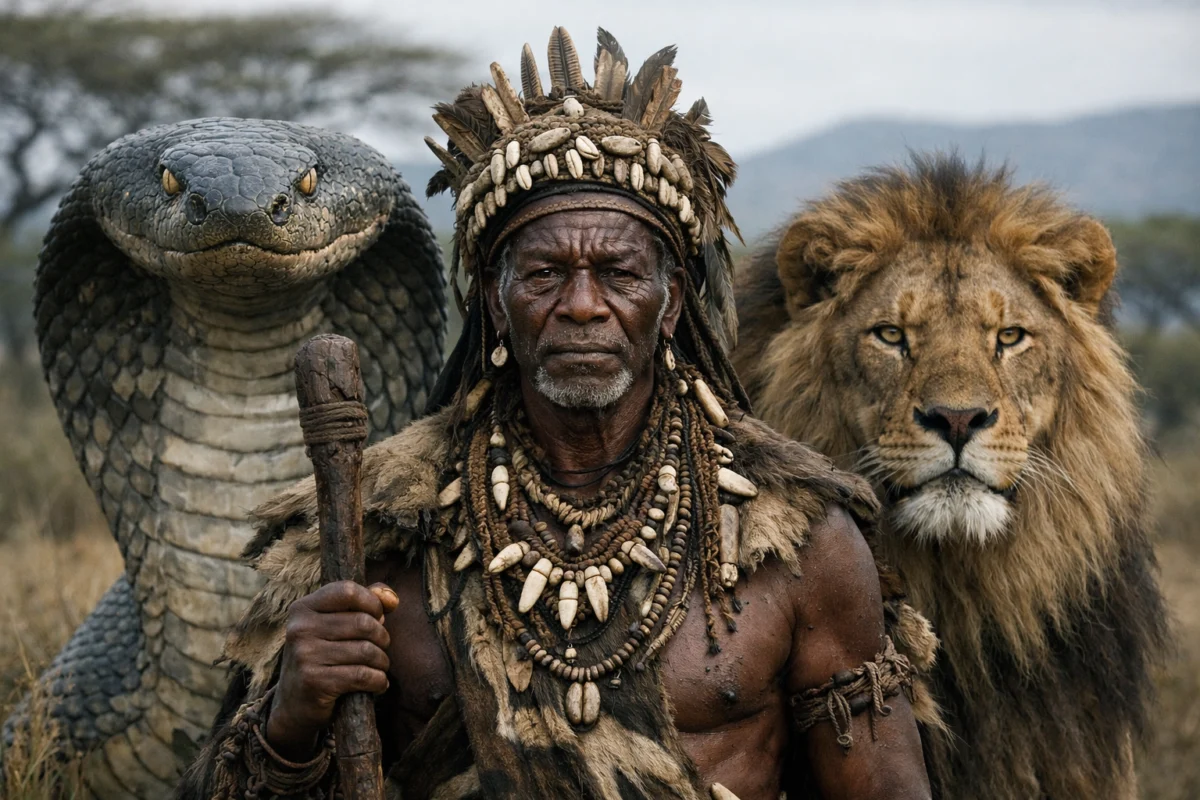
Kinioka kia Tumba is a great serpent from the Kimbundu-speaking Ambundu tradition of Angola. It appears in the heroic tale of Sudika-Mbambi, when the hero descends to the realm of Kalunga-ngombe and is tasked with recovering the ruler’s daughter from the serpent.
Unlike serpent beings supported by many regional stories or ritual traditions, Kinioka kia Tumba is known chiefly through this one important narrative. Its identity is therefore inseparable from Sudika-Mbambi’s otherworldly trials, rather than from an independent body of place legends, worship, or competing origin accounts.
In the recorded episode, Sudika-Mbambi first endures successive attacks by driver ants, red ants, bees, and wasps outside Kinioka’s dwelling. He then confronts serpent heads that appear one after another, cuts them down, and enters the house after the serpent’s death to bring back Kalunga-ngombe’s daughter.
Later comparisons with dragons, the Hydra, and underworld serpents can be useful as interpretation, but they should not replace the tale’s own evidence. Kinioka kia Tumba is most securely understood as a powerful supernatural serpent and a decisive obstacle in Sudika-Mbambi’s descent.
History/Origin
The earliest major published source is Héli Chatelain’s 1894 collection Folk-Tales of Angola, which prints Kimbundu texts beside literal English translations. Chatelain gathered the material during the colonial period, preserving oral narratives that would otherwise have remained difficult for later readers to access.
Within that collection, Kinioka kia Tumba appears in the tale of Sudika-Mbambi, a wonder-child hero whose adventures form part of a larger family cycle. The story combines extraordinary birth, warfare, supernatural helpers, descent, marriage trials, death, rescue, and eventual conflict between brothers.
Sudika-Mbambi reaches the realm of Kalunga-ngombe after falling into a pit and following a road below. An old woman directs him along the correct path and advises him to carry unusual objects, preparing him for the tests awaiting him in the ruler’s domain.
When Sudika-Mbambi asks to marry Kalunga-ngombe’s daughter, the ruler does not simply grant permission. He sets challenges, including the recovery of the daughter from Kinioka kia Tumba.
The serpent therefore enters the narrative as part captor, part guardian, and part supernatural trial.
Later interpretations sometimes describe this episode through broad ideas about death, initiation, or heroic descent. Those readings can be useful, but they are interpretations rather than additional folklore.
The source itself presents Kinioka kia Tumba primarily through action inside the hero’s dangerous otherworld journey.
The tradition belongs most securely to Kimbundu-speaking Ambundu culture in Angola, not to a generic undifferentiated “African mythology.” Some later books loosely label the serpent Kongo, but the original published tale appears within Chatelain’s Kimbundu collection and should retain that specific cultural context.
Name Meaning
The name Kinioka kia Tumba comes from the Kimbundu wording preserved with the tale. Kinioka refers to a snake or serpent, while kia works as a connective meaning roughly “of.”
The first part of the name therefore identifies the creature directly as serpentine.
Tumba is harder to translate with confidence in this particular name. Later scholarship sometimes glosses the whole expression as “Snake of Tumba” and has proposed additional interpretations, but the evidence does not justify treating one speculative meaning as a settled traditional translation.
For MythBeasts, the safest form is therefore to preserve Kinioka kia Tumba as the proper name while explaining its transparent serpent element. Translating it too freely into a dramatic English title would create certainty that the surviving linguistic and folkloric evidence does not provide.
Appearance
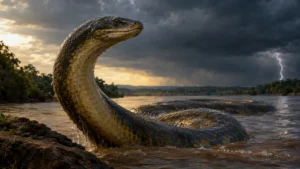
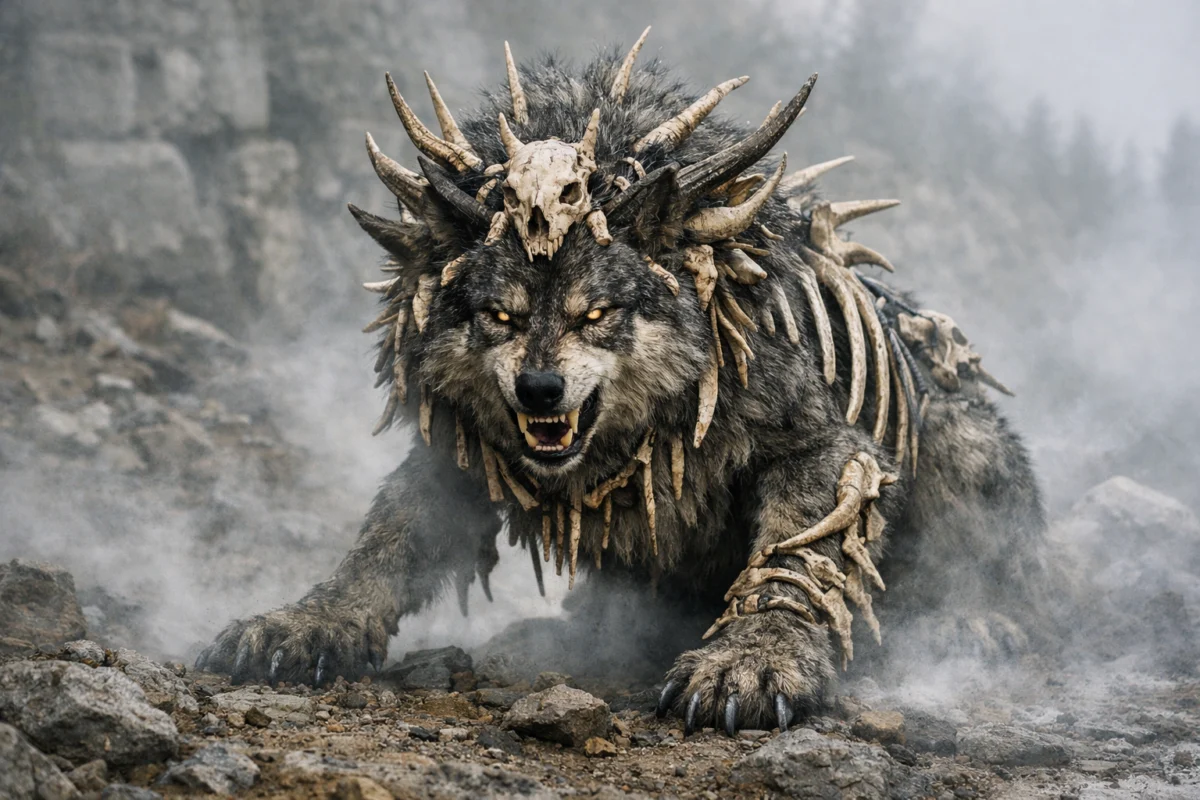
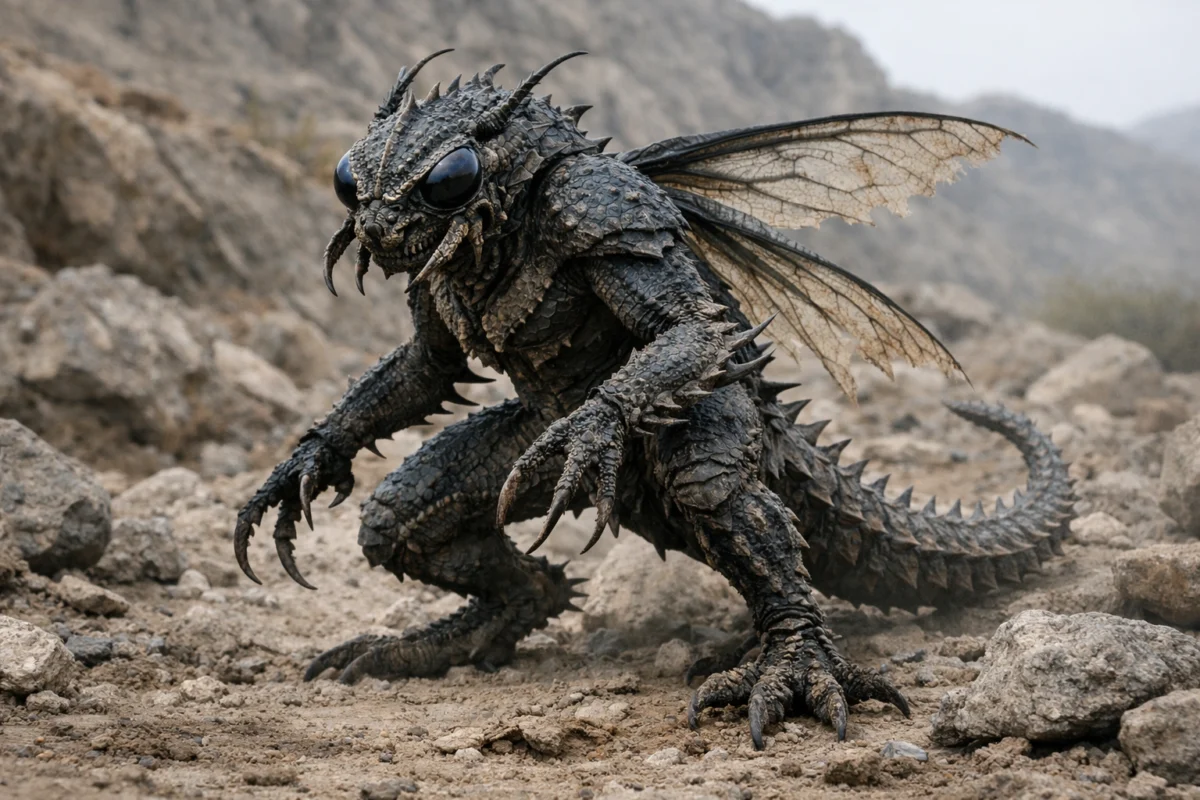
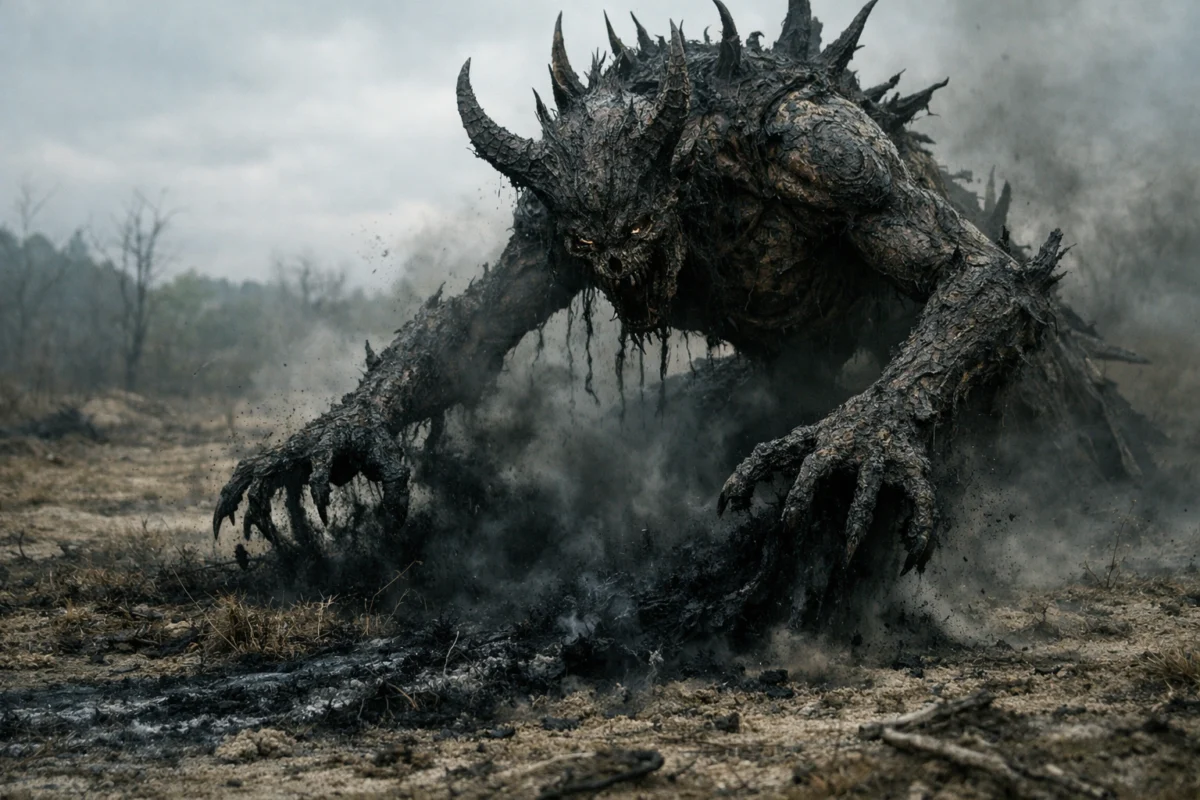
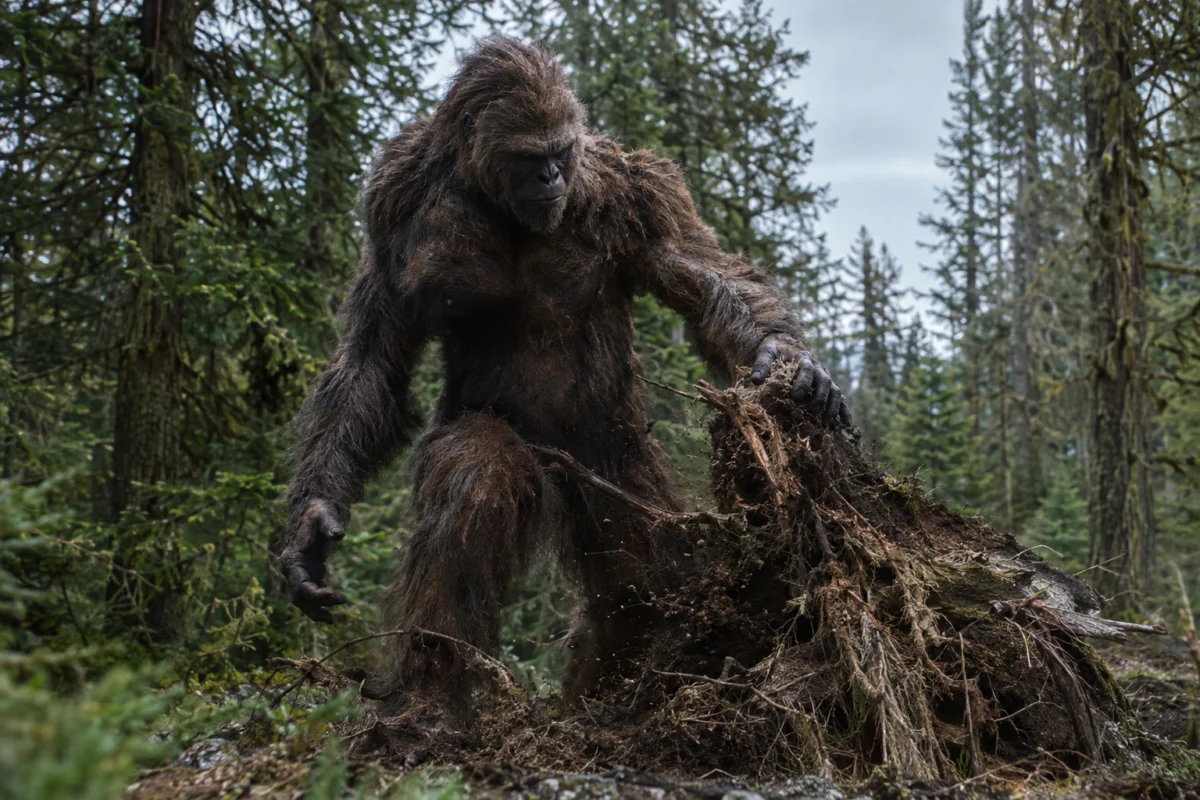
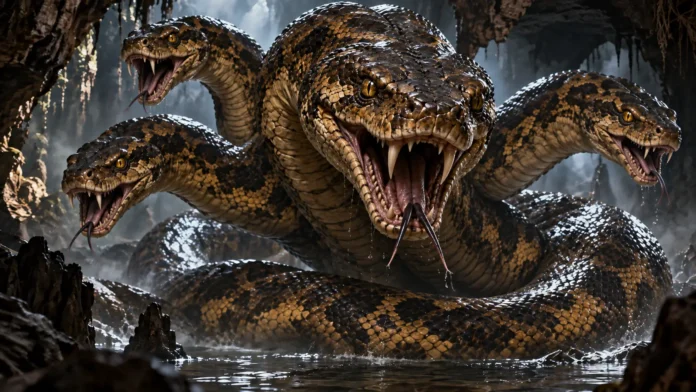
The source gives Kinioka kia Tumba a surprisingly limited physical description. It is unmistakably a great serpent, and the confrontation involves threatening heads with exposed fangs, but the narrative does not establish a canonical color, horn pattern, wings, limbs, or decorative markings.
One striking feature is the repeated appearance of serpent heads during battle. Sudika-Mbambi cuts down one attacking head, only for another to confront him.
Later authors compare this sequence with a many-headed or regenerating monster, although the exact anatomy remains narratively ambiguous.
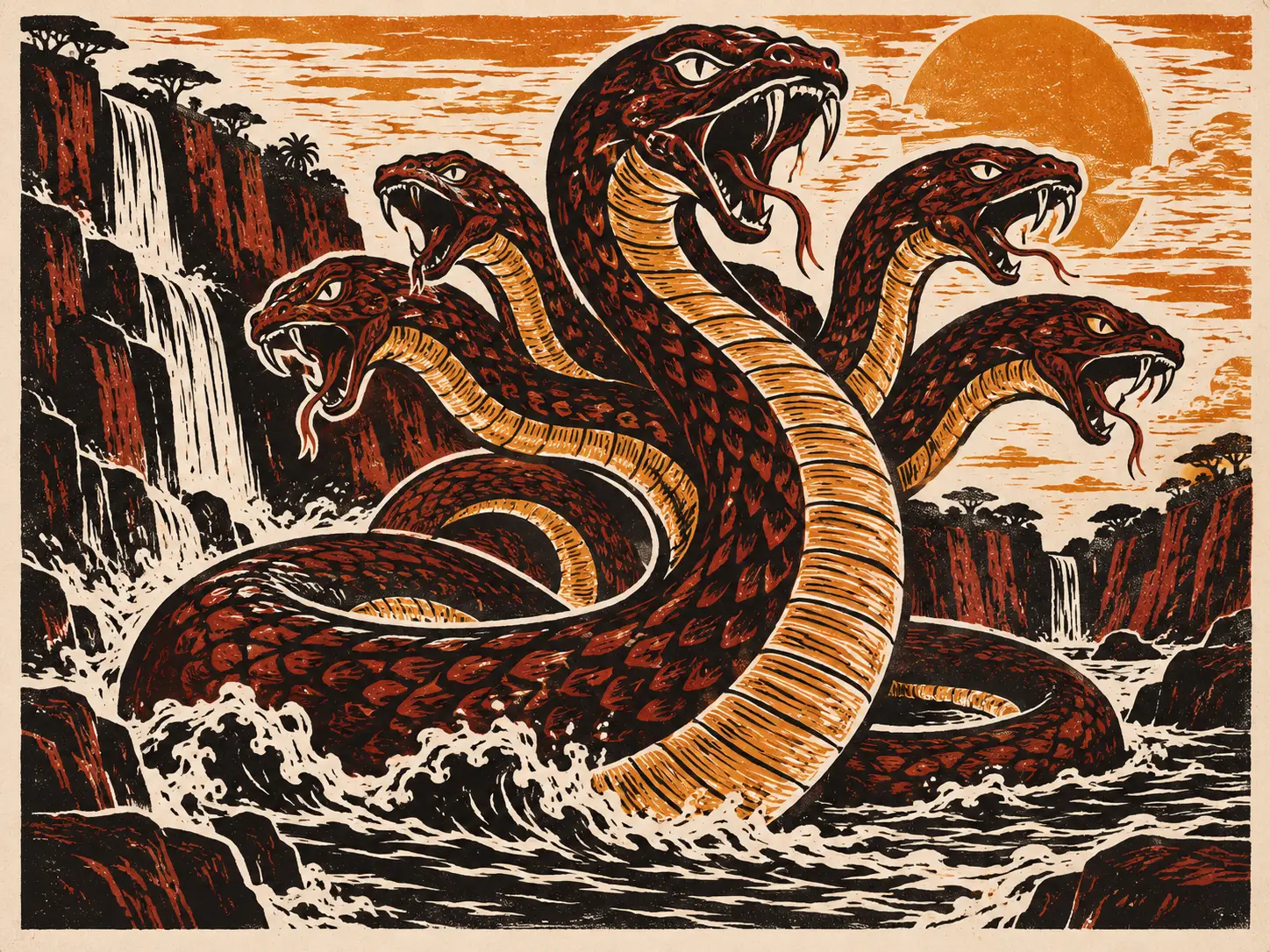
That ambiguity matters for visual reconstruction. An illustration can reasonably show an enormous African serpent with powerful jaws and multiple emerging heads, but presenting a fixed number of heads would go beyond the source.
The story emphasizes repeated danger rather than anatomical cataloguing.
Modern fantasy art should also avoid automatically turning Kinioka kia Tumba into a European dragon. Nothing in the core account requires bat wings, horns, fire breathing, armored limbs, or medieval dragon anatomy.
Its strongest traditional identity remains that of an extraordinary serpent.
Background Story
Kinioka kia Tumba enters the tale only after Sudika-Mbambi has crossed into a supernatural realm. Kalunga-ngombe’s daughter is beyond the hero’s immediate reach, and the ruler makes her recovery from the serpent one of the conditions that Sudika-Mbambi must satisfy.
The serpent does not fight only through direct physical attack. When Sudika-Mbambi reaches its dwelling, hostile swarms come against him in sequence, including driver ants, red ants, bees, and wasps.
This makes the encounter feel like an escalating ordeal controlled by a powerful adversary.
After surviving those assaults, Sudika-Mbambi faces the serpent itself through attacking heads and fangs. He cuts them down and eventually returns with Kalunga-ngombe’s daughter, completing this trial before facing another monstrous opponent connected with the dangerous waters of the underworld.
Kinioka kia Tumba therefore serves a precise narrative purpose. The creature tests whether Sudika-Mbambi can penetrate hostile supernatural territory, endure layered attacks, and recover what has been withheld.
It is less a wandering monster than a concentrated obstacle within the hero’s descent.
The serpent’s role also distinguishes it from Kimbiji kia Malenda, the crocodile-like monster encountered afterward. Kinioka is defeated during the rescue trial, while Kimbiji overpowers and swallows Sudika-Mbambi, creating the later death-and-rescue episode involving the hero’s brother Kabundungulu in the tale.
Because the surviving evidence centers so heavily on this single tale, Kinioka kia Tumba should not receive invented habits, worship, habitat, or powers from unrelated African serpent traditions. Its strongest article remains one that preserves the narrow but vivid mythology actually recorded.
Research verification: Chatelain’s Folk-Tales of Angola identifies “Sudikambambi” as a Kimbundu tale in the 1894 collection, while later reference works describe Kinioka kia Tumba as the great serpent defeated by the Ambundu hero. Later scholarship also cautions that the exact meaning of Tumba remains uncertain.
Famous Folklore Stories
Only one well-documented traditional narrative places Kinioka kia Tumba at its center: the Kimbundu tale “Sudika-Mbambi,” published by Héli Chatelain in 1894. Rather than inventing additional legends, the two episodes below separate the serpent encounter into its best-attested narrative scenes.
The Four Swarms at Kinioka’s House
Sudika-Mbambi reaches Kinioka kia Tumba’s dwelling and asks where the serpent has gone. Kinioka’s wife answers that he has gone shooting, so the hero waits outside rather than entering immediately.
The strange encounter becomes dangerous before the serpent itself ever appears.
While Sudika-Mbambi waits, driver ants approach first. He beats them back, then faces red ants, followed by bees and finally wasps.
Chatelain’s literal translation presents the attacks in quick succession, turning the waiting period into a sequence of escalating natural threats.
“There come the bees; he beats them. There come the wasps; he beats them.” (Folk-Tales of Angola, Tale V, “Sudika-Mbambi,” Héli Chatelain, 1894.)
The original text does not explicitly say that Kinioka commands these creatures, an important distinction from later retellings that describe them as the serpent’s armies. In Chatelain’s version, the swarms simply arrive one after another while Sudika-Mbambi remains outside the dwelling.
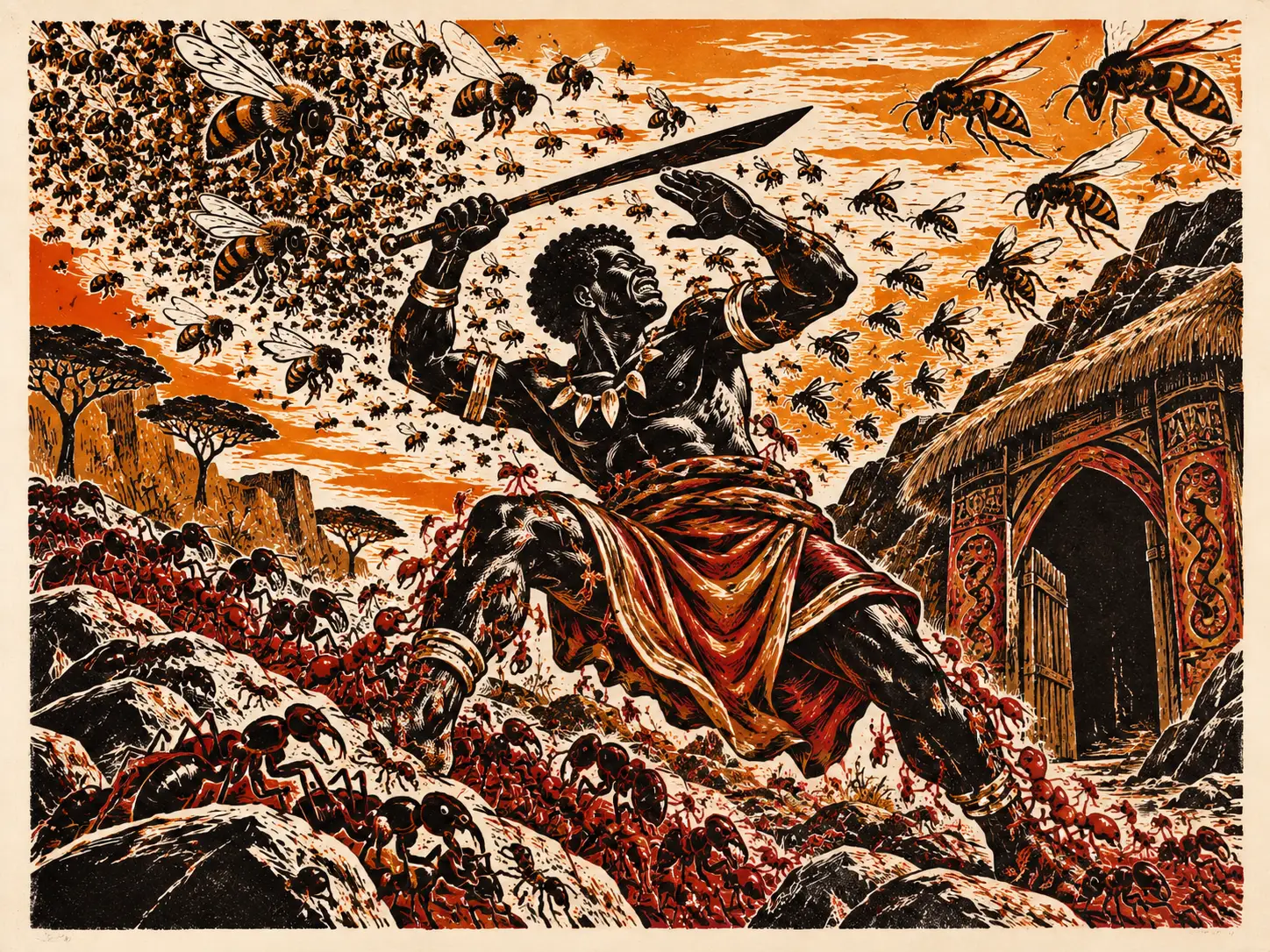
None of the insects defeats him. The episode establishes Sudika-Mbambi’s endurance through repetition rather than elaborate combat description: each new danger comes, he overcomes it, and another follows.
Only after the wasps fail does the tale shift from swarming creatures to Kinioka himself.
That structure makes the scene more than a simple prelude to the serpent battle. The hero survives four distinct threats before confronting the monster, creating a layered ordeal in which persistence matters as much as strength and preparing the sudden appearance of Kinioka’s first head.
The Five Heads of Kinioka kia Tumba
After the insects fail to stop Sudika-Mbambi, a head of Kinioka appears and the hero cuts it off. Another follows and meets the same fate.
The tale repeats this pattern until five heads have appeared separately, making the serpent’s attack feel relentless. Internet Archive
Chatelain’s literal translation adds unusual details during the later blows. Sudika-Mbambi cuts a palm tree belonging to Kinioka during one attack, the serpent’s dog during another, and a banana tree during the last, while continuing to strike each appearing head.
“There comes another head; he cuts it, too.” (Folk-Tales of Angola, Tale V, “Sudika-Mbambi,” Héli Chatelain, 1894.)
The wording does not clearly explain whether these objects participate magically in the fight or simply stand near the serpent’s dwelling. What remains unmistakable is the sequence: five serpent heads appear, Sudika-Mbambi cuts them down, and the source then states directly that Kinioka is dead.
Only after the serpent dies does Sudika-Mbambi enter its house. Inside he finds Kalunga-ngombe’s daughter and tells her to come because her father has sent for her.
The rescue therefore follows the killing immediately, without another negotiation, spell, or supernatural obstacle.
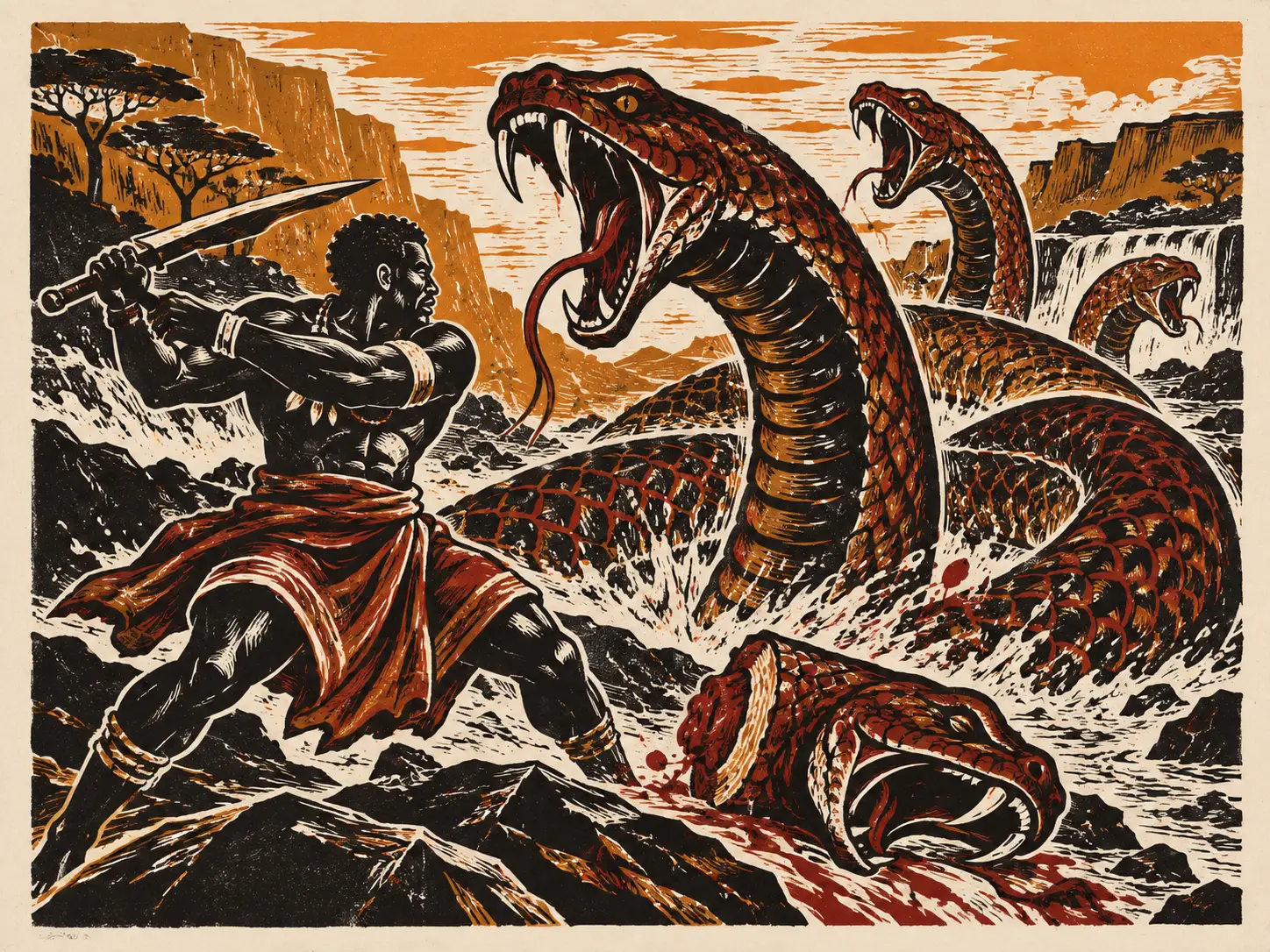
Sudika-Mbambi brings the woman back and announces her return to Kalunga-ngombe. The episode closes without describing Kinioka’s resurrection or survival, so later portrayals of an endlessly regenerating serpent go beyond Chatelain’s text.
Within the recorded tale, the fifth severed head ends the monster.
Cultural Impact
Kinioka kia Tumba remains culturally significant mainly because the serpent belongs to the Sudika-Mbambi cycle, one of the better documented heroic narratives from Kimbundu-speaking Angola. Its survival demonstrates how nineteenth-century folklore collection preserved stories whose supernatural characters otherwise received little international exposure.
Later mythologists shifted attention from the serpent alone toward its narrative function. Kinioka became useful in discussions of heroic descent, marriage trials, encounters with death, and the widespread motif of heroes defeating monstrous serpents before continuing deeper into supernatural territory.
This later attention also created a problem: comparative writers sometimes describe Kinioka through the Hydra, dragon, or archetypal serpent instead of the original Kimbundu narrative. Preserving its Ambundu context prevents a distinctive Angolan monster from becoming merely another generic fantasy dragon.
Similar Beasts
Kimbiji kia Malenda
Kimbiji kia Malenda appears immediately after Kinioka in Sudika-Mbambi’s trials. This enormous crocodile-like water monster swallows the hero whole, making it another dangerous underworld creature within the same Kimbundu narrative, although its powers and defeat differ substantially.
Hydra of Lerna
The Greek Hydra resembles Kinioka through its repeated serpent heads and the hero’s need to cut them down. Clyde W. Ford specifically noted the comparison, although Kinioka’s original tale does not describe the Hydra’s famous regeneration mechanism.
Aido-Hwedo
The Fon people of present-day Benin preserve traditions about Aido-Hwedo, an immense cosmic serpent associated with creation and supporting the world. Both creatures demonstrate the importance of gigantic serpents in African mythology, although Aido-Hwedo is creative rather than antagonistic.
Inkanyamba

Inkanyamba belongs to southern African traditions describing a powerful supernatural serpent associated with deep water, storms, and destructive atmospheric forces. Like Kinioka, it combines familiar serpent anatomy with extraordinary supernatural scale, but it belongs to entirely different cultural traditions.
Kirimu
Kirimu appears in Nyanga heroic tradition as a dangerous monster confronted within an African heroic narrative. Like Kinioka, it functions as an extraordinary opponent whose defeat demonstrates heroic power, rather than existing primarily as an independently worshipped supernatural being.
Religion/Ritual
No reliable evidence establishes a cult, shrine, priesthood, sacrifice, or protective ritual specifically devoted to Kinioka kia Tumba. Chatelain records the creature within narrative folklore, and the surviving story presents it as an opponent rather than a deity approached through religious observance.
The surrounding tale nevertheless enters a supernatural landscape involving Kalunga-ngombe and a realm reached beneath the ordinary world. Such elements can carry cosmological meaning, but the narrative alone cannot prove that every character represented a separately worshipped being within historical Ambundu religion.
This distinction matters because modern mythology summaries frequently turn every supernatural African character into a god or spirit of formal religion. Kinioka is better classified as a folkloric monster within a heroic tale unless additional ethnographic evidence establishes an independent ritual tradition.
Scientific or Rational Explanations
Kinioka’s component dangers draw upon recognizable features of the natural environment. Large snakes, biting ants, bees, and wasps all present genuine hazards, while oral storytelling can enlarge familiar threats until one heroic encounter gathers several frightening creatures into an escalating supernatural ordeal.
The five-head sequence does not require a biological explanation because the tale operates through narrative repetition. Each arriving head raises the challenge before Sudika-Mbambi overcomes it, creating rhythm and suspense similar to repeated obstacles found throughout oral heroic storytelling traditions worldwide.
The serpent should therefore not be treated as evidence for an unknown multiheaded reptile. Kinioka kia Tumba makes more sense as a mythic adversary whose enormous body, successive heads, and dangerous surroundings transform recognizable animal threats into a memorable test of supernatural heroism.
Modern Cultural References
Kinioka kia Tumba has a much smaller modern footprint than internationally famous monsters. Searches produced no dependable evidence for appearances in major films, television series, comics, or commercial games, so the examples below include only modern works that demonstrably name or retell the serpent.
The Hero with an African Face by Clyde W. Ford, 1999
Ford retells the Sudika-Mbambi narrative and gives Kinioka a prominent role in the hero’s underworld trials.
His version explicitly names the “great serpent, Kinioka kia Tumba” and interprets the episode through comparative ideas concerning heroic journeys, death, and transformation.
The Hero with an African Face, Penguin Random House
African Mythology, A to Z by Patricia Ann Lynch and Jeremy Roberts, 2010
The second edition of this mythology reference recounts Sudika-Mbambi’s descent into Kalunga-ngombe’s realm and explicitly identifies Kinioka kia Tumba as the great serpent holding the ruler’s daughter, preserving the monster for a modern general and younger readership.
African Mythology, A to Z on Google Books
Our Mythical Childhood Survey, University of Warsaw, 2018
This academic reception project documents Clyde Ford’s modern presentation of “Sudika-Mbambi: The Hero Child Who Saved His Tribe.”
Its inclusion demonstrates continued scholarly interest in the Angolan heroic cycle through which contemporary readers encounter Kinioka kia Tumba.
Our Mythical Childhood Survey: Sudika-Mbambi
The Brothers of Thunder, Folktales Africa, 2025
Folktales Africa published a contemporary digital retelling of the Kimbundu narrative.
Its version explicitly names Kinioka kia Tumba and recounts Sudika-Mbambi reclaiming Kalunga-ngombe’s daughter while surviving the sequence of ants, bees, wasps, and supernatural monsters.
The Brothers of Thunder, Folktales Africa
Conclusion
Kinioka kia Tumba survives not through hundreds of independent legends but through one extraordinary heroic narrative. That limited source base makes accuracy especially important, because every unsupported power, physical feature, or religious association can quickly become mistaken for authentic Ambundu tradition.
Within the surviving story, the serpent remains memorable enough. Sudika-Mbambi reaches its dwelling, survives successive swarms, confronts five appearing heads, kills the creature, and recovers Kalunga-ngombe’s daughter before continuing toward an even more dangerous encounter with Kimbiji kia Malenda.
Seen in context, Kinioka is an excellent example of how a relatively obscure monster can occupy a crucial place inside a much larger mythic structure. Its importance comes from the ordeal it creates, not from an elaborate biography invented outside the tale.
Further Reading
Folk-Tales of Angola by Héli Chatelain, American Folk-Lore Society, 1894.
The essential primary source containing the Kimbundu text and English translation of “Sudika-Mbambi.”
Smithsonian Libraries: Folk-Tales of Angola
Myths and Legends of the Bantu by Alice Werner, George G. Harrap, 1933.
An influential comparative study retelling Sudika-Mbambi and placing the Angolan hero among wider Bantu traditions.
Myths and Legends of the Bantu
The Hero with an African Face by Clyde W. Ford, Bantam Books, 1999.
A modern interpretation of African heroic mythology containing an extended discussion and retelling of Kinioka.
African Mythology, A to Z by Patricia Ann Lynch and Jeremy Roberts, Chelsea House, 2010.
Accessible reference work covering Sudika-Mbambi, Kinioka kia Tumba, and numerous African mythological traditions.
Google Books
“Sudika-Mbambi: The Hero Child Who Saved His Tribe” by Daniel A. Nkemleke, Our Mythical Childhood Survey, 2018.
Academic reception entry documenting Clyde Ford’s modern treatment of the traditional Ambundu heroic narrative.
University of Warsaw: Our Mythical Childhood Survey