
Introduction
Adnei haSadeh occupy a strange borderland in Jewish tradition: they resemble human beings, yet rabbinic texts discuss them among wild animals. Later accounts give them an extraordinary dependence on the earth, describing a living cord that connects the navel to the ground.
The name refers to a kind of creature rather than one individual with a personal biography. Its unsettling appeal comes from that uncertain identity.
A familiar human outline conceals a being whose life, movement, and vulnerability follow rules entirely different from ours.
“The adnei hasadeh are wild animals.” (Mishnah Kilayim 8:5, compiled around 200 CE; translated from Hebrew.) This brief classification introduces the creature through law, placing an apparently humanlike inhabitant of the wilderness within a discussion of animal categories and their practical consequences.
Across the surviving descriptions, resemblance creates the central puzzle. How should people understand a creature that looks human but belongs outside ordinary human society?
The tradition answers through competing explanations, gradually turning a short legal reference into a memorable account of rooted life.
History and Origin
The earliest foundation for this entry lies in Mishnah Kilayim 8:5. The surrounding chapter considers distinctions between animal kinds and restrictions involving their use together.
Adnei haSadeh appear within that discussion, alongside other creatures whose classification requires careful attention from the rabbis.
Rabbi Yose adds that their dead bodies transmit impurity under a shared covering, as human corpses do. His statement concerns a particular ritual consequence.
It does not supply a complete account of their intelligence, ancestry, behavior, or relationship with ordinary human beings.
The Jerusalem Talmud develops the description by identifying a mountain man whose survival depends on his navel. This late antique passage provides the textual foundation for the later attachment motif.
Its compact wording leaves subsequent commentators considerable room to explain the connection.
“It lives from its navel; if its navel is severed, it cannot live.” (Jerusalem Talmud, Kilayim 8:4, late antiquity; translated from Aramaic.)
The sentence introduces bodily dependence without providing the elaborate hunting procedure that later writers attach to the creature.

Medieval explanations follow different paths. Maimonides describes humanlike animals and reports speechlike sounds that listeners cannot understand. Samson of Sens records a more fantastic account attributed to Meir ben Kalonymus of Speyer, while Obadiah of Bertinoro later presents the dangerous, earth-tethered creature.
Name Meaning
The Hebrew name Adnei haSadeh connects the creature with the field or open countryside. The second element, haSadeh, means “the field.”
The first element requires more care, since its history involves differing spellings and interpretations rather than one universally accepted English equivalent.
The scholarly commentary Mishnat Eretz Yisrael explains adnei through a form related to adam, meaning a human being. On that reading, “field-men” captures the sense.
The explanation suits the creature’s human resemblance while avoiding assumptions that the name necessarily describes supernatural rulers.
Another textual form reads Avnei haSadeh, “stones of the field,” echoing the wording of Job 5:23. Commentators connect that verse with the creature, but the biblical expression alone supplies no description of a humanoid animal or a cord growing from its navel.
The Jerusalem Talmud also uses the Aramaic expression bar nash de-tur, commonly translated “mountain man.” Medieval writers connect the being with an animal called Yadua in explanations of forbidden divination.
These labels reflect interpretive connections, so their meanings depend on the particular source.
Appearance
The detailed medieval portrait emphasizes human anatomy. Samson of Sens describes a face, body, hands, and feet resembling those of a person.
The disturbing feature lies in the attachment beneath that familiar outline: a cord extends from the creature’s navel toward the earth.
“Its form is human in face, hands, and feet.” (Obadiah of Bertinoro, Commentary on Mishnah Kilayim 8:5, late fifteenth or early sixteenth century; translated from Hebrew.)
This description makes recognizability central, giving the creature a human outline rather than an elaborate monstrous silhouette.
Samson compares the connection emerging from the ground with the growth of cucumbers and gourds. That comparison concerns the rootlike attachment.
It does not require a body made from bark, leaves, or branches, even though such features might tempt a modern illustrator.
The cord also determines the space the creature occupies. Medieval descriptions place its feeding and dangerous reach within the area that its tether permits.
Its body can move around that attachment, creating the image of a mobile animal bound to one particular place.
The cited passages leave height, skin color, clothing, and facial details unspecified. Their most distinctive visual combination therefore remains a humanlike body and an exposed connection to the soil.
Artists can vary the surrounding details while preserving those recognizable features of the medieval tradition.
Background Story
Medieval descriptions place Adnei haSadeh within a small but dangerous territory. The cord defines the creature’s relationship with its surroundings: it can feed and move within reach, yet every movement preserves the connection to the place on which its life depends.
In Samson’s account, the being grazes around its rooted connection and kills creatures that enter its reach. This combination makes it difficult to classify through behavior alone.
Feeding links it with grazing animals, while its attacks give encounters a threatening character.
The medieval setting gives hunters a problem of distance: the creature’s strength makes close contact perilous, while its fixed attachment offers a potential weakness. This arrangement explains the tension of an encounter before any particular hunter or successful expedition enters the account.
A further medieval connection explains interest in its remains. Samson identifies the creature with the Yadua associated with yidoni divination, while Sefer HaChinukh describes a practitioner placing a bone from that animal in the mouth.
The text presents this as forbidden magical activity.
The resulting legend combines three tensions: human resemblance with animal classification, dangerous strength with dependence on a fragile connection, and living flesh with growth from the ground. Those relationships give Adnei haSadeh their distinctive identity without requiring an invented creator, homeland, or heroic opponent.
Famous Folklore Stories
The surviving traditions offer two different kinds of account: a folktale about a frightened traveler and a later interpretation of Egypt’s plagues. Their sources present different images of the creature, so each retelling below follows its own text without combining their details.
The Traveler and the Human-Shaped Meal
An elderly traveler receives generous hospitality from a pious man. At midday, he overhears the host’s wife asking what they should serve that evening in his honor.
Her husband answers that they should prepare their own “man,” alarming their unsuspecting guest.
The traveler imagines a household that eats human beings. If someone must die to provide his welcome feast, he reasons, another guest might eventually arrive and receive a meal made from him.
Frightened by that possibility, he leaves for another house.
At mealtime, the first host searches the neighborhood and finds his visitor dining elsewhere. He repeatedly invites him back, but the traveler refuses.
After the disappointed man departs, the second host asks why his guest has embarrassed such a pious person.
“In our country, this is a kind of vegetable.” (Midrash Tanhuma, Salomon Buber’s introduction, p. 63, 1885 edition; translated from Hebrew.)
The second host laughs when he hears the explanation, then reveals what the traveler has misunderstood about the promised meal.
He explains that this local food grows from the earth and resembles a person. Its head emerges first, followed by the rest of its body, while it remains rooted below.
The frightening word therefore names a human-shaped growth familiar to the household.
The explanation ends the mystery surrounding the dinner. The traveler has mistaken a local name for evidence of cannibalism and treated sincere hospitality as a threat.
This account presents an edible human-shaped plant, a distinct variation within traditions about Adnei haSadeh.
The Rooted Creature Among Egypt’s Plagues
A later interpretation in Chanukat HaTorah brings the rooted creature into the story of Egypt’s plagues. Following Rashi’s explanation of arov as an assortment of dangerous animals, the commentary asks how the earthbound being could join the creatures invading Egyptian homes.
The difficulty follows directly from its dependence on the ground. Ordinary animals can travel to Egypt, but this creature cannot simply leave its rooted connection behind.
Breaking that attachment would kill it before it could take any part in the threatened invasion.
The commentary turns to the additional reference to the ground in the biblical warning. It reads those words as the answer to the difficulty: the creature arrives together with the earth that sustains it, preserving the connection that movement would otherwise destroy.
“The ground to which the animal is attached by a cord.” (Chanukat HaTorah, section 57, Va’era, 1900 edition; translated from Hebrew.)
This explanation identifies the accompanying earth as essential to the creature’s arrival, allowing the unusual animal to participate in the plague.
Within this interpretation, the invasion includes more than animals entering houses. The creature’s own patch of ground accompanies it into Egypt.
Its rooted nature remains intact, while the divine punishment overcomes the obstacle that would normally keep it in one place.
The biblical passage itself does not name Adnei haSadeh. The later commentator supplies that identification by connecting the plague with rabbinic creature lore.
The result gives a reference to the ground a specific narrative purpose: bringing an earthbound creature into Egypt.
Cultural Impact
Adnei haSadeh have offered later writers a striking image of attachment to place. A body physically connected to its surroundings can suggest security, dependence, or confinement.
Those possibilities help explain why a creature from legal commentary could become material for literary invention.
In modern Hebrew literature, the contrast between rooted inhabitants and a wandering outsider gained particular force. It allowed questions about belonging, land, and exclusion to take visible bodily form.
The creature’s connection to soil could therefore carry meanings beyond the dangers of wilderness.
Another part of its cultural afterlife concerns reading itself. Modern discussions place Adnei haSadeh alongside other puzzling creatures from traditional texts, inviting audiences to compare inherited authority, historical knowledge, and observation.
Its continued interest rests partly on the disagreements it generates among interpreters.
Similar Beasts
Vegetable Lamb of Tartary
The Vegetable Lamb belongs to European accounts of a remarkable plant-animal being associated with Tartary. In its stalk-bound form, a living lamb grows attached to the earth and grazes on vegetation within reach.
This is a close parallel to the medieval Adnei haSadeh: both combine animal movement with a fixed, life-sustaining attachment. Their resemblance concerns bodily dependence and restricted feeding territory, rather than evidence that the traditions share a single origin.
Mandrake

Mandrake is a real plant surrounded by longstanding magical folklore. Its branching root can suggest a human figure, while legends give it a fatal scream that makes pulling it from the ground dangerous.
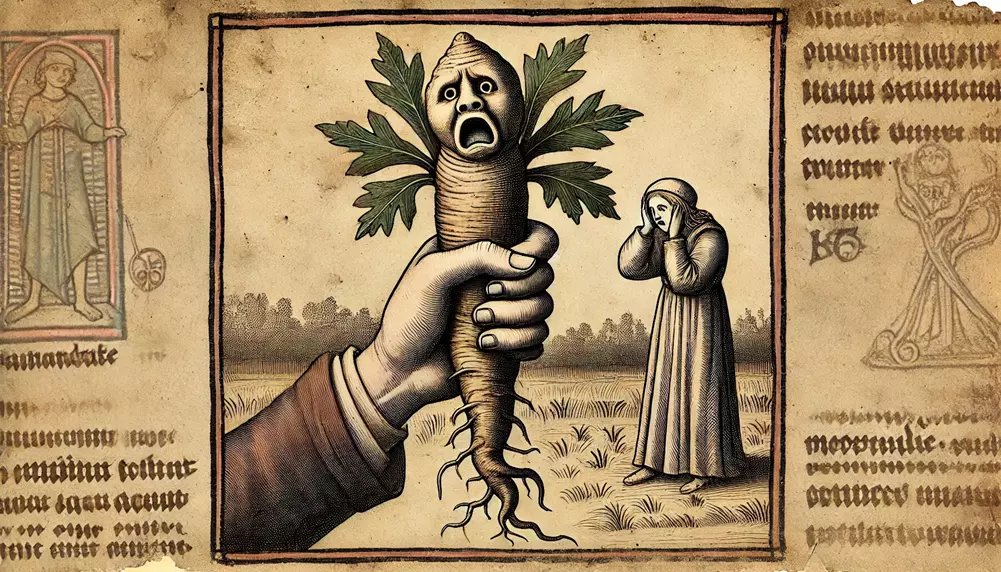
Like Adnei haSadeh, the legendary mandrake unsettles the boundary between human form and rooted growth. The danger differs: mandrake threatens through its imagined cry, while medieval Adnei haSadeh threaten creatures entering their reach.
Ghillie Dhu

The Ghillie Dhu is a solitary figure of Scottish forest folklore, associated with birchwoods and clothing made from leaves and moss. He is remembered for helping a lost child.
His humanlike appearance and close association with vegetation offer a visual comparison with Adnei haSadeh. The distinction matters: plant clothing is not an earthbound lifeline, and his helpful behavior does not establish a protective role for Adnei haSadeh.
Ents

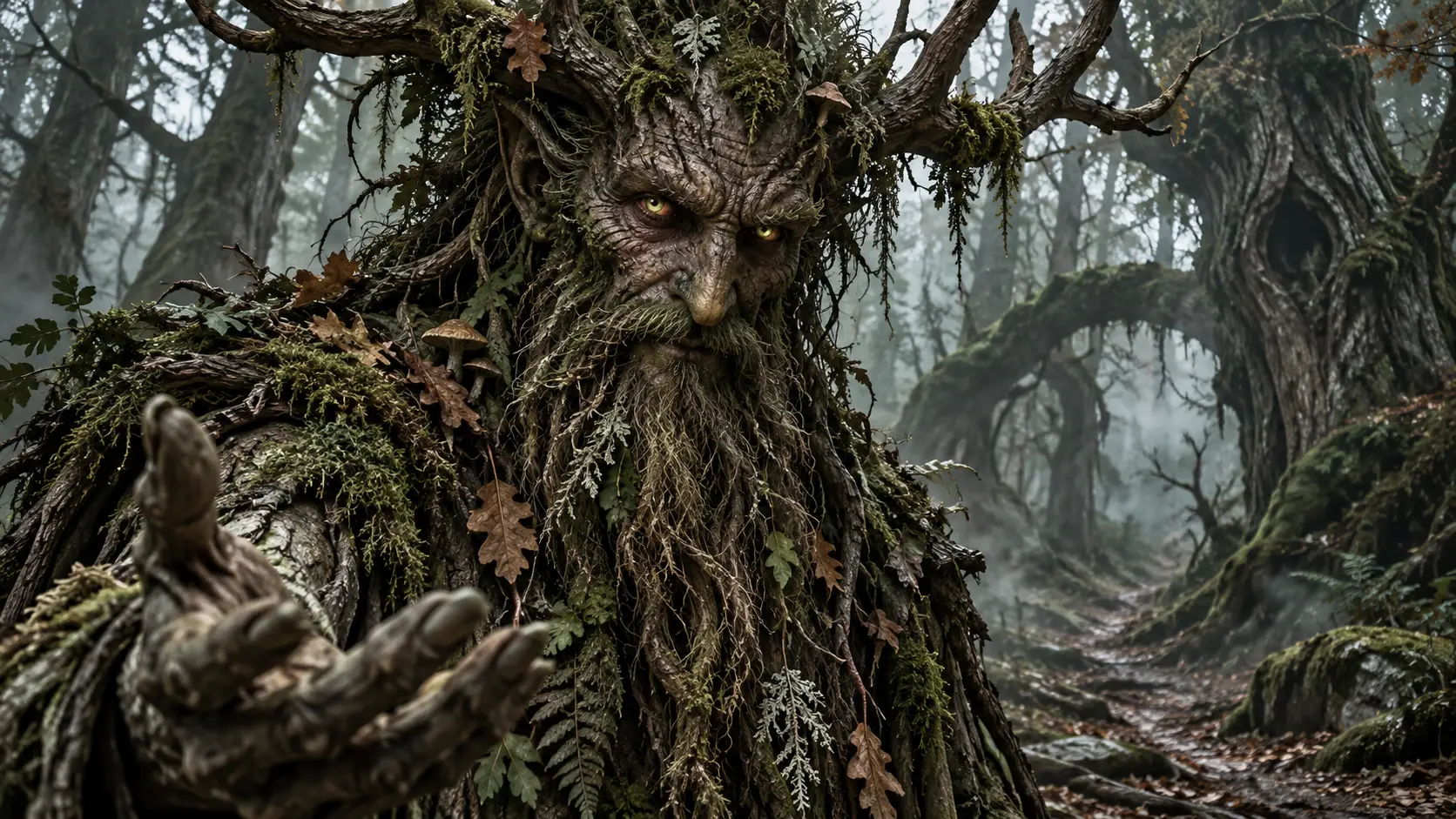
Ents are the sentient, tree-like shepherds of the forest in J. R. R. Tolkien’s Middle-earth. Those of Fangorn can walk, speak, and defend the woodland against destruction.
They provide a modern literary parallel through their combination of bodily life and vegetation. Unlike the tethered Adnei haSadeh of medieval accounts, Ents move freely; their guardianship of trees should not be transferred to the Jewish creature.
Leshy
The Leshy is a woodland spirit in Slavic folklore, especially Russian tradition. Often humanlike but changeable in appearance, he acts as a master of the forest and can mislead travelers through borrowed voices.
The comparison lies in a humanlike being encountered beyond settled society, where approaching the unfamiliar can be dangerous. Their roles remain distinct: the Leshy governs woodland life, while medieval Adnei haSadeh are dangerous creatures physically dependent on their attachment to the ground.
Religion and Ritual
Rabbinic discussions of the creature concern legal categories, especially the treatment of its remains. Ritual impurity here describes a religious status with defined consequences.
It does not by itself establish moral wickedness, demonic possession, or a supernatural attack against anyone sharing the space.
The associated discussion of yidoni belongs to prohibitions on divination. Sefer HaChinukh explains the forbidden consultation through a practitioner’s use of an animal bone.
Its purpose is to define a prohibited practice within Jewish law, rather than recommend contact with the creature.
These sources provide contexts for classification and prohibited magical activity. They do not describe a festival, sanctuary, or offering dedicated to Adnei haSadeh.
Their religious significance emerges from the questions scholars ask about them and the boundaries those discussions draw around permissible conduct.
Scientific or Rational Explanations
Israel Lipschitz offers an animal identification in his nineteenth-century Tiferet Yisrael commentary, proposing an orangutan. He emphasizes its humanlike build and describes reports of trained behavior.
This represents a historical attempt to interpret the textual reference through zoology, rather than evidence establishing its identity.
In the accompanying Boaz discussion, Lipschitz questions the explanation of nourishment through an attachment to the earth. He also distinguishes the Jerusalem Talmud’s statement about the navel from the fuller claim of a ground-bound cord.
His criticism examines how commentators expand earlier wording.
Another useful comparison comes from human-shaped plant roots and legends that attribute animal qualities to vegetation. Mandrake and Vegetable Lamb traditions show how such combinations circulated.
Similarity alone cannot establish a common origin, but it provides context for understanding the creature’s later descriptions.
Modern Cultural References
“Among the Adnei haSadeh” by Judah Leib Katzenelson, writing as Buki ben Yogli, collected edition, 1905.
Katzenelson’s Hebrew story places a wandering outsider among people tethered to their land, using the encounter to explore belonging, exclusion, and the desire for secure roots.
Source: https://benyehuda.org/read/5539
The Hidden Saint by Mark Levenson, Level Best Books, 2022; author’s explanation and excerpt.
Levenson explicitly identifies Adnei haSadeh as the inspiration for his Yedonim, three threatening creatures encountered in the woods by Rabbi Adam and his golem companion.
Source: https://marklevensonauthor.com/on-pesach-this-vegetable-monster-wants-to-turn-you-into-a-salad/
Sacred Monsters: Mysterious and Mythical Creatures of Scripture, Talmud and Midrash by Natan Slifkin, 2007.
Slifkin includes the creature in his discussion of vegetable-men and tree-geese, presenting traditional accounts within a broader examination of unusual creatures and approaches to interpreting them.
Source: https://www.biblicalnaturalhistory.org/product-page/sacred-monsters-israel
Conclusion
Adnei haSadeh endure because their familiar outline carries an unfamiliar condition of life. They make attachment visible, turning the relationship between a body and its surroundings into something readers can imagine, question, and reinterpret.
Their strongest feature is the uncertainty that surrounds that connection.
Reading the tradition carefully preserves its variety: legal discussion, medieval description, skeptical commentary, and modern fiction each contribute something different. Together they reveal how one obscure creature can support questions about belonging, dependence, and the limits of categories used to describe living beings.
Further Reading
Mishnah Kilayim 8:5, with commentaries by Maimonides, Samson of Sens, and Obadiah of Bertinoro; ancient and medieval texts.
Read the short legal passage beside contrasting explanations, allowing direct comparison between the Mishnah’s wording and the elaborate descriptions that later commentators supply.
Source: https://he.wikisource.org/wiki/משנה_כלאים_ח_ה
Jerusalem Talmud, Kilayim 8:4, late antiquity, Hebrew and Aramaic text, Mechon Mamre.
Contains the mountain-man description and the statement about survival through the navel, preserving the compact passage behind later accounts of an earthbound creature within its discussion of animal classification.
Source: https://mechon-mamre.org/b/r/r1408.htm
Tiferet Yisrael, Yachin and Boaz on Kilayim, by Israel Lipschitz, nineteenth century; excerpts on Sefaria.
Includes the orangutan interpretation and questions about earthly nourishment, offering a useful historical example of critical disagreement within the traditional commentary surrounding the creature.
Source: https://voices.sefaria.org/sheets/555705
Sefer HaChinukh, commandment 514, anonymous thirteenth-century work; English translation by R. Francis Nataf, 2018.
Explains the prohibition on consulting a yidoni and records the animal-bone account, clarifying the legal setting of the creature’s association with forbidden divination and supernatural consultation.
Source: https://www.sefaria.org/Sefer_HaChinukh.514.1
“Celebrating Spring,” Ashmolean Museum, University of Oxford, publication date unspecified.
Discusses a historical image of the Vegetable Lamb, including its attachment to the earth and grazing habits, supporting comparison with other imagined plant-animal beings attributed to plants in European folklore.
Source: https://ashmolean.web.ox.ac.uk/article/spring-artworks
“Herbology,” Renaissance Science, Magic, and Medicine in Harry Potter’s World, National Library of Medicine, updated 2023.
Presents historical mandrake illustrations and explains beliefs about human-shaped roots and fatal screams, providing documented context for comparison with another unsettling figure of rooted life.
Source: https://www.nlm.nih.gov/exhibition/sciencemagicmedicine/exhibition3.html
“Wild Man,” late fifteenth-century sculpture, Cleveland Museum of Art, collection record, publication date unspecified.
Describes the hairy woodland figure and its place beyond settled society, helping distinguish European wild-man imagery from the specific earthbound anatomy of Adnei haSadeh.
Source: https://www.clevelandart.org/art/1965.21
“Golem: From Mysticism to Minecraft” by Anna-Carolin Augustin, Jewish Museum Berlin, 2016.
Explores the artificial human across Jewish tradition and modern art, providing a clear comparison for questions about animation, bodily form, creation, and human identity and religious imagination.
Source: https://www.jmberlin.de/en/golem-from-mysticism-to-minecraft