Introduction
Al-Buraq is the extraordinary riding mount associated with the Prophet Muhammad’s Night Journey in Islamic tradition. Brought to him by the angel Gabriel, it carries him from Mecca to Jerusalem, linking two sacred places within an account of divine signs and prophetic experience.
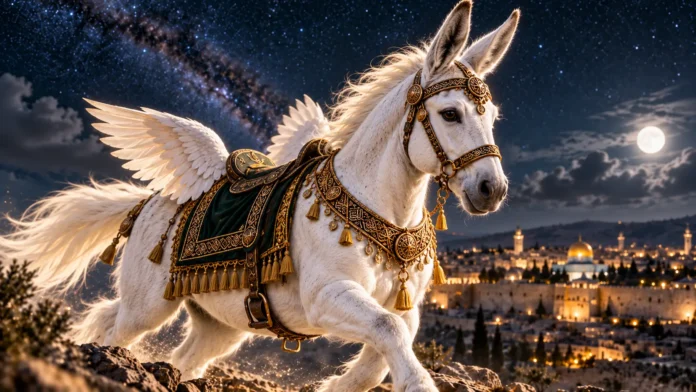
The most widely cited early description presents a white animal larger than a donkey but smaller than a mule. Its exceptional power lies in its movement: each stride reaches as far as it can see.
This is a miraculous mount, not an ordinary animal species.
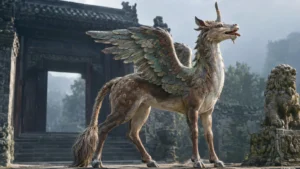
Its familiar appearance in later art is more elaborate. Persian and other Islamic visual traditions often portray a horse-like creature with wings and a human, frequently female, face.
That influential image should be distinguished from the shorter descriptions preserved in early religious texts.
Buraq’s importance comes primarily from its place in sacred narrative rather than an independent cycle of adventures. The Night Journey, or isra, is frequently joined to Muhammad’s heavenly ascent, or miʿraj, although accounts differ over how the two episodes connect and how Buraq participates.
History/Origin
The scriptural starting point is Qur’an 17:1, which describes the nocturnal journey of God’s servant from the Sacred Mosque to the Farthest Mosque, whose surroundings are blessed. The verse does not name Buraq or describe a riding animal.
Those details appear in transmitted accounts.
Early biography and hadith supply the mount’s name, appearance, and narrative actions. These sources expand the journey’s brief Qur’anic presentation into an account involving Gabriel, travel to Jerusalem, prayer, and encounters with earlier prophets.
Buraq belongs to this developed narrative setting.
Ibn Isḥāq’s eighth-century biography preserves an important early version, transmitted through Ibn Hishām’s later recension. Here the animal is white, described in relation to both mule and donkey, and equipped with two wings covering its hind legs.
Gabriel leads Muhammad to this extraordinary mount.
The ninth-century collection Ṣaḥīḥ Muslim preserves a differently focused description. Report 162a specifies an animal between donkey and mule in size, with a hoof reaching as far as its sight.
It recounts the ride to Jerusalem without specifying wings or a human face.
These accounts should not be collapsed into one exhaustive description. The winged animal has early biographical support, while the concise hadith emphasizes size, whiteness, and miraculous movement.
Neither establishes the complete woman-faced, horse-bodied figure familiar from many later paintings as a universal textual form.
Over subsequent centuries, manuscript illustration gave the journey an increasingly recognizable visual language. Surviving ascension paintings, including an example held by Harvard Art Museums, show Muhammad riding Buraq with Gabriel.
Such objects document the history of representation, rather than the origin date of the religious narrative.
Name Meaning
The Arabic name is written البُراق and commonly transliterated al-Burāq or Buraq. The initial al- is the Arabic definite article.
Spellings such as Bouraq and Burak reflect different transliteration practices and language settings, rather than necessarily identifying different beings or separate traditions.
The usual explanation connects the name with Arabic barq, meaning lightning or a flash, and the related verb baraqa, to flash or shine. This association suits a mount whose movement overcomes ordinary distances, making lightning an apt comparison for its extraordinary speed.
That explanation is common, but it is not beyond dispute. The specialist discussion in Encyclopaedia Iranica considers the Arabic-root derivation alongside competing etymological proposals.
The name’s familiar lightning association should therefore be presented as a conventional interpretation, not a conclusively established linguistic origin.
Nor does the lightning gloss supply additional anatomy. It does not establish that Buraq has a luminous body, produces thunder, or takes the physical form of lightning.
The early narrative’s concrete description of a white riding animal remains distinct from interpretations suggested by its name.
Appearance
The clearest concise textual description is a white mount larger than a donkey and smaller than a mule. These comparisons establish relative size, not a precise zoological classification.
Calling Buraq simply a horse would replace the transmitted wording with a more familiar but less accurate category.
Its most remarkable feature is the reach of its stride. In Ṣaḥīḥ Muslim, its hoof lands as far away as its sight extends.
The description expresses miraculous travel through a bodily action, without requiring the feathered wings or airborne posture prominent in later illustrations.
Wings nevertheless belong to an early documented variant. Ibn Isḥāq’s account gives Buraq two wings covering its hind legs.
This detail matters because wings are not exclusively a late artistic invention, even though their arrangement differs from the familiar image of a conventional winged horse.
Later Persian painting often adds a horse-like body, wings, and a human or woman’s face. These features form an established artistic convention, not a single description shared by every religious account.
The human face in particular should not be read back into the concise hadith.
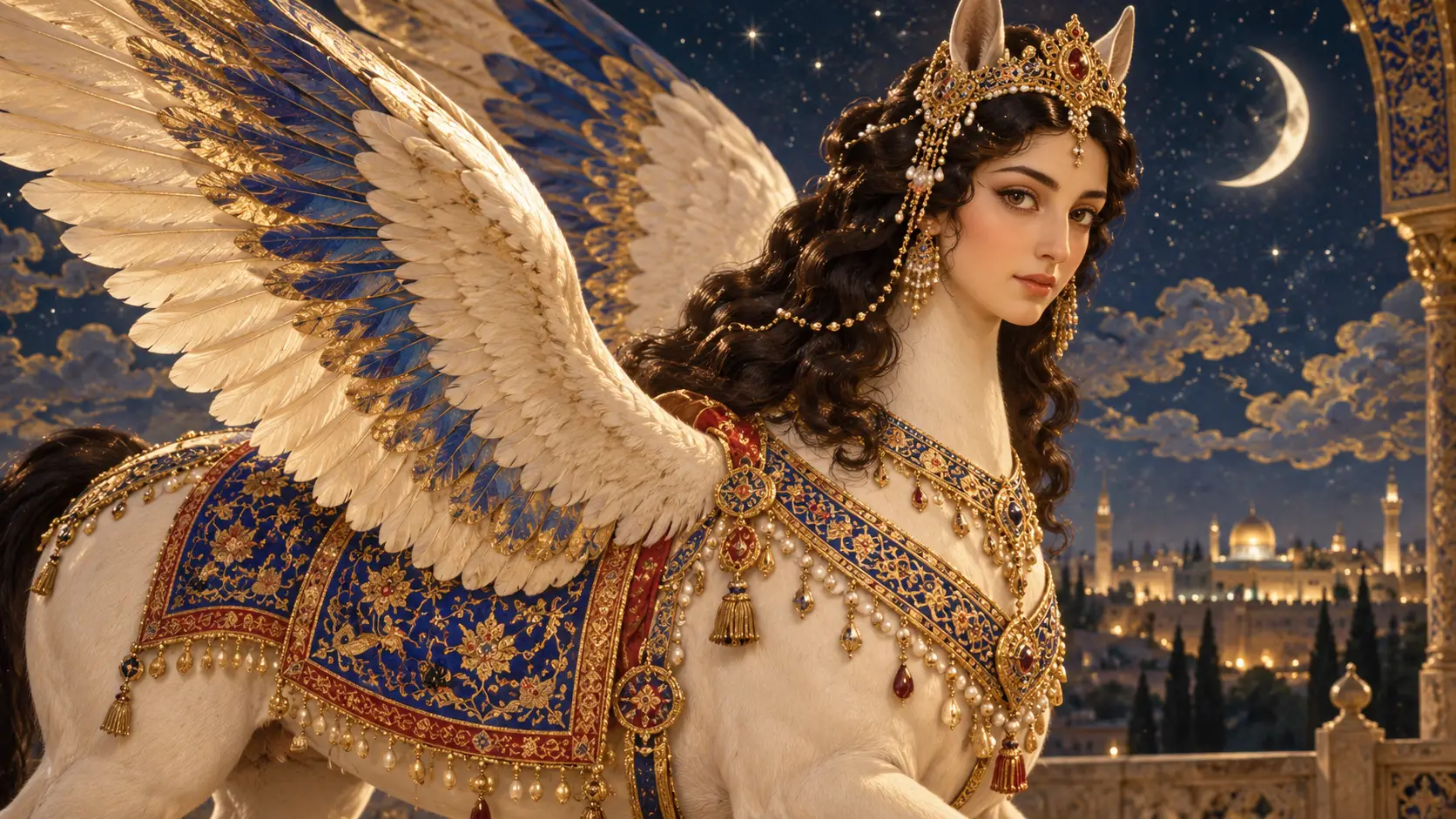
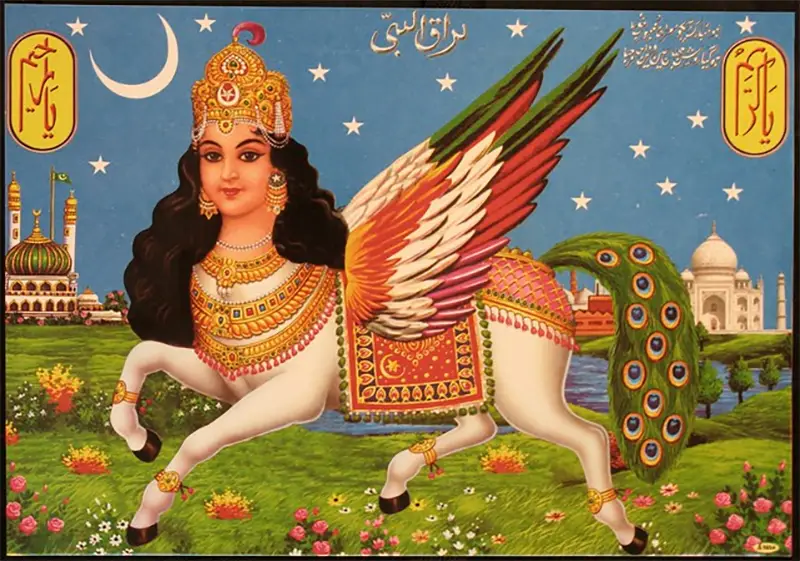
Individual artworks introduce further variation. A 1927 Iranian panel in the Metropolitan Museum of Art depicts Buraq with a horse’s body, a woman’s face, and a peacock-feathered tail.
The tail belongs to that documented visual form, rather than to the basic early description.
Two complementary approaches therefore remain useful: the text-led white mount with an immense stride, and the more elaborate composite creature of later art. Neither should erase the other.
Their differences reveal how a relatively brief narrative description acquired distinctive forms through artistic interpretation.
Background Story
Buraq’s narrative setting is a journey granted through divine initiative. Gabriel brings the mount to Muhammad, rather than Muhammad finding or capturing it.
Its function is to make the extraordinary passage possible, placing it within a sacred encounter rather than an animal-taming adventure.
The journey joins Mecca and Jerusalem within an Islamic understanding of prophetic history. Jerusalem is not merely a distant destination: it is a setting associated with earlier prophets.
Buraq’s movement between the two places supports a narrative of continuity between Muhammad and preceding messengers.
The tethering episode gives that continuity a concrete expression. In Ṣaḥīḥ Muslim, Muhammad secures Buraq to a ring used by the prophets before entering the sanctuary and praying.
An ordinary act of handling a mount thus accompanies an explicitly extraordinary and sacred journey.
The Night Journey and heavenly ascent are closely linked in many retellings, but they are distinguishable episodes. The ride to Jerusalem establishes Buraq’s clearest early role.
Accounts and interpretations differ in how they connect that terrestrial passage with the subsequent ascent through the heavens.
Those differences shaped the creature’s later presentation. Ascension imagery can place Buraq within a celestial scene beside Muhammad and Gabriel, making the mount a visible emblem of the combined journey.
Such imagery need not imply that every early account assigns it the same heavenly itinerary.
Buraq’s background is therefore best understood through scripture, transmitted prophetic narrative, and their later interpretation in art. Its defining significance is the miraculous conveyance of Muhammad between sacred places.
The tradition’s expanding visual vocabulary elaborates that role without replacing its early narrative foundation.
Famous Folklore Stories
Al-Buraq’s best-documented narratives belong to the Night Journey tradition, rather than a collection of independent animal folktales. The episodes below are versions of the same sacred journey.
Their headings are descriptive editorial labels, not authenticated titles of separate traditional tales.
The Night Journey with Gabriel
In Ibn Isḥāq’s biographical account, Gabriel brings Muhammad to Buraq and accompanies his journey from Mecca to Jerusalem. The mount is a white beast described through comparison with a mule and donkey, with two wings covering its hind legs.
The destination gives the journey its religious significance. At Jerusalem, Muhammad encounters earlier prophets and prays. Buraq’s role is to carry him into this encounter, linking the extraordinary journey with the continuity of prophetic revelation rather than undertaking an independent adventure.
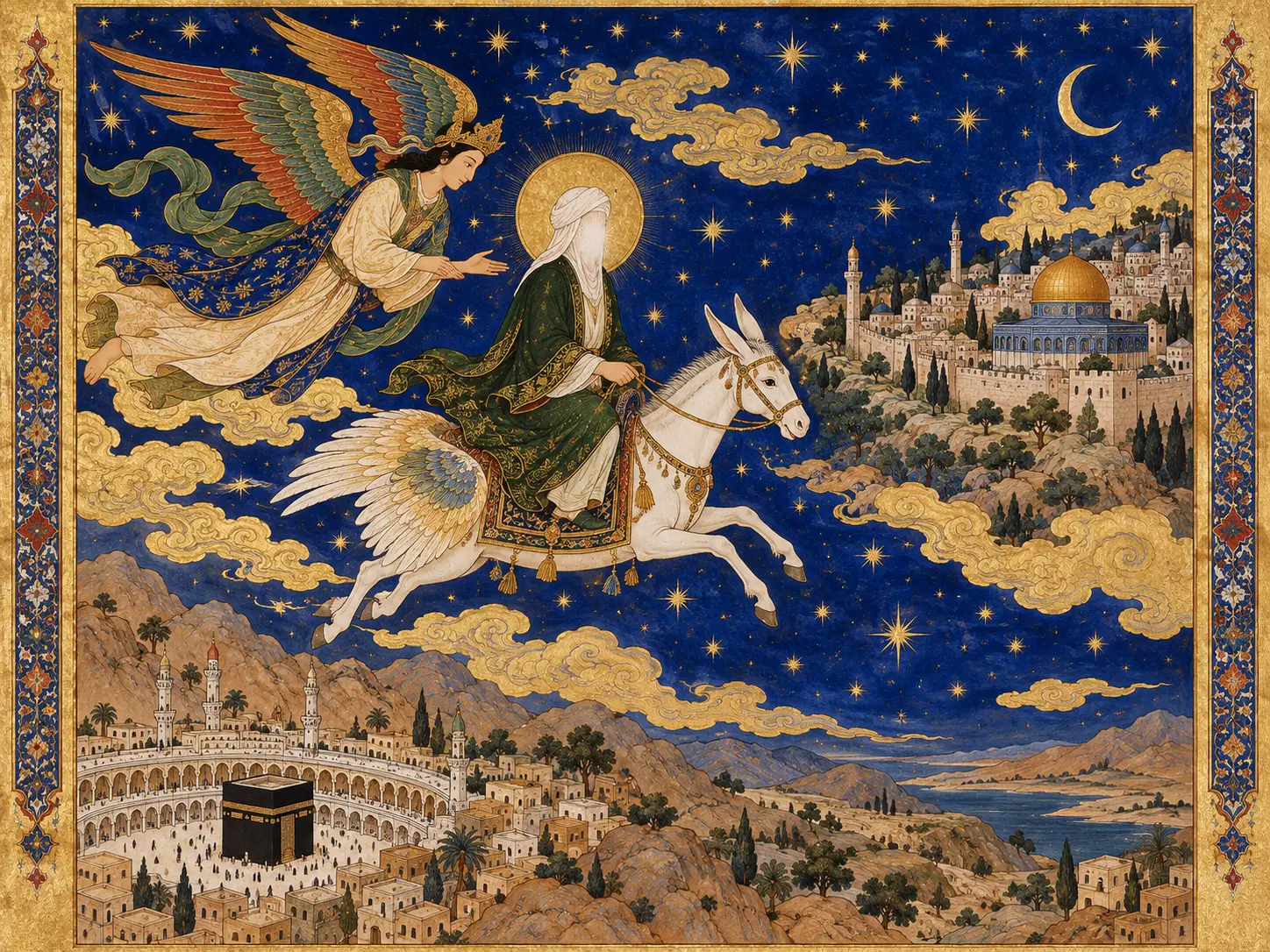
This version survives through the transmission of Ibn Isḥāq’s biography, particularly Ibn Hishām’s recension. Its winged description is an important early variant, but it does not supply the complete woman-faced, horse-bodied appearance familiar from later paintings.
Those visual details should not be inserted into this account.
The Ride and Tethering at Jerusalem
Ṣaḥīḥ Muslim 162a preserves another account of the ride. Muhammad receives a white animal larger than a donkey and smaller than a mule.
Its hoof reaches as far as its sight, making extraordinary movement, rather than elaborate anatomy, the defining supernatural feature.
After reaching Jerusalem, Muhammad tethers Buraq to a ring used by the prophets, enters the sanctuary, and prays. The tethering is a distinctive narrative detail: the miraculous mount participates in an otherwise recognizable sequence of arrival, securing a riding animal, and entering a place of worship.
The report subsequently recounts the heavenly ascent, but the ride to Jerusalem and the ascent should not automatically be treated as identical movements. Unlike Ibn Isḥāq’s description, this report does not specify wings.
Both versions establish Buraq’s role as a mount while preserving different descriptive details.
Cultural Impact
Buraq became a recognizable subject in Islamic manuscript painting because the mount could identify the Night Journey within a larger composition. Images placing Muhammad, Gabriel, and Buraq together turn the journey into a visible scene, linking its participants through their positions and movement.
In Persian artistic traditions, the creature often acquired a horse-like body, wings, and a human or woman’s face. This composite form gave painters a distinctive way to represent an extraordinary mount.
It should be understood as an influential visual convention, not a universal textual definition.
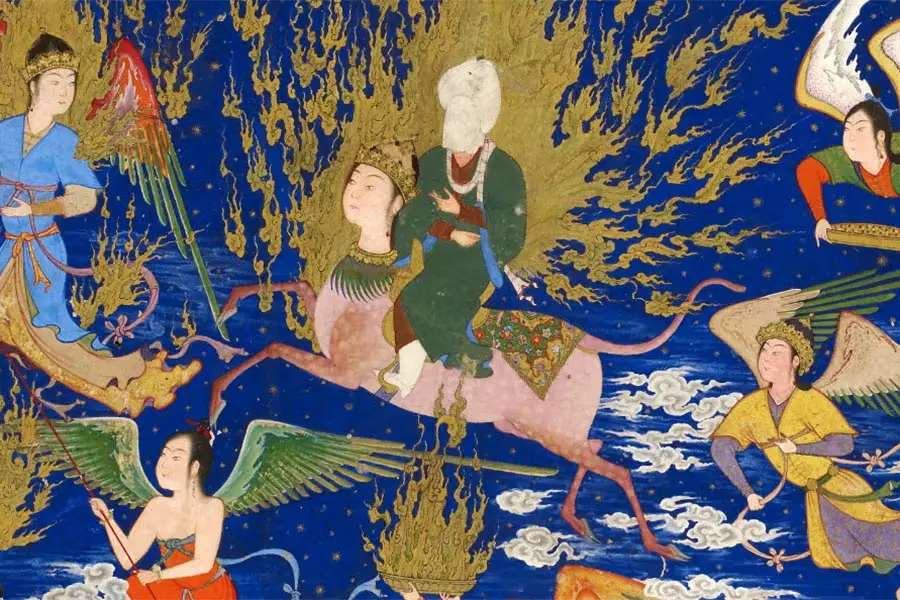
A manuscript image preserved at Harvard Art Museums depicts Muhammad riding Buraq with Gabriel. Such works demonstrate how the mount became part of ascension imagery as well as journey imagery, even where a particular written account distinguishes the ride to Jerusalem from the subsequent ascent.
Later devotional and popular art also allowed Buraq to appear as an identifiable subject in its own right. A 1927 Iranian panel in the Metropolitan Museum of Art gives it a horse’s body, a woman’s face, and a peacock-feathered tail, documenting one specific elaboration.
For modern historical interpretation, these objects reveal the creature’s changing representation rather than a single fixed appearance. Comparing manuscripts with later panels helps distinguish narrative continuity from artistic innovation: the association with Muhammad’s journey remains recognizable while bodily features and decorative details can change substantially.
Similar Beasts
Pegasus

Pegasus is the winged horse of Greek mythology, associated with heroic narratives and divine inspiration. Its recognizable equine body and wings make it a useful comparison in visual terms.
The resemblance concerns later winged depictions of Buraq, not an identical early description. Pegasus belongs to a separate tradition; visual similarity alone does not establish historical borrowing.
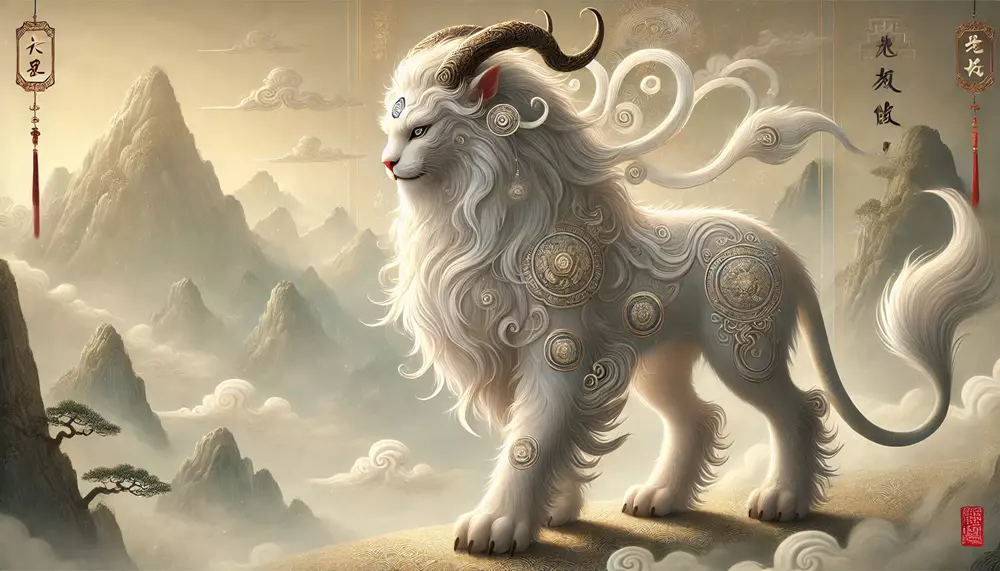
Qilin

The Qilin is an auspicious creature of East Asian tradition, often shown with a scaled, deer-like body, antlers, and a dragon-like head. It is associated with virtue and sages.
Its relevance is symbolic: both are extraordinary animals connected with religiously significant people. Unlike Buraq, the Qilin’s defining role is not carrying Muhammad on the Night Journey.
Haizum
Haizum is a separate horse associated with the angel Gabriel in some Islamic traditions. It offers a closer religious comparison than creatures drawn from unrelated mythological systems and settings.
Both figures connect supernatural riding animals with Islamic sacred narratives, but their identities differ. Haizum’s association with Gabriel does not make it another name for Muhammad’s mount, Buraq.
Religion/Ritual
Buraq belongs to the sacred narratives of the isrāʾ, the Night Journey, and the miʿrāj, the heavenly ascent. Its importance comes from service within Muhammad’s journey, not from an independent divine status.
The narrative places the mount within a setting of revelation, prophecy, and prayer.
The prayer at Jerusalem is an action within the account, not evidence of a ritual directed toward Buraq. The available sources establish no distinct Buraq-centered rite, offering, or taboo.
Narrative reverence and devotional representation should therefore be distinguished from worship of the creature itself.
Scientific or Rational Explanations
The evidence for Buraq consists of religious texts, transmitted narratives, and artworks, not zoological observations. Its extraordinary stride belongs to a miraculous account.
Treating the mount as an unidentified animal species would substitute a modern cryptid framework for the religious setting in which it is documented.
Historical analysis instead asks how the journey was narrated and how its versions relate. The Qur’anic passage concerning the Night Journey does not name Buraq; hadith and early biography provide the mount’s narrative details.
These different textual settings matter when reconstructing the development of the tradition.
Differences between versions are evidence of transmission, not grounds for combining every detail into one supposedly original description. The wings in Ibn Isḥāq’s account and their absence from Ṣaḥīḥ Muslim’s concise description should remain visible.
Neither difference warrants inventing a biological explanation for the animal.
Specialist discussion of the miʿrāj also examines interpretive differences concerning the journey and ascent. This historical approach does not require deciding whether a miracle occurred.
It investigates how religious narratives were connected, understood, and expanded, while keeping theological claims distinct from questions about textual development.
Art history provides another explanation for the familiar composite image: later painters developed recognizable conventions for a supernatural mount. A woman’s face or peacock-feathered tail documents a representational choice, not observed anatomy.
Reading each image within its artistic context avoids projecting later features backward into earlier reports.
Modern Cultural References
Contemporary representations of Buraq range from reinterpretations of Islamic miniature painting to sculpture, video, and narrative film. These works show the figure’s continuing creative relevance, but their imagery and themes should not be mistaken for descriptions shared by every religious account.
The Night Journey, contemporary artwork and exhibition
Haroon Mirza’s work draws inspiration from an Indian miniature painting. Its connection to Buraq comes through the depicted journey of Muhammad, reinterpreted within contemporary artistic practice.
(exhibitions.asianart.org)
Buraq, film/video artwork (2014)
Mohamed Sabsabi’s video work explores religious and local cultural practices. Buraq provides an analogy connecting its contemporary subject matter with the extraordinary journey associated with the mount.
(assets.museummacan.org)
al-Buraq resting in the wood of the suicides, artwork (2023)
Safdar Ahmed’s painting places al-Buraq within a scene from Dante’s Divine Comedy.
This encounter brings the Islamic mount into a literary setting outside its traditional sacred narrative.
(safdarahmed.com)
The Buraq That Can’t Fly, short film (2024)
Written and directed by Zeed, this short film incorporates tales of the mythical Buraq.
Its documented festival premiere establishes a released narrative interpretation, rather than an announced project.
(filmfreeway.com)
‘Alburaq’, lantern artwork (1997)
Jennifer Oram’s lantern depicts al-Buraq and is documented by the Sierra Leone National Museum.
It provides a specific example of the figure’s representation through a crafted object.
(artsandculture.google.com)
Buraq, sculpture (2020)
Abdul-Rahman Abdullah’s sculpture uses painted wood and silk petals. The work explicitly takes Buraq as its subject, extending the mount’s artistic reception into a contemporary three-dimensional form.
(arts.unimelb.edu.au)
Conclusion
Al-Buraq is best understood as the extraordinary mount of Muhammad’s Night Journey, rooted in Islamic sacred narrative rather than a generic category of winged horses. Its defining role is to carry the Prophet to Jerusalem through a journey beyond ordinary human limits.
Early descriptions emphasize a white animal, intermediate in size between donkey and mule, with an immense stride. Wings appear in some transmitted accounts, while the familiar human-faced, horse-like form belongs especially to the figure’s evolving artistic history.
The distinction between narrative and image strengthens, rather than diminishes, Buraq’s cultural importance. Different texts and artworks preserve different ways of expressing an extraordinary journey, without requiring one universal anatomy.
Manuscript painting, later devotional imagery, and contemporary creative works demonstrate the mount’s lasting capacity to inspire visual interpretation. Its symbolic force remains inseparable from the sacred journey it serves: movement beyond ordinary distance, the connection between earthly places and heavenly experience, and the portrayal of an event understood within faith.
Further Reading
Ṣaḥīḥ Muslim 162a, Sunnah.com
A hadith account describing Buraq as a white animal between donkey and mule in size, with an extraordinary stride, ridden to Jerusalem and tethered there.
Source
Sīrat Rasūl Allāh, Ibn Isḥāq, translated by A. Guillaume, Emaan Library
An English translation of the early prophetic biography, preserving a Night Journey account with Buraq’s winged description and Muhammad’s journey with Gabriel to Jerusalem.
Source
Meʿrāj i. Definition, Encyclopaedia Iranica
Specialist discussion of the heavenly ascent tradition, its development and interpretation, and competing proposals concerning Buraq’s name.
Useful for distinguishing conventional etymology from established linguistic conclusions.
Source
The Prophet’s Ascent to Heaven, Harvard Art Museums
A manuscript image depicting Muhammad riding Buraq with Gabriel. The collection record supplies object and publication context for studying the mount’s place in Islamic ascension imagery.
Source
Image of a Buraq, The Metropolitan Museum of Art
A 1927 Iranian panel depicting Buraq with a horse’s body, a woman’s face, and a peacock-feathered tail, documenting a specific later artistic form rather than universal anatomy.
Source
Haroon Mirza: The Night Journey, Asian Art Museum
Exhibition documentation for a contemporary artwork inspired by an Indian miniature depicting Muhammad’s Night Journey on Buraq.
Relevant to the mount’s modern artistic reception, not its earliest description.
Source