Introduction
A monster large enough to swallow a village, a man-eating creature with eyes in its feet, a forest predator waiting above a hunter’s head, and a river deity powerful enough to challenge the construction of a dam. These are just a few of the extraordinary beings found in African folklore.
Across sub-Saharan Africa, communities have preserved stories about supernatural creatures through oral storytelling, songs, religious traditions, historical accounts, and later written collections. Some monsters challenge legendary heroes, while others inhabit dangerous forests, rivers, mountains, and places associated with invisible spiritual forces.
The creatures also differ considerably in their relationship with people. A swallowing monster may imprison an entire community until a remarkable child defeats it.
A witch spirit may cause illness without ever appearing as a recognizable monster. A river deity may protect the people who depend upon its waters while threatening those who disturb its domain.
These stories belong to many distinct cultural worlds, including Basotho, Nyanga, Akan, Ewe, Khoekhoe, Zulu, Tonga, and Ethiopian traditions. Their beliefs, characters, and histories cannot be reduced to one African mythology.
The following twelve beings reveal a fascinating range of monsters, encounters, supernatural powers, and traditions, from centuries-old recorded folktales to more recent legends transformed by exploration and popular culture.
Kholumolumo: The Monster That Swallowed a Community
Tradition / Cultural origin: Basotho and related Sotho-speaking traditions, southern Africa.
Recorded period: Nineteenth-century collections, including Eugène Casalis’s The Basutos (1861).
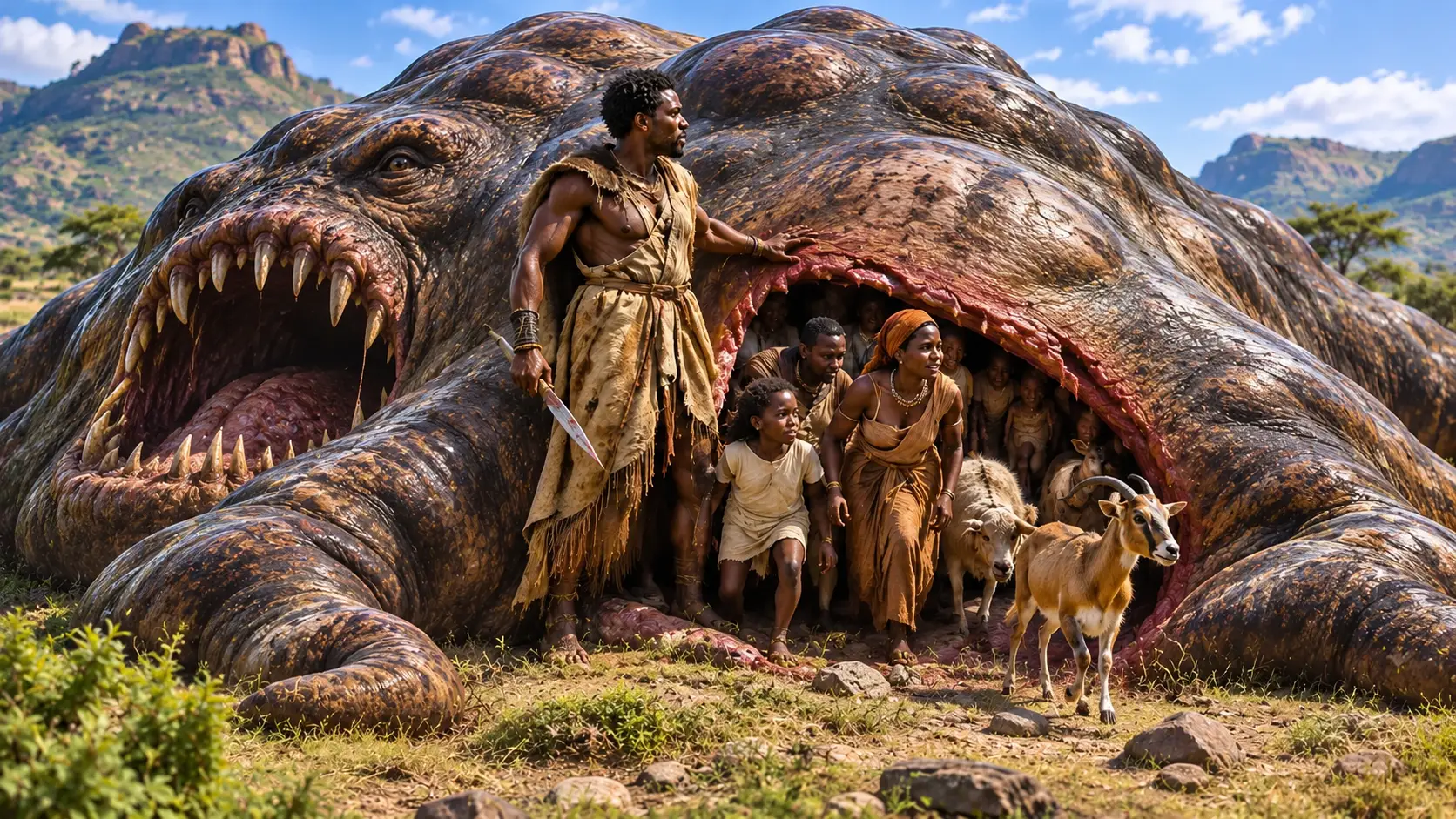
Appearance: An enormous, shapeless creature, sometimes described as mountain-sized, with a mouth and stomach capable of swallowing entire settlements.
The beast and its stories
Kholumolumo, also recorded as Khodumodumo or Kammapa, is one of the great swallowing monsters of southern African folklore. Its appetite is so extraordinary that whole villages disappear inside it, together with their livestock and possessions.
In a Basotho telling reproduced by Alice Werner, a woman survives when the creature devours the inhabitants of her valley. She gives birth to a remarkable son who grows with supernatural speed.
The boy, called Ditaolane in this version, learns what happened and confronts the enormous monster. He avoids its open mouth, drives spears into its body, and kills it.
Cutting open the monster becomes another challenge. Voices from inside warn him to avoid injuring the people and animals imprisoned there. Eventually, he frees the entire population.
Meaning and cultural context
The villagers celebrate Ditaolane and choose him as their chief, but his extraordinary birth and powers eventually provoke suspicion. One man accidentally wounded during the rescue helps turn the community against its savior.
Werner records an ending in which repeated attempts to murder Ditaolane fail until he allows his enemies to kill him. Other versions describe an escape through transformation, including becoming a stone.
The story therefore goes beyond defeating a monster. It also examines a community’s uneasy relationship with someone whose supernatural abilities have saved its people.
Five interesting facts
- Several names: Khodumodumo, Kholumolumo, and Kammapa occur in related traditions, although their exact use and spelling vary between collectors and tellings.
- An unusual hero: Ditaolane’s name is associated with divining bones; Moshanyana, another designation in recorded variants, simply means a little boy.
- A living stomach: The monster’s victims remain alive inside it, making rescue possible even after entire settlements have apparently been destroyed.
- Different methods: In some versions the hero kills the creature from outside; another recorded telling has him cut his way through its interior.
- A bitter ending: One narrative has Ditaolane’s heart escape as a bird after his death, while another features a protective ox that warns him.
Kirimu: The Dragon of the Mwindo Epic
Tradition / Cultural origin: Nyanga (Banyanga), eastern Democratic Republic of the Congo.
Recorded period: Documented in the twentieth-century Mwindo Epic, published by Daniel Biebuyck and Kahombo C. Mateene in 1969.
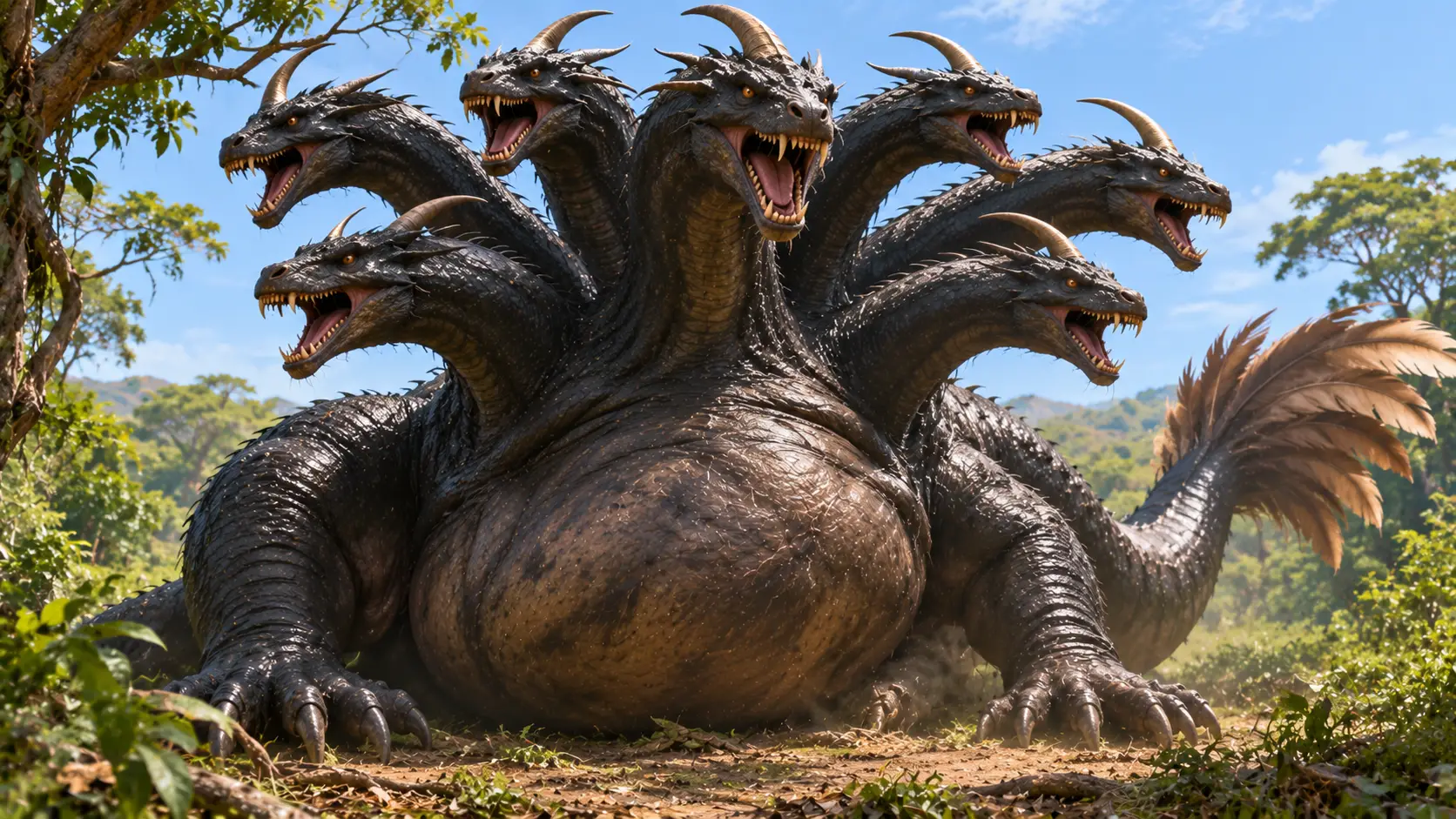
Appearance: A gigantic, black-hided forest monster with seven horned heads, seven eyes, doglike teeth, an enormous swollen belly, and an eagle’s tail.
The beast and its stories
Kirimu belongs to the Nyanga epic of Mwindo, a heroic narrative containing magical objects, supernatural battles, family conflict, and encounters with powerful beings.
The monster appears during a hunting expedition undertaken by Mwindo’s people. Kirimu swallows the hunters, leaving a survivor named Nkurongo to carry news of the disaster.
Mwindo confronts the creature using his magical conga-scepter and a song of defiance. After overpowering Kirimu, he has its enormous body carried back to the village.
The monster is cut apart, releasing people who have remained trapped inside. Its eyes produce an even stranger result: when roasted, they burst open, releasing additional people, ultimately numbering a thousand.
Meaning and cultural context
Kirimu’s destruction should be understood within the larger Mwindo epic, rather than as an isolated dragon-slaying adventure. Mwindo has already demonstrated remarkable powers, but his conduct still attracts supernatural judgment.
Nkuba, the being associated with lightning, has made a blood pact with Kirimu. The dragon’s death brings Mwindo into conflict with this powerful ally of his defeated enemy.
Nkuba carries Mwindo into the sky, where the hero experiences suffering and learns that his strength does not place him beyond responsibility or restraint.
The episode forms part of an oral epic traditionally performed through narration, song, and dramatic expression, not merely a collection of monster encounters.
Five interesting facts
- An epic creature: Kirimu is a significant opponent within a continuous Nyanga heroic narrative, rather than a monster known solely through a brief standalone legend.
- The surviving witness: Nkurongo escapes the attack and delivers the news that brings Mwindo into the confrontation.
- The magical scepter: Mwindo’s conga is a recurring supernatural instrument in the epic, important in several adventures beyond his battle with Kirimu.
- The extraordinary eyes: The bursting eyes release a thousand people, an unusual multiplication motif not shared by every African swallowing-monster story.
- An unexpected consequence: Kirimu’s relationship with Nkuba turns the apparent conclusion of a monster-slaying adventure into another trial for the victorious hero.
Asanbosam: The Predator Waiting in the Trees
Tradition / Cultural origin: Akan peoples, including Asante communities of present-day Ghana.
Recorded period: Nineteenth-century descriptions, with important accounts in R. S. Rattray’s publications of 1916 and 1930.
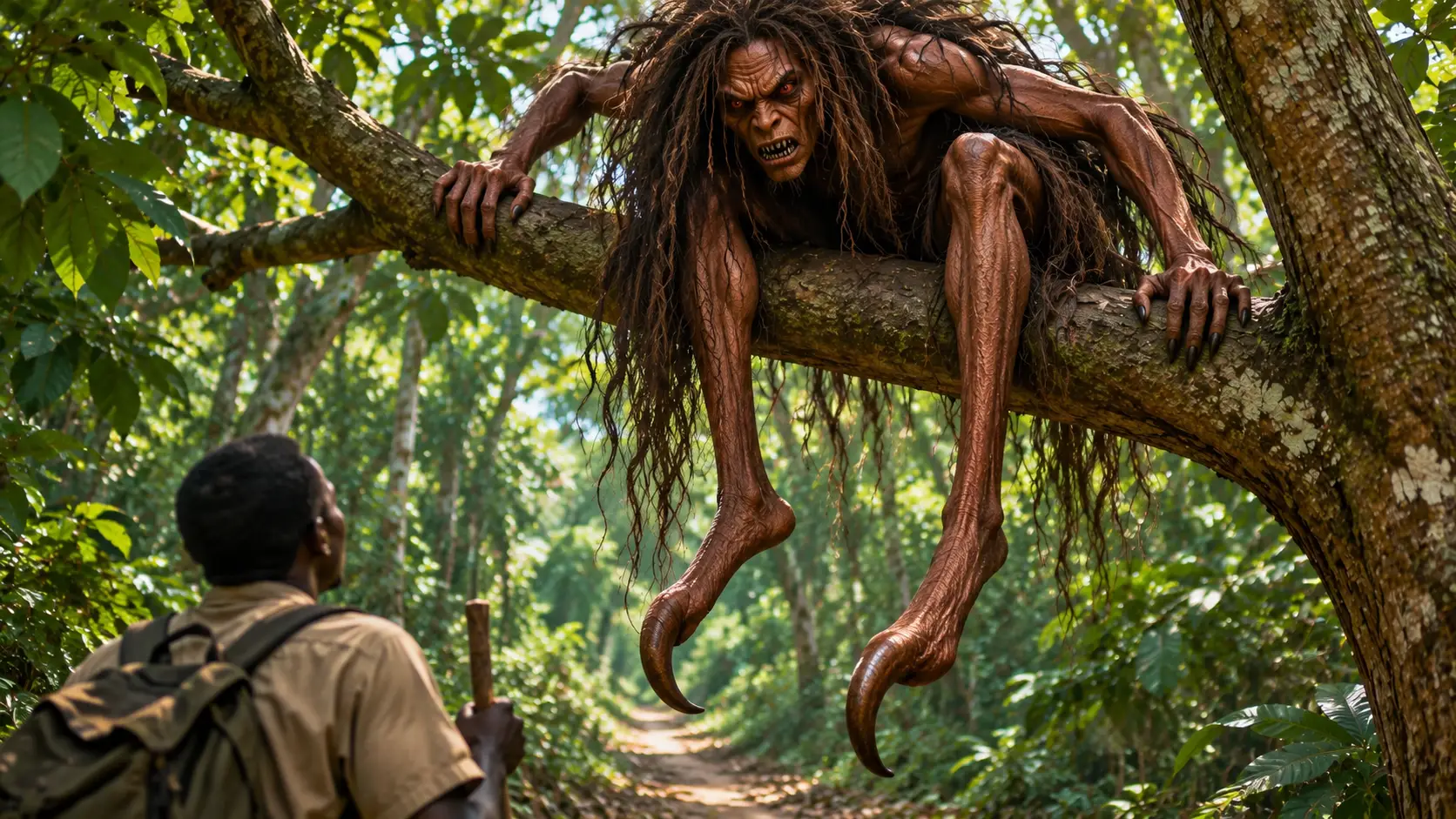
Appearance: A gigantic, reddish, long-haired humanoid with bloodshot eyes, iron teeth, extraordinarily long legs, and hooked feet used to seize travelers beneath forest trees.
The being and its stories
Asanbosam, closely associated with the name Sasabonsam, inhabits the dense forests of Akan folklore. Unlike a monster that pursues people along the ground, it threatens them from the treetops.
Rattray describes a being that waits in the forest with its long legs hanging from branches. Its hooked feet can catch a person passing underneath, allowing it to seize unsuspecting victims.
One recorded folktale concerns a hunter gathering kola nuts. A Sasabonsam confronts him and demands to know who has taken the nuts from its tree.
The hunter asks permission to summon his dogs before the creature attacks. When the animals arrive, they overcome and devour the threatening forest being.
Meaning and cultural context
This encounter offers a particularly interesting variation on the monster story. The hunter does not defeat Sasabonsam by possessing greater supernatural power. He survives by calling upon familiar companions.
Sasabonsam also appears in wider Akan discussions of dangerous forest beings, witchcraft, and supernatural threats. Its association with remote woodland makes location especially important to its identity.
Later illustrations frequently present Asanbosam as a bat-winged vampire. Some such portrayals combine details from different modern descriptions, while the earlier accounts emphasize the creature’s forest dwelling and peculiar body.
The original stories place the danger among hunters, trees, and the unpredictable inhabitants of the forest, rather than within the conventions of European vampire folklore.
Five interesting facts
- Forest habitation: Earlier descriptions associate Sasabonsam with deep woodland, particularly large trees far from ordinary settlements.
- Iron teeth: Iron teeth appear in influential recorded descriptions, although the creature’s full anatomy is not identical in every account.
- A family of beings: Rattray records male, female, and young Sasabonsam, rather than describing a single unique monster.
- The hunter’s helpers: The kola-nut tale gives the hunter four dogs with distinctive descriptive names connected to their actions and abilities.
- The vampire comparison: Modern adaptations often emphasize blood-feeding and wings, but these features should not be treated as a universal traditional description.
Adze: The Supernatural Intruder of Ewe Folklore
Tradition / Cultural origin: Ewe communities of Ghana and Togo.
Recorded period: Documented in Jakob Spieth’s Ewe collections from 1906 and 1911 and in later ethnographic accounts.
Appearance: A luminous nocturnal spirit, sometimes appearing like a large firefly or glowing insect, with the ability to assume human form.

The being and its stories
The Adze is associated with Ewe beliefs concerning witch spirits, supernatural harm, and dangers that may enter ordinary human life without revealing their presence.
One recorded account, preserved in Spieth’s collection, describes an unusual light resembling a powerful firefly. Someone manages to capture the luminous being in a closed hand.
Inside the hand, the light becomes a human figure. The captured being offers cowries and asks that the encounter remain secret.
The money is connected to the keeping of that secret.
Other accounts describe Adze as a harmful spirit active at night, attacking people through blood-sucking or the removal of a person’s shadow or soul.
Meaning and cultural context
The Adze differs considerably from a conventional undead vampire. The Ewe material concerns spiritual agency, including witch spirits associated with living people, rather than necessarily describing a reanimated corpse.
In a 1935 ethnographic account, B. Foli explains beliefs about spirits leaving human bodies at night and harming others. Fire, unnatural movement, blood, and the soul all appear in the descriptions.
These traditions connect supernatural danger with concerns about sickness, secrecy, and the possibility that a harmful spiritual agent might be associated with someone living nearby.
Modern monster literature frequently reduces the Adze to a firefly-shaped vampire. That captures one memorable image but leaves out the wider religious and social setting.
Five interesting facts
- Different spellings: Adzé and azé appear in Ewe records, reflecting regional or dialectal differences rather than necessarily describing separate beings.
- Night-fire: Spieth’s material associates the luminous appearance with a term meaning night-fire, emphasizing brightness rather than ordinary insect anatomy.
- A captured spirit: In one story, capturing the glowing apparition reveals a human figure, connecting the supernatural encounter with human identity.
- More than blood: Some documented beliefs include the removal of a person’s shadow or soul, not simply physical blood-feeding.
- Social consequences: Accusations of witchcraft could affect real people, so historical descriptions of supposed supernatural guilt should be distinguished from actual human conduct.
Read more: Adze
Aigamuxa: The Man-Eater with Eyes in Its Feet
Tradition / Cultural origin: Khoekhoe, particularly Nama traditions of southern Africa.
Recorded period: Narratives collected by Leonhard Schultze during 1903-1905 and published in Aus Namaland und Kalahari (1907).
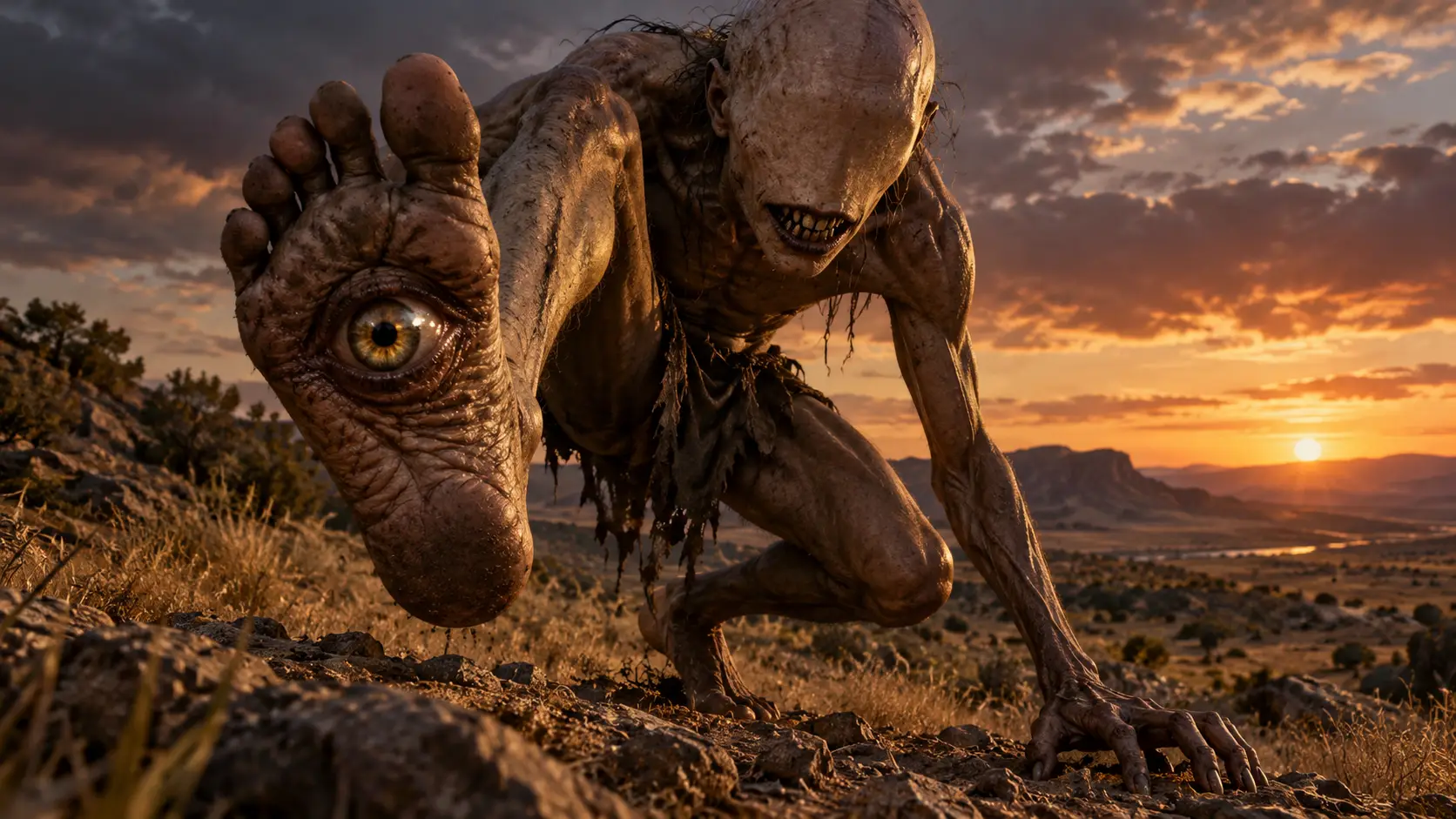
Appearance: A humanlike, man-eating being whose eyes occupy its feet rather than its face, sometimes accompanied by unusually long teeth.
The being and its stories
The Aigamuxa, also called Aigamuchab, is remarkable for its extraordinary anatomy. Its eyes are located on its feet, creating an unusual disadvantage for a creature that hunts human beings.
In one recorded Nama story, Jackal shares a meal with an Aigamuxa. Jackal notices that his companion can identify the best pieces of meat despite apparently lacking eyes in its face.
The explanation becomes clear when Jackal discovers the eyes near the creature’s feet. He persuades the Aigamuxa to prepare a pipe, then scatters tobacco into its eyes.
With the monster temporarily unable to see, Jackal escapes. The encounter turns a frightening physical characteristic into a practical weakness that a clever opponent can exploit.
Meaning and cultural context
Schultze’s collection preserves several narratives involving these beings. Their humanlike appearance makes encounters especially dangerous because their extraordinary anatomy may not be immediately obvious.
Other stories describe people escaping through deception, including a girl who leaves a stone beneath her bedding to mislead a threatening household.
The Aigamuxa belongs within a wider Khoekhoe storytelling world in which Jackal frequently succeeds against more physically powerful opponents through observation and trickery.
Its unusual vision is not simply decorative. The placement of the eyes determines how it perceives its surroundings and how its intended victims can escape.
Five interesting facts
- Name variations: Aigamuxa and Aigamuchab represent recorded variations of the name, with different spellings appearing in modern references.
- Unusual vision: Depending on the description, its eyes are placed on the insteps or other surfaces of the feet, rather than beneath a normal human face.
- A dangerous meal: The Jackal narrative uses the selection of meat to reveal the creature’s hidden anatomical peculiarity.
- A pipe as a weapon: Tobacco, rather than a spear or blade, supplies the trick that allows Jackal to escape in the recorded episode.
- Other escape stories: Schultze’s collection includes further encounters involving deceptive substitutions, pursuit, and household situations in which a victim discovers the danger.
Ga-gorib: The Deadly Challenge Beside the Pit
Tradition / Cultural origin: Khoekhoe traditions, particularly Nama-speaking communities of southern Africa.
Recorded period: Nineteenth-century accounts, including material collected by Theophilus Hahn and published in Tsuni-Goam (1881).
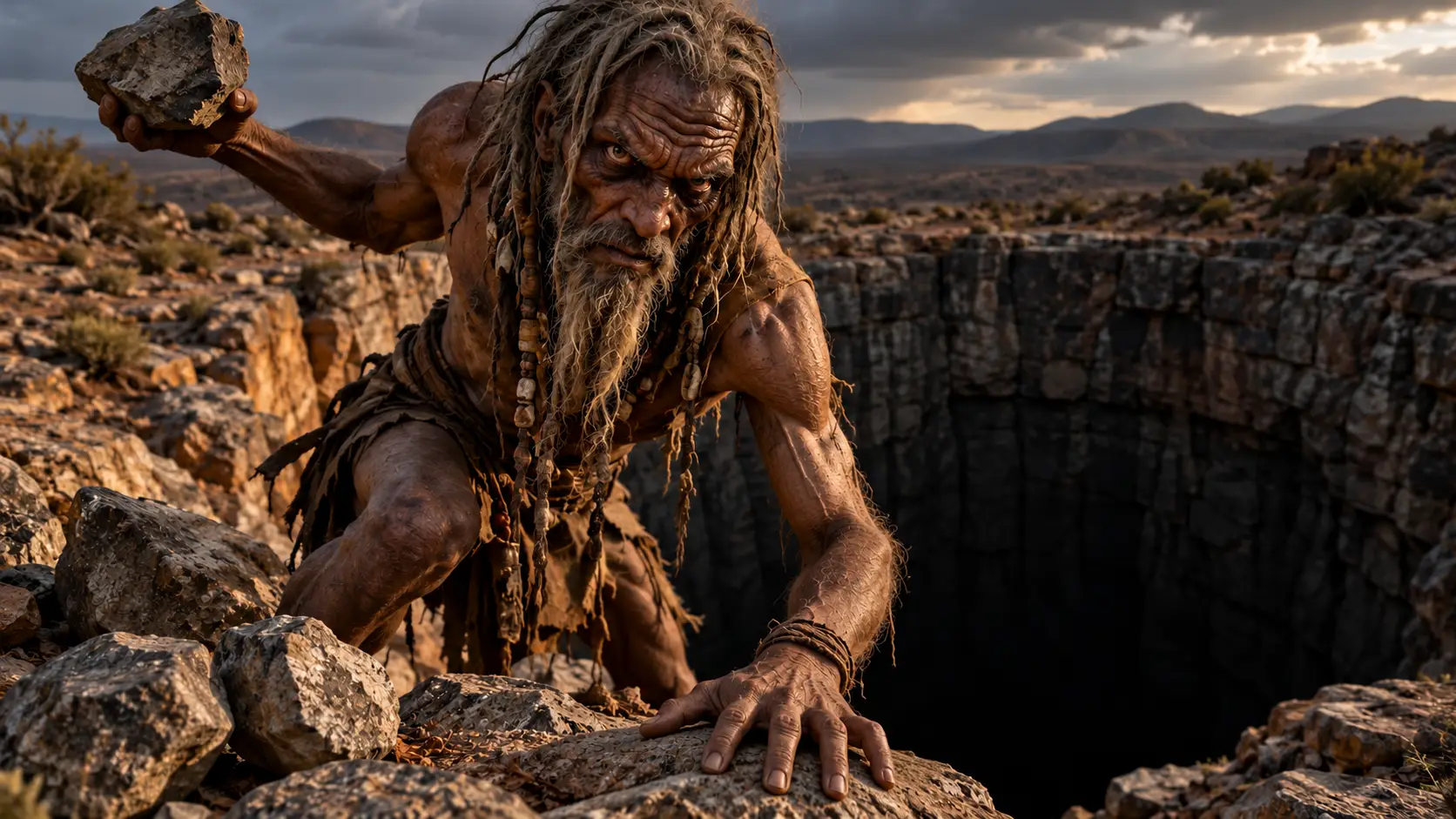
Appearance: A dangerous humanlike adversary associated with a deep pit, a deadly challenge, and, in one variant, stones that rebound against attackers.
The being and its stories
Ga-gorib, also recorded as Gama-gorib, appears in traditions concerning the powerful hero Heitsi-eibib. The encounter takes place beside a pit into which the adversary sends those who challenge him.
One telling collected by Hahn describes Heitsi-eibib traveling to discover why his people have disappeared. Ga-gorib sends Hare to summon him after he passes without offering a greeting.
When the two finally meet, Ga-gorib challenges the hero to a game. He throws Heitsi-eibib into the pit twice, but each time the hero calls upon the ancestral hole to raise its bottom.
During the third contest, Heitsi-eibib strikes Ga-gorib behind the ear and throws him into the pit, where the dangerous challenger dies.
Meaning and cultural context
Other recorded versions feature a different challenge: the adversary invites travelers to throw a stone at his forehead, only for it to rebound and kill them.
In Hahn’s extended narrative, a second opponent, Hau-gai-gaib, also uses this deadly stone challenge. The variants should therefore be distinguished rather than presented as one identical encounter.
The longer narrative connects Heitsi-eibib’s victory with the recovery of people and his subsequent confrontations with other enemies.
The story gives unusual importance to knowledge and careful judgment. Heitsi-eibib succeeds because he understands the danger of the challenge and finds a way around its intended result.
Five interesting facts
- The pit: Ga-gorib’s victims are thrown into a hole, creating a recurring image of travelers disappearing beneath the ground.
- Hare the messenger: In Hahn’s version, Hare repeatedly summons Heitsi-eibib and later receives a curse that explains aspects of its behavior.
- Three contests: The hero escapes the pit twice before defeating Ga-gorib during their third encounter.
- Different challenges: Some tellings emphasize the rebounding stone, while another places the stone trick with a separate enemy encountered afterward.
- An ancestral helper: In the wrestling version, the pit itself responds to Heitsi-eibib’s appeal, helping him survive an otherwise fatal fall.
Isiququmadevu: The Monster of the Forbidden River
Tradition / Cultural origin: Zulu oral traditions, southern Africa.
Recorded period: Documented in Henry Callaway’s Nursery Tales, Traditions, and Histories of the Zulus (1868).
Appearance: A bloated, squatting, bearded monster, presented as female in the Untombinde narrative and capable of swallowing entire communities.
The beast and its stories
Isiququmadevu is a swallowing monster featured in recorded Zulu narratives, including the tale of Untombinde, where an encounter at a forbidden river threatens an entire community.
In the tale of Untombinde, a chief’s daughter accompanies other girls to the river Ilulange despite warnings that those who enter its domain do not return.
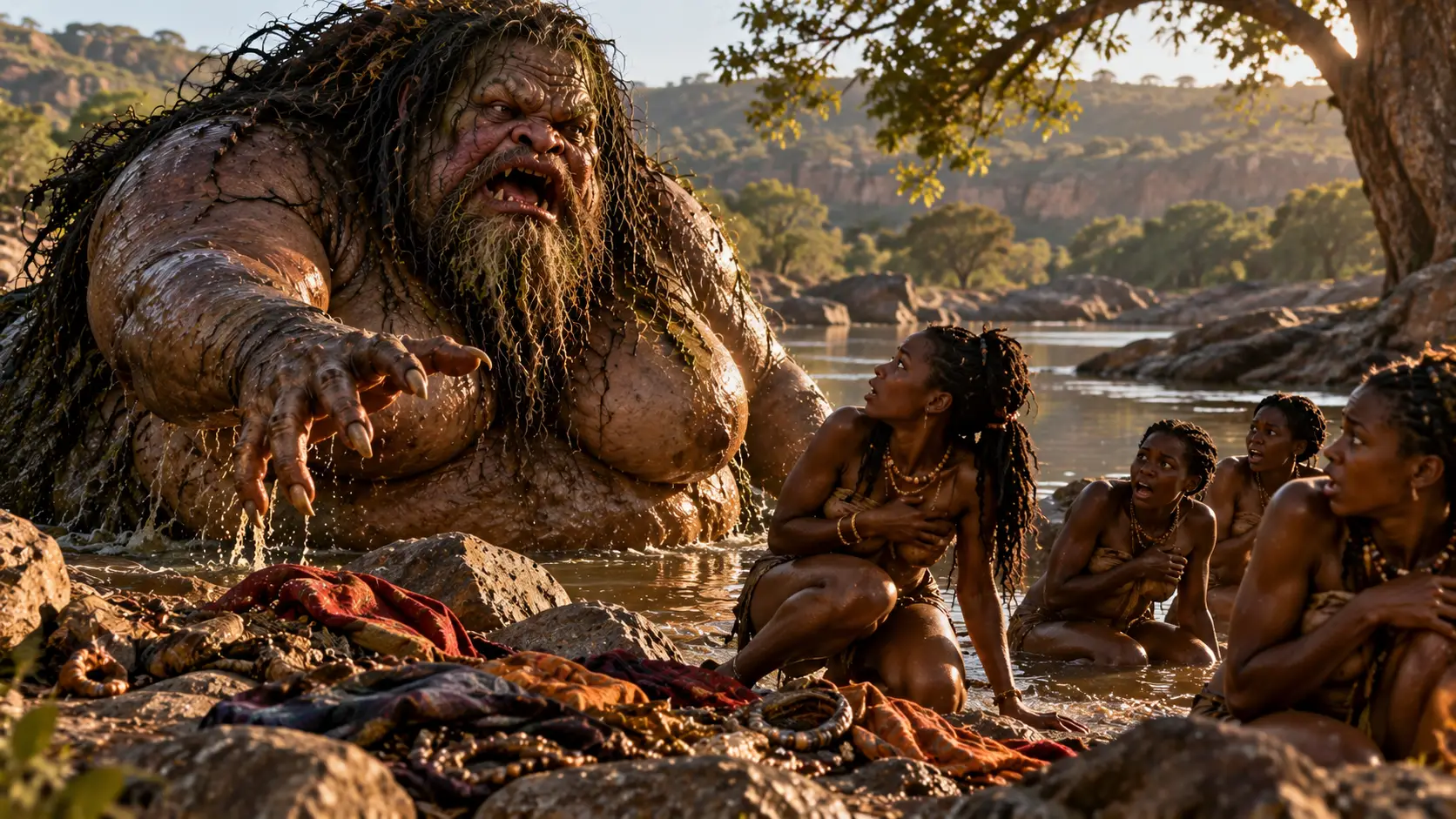
After bathing, the girls discover that their clothing and ornaments have disappeared. The others beg the monster to return their possessions, but Untombinde refuses to plead and is dragged away.
Warriors sent to investigate are swallowed. The creature then devours the surrounding population, including cattle and dogs, before a father searching for his children eventually tracks it down.
The father receives directions from buffaloes, leopards, and an elephant. When he finally confronts Isiququmadevu, the monster attempts to send him onward rather than admit its identity.
He recognizes the deception, stabs the creature, and releases its victims. Untombinde emerges among the survivors and returns home, completing the rescue after the community’s disappearance.
Meaning and cultural context
The rescue depends on the swallowed victims remaining alive inside the monster. Its defeat therefore restores the community rather than simply avenging those it has consumed.
Another recorded tale, Usitungusobenhle, also features the monster, but a girl becomes the rescuer. The comparison shows that the swallowing-monster motif does not require a single heroic role.
In Untombinde’s story, animal guides and the father’s recognition of deception help bring about the rescue. These details make knowledge and assistance important alongside physical force.
Zulu trickster Uhlakanyana also encounters cannibals, but his deception involving an ogre’s mother belongs to a separate recorded tale, not Untombinde’s confrontation with Isiququmadevu.
Five interesting facts
- An unusual name: Callaway explains Isiququmadevu as a bloated, squatting, bearded monster, a description distinct from ordinary animal anatomy.
- A forbidden river: The Ilulange of the Untombinde story is presented as a place from which people do not return.
- A female monster: The Untombinde narrative treats the bearded swallowing being as female.
- Different rescuers: Untombinde’s story features a father searching for his children; another tale gives the decisive role to a girl.
- The trickster distinction: Uhlakanyana’s separate cannibal encounters include cooking an old woman and wearing her clothing. This episode is not an exploit of Isiququmadevu.
Kongamato: The Winged Terror of the Wetlands
Tradition / Cultural origin: Accounts collected among Kaonde-speaking communities of present-day Zambia.
Recorded period: Described by Frank Hulme Melland in In Witch-Bound Africa (1923).
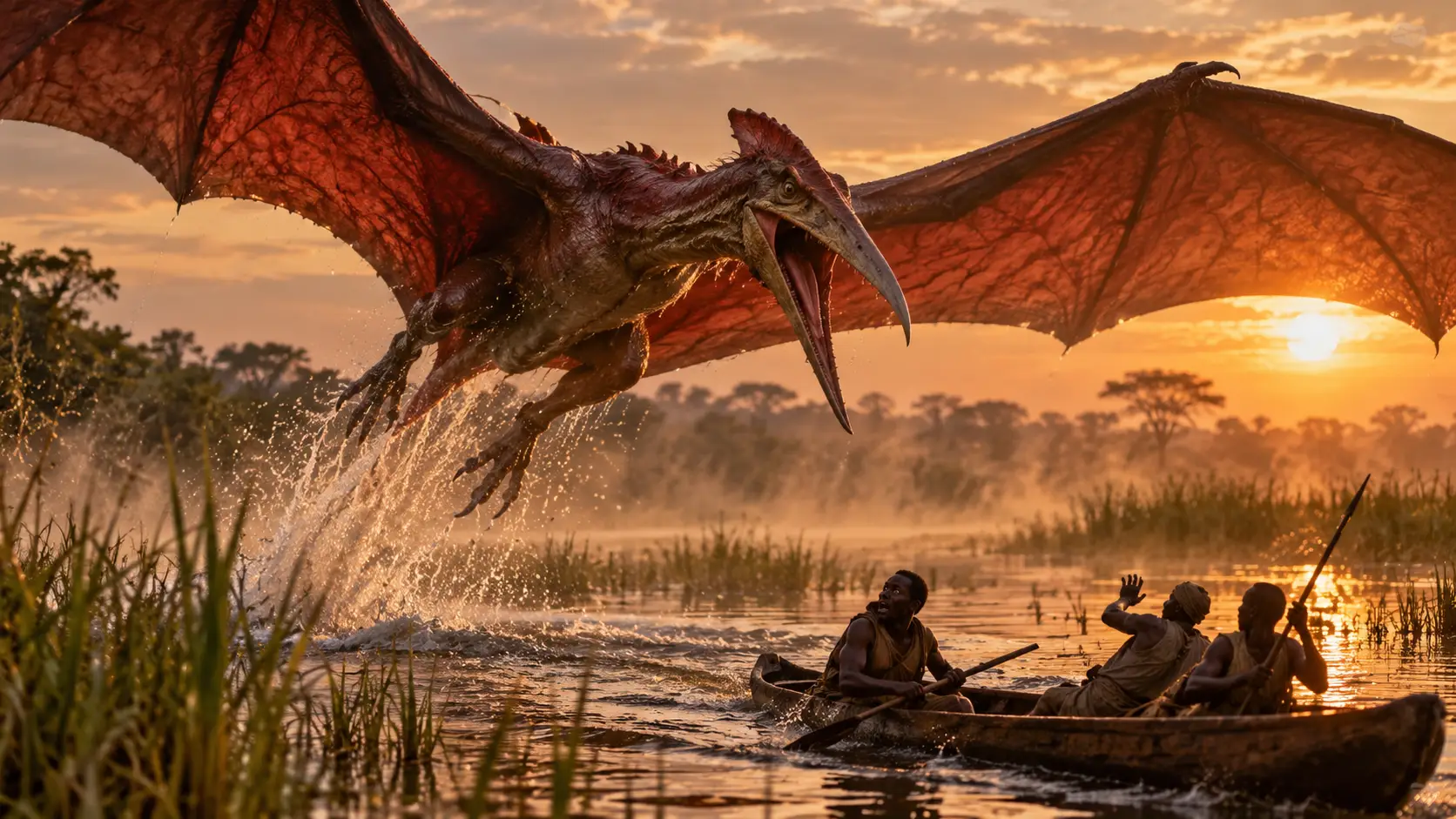
Appearance: A frightening flying creature with membranous wings, a reddish body, a beaklike mouth, and a reptilian rather than feathered appearance.
The beast and its stories
Kongamato became widely known through the writings of Frank H. Melland, who collected accounts concerning a dangerous winged being associated with river crossings and swampy country.
The creature was particularly feared around the Jiundu region, where waterways and flooded channels made travel hazardous. Its name was associated with the overturning or overwhelming of boats.
Melland recorded descriptions of something resembling a bird but possessing reptilian characteristics, including skin-covered wings rather than feathers. Reported wingspans ranged from approximately four to seven feet.
When Melland showed illustrations of prehistoric flying reptiles to local informants, they reportedly identified the pictures as resembling Kongamato. This encounter helped establish the creature’s later association with pterosaurs.
Meaning and cultural context
The accounts concerned more than sightings of an unusual flying animal. They also described protective measures taken when approaching dangerous water.
Melland recorded a charm involving the mulendi plant. Travelers used its roots and water in a protective procedure intended to guard against Kongamato during river crossings.
He also mentioned drownings attributed to the creature, although those accounts did not provide a witnessed attack that could establish what caused the deaths.
Later cryptozoological literature interpreted Kongamato as a possible surviving prehistoric reptile. That interpretation belongs to the history of modern monster investigation, not to evidence of a living pterosaur.
Five interesting facts
- The uncertain name: Melland tentatively interpreted Kongamato as meaning something like an overturner of boats, without claiming complete linguistic certainty.
- No feathers: Informants distinguished the creature from an ordinary bird by its leathery, membranous wings.
- A protective plant: The mulendi-root charm was connected with safe passage through rivers and flooded terrain.
- A historical report: Melland recorded drownings attributed to Kongamato in 1911, while acknowledging the absence of a clear witnessed attack.
- The dinosaur connection: Pterosaur illustrations became influential after Melland’s identification exercise, although the resemblance did not establish the creature’s zoological identity.
Read more: Kongamato
Mokele-mbembe: The Mystery of the Congo Basin
Tradition / Cultural origin: Congo Basin accounts, particularly the Likouala region of the Republic of the Congo, and twentieth-century cryptozoological traditions.
Recorded period: Early twentieth-century reports, followed by extensive publicity and expeditions from the 1980s onward.
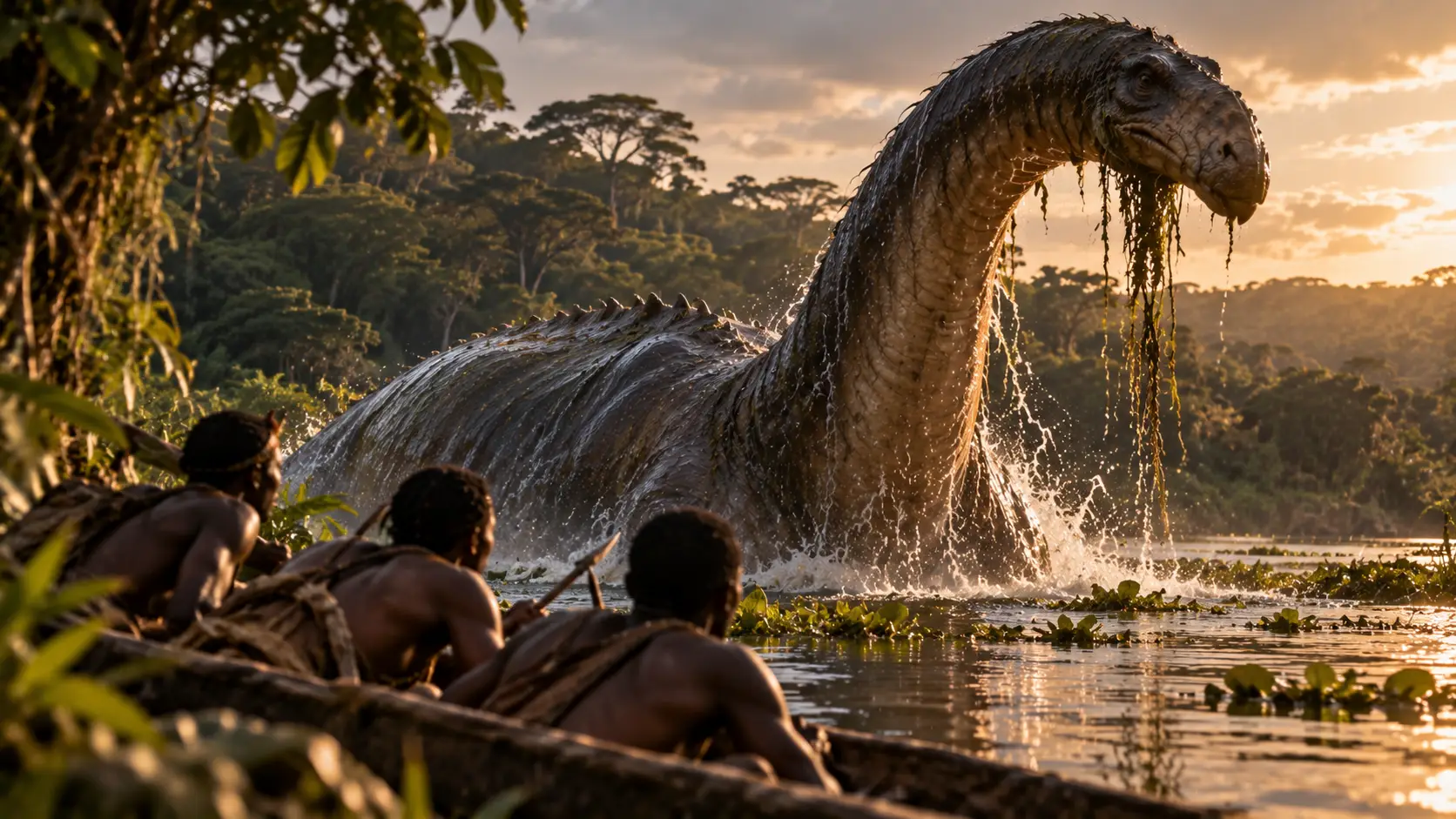
Appearance: Commonly described in modern reports as a large aquatic animal with a long neck, small head, massive body, and occasionally a long tail.
The beast and its stories
Mokele-mbembe occupies an unusual position between regional reports about mysterious animals and the modern search for supposedly surviving prehistoric creatures.
Reports associated with the Congo Basin describe a large animal living around rivers, marshes, and lakes. Some versions present it as a powerful aquatic being that can overturn boats.
The familiar long-necked dinosaur appearance became especially prominent in twentieth-century writing, after European animal collectors and later cryptozoologists began comparing African reports with prehistoric reptiles.
Roy P. Mackal undertook expeditions to the Republic of the Congo in 1980 and 1981, gathering testimony concerning the creature and investigating reports from the Likouala region.
Meaning and cultural context
Lake Télé became a famous location in subsequent searches. In 1981, an expedition led by Herman Regusters reported unusual observations there, followed by a Congolese expedition led by Marcellin Agnagna in 1983.
None of these efforts produced a confirmed specimen or conclusive evidence of an unknown large animal. The accounts remain significant as part of the history of exploration and modern monster narratives.
Different descriptions have circulated across regions and decades. The reports should not be treated automatically as one unchanging tradition about the same creature.
Mokele-mbembe’s international reputation illustrates how local testimony, explorers’ expectations, dinosaur imagery, and the appeal of undiscovered animals can combine into a powerful modern legend.
Five interesting facts
- A disputed translation: Mokele-mbembe is frequently translated as one who stops the flow of rivers, although the precise linguistic history requires caution.
- The Likouala region: Modern searches concentrated on its extensive swamps, forest waterways, and remote settlements in northern Republic of the Congo.
- Lake Télé: This secluded forest lake became one of the creature’s most famous alleged habitats during the expeditions of the 1980s.
- A filmed encounter: Agnagna reported seeing an unusual animal in 1983, but the expedition did not obtain usable photographic evidence.
- A popular image: Books, television programs, and films helped establish the long-necked dinosaur as the creature’s internationally recognizable appearance.
Nyami Nyami: The Serpent Power of the Zambezi
Tradition / Cultural origin: Tonga-associated traditions of Zambia and Zimbabwe, particularly communities of the Zambezi Valley.
Recorded period: Documented in early twentieth-century accounts and extensively discussed during and after construction of Kariba Dam in the 1950s.
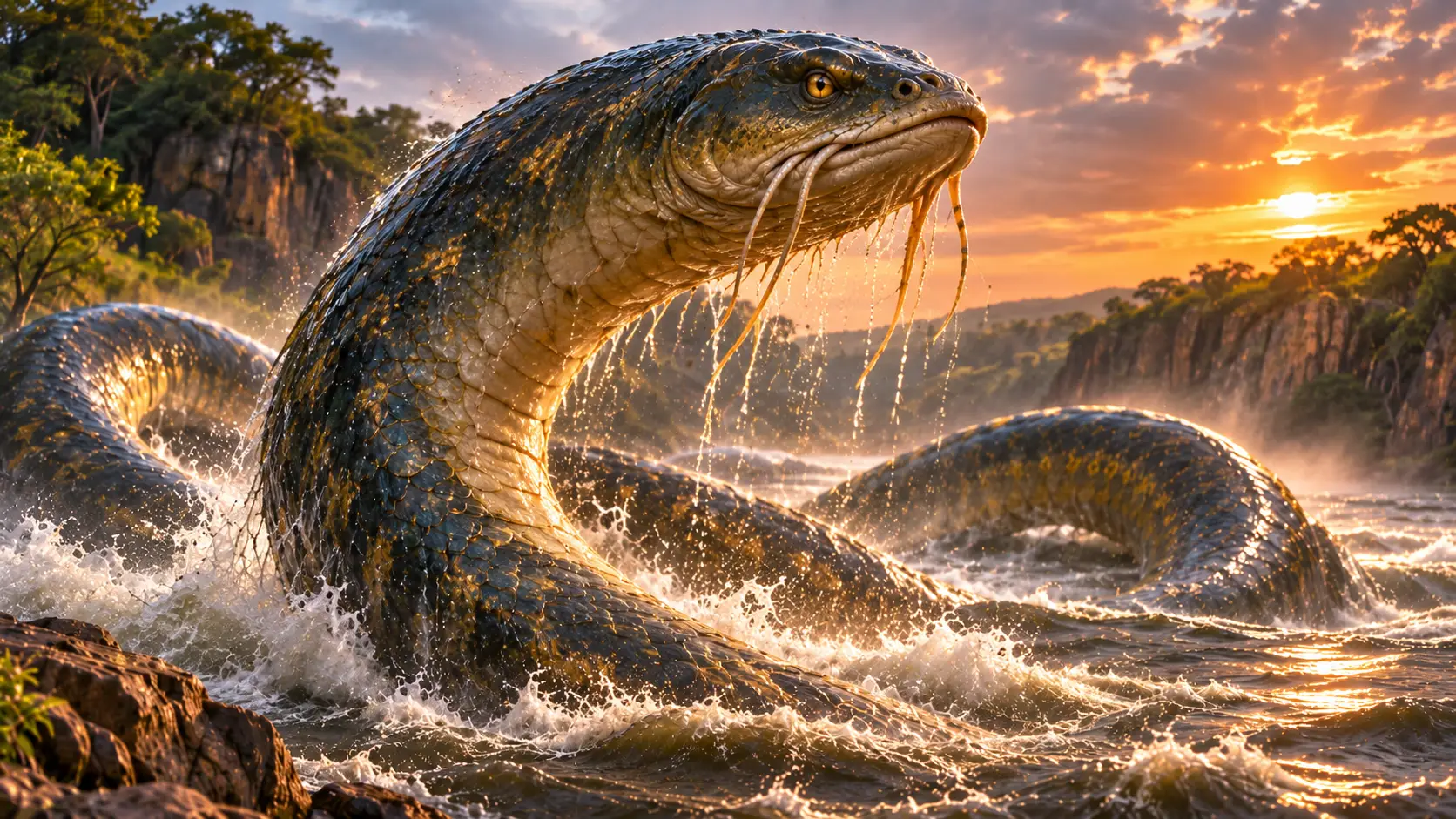
Appearance: A powerful aquatic being commonly represented with a long serpentine body and fishlike head, although traditional descriptions and artistic forms vary.
The beast and its stories
Nyami Nyami, also written Nyaminyami, is associated with the Zambezi River and the spiritual relationship between its waters and the people who depend upon them.
The deity is especially connected with Kariba Gorge, a dangerous section of river whose powerful currents and deep waters acquired religious importance within local traditions.
Accounts describe Nyami Nyami as a source of protection, sustenance, and danger. The being is not simply a monster hiding in the river but a supernatural power associated with its life-giving and destructive capabilities.
One widely circulated tradition describes Nyami Nyami separated from his wife by the construction of Kariba Dam. The barrier prevents their reunion, and subsequent floods become associated with his anger.
Meaning and cultural context
Kariba Dam transformed the Zambezi Valley during the 1950s, forcing Tonga communities away from their homes, agricultural land, and established relationships with the river.
Major floods damaged construction works and contributed to the project’s difficulties. In retellings about Nyami Nyami, these disasters were interpreted as signs of the river deity resisting the disturbance.
The actual displacement, floods, and construction are historical events; the supernatural explanation belongs to the religious and narrative traditions surrounding them.
Today, Nyami Nyami remains prominent in regional art, including curved serpentine carvings and pendants. These representations preserve connections with the river and the cultural memory of Kariba.
Five interesting facts
- Different spellings: Nyami Nyami and Nyaminyami are both widely used forms of the deity’s name.
- A changing appearance: Some representations emphasize a fishlike head and serpentine body, while descriptions in cultural accounts include additional human or animal characteristics.
- Kariba’s floods: Particularly damaging floods during the 1950s became central events in retellings about the deity’s anger.
- A history of displacement: The dam’s reservoir flooded inhabited land, requiring large-scale resettlement of Tonga communities and disrupting established livelihoods.
- A recognizable carving: Nyami Nyami’s curved body appears in carvings, jewelry, and other objects associated with the Zambezi region.
Read more: Nyami Nyami
Grootslang: The Great Serpent and Its Hidden Treasure
Tradition / Cultural origin: South African monster accounts, particularly the Richtersveld and Orange River region.
Recorded period: Early twentieth-century reports, including Fred C. Cornell’s The Glamour of Prospecting (1920).
Appearance: An enormous serpent in Cornell’s account; modern popular retellings also depict a giant hybrid combining serpentine and elephant-like features.
The beast and its stories
Grootslang, meaning Great Snake in Afrikaans, is associated with the remote country surrounding South Africa’s Orange River and the mountainous Richtersveld.
An early published account appears in Fred C. Cornell’s The Glamour of Prospecting. Cornell describes hearing about an enormous serpent believed to inhabit a rock in the river.
In Cornell’s account, local guides fear the creature. The setting is the Orange River, rather than the diamond-filled cavern familiar from popular treasure stories.

Popular retellings also connect Grootslang with the Wonder Hole, a cavern in the Richtersveld where the creature is said to guard a hoard of diamonds.
Meaning and cultural context
The treasure stories place Grootslang in a landscape associated with mineral exploration and prospecting. In these tellings, the serpent makes access to valuable stones dangerous.
Modern popular descriptions also depict Grootslang as an elephant-serpent hybrid, combining a trunk, tusks, an enormous body, and a serpentine tail, rather than simply an immense snake.
In one modern origin story, divine beings create a hybrid too powerful to leave intact, then separate elephants from snakes. A surviving Grootslang escapes that separation.
The versions give the creature different narrative roles: Cornell’s account concerns a feared river serpent, while the hybrid tale explains its extraordinary anatomy through an act of creation.
Five interesting facts
- The name: Grootslang derives from Afrikaans words meaning great or large snake.
- The Orange River: Cornell’s account associates the creature with the river, rather than exclusively with a cave.
- The Wonder Hole: Popular treasure stories identify a cavern or pit in the Richtersveld as the creature’s home.
- The diamonds: In treasure-guarding versions, valuable stones give people a reason to approach the monster’s dangerous dwelling.
- The hybrid story: A modern origin tale explains the elephant-serpent form through a divine separation of animals, an episode distinct from Cornell’s river account.
Read more: Grootslang
Werehyena: When Humans Become the Monster
Tradition / Cultural origin: Selected Ethiopian highland traditions, particularly beliefs concerning buda among Amhara and neighboring communities.
Recorded period: Discussed in ethnographic research, including studies by Ronald A. Reminick (1974) and Marcus Baynes-Rock (2015).
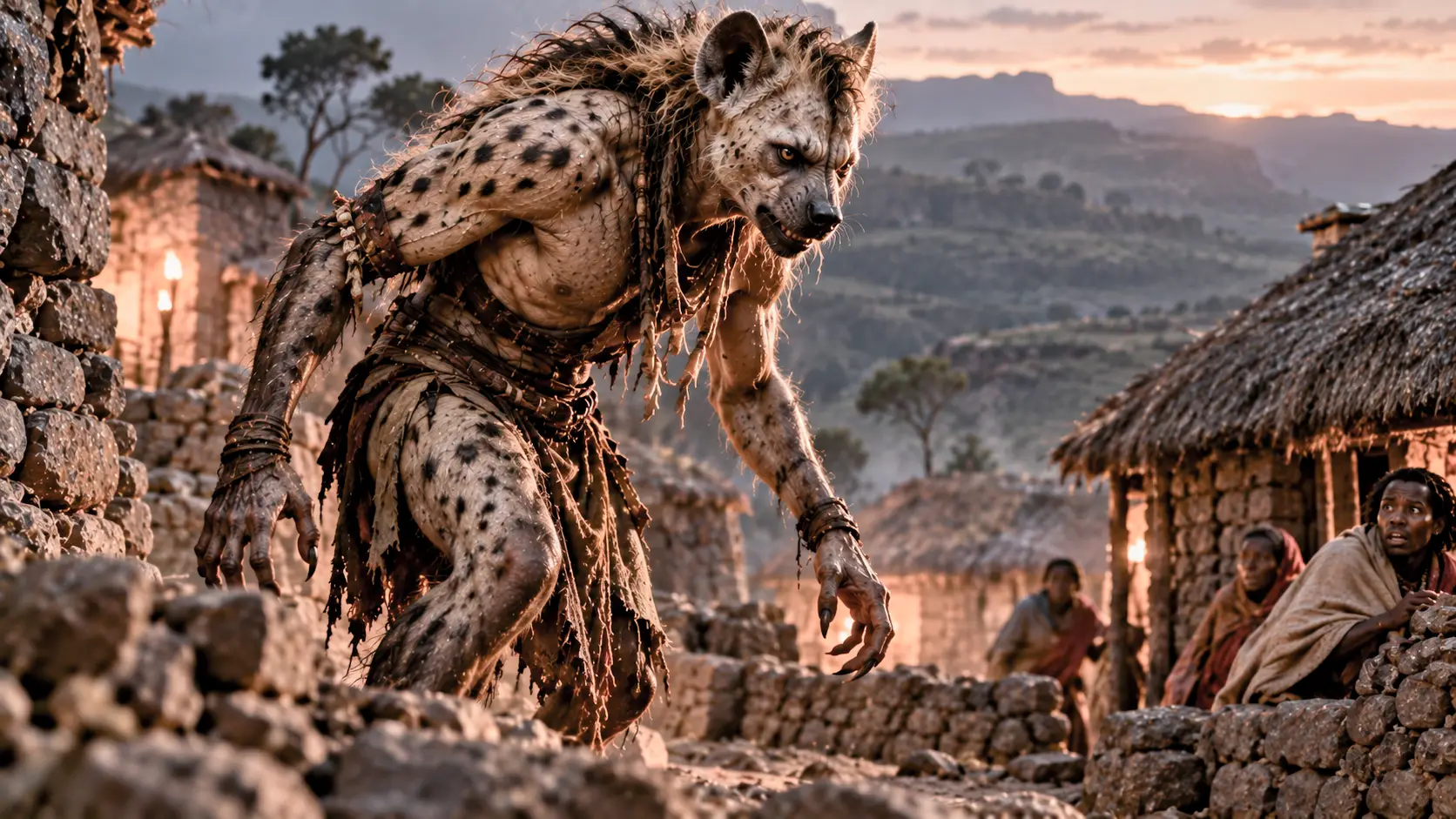
Appearance: A human believed capable of assuming a hyena’s form, rather than a creature with one fixed hybrid appearance.
The beast and its stories
Werehyena traditions belong to a broad group of beliefs concerning the transformation of human beings into dangerous animals. In parts of Ethiopia, these ideas intersect with beliefs about buda.
Buda is not simply another word for a werehyena. The term concerns a wider complex of beliefs about the evil eye, harmful spiritual agency, and people accused of possessing such powers.
In transformation accounts, the feared hyena is not merely a wild animal: it is understood as a human being in another form, connecting animal encounters with suspicions about neighbors.
Anthropologist Marcus Baynes-Rock examines this connection in Ethiopian Buda as Hyenas: Where the Social Is More Than Human, treating transformation as part of human-animal relationships in Ethiopian belief.
Meaning and cultural context
These beliefs also have consequences for human relationships. Certain artisans and socially marginalized groups have been accused of possessing dangerous spiritual powers, although associations vary between communities.
Ronald A. Reminick’s The Evil Eye Belief Among the Amhara of Ethiopia examines beliefs linking harmful gazes, illness, and social suspicion, including accusations directed at artisans.
Metalworkers and potters appear among the occupations associated with these accusations. Their place in the tradition concerns the social treatment of craftworkers, not evidence of wrongdoing by those accused.
Hyenas themselves are familiar animals in the Ethiopian landscape. Their scavenging and proximity to settlements bring them into contact with people, giving transformation beliefs an identifiable animal presence.
The werehyena tradition therefore combines animal transformation, spiritual danger, and social suspicion. Reducing it to an Ethiopian version of a werewolf obscures the particular importance of buda accusations.
Five interesting facts
- Buda terminology: The term can concern both harmful powers and people believed to possess them, not exclusively hyena transformation.
- Human identity: Transformation accounts connect the hyena with a human agent rather than presenting it solely as an independent monster.
- The evil eye: A dangerous gaze provides another explanation for illness within the wider complex of beliefs.
- Occupational accusations: Suspicions involving metalworkers and potters make social status an important part of the cultural context.
- Different scholarly perspectives: Reminick examines Amhara evil-eye beliefs, while Baynes-Rock focuses specifically on the relationship between buda and hyenas.
More Than a Monster’s Silhouette
The twelve beings in this collection demonstrate how much variety lies behind the familiar idea of an African mythical monster.
Kholumolumo and Isiququmadevu swallow entire communities, creating stories about extraordinary rescue and the return of ordinary life. Kirimu becomes an opponent whose destruction brings new responsibilities to the victorious hero.
Asanbosam and Aigamuxa introduce dangers that depend on unusual physical characteristics, while the Adze and Ethiopian werehyena traditions place supernatural threats within the more complicated world of human relationships and spiritual belief.
Nyami Nyami belongs to a different setting, where a river deity carries meanings associated with sustenance, protection, environmental danger, and historical displacement. Kongamato, Mokele-mbembe, and Grootslang also reveal how recorded local accounts can acquire new appearances and interpretations through exploration, journalism, and modern popular culture.
These creatures are not members of one shared supernatural system. They belong to distinct languages, histories, storytelling practices, and cultural environments.
Understanding their individual traditions reveals something more interesting than a catalogue of frightening appearances: the particular stories people have told about extraordinary beings, the situations in which those beings appear, and the relationships between the human and supernatural worlds.
Further Reading
The following books, historical collections, scholarly studies, and institutional resources provide further background on the twelve beings. Some contain translated traditional narratives, while others examine folklore, historical documentation, cultural interpretations, or the development of modern monster legends.
The Basutos: Or, Twenty-three Years in South Africa – Eugène Casalis, 1861.
An early collection of Basotho cultural observations and narratives.
Important for understanding the swallowing-monster tradition, Ditaolane, and related versions of the Kholumolumo story.
https://books.google.com/books?id=ALDbWMlpzu0C
Myths and Legends of the Bantu, Chapter XIV: The Swallowing Monster – Alice Werner, 1933.
Examines several African swallowing-monster traditions, including Khodumodumo and Isiququmadevu, with detailed narrative summaries and attention to variations in their endings and rescuers.
https://sacred-texts.com/book/myths-and-legends-of-the-bantu/chapter-xiv-the-swallowing-monster
The Mwindo Epic from the Banyanga – Daniel P. Biebuyck and Kahombo C. Mateene, 1969.
The central published source for Kirimu’s place in the Mwindo epic, including the dragon’s defeat, the liberation of swallowed people, and the intervention of Nkuba.
https://www.ucpress.edu/books/the-mwindo-epic-from-the-banyanga/paper
Akan-Ashanti Folk-Tales – R. S. Rattray, 1930.
A collection of traditional Akan narratives with original-language material and English translations.
Essential for investigating Sasabonsam’s encounters with hunters and other supernatural figures.
https://www.si.edu/object/siris_sil_155408
Ashanti Proverbs – R. S. Rattray, originally published 1916.
Provides descriptions and cultural terminology relevant to Akan forest beings, including Sasabonsam.
Useful alongside Rattray’s later folktale collection for comparing recorded characteristics.
https://books.google.com/books?id=z6GRAAAAIAAJ
Die Ewe-Stämme – Jakob Spieth, 1906.
A substantial Ewe ethnographic and linguistic collection containing folklore and traditional accounts.
Valuable for investigating early recorded traditions surrounding luminous supernatural beings and witch spirits.
https://library.si.edu/digital-library/book/dieewestmmemater00spie
XVI. Glidyi Ewe – B. Foli, Africa, 1935.
A scholarly account describing Ewe beliefs about adzé or azé, witch spirits, nocturnal spiritual activity, blood-sucking, and the removal of a person’s soul-shadow.
https://www.cambridge.org/core/journals/africa/article/abs/xvi-glidyi-ewe/91DAA728218FE06DD55853E908945C5F
Aus Namaland und Kalahari – Leonhard Schultze, 1907.
An important collection of Nama ethnography and oral narratives, including Aigamuxa stories.
Provides the historical context for Jackal’s encounters with the extraordinary foot-eyed monsters.
https://books.google.com/books?id=oSIPAAAAYAAJ
Tsuni-Goam: The Supreme Being of the Khoi-Khoi – Theophilus Hahn, 1881.
Contains accounts of Heitsi-eibib and his adversaries, including Ga-gorib.
Particularly useful for distinguishing the deadly stone challenge from the wrestling contest beside the pit.
https://ibali.uct.ac.za/files/original/1f398234452098d887e73f209fce408e35f17336.pdf
Nursery Tales, Traditions, and Histories of the Zulus – Henry Callaway, 1868.
An early collection presenting Zulu narratives in their original language with English translations, including Untombinde, Isiququmadevu, and the wider traditions of monsters and tricksters.
https://books.google.com/books/about/Nursery_Tales_Traditions_and_Histories_o.html?id=C4UBAAAAMAAJ
Trickster Tropes: Female Storytelling and the Re-imagination of Social Orders in Four Nineteenth-Century Southern African Communities – Historia, 2010.
Examines the trickster narratives associated with figures including Uhlakanyana, investigating their recorded actions and their relationship to social authority, family relationships, and storytelling traditions.
https://www.scielo.org.za/scielo.php?pid=S0018-229X2010000100004&script=sci_arttext
In Witch-Bound Africa – Frank H. Melland, 1923.
The influential early published source for Kongamato, including descriptions associated with Kaonde informants, protective practices during river crossings, and Melland’s comparison with prehistoric flying reptiles.
https://books.google.com/books/about/In_Witch_bound_Africa.html?id=J4AwAAAAIAAJ
A Living Dinosaur? In Search of Mokele-mbembe – Roy P. Mackal, 1987.
A firsthand account of twentieth-century cryptozoological investigations in the Congo Basin.
Valuable for examining expedition reports, testimony, and the modern development of the long-necked creature’s reputation.
https://ci.nii.ac.jp/ncid/BA65282047
Mokele-Mbembe: An Investigation into Rumors Concerning a Strange Animal in the Republic of the Congo, 1981 – CaltechAUTHORS.
A historical expedition report documenting inquiries into the creature.
Useful for comparing the claims of investigators with the actual observations and limitations of field research.
https://authors.library.caltech.edu/records/1sbtg-gx017
Roy Mackal’s Wild Speculation – University of Chicago Magazine.
Examines the zoologist’s unusual search for Mokele-mbembe, his expeditions, and the relationship between scientific investigation, cryptozoology, and the popularity of the Congo dinosaur legend.
https://magprod1.uchicago.edu/science-medicine/roy-mackals-wild-speculation
Towards an African Theological Ethic of Earth Care: Encountering the Tonga Lwiindi of Simaamba of Zambia in the Face of the Ecological Crisis – Kapya John Kaoma, 2017.
Discusses Tonga religious traditions and the Zambezi environment, including historical references to Nyami Nyami, Kariba Gorge, and the relationship between spiritual beliefs and water.
https://hts.org.za/index.php/hts/article/view/3834/10659
We Were Displaced Several Times Since 1956: The Tonga-Goba Involuntary Resettlement Experiences at the Kariba Dam – Joshua Matanzima, 2022.
Scholarly research examining the displacement of Tonga-Goba communities and the long-term social consequences of the Kariba Dam, providing historical context for Nyami Nyami’s modern significance.
https://www.tandfonline.com/doi/abs/10.1080/02508060.2022.2085851
The Glamour of Prospecting – Fred C. Cornell, 1920.
An early firsthand source for published Grootslang accounts in the Richtersveld.
Describes beliefs concerning a giant snake associated with the Orange River and reports from local guides.
https://www.gutenberg.org/cache/epub/70674/pg70674-images.html
Ethiopian Buda as Hyenas: Where the Social Is More Than Human – Marcus Baynes-Rock, 2015.
A focused anthropological study examining beliefs about buda transformation into hyenas and their wider significance for understanding human-animal relationships in Ethiopian folklore.
https://www.tandfonline.com/doi/abs/10.1080/0015587X.2015.1081514
The Evil Eye Belief Among the Amhara of Ethiopia – Ronald A. Reminick, 1974.
An ethnographic examination of Ethiopian evil-eye beliefs, social suspicion, and accusations against artisans.
Essential for understanding the historical consequences of beliefs associated with buda.
https://ehrafworldcultures.yale.edu/cultures/mp05/documents/021