Introduction
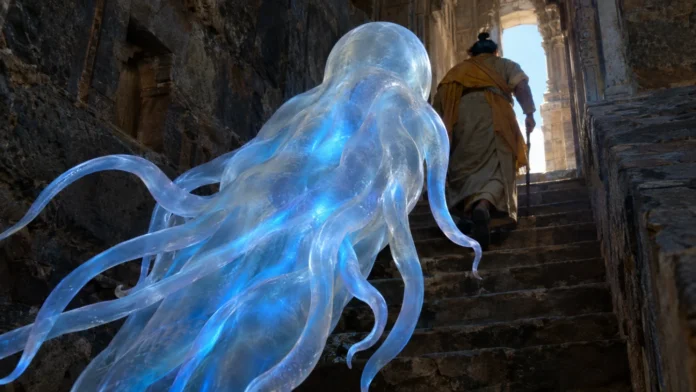
Á Bao A Qu is a literary imaginary being associated with the Argentine writer Jorge Luis Borges and his collaborator Margarita Guerrero. It inhabits the stairway of the Tower of Victory at Chitor, awakening whenever a visitor begins climbing toward the tower’s upper terrace.
Although frequently categorized as a creature from Malay, Indian, or South American folklore, it has not been verified in an independent traditional source. The strongest evidence identifies it as a modern literary creation or fabrication presented through the language and conventions of comparative mythology.
Its defining feature is its dependence upon the spiritual condition of another being. As a climber ascends, the creature follows and gradually acquires color, light, tentacles, and bodily definition.
Complete development becomes possible only when the person it follows attains Nirvana.
This unusual relationship makes Á Bao A Qu less a conventional monster than an embodiment of incomplete perfection. An insufficiently perfected climber leaves it stalled before the summit, incomplete and suffering; when the visitor descends, it rolls back to the initial steps and waits for another visitor.
Its story combines an actual Indian monument, Buddhist terminology, uncertain bibliographic claims, and Borges’s characteristic blending of scholarship with invention. The result feels like a fragment of inherited legend even though its recoverable history begins in a twentieth-century literary bestiary.
History/Origin
Á Bao A Qu’s earliest documented appearance is in Manual de zoología fantástica, published in 1957 by Jorge Luis Borges and Margarita Guerrero. This literary bestiary brings together beings from religious texts, classical literature, folklore, travelers’ accounts, philosophy, and imaginative writing.
Its presentation does not consistently separate inherited traditions from uncertain or potentially invented material.
An expanded version of the collection appeared in 1967 as El libro de los seres imaginarios, known in English as The Book of Imaginary Beings. Translation and magazine publication subsequently brought the creature to a wider readership.
Its place alongside established legendary beings helps explain its later treatment as folklore, although inclusion in a bestiary does not itself establish an earlier oral or religious tradition.
The account’s source attribution differs between versions. The 1957 Spanish text associates the creature with a note in Richard Francis Burton’s translation of The Arabian Nights.
Burton’s reputation as a traveler and translator gives this reference an appearance of historical authority, but no verified passage establishing Á Bao A Qu in his work has been identified in the research supporting this article. The attribution therefore remains unconfirmed.
The English version instead credits On Malay Witchcraft, attributed to C. C. Iturvuru and dated 1937. This citation has not been substantiated as an independent source for the creature.
Its title and publication date belong to the bestiary’s claimed provenance, not to a securely established history of Malay belief. They cannot, by themselves, demonstrate that Á Bao A Qu was known before 1957.
These changing references are important to the creature’s literary history. Scholarly analysis of the bestiary examines Borges’s appropriation and reshaping of authoritative discourse, with Á Bao A Qu offering a possible example of invention presented as recovered knowledge.
Its precise setting and bibliographic framing make it resemble an inherited legend. The evidence favors a modern literary construction, while leaving the authors’ exact process of composition uncertain.
The setting is Chitor, now generally called Chittor or Chittorgarh, in Rajasthan, India. Its Tower of Victory supplies both a recognizable architectural location and an ascending stairway suited to the story’s theme of spiritual perfection.
That Indian setting does not establish a Rajasthani tradition surrounding the creature, just as the alleged Malay source does not establish Malay origins.
Á Bao A Qu’s best-supported cultural connection is therefore to Borges and Guerrero’s Argentine literary work. Its Indian location, Buddhist terminology, Burton reference, and supposed Malay source form different layers of the narrative rather than a demonstrated chain of cultural transmission.
An earlier traditional origin remains unverified; its recoverable history begins with the twentieth-century bestiary.
Name Meaning
No reliable etymology for the name Á Bao A Qu has been established. The expression is not supported by a known early inscription, oral collection, Malay treatise, or Indian narrative predating Borges and Guerrero’s book.
Its meaning must therefore be treated as unresolved.
The spelling also appears as A Bao A Qu, without an accent on the initial letter. This variation reflects publication and editorial practice rather than evidence for separate beings.
The accented and unaccented forms refer to the same literary creature.
The division into four short units gives the name a memorable, incantatory rhythm, but sound alone cannot identify its language. Its appearance in a story framed as distant and esoteric can encourage readers to assume that it preserves a transliterated traditional term.
No documentation establishes such an origin.
A proposed derivation from the Malay words abang aku has circulated in later discussions. This resemblance is speculative and does not demonstrate that the phrase generated the creature’s name.
No documented chain connects it to a Malay legend, collector, source used by Borges, or historical usage of Á Bao A Qu as the name of a supernatural being.
The name may instead have been constructed for visual and phonetic effect, fitting Borges’s interest in unfamiliar catalogues and ambiguous citations. Without notes from the authors explaining its formation, however, even a deliberately invented etymology remains conjectural.
The safest conclusion is that the name first becomes verifiable in the literary bestiary and has no securely established translation.
Appearance
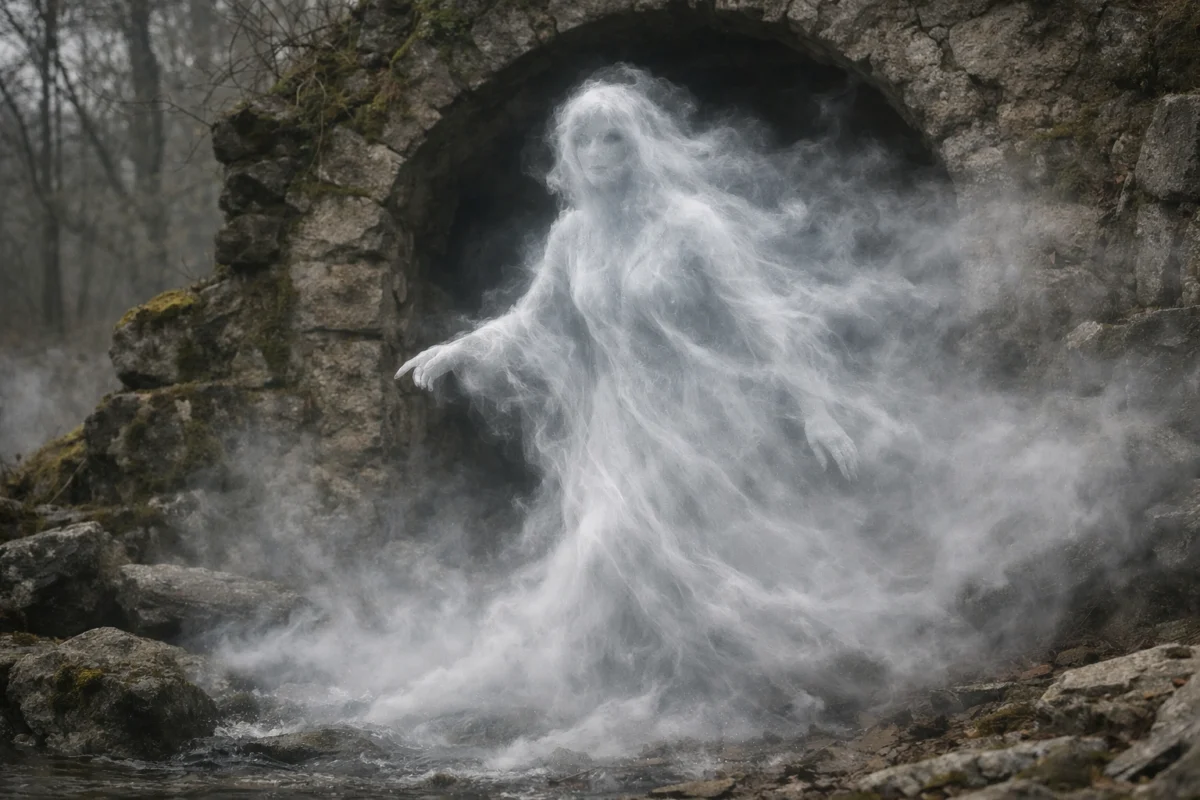
Á Bao A Qu does not possess one fixed appearance. At rest on the lowest step of the tower, it is dormant, almost colorless, and nearly translucent.
Its body is so imperfectly formed that it seems to exist only as an indefinite presence awaiting another creature’s movement.
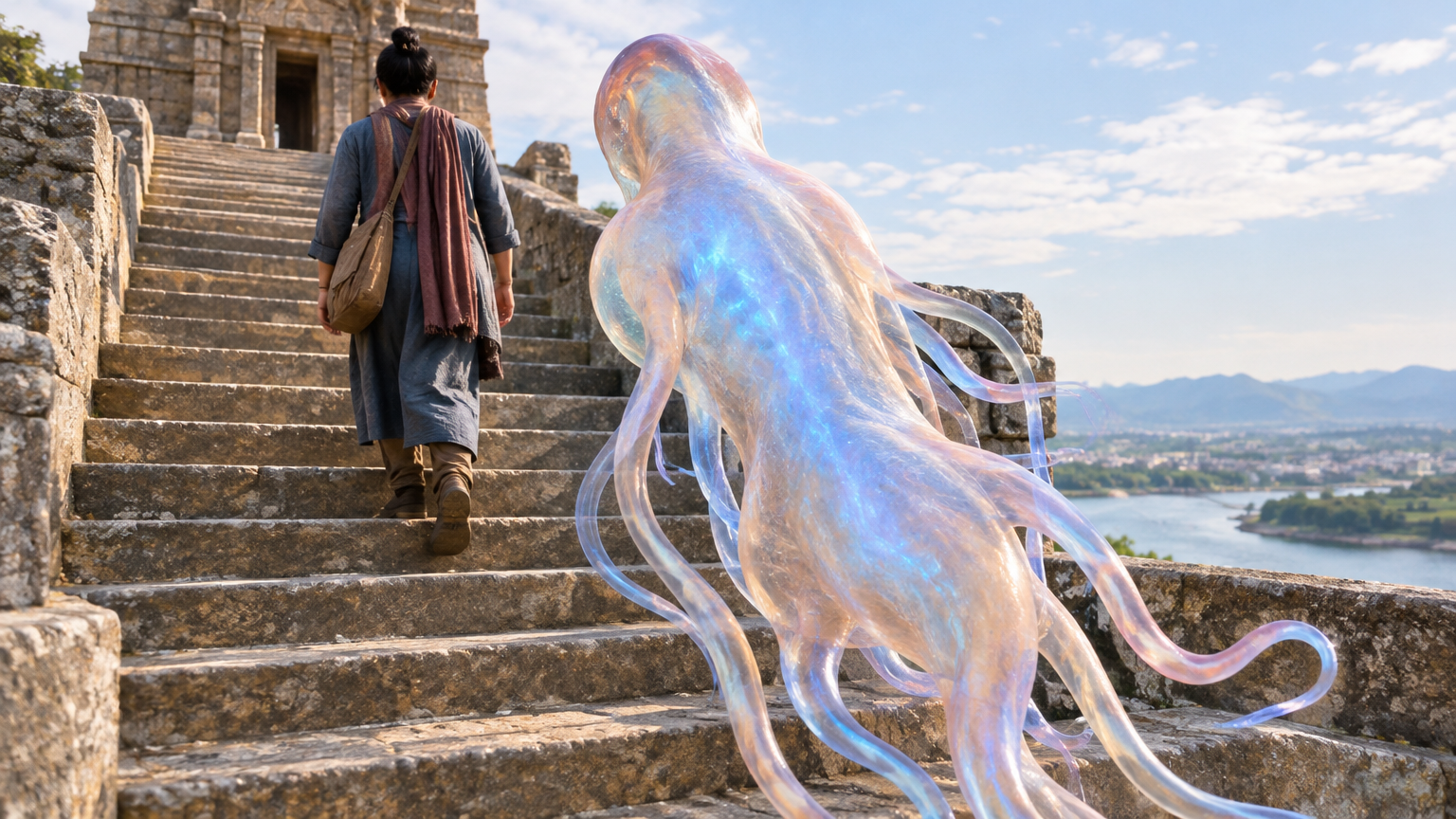
Contact with a person beginning the ascent brings it to life. It follows closely behind the climber, and each upward step gives it greater definition.
A bluish light develops within its body, while the creature’s initially vague outline becomes increasingly organized and visible.
This development is gradual rather than an abrupt metamorphosis. Height, illumination, and bodily coherence increase together. The creature is therefore best imagined not as changing from one animal into another but as passing from near formlessness toward a complete state that it almost never reaches.
By the middle of the stairway, its tentacles can be clearly distinguished. The account provides no fixed number, arrangement, or practical function for these appendages.
They mark a stage in the progressive manifestation rather than supplying the detailed anatomy of a stable zoological species.
Its perception is equally unusual. Instead of looking through localized eyes, Á Bao A Qu sees through the entire surface of its body.
The description removes the distinction between a face and the rest of its form, reinforcing the impression that it belongs to no familiar class of animal.
Touch is also important to its portrayal. Its skin feels like the soft outer surface of a peach.
That intimate tactile comparison contrasts with the creature’s translucence and supernatural radiance: although difficult to define visually, it has a recognizable texture when encountered at close range.
Near the summit, its internal blue radiance becomes stronger and its form approaches perfection. The color is not merely decorative.
Light, bodily completeness, and upward movement operate together, making the creature’s visible development a measure of the climber’s spiritual progress.
If the climber proves incapable of reaching Nirvana, Á Bao A Qu never achieves its final state. It remains stalled before the summit, incomplete and suffering, and its faint pain is expressed by a sound compared to the rustling of silk.
When the visitor descends, the creature wheels and tumbles back to the initial steps, resumes its nearly translucent condition, and waits for another visitor.
The only fully perfected appearance is left largely undescribed because the condition needed to produce it has supposedly occurred just once. Readers see the being chiefly in transition: dormant, awakening, brightening, extending its tentacles, nearing completion, remaining incomplete when the climber falls short, and returning to the first steps when the visitor descends.
Incompleteness is consequently not a minor flaw in its appearance but the form in which it almost always exists.
Background Story
The creature’s narrative is attached to the Tower of Victory at Chitor, an actual monument within the fortified landscape of Rajasthan. The account transforms its ascending interior into a spiritual testing ground, where physical height corresponds to a more difficult movement toward enlightenment.
Á Bao A Qu waits on the first step until someone enters the stairway. It then awakens, clings near the visitor’s heels, and shares the ascent.
Its progress is not independent: every increase in substance, color, and luminosity depends upon the inner development of the person ahead.
The visitor does not need to fight, command, or knowingly test the creature. Instead, the climber’s spiritual condition acts upon it directly.
This gives the encounter an unusual structure. The human being appears to lead, but Á Bao A Qu silently reveals how far that person can truly ascend.
The decisive condition is the attainment of Nirvana. Only a spiritually perfected climber can enable the creature to reach the terrace in its complete form.
The narrative claims that this has happened only once, many centuries ago, leaving all later ascents incomplete. The successful climber is not named, and the perfected creature’s subsequent fate is not explained.
When a visitor cannot attain that state, the creature remains stalled before the summit, incomplete and suffering. It does not immediately return to the bottom because of that spiritual failure.
When the visitor descends, Á Bao A Qu wheels and tumbles back to the initial steps, resumes its translucent condition, and waits for another visitor.
The creature’s suffering makes the failure more than a neutral pause. Its silk-like cry suggests pain, yet it has no power to change the condition governing its development.
It must wait for the visitor’s descent, return to the first steps, and then await another visitor for a new ascent whose success depends entirely upon someone else.
The background draws together elements that do not constitute one established religious tradition: an Indian tower, Buddhist language, an alleged Malay source, and an earlier attribution involving Burton’s Arabian Nights. Their combination is better understood as literary construction than as evidence of cultural transmission among those regions.
Nirvana and pilgrims belong to the story’s imagery, but their presence does not establish a cult, ritual, or religious doctrine centered on Á Bao A Qu. No documented worship, offering, prohibition, pilgrimage practice, or local ceremonial role is associated with the being outside the literary account.
Within that construction, Á Bao A Qu functions as a spiritual double. It reveals the climber’s incompleteness by remaining incomplete itself.
The creature is therefore neither guide nor adversary. It blocks no passage and offers no instruction; it simply reflects another being’s capacity to move from ordinary existence toward an almost unattainable perfection.
Famous Folklore Stories
The A Bao A Qu on the Tower of Victory
This is a descriptive editorial heading for the creature’s one documented narrative, not an authenticated traditional title preserved by Indian or Malay storytellers. No independently collected cycle of Á Bao A Qu folktales has been established.

In the episode, the dormant being awakens when a visitor begins climbing the Tower of Victory. It follows closely around the stairway, gradually acquiring color, light, tentacles, and a more definite body as the climber approaches spiritual perfection.
Complete manifestation depends upon the pilgrim attaining Nirvana. Nearly every climber falls short, leaving the creature stalled before the summit, incomplete and suffering.
When the visitor descends, Á Bao A Qu wheels and tumbles back to the initial steps and returns to its indistinct state. The narrative says it reached the terrace only once, though the successful climber remains unnamed.
The Ascent and Failed Transformation
This second descriptive heading identifies the recurring pattern within the same account rather than a separate traditional story. Physical elevation parallels spiritual advancement, while the creature’s incomplete body reflects the climber’s inability to reach enlightenment.
Failure is communicated through motion, appearance, and sound. The blue light and visible tentacles mark the creature’s progress, and its hesitation and silk-like cry mark the limit of the climber’s advancement and the creature’s incomplete, suffering state.
Only when the visitor descends does Á Bao A Qu wheel and tumble back to the first steps, where it again waits in its nearly translucent condition.
The pattern should not be treated as evidence for a wider oral tradition. No independently verified variants, local encounter reports, or related Á Bao A Qu narratives predate the bestiary.
Its significance lies in the carefully constructed literary motif rather than in documented circulation among traditional storytellers.
Cultural Impact
The creature’s principal cultural importance comes from its place in Borges and Guerrero’s imaginary bestiary. There it stands beside figures drawn from classical literature, religious writings, travelers’ accounts, and folklore, even though its own supposed traditional provenance cannot be independently substantiated.
This uncertain status contributes to the entry’s effect. The authoritative tone, precise architectural setting, and attribution to obscure source material encourage readers to approach the account like a genuine piece of comparative mythology.
Doubts emerge only when its references are compared across editions or checked against identifiable earlier sources.
The creature demonstrates how the format of a bestiary can shape belief. Alphabetical presentation, compressed description, geographic specificity, and bibliographic attribution place very different kinds of beings on the same apparent level.
An invention can consequently acquire the texture of folklore simply by standing beside creatures with long textual or oral histories.
Its transformation also gives Á Bao A Qu considerable symbolic force. Because its body develops in response to someone else’s spiritual progress, it can be read as an image of unrealized potential, dependent existence, or the painful distance between aspiration and fulfillment.
The recurring sequence complicates any simple image of enlightenment. The creature strives upward without controlling the outcome, approaches beauty and coherence, and remains incomplete and suffering when the climber falls short.
When the visitor descends, it loses what it has gained as it tumbles back to the first steps. Its single reported success only emphasizes how exceptional completion is within the structure of the story.
Such readings are modern literary interpretations, not meanings established by a religious community. The text does not provide a traditional commentary explaining what the being symbolizes, so its associations with failure, enlightenment, dependence, and incompleteness remain open to critical analysis.
Academic discussion has used the entry to examine Borges’s practice of combining recognizable learning with uncertain or invented references. The change from Burton to the supposed Iturvuru source is especially revealing because it shows that an authoritative citation can be part of the literary design rather than transparent proof of origin.
Á Bao A Qu therefore matters less as evidence for an old belief than as an example of how literary authority can manufacture the appearance of ancient tradition. Its later reputation as a folkloric creature also illustrates how easily source framing can become detached from a story when that story is repeated in reference literature.
Similar Beasts
Kasa-obake
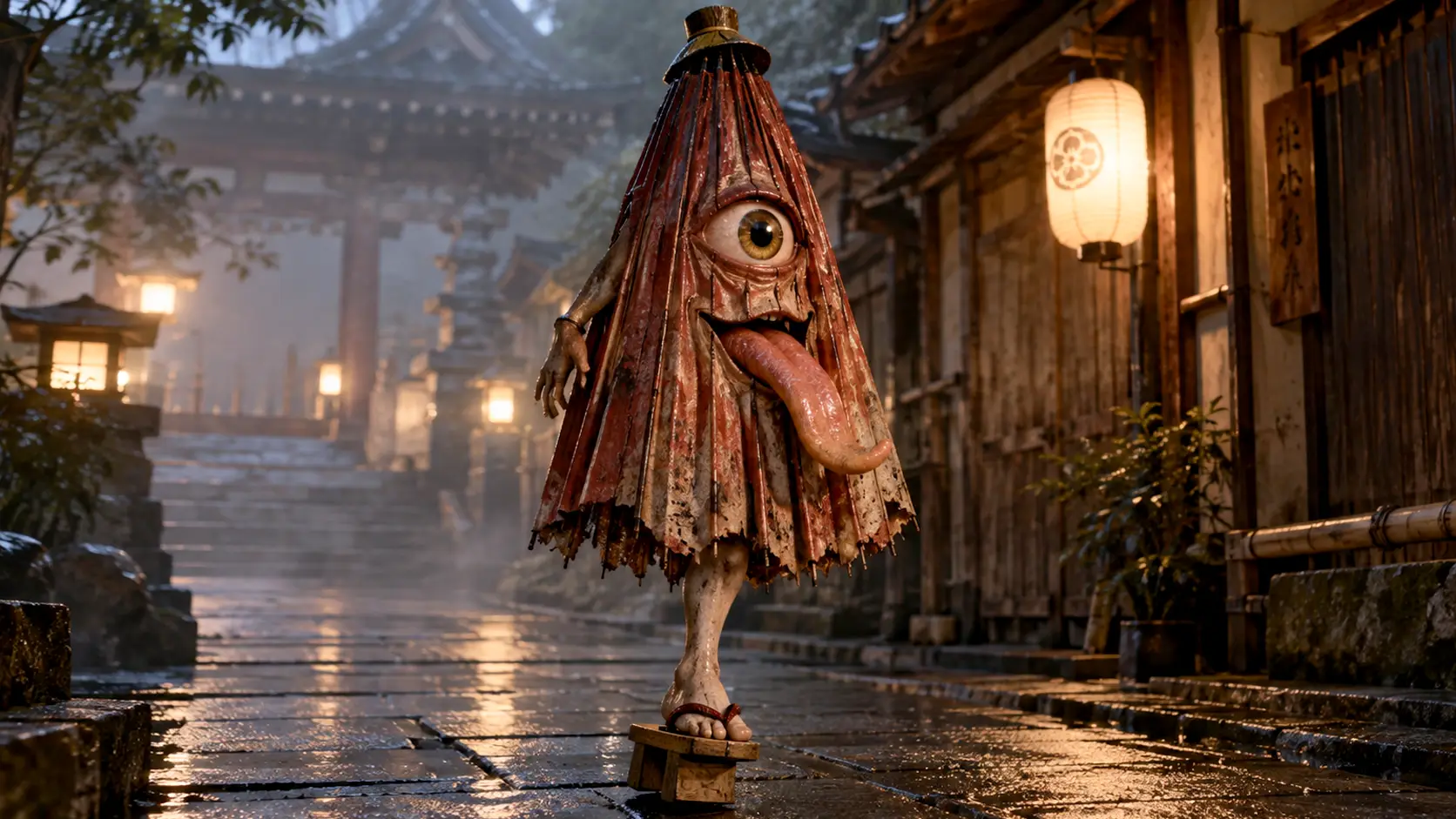
Kasa-obake is a Japanese one-eyed umbrella yōkai, commonly depicted hopping on one sandal-clad leg. Its familiar form was shaped substantially by visual art and entertainment.
Like Á Bao A Qu, it demonstrates how repeated literary or artistic presentation can give an imaginative being apparent folkloric solidity. Kasa-obake remains a distinct Japanese figure, however, not a name or regional form of Á Bao A Qu.
Gremlin

The Gremlin is a mischievous creature from modern aviators’ folklore, blamed for otherwise unexplained mechanical failures. Its reputation expanded during the Second World War and through later popular culture.
Both figures show how comparatively recent beings can acquire mythlike status. Unlike Á Bao A Qu, Gremlins circulated through occupational storytelling and shared explanations of mechanical misfortune rather than through one defining bestiary entry.
Monopod

The Monopod, or Sciapod, is a legendary one-legged humanoid described in Greek and Roman geographical writing. Its enormous foot supposedly served as shade in distant, unfamiliar lands.
It resembles Á Bao A Qu as a bestiary figure encountered largely through texts. The Monopod differs in having a verifiable written history extending back to classical sources rather than first appearing in a modern literary catalogue.
Bannik

The Bannik is an East Slavic spirit associated with the traditional bathhouse. It is commonly understood as the unseen owner or guardian of a particular domestic building.
Both beings are bound to distinctive architectural spaces and become relevant through human presence. The Bannik, however, belongs to documented regional folklore and customary belief, whereas Á Bao A Qu’s connection to the Tower of Victory is literary.
Scientific or Rational Explanations
A zoological explanation is unnecessary because there is no verified sighting tradition, physical specimen, or stable body of testimony requiring identification. The evidence instead points to a literary being whose characteristics serve a compact philosophical narrative.
The strongest historical explanation is deliberate literary creation or fabrication. The entry combines documentary language with questionable attribution, and no independently verifiable ancient legend or traditional source establishes the creature before Manual de zoología fantástica.
The changing citations are more informative than a search for an unknown animal. Burton’s real name supplies recognizable scholarly authority, while the later Iturvuru attribution creates another layer of apparent documentation.
Neither claim provides a secure pre-Borges history for the being.
Its unusual anatomy likewise supports a literary reading. Translucence, blue illumination, tentacles, whole-body vision, and peachlike skin do not form a plausible report of a misunderstood local animal.
Each feature contributes to an aesthetically controlled progression from vagueness toward bodily perfection.
The absence of a stable final form is particularly important. Naturalistic creature reports generally attempt to identify lasting physical traits, while Á Bao A Qu changes according to another person’s spiritual status.
Its anatomy operates as a narrative instrument rather than as an organism’s adaptation to an environment.
The ascent can be interpreted psychologically as an external representation of human striving. The creature becomes more coherent as the climber approaches perfection, then remains stalled, incomplete, and suffering when that effort falls short.
It returns to the first steps when the visitor descends. Bodily transformation thus gives visible form to an otherwise abstract spiritual judgment.
A related allegorical reading treats the being as dependent potential. It cannot complete itself through its own actions and must wait for another consciousness to attain enlightenment.
Its repeated pain and regression dramatize frustration, incompleteness, and the consequences of relying upon a condition almost no one can fulfill.
The tower supplies a simple spatial model for this process. Upward movement corresponds to increasing spiritual and bodily definition, the terrace represents the unreachable completion of the journey, and the visitor’s descent triggers the creature’s tumble back to uncertainty at the initial steps.
These correspondences explain the episode without requiring a literal supernatural encounter.
The entry also illustrates how readers evaluate authority. Precise place names, scholarly presentation, and source-like framing can make an invented account appear inherited and factual.
Once repeated without its publication history, the creature can be recategorized as Malay, Indian, or South American folklore despite the lack of an independent tradition in any of those settings.
Consequently, rational analysis is best directed toward authorship, transmission, narrative structure, and interpretation rather than cryptozoology. Á Bao A Qu remains meaningful as a literary construction, but the evidence does not support explaining it as an animal, hallucination, or remembered local spirit.
Conclusion
Á Bao A Qu is best understood as a literary being associated with Jorge Luis Borges and Margarita Guerrero, not as a securely documented figure from Malay, Indian, or South American folklore. Its ascent through the Tower of Victory connects physical transformation with spiritual attainment: the creature becomes complete only when the climber does.
This dependence gives it an unusual symbolic role. It does not attack, instruct, or independently seek enlightenment, but reflects another being’s progress through its own changing body.
When a climber falls short, Á Bao A Qu remains stalled before the summit, incomplete and suffering; when the visitor descends, it tumbles back to the initial steps. Its light, tentacles, peachlike surface, and silk-like cry turn incomplete spiritual attainment into a vivid sensory event.
The uncertain citations surrounding the account are central to its significance. Changing attributions, an unsupported etymology, and the absence of an earlier traditional record illustrate how Borges blurred scholarship, invention, and inherited legend.
Á Bao A Qu therefore matters both as an evocative imaginary creature and as an example of literary fabrication acquiring the appearance of folklore.
Further Reading
El libro de los seres imaginarios / The Book of Imaginary Beings, “A Bao A Qu”, Jorge Luis Borges and Margarita Guerrero; English edition text hosted as a PDF
Primary literary account; gives the creature’s description and the English edition’s Iturvuru attribution.
(theteacherscrate.wordpress.com)
La reescritura y la apropiación del discurso en el Manual de zoología fantástica, Revista Latinoamérica / SciELO México
Scholarly analysis notes the Burton attribution and argues that A Bao A Qu may be Borges’s own invention.
(scielo.org.mx)