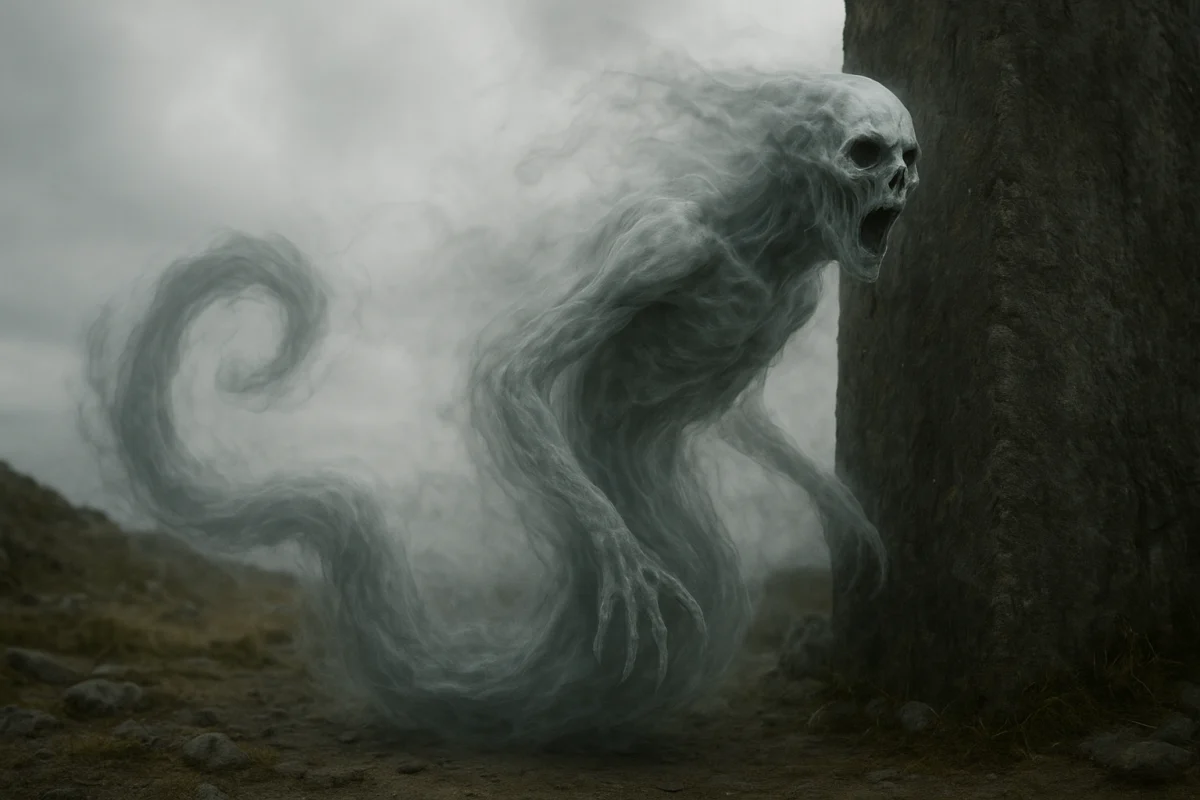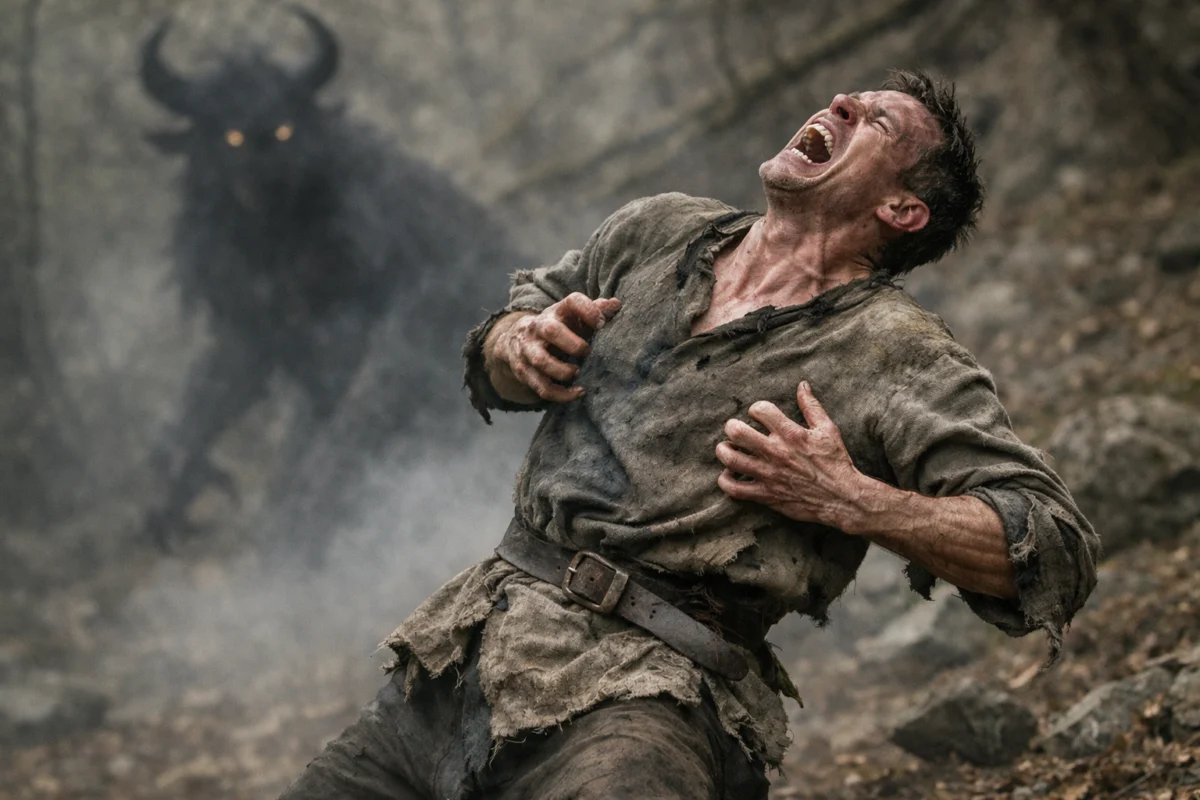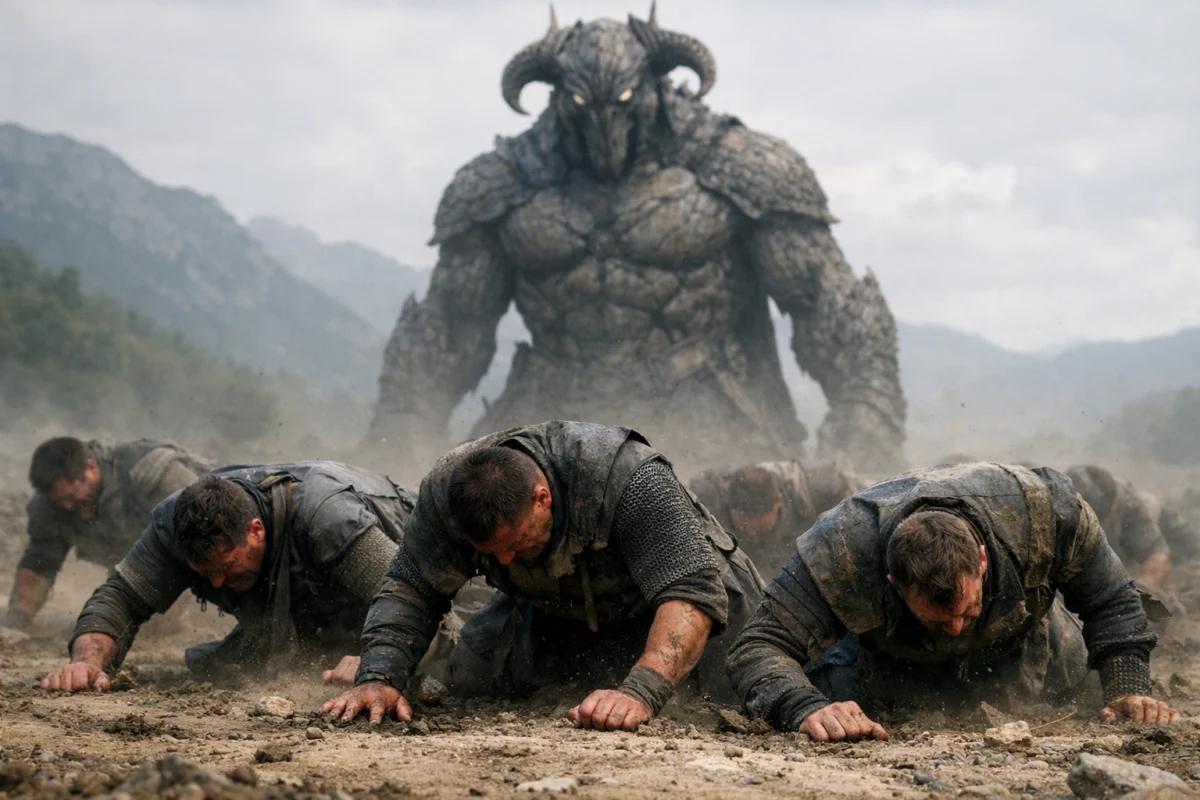
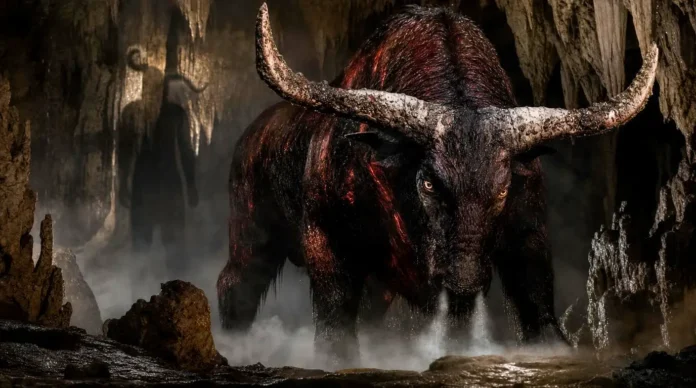
Aatxe is a supernatural figure from Basque folklore, closely tied to caves, cattle imagery, and the underground world. Traditional descriptions present it as a bovine spirit, especially a young bull, although some accounts also allow cow, calf, or human forms locally.
The creature belongs to a wider Basque pattern in which animal-shaped spirits guard caverns and other charged places. José Miguel de Barandiarán connected these beings with Mari, the major female numen of Basque mythology, either as manifestations or subordinate powers.
At Lezia, the cave of Sare, the bull or cow-shaped spirit acts as a guardian and may take human form when confronting people who offend it. Local tradition also calls this figure Etsai, a name associated with hostility and the devil.
Aatxe therefore works best as a cave guardian rather than a simple monster. Its identity combines animal power, restricted sacred space, punishment, and shape-changing, while the surviving folklore remains local and variable instead of presenting one fixed story accepted across the Basque Country.
History/Origin
Most detailed written evidence for Aatxe comes from twentieth-century Basque ethnography, especially the work of José Miguel de Barandiarán. His collections preserved oral traditions from rural communities and linked the bovine cave spirit with places including Sare, Isturitz, Zugarramurdi, Santimamiñe, and Balzola.
Barandiarán described a broad class of cave-dwelling animal spirits rather than treating every bovine apparition as one rigid character. In his English-language selected writings, he summarized their guarded territories plainly: “They do not allow anyone to enter their dwelling place.”
The Auñamendi entry gives the clearest Aatxe-specific description of Lezia. Translated from Spanish, it states: “The bull or cow-shaped spirit living in Lezia is the guardian of that spacious cavern.”
This establishes guardianship as one of the figure’s best-supported functions.
A connected Sare tradition identifies the cave teacher Etsai with the same local supernatural complex. Auñamendi’s account of Axular, translated from Spanish, says: “The spirit Etsai, a devil, established a school in the caves of Sara.”
The association broadens Aatxe beyond animal form.
Barandiarán also noted Roman coins discovered in several Basque caves and interpreted them through ancient customs of offering objects to cave spirits. The finds support a long history of ritual attention to caves, but they do not identify Aatxe by name or prove direct continuity.
Paleolithic paintings and engravings of bulls, bison, horses, deer, and other animals appear in some caves later associated with Basque legends. Barandiarán saw a meaningful parallel, but modern readers should treat it as interpretation, not evidence that the named Aatxe myth began in prehistory.
Name Meaning
The name Aatxe is Basque. Auñamendi glosses it as a young bovine, while Euskaltzaindia’s historical dictionary defines the related word aratxe as a calf or young bovine.
This strongly supports the familiar English renderings “young bull,” “calf,” or “young cattle.”
Aatxegorri adds the Basque color term gorri, meaning red, producing the sense of a red calf or red young bull. Auñamendi also records Beigorri, a name built around behi, cow, and likewise connected with the broader red bovine cave-spirit tradition.
The form Ahatxe also appears in Basque mythological glossaries and reflects spelling or dialect variation rather than a separate creature. These variants matter because oral traditions rarely preserve a single standardized name across every valley, cave, village, and period of documentation.
Etsai requires more care. In the Sare material, the name refers to the hostile cave spirit who teaches hidden knowledge and punishes offenders.
It can overlap with Aatxe locally, but it also has a wider identity, so it should not replace Aatxe everywhere.
Appearance
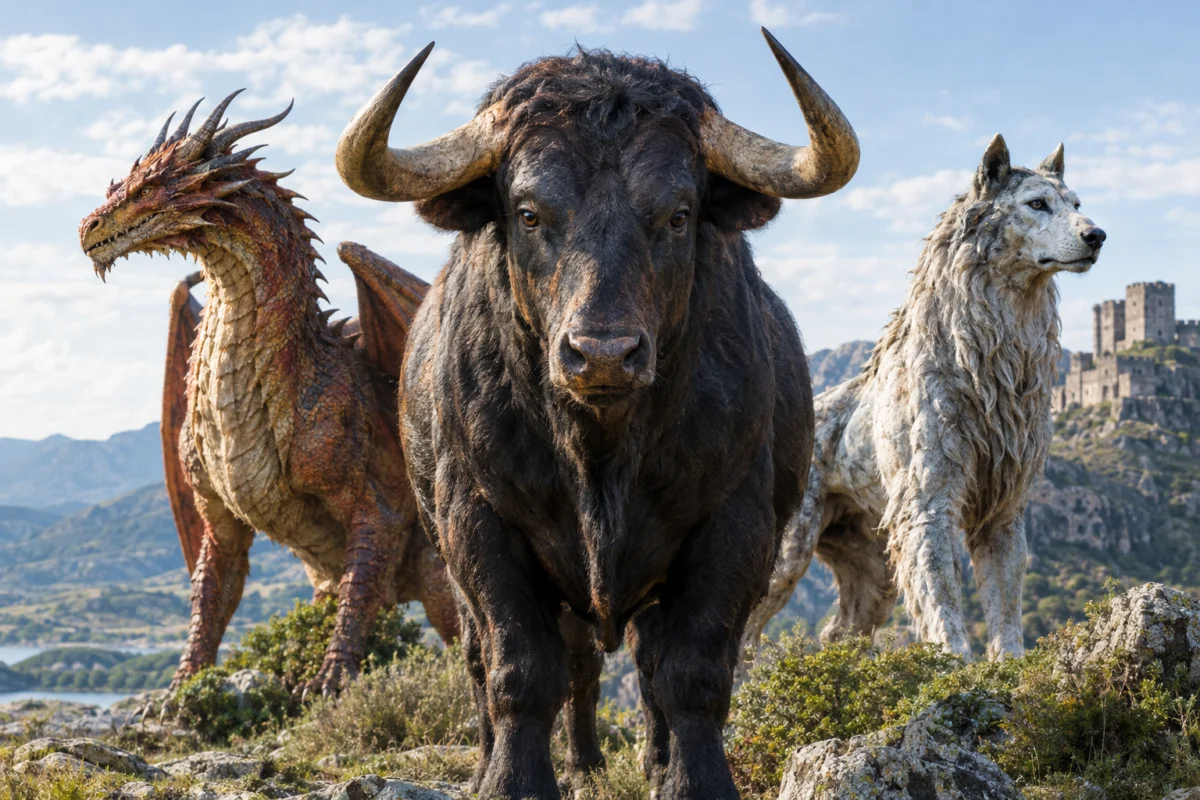
Aatxe’s safest core appearance is bovine. Sources describe a young bull, bull, cow, or small red cow associated with caves.
Red coloring becomes especially explicit in names such as Aatxegorri and Beigorri, while some local accounts do not require one fixed bovine form.
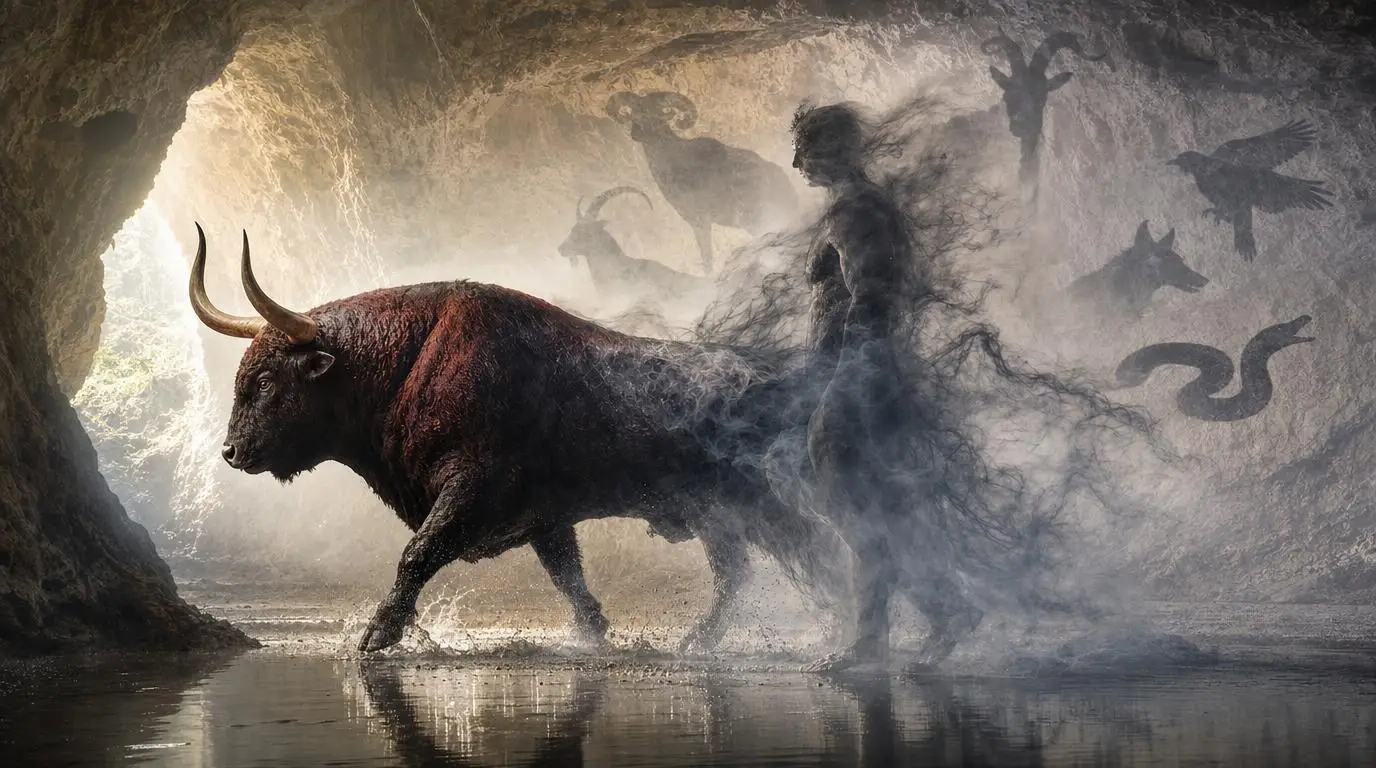
Barandiarán’s broader mythology places these cattle forms among many animal manifestations connected with the underground world, including horses, rams, goats, pigs, dogs, serpents, and vultures. The emphasis falls less on anatomy than on the transformation of a cave spirit into recognizable animal bodies.
At Lezia, the guardian can also assume human form, especially when confronting people who have offended it. This shape-changing detail prevents Aatxe from fitting neatly into the category of a magical bull, because the folklore treats physical form as flexible rather than permanent.
Related Zezengorri traditions sometimes describe fiery bulls or bulls that emit fire, but those stories belong to a broader Basque red-bull complex. They should not automatically define Aatxe’s standard appearance unless a specific local source explicitly connects the fiery features to Aatxe.
Background Story
Aatxe does not survive through one canonical epic. Its background emerges from a network of cave traditions in which supernatural beings occupy underground spaces, guard entrances, control access, and punish disrespect.
This structure makes place more important than a single biography, genealogy, or creation story.
The strongest localized account centers on Lezia at Sare. There, a bull or cow-shaped guardian watches the cavern and can appear as a man when dealing with offenders.
The same being is called Etsai in the surrounding tradition because of its threatening, punitive role.
Lezia also belongs to the Axular story cycle. Etsai runs a supernatural school in the caves, where students learn theology, magic, arts, or sciences, depending on the version.
The teacher demands a dangerous price, turning the cave into both a place of knowledge and captivity.
This overlap explains why Aatxe can seem contradictory. One strand presents a bovine guardian, another a humanlike teacher or punisher, and Barandiarán’s larger framework treats such forms as expressions of subterranean powers connected with Mari.
The folklore values function and location over stable appearance.
The Mari connection also places Aatxe inside a larger mythic geography. Caves serve as openings between the human landscape and an underground realm populated by numina, treasures, and animal-shaped powers.
In that setting, a red bull guardian fits a repeated Basque supernatural pattern.
For the article, it is safest to present Aatxe as a localized shape-changing cave spirit with strong bovine imagery and a close relationship to Mari’s mythological world. Claims about universal morality, prehistoric worship, or a single ancient origin should remain qualified unless stronger evidence appears.
Famous Folklore Stories
Axular and the Shadow of Etsai
In the best-documented Lezia tradition, the cave spirit called Etsai occupies the same local mythic identity as Aatxe, the bull or cow-shaped guardian. Etsai runs a hidden school inside the caves of Sare, where Axular and other pupils study theology and magic.
At the end of their studies, one pupil must remain in Etsai’s service as payment. Axular takes his brother’s place and receives an impossible task: drawing water with a vessel whose bottom works like a sieve while constantly answering his supernatural master.
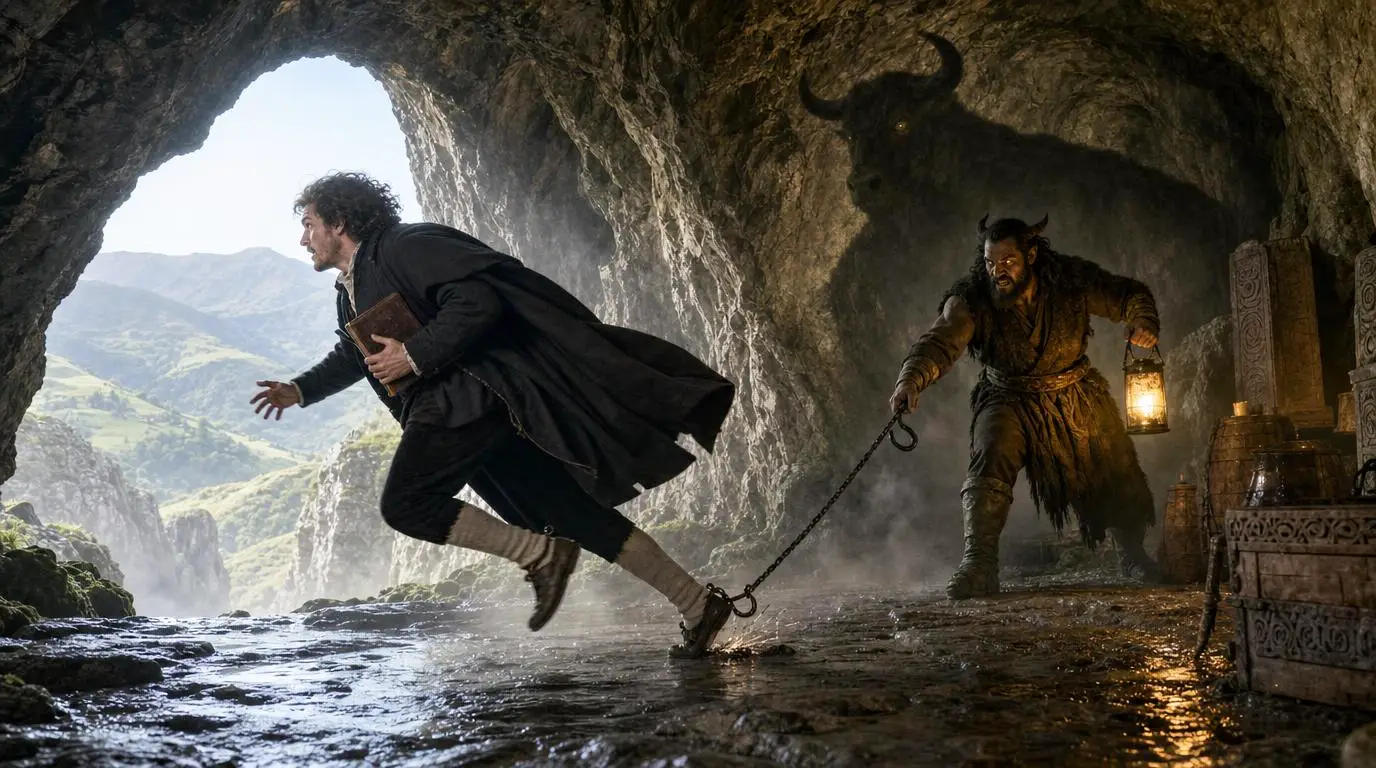
“Axular, where are you?” “I am here!” Barandiarán records this repeated exchange in the collected legend.
The English wording translates the Basque dialogue preserved in José Miguel de Barandiarán’s “Axular’en itzala,” published in Gure Herria of Bayonne, volume XXIX, 1957, pages 97-110.
Axular eventually teaches the sieve, or in another version his beret, to answer for him. While Etsai hears the false response, Axular races toward the cave entrance, hoping to cross the boundary before his captor realizes that his prisoner has escaped.
Etsai notices at the last moment and throws an iron hook. Axular reaches freedom, but the hook catches his heel and shadow, leaving both under Etsai’s power.
The legend later explains Axular’s wisdom, priesthood, and troubling supernatural bond through this escape.
Jabier of Arratiñea and the Fiery Red Bull
A second important red-bull story comes from Ataun, where Barandiarán’s mother told him the tale of Jabier of Arratiñea in 1921. Although the spirit is called Zezengorri, it belongs to the same Basque red-bovine complex as Aatxegorri and related cave beings.
Jabier spends an evening at Urretsu with local young women and jokingly imitates a priest, handing out boiled chestnuts as Communion. The women warn him not to walk home after such behavior, fearing something uncanny may confront him along the dark rural road.
“Then a fiery Red Bull appeared to him, coming toward him again from Laioa.” This English translation follows the recorded Basque tale “Arratiñeako Jabier,” told by Maria Antonia Aierbe Dorronsoro to José Miguel de Barandiarán in Ataun in 1921 and preserved today.
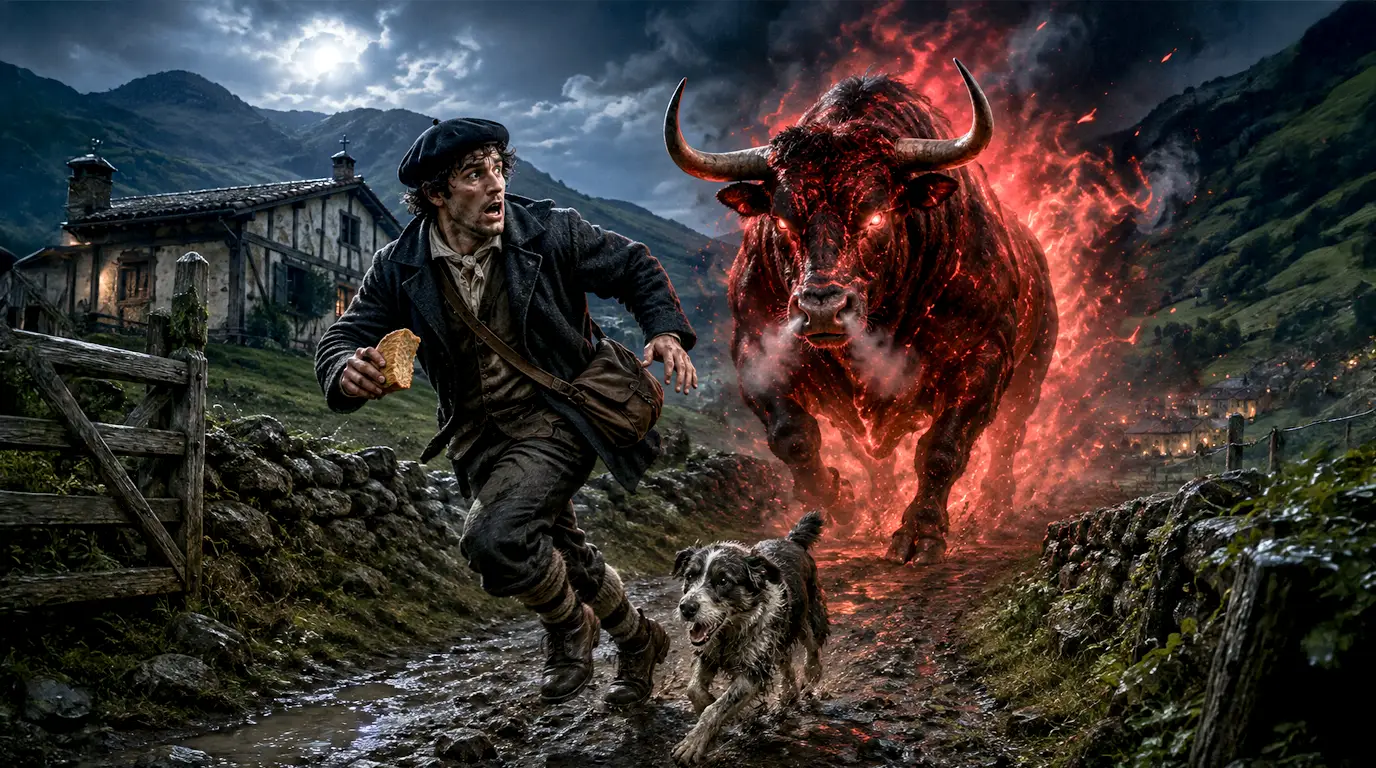
Frightened by supernatural signs, Jabier reaches Tellerietxe and asks for a dog to accompany him. He keeps the animal beside him with a piece of corn cake, and the fiery bull no longer terrifies him while the dog remains close during his journey.
When the food runs out, the dog turns back and the threatening apparitions return. Jabier runs desperately to Arratiñea and reaches the farmhouse.
That night, the cattle remain violently disturbed, with loud bellowing and noises from horns and feeding troughs around the stable.
Cultural Impact
Aatxe contributes to a wider Basque cultural landscape where caves, mountains, storms, animals, and supernatural beings remain closely connected. Its importance lies less in one famous epic than in how local communities attached mythic meaning to specific places, especially cavern entrances and mountain terrain.
Barandiarán’s collections helped preserve these regional traditions during the twentieth century, when oral folklore faced rapid social change. By recording names, locations, and local variants, his work allowed figures such as Aatxe to enter modern scholarship without erasing their strongly local character.
Today, Aatxe also illustrates how Basque folklore resists simple categories such as god, demon, or monster. The creature can function as guardian, punisher, animal apparition, or form of another numen, showing how flexible traditional supernatural identities can remain across neighboring communities.
Similar Beasts
Zezengorri
Zezengorri, the “Red Bull,” is a Basque folkloric bull apparition that appears in local legends as a dangerous, uncanny animal, sometimes described with fiery or storm-linked traits. It belongs to the same wider Basque complex of supernatural cattle and red-bovine figures that cluster around specific places and cautionary encounters.
Zezengorri is the closest parallel to Aatxe because both are framed through bovine power and threat, and both sit in the same Basque landscape of caves, roads, and night travel where a wrong step can bring a supernatural confrontation.
Akerbeltz
Akerbeltz is a Basque numen commonly described as a black goat or goat-shaped spirit associated with livestock and, in later tradition, witchcraft imagery. Like other Basque animal numina, it is less a single “monster” than a supernatural presence that can mark places, boundaries, and authority over herds.
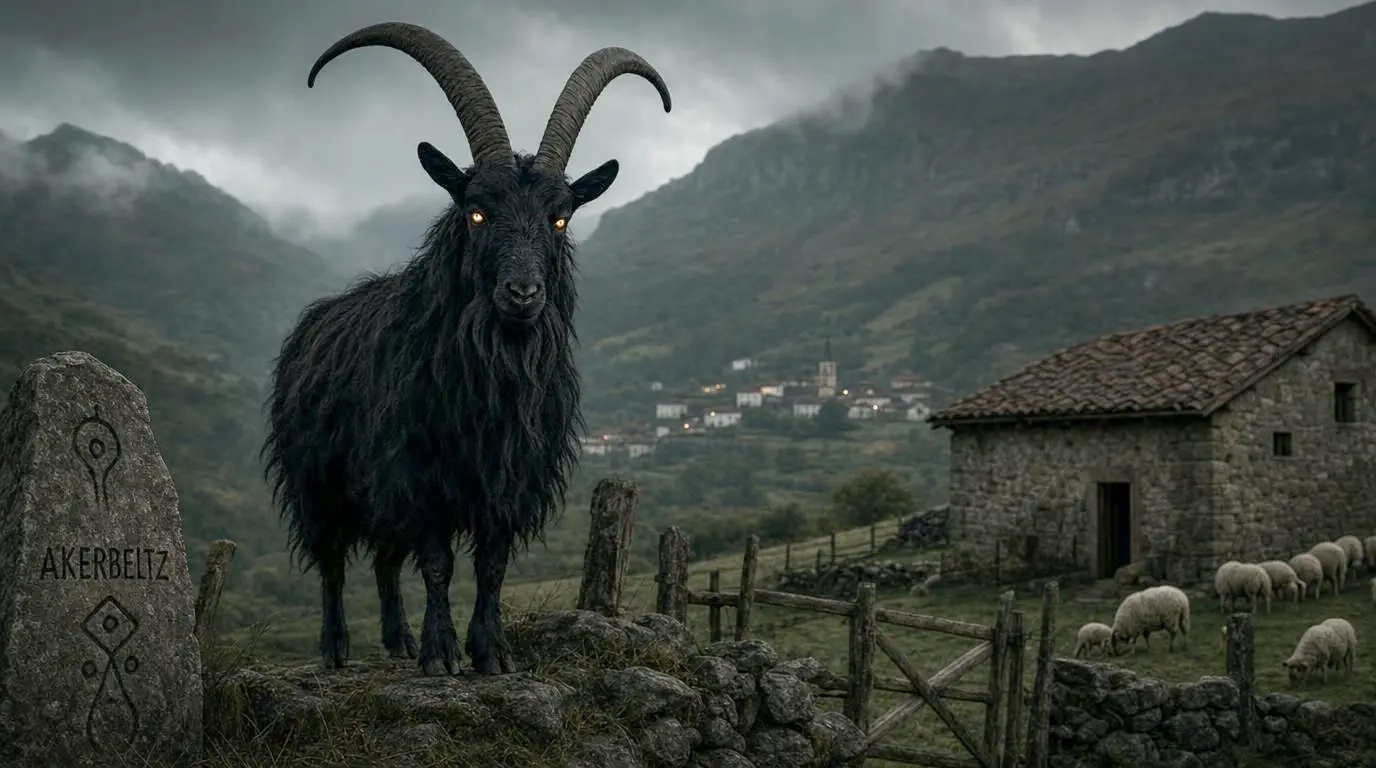
Akerbeltz belongs here because it shows the same Basque pattern that shapes Aatxe: animal form used as a sign of supernatural power, often tied to rural life and liminal spaces, even though Akerbeltz is primarily caprine rather than bovine.
Mari
Mari is the major Basque numen associated with mountains, caves, weather, wealth, and transformation. In ethnographic discussion, Mari often functions as the larger framework that explains why certain caves and peaks are treated as inhabited, guarded, and morally charged.
Mari is not “similar” to Aatxe as another bull-spirit, but she is closely related in function and context because Barandiarán and later writers sometimes treat animal-shaped cave spirits as manifestations of Mari or as powers operating within her mythic geography.
The Cretan Bull
The Cretan Bull is a powerful bull from Greek mythology, best known as a dangerous creature subdued by Heracles and tied to the myth-cycle around Crete. It is a narrative beast of heroic conquest rather than a localized guardian spirit anchored to one sacred site.
It fits as a cross-cultural comparison because it highlights how bull imagery can signal overwhelming, other-than-human force, but Aatxe differs in role and setting: Aatxe is primarily a place-bound cave guardian and shape-changing presence rather than a trophy of a hero’s labor.
Religion/Ritual
No surviving evidence shows a formal cult dedicated specifically to Aatxe. The strongest ritual context comes instead from broader Basque cave religion, where Barandiarán recorded offerings, pilgrimage customs, and rules for approaching supernatural cave dwellers, especially traditions centered on Mari.
Roman coins found in caves including Isturitz, Santimamiñe, Sagastigorri, Covairada, and Solacueva were interpreted by Barandiarán as offerings seeking protection from cave spirits. These finds establish ritual use of caves, but they do not identify Aatxe as the intended recipient.
Mari traditions also preserve offerings of rams, candles, coins, clothing, and annual visits to sacred caves. Because Aatxe may represent a form of Mari in some accounts, these practices provide useful religious context, but they should not be presented as confirmed Aatxe worship.
Scientific or Rational Explanations
There is no accepted scientific explanation for Aatxe, because folklore does not require a single physical event behind it. A cautious approach instead considers how real caves, cattle, storms, darkness, and inherited oral traditions could have supplied memorable material for supernatural stories.
Basque caves genuinely contain prehistoric animal art. Santimamiñe preserves paintings of bison, horses, goats, deer, and bears, while Altxerri contains dozens of bison images.
These discoveries create a striking visual parallel with animal spirits, but they cannot date Aatxe itself.
Caves also create restricted, dangerous environments where darkness, echoes, falling water, unusual rock forms, and sudden weather outside can intensify fear and imagination. Such conditions may help explain why folklore locates powerful beings underground, although this remains interpretation rather than documented origin.
Modern Cultural References
Guild Wars
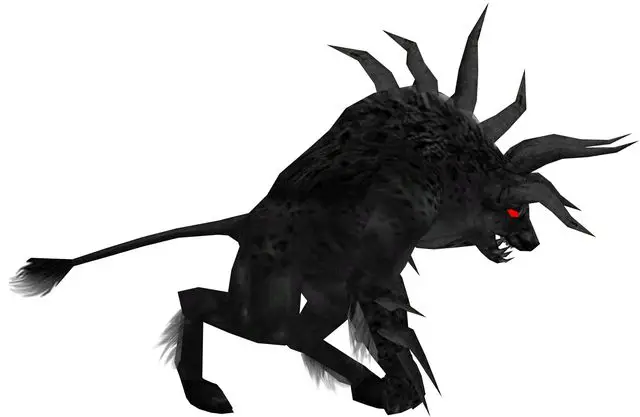
In the original Guild Wars, Bladed Aatxes appear as Nightmare warriors within the Underworld. The game preserves the creature’s name and threatening bovine identity while transforming a localized Basque cave spirit into an aggressive fantasy enemy encountered during high-level supernatural adventures.
Guild Wars 2
Guild Wars 2 continues the name with Aatxes classified as Nightmare creatures appearing where the boundary between the world and Underworld grows thin. Their charging attacks retain a bull-like combat idea, while the setting replaces Basque caves with Tyria’s supernatural geography.
Creature Codex
Kobold Press included Aatxe in its 2018 Creature Codex for Fifth Edition fantasy roleplaying. This version presents a crimson bull-shaped celestial guardian that can assume human form, deliberately emphasizing the protective and shapeshifting elements found in Basque folklore rather than pure monstrosity.
Disco Zoo
NimbleBit’s mobile game Disco Zoo includes Aatxe among the animals available in its Mountain region. The game turns the obscure Basque spirit into a collectible pixel creature, placing it beside ordinary mountain animals and using mythology as part of its playful zoo roster.
Conclusion
Aatxe survives as one of the most distinctive bovine spirits in Basque folklore, yet its identity remains deliberately unstable. Depending on place and storyteller, it can appear as bull, cow, calf, man, guardian, enemy, teacher, or manifestation of a larger underground power.
That flexibility matters more than attempts to force Aatxe into a single modern monster profile. The most reliable evidence ties the figure to caves, bovine forms, Lezia, Etsai, and Mari’s mythological sphere, while many popular details come from later interpretation.
Modern games and roleplaying books have carried Aatxe far beyond the Basque Country, often simplifying or reshaping the spirit for fantasy audiences. Returning to Barandiarán’s collected traditions reveals a stranger figure whose meaning depends on landscape, local memory, and supernatural transformation.
Further Reading
The Element Encyclopedia of Magical Creatures: The Ultimate A-Z of Fantastic Beings from Myth and Magic (AATXE entry) | Everand
Contains a direct ‘AATXE’ entry describing it as a Basque bull-spirit associated with caves/gorges and stormy nights, and explicitly distinguishes the younger form ‘Aatxegorri’.
Source
Leize sakratua zaintzen duen zezena | Lurkaia
Basque-language version of an Aatxe legend/explainer, useful for terminology/phrasing in Euskara (e.g., ‘zezen gaztea’, ‘txahala’) and for seeing how the creature is framed in Basque narrative context; includes source leads (Barandiaran/Azkue/Caro Baroja).
Source
Aatxe – Toro Guardián | Lurkaia
Dedicated creature profile: describes Aatxe’s appearance (red bull with fiery eyes), storm-night emergence, connection to Mari, cave/sima guardianship, and notes the alias Etsai plus brief etymology.
Source
Living Mountains in Iberian Cave Art (PDF) | ResearchGate
Scholarly discussion linking Basque mythic figures and landscape/cave contexts; includes a specific passage connecting Mari’s transformations and the shape-shifting red bull ‘Aatxe’ as a cave-dwelling spirit, giving an academic framing for motif/origin arguments.
Source
Lo pagano y lo cristiano en Iruña-Veleia: ponentzia osoa (PDF) | euskerarenjatorria.eus
Long-form scholarly text that explicitly names Aatxe/Aatxegorri alongside Zezengorri/Beigorri as animal-transform manifestations associated with Mari/Andere, discussing unclear boundaries between ‘genius’ and goddess manifestation, useful for disambiguating aliases and roles.
Source
Aatxe – Auñamendi Eusko Entziklopedia
Source