

Introduction
The Sirens are dangerous singers in Greek mythology, best known for confronting Odysseus during his voyage home. In the Odyssey, two voices call from an island, offering pleasure and knowledge while threatening the safe return of anyone who stops to listen.
Their power works through attraction rather than an attack on the ship. Odysseus wants to hear them, but his crew must keep rowing.
Wax protects the sailors’ hearing, while ropes prevent their commander from acting on the desire their song awakens.
Homer gives the Sirens no physical description. The familiar classical image of women combined with birds belongs to other ancient evidence, including Greek vase painting and later mythography.
The fish-tailed Siren familiar from later imagery should not be projected backward into the poem.
This distinction matters because the Sirens’ identity does not originally depend on a particular monstrous body. Their defining qualities are their voices, their promise of understanding, and the deadly interruption they pose to a journey that must continue if its travelers are to survive.
History/Origin
The earliest literary account considered here is Book 12 of the Odyssey, conventionally dated to the eighth century BCE. The Sirens enter the narrative as an existing danger along Odysseus’ route, not as characters whose birth or transformation the poem needs to explain.
That account establishes the central encounter: an island, two singers, a passing ship, and precautions that allow the travelers to escape. The bones of dead men nearby reveal the consequences of listening.
Their presence makes the pleasant invitation inseparable from the prospect of death.
By about 480–470 BCE, Greek vase painting provides direct evidence for a bird-bodied visual form. A vase discussed by the British Museum depicts woman-headed birds around Odysseus’ ship.
It demonstrates that artists could give visible anatomy to beings whose bodies Homer leaves unstated.
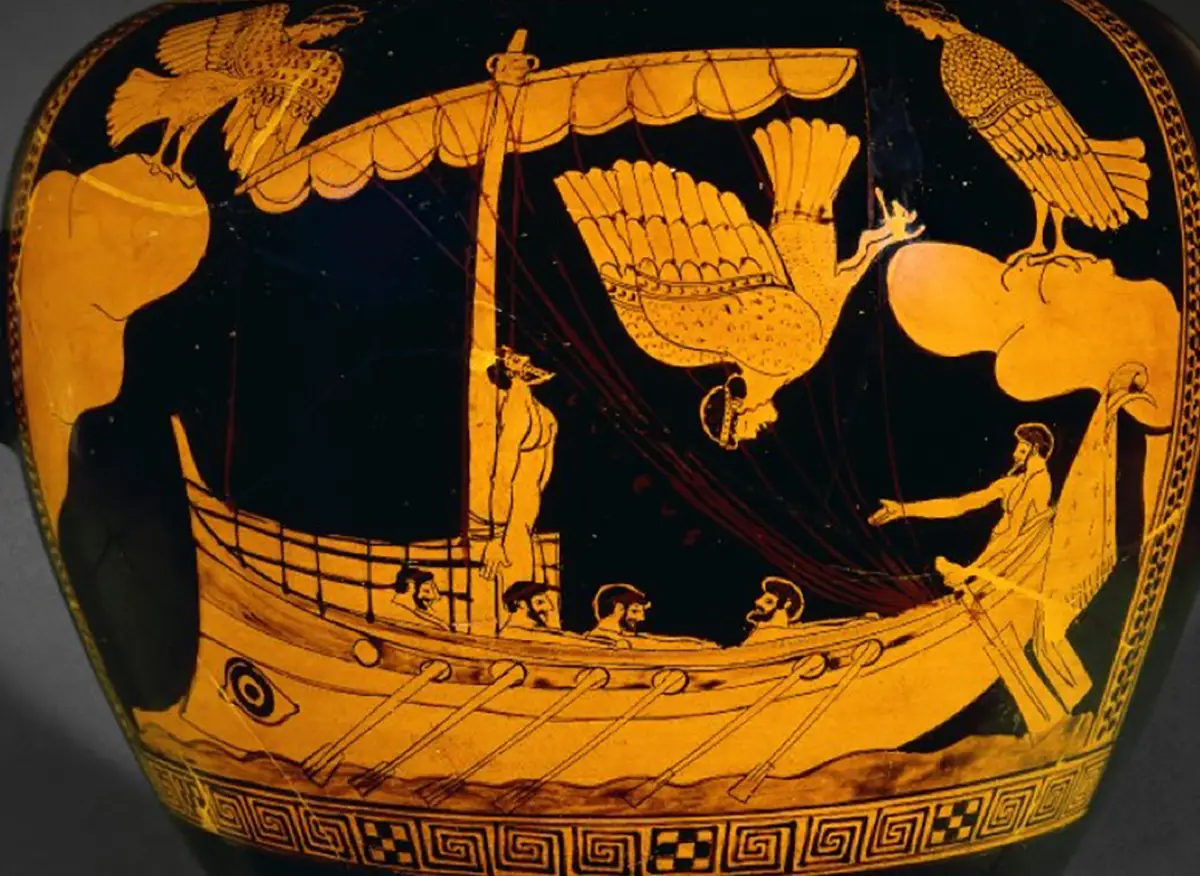
The same vase also illustrates how an image can extend beyond the surviving Homeric narrative. One Siren plunges into the sea, interpreted in the museum’s account as despair at being outwitted.
That action should not be treated as an event narrated in the Odyssey.
A death following the ship’s escape appears in the later mythographic account attributed to Apollodorus. There, the Sirens are destined to die when a ship passes them.
Odysseus’ successful passage therefore fulfills a prophecy, whereas Homer ends the encounter with the travelers safely beyond hearing.
The tradition consequently preserves more than one narrative layer. Homer supplies the foundational literary encounter; ancient art supplies explicit hybrid bodies; later mythography gives a fatal outcome for the singers.
These forms are related, but they do not constitute a single unchanging description.
Name Meaning
The Greek singular is Seirēn, and the plural is Seirēnes. English normally uses “Siren” and “Sirens.” The forms Seiren and Seirenes also occur as transliterations, but the underlying meaning of the Greek name remains disputed rather than securely translated.
A specific linguistic proposal appears in the 2018 study by Luján Martínez and Vita Barra. They suggest a connection with Ugaritic šrm, understood as a dual or plural form of šr, meaning “singer.”
Their argument presents a candidate origin, not an established consensus.
Under that proposal, the name would connect with the activity most prominent in the Greek narrative: singing. That correspondence makes the hypothesis relevant to the Sirens’ identity, but a meaningful resemblance between words and mythic roles does not, by itself, establish a historical derivation.
The distinction between a creature’s function and its name’s origin is especially important here. The Sirens unquestionably sing in the Odyssey; whether their name originally meant “singers” is a separate linguistic question.
The proposed Ugaritic connection should therefore remain attributed rather than stated as a translation.
Appearance
The Homeric Sirens have no stated anatomy. Their island, voices, and deadly surroundings are described, but the poem does not identify wings, feathers, human torsos, or fish tails.
A reconstruction based strictly on this account must leave their bodily form open.
Other ancient evidence supplies a recognizable woman-and-bird hybrid. Classical depictions commonly combine a female head or upper body with a bird’s body, wings, or legs.
This is the best-supported visual tradition for an explicitly classical Siren, although it should not be labeled Homer’s description.
The Greek vase dated about 480–470 BCE offers a concrete example: its Sirens have women’s heads and birds’ bodies. Their position around the passing ship connects their hybrid appearance to the familiar encounter, rather than presenting them merely as unrelated decorative birds.
Later mythography also makes the combination explicit. The account attributed to Apollodorus describes women above and birds below.
Its bodily description agrees broadly with the classical hybrid tradition, while adding information absent from the Homeric passage rather than explaining words already present there.
The fish-tailed form belongs to a later development in Siren imagery and overlaps with the familiar mermaid. It is therefore misleading as the default appearance for the Odyssey.
The enduring name links these images, but the bodies represent different stages of the figure’s visual history.
Background Story
The Sirens’ Homeric background is the difficult business of getting home. Their island interrupts a voyage whose success depends on continued movement.
Unlike a barrier that must be physically broken, their danger invites the traveler to abandon progress willingly for the experience of listening.
The promise is not simply an attractive sound. Their song offers pleasure and knowledge, giving Odysseus a reason to want an encounter he has already been warned against.
As a literary temptation, it joins the wish to hear with the wish to understand.
Circe’s warning provides the practical framework for survival. The sailors stop their ears with wax, while Odysseus is bound upright to the mast.
The arrangement separates hearing from action: he can experience the song, but he cannot redirect the ship toward its source.
His subsequent demand for release shows why advance preparation matters. The crew responds by tightening his bonds and continuing to row.
The episode can thus be read as a conflict between an earlier, informed decision and an immediate desire strong enough to overturn it.
The bones beside the singers give this conflict its stakes. Pleasure and promised knowledge occupy the same setting as the remains of previous listeners.
The contrast makes the Sirens more than entertainers or generic sea monsters: their invitation conceals the destruction of the traveler’s future.
Later versions reshape that balance by making the Sirens themselves vulnerable to a successful passage. The prophecy preserved in Apollodorus turns Odysseus’ escape into their destruction.
Homer’s narrative centers on resisting their power; the later ending also explains how that power comes to an end.
Famous Folklore Stories
Odysseus and the Sirens
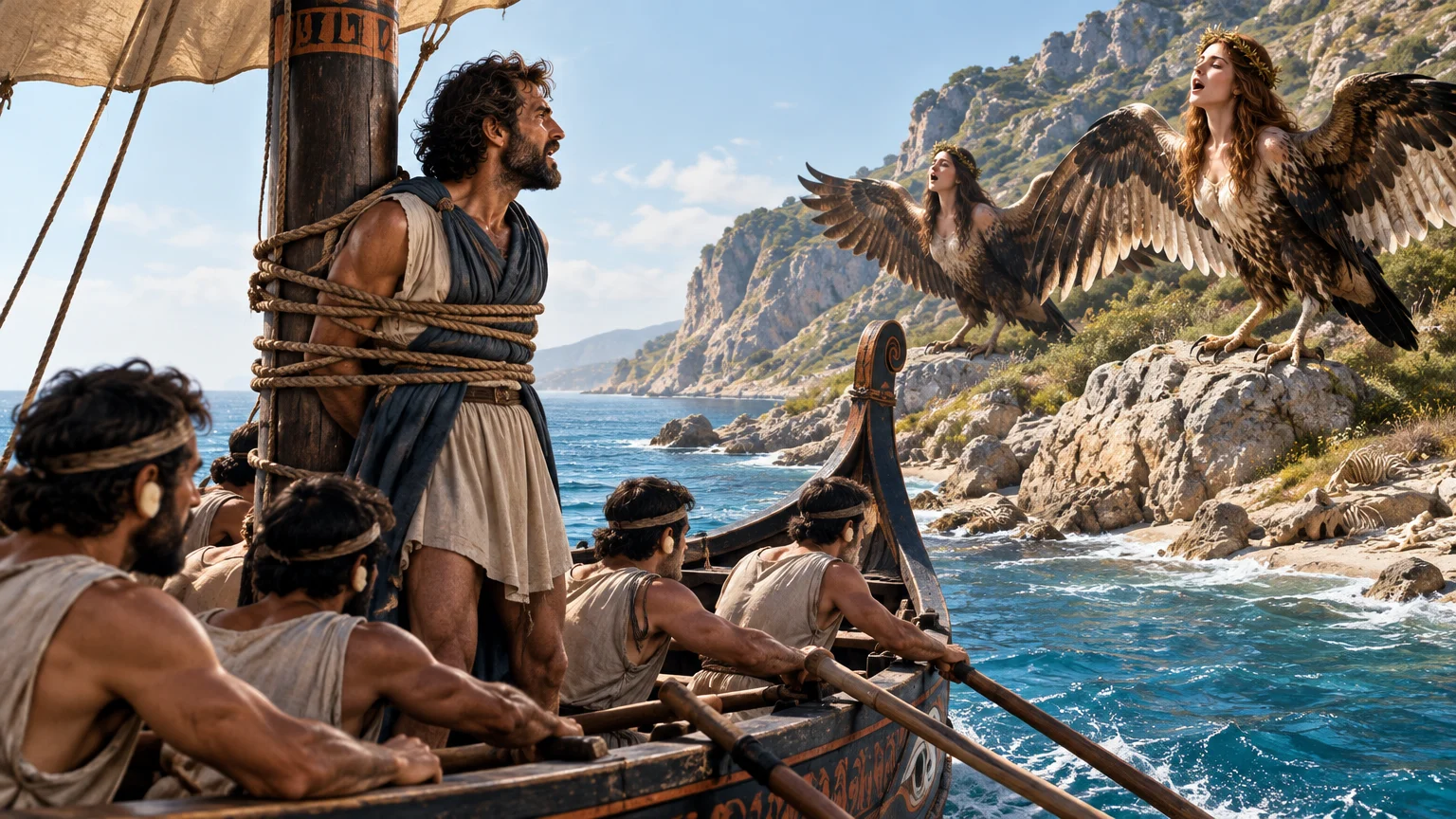
The encounter in Book 12 of the Odyssey begins with advance warning rather than an unexpected attack. Circe explains the danger, allowing Odysseus to prepare his crew.
Their protection depends on stopping their ears with wax and binding their captain upright to the mast.
As the ship approaches, two Sirens address Odysseus by name. They promise pleasurable listening and knowledge, including knowledge of the suffering at Troy.
The appeal is directed toward his experience and curiosity, not simply toward an anonymous sailor’s attraction to a beautiful voice.
Odysseus signals that he wants release, but his companions follow his earlier instructions and tighten his bonds. They continue rowing until the song is beyond hearing, then take out their earplugs and untie him.
Homer supplies neither a physical description nor a death scene for the Sirens.
The Sirens’ Death After Odysseus Passes
A later ending appears in the mythographic Epitome attributed to Apollodorus. The Sirens are subject to a prediction that they will die when a ship passes them.
Odysseus successfully sails beyond their reach, and their own deaths follow the failure of their song.
This version changes the outcome from a successful escape into a fatal defeat for the singers. Homer’s episode ends differently: the Odyssey brings Odysseus safely out of hearing but leaves the Sirens’ subsequent fate unstated.
Orpheus and the Argonauts
In Apollonius’ Argonautica, the Argonauts encounter the Sirens with a musician aboard. Orpheus plays his lyre strongly enough to overpower their voices.
Instead of relying on silence and physical restraint, this episode sets protective music against music that draws its listeners toward danger.
The escape is not equally secure for everyone. Despite Orpheus’ counter-song, Boutes hears the Sirens and leaps into the sea, drawn toward their shore.
Aphrodite rescues him before he can perish and carries him away to safety. His survival depends on divine intervention, showing that Orpheus’ music protects the voyage without shielding every individual from the Sirens’ appeal.
Cultural Impact
The encounter became a recognizable subject in Greek visual storytelling. A vase dated about 480–470 BCE, discussed by the British Museum, shows bird-bodied Sirens around Odysseus’ ship.
One plunges into the sea, giving the image an outcome absent from Homer’s narrated encounter.
Siren imagery also circulated independently of illustrations of epic. An East Greek perfume vessel, dated about 540 BCE and now in the Walters Art Museum, takes the shape of a woman-headed bird.
Such objects brought the hybrid figure into material culture beyond narrative painting.
The wider artistic background includes exchanges between Greece and the Near East. Siren-like attachments decorated bronze cauldrons, many manufactured in the Near East and imported into Greece.
These connections illuminate the circulation of hybrid imagery without proving that every object represented Homer’s island singers.
A specific medieval reinterpretation appears in Dante’s Purgatorio, Canto XIX. A Siren appears in a dream, sings of her power to divert mariners, and claims to have drawn Ulysses aside.
A saintly woman intervenes, and the exposure of the figure brings the dream to an end.
Dante’s episode turns attractive song into a problem of deceptive perception and moral temptation. This is a literary reworking, not another surviving Greek adventure of Odysseus.
Its dream setting makes the listener’s response central to the Siren’s apparent beauty and persuasive power.
Similar Beasts
Mermaid
Mermaids are aquatic beings in European folklore and later storytelling, usually depicted with a woman’s upper body and a fish’s tail. Their character and relationship with humans vary between traditions.

Later fish-tailed Siren imagery overlaps with mermaids, but classical Sirens commonly have bird features, while Homer leaves their anatomy unstated.
Scylla

Scylla is a Greek sea monster encountered during Odysseus’ voyage after the Sirens. She belongs to the same narrative world of dangerous passages that threaten a ship’s company.
The comparison is narrative rather than anatomical: both endanger homecoming, but Scylla represents direct physical attack rather than the persuasive attraction of song.
Harpy
Harpies are distinct beings in Greek mythology whose imagery combines female and avian features. Their bird-woman appearance makes them a useful comparison with the classical visual form of Sirens.
Shared wings or female heads do not make these beings interchangeable. The Sirens’ defining Homeric function is their dangerous singing, while Homer leaves their anatomy unstated.
Kelpie

The Kelpie is a shapeshifting water spirit from Scottish folklore, commonly appearing as a horse. Its stories connect an apparently approachable creature with the danger of being drawn into water.
Like the Sirens, it can make approach itself hazardous. Unlike them, its characteristic lure involves an animal form rather than a promise delivered through singing.
Näcken

Näcken is a Scandinavian water spirit associated with enchanting music and shapeshifting. The combination of supernatural musical skill and a watery setting makes it an especially useful cross-cultural comparison.
The resemblance concerns music’s power over human listeners, not shared ancestry. Näcken belongs to a separate tradition and should not be treated as a Scandinavian Siren.
Crocotta

The Crocotta is a legendary predator in Greek and Roman animal lore, variously resembling a wolf-dog or hyena. Tales credit it with imitating human speech to draw people toward danger.
Its strongest parallel with the Sirens is an acoustic lure. Speech imitation and irresistible song are different devices, but both turn listening into a vulnerability.
Religion/Ritual
Siren imagery had a funerary dimension beyond its maritime setting. Figures associated with music and mourning appear in funerary art, connecting the hybrid singer with death and lamentation.
This context complicates any description of Sirens as nothing more than predatory sea monsters.
In Euripides’ Helen, lines 169–175, Sirens associated with Persephone in Hades are invoked to accompany lamentation with their lyres. This is a specific dramatic invocation, not documentation of a universally practiced ceremony.
It supports their connection with mourning without establishing a standardized Siren cult.
Scientific or Rational Explanations
The strongest explanations here concern literary construction and cultural history rather than the identification of a real animal. Homer’s episode describes dangerous voices but supplies no anatomy.
Consequently, a zoological identification cannot be established simply by comparing the poem’s creatures with a bird or marine mammal.
A psychological reading can begin with the precautions themselves. Odysseus anticipates that hearing the song will change what he wants, so he makes his earlier decision binding.
His crew’s refusal to release him dramatizes the conflict between immediate desire and a previously chosen goal.
The content of the song also supports a reading centered on knowledge. The Sirens appeal to Odysseus’ connection with Troy and promise fuller understanding.
Their danger can therefore be interpreted as consuming curiosity, not merely sexual temptation, although that interpretation does not establish the myth’s original purpose.
The contrast with Orpheus reveals another literary possibility: sound is not inherently destructive. In the Argonautica, one musical performance counters another.
The episode distinguishes music that interrupts a voyage from music that enables it to continue, rather than presenting all enchantment as an identical force.
Material evidence offers a separate historical explanation for the familiar hybrid image. Imported cauldron ornaments and locally used vessels demonstrate the circulation of composite forms.
Their history helps explain artistic conventions, but neither trade connections nor visual resemblance alone can reconstruct a single origin for the Sirens’ story.
Modern Cultural References
The Witcher 3: Wild Hunt, video game (2015)
CD Projekt RED’s fantasy role-playing game includes Sirens as hostile creatures.
Their deceptive female appearance gives way to winged, fish-like monsters, creatively reworking the tradition of dangerous attraction.
(press-start.gla.ac.uk)
Conclusion
The Sirens’ defining power is their song, not a single unchanging body. In the Odyssey, two singers promise Odysseus pleasure and knowledge while threatening his return home; Homer leaves their anatomy undescribed.
The bird-women familiar from ancient art and later mythography belong to a broader tradition, while fish-tailed imagery reflects subsequent developments. Keeping these forms distinct preserves the differences between poetic narrative, visual convention, and later adaptation, rather than treating every Siren as the same creature.
Across these traditions, the Sirens connect compelling voices with danger, desire, and the limits of human judgment. Their associations with mourning and death also extend their significance beyond the familiar maritime encounter.
Odysseus survives through preparation and his crew’s refusal to obey his momentary wishes, making the episode a story about restraint as well as temptation. Modern reinterpretations retain selected elements of that inheritance, but the ancient figure remains richer than either a beautiful mermaid or a monster defeated at sea.
Further Reading
Homer, Odyssey 12.153, Perseus Digital Library, 1900
Perseus provides Samuel Butler’s English translation of the Homeric encounter. It supplies the Sirens’ promises, the crew’s precautions, and the escape without specifying the singers’ anatomy.
(beta.perseus.tufts.edu)
Apollodorus, Epitome 7, Perseus Digital Library, 1921
This ancient mythographic account appears with accompanying commentary in Perseus. It documents bird-woman anatomy and the Sirens’ death, distinguishing later narrative developments from Homer’s earlier account.
(beta.perseus.tufts.edu)
The etymology of Greek ‘seirén’ revisited, Universidad Complutense de Madrid research portal, 2018
This university research record presents a specialist linguistic study and abstract.
It reviews disputed derivations and proposes a Ugaritic connection, useful for understanding why the name remains uncertain.
(produccioncientifica.ucm.es)
The Sirens’ lure, The adventures of Odysseus, British Museum
The British Museum’s exhibition guide discusses a Greek vase depicting Odysseus and the Sirens.
Its account illuminates bird-bodied imagery and an ending absent from Homer’s narrative.
(britishmuseum.org)
Argonautica IV 883–979, Dickinson College Commentaries
Dickinson’s commentary examines Apollonius’ account of the Argonauts encountering the Sirens. It explains Orpheus’ musical intervention and Boutes’ leap, offering an important comparison with Odysseus’ escape.
(dcc.dickinson.edu)
Ancient Terracottas from South Italy and Sicily in the J. Paul Getty Museum: Catalogue, Getty Publications
This Getty catalogue provides specialist discussion of Siren imagery and literary traditions.
It is particularly useful for their funerary associations, musical attributes, and connections with lamentation.
(getty.edu)
Vase in the Form of a Siren, The Walters Art Museum
The museum’s object record documents an East Greek perfume vessel shaped as a Siren.
It provides concrete evidence of woman-headed, bird-bodied imagery beyond illustrations of epic encounters.
(art.thewalters.org)
Sirens in Ancient Greece and the Near East, University of Colorado Boulder, Department of Classics, 2018
This university Classics essay explores Sirens through ancient objects and regional artistic connections.
It helps contextualize Greek imagery alongside Near Eastern manufacture, imports, and related visual traditions.
(colorado.edu)