Introduction
The Ennedi Tiger is a reported large feline associated with northeastern Chad and, in broader accounts, other mountainous parts of Central Africa. It belongs to cryptid literature rather than an established zoological classification.
Popular reference pages present it as a possible surviving saber toothed cat. The more directly relevant evidence comes from French hunting guide Christian Le Noël, whose account records testimony attributed to regional informants.
Le Noël connects a mountain tiger tradition with Toubou communities in Chad and Yulu communities in the Central African Republic. These geographical associations matter because the available descriptions do not all concern Ennedi itself.
The name evokes the Ennedi Massif, a sandstone landscape of plateaus, canyons, and valleys. UNESCO describes its water supported ecosystems and cultural heritage, providing geographical context without independently confirming the reported animal.
Its interest lies in the meeting of local animal testimony and cryptozoological interpretation. Reported names, remembered encounters, and comparisons with prehistoric cats became connected, although their relationship remains less secure than popular summaries suggest.
History/Origin
The tradition’s earliest beginnings cannot be securely dated from the available documentation. A central source is Le Noël’s French account, preserved in the Institut Virtuel de Cryptozoologie archive, which recounts conversations and reported encounters.
Le Noël presents the mountain tiger as an animal known to groups in several mountainous regions. This establishes how he understood the reports, rather than demonstrating a single tradition with a common historical origin.
One chronological anchor is his reference to a 1970 visit involving Yulu informants. A tracker reportedly placed an encounter with his father roughly thirty years earlier, suggesting approximately 1940 within that remembered account.
That chronology belongs to testimony about the Mellé hills, not a securely dated Ennedi sighting. Keeping the locations separate prevents an episode from the Central African Republic becoming evidence for an encounter in Chad.
The Ennedi landscape has a much deeper documented human history. UNESCO and the British Museum’s African rock art resources describe its artistic heritage, but that heritage does not establish the antiquity of this feline tradition.
Name Meaning
Ennedi Tiger combines a geographical designation with an animal comparison. Ennedi identifies the Chadian massif associated with the cryptid label; tiger conveys a perceived feline resemblance rather than establishing membership in the tiger species.
The French expression tigre des montagnes translates directly as mountain tiger. In Le Noël’s account, this broader descriptive term connects reports from different communities without proving that their animal categories were identical.
Le Noël attributes the name Biscoro to Toubou informants in Chad. His account does not establish its literal meaning, so translating it as saber toothed tiger or mountain spirit would exceed the evidence.
Koq-Nindji is the name he reports from Yulu informants. Its presence in the same discussion explains its association with the Ennedi Tiger in later summaries, but does not make it a verified Toubou synonym.
The safest approach preserves these names with their attributed communities. Their linguistic meanings and distribution remain unresolved in the examined material, while the French and English labels function primarily as descriptive umbrellas.
Appearance
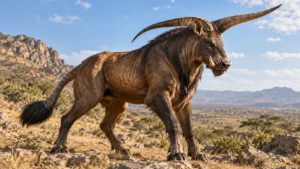
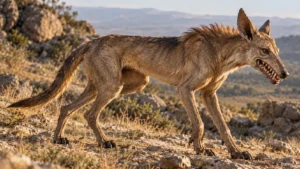
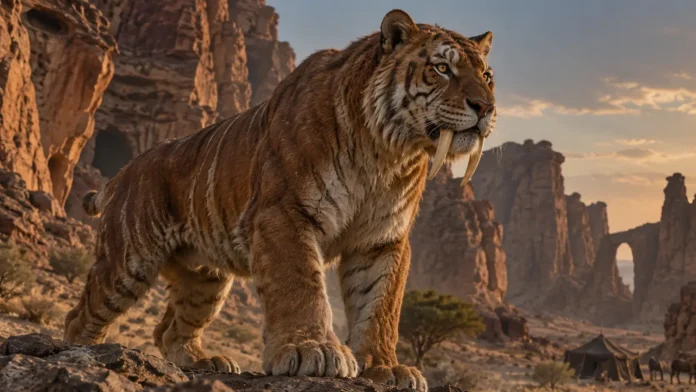
Le Noël’s account of Yulu descriptions portrays an animal somewhat larger than a lion. This relative comparison supplies a general impression of size, not measured dimensions or a verified anatomical profile for the creature.
The reported coat is reddish, with pale spots or stripes. Those alternative markings should remain alternatives: turning them into a fixed tiger pattern would erase the uncertainty preserved in the description itself.
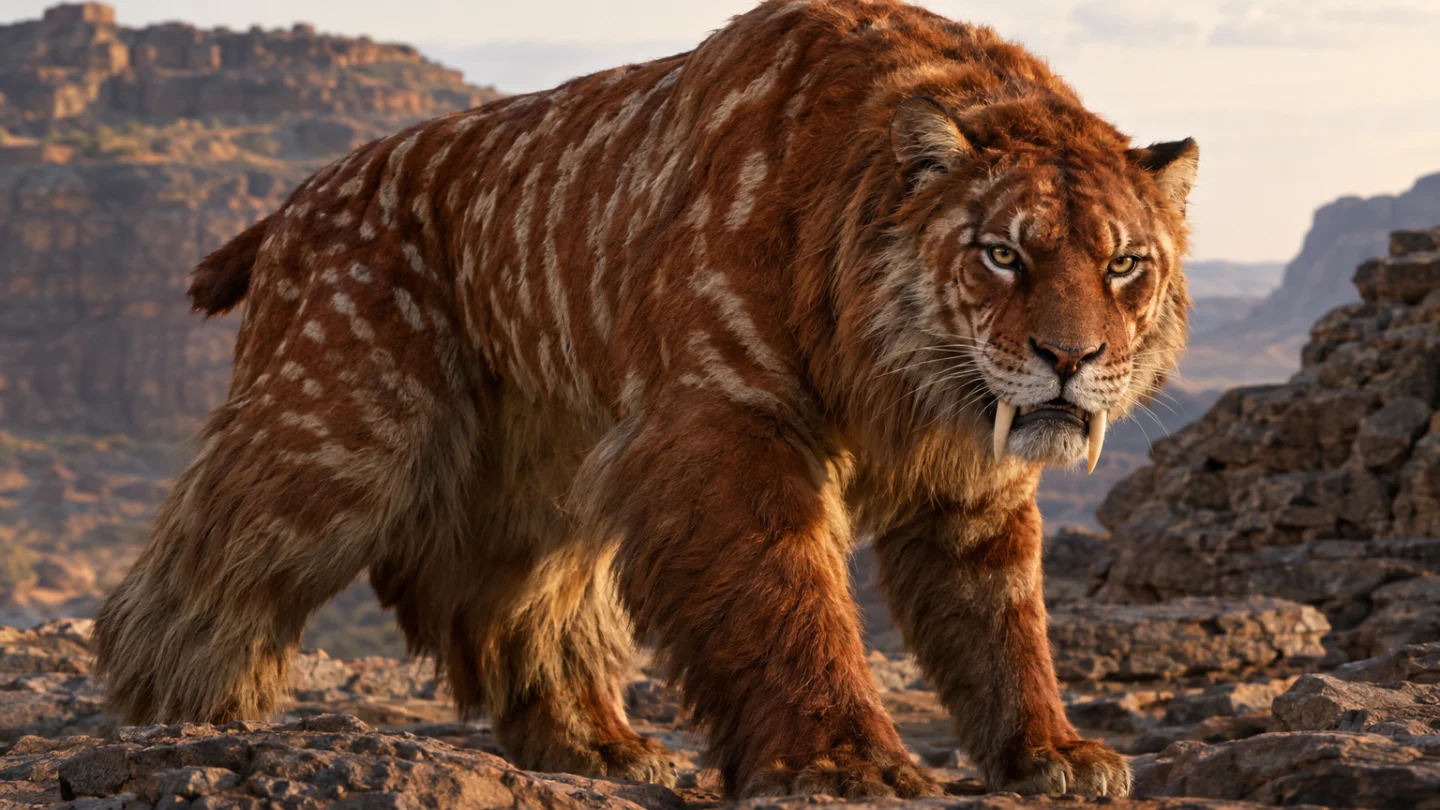
A short tail and long, thick hair on the upper legs distinguish the reported outline. Together, these details suggest a more particular feline image than the name tiger alone might lead readers to imagine.
The most striking feature is prominent canine teeth extending beyond the mouth. Le Noël also mentions a possible black form, which should be treated as a reported variation rather than the creature’s standard coloration.
Cryptid Wiki’s illustration offers a modern interpretation, not an independently documented traditional design. Moreover, the detailed Yulu description should not automatically be assigned to every Toubou report simply because later references group them together.
Background Story
The figure emerges from accounts of encounters with wildlife, rather than a documented creation myth or supernatural biography. Le Noël’s hunting background and conversations with trackers shaped how these reports entered written cryptozoological discussion.
The Mellé hills testimony concerns an animal taking an antelope killed by a tracker and his father. Its narrative setting is practical hunting experience, presenting the feline through its alleged actions rather than sacred ancestry.
Another formative element is Le Noël’s use of animal drawings. He reports showing Yulu trackers images of living cats and a prehistoric feline, then interpreting their selection of Smilodon as relevant to identification.
This exchange brought local testimony into contact with European paleontological imagery. The resulting saber toothed interpretation therefore reflects both the descriptions attributed to informants and the comparative framework supplied by the investigator himself.
Explore Chad and UNESCO describe Ennedi’s dramatic sandstone formations and water sustaining habitats. These sources help readers understand the landscape attached to the name, while providing no basis for assigning the creature a particular den.
Famous Folklore Stories
Christian Le Noël’s archived account records a hunting story and a picture-identification exchange associated with Central Africa’s mountain tiger reports. Both concern Yulu informants in the Central African Republic.
Their connection to the Ennedi Tiger comes through Le Noël’s comparison with reports from Chad, not through encounters in the Ennedi Massif. The subheadings here are descriptive labels rather than traditional tale titles.
The Mellé Hills Antelope Account
A Yulu tracker told Le Noël that he and his father had been hunting in the Mellé hills when they killed an antelope. A mountain tiger reportedly appeared and carried away the carcass, taking the hunters’ kill.
Le Noël places this encounter roughly thirty years before his 1970 visit, suggesting a date around 1940. That date depends on the tracker’s recollection rather than an independently dated record.
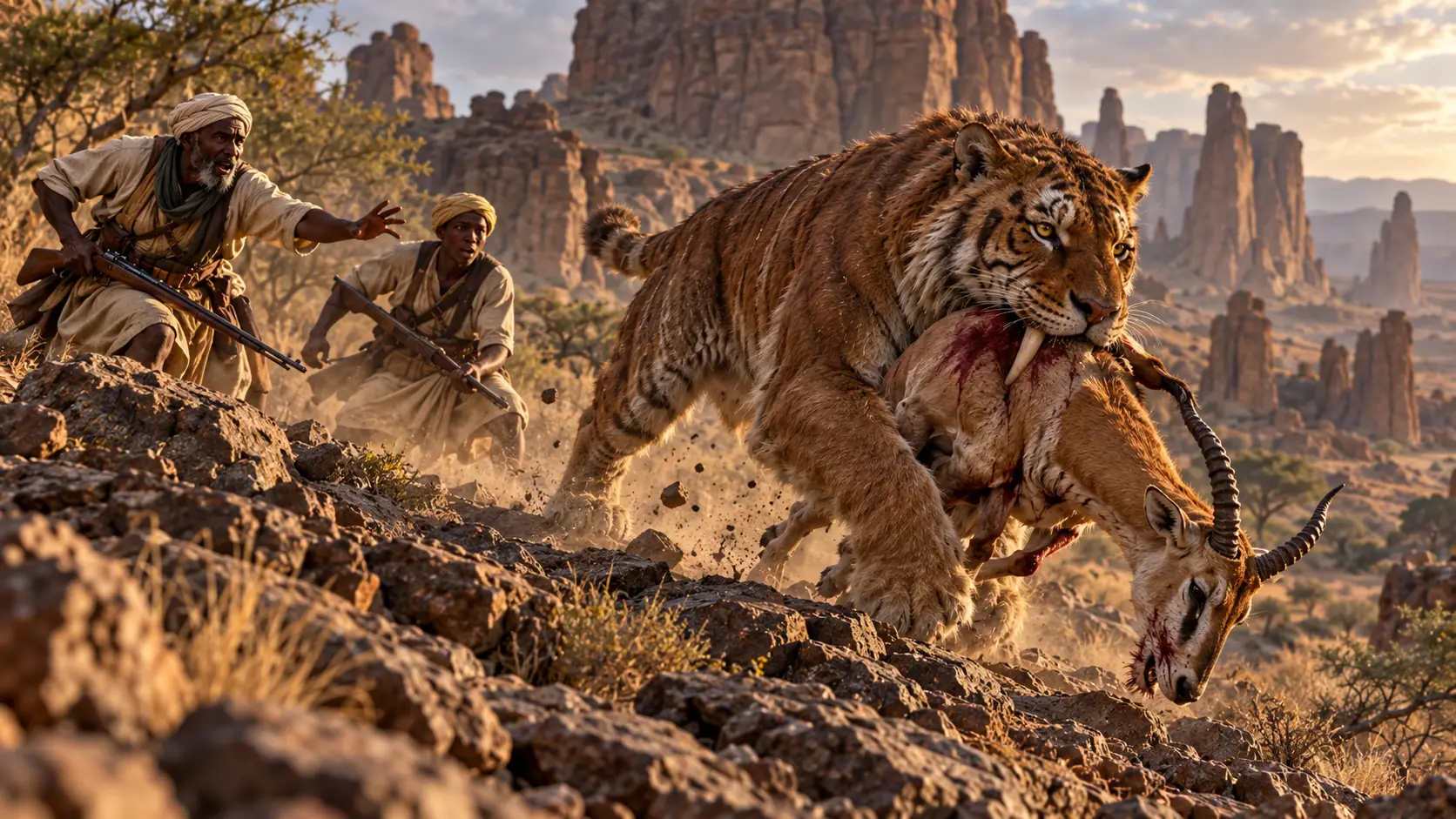
The episode portrays the reported feline through its actions: an animal capable of carrying off prey killed by hunters. It is a recorded encounter narrative within the broader mountain tiger material, not a verified sighting from Chad.
The Trackers’ Picture Identification
Le Noël also reports showing Yulu trackers drawings of living felines alongside an illustration of the extinct saber-toothed cat Smilodon. According to his account, they selected the Smilodon picture as resembling their mountain tiger.
This exchange is an investigative anecdote rather than a traditional folktale. It helps show how descriptions attributed to local informants became linked with prehistoric cats in Le Noël’s interpretation.
The selection records a reported resemblance, not a confirmed species identification. The supplied pictures limited the available comparisons, and the account does not establish a controlled identification procedure.
Cultural Impact
The clearest documented cultural context is hunting knowledge conveyed through local testimony. In Le Noël’s account, informants describe an animal within their regional experience, rather than presenting a fully developed supernatural character.
His French account connects Toubou reports from Chad with Yulu testimony farther south. That comparison helped frame a broader cryptozoological subject, but it does not demonstrate a shared tradition across those communities.
Modern popularization is visible on Cryptid Wiki, where illustration and discussion present the Ennedi Tiger to online audiences. Such representation belongs to contemporary cryptid culture, not to an authenticated traditional artistic canon.
The British Museum’s Chad rock-art resources and UNESCO’s Ennedi documentation establish a substantial cultural heritage independently of this report. Neither source justifies identifying ancient images as mountain tigers without specific supporting evidence.
Similar Beasts
The closest comparisons in Christian Le Noël’s account are regional mountain tiger reports and aquatic feline traditions. These entries are not four securely distinct creatures: some are overlapping labels whose relationship remains uncertain.
Mountain Tiger
The French expression tigre des montagnes means mountain tiger. Le Noël uses it as a broader category for reported felines associated with mountainous parts of Central Africa.
The Ennedi Tiger overlaps with this category rather than standing apart as a confirmed separate creature. The comparison places the Ennedi reports within Le Noël’s regional framework without establishing that every account concerns the same animal.
Koq-Nindji
Koq-Nindji is the name Le Noël attributes to Yulu informants in the Central African Republic. Their descriptions include a large feline with a short tail and prominent canine teeth extending beyond its mouth.
These reported features help explain the comparison with the Ennedi Tiger and the later saber-toothed interpretation. However, the Yulu testimony concerns a different geographical setting and does not establish an identical tradition or species in Chad.
Biscoro
Biscoro is a reported Toubou name recorded by Le Noël in connection with Chad’s mountain tiger tradition. Its literal meaning and wider linguistic usage remain unverified in the available account.
Its relevance is primarily as a community-attributed designation associated with the Chadian reports, not as evidence of another beast. The detailed Yulu description should not automatically be assigned to Biscoro simply because Le Noël discusses both together.
Water Lion or Water Leopard
Le Noël also discusses reported aquatic felines under water lion or water leopard terminology, including the name Ndzé-ti-ngou. These accounts associate a feline-like creature with water rather than the mountainous setting emphasized by the mountain tiger label.
They provide a comparison through their reported feline nature, and Le Noël considers a possible relationship. That connection remains speculative: aquatic reports should not be merged with the Ennedi Tiger or treated as confirmation of its identity.
Scientific or Rational Explanations
Le Noël interprets the reported projecting canines through comparisons with Machairodus and Smilodon. This is a cryptozoological hypothesis based on descriptions, not physical evidence that an extinct feline survived into modern times.
Misidentification of a living large cat is another possible explanation, although the available reports cannot establish it. Assessing that possibility would require reliable observations of size, markings, dentition, and the encounter’s conditions.
The antelope episode reached Le Noël through recollection of an event decades earlier. Memory, embellishment, and oral retelling are possible influences on its details, but none has been demonstrated as the explanation.
The picture exercise also presents an interpretive limitation: choosing the closest available illustration need not mean identifying an exact animal. Without a documented questioning procedure, the significance of that selection remains uncertain.
UNESCO and Explore Chad describe Ennedi’s sandstone terrain and ecological setting, not confirmed cryptid habitat. Geographic remoteness provides context for investigation, but does not independently support the existence of an unknown feline.
Modern Cultural References
Earth’s Incredible Places: The Sahara, Ennedi Tiger, novel
This illustrated nonfiction book includes a section titled “Legend of the Ennedi Tiger,” presenting the creature as part of the Sahara’s myths and legends.
It is a named legendary-creature reference within the book, rather than a screen or game appearance.
Source · More info
Conclusion
The Ennedi Tiger is best understood as a regional cryptid tradition preserved through reported testimony and later interpretation. Its importance lies in those accounts, not in proof of a surviving prehistoric feline.
The reported names and descriptions should retain their community-specific attributions rather than merge into one standardized monster. Read carefully, the material reveals how local testimony becomes a broader mystery through cryptozoological interpretation.
Further Reading
Christian Le Noël, “Le Tigre des montagnes : des félins à dents en sabre au coeur de l’Afrique ?,” Institut Virtuel de Cryptozoologie (archived), Web.archive (1970)
Christian Le Noël recounts a Yulu tracker’s claim that he and his father killed an antelope, after which a mountain tiger emerged and carried it away. Le Noël.
(web.archive.org)
The Ennedi Tiger, cryptidz.fandom.com
Cryptid illustration and online discussion Not established Shows modern cryptid popularization and an illustrative interpretation, not independent evidence of the animal or of traditional visual canon. Verified modern.
(cryptidz.fandom.com)
The Ennedi Massif, Explore Chad
Provides geographic and ecological context for the Ennedi region, but does not document the cryptid tradition.
Verified Further Reading source Not stated on the opened page.
(explore-chad.org)
Ennedi Massif: Natural and Cultural Landscape, UNESCO World Heritage Centre (2016)
Authoritative background on the Ennedi landscape, ecosystem, and rock-art heritage; not evidence for the tiger reports.
Verified Further Reading source Inscribed 2016.
(whc.unesco.org)
Ennedi Plateau, en.wikipedia.org
Live web source found during entity grounding before article generation.
(en.wikipedia.org)
Tigre D’Ennedi, fr.wikipedia.org
Live web source found during entity grounding before article generation.
(fr.wikipedia.org)
Chad, vr.africanrockart.britishmuseum.org
Live web source found during entity grounding before article generation.
(vr.africanrockart.britishmuseum.org)
The Ennedi Tiger, reddit.com
Live web source found during entity grounding before article generation.
(reddit.com)