Introduction
Kianda is a supernatural water spirit associated with Angola, especially Kimbundu-speaking traditions and the cultural life of Luanda. Although often translated as a mermaid, the name has a broader range of meanings encompassing powerful beings connected with water and other natural environments.
The tradition appears in both oral narrative and religious-cultural practice. A Kimbundu tale collected in Luanda during the 1880s, subsequently published by Héli Chatelain, places a Kianda in a lagoon and describes an underwater household where human and supernatural lives become entangled.
Kianda is therefore better understood as a water-spirit tradition than as one creature with a fixed appearance or biography. Dictionary definitions, collected folklore, and modern representations differ in their treatment of gender, bodily form, and the environments associated with the being.
This flexibility helps explain Kianda’s continuing importance. Virgílio Coelho’s research treats the figure as a magic-religious symbol within Luanda’s urban culture, while Angolan literary scholarship follows its transformation into a means of exploring cultural memory, place, and political change.
History/Origin
Kianda belongs to an established Angolan tradition, but its beginnings cannot be assigned a precise date. Literary scholarship describes it as an ancient water spirit within Bantu and Luanda-associated mythology.
That characterization indicates inherited cultural depth, not a securely dated founding event.
A concrete historical record comes from Héli Chatelain’s collecting work between 1884 and 1888. His 1894 volume, Folk-tales of Angola, presented Kimbundu texts alongside English translations, preserving a linguistic and narrative record rather than merely summarizing beliefs about supernatural beings.
Morgan State University’s African Folk Tale Library identifies the relevant tale as Kianda Ni Mon’a Muhetu, catalogued in English as The Kianda and the Young Woman. Its record specifies Kimbundu as the language, Luanda as the collection location, and Chatelain’s volume as the source.
This documentation establishes that a Kianda narrative circulated in nineteenth-century Luanda. It does not establish that the collector encountered the tradition at its beginning.
The distinction matters because a publication date records the entry of an oral story into print, not its invention.
Later scholarship examines a different stage of the tradition’s history. Coelho’s 1998 study considers quiandas, quitutas, and mermaids through local imagery and regional identities, including Luanda’s publicity and marketing.
Kianda was thus present in urban representation as well as collected folklore.
Angolan writers subsequently reshaped the inherited figure for new narrative purposes. The 2022 study A sobrevivência da kianda na literatura angolana examines its presence in works by Arnaldo Santos and Pepetela.
These literary appearances extend the tradition without making every fictional detail an older belief.
Name Meaning
The Kimbundu Dictionary records the headword Kyanda and gives Kianda as its Portuguese spelling. These forms identify the same lexical entry in different spelling conventions.
The dictionary also records ianda as a plural, which should not be treated as another singular name.
The entry includes meanings translated as “mermaid” and “water god,” together with a broader description of a supernatural being associated with seas, rivers, mountains, and forests. Its semantic range therefore reaches beyond the familiar image of a woman with a fish’s tail.
These translations emphasize different aspects of the term. “Mermaid” suggests an appearance, whereas “water god” emphasizes supernatural status and power.
“Water spirit” is a useful general description because it accommodates the documented aquatic association without prescribing either a particular body or one universal theological rank.
The available lexical evidence supports these meanings, but not a definitive word-root derivation or poetic translation. In practice, context is crucial: Kianda can name a particular narrative character, while the attested plural shows that the vocabulary also allows reference to multiple such beings.
Appearance
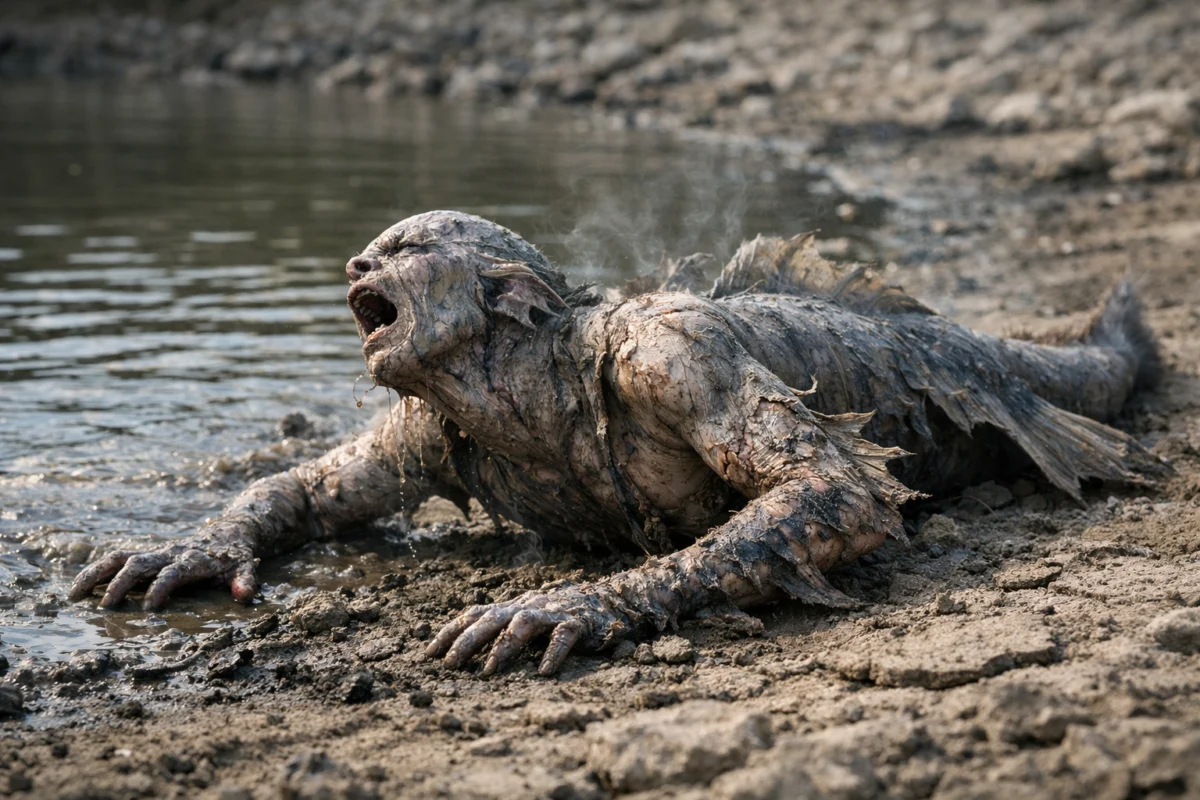
The strongest descriptive evidence is lexical rather than anatomical. The Kimbundu Dictionary includes “mermaid” among its meanings for Kyanda, making mermaid imagery a legitimate interpretation.
Its other definitions, however, describe supernatural associations and environments rather than a compulsory arrangement of human and fish body parts.
A contrasting narrative image appears in The Kianda and the Young Woman. The suitor initially appears as a skull and becomes a Kianda after being thrown into a lagoon.
This transformation belongs to that particular story; it is not a general explanation of how all ianda originate.
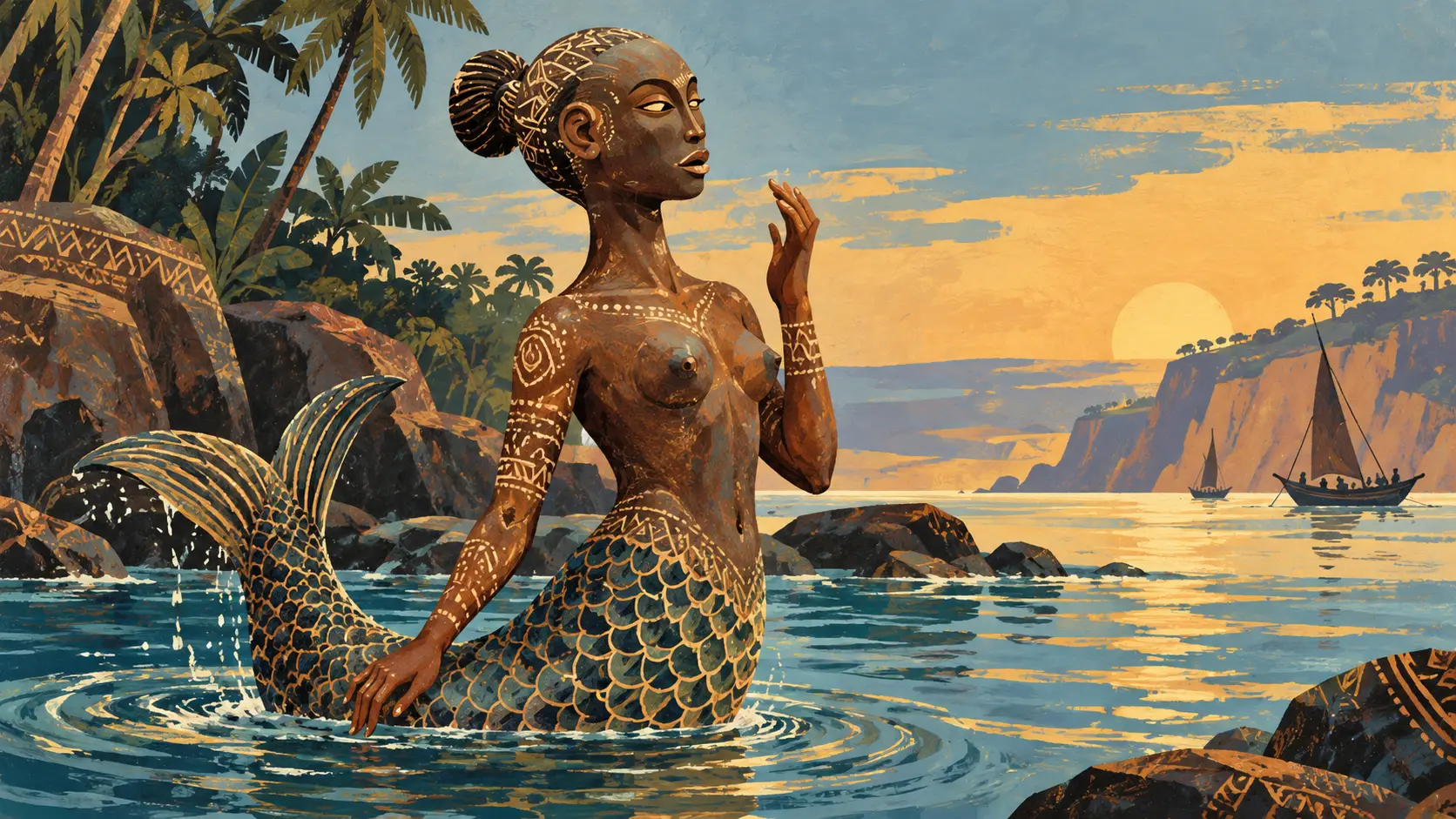
The tale’s character is male, which complicates an exclusively female mermaid description. His role as a suitor and inhabitant of an underwater household supplies narrative identity, but those details do not establish a standard physical appearance for every being called Kianda.
The story also associates the underwater household with ornaments and gifts given to the young woman. These objects characterize supernatural wealth and the relationship between the characters.
They should not be converted into a universal costume, crown, or set of accessories worn by Kianda.
Coelho’s study places quiandas alongside mermaids within a wider investigation of images, symbols, and local identities. That approach makes an important distinction visible: representations belong to particular cultural settings.
A recognizable artistic image need not exhaust the meanings carried by the spirit in language and folklore.
Across the documented material, habitat is more consistent than bodily form. Seas and rivers appear in dictionary definitions, while the collected tale specifies a lagoon.
A faithful description can therefore foreground the connection with water while leaving gender and anatomy dependent on the source.
Background Story
The background shaping Kianda is the relationship between human communities and places understood to contain supernatural agency. Water is central, but the dictionary’s references to mountains and forests suggest a wider vocabulary of nature-associated beings rather than an isolated aquatic monster with a single biography.
Accounts of fishermen’s offerings provide another dimension of that relationship. Ritos de Angola describes offerings intended to appease Kianda.
Within that source’s account, the spirit is approached as a power requiring recognition, not simply as an unusual creature glimpsed beneath the surface.
The collected marriage tale explores this relationship through domestic life. An underwater home, gifts, and a supernatural spouse make the other world resemble a human household.
The lagoon becomes a boundary that a person can cross, rather than merely the hiding place of a beast.
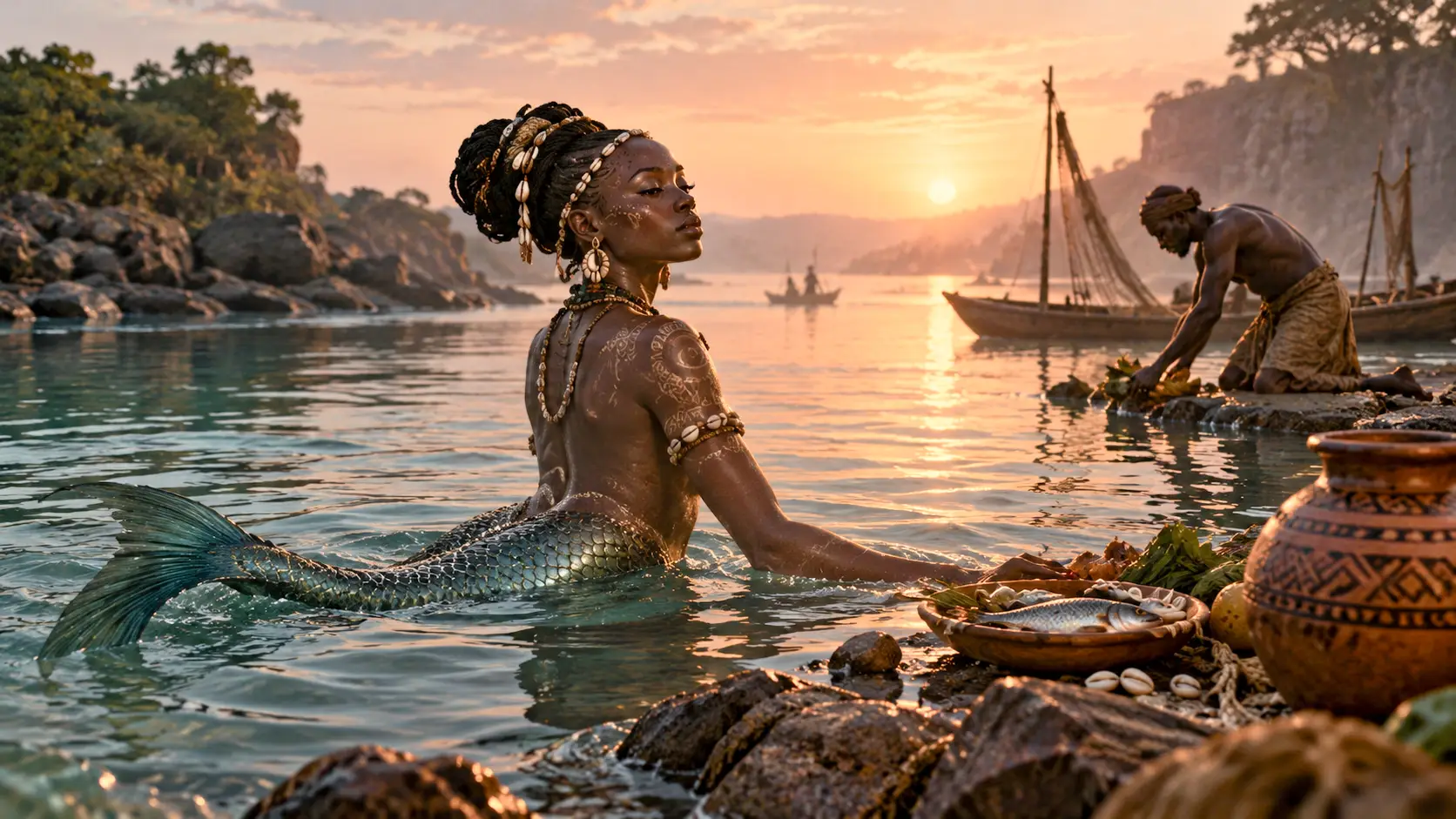
The story’s combination of wealth, family tragedy, disobedience, and supernatural danger supports a reading concerned with the risks of intimacy across that boundary. This is an interpretation of its narrative structure, not evidence that every Kianda tradition teaches an identical moral lesson.
Later literature transfers the inherited water spirit into changing urban circumstances. Pepetela’s 1995 novel O desejo de Kianda places the figure within a Luanda unsettled by unexplained building collapses and political change.
The setting brings supernatural presence into contact with the material organization of the modern city.
Scholarship on Pepetela’s Magias do Mar likewise examines animist and postcolonial themes. Together with research on Kianda’s survival in Angolan literature, this shows how the tradition supports reflection on historical change.
These later interpretations build upon inherited associations while remaining distinct from nineteenth-century collected folklore.
Famous Folklore Stories
The clearest named traditional narrative in the available record is preserved through Héli Chatelain’s collection of Kimbundu tales. It presents a particular Kianda character, not a complete mythology shared by every community that recognizes water spirits under this name.
The Kianda and the Young Woman
Morgan State University’s African Folk Tale Library identifies this tale as “Kianda Ni Mon’a Muhetu,” collected in Luanda and published in Chatelain’s Folk-tales of Angola in 1894. Its English catalog title identifies the narrative without establishing a single authoritative title for every oral version.
The suitor initially appears as a skull. After being thrown into a lagoon, he becomes a Kianda and takes a young woman to an underwater household.
Ornaments, gifts, and a magical object capable of producing houses and people connect the supernatural world with extraordinary abundance.
The narrative continues through births, deaths, disobedience, and supernatural danger. Its movement from courtship and wealth toward family tragedy supports a reading of supernatural intimacy as both attractive and perilous.
The skull transformation belongs to this story, rather than explaining the origin of all Kianda.
Cultural Impact
Kianda’s cultural importance extends beyond storytelling. In Luanda-associated traditions, the figure connects water, religious meaning, and local identity.
Reading Kianda only as an exotic monster would overlook the relationships with place and supernatural agency that make the spirit meaningful within these settings.
Virgílio Coelho’s 1998 study examines Kianda as a magic-religious symbol within Luanda’s urban culture. His attention to imagery, publicity, and marketing shows that representations circulate outside explicitly religious contexts, becoming part of the city’s public visual vocabulary as well as its inherited beliefs.
That circulation does not make every image a statement of religious commitment. A figure can carry associations with local belonging while appearing in commercial or artistic settings.
Coelho’s focus on representations therefore helps distinguish the spirit’s religious significance from its broader uses as a cultural symbol.
Modern Angolan literature also gives Kianda renewed narrative importance. The 2022 study “A sobrevivência da kianda na literatura angolana” considers the spirit’s presence in works by Arnaldo Santos and Pepetela, treating literary survival as an important dimension of the tradition’s continuing cultural life.
These literary appearances are modern reinterpretations, not additional evidence for unchanged ancient stories. Scholarship on Pepetela’s “Magias do Mar,” for example, explores animist and postcolonial themes.
Here Kianda becomes a means of considering relationships among supernatural agency, history, and contemporary experience.
Visual art provides another documented expression. Jorge Gumbe’s 1999 painting “Oferendas para a Kianda” depicts offerings to the spirit.
Its subject brings ritual relationships into artistic representation, although a painting alone cannot establish how frequently such practices occur or how individual communities conduct them.
Similar Beasts
Iara

Iara is a Brazilian water being associated with Amazonian rivers and commonly represented as a woman with a fish-like lower body. Like Kianda, she connects supernatural agency with water, although her traditions developed within a very different Brazilian cultural setting.
Encantado
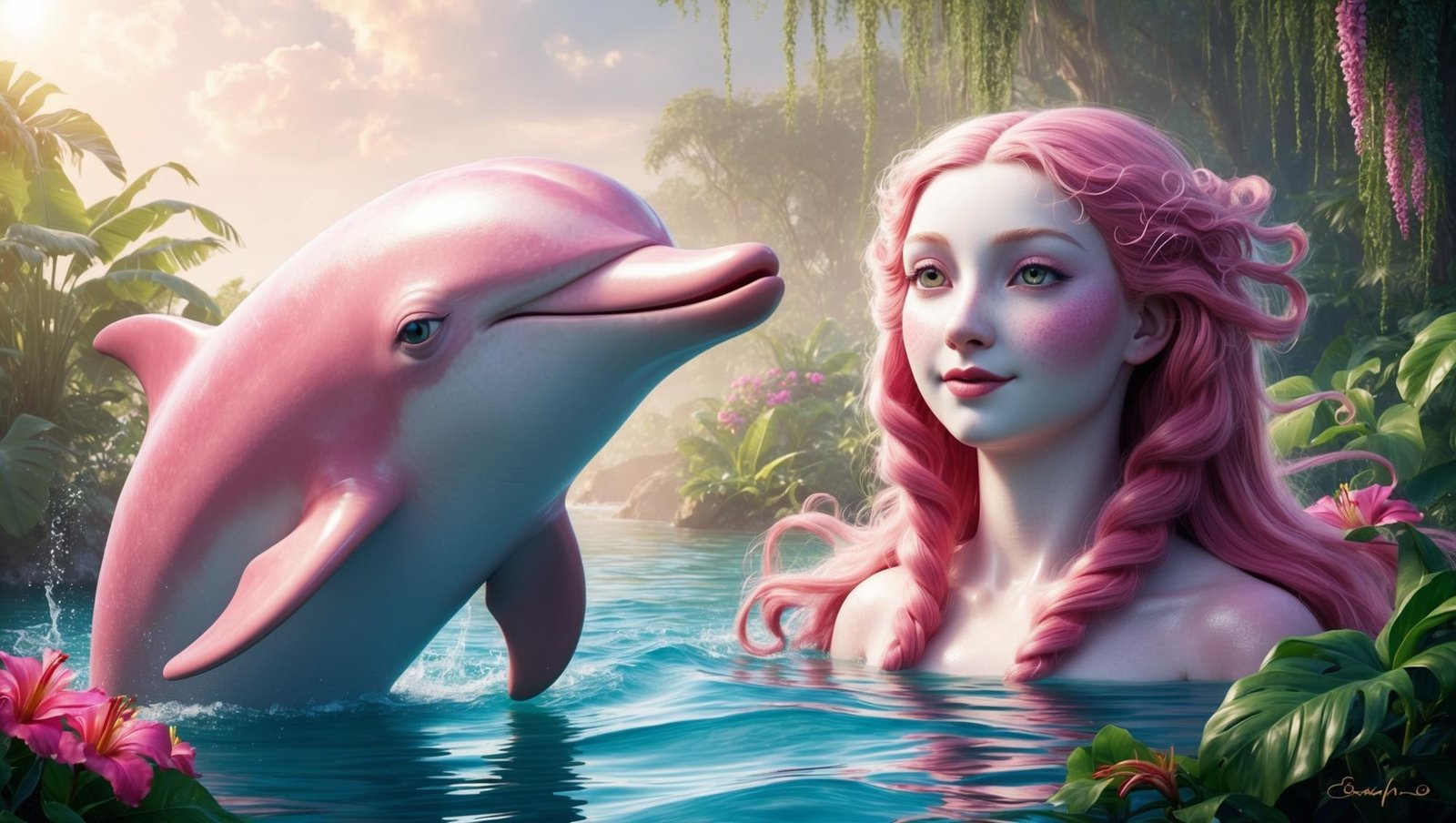
The Encantado of Amazonian folklore is closely associated with rivers and the supernatural world beneath them. Often linked with the boto river dolphin and transformation into human form, it resembles Kianda through the idea of inhabited, spiritually active waters.
Mermaid

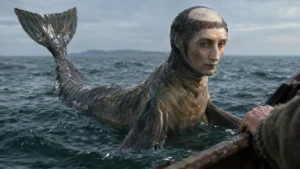
Mermaids provide an important visual comparison because Kianda has increasingly been represented in mermaid form, particularly in modern Angolan imagery. The resemblance should not imply identity, since Kianda’s traditional meaning extends beyond a half-human, half-fish creature.
Selkie

Selkies belong to Scottish and North Atlantic folklore and move between seal and human forms. Their relationship with both sea and human society offers a useful comparison with Kianda, although selkies are shapeshifters rather than nature or water spirits.
Simbi
Simbi belong to a distinct Kongo-associated tradition of nature and water spirits in West-Central Africa. Scholarship discusses them alongside Kianda while retaining differences in regional terminology.
The comparison rests on connections with water and spiritually significant environments. Simbi are not aliases for Kianda, and shared associations do not establish identical narratives or rituals.
Mami Wata
Mami Wata encompasses water-spirit traditions found across parts of Africa and its diaspora. Often represented through mermaid imagery, these spirits can be associated with beauty, wealth, healing, and danger.
Mami Wata offers a parallel to Kianda’s aquatic associations and the supernatural wealth found in the collected marriage tale. Neither tradition is adequately described by mermaid anatomy alone, and their names are not interchangeable.
Jengu
Jengu, with the plural miengu, refers to water spirits in traditions of coastal Cameroon, particularly among Sawa peoples. These beings are associated with healing and relationships between human communities and spiritual powers.
Like Kianda, miengu belong to a cultural understanding of water as a place of supernatural agency, not merely a creature’s habitat. Their Cameroonian setting and community-specific practices distinguish them from Kianda’s Angolan traditions.
Yemọja
Yemọja is an orisha of Yoruba tradition associated with motherhood and river waters. In several African-diasporic religions, her identity has developed strong connections with the sea.
Yemọja provides a comparison for understanding water-associated beings as religious powers rather than only folklore creatures. Her identity as an orisha belongs to a different religious framework from Kianda’s Kimbundu-associated spirit tradition.
Religion/Ritual
The account presented by Ritos de Angola describes fishermen making offerings to appease Kianda. This is direct evidence for a reported ritual relationship with the spirit, but it should be attributed to the traditions described there rather than generalized to all Angolan fishing communities.
Appeasement presents Kianda as a being with whom people seek an appropriate relationship, not simply an adversary to defeat. In this account, offerings acknowledge supernatural influence connected with waters.
The evidence supports that purpose without establishing a universal ceremony or fixed set of ritual rules.
Coelho’s description of Kianda as a magic-religious symbol supplies a scholarly context for such accounts. Together, these sources show that the figure can belong to religious practice as well as oral narrative, while leaving room for differences between representations and actual observance.
The available evidence does not establish a shared offering inventory, calendar, officiant, or sequence of actions. Gumbe’s painting documents the cultural representation of offerings, but should not be treated as a ritual manual or used to fill gaps in descriptions of community practice.
Scientific or Rational Explanations
The sources document Kianda as a folklore and religious figure, not as a biological species. The most useful rational approaches therefore concern how narratives, practices, and representations work within human communities, rather than attempting to identify a physical animal behind every account.
An environmental interpretation can begin with the documented connection between fishermen, offerings, and water. Such practices may be understood as ways of negotiating dependence on an unpredictable environment.
This is an interpretive possibility, not proof that environmental anxiety alone produced the tradition.
The collected tale permits a different, narrative-centered approach. Gifts and supernatural abundance draw the young woman into an underwater household, while later episodes introduce loss and danger.
Read symbolically, these contrasts explore the uncertain consequences of intimacy with powers outside ordinary human control.
Historical analysis must also distinguish collection from origin. Chatelain’s publication establishes that a particular narrative was recorded by the late nineteenth century.
It does not reveal when its motifs first developed, how widely that version circulated, or whether other communities told substantially different stories.
Coelho’s research offers a social explanation for Kianda’s continued visibility: inherited symbols can circulate through urban imagery and commerce as well as religious life. Literary scholarship adds another mechanism, showing how writers adapt the spirit to examine historical change and contemporary concerns.
Finally, translating Kianda simply as “mermaid” can narrow interpretation before it begins. The Kimbundu dictionary records a wider range of supernatural associations.
A careful analysis separates a convenient translation, a story-specific character, and a religious symbol rather than assuming that all describe one fixed creature.
Modern Cultural References
Kianda’s documented modern representations include fiction, painting, and comics. These works adapt the water-spirit tradition for different audiences rather than establish a single authoritative version.
Literary scholarship also distinguishes creative reinterpretation from the older beliefs and collected tales that inform it.
O desejo de Kianda, novel (1995)
Pepetela’s novel follows unexplained building collapses amid political change in Luanda. Kianda is central to its narrative, connecting the urban setting with the presence of a water spirit.
(kapulana.com.br)
The Return of the Water Spirit, translated novel (2002)
Luis R. Mitras translated Pepetela’s O desejo de Kianda into English.
The same narrative portrays a returning water spirit associated with a lagoon covered by urban development.
(books.google.com)
Magias do Mar, short story (2017)
Pepetela’s short story draws on Angola’s Kianda tradition in a modern literary setting.
Scholarship examines its use of the spirit through animist and postcolonial interpretations of the narrative.
(jls.apsa.us)
Oferendas para a Kianda, painting (1999)
Jorge Gumbe’s painting depicts offerings to Kianda, as documented in a cultural article.
It provides a visual interpretation of the spirit’s place in Angolan religious and cultural imagery.
(pordentrodaafrica.com)
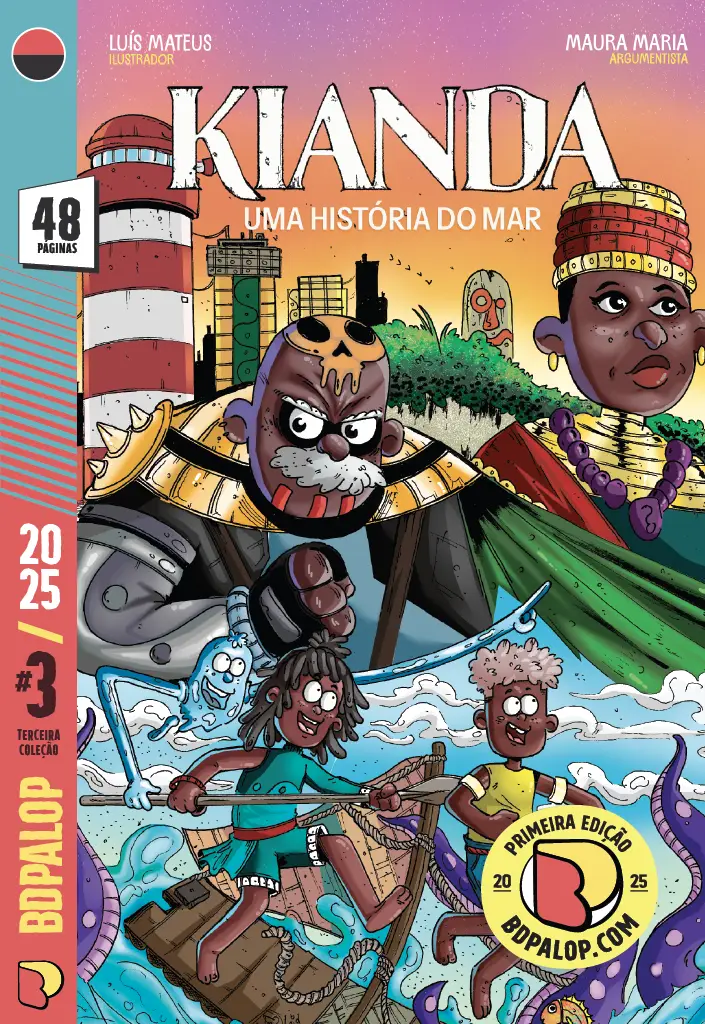
Kianda: A Story of the Sea, comic
Written by Maura Maria and illustrated by Luís Mateus, this comic follows young adventurers.
Their quest seeks Kianda, portrayed within the story as the mythical guardian of waters.
(aseita.pt)
Conclusion
Kianda is best understood as a documented Angolan water-spirit tradition, especially associated with Kimbundu-speaking communities and Luanda, rather than a creature with one fixed anatomy or biography. Collected folklore, linguistic evidence, and studies of religious imagery reveal overlapping meanings without making every account identical.
The mermaid interpretation belongs within that range, but does not exhaust it. Likewise, the skull transformation in a recorded tale illustrates one narrative possibility, not a universal explanation of the spirit’s origin.
Across the material considered here, water connects supernatural power with human relationships, livelihood, and place. Kianda’s importance therefore extends beyond physical description: the tradition gives cultural meaning to encounters with waters and to the obligations people associate with them.
Modern writers and artists continue to reinterpret that inheritance, including within narratives of urban change. Its lasting relevance rests on this combination of local cultural depth and creative adaptability, while differences between folklore, religious practice, and literary invention remain essential to an accurate account.
Further Reading
541, en.wikisource.org
en.wikisource.org provides additional contextual reading relevant to Kianda.
(en.wikisource.org)
O desejo de Kianda, kapulana.com.br
Novel 1995 Kianda is a determining spirit-character in this Angolan novel, set in Luanda amid unexplained building collapses and political change; the publisher’s description identifies the spirit as.
(kapulana.com.br)
Oferendas para a Kianda, pordentrodaafrica.com
Painting 1999 A cultural article documents this painting depicting offerings to Kianda, providing a specific visual-art reference.
(pordentrodaafrica.com)
O desejo de Kianda, search.worldcat.org
novel 1995 Published fiction in which Kianda, the water spirit, is central to the story; the original Portuguese edition is catalogued as a novel.
(search.worldcat.org)
Kianda: A Story of the Sea, aseita.pt
comic A modern comic adventure sends its young characters on a quest to find Kianda, described as the mythical guardian of the waters.
The publisher offers print and.
(aseita.pt)
Images, symbols and representations: Quiandas, Quitutas, Mermaids, local imaginaries, regional identities and alterities, Revista do Museu de Arqueologia e Etnologia, University of São Paulo
Virgílio Coelho’s article examines Kianda as a magic-religious symbol and its representations in Luanda’s urban culture.
(revistas.usp.br)
A sobrevivência da kianda na literatura angolana, Metamorfoses, Universidade Federal do Rio de Janeiro
Literary scholarship considers Kianda as an ancient water spirit and analyzes its appearances in works by Arnaldo Santos and Pepetela.
(revistas.ufrj.br)
You Can’t Kill a Kianda: A Reading of Pepetela’s “Magias do Mar”, Journal of Lusophone Studies
Analyzes how Pepetela’s short story draws on Kianda and interprets its animist and postcolonial themes.
(jls.apsa.us)