Introduction
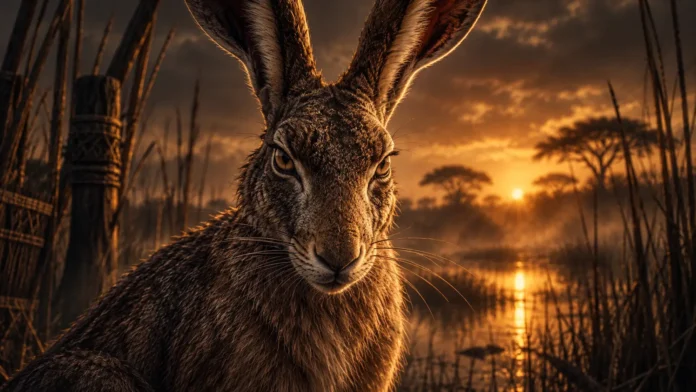
Kadimba is a hare trickster in southern African folklore, directly documented in Hambukushu storytelling from the Okavango region. His importance lies in his ability to outwit stronger opponents through persuasion and deception, rather than in supernatural anatomy or extraordinary physical strength.
The collection Tales from the Okavango identifies Kadimba as a hare among characters whose stories Hambukushu narrators told to Thomas J. Larson. This collected material provides a firmer cultural anchor than the broad label of an African trickster, which can obscure distinct storytelling traditions.
African Mythology A to Z places Kadimba within southern Bantu-speaking traditions associated with Angola, Botswana, and Namibia. It describes him as clever, mischievous, and greedy.
These qualities provide a useful overview, although individual episodes reveal different motives and should not be reduced to one fixed personality.
His adventures combine animal characters with recognizably human concerns: work, pride, retaliation, and theft. A small hare can manipulate an elephant or hippopotamus without becoming physically powerful himself.
Kadimba is therefore best understood as a personified folktale animal, not a cryptid or a separate supernatural species.
History/Origin
Kadimba’s origins cannot be securely dated. His clearest documentary connection is to Hambukushu storytelling from the Okavango region, preserved in Tales from the Okavango, first published in 1972 and reissued in 2002.
These dates mark publication of collected tales, not the beginning of the hare’s oral tradition.
The collection by Thomas J. Larson and Mary Hyde identifies Kadimba as a hare. Its publisher names three Hambukushu storytellers who told the tales to Larson: Setomba of Shakawe, Mohore, and Samarango of Seronga.
The stories combine narration and song, with some presented in only one of those forms. This provenance places Kadimba within a specific storytelling tradition rather than an undifferentiated body of African mythology.
A broader documentary context appears in Narrations of the Kavango: Folktales and Documentary Texts from Northern Namibia and Southern Angola, published in 2006. Its 59 folktales represent Kwangali, Mbunza, Manyo, Mbukushu, and Nyemba communities, supported by recordings, transcriptions, translations, and annotations developed with storytellers.
The publisher’s description does not identify a particular Kadimba episode, so the collection provides regional context rather than proof that every represented community shares his tales.
Later publications make the character accessible in different ways. African Mythology A to Z summarizes regional associations and several plots.
Multilingual English Storybooks presents Why hippos have no hair in Thimbukushu and English, crediting Basilio Gimo and David Ker as writers. Its English text calls Kadimba Rabbit, whereas Tales from the Okavango identifies him as a hare.
This difference in rendering does not establish a separate character or a historical change in his identity.
A 2020 Boundless Journeys retelling credits Matshidiso Nthela of Kalahari Plains Camp with a story in which Kadimba tricks Hippo and Elephant into a tug-of-war. It documents contemporary circulation through an identified teller.
The published heading, The Mighty Tug of War, is not evidence of an ancient or universally recognized traditional title.
Together, these records establish a collected Hambukushu tradition and later reference, educational, and storytelling presentations. They do not establish when Kadimba first entered oral storytelling or a continuous historical sequence linking every surviving version.
Name Meaning
The available sources securely connect the name Kadimba with the hare character, but they do not provide a verified linguistic derivation. Identification and etymology are different questions: knowing which animal a name designates does not establish its literal meaning or historical formation.
Tales from the Okavango identifies Kadimba as a hare, while the bilingual educational story Why hippos have no hair identifies him as Rabbit. These English labels vary across the sources without establishing two separate characters or a different underlying mythology.
The strongest baseline remains the hare identification in the Hambukushu collection. The educational version’s use of Rabbit is worth preserving as a translation choice, but it does not justify reclassifying Kadimba or treating the name itself as a proven English-equivalent animal term.
Likewise, other African hare trickster names should not automatically be listed as translations or aliases of Kadimba. A shared animal form and similar narrative role establish grounds for comparison, not linguistic equivalence.
The evidence here supports a named regional character more clearly than a precise name meaning.
Appearance
Kadimba’s defining physical form is that of a hare. Tales from the Okavango and African Mythology A to Z agree on this identification.
His unusual qualities emerge through speech, planning, and manipulation, rather than through a distinctive monstrous body or a transformation into another creature.
An ordinary hare’s long ears and strong hind legs offer a reasonable basis for representing him, but they are not individually documented magical attributes. The available descriptions do not establish a particular coat color, markings, costume, or zoological species as part of his traditional identity.
The contrast in scale between Kadimba and his opponents is more important than detailed anatomy. In the tug-of-war episode, Hippo and Elephant supply the strength.
Kadimba controls the arrangement of the contest, making his small animal form integral to the reversal of expectations.
In Why hippos have no hair, his vulnerability is equally significant: Hippo accidentally steps on him. Kadimba responds through a scheme involving Fire.
Fire remains a separate personified character, so the episode should not be read as giving the hare a fiery body or an innate power to burn others.
Visual details such as a rope, a cultivated field, or a waterside setting belong to particular episodes rather than to a permanent design. The illustrated educational story also represents one adaptation.
Kadimba is recognizable principally through his hare form and trickster actions, not a standardized set of accessories.
Background Story
Kadimba emerges from animal storytelling in which creatures speak, bargain, compete, and pursue practical goals. His background is not a continuous biography.
The surviving examples instead place a recurring hare character in separate situations, allowing each tale to explore a different use of cleverness.
The tug-of-war plot turns unequal strength into an advantage for the weaker participant. Kadimba persuades Hippo and Elephant to pull opposite ends of a rope, each believing the contest involves him.
In the reference summary, their struggle clears and plows his field, connecting deception with agricultural work.
This arrangement makes the hare’s intelligence morally ambiguous. He succeeds not simply by escaping danger but by securing others’ labor under false pretenses.
The modern retelling credited to Matshidiso Nthela emphasizes arrogance alongside cleverness, illustrating how a teller’s presentation can change the balance between admiration and criticism.
Why hippos have no hair gives the trickster a retaliatory motive. After being stepped on, Kadimba persuades Fire to burn Hippo’s hair.
The resulting flight into water connects a quarrel between characters with an explanation of the hippopotamus’s appearance and behavior, making the episode an origin-explanation tale.
A different social concern appears in the cattle-theft episode summarized by African Mythology A to Z. Kadimba places fireflies on Dikithi’s clothes, causing the thief to mistake their light for watching eyes. Here deception discourages repeated theft rather than obtaining work or exacting revenge.
Together, these episodes make cleverness a flexible narrative resource, not an invariably virtuous power. Kadimba can exploit pride, retaliate against injury, or deter wrongdoing.
Their shared pattern is the manipulation of another character’s understanding, while their differing outcomes preserve the trickster’s capacity to be useful, selfish, and disruptive.
Famous Folklore Stories
Kadimba’s documented episodes include an explanation of Hippo’s appearance, a contest with larger animals, and a deception that stops cattle theft. Their surviving presentations differ in provenance: an educational storybook, a reference summary, and a modern attributed retelling should not be treated as equivalent records.
Why Hippos Have No Hair
The Thimbukushu-language story presented by Multilingual English Storybooks begins when Hippo accidentally steps on Kadimba. The small animal responds with retaliation rather than forgiveness, persuading Fire to burn Hippo’s hair.
Hippo escapes into water, which becomes his refuge from the danger.
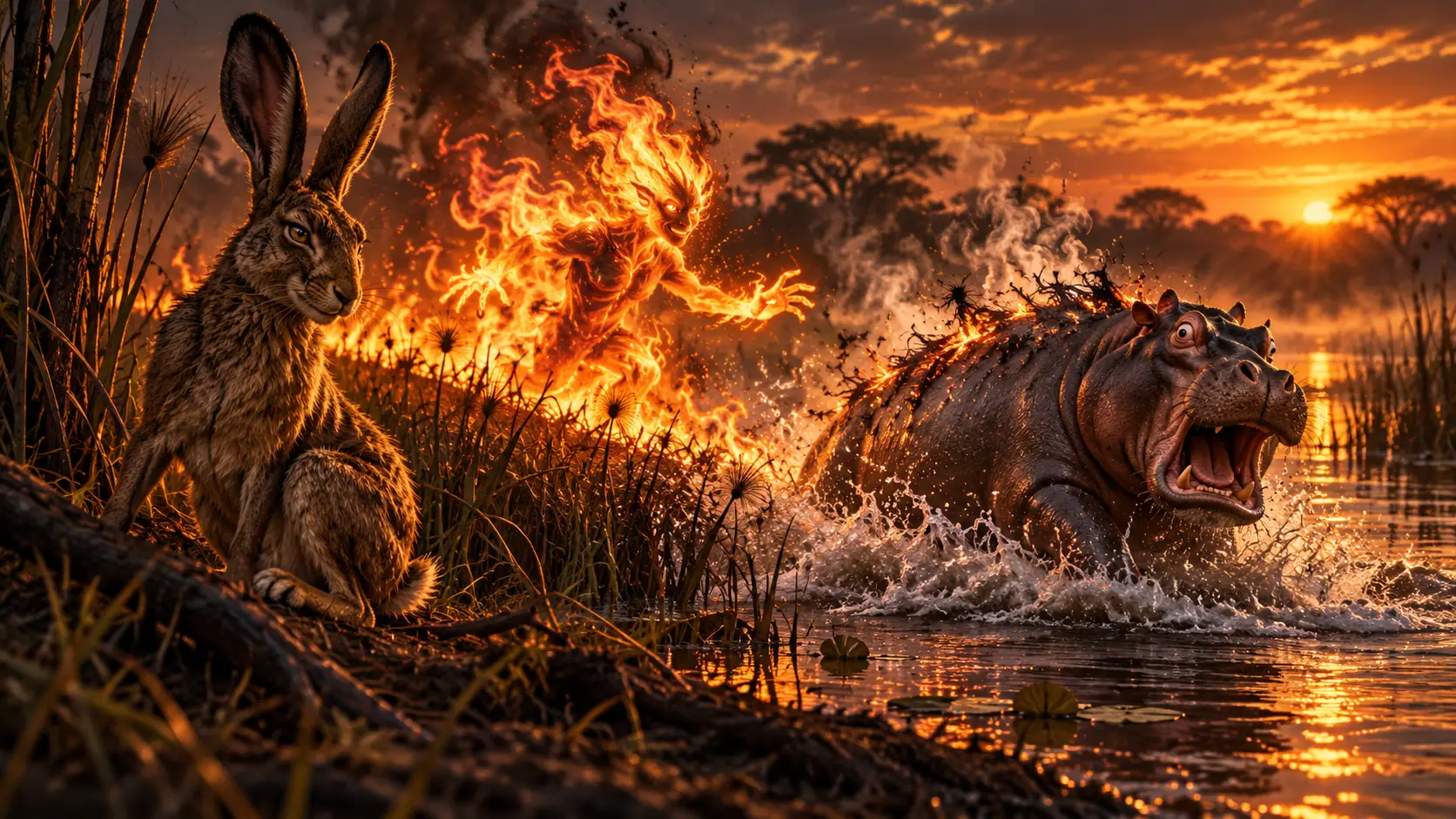
The ending explains both Hippo’s nearly hairless appearance and his attachment to water through a memorable encounter. Kadimba supplies the plan, but Fire remains a separate personified character.
The episode does not give the hare fire-producing powers or make him an elemental being.
The published version credits Basilio Gimo and David Ker as writers. Its English rendering calls Kadimba Rabbit, while the collected Okavango material identifies him as a hare.
That translation difference should remain visible without being inflated into evidence for two separate supernatural creatures.
The Tug-of-War Between Hare, Elephant, and Hippo
This descriptive heading identifies a documented episode, not an authenticated traditional title. In the summary preserved by African Mythology A to Z, Kadimba challenges Elephant and Hippo separately.
He arranges for them to pull opposite ends of a rope, each believing the hare is the opponent.
The larger animals provide the strength that Kadimba lacks. Their struggle clears and plows his field, turning an apparent competition into useful labor.
The joke depends on unequal knowledge: Kadimba understands the whole arrangement, while each powerful participant understands only the challenge presented to him.
Boundless Journeys’ 2020 retelling, published as The Mighty Tug of War and credited to Matshidiso Nthela, emphasizes an arrogant but clever hare and a staged signal through which he claims victory. This later presentation preserves the central deception while giving boasting and performance particular prominence.
Kadimba and the Cattle Thief
This heading is also editorial rather than a verified traditional title. African Mythology A to Z summarizes an episode involving Dikithi, a repeated cattle thief.
Kadimba places fireflies on Dikithi’s clothes, creating lights that the thief interprets as the hare’s eyes watching him.
Dikithi abandons his thefts because he believes he remains under observation. Kadimba does not need to defeat him physically or possess supernatural sight.
The trick works by controlling the thief’s interpretation of an ordinary phenomenon, allowing a small animal to influence human behavior.
Unlike the retaliatory Hippo episode, this deception has a protective outcome: it stops wrongdoing. The contrast matters when describing Kadimba’s character.
Cleverness connects the stories, but their different motives and consequences resist reducing him to either an unfailingly virtuous hero or a purely destructive prankster.
Cultural Impact
Kadimba’s strongest documented cultural setting is Hambukushu storytelling in the Okavango region. The publisher’s account of Tales from the Okavango identifies him among tales told to Thomas J. Larson by Hambukushu storytellers.
This provenance anchors the figure in an oral tradition rather than an invented modern bestiary.
His encounters make disparities of size and strength central to their humor. Elephant and Hippo can perform work beyond the hare’s physical capacity, yet Kadimba directs their efforts.
Read as social commentary, this reversal suggests that intelligence can unsettle power, although that interpretation is not a documented universal lesson.
The stories also allow cleverness to remain morally ambiguous. Retaliation against Hippo, manipulation of competing animals, and deterrence of cattle theft do not express identical values.
Their contrasting outcomes give audiences material for discussing ingenuity, selfishness, pride, and consequences without requiring a single fixed moral identity.
Modern preservation places these narratives in new settings. The bilingual Hippo story makes an episode available through educational publishing.
Meanwhile, the specialist collection Narrations of the Kavango documents regional storytelling through original-language texts, translations, and annotations, although its publisher description does not identify a particular Kadimba episode.
Comparisons with other African animal tricksters help situate Kadimba within a broader narrative pattern. They do not establish direct descent between characters.
In particular, the supplied evidence does not substantiate the claim, found in a modern reference summary, that Br’er Rabbit derives specifically from Kadimba.
Why Hares Became Tricksters
Across many storytelling traditions, the hare succeeds without possessing the strength of a lion, elephant, or wolf. Its advantage comes from escaping danger, changing direction quickly, noticing opportunities, and surviving encounters with animals that appear physically capable of destroying it.
Real hares reinforce that image. They live under constant pressure from predators and depend heavily on speed and evasive movement.
Brown hares can run at roughly 45 miles per hour, while several species escape pursuit through rapid turns and unpredictable zigzag movement.
Folklore transforms those physical survival strategies into intelligence. Instead of escaping a predator through speed alone, the fictional hare talks, lies, bargains, sets traps, or persuades stronger animals to defeat themselves.
Weakness becomes the reason the character must depend on cleverness.
This pattern appears especially clearly in African trickster traditions. Folklorist Denise Paulme described many African tricksters as clever weaklings whose adventures unfold within everyday social situations.
Hares, tortoises, spiders, jackals, and other seemingly disadvantaged animals repeatedly defeat creatures with greater physical power.
Kadimba fits this pattern directly. Sources from southern Bantu-speaking traditions describe the hare as clever, mischievous, greedy, and sometimes lazy.
In one famous story, Kadimba tricks an elephant and hippopotamus into pulling against each other while believing they are competing against the hare.
The trickster hare does not always represent admirable intelligence. Its cleverness can help the vulnerable survive, but it can also become selfishness, arrogance, or cruelty.
That moral instability makes the hare useful because storytellers can celebrate intelligence while simultaneously warning audiences against deception.
The animal’s appearance also strengthens the contrast. Hares look relatively harmless beside large predators and herbivores, yet they remain difficult to catch.
A story becomes immediately satisfying when the smallest participant understands something that the strongest character cannot see until the trick has already succeeded.
This does not mean people everywhere independently decided that real hares were dishonest animals. Folklore exaggerates recognizable traits into human personalities.
Speed becomes cleverness, evasiveness becomes deception, vulnerability becomes resourcefulness, and the ability to disappear from danger becomes the perfect foundation for a trickster.
Kadimba, Jackalope and Wolpertinger
At first glance, Kadimba, the Jackalope, and the Wolpertinger seem remarkably similar. All three center on hare-like animals, all undermine expectations about harmless prey, and all belong to traditions where humor, deception, and the difficulty of believing what one sees matter greatly.
Their geographical separation makes the resemblance especially striking. Kadimba belongs to southern African traditions associated with Angola, Botswana, and Namibia.
The Jackalope became famous in the American West, particularly Wyoming, while the Wolpertinger developed as a strongly Bavarian figure in southern Germany.
Kadimba, however, differs fundamentally from the other two. It is not primarily an invented hybrid animal. Kadimba is the hare itself, acting as a speaking trickster within traditional animal tales and defeating stronger characters through schemes, manipulation, arrogance, and intelligence rather than unusual anatomy.
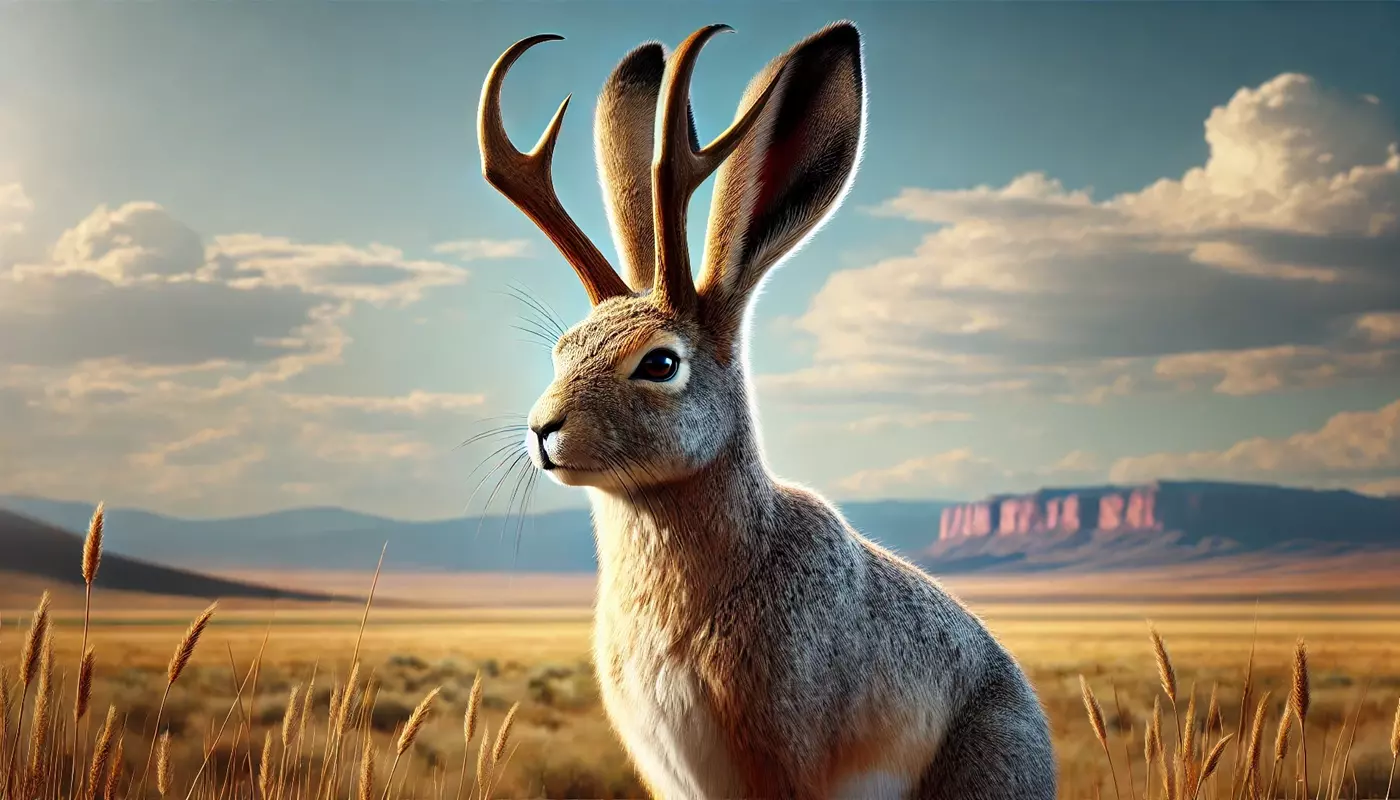
The Jackalope reverses that emphasis. Its defining joke is physical: an ordinary jackrabbit appears with antlers. Douglas, Wyoming records that taxidermists Douglas and Ralph Herrick produced their famous mounted version in 1934, after placing a rabbit carcass beside a set of antlers.
Stories later gave the Jackalope more personality. Western tall tales credited it with mimicking human voices, avoiding hunters, drinking whiskey, and remaining almost impossible to capture.
Its cunning therefore developed around the joke of an elusive fictional animal rather than an established trickster mythology like Kadimba’s.
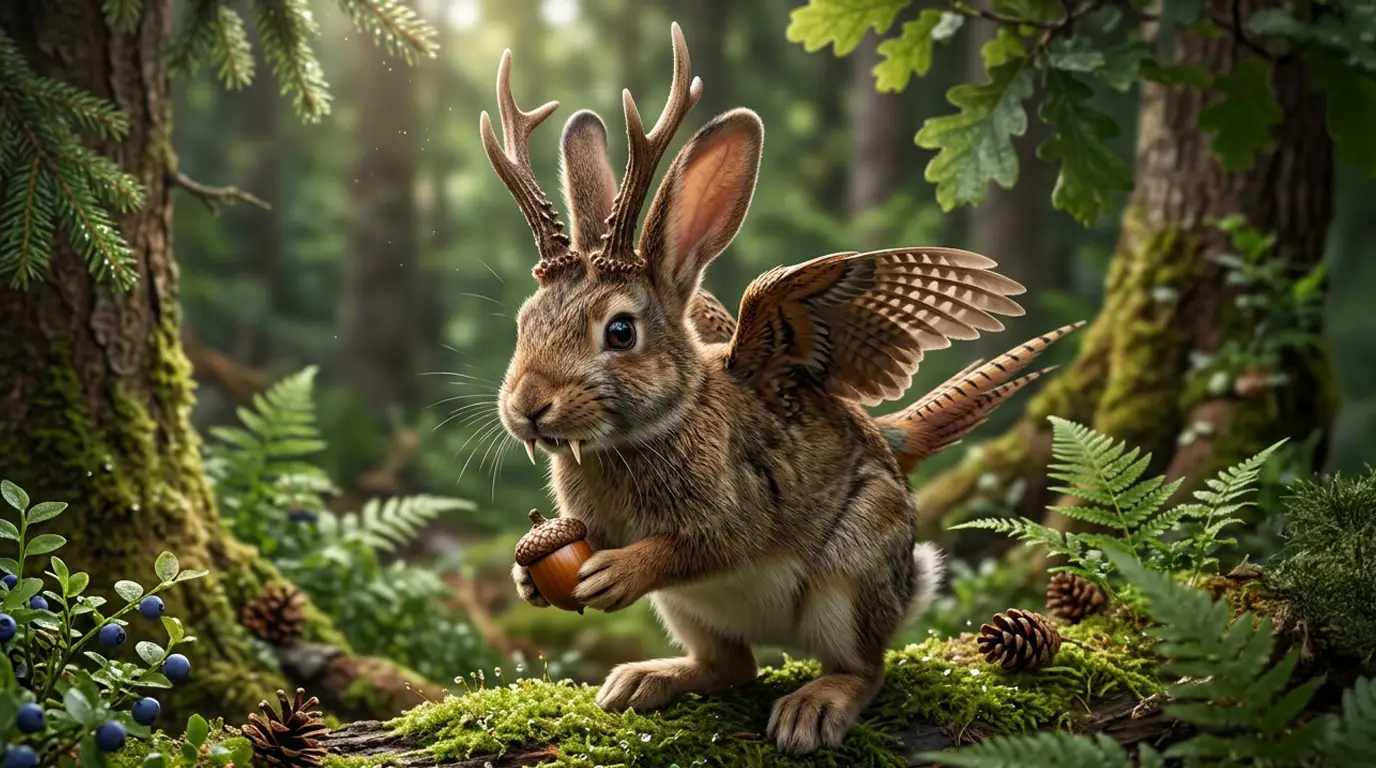
The Wolpertinger follows another version of that joke. Bavarian examples commonly combine a hare or rabbit with antlers, wings, bird feet, fangs, or other animal parts.
Taxidermists physically constructed specimens, allowing storytellers to present an obviously impossible creature with mock seriousness.
Here the trick often belongs as much to the storyteller as to the animal. Bavarian Wolpertinger tradition plays with the inexperienced visitor who might believe that the mounted hybrid represents real local wildlife.
The creature becomes part monster, part hunting story, and part practical joke.
That makes the Jackalope and Wolpertinger particularly close relatives in concept. Both use fabricated animal specimens, regional humor, impossible anatomy, and stories about elusive wildlife.
European images of horned hares also existed centuries before the Wyoming Jackalope became famous, showing that the visual idea itself was older.
However, no reliable evidence currently proves that the Herrick brothers copied the Wolpertinger when creating their Jackalope. Similarity alone cannot establish direct transmission.
The safer explanation recognizes a shared human fascination with imaginary hybrids and the naturally convincing shape of a hare fitted with antlers.
Real animals may also have encouraged horned-rabbit imagery. Papillomaviruses can produce hard, horn-like growths on rabbits, providing occasional living animals that resemble impossible folklore creatures.
Such sightings offer a plausible contribution to horned-hare legends, although they cannot explain every tradition automatically.
Kadimba therefore connects with the other creatures through a different route. Its similarity lies in the hare’s cultural personality rather than antlers or taxidermy.
Kadimba represents the clever prey animal, while Jackalope and Wolpertinger turn a familiar prey animal into something visually impossible.
Together, the three show two ways folklore transforms the hare. One tradition gives a small animal extraordinary intelligence, while another gives it an extraordinary body.
Both begin with the same contradiction: an apparently vulnerable creature repeatedly refuses to behave as harmlessly as expected.
Their resemblance should therefore not erase their differences. Kadimba belongs to African oral trickster storytelling, the Jackalope to American Western tall tales and commercial folklore, and the Wolpertinger to Bavarian hunting humor.
Similar animals became memorable for different cultural reasons.
Similar Beasts
Kitsune

Kitsune are legendary fox spirits in Japanese folklore, known for shapeshifting and mystical abilities. Their animal identity and association with trickery make them a useful cross-cultural comparison.
Both figures can make deception central to an encounter. Unlike Kitsune, Kadimba’s documented tricks depend on planning rather than shapeshifting or an established repertoire of magical powers.
Tanuki

Tanuki are mischievous shapeshifters in Japanese folklore. Their stories feature magical disguises as humans or objects, linking an animal figure with playful deception, illusion, and misleading appearances.
Tanuki and Kadimba share a trickster role, but their methods differ: magical disguise characterizes Tanuki, whereas Kadimba manipulates what his opponents know and believe.
Azeban

Azeban is a raccoon trickster associated with Abenaki folklore. The figure is described as creating confusion and mischief, providing another example of an animal-centered trickster narrative tradition.
The comparison concerns narrative role, not shared origin. Kadimba’s retaliatory behavior in the Hippo story also differs from the comparatively harmless mischief associated with Azeban.
Anansi

Anansi is a distinct spider trickster of Akan and Ashanti traditions. His clever animal-trickster role makes him an important African comparison, without making him another form of Kadimba.
Both figures place cunning at the center of animal narratives. Their resemblance is functional; the evidence does not establish that they are interchangeable characters.
Ijapa
Ijapa is a tortoise trickster in Yoruba folklore, identified in modern reference material as a comparison for Kadimba. He belongs to a separate storytelling tradition and animal identity.
Ijapa offers a parallel in the prominence of cleverness over physical force. The relationship is comparative, not evidence that either name is the other’s alias.
Religion/Ritual
The available sources document Kadimba as a folktale character, not as the focus of verified worship, offerings, taboos, or ceremonies. Personified Fire and speaking animals belong to the narratives themselves; their presence does not establish a ritual practice connected specifically with the hare.
Scientific or Rational Explanations
Kadimba is not a reported cryptid requiring zoological identification. His hare form provides the recognizable animal basis for a speaking, planning character.
The relevant explanatory questions concern how the narratives work and what they communicate, rather than whether an unknown species inspired sightings.
The Hippo episode is an etiological tale: it explains a familiar feature of the world through a narrated cause. Burning hair and fleeing to water create a coherent story ending, but they should not be mistaken for a biological account of hippopotamus anatomy or behavior.
The tug-of-war can be read as a model of information asymmetry. Each large animal acts on an incomplete understanding, while Kadimba coordinates both sides.
This modern analytical description clarifies the mechanism of the joke without claiming that storytellers formulated it in those terms.
The firefly episode likewise depends on perception and expectation. Dikithi interprets small lights as watching eyes, and that belief changes his conduct.
The story’s own explanation is deception rather than supernatural surveillance; a psychological reading highlights fear of detection, not an extraordinary sensory power.
Source form also affects interpretation. A reference summary compresses a plot, an educational adaptation organizes it for reading, and an attributed contemporary retelling may emphasize performance.
Their differences should not automatically be reconstructed as a historical sequence or a definitive account of the earliest version.
Regional collections offer firmer methods for studying variation. Narrations of the Kavango describes recording, transcription, translation, and work with storytellers.
That approach preserves linguistic and narrative context more effectively than isolated summaries, while its general collection description cannot independently verify a specific Kadimba tale.
Modern Cultural References
Kadimba’s confirmed modern appearances are concentrated in illustrated educational storytelling and published folktale retellings. These examples preserve his role as a speaking animal trickster rather than reinventing him as a monster.
The available evidence does not establish a wider presence in film, television, or games.
Eyi dhapirera mvu ghuhuki (Why hippos have no hair), illustrated multilingual educational storybook
Basilio Gimo and David Ker’s illustrated story is available in Thimbukushu and English.
Kadimba, rendered as Rabbit in English, persuades Fire to burn Hippo’s hair.
(englishstorybooks.org)
The Mighty Tug of War, published folktale retelling (2020)
Boundless Journeys publishes a telling credited to Matshidiso Nthela of Kalahari Plains Camp.
Kadimba tricks Hippo and Elephant into pulling against each other, then claims victory.
(boundlessjourneys.com)
The educational adaptation credits Carol Liddiment as illustrator and Ruthgela Shawanga and Servasius M. Ndjunga as translators. These credits distinguish a particular modern presentation from the wider tale tradition.
Likewise, “The Mighty Tug of War” is a published heading, not an established traditional title.
Conclusion
Kadimba is best understood as a hare trickster within southern African storytelling, with a particularly firm documentary connection to Hambukushu tales from the Okavango region. His importance lies in narrative action rather than supernatural anatomy: he speaks, plans, deceives, and turns unequal encounters to his advantage.
Stories involving larger animals make intelligence a counterweight to physical strength, while episodes involving retaliation or theft reveal that cleverness can serve different purposes. He is neither a cryptid nor a single, consistently heroic figure.
The surviving material supports a recognizable character without supplying a complete biography, fixed appearance, or securely explained name. Individual tellings should therefore retain their differences instead of becoming parts of an invented universal legend.
Collected folklore, reference summaries, and modern educational adaptations offer different kinds of evidence, each useful within its limits. Together, they show how a small animal can carry substantial narrative authority, using wit to unsettle stronger opponents while leaving audiences to consider the consequences and ambiguities of his success.
Further Reading
64038, gutenberg.org
gutenberg.org provides additional contextual reading relevant to Kadimba.
(gutenberg.org)
Jj.36106038, jstor.org
jstor.org provides additional contextual reading relevant to Kadimba.
(jstor.org)
Multilingual English Storybooks, Englishstorybooks
In a Thimbukushu-language story, Hippo accidentally steps on Kadimba. In retaliation, Kadimba persuades Fire to burn Hippo’s hair; Hippo flees to the water and thereafter stays near it.
(englishstorybooks.org)
African Mythology A to Z, 2nd edition, Calibre.thecartwrights
Kadimba challenges Hippo and Elephant separately, then has them pull opposite ends of a rope.
Their struggle clears and plows his field. This episode is recounted in a.
(calibre.thecartwrights.nz)
Boundless Journeys, Boundlessjourneys
A modern retelling credited to Matshidiso Nthela portrays Kadimba as an arrogant but clever hare who tricks Hippo and Elephant into a rope-pulling contest, then claims victory through.
(boundlessjourneys.com)
Tales from the Okavango, iUniverse
Publisher page for Thomas J. Larson and Mary Hyde’s collection identifies Kadimba as a hare among Hambukushu folktale characters and describes the stories’ oral sources.
(iuniverse.com)
2380 Greatmythologies 3, cerritos.kanopystreaming.com
cerritos.kanopystreaming.com provides additional contextual reading relevant to Kadimba.
(cerritos.kanopystreaming.com)
National Outlook On ILK Of Biodiversity, nnf.org.na
nnf.org.na provides additional contextual reading relevant to Kadimba.
(nnf.org.na)