Introduction
Djinn, also spelled jinn, are supernatural beings originating in Arabian tradition and occupying an important place in Islamic cosmology. Internationally familiar through the English name genie, they have become associated with magical lamps, extraordinary powers, supernatural bargains, and the fulfilment of human wishes.
Islamic scripture describes jinn as beings created from fire who possess intelligence, moral responsibility, and the capacity to accept or reject religious guidance. Unlike uniformly malevolent demons, they encompass different personalities and intentions, allowing for both benevolent and dangerous encounters with humans.
Literary traditions, particularly The Thousand and One Nights, introduced some of the most recognizable portrayals of jinn. Stories such as Aladdin and the Wonderful Lamp and The Fisherman and the Jinni helped establish the familiar association between supernatural spirits and enchanted objects.
The wider jinn tradition also encompasses more specific supernatural designations, including the powerful ifrit. Distinguishing these religious and folkloric concepts from the popular wish-granting genie reveals the considerable diversity behind one of the world’s most recognizable categories of supernatural beings.
History/Origin
The origins of jinn beliefs lie within the religious landscape of ancient Arabia, although scholars cannot establish a precise date for their formation. Evidence from inscriptions, early Arabic poetry, and Islamic scripture reveals different stages of documentation rather than a continuous, securely dated history.
An important pre-Islamic reference survives in the Safaitic inscription AAWAB 4, discovered in northeastern Jordan in 2021. Epigraphist Ahmad Al-Jallad interprets its wording as referring to jinn and a supernatural authority associated with these ordinarily concealed beings.
Safaitic inscriptions conventionally date between the first century BCE and the fourth century CE, although scholars have identified evidence of earlier usage. This chronological range provides historical context for the inscription but does not establish its individual date or the origin of jinn beliefs.
Arabic literary traditions also associate supernatural spirits with poetic inspiration before and during the emergence of Islam. Maxim Yosefi’s comparative research examines this relationship, while questions surrounding the transmission and dating of early poetry prevent its uncritical treatment as contemporary historical documentation.
The Qur’an provides a securely identifiable seventh-century literary witness that describes jinn extensively. Its passages incorporate these supernatural beings into Islamic cosmology, establishing their creation from fire, their moral responsibilities, and their capacity to respond to divine revelation and authority.
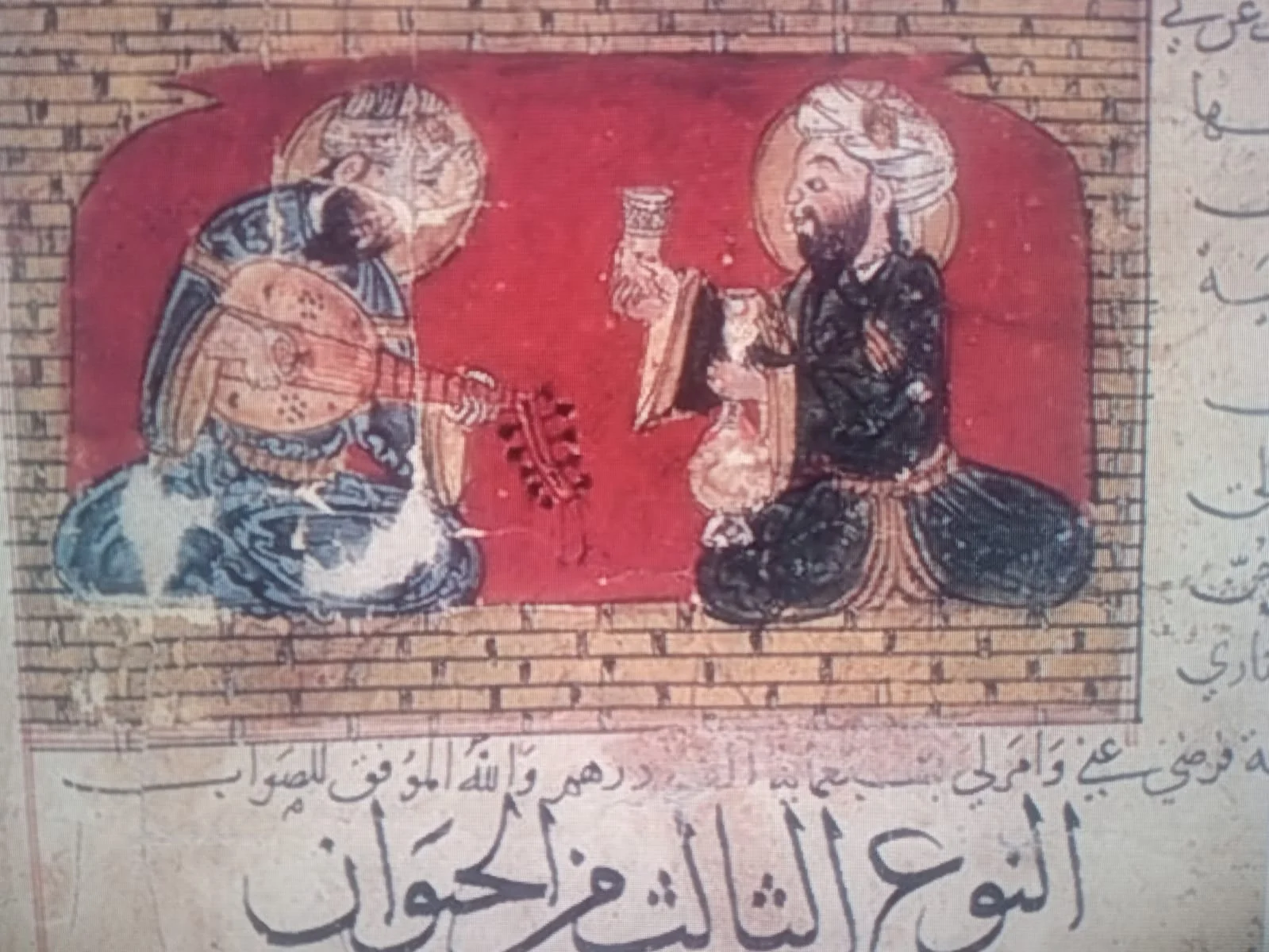
Later Arabic literature developed additional narrative conventions surrounding jinn. The evolving collection of stories known as The Thousand and One Nights portrayed these beings as participants in supernatural adventures involving transformation, captivity, dangerous encounters, extraordinary wealth, and relationships with human characters.
In May 1709, the Syrian storyteller Hanna Diyab completed his narration of Aladdin to Antoine Galland in Paris. Galland incorporated the story into his French edition of the Nights in 1712, establishing a documented stage in the tale’s international literary transmission.
These historical developments establish the circulation of jinn beliefs before Islam, their seventh-century scriptural characterization, and their subsequent literary transformation. The surviving evidence does not establish when the underlying supernatural concept first emerged or whether it developed from one exclusive cultural source.
In Different Cultures
Arabian and Islamic Tradition
The Qur’an establishes jinn as morally responsible supernatural beings rather than uniformly hostile spirits. Surah al-Jinn distinguishes righteous members of their community from others, while Surah al-Rahman identifies fire as their original substance without prescribing a permanent physical appearance.
Their relationship with Solomon introduces another distinctive characteristic. Surah Saba describes jinn undertaking construction and other tasks under divine authorization. Nevertheless, their failure to recognize Solomon’s death demonstrates limitations in their knowledge, distinguishing their extraordinary capacities from divine omniscience.
Persian Folklore
Persian traditions describe jinn, commonly called jenn, as supernatural beings whose manifestations sometimes reveal unusual physical characteristics. In Gilan, recorded appearances include figures with rounded, toeless feet, heavily covered bodies, and animal forms such as snakes, cats, and horses.
Iranian folklore also documents a particular vulnerability to iron. Some narratives describe humans gaining control over jinn by attaching iron needles to their clothing. Other protective traditions place iron objects around homes to discourage supernatural disturbances or retaliatory encounters.
Another distinctive belief concerns the hamzād, a supernatural counterpart associated with an individual from birth. Traditions recorded by Mahmoud Omidsalar connect this counterpart with disturbances affecting children, while regional accounts from Gilan also describe jinn substituting their offspring for human children.
Egyptian Folklore
Nineteenth-century observations by Edward William Lane describe Egyptian beliefs concerning invisible spirits and their interactions with everyday domestic life. Some households employed salt and religious invocations as protective measures against jinn, particularly around the festival marking Ramadan’s conclusion.
Egyptian zār traditions provide another distinctive cultural framework. In some communities, afflictions attributed to supernatural spirits become the subject of ceremonies involving music, rhythmic movement, and communal participation. These practices differ from the predominantly scriptural approach associated with Qur’anic healing.
Ethnographic research in the Dakhla Oasis documents an alternative approach through religious healers who investigate disturbances attributed to jinn or sorcery. These locally documented interpretations demonstrate that Egyptian communities employ different explanatory and protective traditions rather than one uniform ritual system.
Yemeni Folklore
Yemeni traditions preserve a distinctive association between jinn and poetic creativity. Maxim Yosefi’s research documents contemporary vernacular poetic traditions involving supernatural inspiration, examining their similarities and differences with beliefs recorded in early Arabic literary and historical sources.
Within this context, supernatural inspiration represents more than a threat or an opportunity for material reward. Relationships between poets and unseen beings illuminate cultural attitudes toward exceptional verbal abilities, although modern Yemeni traditions cannot automatically establish uninterrupted continuity with ancient Arabian beliefs.
Name Meaning
The Arabic collective noun jinn (جِنّ) identifies a category of supernatural beings, while jinnī (جِنِّيّ) denotes an individual male member. The spelling djinn represents an alternative transliteration of the collective Arabic term rather than the name of a separate supernatural creature.
Traditional Arabic lexicography connects jinn with the root j-n-n, associated with hiding or concealment. This interpretation corresponds with their ordinarily invisible existence, although scholars have questioned whether the name’s ultimate linguistic origin can be established exclusively through its relationship with this Arabic root.
The English word genie entered through the French génie, a term historically associated with the Latin genius, meaning a guardian or attendant spirit. French translators adopted it to represent the Arabic jinnī when introducing The Thousand and One Nights to European readers.
Through literary usage, genie acquired a particularly strong association with magical service and wish fulfilment. Although modern entertainment frequently treats these characteristics as defining features, the word remains connected to the wider jinn tradition rather than identifying an independently established supernatural species.
Appearance
Jinn are ordinarily hidden from human sight, and the Qur’anic passages characterize them more by their actions than by their looks. The listeners in Surah al-Jinn, for instance, are recognizable as a group through what they hear and say, not through a description of their bodies.

Surah al-Rahman describes the jinn as created from a smokeless flame of fire. That is an account of what they were made from, not a picture of how they appear when encountered. It gives no reason to expect every jinni to move through the world visibly ablaze.
Later accounts do give jinn recognizable shapes. Traditions surveyed by Omidsalar describe humanlike manifestations as well as animal forms, including snakes, cats, dogs, goats, wild sheep and pigeons. The variety includes creatures that would look unremarkable until something in their behavior drew attention to them.
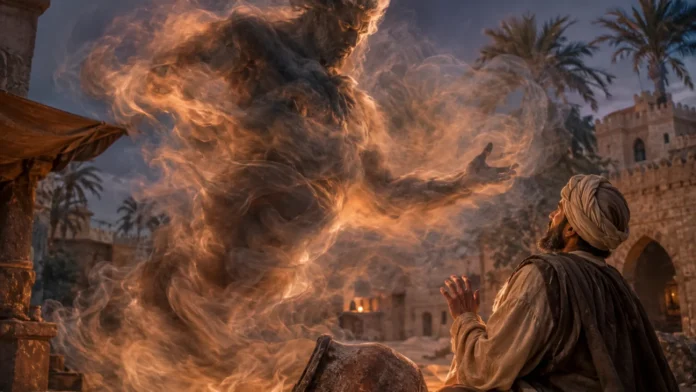
In The Fisherman and the Jinni, the transformation works differently. The jinni becomes vapor, condenses and enters the jar a little at a time. Instead of resembling a person or an animal, the being changes into a form that can pass through the vessel’s narrow opening.
As soon as the last of the vapor is inside, the fisherman closes the jar with its sealed lead cap. The change of form makes the trick possible: the jinni can enter a container that can then be shut. The story makes confinement the consequence of a choice, not an automatic weakness.
The Familiar Appearance of the Genie
The popular image of a genie emerging from an enchanted lamp or bottle developed through literary illustration and subsequent entertainment adaptations. Such representations frequently combine an enormous humanlike upper body with a lower form dissolving into vapor, emphasizing transformation and supernatural confinement.

Modern films have introduced additional recognizable characteristics, including brightly colored skin, exaggerated proportions, elaborate jewelry, and magical effects. These features belong to particular artistic interpretations rather than Islamic scripture, which establishes the fiery origin of jinn without prescribing a universal physical appearance.
Background Story
Jinn occupy a distinct position within Islamic accounts of creation. Surah al-Hijr describes their creation before humanity, while Surah al-Rahman identifies their original substance as fire. Their existence belongs to a broader cosmological framework involving humans, supernatural beings, and divine authority.
Their relationship with humanity also extends to religious responsibility. Surah al-Dhariyat identifies worship as a purpose shared by humans and jinn, while Surah al-Jinn describes differences in belief and conduct within their community. Supernatural origin does not remove their moral obligations.
Solomon’s relationship with jinn provides one of the clearest examples of extraordinary supernatural service. Surah Saba describes their construction of buildings, production of images, and manufacture of enormous vessels under the authority that God grants to the king.
However, this supernatural community does not possess unlimited knowledge. After Solomon dies, the jinn continue their labor until a creature consumes his staff and his body falls. The episode explicitly challenges the assumption that jinn possess unrestricted access to hidden knowledge.
Later storytelling develops the tension between supernatural independence and imposed service through accounts of captivity, magical commands, and negotiated obligations. These narratives place remarkable beings within relationships where human intelligence, religious authority, or enchanted objects can influence the outcome of an encounter.
Famous Folklore Stories
Aladdin and the Wonderful Lamp
A magician persuades Aladdin, a poor young man living in China, to enter an underground chamber containing extraordinary treasures. When Aladdin refuses to surrender a mysterious lamp before escaping, the magician seals the entrance, leaving him trapped beneath the ground without assistance.
While desperately seeking a means of escape, Aladdin accidentally rubs a magical ring previously given to him by the magician. An enormous supernatural being appears and offers its service, enabling Aladdin to leave the underground chamber and return safely to his mother.
“I am the Slave of the Ring.” (Aladdin and the Wonderful Lamp, Andrew Lang’s The Blue Fairy Book, 1889).
Later, Aladdin’s mother rubs the lamp while attempting to clean it, summoning a second and more powerful genie. Its extraordinary abilities provide the family with food and wealth, eventually allowing Aladdin to marry the sultan’s daughter and acquire a magnificent palace.

The magician subsequently obtains the lamp through deception and commands its genie to transport the palace and princess to Africa. The genie of the ring helps Aladdin reach them, but cannot restore the palace, demonstrating the unequal capabilities of the two spirits.
Aladdin eventually recovers the lamp through cooperation with his wife and commands its genie to return their palace to China. Unlike many modern adaptations, the literary story involves repeated supernatural commands and two separate genies, without imposing a universal limit of three wishes.
The Fisherman and the Jinni
A fisherman discovers a sealed copper vessel while casting his net. Curious about its contents, he removes the stopper bearing Solomon’s seal. A great cloud of vapor emerges from the container and gradually assumes the form of an enormous and threatening ifrit.
Instead of rewarding his rescuer, the spirit announces his intention to kill him. Recognizing that physical resistance would be useless, the fisherman questions how such an immense creature could possibly have occupied the small vessel, challenging the ifrit to demonstrate its extraordinary transformation.
“This is a Jinni.” (The Book of the Thousand Nights and a Night, Volume I, translated by Richard Francis Burton, 1885).
The ifrit transforms into vapor and returns to the vessel. The fisherman immediately replaces the stopper, trapping the supernatural being beneath Solomon’s seal. The powerful spirit can no longer threaten him directly and must instead persuade the fisherman to release him again.
After further negotiation, the fisherman eventually releases the spirit under a promise of safety. The ifrit then leads him to a remarkable lake containing fish of different colors, beginning another sequence of adventures and demonstrating how intelligence can overcome supernatural strength.
The Ifrit’s Offer to Solomon
In the Qur’anic account of Solomon and the Queen of Sheba, the king asks members of his assembly who can bring him the queen’s throne before she arrives. An ifrit belonging to the jinn responds by offering to undertake the extraordinary task.
“Said an ‘Ifrit, of the Jinns: ‘I will bring it to thee before thou rise from thy council.’” (The Qur’an, Surah al-Naml 27:39, seventh century CE, translated by Abdullah Yusuf Ali).
Another individual, described as possessing knowledge of the Book, offers to accomplish the task before Solomon’s glance returns. The throne then appears before the king, who recognizes its arrival as an expression of divine favor and a test of his gratitude.
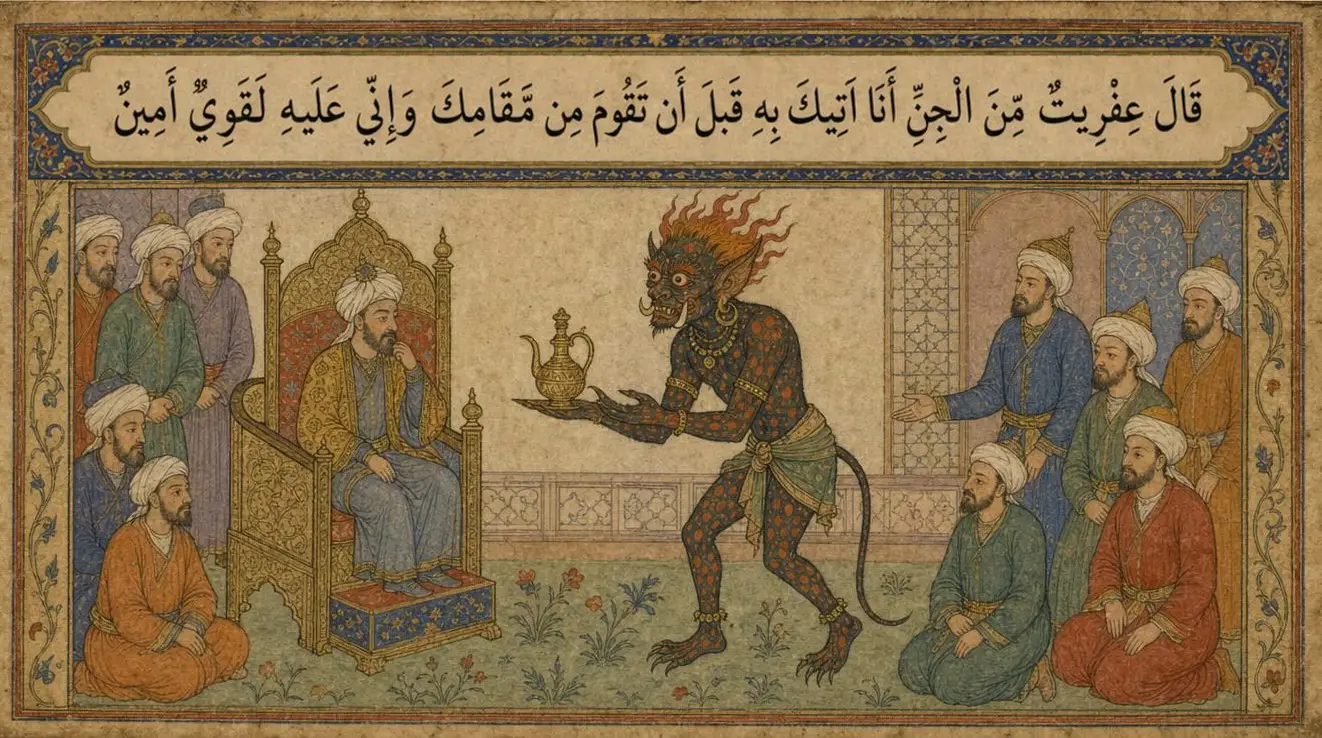
Although the ifrit does not ultimately transport the throne, his offer establishes his claimed extraordinary strength and willingness to serve Solomon. The passage also explicitly identifies him as belonging to the jinn, providing important evidence concerning the relationship between these supernatural designations.
The Difference Between Djinn, Genie and Ifrit
The terms djinn, genie, and ifrit overlap historically but do not operate at the same linguistic or religious level. Their differences reflect Arabic terminology, Islamic scripture, European translation, and later imaginative literature rather than three consistently separate categories of supernatural beings.
Djinn
Jinn is the Arabic collective designation for the supernatural beings described in Islamic scripture and regional folklore. Its singular masculine form is jinnī, while jinniyya identifies a female individual. Djinn represents an alternative spelling of the collective term in European languages.
Genie
The European term genie derives from French génie and ultimately Latin genius. Translators adopted the French term to represent Arabic jinnī, partly because of their accidental linguistic resemblance. Consequently, the European word has a historical association with jinn but a different linguistic origin.
Literary and cinematic portrayals subsequently narrowed its popular associations toward supernatural service, enchanted containers, and wishes. Although genie commonly translates jinnī in English, its familiar cultural associations do not encompass the complete religious and folkloric significance of the original Arabic designation.
Ifrit
The Arabic term ifrit identifies a formidable supernatural figure. Surah al-Naml explicitly describes an ifrit belonging to the jinn, establishing their relationship in scripture. Later literary accounts frequently associate ifrits with exceptional strength, hostility, and formidable capabilities without establishing universally consistent classifications.
Overlapping Literary Terminology
The Thousand and One Nights demonstrates the flexibility of these designations. The imprisoned spirit in The Fisherman and the Jinni receives both jinni and ifrit descriptions, while Burton’s translation of Aladdin compares the ring’s supernatural servant with an ifrit among Solomon’s jinn.
These examples establish overlapping terminology rather than three mutually exclusive species. Modern fantasy may assign separate anatomical characteristics, abilities, and hierarchies to djinn, genies, and ifrits, but such classifications belong to particular fictional settings rather than a universally accepted traditional system.
Cultural Impact
The 1940 film The Thief of Bagdad established a spectacular cinematic interpretation of the genie through Rex Ingram’s enormous supernatural character. Its Academy Award-winning special effects made the dramatic emergence of a gigantic spirit from a small container visually convincing.
I Dream of Jeannie subsequently relocated the enchanted-bottle motif into contemporary American domestic comedy. Disney’s 1992 Aladdin developed another influential interpretation through Robin Williams’s performance, combining rapid transformations, comedic impersonations, and a supernatural servant’s personal desire to obtain freedom.
Modern authors have also challenged the conventional servant archetype. P. Djèlí Clark’s A Dead Djinn in Cairo places supernatural beings within an alternative Egyptian society, demonstrating how jinn can participate in civic institutions and historical narratives rather than exclusively magical encounters.
Similar Beasts
Ifrit

Ifrits are formidable supernatural beings associated with the wider jinn tradition. The Qur’an explicitly identifies an ifrit among Solomon’s jinn, while later stories emphasize their exceptional strength, dangerous encounters, and occasionally constrained supernatural service.
Read more about Ifrit
Ghoul
The Ghoul is a supernatural creature associated with predation, deception, and dangerous encounters in Arabic folklore. Regional traditions sometimes classify ghouls among the jinn, although their characteristic behavior differs from the wider diversity of jinn personalities.
Div-e Sepid

Div-e Sepid, the White Demon, is a powerful supernatural adversary in Persian mythology. The broader Iranian traditions surrounding dīvs occasionally overlap with beliefs about jinn, although this particular legendary figure retains a distinct mythological identity.
Read more about Div-e Sepid
Shedim
Shedim are supernatural beings in Jewish tradition capable of interacting with humanity through both harmful and beneficial actions. Their varied moral characteristics resemble those of jinn, although their origins and religious contexts remain culturally distinct.
Read more about Shedim

Asmodeus
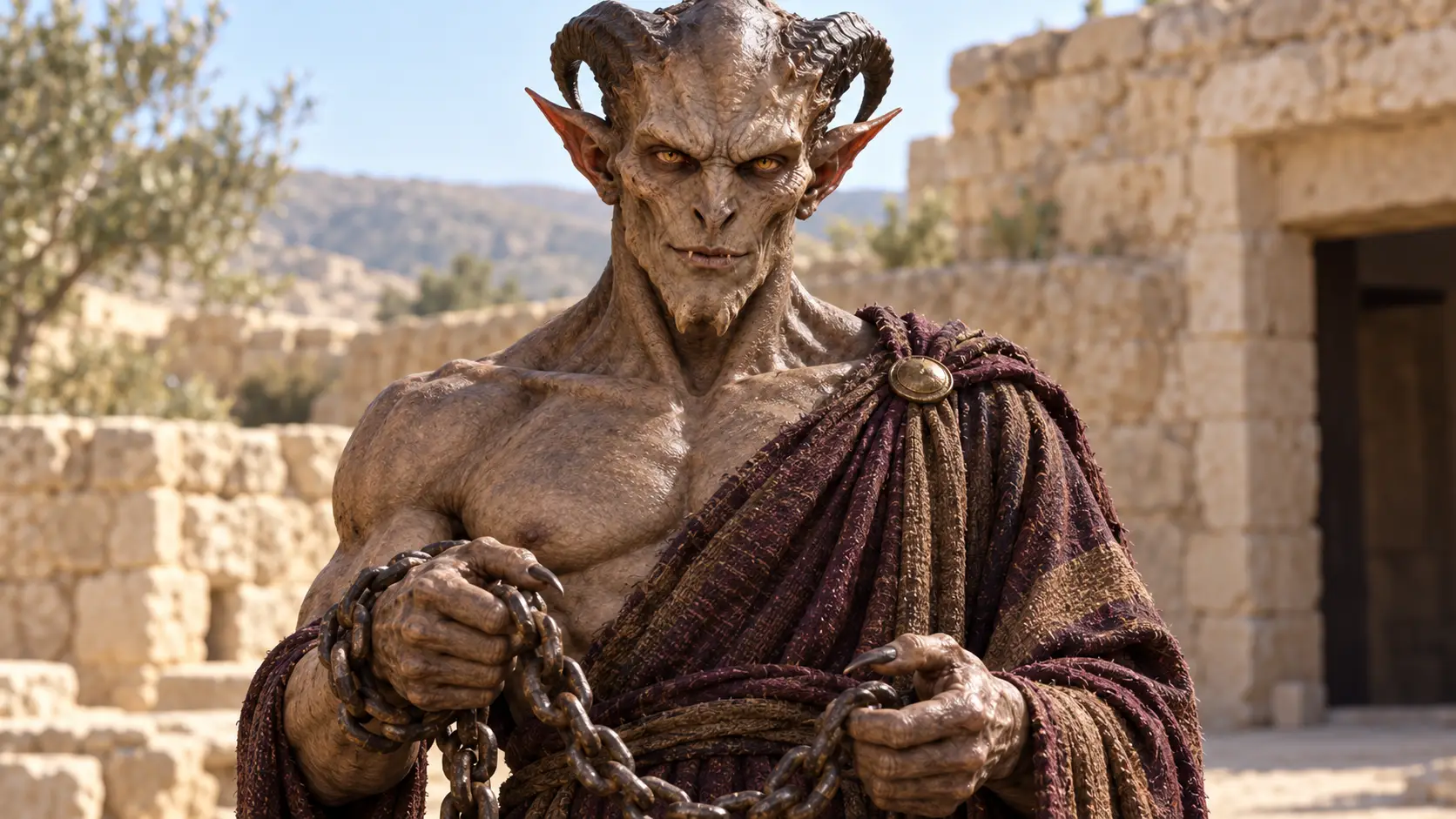
Asmodeus is a powerful demon whose encounters with Solomon feature supernatural authority, resistance, and confinement. These motifs provide parallels with Solomonic accounts involving jinn, without establishing that Asmodeus belongs to the same supernatural category.
Read more about Asmodeus
Religion/Ritual
Surah al-Jinn refers to people seeking refuge with jinn, but the passage does not recommend the practice. It puts the reference in the jinn’s own account and distinguishes the righteous among them from others. Recognizing jinn as fellow created beings is not an instruction to seek their protection.
In Egypt’s Dakhla Oasis, one documented healer addressed afflictions attributed to jinn through ruqya, the recitation of Qur’anic verses for healing or protection. The recitation was directed toward helping the afflicted person, rather than toward asking a jinni to provide refuge.
Written amulets and holy water also formed part of that healer’s practice. A healer could prepare them for someone believed to be under a jinni’s influence, extending the protective practice beyond the recitation itself. These were locally documented methods, not requirements observed by all Muslims.
A practitioner in Stockholm used a set of passages that included al-Fatihah, the Qur’an’s opening chapter, the Verse of the Throne, and the final three surahs. These passages formed the core of that practitioner’s ruqya, rather than a separate rite reserved for suspected jinn possession.
Scientific or Rational Explanations
Sleep paralysis can leave someone briefly unable to move while falling asleep or waking. An episode can also bring a vivid sense that another being is in the room. In a 2013 comparison of Egyptian and Danish participants, some Egyptian respondents attributed their experiences to jinn.
One proposed explanation for differences in reporting is the salience hypothesis. When people share explanations for sleep paralysis and discuss what to do about it, they may be more likely to recognize, remember and report an episode. Higher reporting rates do not necessarily mean more episodes occur.
Egyptian fieldwork on wahm points to a different distinction. In this local usage, someone can show signs associated with possession and sincerely believe a jinni is responsible, while those applying the term understand that belief to be mistaken. It describes a way of interpreting distress, not a standard psychiatric diagnosis.
Wahm shows why religious belief and alternative explanations do not always sit on opposite sides of a dispute. A healer can accept possession as a possibility without attributing every case to it. The person’s distress can be taken seriously even when its cause is disputed.
Modern Cultural References
The Thief of Bagdad (1940, Fantasy Film)
Rex Ingram portrays an enormous genie released from a magical container by Abu. The supernatural being grants three wishes and participates in the young adventurer’s extraordinary journey.
Source: https://www.tcm.com/articles/102776/the-thief-of-bagdad-1940
I Dream of Jeannie (1965–1970, Television Series)
Barbara Eden portrays Jeannie, a magical spirit discovered inside a bottle by astronaut Tony Nelson, whose supernatural abilities repeatedly complicate his personal and professional life.
Source: https://www.sonypictures.com/tv/idreamofjeannie
Aladdin (1992, Animated Film)
Robin Williams voices the blue-skinned Genie, a magical servant associated with Aladdin’s lamp who grants three wishes and accompanies him throughout his adventures alongside Princess Jasmine.
Source: https://movies.disney.com/aladdin
The Djinn in the Nightingale’s Eye, A. S. Byatt (1994, Novella)
Literary scholar Gillian Perholt releases a djinn from a glass bottle and develops an intimate relationship with the supernatural being through wishes, conversations, and personal storytelling.
Source: https://www.kirkusreviews.com/book-reviews/as-byatt/the-djinn-in-the-nightingales-eye/
Djinn (2013, Horror Film)
Directed by Tobe Hooper, the film follows a couple experiencing disturbing supernatural events after returning home, leading them to suspect the presence of a shapeshifting djinn.
Source: https://tv.apple.com/us/movie/djinn/umc.cmc.6bpdw07qttrpxgala24hf88b9
A Dead Djinn in Cairo, P. Djèlí Clark (2016, Fantasy Novelette)
Special Investigator Fatma el-Sha’arawi investigates a mysterious death in an alternative Cairo of 1912, where djinn and other supernatural beings form part of the city’s existence.
Source: https://us.macmillan.com/books/9780765389442/adeaddjinnincairo/
The Djinn (2021, Horror Film)
A young boy performs a supernatural ritual hoping to obtain a voice, but instead releases a hostile djinn that threatens him within his own home.
Source: https://www.amcglobalmedia.com/2021/02/10/ifc-midnight-picks-up-supernatural-horror-the-djinn-sharply-directed-by-breakout-duo-david-charbonier-and-justin-powell/
Three Thousand Years of Longing (2022, Fantasy Film)
Idris Elba portrays a djinn who offers three wishes to academic Alithea Binnie in exchange for freedom, recounting his extraordinary experiences throughout different historical periods.
Source: https://www.festival-cannes.com/en/f/three-thousand-years-of-longing/
Conclusion
The historical evidence concerning jinn encompasses pre-Islamic Arabian inscriptions, seventh-century Islamic scripture, regional folklore, and subsequent literary traditions. Together, these sources document the development of a supernatural concept without establishing a precise date or exclusive cultural source for its original formation.
Regional traditions reveal significant differences in supernatural characteristics and human relationships. Persian accounts emphasize protective substances and supernatural counterparts, Egyptian communities preserve diverse healing traditions, and Yemeni poetry demonstrates associations with inspiration. These distinctions reveal aspects absent from standardized fantasy portrayals.
The enduring importance of jinn lies in their adaptability across religious, cultural, and literary contexts. Understanding these developments requires preserving the distinction between documented traditional beliefs, historically transmitted narratives, and the imaginative characteristics that individual authors and entertainment productions subsequently introduced.
Further Reading
Surah al-Jinn 72:1–2, Quran.com
This English translation opens with a group of jinn listening to a recitation. Their response shows how the Qur’an portrays them as beings capable of faith.
(quran.com)
Surah al-Naml 27:38–40, The Qur’an
The complete scriptural passage documenting Solomon’s request, the ifrit’s offer, and the subsequent arrival of the throne.
Source: https://quran.com/an-naml/38-40
Jinn in the Qur’an, Penn State research repository, 2021
Penn State hosts the abstract of Ali A. Olomi’s chapter on jinn in Islamic scripture. It explains how the Qur’an reworks Arabian lore familiar to its first audience.
(pure.psu.edu)
Genie, Encyclopaedia Iranica, 2000
Mahmoud Omidsalar’s entry surveys jinn in scripture and regional traditions, including Persian literature. It explains why the name’s derivation is disputed and documents several reported animal forms.
(iranicaonline.org)
The Fisherman and the Jinni, The Book of the Thousand Nights and a Night, vol. 1, 1885
This digitized volume includes the fisherman’s encounter with a captive jinni. The tale shows how the fisherman turns the spirit’s ability to change shape against him.
(ignca.gov.in)
Notes on the Jinn and the Ghoul in the Peasant Mind of Lower Egypt, Cambridge Core, 1924
Constance E. Padwick’s study records folk beliefs in Lower Egypt. The extract documents how terms for jinn and ghouls sometimes overlapped in the speech of local communities.
(cambridge.org)
Dangerous Liaisons: Science, Tradition, and Qur’anic Healing in the Dakhla Oasis of Egypt, Springer Nature, 2020
This ethnographic chapter examines Qur’anic healing in Egypt’s Dakhla Oasis. It documents how a local practitioner uses recitation, amulets, and holy water in cases attributed to jinn.
(link.springer.com)
An emergent affliction in today’s Egypt: Islamic healing, the psy sciences, and what lies in-between, Medicine Anthropology Theory, 2018
This field study examines the Egyptian category wahm, an affliction that can resemble possession. It shows how people can recognize possession-like symptoms without attributing them to jinn.
(journals.ed.ac.uk)
The Thousand and One Nights, Bibliothèque nationale de France
This institutional literary history examines Galland’s translations, European reception, illustrated editions, and the development of popular storytelling surrounding Aladdin and other influential tales.
Source: https://heritage.bnf.fr/bibliothequesorient/en/thousand-and-one-nights-0
East Meets West: Hannā Diyāb and The Thousand and One Nights, Ruth B. Bottigheimer, Marvels & Tales, 2014
This scholarly article examines Hanna Diyab’s contributions to Galland’s collection, including Aladdin, and investigates the cultural influences shaping the transmission of these stories.
Source: https://digitalcommons.wayne.edu/marvels/vol28/iss2/5/
The Book of Travels, Hanna Diyab, translated by Elias Muhanna, New York University Press, 2021
Diyab’s autobiographical account and its scholarly editorial material provide historical context for the Syrian storyteller whose contributions helped establish Aladdin in international literature.
Source: https://nyupress.org/9781479820023/the-book-of-travels/
Aladdin and the Wonderful Lamp, The Blue Fairy Book, Andrew Lang, 1889
This historical English version preserves the two distinct genies, their unequal capabilities, the magical lamp and ring, and their roles in Aladdin’s adventures.
Source: https://etc.usf.edu/lit2go/141/the-blue-fairy-book/3132/aladdin-and-the-wonderful-lamp/
Aladdin; or, The Wonderful Lamp, Supplemental Nights, Volume III, Richard Francis Burton, 1887
Burton’s translation preserves supernatural terminology connecting the spirits of Aladdin’s narrative with jinn, marids, and ifrits, illustrating the overlap between these designations.
Source: https://sacred-texts.com/book/the-arabian-nights/aladdin-or-the-wonderful-lamp
Genie, Oxford Learner’s Dictionaries
This dictionary entry explains the word’s development from French and Latin terminology, including its adoption by translators to represent the Arabic word jinnī.
Source: https://www.oxfordlearnersdictionaries.com/definition/english/genie
Surah al-Naml, Verse 39, Quranic Arabic Corpus, University of Leeds
Multiple English translations of the original Qur’anic passage explicitly establish the relationship between the ifrit and the wider jinn community in Solomon’s assembly.
Source: https://corpus.quran.com/translation.jsp?chapter=27&verse=39