Introduction
Balam, also spelled Balaam, is a royal spirit in early modern European demonological literature. Listed as the fifty-first spirit in the Ars Goetia, he belongs to the Solomonic grimoire tradition, where supernatural beings are classified by rank, appearance, powers, and the procedures associated with summoning them.
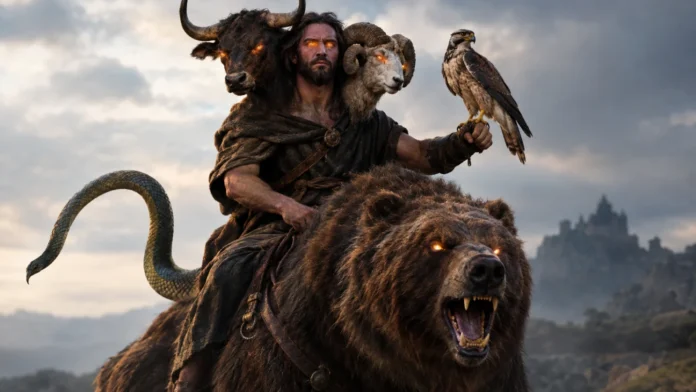
His appearance is unusually elaborate: three heads, resembling those of a bull, a man, and a ram, accompany a serpent’s tail and flaming eyes. He rides a bear and carries a hawk on his fist, combining several distinct animals in a single mounted figure.
Balam’s importance within the catalogue rests on more than his appearance. He is presented as a powerful king commanding forty legions, with abilities involving divination, invisibility, and wit. These functions make him a potential source of knowledge and advantages sought through ritual magic.
This identity is distinct from the Maya term báalam and the protective spirits called báalamo’ob. Despite the resemblance in spelling, these belong to a separate linguistic and religious setting. The documented Goetic Balam is neither a Maya jaguar spirit nor an established Middle Eastern regional folk creature.
History/Origin
Balam’s securely documented setting is early modern European demonology. His description occurs in Johann Weyer’s Pseudomonarchia daemonum and subsequently in the Ars Goetia, the opening book of The Lesser Key of Solomon. These textual witnesses establish a history of transmission rather than an ancient biography.
The sixteenth-century Weyer catalogue provides the earlier written witness represented here. Its Balam entry already contains the central visual combination: three unlike heads, a serpent’s tail, fiery eyes, a bear mount, and a hawk. The recognizable figure therefore predates his placement in the later Goetic sequence.
The continuity extends beyond outward appearance. Weyer’s Balam is already a king with forty legions, associated with truthful answers and invisibility. The later entry preserves a compact package of identifying features and supernatural services, rather than borrowing only a name for a substantially different being.
The seventeenth-century Goetia manuscript tradition identifies Balam as spirit fifty-one. The correspondence between the Goetia and Weyer’s catalogue demonstrates continuity between written descriptions, not two independently documented regional traditions.
The change in numbering makes this process particularly clear. Balam occupies position sixty-three in Weyer’s catalogue but fifty-one in the Goetia. His ordinal position belongs to the arrangement of each work; it is separate from his title of king. Reordering the catalogue did not require the compilers to discard his established appearance or offices.
The earlier formation of Balam’s particular identity cannot be dated securely from these witnesses. His established presence in the sixteenth-century catalogue supports circulation by that period, but does not determine how long his name or description existed beforehand. An earlier oral history cannot simply be assumed.
Likewise, the Solomonic framework should not be mistaken for proof that Balam originated in Solomon’s historical environment. Here, “Solomonic” identifies the magical literary tradition in which he appears. The defensible chronology separates that attributed authority from the early modern texts that preserve his description.
Name Meaning
The documented name is Balam, with Balaam recorded as an alternative spelling in the textual apparatus to the Goetia entry. Both forms refer here to the same catalogued spirit. Their coexistence establishes a spelling variation, but does not by itself explain the name’s linguistic origin.
A secure etymology is not established. The name should therefore remain a proper name rather than receive an unsupported translation. Neither his royal title nor his animal features supplies a linguistic explanation for what “Balam” originally meant.
A connection with the biblical Balaam has been proposed, but remains unproven. The modern specialist overview in Divinity Atlas treats the resemblance as plausible rather than conclusive: neither Weyer’s entry nor the Goetic passage explicitly identifies the spirit with that biblical figure.
The similar Maya terminology requires a separate distinction. In Yucatán scholarship, báalam has a dictionary association with the jaguar, while báalamo’ob can designate a class of protective spirits rather than literal animals. That usage explains a possible modern confusion, not the derivation of the Goetic name.
Appearance
Balam appears as a composite spirit whose three heads are described in a fixed sequence: first a bull’s, second a man’s, and third a ram’s. The wording distinguishes three simultaneous heads, rather than three alternative shapes assumed at different moments during an encounter.
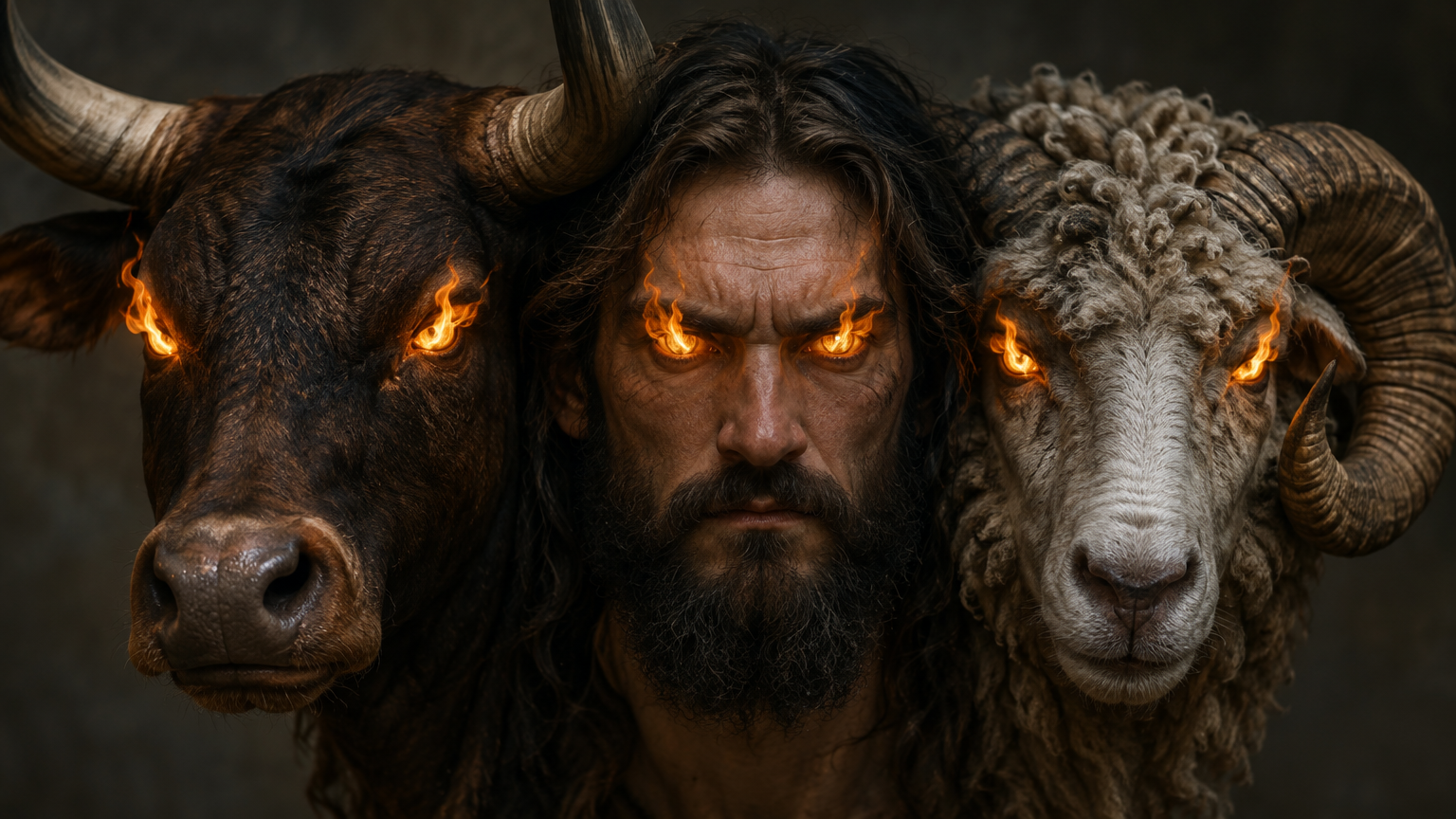
A serpent’s tail and flaming eyes complete the explicitly supernatural anatomy. The description does not explain how the heads join the body or provide a full account of his torso and limbs. His fist, however, is specified because it supports the bird he carries.
The bear is Balam’s mount, not another part of his body. In the Goetia wording it is a furious bear; the reproduced Weyer passage likewise conveys its formidable power. Keeping rider and mount distinct preserves an important feature of the composition: Balam is a mounted being accompanied by animals, not simply a creature assembled from all their body parts.
The bird introduces a small but meaningful difference in descriptive precision. Weyer’s reproduced entry calls it a hawk, while the Goetia manuscript specifies a goshawk. Both place it on Balam’s fist, so the later wording sharpens the bird’s identification without changing the essential arrangement.
His title of king establishes rank, but the quoted physical description does not specify a crown, armor, or royal clothing. Likewise, the flaming eyes should not become a wholly burning body. A text-faithful depiction emphasizes the three heads, serpentine tail, bear, and perched bird without adding unsupported embellishments.
The description is precise about these identifying features but leaves other visual questions open. It supplies no measurements, general body color, natural habitat, or surrounding landscape. Those omissions matter because the entry presents a recognizable manifestation, not a complete anatomical study or a scene set in a particular wilderness.
The three heads also resist an overly tidy symbolic explanation. Their recurrence in another Goetic description offers a literary comparison, but the Balam passage itself assigns no separate meaning to bull, man, or ram. Their documented role is to distinguish his appearance; any further interpretation must remain interpretation.
Background Story
Balam’s background is that of a classified spirit in a ritual handbook, rather than a protagonist introduced through a birth, journey, or heroic defeat. His entry concentrates on information useful for identifying and approaching him: name, rank, visible manifestation, powers, command, and seal.
The title of king and the command of forty legions place him within a hierarchy of supernatural authority. This organizational framework gives his extraordinary appearance a defined position in the catalogue. He is not merely an unnamed monster encountered in a dangerous landscape.
The forty legions express the extent of his assigned command, but the entry does not turn those subordinate spirits into individual characters. They are part of his status within the hierarchy, not participants in a recorded battle. His kingship similarly establishes authority without supplying a kingdom’s geography, royal genealogy, or account of accession.
His attributed powers explain his place in this magical setting. Divination promises access to knowledge beyond ordinary perception, while invisibility offers concealment. The ability to confer wit adds an intellectual or expressive benefit alongside these more obviously supernatural capacities, broadening the purposes associated with him.
Knowledge is especially prominent because his answers encompass past, present, and future. The office is not limited to predicting events: it extends across time. Within the logic of the entry, Balam’s usefulness rests on being able to disclose information unavailable to an ordinary questioner.
The seal connects that catalogue identity to ritual practice. His entry directs that it be made and worn as a lamina, a plate bearing the design. This belongs to the grimoire’s instructions for dealing with the spirit, rather than to his anatomy or an episode in his life.
The surviving description thus links formidable appearance with potentially useful abilities inside a structured magical system. Its continuity from Weyer’s catalogue into the Goetia helps explain Balam’s stable identity: the figure is preserved through repeated textual particulars, not through a developed sequence of narrative adventures.
Famous Folklore Stories
No named Balam folktale or developed encounter narrative is documented in these early entries. His surviving material consists chiefly of catalogue descriptions. The headings below identify recorded motifs of supernatural service, not traditional story titles.
The Spirit Who Answers Questions
Balam’s principal speaking role is to answer questions about the past, present, and future. The catalogue attributes truthful answers to him, presenting supernatural knowledge as a service available through ritual contact rather than as a prophecy delivered within a narrated adventure.
There is no documented questioner, particular prediction, or fulfilled warning in the entry. The motif concerns access to otherwise unavailable knowledge; supplying a dramatic consultation and its consequences would turn a brief magical description into an invented story.
Invisibility and Sharpened Wit
Balam also grants invisibility and makes people witty. These powers belong to his assigned offices within the spirit catalogue. They concern changes in the person seeking assistance, unlike his extraordinary appearance, which identifies the being expected to provide that assistance.
Neither passage supplies a beneficiary or an account of the power being tested. The documented motif is a promised capacity, not a successful exploit.
Cultural Impact
Balam’s clearest cultural legacy is his transmission through demonological catalogues and ritual manuscripts. His preservation shows how a compact description could remain recognizable across related works without acquiring the extended adventures, family relationships, or local landscape associations characteristic of many legendary beings.
His identity combines two kinds of information that reinforce each other. The composite appearance makes him visually distinctive, while rank, powers, legions, and seal place him within an ordered system. Removing either side would lose something important: he is neither only a fantastic image nor merely a name attached to a magical function.
His changing catalogue position illustrates the difference between preserving a figure and preserving a book’s arrangement. Weyer’s spirit sixty-three became the Goetia’s spirit fifty-one while retaining closely related attributes. The numbers reflect different organizations of the material, not successive promotions or demotions within a supernatural history.
Modern editions sustain this textual legacy. The digital transcriptions at Esoteric Archives preserve manuscript comparisons, making variations visible alongside the familiar portrait.
Cultural identification also requires separating unrelated names. The study The Gods of Yucatán from A.D. 1560 to 1980 distinguishes Maya protective spirits from a simple dictionary translation as jaguars. That distinction preserves the complexity of the Maya tradition while preventing its absorption into the European grimoire figure’s history.
Similar Beasts
Asmodeus
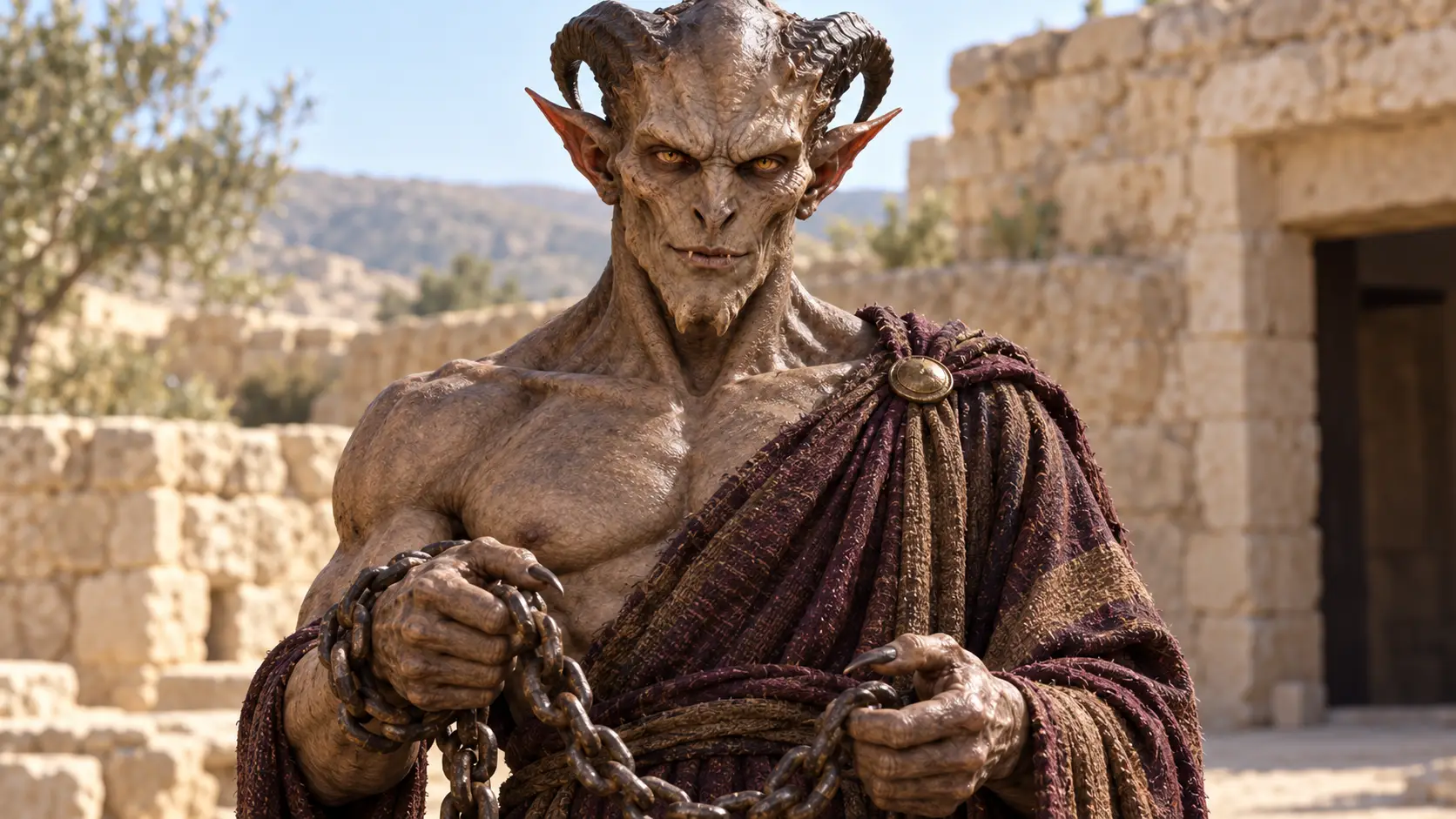
Asmodeus, appearing as Asmoday in the Goetic tradition, is an especially close comparison because his description shares the bull, human, and ram heads. Divinity Atlas highlights this repeated formula when discussing Balam’s textual construction.
The resemblance concerns a particular combination of features, not simply the general category of demon. It offers a useful example of shared descriptive material within the catalogue, while the separate entries preserve the spirits as distinct identities.
Bael
Bael is another king in the Goetic catalogue, with a separate entry and identity. He belongs to the same system of named spirits whose descriptions combine rank, manifestation, supernatural offices, and authority over subordinate spirits.
His closest relevance is structural: both figures occupy royal positions within the catalogue. Similar status and related-looking names should not obscure their treatment as distinct beings.
Alloces
Alloces is a separate Goetic spirit whose appearance includes a soldier riding a horse. Like Balam, he is presented through a brief descriptive entry rather than a developed cycle of personal adventures.
The mounted presentation offers a useful visual comparison. Alloces’ horse and soldier form differ from Balam’s bear-mounted manifestation, despite their shared place in the same catalogue.
Caim
Caim is another distinct Goetic spirit, associated with a bird manifestation and a human form. He provides a contrast between alternative manifestations and Balam’s simultaneous combination of unlike heads.
The bird connection should not erase that difference. Balam carries a hawk as part of his mounted appearance; Caim’s bird manifestation belongs to the description of Caim himself.
Religion/Ritual
Balam belongs to a ritual-magic text, not merely a collection of fantastic animals. His entry includes a seal and directs that it be made and worn as a lamina, an inscribed plate associated with the practitioner’s ritual equipment.
The seal is therefore a material feature of the prescribed operation, not a bodily marking or anatomical attribute of the spirit. Keeping that distinction clear prevents an illustration of ritual apparatus from being mistaken for part of Balam’s manifested form.
This instruction documents what the text prescribes, not an independently observed ceremony. The entry does not establish a Balam-specific public cult, seasonal festival, or offering tradition. Its contribution is narrower: it connects this named spirit with a particular identifying seal and an instruction concerning its use.
Scientific or Rational Explanations
The strongest rational approach is textual and historical rather than zoological. Balam’s description survives within a catalogue of spirits and their offices, not a natural-history report. Its documentary value concerns how supernatural beings were classified and represented in early modern magical literature.
The close agreement between Weyer’s description and the later Goetic entry supports transmission through related texts. Repeated wording and attributes do not constitute independent sightings. They show that a recognizable description was preserved and reorganized within a continuing literary tradition.
This distinction separates two different questions: whether Balam is historically documented as a literary and ritual figure, and whether his attributed powers are independently demonstrated. The entries establish the former. Their statements about invisibility, divination, and supernatural command belong to the claims of the magical tradition, not verified accounts of physical effects.
A modern synthesis in Divinity Atlas highlights the repetition of Asmoday’s three-head formula in Balam’s description. This supports reading the imagery as potentially formulaic or compilatory. It does not establish which author first devised the combination or whether every feature had a fixed symbolic meaning.
The same restraint applies to explanations based on mistaken animal identification. The entry provides no observed specimen, location, or chain of eyewitness testimony to test against a known species. Its composite anatomy is best addressed through the documented literary setting rather than an unsupported proposal about what animal someone might have seen.
The proposed connection with the biblical Balaam remains an interpretation, not a demonstrated derivation. Name resemblance can suggest a connection worth examining, but the absence of an explicit identification in the early entries leaves the proposal uncertain.
Modern Cultural References
Shin Megami Tensei if… (1994, Video Game)
Atlus incorporates Balam as a fallen angel and supernatural adversary. His appearance draws upon Louis Le Breton’s nineteenth-century illustration of the demon in the Dictionnaire Infernal.
Source: Megami Tensei Wiki
Dungeons & Dragons: Tome of Magic (2006, Tabletop Role-Playing Game)
The supplement reimagines Balam as the Bitter Angel, a supernatural vestige with a serpentine body and three-part head, granting characters abilities associated with cunning and supernatural perception.
Source: D&D Tools — Vestiges
B.P.R.D.: Hell on Earth — The Exorcist (2016, Comic Book)
Within Mike Mignola’s Hellboy universe, Balam appears as an imprisoned demon confronted by exorcist Ashley Strode, retaining his command of forty legions and powers of supernatural foresight.
Source: Hellboy Wiki
Goetia: Kings of Hell — Zach Titterington (2019, Illustrated Art Book)
This illustrated project presents Balam under the title King of Truths, reinterpreting his demonological identity through contemporary fantasy artwork alongside other royal spirits from the Ars Goetia.
Source: Art of Goetia
Goetia: Nine Kings of Solomon (2021, Board Game)
Published by Demonic Games, this strategy game features King Balam among nine Goetic demons, adapting the supernatural hierarchy of the Ars Goetia into resource management and card-based mechanics.
Source: Demonic Games — Official Rulebook
Tsukuyomi: The Divine Hunter (2025, Video Game)
Developed by COLOPL with renowned artist Kazuma Kaneko, this strategic card-battle game introduces a redesigned Balam as a supernatural boss encountered within its first dungeon.
Source: Creative Uncut — Balam Character Artwork
Conclusion
Balam belongs most securely to the early modern European tradition of Solomonic demonology. His three heads, serpent’s tail, bear mount, and carried hawk form a distinctive composite image, while his attributed gifts connect knowledge with concealment and intellectual ability.
His history is chiefly one of textual continuity: an earlier demon catalogue and the later Goetia preserve closely related descriptions despite different numbering. Read within that setting, Balam illustrates how ritual literature combined extraordinary imagery with a carefully ordered hierarchy of supernatural powers.
Further Reading
The Lesser Key of Solomon, Joseph H. Peterson text edition
Peterson’s edition presents the Goetia with explanatory notes. It includes Balam’s manuscript description, attributed powers, and seal instruction.
(jamesparsonslakebucket.s3-us-west-1.amazonaws.com)
Pseudomonarchia Daemonum (Liber officiorum spirituum), Twilit Grotto Esoteric Archives
This archive presents Johann Weyer’s demon catalogue with Balam in its sixty-third position. The entry preserves his composite appearance, kingship, forty legions, truthful answers, and invisibility.
(esotericarchives.com)
Lemegeton, Part 1: Goetia, Twilit Grotto Esoteric Archives
This digital edition presents the Goetia with manuscript comparisons and editorial annotations. Its fifty-first entry supplies Balam’s appearance, forty legions, seal, and powers of knowledge and concealment.
(esotericarchives.com)
Balam, Divinity Atlas, 2026
This specialist overview examines Balam’s textual background and proposed biblical connections. It distinguishes established grimoire attributes from uncertain name derivations and discusses the repeated three-head formula shared with Asmoday.
(divinityatlas.com)
The Gods of Yucatán from A.D. 1560 to 1980, Estudios de Cultura Maya, 2011
This scholarly study provides context for Maya religious terminology and protective spirits. It explains why báalamo’ob cannot simply be reduced to literal jaguars and documents a tradition distinct from Goetic Balam.
(scielo.org.mx)
Balam — entry in the Dictionnaire infernal reception record, Wikipédia française
Useful as a discovery aid for the alternate spelling Balan and the contrast between the Lemegeton’s 51st position and the Pseudomonarchia Daemonum’s 63rd. It also summarizes the established attributes, but the cited historical texts above are preferable for substantiating them; this page does not establish an independent literary or stage role.
(fr.wikipedia.org)