Introduction
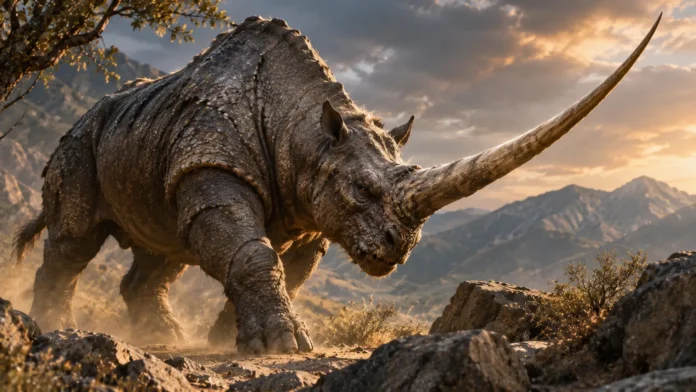
The karkadann belongs to Persianate and Arabic traditions at the meeting point of natural history and fabulous zoology. Its best-supported foundation is the rhinoceros, particularly the Indian rhinoceros, rather than a horse-shaped unicorn. Some literary descriptions and artistic representations nevertheless give it distinctly legendary characteristics.
The name therefore does not identify one consistently imagined monster. It can refer to an actual animal, an embellished account of that animal, or a unicorn-like subject. These meanings overlap, but treating them as interchangeable obscures the creature’s history.
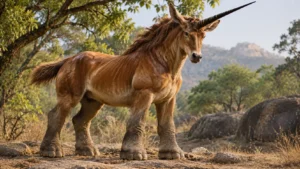
The rhinoceros provides the clearest starting point: a powerful, thick-skinned quadruped with a prominent nose horn. Later fabulous imagery can depart from that anatomy. The familiar European image of a white horse with a forehead horn is not an appropriate default.
The karkadann matters because its changing identity preserves different ways of understanding an unfamiliar animal. Persian vocabulary, Arabic natural-history writing, and Indo-Persian art brought zoological knowledge into contact with inherited marvels, allowing recognizable animal features and imaginative elaboration to coexist.
History/Origin
The karkadann’s origins cannot be reduced to a single invention or founding story. Its history includes both the naming of rhinoceroses and the development of fabulous horned animals. The strongest linguistic evidence anchors it in an animal category, even where literary treatments become less zoologically precise.
Ancient descriptions of one-horned animals form part of this wider background. In his specialist study of Indo-Persian imagery, Iván Szántó discusses Ctesias’s description of a horned wild ass. That comparison illustrates an early problem of identification, not a demonstrated direct origin for every later karkadann tradition.
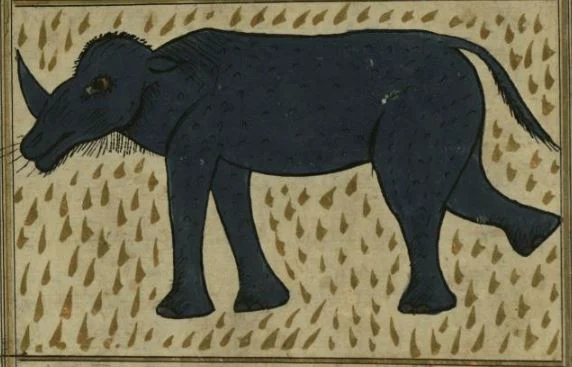
Within medieval Persianate and Arabic natural history, the rhinoceros became a subject that could accommodate both observation and marvel. Early rhinoceros-like descriptions are important to its identity, while subsequent accounts and images sometimes amplify the animal’s unusual appearance into something more fabulous.
Limited direct familiarity with rhinoceroses in some Iranian settings helped shape this development. Reports about horns and circulating images could convey knowledge of the animal without providing a complete understanding of its anatomy. Such conditions allowed recognizable features to survive alongside imaginative reinterpretation.
The visual history is not simply a progression from accurate animal to invented monster. Indo-Persian art includes both zoologically recognizable rhinoceroses and unicorn-like counterparts. Their coexistence matters: a fabulous depiction does not establish that the ordinary animal meaning had disappeared.
An 1829 edition of A Dictionary, Persian, Arabic, and English, revised by Francis Johnson, preserves this lexical complexity. It defines kargadan or karkadan as a rhinoceros, while separately recording a fabulous bird association. This is a later witness to varied meanings, not an origin date.
Name Meaning
The most securely supported meaning of the name is “rhinoceros.” Historical Persian vocabulary includes karg and kargadan, while the dictionary also gives the form karkadan. These animal names provide firmer evidence than translations constructed from the creature’s supposed personality or habitat.
The English spelling karkadann appears alongside forms such as kargadan and karkadān. Variation in spelling should not, by itself, be taken as evidence for separate species of legendary beast. The substantive distinction is between the word’s zoological use and its fabulous associations.
Its deeper derivation is less certain than its recorded meaning. The specialist discussion in “Chieh-huan as Word, Art Motif and Legend” explicitly states that the source from which kargadān entered Persian is not exactly known. A confident word-by-word translation would therefore overstate the evidence.
This distinction between meaning and etymology is essential. A historical dictionary can establish that people used a word for the rhinoceros without explaining how that word originally formed. The karkadann’s association with unicorn imagery likewise does not prove that its name originally meant “unicorn.”
Appearance
The best-supported representative form is a rhinoceros-like quadruped: heavy-bodied, thick-skinned, and equipped with one conspicuous nose horn. The Indian rhinoceros offers the strongest anatomical baseline. This places the creature’s defining horn on a robust animal rather than automatically on an elegant horse.
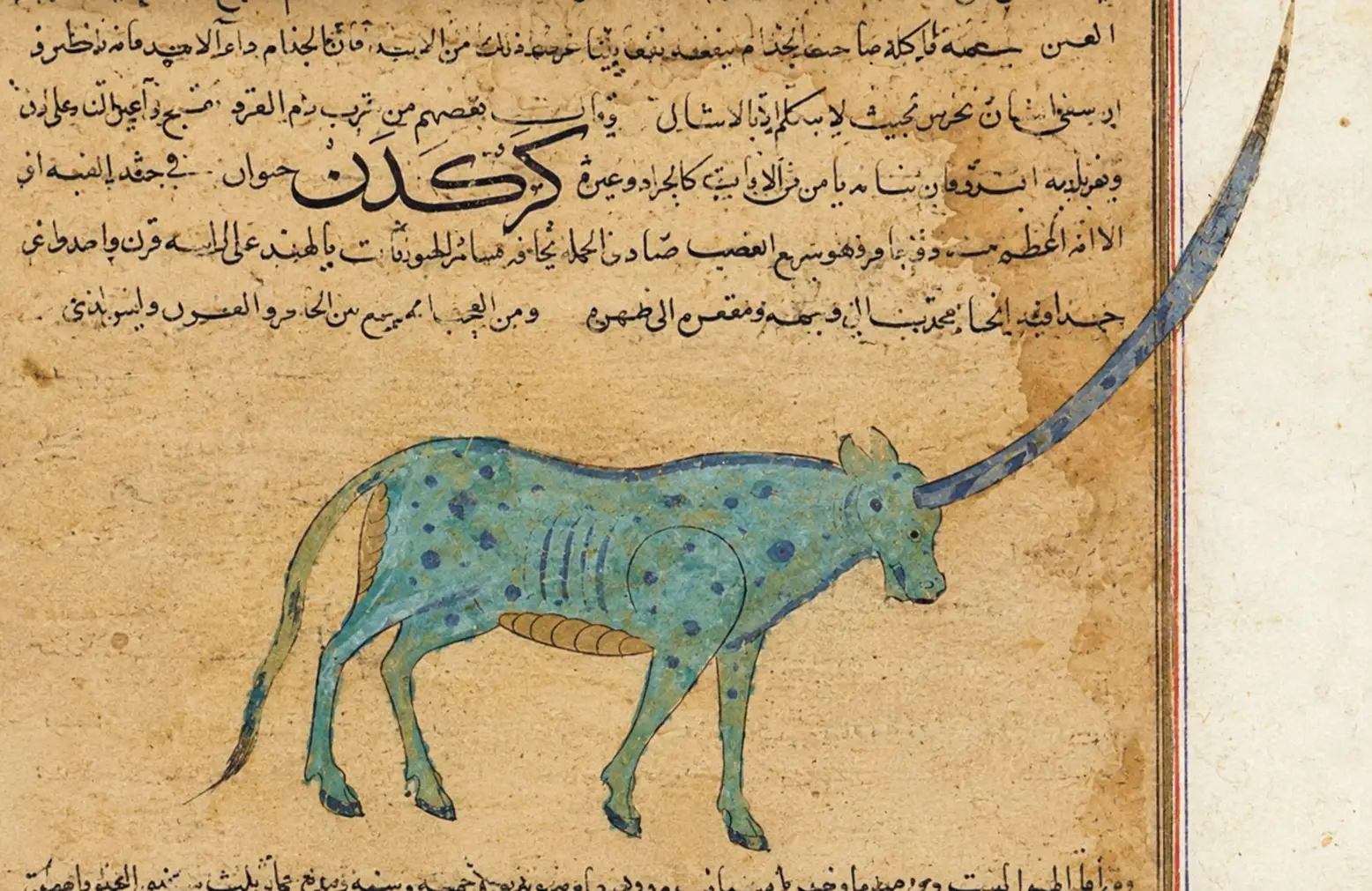
The distinction concerns the whole body, not merely the number of horns. A rhinoceros silhouette preserves the animal identity established by the vocabulary and early descriptive tradition. Replacing it with a horse-shaped body selects a fabulous interpretation instead of presenting a neutral image of the karkadann.
Unicorn-like variants nevertheless belong to its documented visual history. Some later descriptions or images emphasize a longer, straighter, or otherwise exaggerated horn. Such features should be understood as particular treatments of the subject, not as mandatory characteristics shared by every account.
Szántó’s study distinguishes the rhinoceros from its mythological cousin, the unicorn, while examining their artistic relationship. That distinction helps explain why the karkadann cannot be assigned one universal anatomy. A recognizable animal and a transformed fabulous counterpart can belong to connected traditions without being visually identical.
A separate complication appears in the 1829 dictionary’s enormous-bird gloss. This is not a reason to give the usual rhinoceros-shaped karkadann wings or merge the two forms into a hybrid. The bird belongs to a distinct recorded association under the same lexical entry.
Background Story
The karkadann is better understood through its cultural and literary background than through a personal biography. The evidence does not establish one canonical narrative explaining its birth, ancestry, or adventures. Its identity emerges instead from animal terminology, natural-history accounts, and changing artistic representations.
A central influence was the distance between knowing that an animal existed and knowing exactly what it looked like. Where direct familiarity was limited, descriptions and images carried much of that knowledge. Reports centered on an unusual horn could preserve a striking feature while leaving the surrounding anatomy less stable.
The horn consequently links the zoological and fabulous strands without making them identical. It belongs naturally to the rhinoceros, yet can become more visually prominent in legendary representation. This shared feature helps explain the overlap with unicorn imagery without requiring every depiction to follow a single model.
The dictionary’s bird association offers a different glimpse of fabulous elaboration: an enormous bird called kargadan pursues a ten-year-old elephant. The gloss preserves a specific motif, but not a complete tale. It should neither become the creature’s standard biography nor be silently transferred to the rhinoceros form.
The resulting tradition holds observation and imaginative transformation together. Its cultural interest lies not in separating a supposedly authentic monster from an unrelated real animal, but in recognizing their documented connection. The rhinoceros remains the foundation, while particular texts and images determine how far the karkadann departs from it.
Famous Folklore Stories
The Second Voyage of Sindbad the Seaman
The karkadann has a concrete literary episode in The Second Voyage of Sindbad the Seaman, part of The Arabian Nights. Here, the rhinoceros becomes an animal of extraordinary strength, embedded in a sequence that links it with an elephant and the gigantic roc.
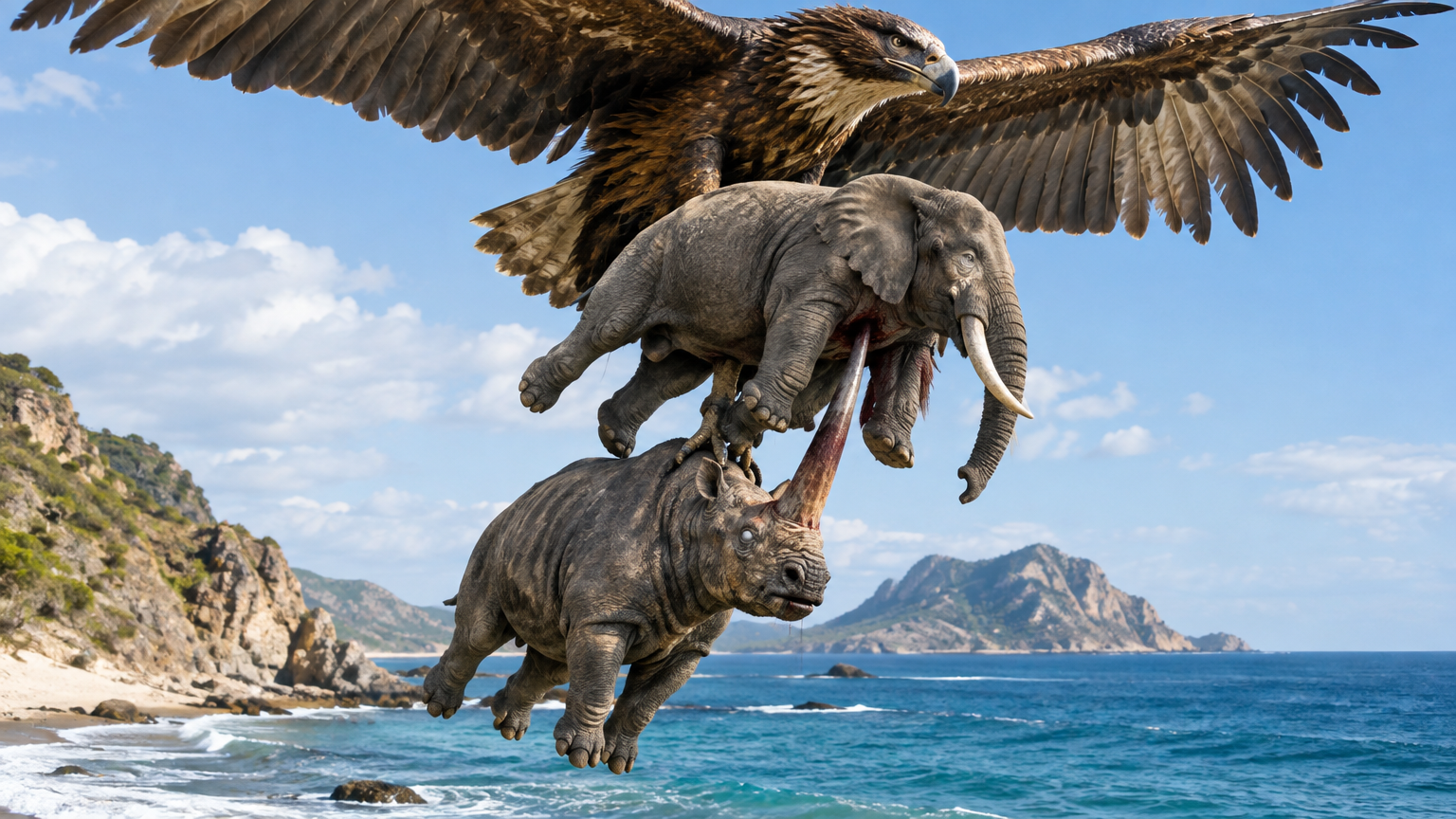
In the account attributed to voyagers, pilgrims, and travelers, the karkadann carries a great elephant impaled upon its horn. It continues grazing around the island and seacoast, apparently untroubled by its burden. The elephant eventually dies, but the karkadann’s apparent triumph brings its own destruction.
As the elephant’s fat melts in the sun, it runs into the karkadann’s eyes and blinds it. The stricken animal lies down on the shore. A roc then carries away the karkadann together with the elephant, turning the formidable horned beast into another creature’s prey.
This is reported animal lore within Sindbad’s voyage, rather than a battle in which Sindbad defeats the beast himself. Its narrative force comes from successive reversals of scale: the elephant is overcome by the karkadann, which is then overcome by something still larger.
Cultural Impact
The karkadann occupied a space where knowledge of distant animals and literary wonder could coexist. Its cultural importance does not depend on every reader mistaking fiction for zoology. A recognizable rhinoceros could also become an exaggerated creature through which writers explored the extraordinary scale of the world.
In The Arabian Nights, the elephant-bearing episode makes the animal part of a memorable hierarchy of strength. Its horn provides the mechanism of victory, but also the means of its undoing. The roc’s intervention enlarges the marvelous world surrounding Sindbad without making the karkadann a humanlike character.
Manuscript painting gave the subject a material presence beyond storytelling. An early fifteenth-century folio titled Rhinoceros (Karkadann), from an Aja’ib al-makhluqat, or Wonders of Creation, survives in the Smithsonian’s collections. It is cataloged as originating in Iraq or eastern Turkey.
Made with opaque watercolor, ink, and gold on paper, that folio documents the animal’s place in illustrated wonder literature. It is a specific historical object, not simply evidence for a supposedly universal design. Other Indo-Persian representations range between recognizable rhinoceroses and more fabulous, unicorn-like animals.
This variation is central to the creature’s artistic legacy. Zoologically attentive images and imaginative versions need not represent separate, unrelated traditions. They show how the same subject could accommodate observation, inherited descriptions, and artistic invention, although the balance must be assessed for each individual work.
A modern reinterpretation appears in CableHook Games’ Here Comes the Swarm, whose 2026 Early Access material names Karkadann among the deities encountered in play. That divine role belongs to the game’s creative setting; it does not establish that the historical karkadann was traditionally worshipped.
Similar Beasts
Shadhavar
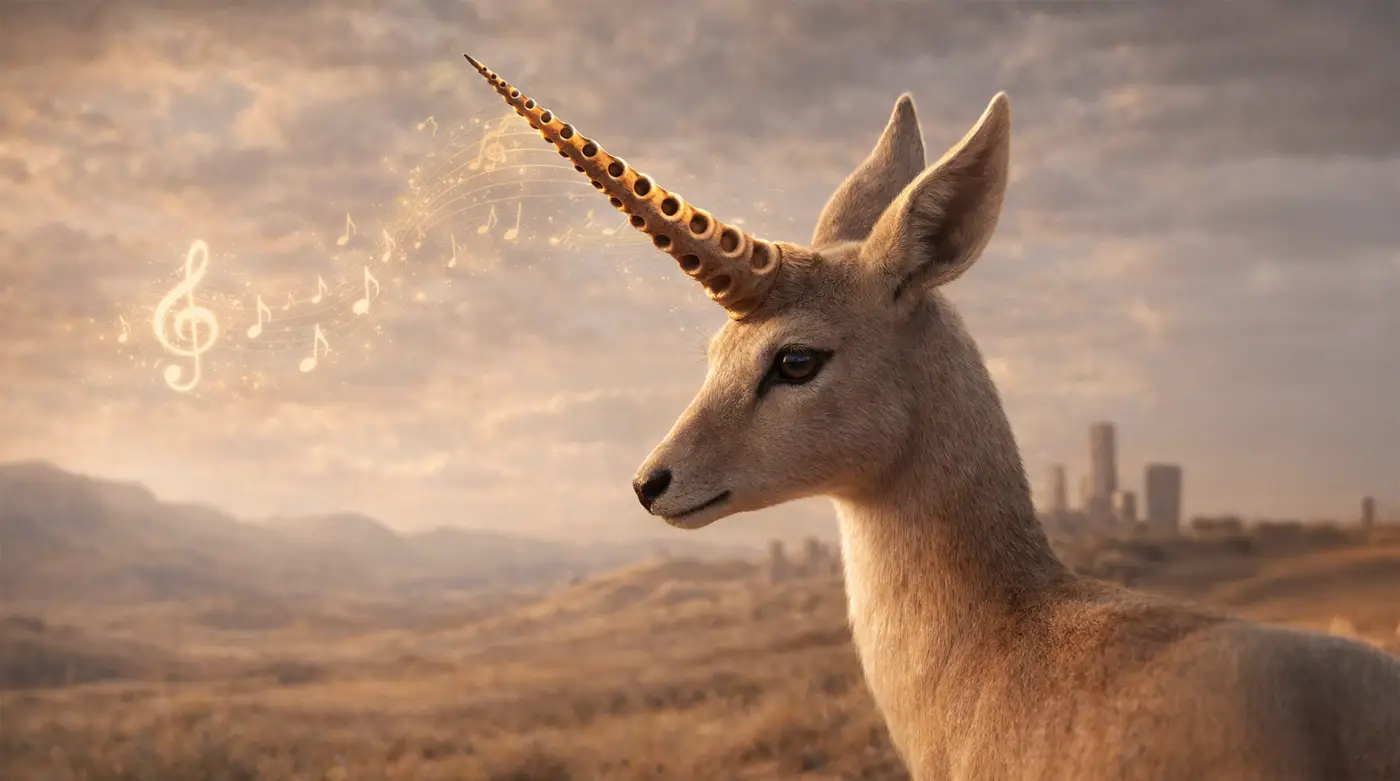
The Shadhavar is a fabulous horned animal in Persian folklore, distinguished by a horn that produces enchanting music. Its defining marvel is musical rather than bodily strength.
It offers a close Persianate comparison for an extraordinary horned beast, but its musical power should not be transferred to the karkadann.
Roc
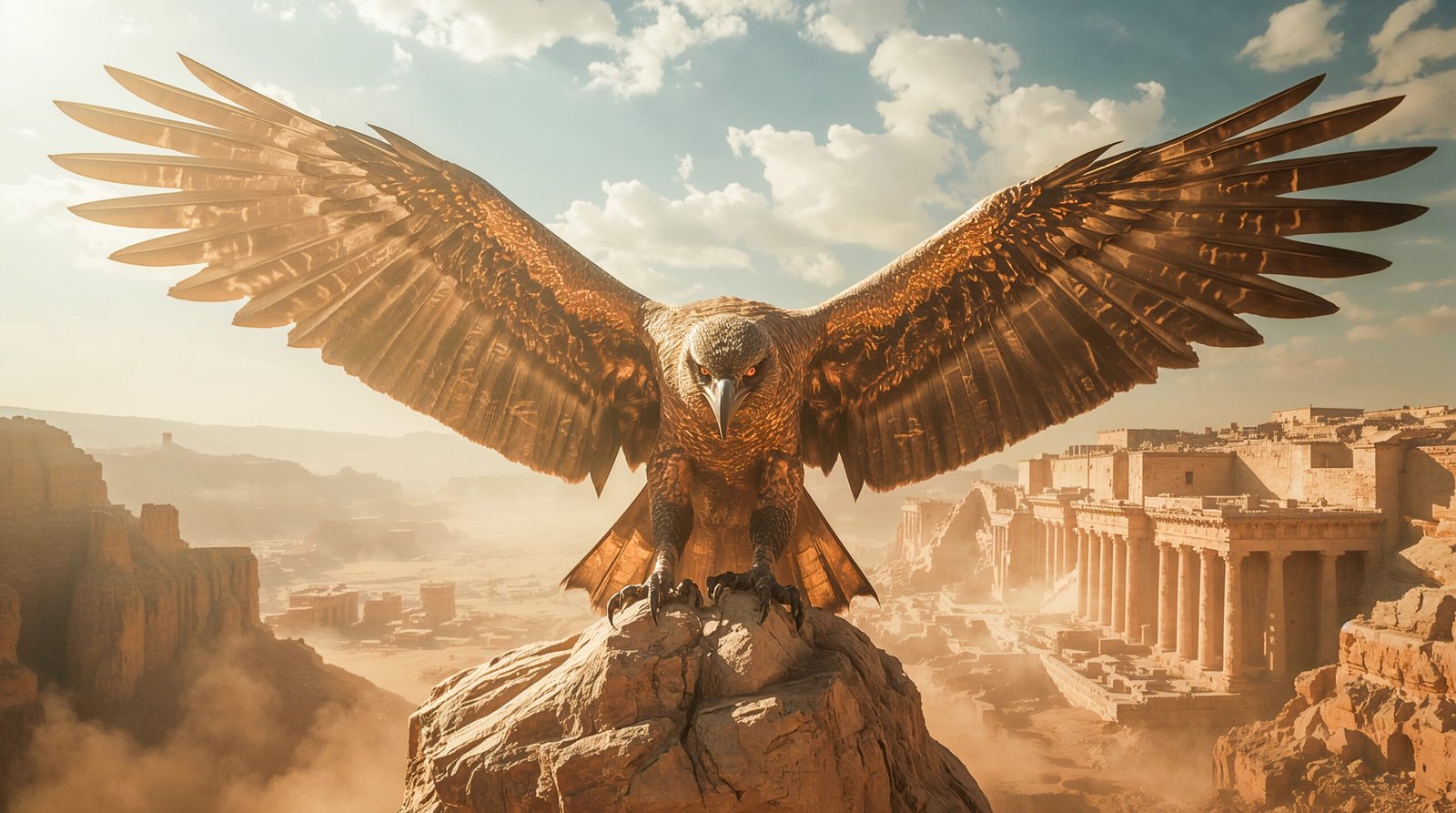
The Roc is a colossal bird of Persian and Arabian storytelling, famous for carrying enormous animals. It belongs directly to the marvelous world of Sindbad’s voyages.
Unlike a merely visual parallel, its connection is narrative: in the second voyage, it carries away the blinded karkadann and the elephant together.
Unicorn
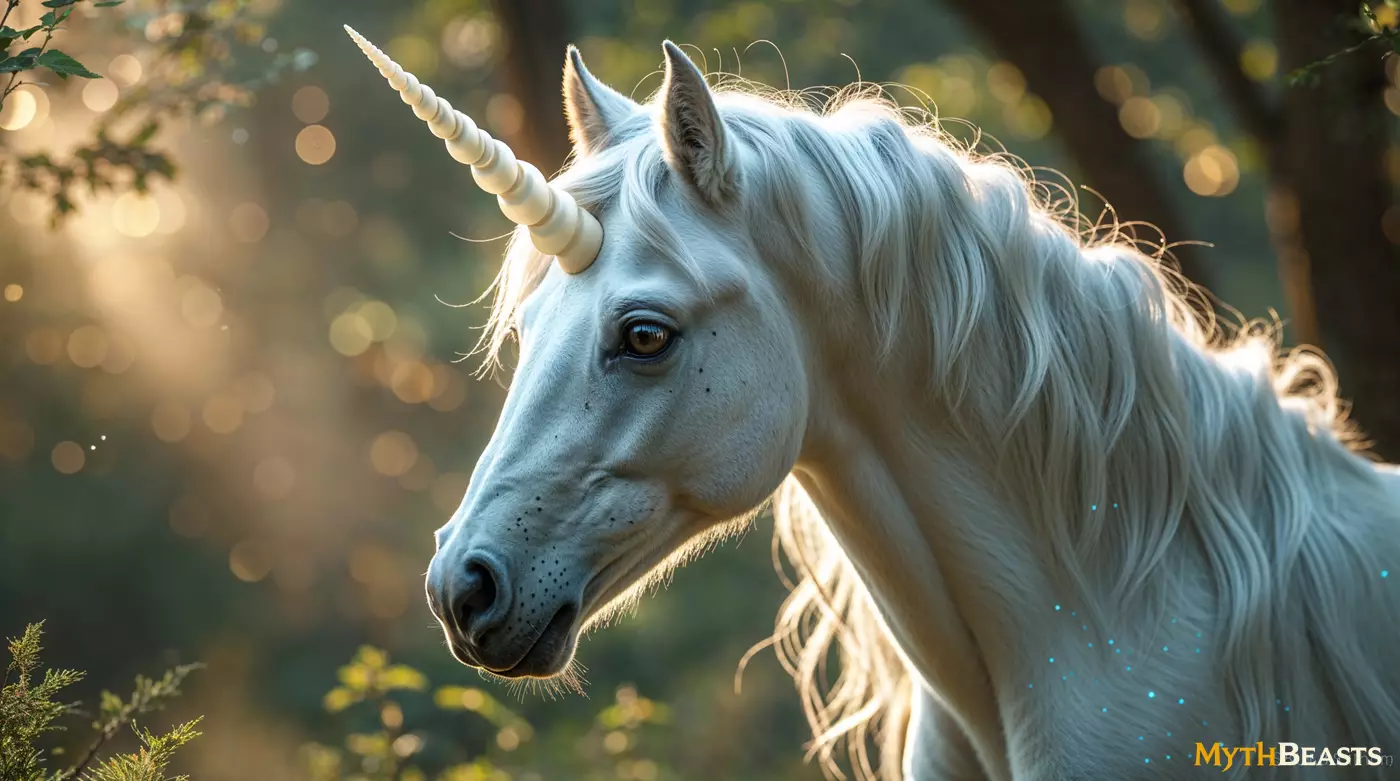
The Unicorn belongs to a broad tradition of one-horned legendary animals, with associations including healing and purity. Its familiar horse-like form does not encompass every historical version.
Unicorn imagery overlaps with fabulous karkadann depictions, but the comparison must preserve the latter’s rhinoceros foundation rather than replace it with horse anatomy.
Yale
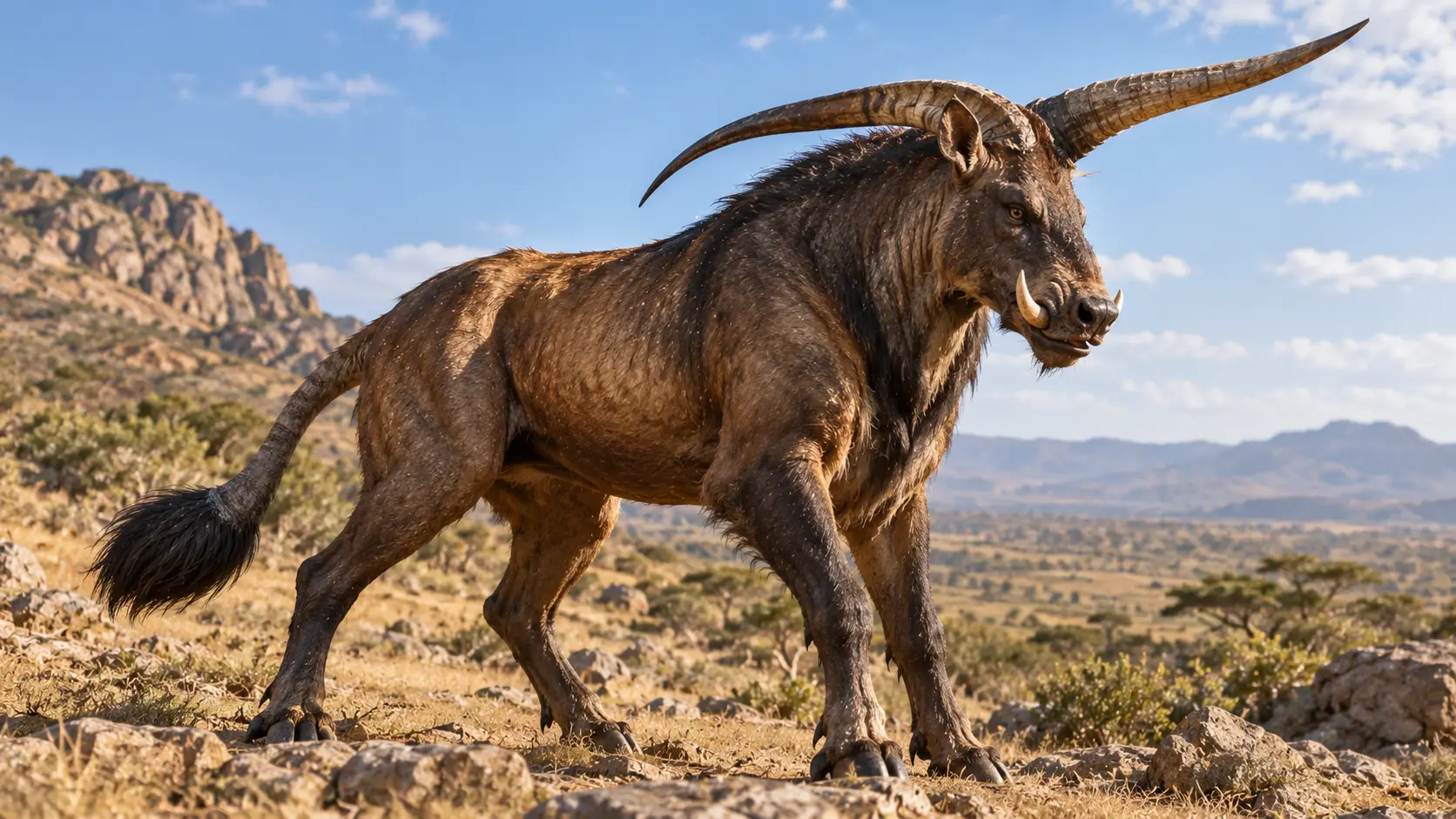
The Yale is an antelope-like beast of classical accounts and medieval bestiaries, distinguished by horns said to swivel during combat. It also became a European heraldic figure.
Like the legendary karkadann, it turns horned-animal anatomy into extraordinary weaponry. This is a comparison of bestiary motifs, not evidence of direct descent.
Qilin

The Qilin is an auspicious East Asian creature associated with gentleness, prosperity, and virtuous authority. Its composite appearance can include a deer-like body, scales, and prominent horns.
Its horned appearance invites comparison, but its auspicious role differs sharply from the karkadann’s destructive strength in Sindbad. The two remain culturally distinct.
Religion/Ritual
No securely documented ceremony, offering, or worship practice specifically centered on the historical karkadann is established here. Its presence in Arabic and Persianate wonder literature does not itself make it a deity, and beliefs about exceptional horns should not automatically be classified as religious ritual.
Scientific or Rational Explanations
The strongest explanation begins with an actual animal, especially the Indian rhinoceros, rather than an unidentified monster. The historical vocabulary names a rhinoceros, while literary and artistic treatments sometimes enlarge its capabilities or reshape its appearance. Zoological identity and fabulous elaboration therefore need to be examined together.
Historical word evidence is particularly useful because appearance alone can mislead. The 1829 A Dictionary, Persian, Arabic, and English defines kargadan or karkadan as rhinoceros. Specialist linguistic discussion likewise connects the Persian forms with that animal, while cautioning that the word’s precise derivation remains uncertain.
Limited direct familiarity offers a plausible explanation for some changes in representation. Where knowledge circulated through descriptions, images, or reports about horns rather than living animals, a prominent feature could remain recognizable while the surrounding anatomy became less accurate. This is a historical interpretation, not a demonstrated explanation for every image.
Written testimony also requires contextual reading. Babur’s account of animals seen and hunted near Peshawar presents a textual problem discussed in The Rhinoceros in the Arts and Sciences: without diacritical marks, the animal-name can be read as either gurg, meaning wolf, or karg, meaning rhinoceros.
The surrounding description favors the rhinoceros reading. This example concerns an observed animal rather than a supernatural encounter, but it illustrates an important method: historical names cannot always be interpreted reliably in isolation. Actions, physical descriptions, and the wider passage help distinguish zoological testimony from fabulous narrative.
The elephant-bearing episode is different in kind. Its impossible burden, prolonged grazing, blinding, and removal by a gigantic bird form an escalating literary sequence. It is best read as marvelous animal lore, not as reliable evidence of rhinoceros behavior or a literal record of an encounter.
Reported medicinal or poison-related powers of exceptional horns likewise belong to the history of belief, not established biological effects. The careful distinction is between a real animal, claims historically attached to it, and later imaginative transformations. Explaining the animal basis does not erase the literary tradition built around it.
Modern Cultural References
Here Comes the Swarm, video game (2026)
CableHook Games’ strategy game includes encounters with powerful deities in its playable Early Access version. Karkadann appears as one of these beings, adapting the name for modern fantasy.
(store.steampowered.com)
Conclusion
The karkadann stands at the meeting point of observed animals and imagined wonders. Its strongest historical foundation is the rhinoceros, particularly the Indian rhinoceros, rather than a horse-shaped unicorn with a fixed set of magical attributes. Yet its fabulous forms are also part of the tradition, not simply errors to be discarded. Persianate and Arabic writing, together with Indo-Persian imagery, reveal how an identifiable animal could become a subject of extraordinary strength, unfamiliar anatomy, and literary invention.
Understanding the karkadann therefore requires preserving differences between words, pictures, and stories. A dictionary’s rhinoceros, a manuscript’s fabulous animal, and a modern game’s deity do not carry identical meanings, even when they share a name. The creature’s cultural importance lies in that capacity for transformation across languages and media. Its uncertain etymology and variable appearance discourage a single rigid definition, while its rhinoceros foundation keeps interpretation anchored in the historical encounter between natural knowledge and the literature of marvels.
Further Reading
“Kargadan: An Animal between Myth and Reality in Indo-Persian Art and Culture,” Iván Szántó, 2019
This specialist essay examines rhinoceros and fabulous animal imagery in Indo-Persian culture. It helps distinguish zoological representations from unicorn-like forms without erasing their connections within the tradition.
(academia.edu)
“Chieh-huan as Word, Art Motif and Legend,” Rhino Resource Center
This specialist study discusses rhinoceros terminology, including Persian karg and kargadan. It is particularly useful for understanding why the word’s historical derivation should not be treated as settled.
(rhinoresourcecenter.com)
A Dictionary, Persian, Arabic, and English, Qatar Digital Library, 1829
This digitized historical dictionary records kargadan or karkadan as a word for rhinoceros. Its additional fabulous association illustrates the need to distinguish lexical meanings from complete narratives.
(qdl.qa)
The Second Voyage of Sindbad the Seaman, The Arabian Nights, Sacred Texts
This narrative includes the karkadan carrying an elephant on its horn before the roc intervenes. It provides a primary literary example of the animal’s greatly exaggerated strength.
(sacred-texts.com)
Rhinoceros (Karkadann); folio from an Aja’ib al-makhluqat (“Wonders of Creation”), Smithsonian National Museum of Asian Art
This museum catalog documents an early fifteenth-century manuscript folio from Iraq or eastern Turkey. Its material details and attribution provide a concrete reference for the karkadann’s visual history.
(collections.si.edu)
The Rhinoceros in the Arts and Sciences, chapter 11, Brill
This scholarly chapter examines historical rhinoceros testimony, including passages from Babur’s memoirs and the reading of karg. It helps separate observed animals from fabulous descriptions and linguistic ambiguities.
(brill.com)