Introduction
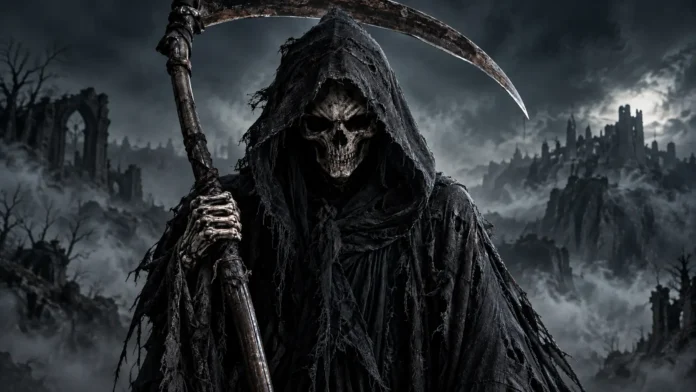
The Grim Reaper is an English-language personification of death, familiar as a skeleton wearing a long, dark cloak and carrying a scythe. It belongs to a European tradition of representing mortality through humanlike figures, rather than to a single mythology with an established divine genealogy.
Its appearance turns an abstract condition into a recognizable presence. The skeleton represents the dead body, while the harvesting tool expresses the taking of human lives.
Together, these features make the figure intelligible without requiring a particular story, setting, or named victim.
The image and the name have different histories. Skeletal representations of Death circulated in European art centuries before the expression “Grim Reaper” appeared in nineteenth-century English.
Medieval imagery therefore provides its visual background, but does not establish a medieval character bearing that exact name.
The figure matters chiefly as an allegory of mortality. Artists and writers can make Death threatening, impartial, or approachable, depending on their purpose.
These interpretations belong to a flexible cultural tradition, not to a single authoritative account of the Reaper’s personality or actions.
History/Origin
The Grim Reaper’s visual ancestry lies in European representations of personified Death. Its familiar features developed across artistic and literary traditions rather than through one identifiable founding tale.
The history is therefore best understood as the gradual convergence of skeletal imagery, harvesting symbolism, and a later English expression.
Late-medieval Dance of Death imagery provides an important part of that background. Skeletons interact with living people drawn from different social ranks, placing mortality alongside the distinctions that organize earthly society.
The central message is that status cannot exempt anyone from death.
These scenes do not always present a solitary hooded figure. Multiple skeletal participants may appear among the living, making death a shared condition rather than the activity of one individualized character.
Their connection to the later Reaper is visual and thematic, not evidence of an identical name or biography.
The fourteenth-century Black Death is often invoked as the Reaper’s origin. Epidemic mortality belongs to the historical context of European macabre imagery, but that association should not be mistaken for a precise creation date.
In particular, it cannot date the much later English name.
Pieter Bruegel the Elder’s The Triumph of Death supplies a concrete example of the older visual tradition. A scythe-bearing skeleton represents Death within a larger scene of devastation.
The painting demonstrates the established association between skeletal Death and reaping, without documenting a character called the Grim Reaper.
The English wording is documented in the nineteenth century. PBS’s Monstrum identifies “Grim Reaper” in the 1847 devotional publication The Circle of Human Life, partially translated from a German work first published in 1841.
An Oxford English Dictionary excerpt reproduced by San José State University also records figurative “reaper” in 1839.
Name Meaning
“Grim Reaper” names Death as a fearsome harvester. “Grim” means harsh, forbidding, or frightening, while a “reaper” is someone who harvests crops.
Together, the words turn mortality into a concrete image: human lives are cut down and gathered like a harvest.
The scythe gives this metaphor its familiar visual form. It is a harvesting tool, not merely a weapon.
In the hands of personified Death, it connects the figure’s appearance with the action expressed by the English name.
Related expressions include “the Reaper,” “the Great Reaper,” and “the Old Reaper.” These variants, recorded in the Oxford English Dictionary, retain the harvesting metaphor while changing the descriptive wording.
They are alternative designations for personified Death, not evidence of separate beings with distinct biographies.
The name’s documented history must be distinguished from the history of the image. An Oxford English Dictionary excerpt reproduced by San José State University records figurative “reaper” in 1839; PBS’s Monstrum identifies “Grim Reaper” in the 1847 devotional work The Circle of Human Life.
These examples concern different wording and establish recorded usage, not necessarily the first use of either expression. Neither dates the beginning of Europe’s much older representations of Death.
Appearance
The conventional modern Reaper has an anthropomorphic skeletal body beneath a long cloak or robe. A hood commonly frames or obscures the skull, and the clothing is often dark.
The combination of skeleton, cloak, and scythe forms the most recognizable English-language representation.
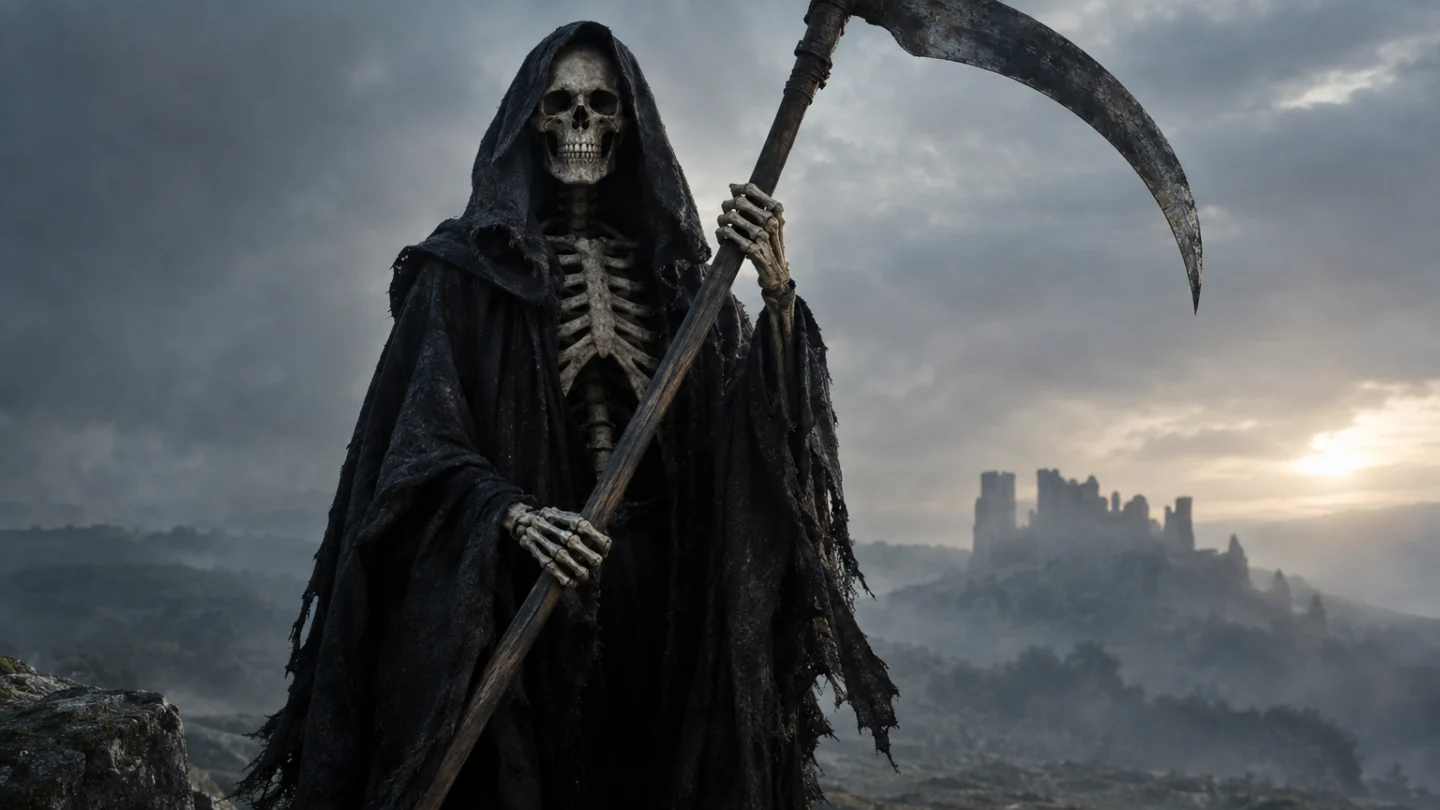
The exposed skull and bones distinguish the figure from a living person. Visually, Death carries the evidence of bodily mortality in its own form.
Artists may reveal much of the skeleton or conceal nearly everything beneath clothing, while retaining enough skeletal detail to identify the allegory.
The long cloak gives the skeletal figure a humanlike silhouette while hiding its body. Its darkness contributes to the familiar somber presentation, but neither a particular shade nor complete concealment is universal.
Historical representations of Death need not reproduce the modern black-robed outline.
The scythe is the clearest link between appearance and name: Death is shown as a harvester of lives. Bruegel’s scythe-bearing skeleton illustrates that this association predates the nineteenth-century expression.
The implement identifies a symbolic action, rather than establishing one fixed narrative about how every death occurs.
Historical imagery is broader than this single design. Dance of Death scenes can feature several skeletons interacting with the living, while other death imagery includes an hourglass to signify passing time.
The hourglass is an optional attribute, not a necessary component of every Grim Reaper depiction.
Background Story
No single traditional origin story or fixed biography is established for the Grim Reaper. Its background is instead the cultural process by which death became a visible actor.
Skeletal bodies, encounters with the living, and harvesting imagery supplied elements that could be combined without a continuous narrative.
The Dance of Death tradition shaped this background through its attention to social difference. By placing skeletal Death among people of varying rank, it made mortality a counterpoint to worldly privilege.
Death’s universality, rather than the private history of a supernatural individual, gave the imagery its force.
Agricultural symbolism contributed another way to make mortality comprehensible. Reaping is a familiar action with a clear result: standing growth is cut down.
Transferred to human life, that action offers a concrete image of death’s reach, without requiring an explanation of disease, injury, or aging.
Christian devotional culture also forms part of the expression’s documented literary background. The reported 1847 wording appears in a translated devotional work, showing how personified Death could serve religious reflection.
That publishing context does not, by itself, make the Grim Reaper a formal figure of Christian doctrine.
The tradition leaves considerable room for later storytelling. A writer may turn the allegory into an individual with speech, motives, or duties, but those features belong to particular adaptations.
The enduring foundation is simpler: a humanlike representation makes mortality visible and gives artists a figure through which to address it.
Famous Folklore Stories
No named Grim Reaper folktales are established by the evidence reviewed here. The strongest documented narrative material consists of recurring artistic motifs involving personified Death.
These belong to the figure’s European visual ancestry, rather than to a single character’s collected adventures.
Death Among the Living
The late-medieval Dance of Death tradition brings skeletal Death into contact with living people of different social ranks. Its central pattern is an encounter that nobody can ultimately avoid.
Differences in earthly authority do not remove anyone from the reach of mortality.
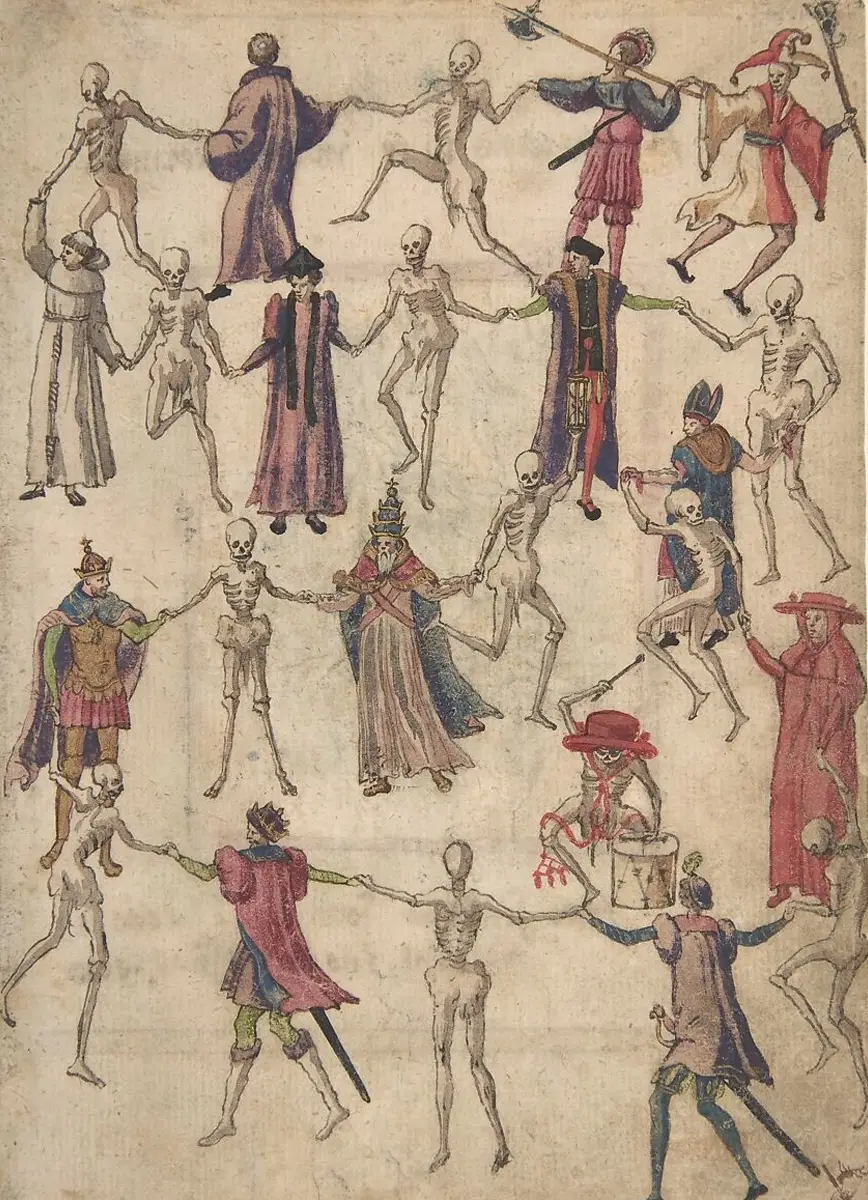
These scenes can include multiple skeletal figures rather than one solitary, hooded visitor. That variation matters: the tradition presents death through a sequence of encounters, not necessarily through the actions of a single supernatural individual with a fixed appearance or personality.
The motif’s narrative force lies in the contrast between ordinary human distinctions and a shared ending. Reading every skeleton as the named Grim Reaper would obscure that broader allegory.
These are historical representations of Death, connected to but older than the familiar English label.
Death Harvesting Human Lives
The harvesting motif makes mortality visible through an agricultural implement. A scythe-bearing skeleton represents Death cutting down lives as a worker cuts a crop.
This is a documented symbolic pattern, not evidence for a traditional account of an actual scythe-wielding apparition.
In Pieter Bruegel the Elder’s The Triumph of Death, a skeleton wielding a scythe participates in a wider vision of death overwhelming human society. The painting provides a concrete artistic example of the motif, rather than a named folktale about the Grim Reaper.
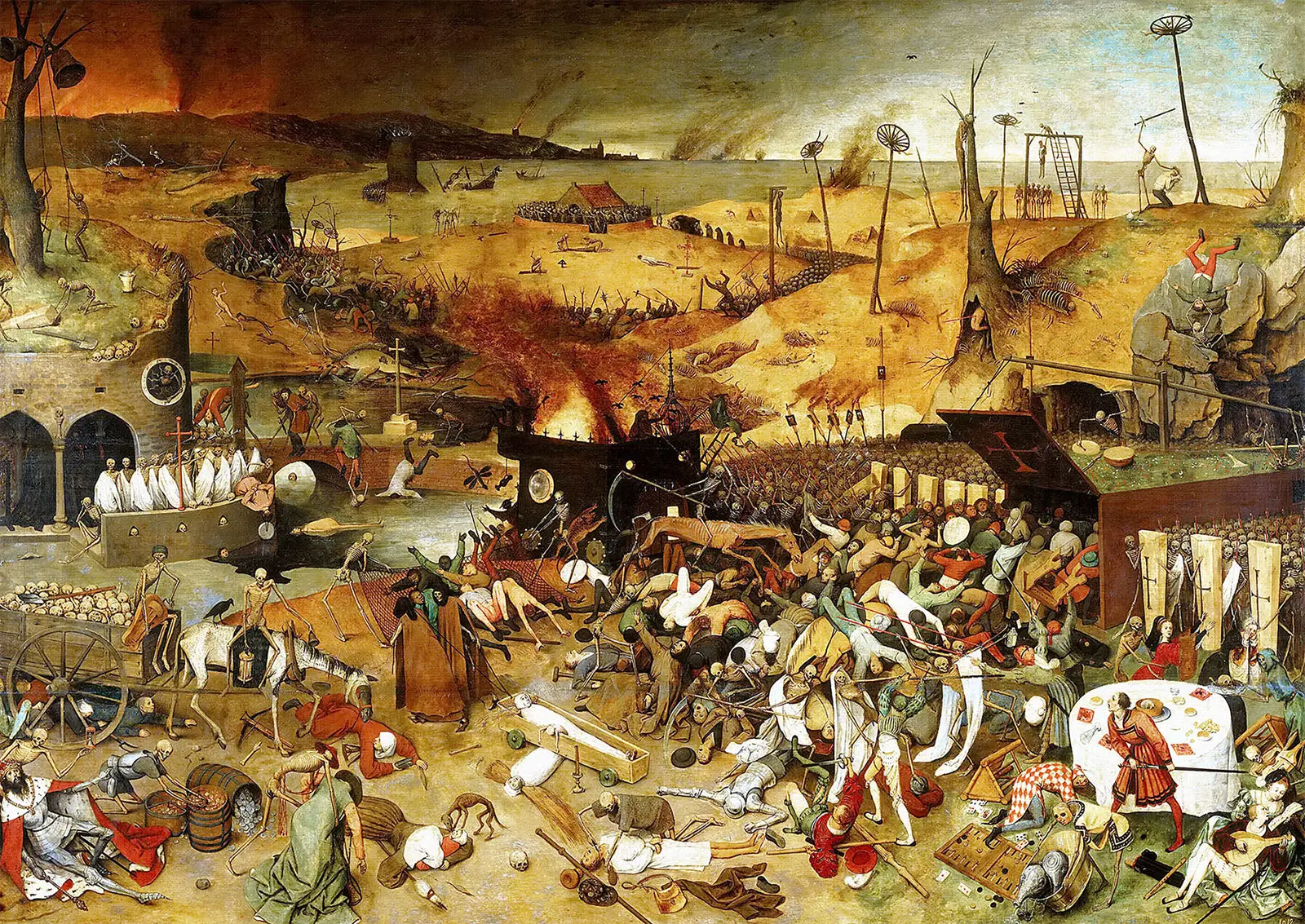
Unlike a personal encounter story, this image works on a collective scale. Its subject is humanity’s vulnerability, not one protagonist’s escape or bargain.
The harvesting metaphor later fits the English name “Reaper,” but the artwork should retain its own historical identity as an allegory.
Cultural Impact
Personified Death gave mortality a recognizable presence in European art. A skeleton could interrupt the world of the living without needing a lengthy explanation.
The resulting images made an abstract condition immediate, turning the certainty of death into something viewers could confront visually.
The Dance of Death also made social comparison central to that confrontation. By placing people of different ranks within the same mortal framework, it challenged the apparent security of status.
Its cultural meaning depended on the living figures as much as on the skeletons beside them.
Large allegorical works such as The Triumph of Death extend this meaning beyond an individual’s final moment. Death becomes a force affecting an entire human world.
Such imagery helps explain why the later Reaper remains useful as a symbol of mortality rather than merely a frightening character.
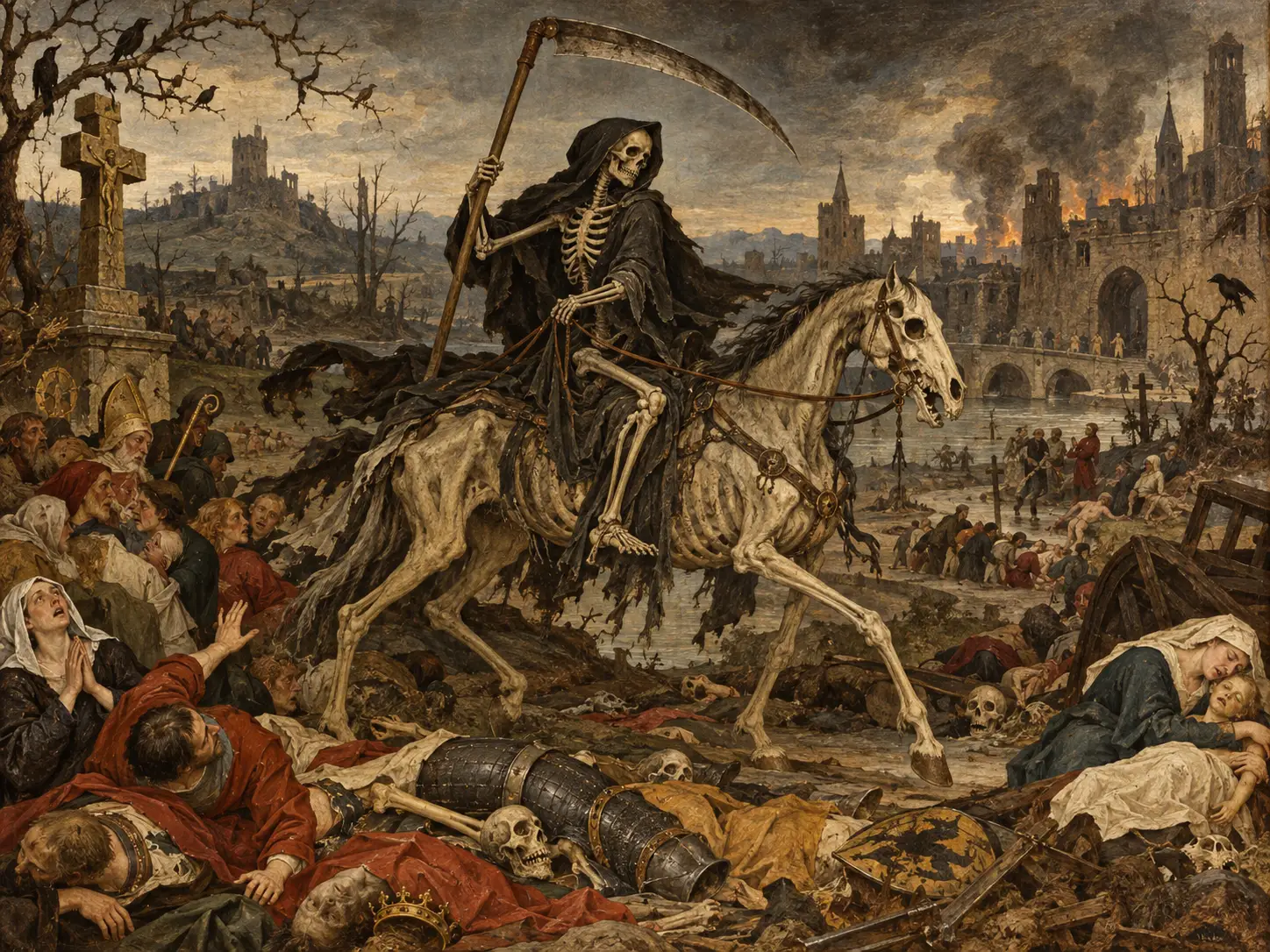
In English-language culture, the conventional skeleton, cloak, and scythe now form a compact visual shorthand. The image can communicate death without establishing a setting or biography.
Its familiarity does not mean that every historical representation of Death followed this standardized arrangement.
Modern reinterpretations can replace solemn allegory with comedy or occupational routine. The verified game Grim Fandango, for example, places Grim Reapers within a Department of Death.
That bureaucratic treatment is a deliberate fictional adaptation, not evidence that traditional European belief assigned Death an administrative organization.
Similar Beasts
Dullahan
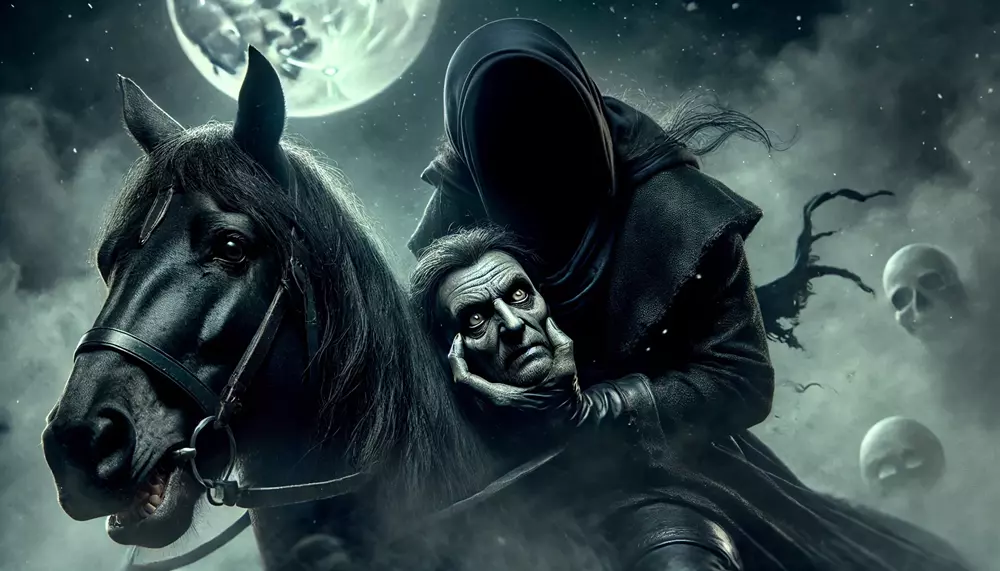
The Dullahan is a headless rider from Irish folklore, associated with nighttime appearances and the foretelling of death. It is a distinct supernatural figure with its own recognizable form.
Both figures make approaching death visible, but their roles differ: the Dullahan foretells death, while the Grim Reaper primarily personifies mortality itself.
Read more about Dullahan
Banshee

The Banshee is a spectral figure in Irish folklore whose mournful wail heralds the death of a family member. Her defining expression is an audible warning rather than a weapon.
She resembles the Reaper through her association with death, but announcing a death is not the same narrative function as embodying or taking life.
Read more about Banshee
Samael
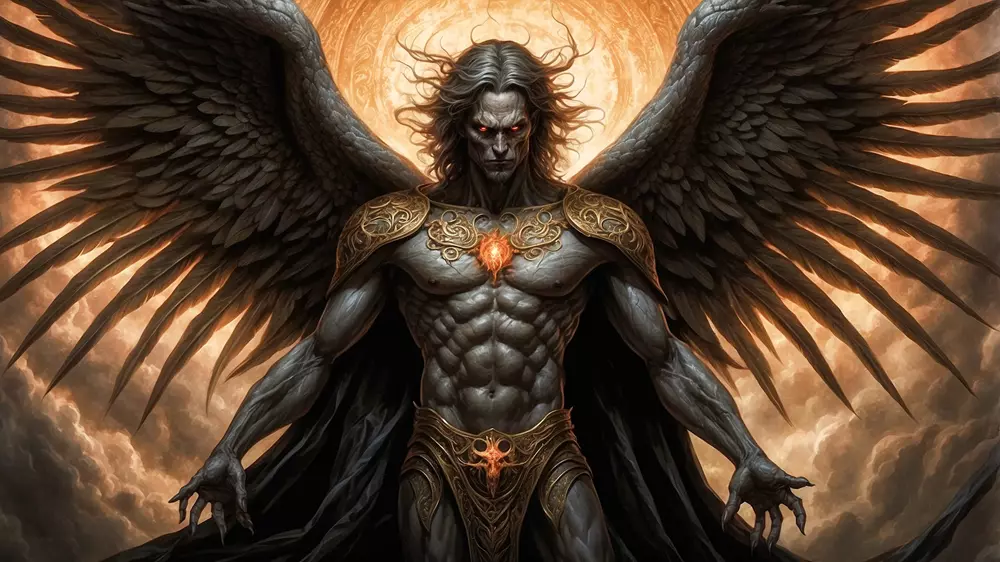
Samael is associated with the Angel of Death in Jewish lore, alongside themes of divine judgment, punishment, and temptation. His religious identity is more complex than a general mortality symbol.
The comparison concerns a personified agent associated with death. Samael’s place in religious narratives should not be transferred to the English Reaper’s allegorical identity.
Read more about Samael
Santa Muerte
Santa Muerte is a Mexican folk saint associated with death and religious devotion. Her skeletal appearance can resemble a female Grim Reaper, but she has a distinct devotional identity.
The visual resemblance does not make them interchangeable. Santa Muerte’s religious significance differs fundamentally from the Reaper’s conventional role as an artistic personification of death.
Religion/Ritual
The reviewed evidence documents no distinct rite, offering, or worship tradition directed specifically toward the Grim Reaper. Its presence in religiously inflected art does not establish a cult.
An image can encourage reflection on mortality without being treated as a sacred recipient of devotion.
The reported 1847 appearance of “Grim Reaper” occurs in The Circle of Human Life, a translated Christian devotional work. That provenance explains one religious setting for the expression, but it does not make the figure a formal Christian doctrinal being or establish associated ritual practices.
Scientific or Rational Explanations
The appropriate rational framework is the history of representation, not the identification of an unknown organism. The Grim Reaper is an allegory with documented artistic and linguistic forms.
Its cultural existence does not depend on evidence that a skeletal being physically appears when people die.
The scythe has a clear symbolic function: harvesting provides a concrete analogy for lives ending. Understanding that analogy explains the implement without treating it as a reported supernatural weapon.
The familiar figure combines the action suggested by the tool with the mortality represented by bones.
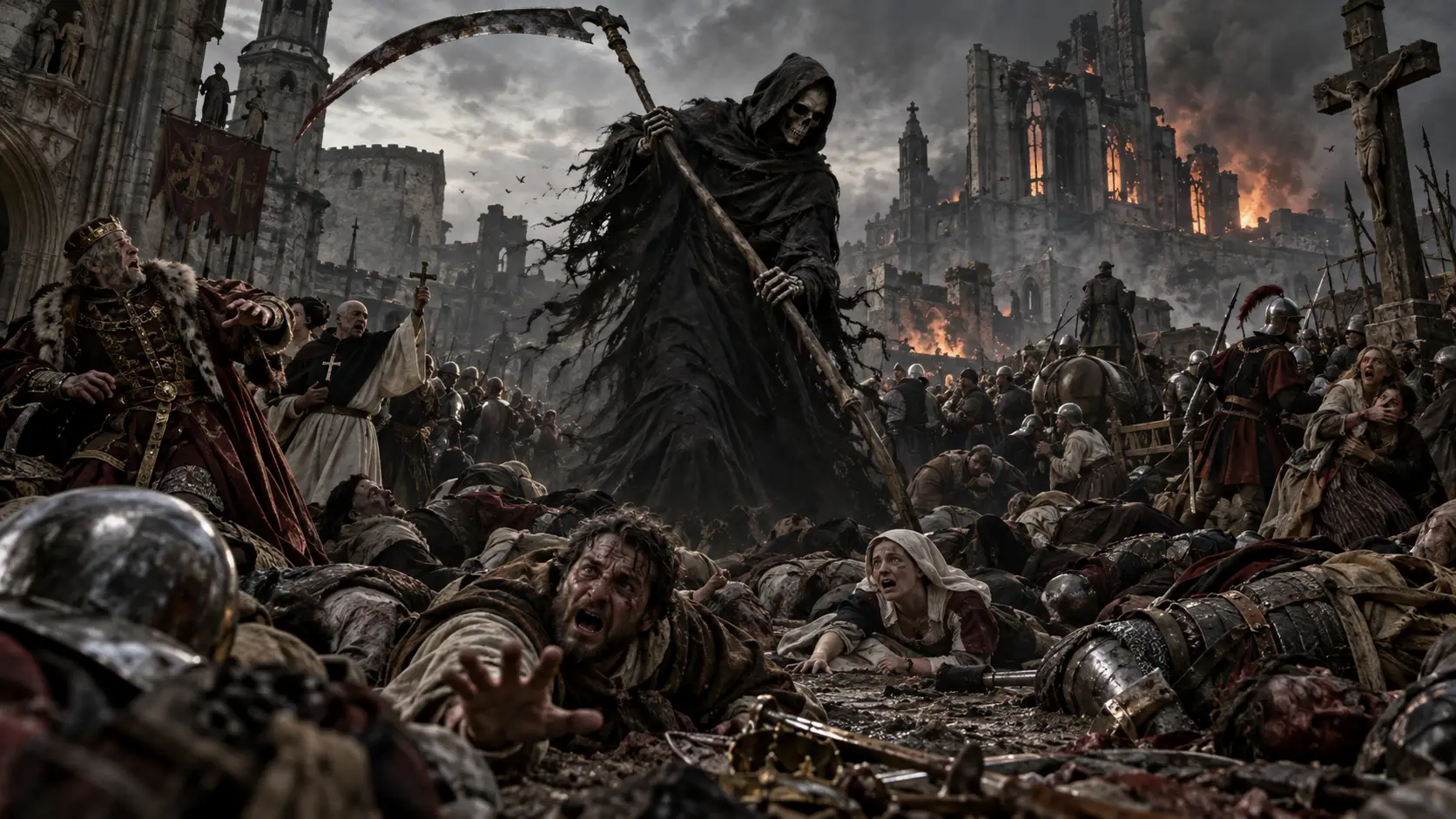
The skeleton can likewise be interpreted as a direct visual reminder of the human body after death. This is an interpretation of its symbolic effectiveness, not a claim that every artist or viewer understood it identically.
Historical variations resist a single, universal explanation of all death imagery.
Personification offers another interpretive approach. Giving death a body makes an impersonal process available for depiction as an encounter or action.
This helps explain the figure’s narrative usefulness, although it should not be mistaken for proof of one psychological cause behind every representation.
Chronology also limits simple origin theories. Medieval skeletal Death and the later English expression belong to connected but different stages of development.
The Black Death context cannot, by itself, establish the creation of a named Grim Reaper character with all the attributes familiar today.
Finally, an artwork and an encounter testimony are different kinds of evidence. A painted skeleton carrying a scythe demonstrates that the symbol was used, not that its subject was observed.
Keeping that distinction intact allows the imagery to be studied without converting allegory into an authenticated supernatural report.
Modern Cultural References
Modern Cultural References
The Seventh Seal, Ingmar Bergman, 1957, film
Ingmar Bergman turns Death into a calm, black-clad opponent who plays chess with a medieval knight, creating one of cinema’s most influential personifications of the Grim Reaper ever filmed worldwide.
Link: IMDb
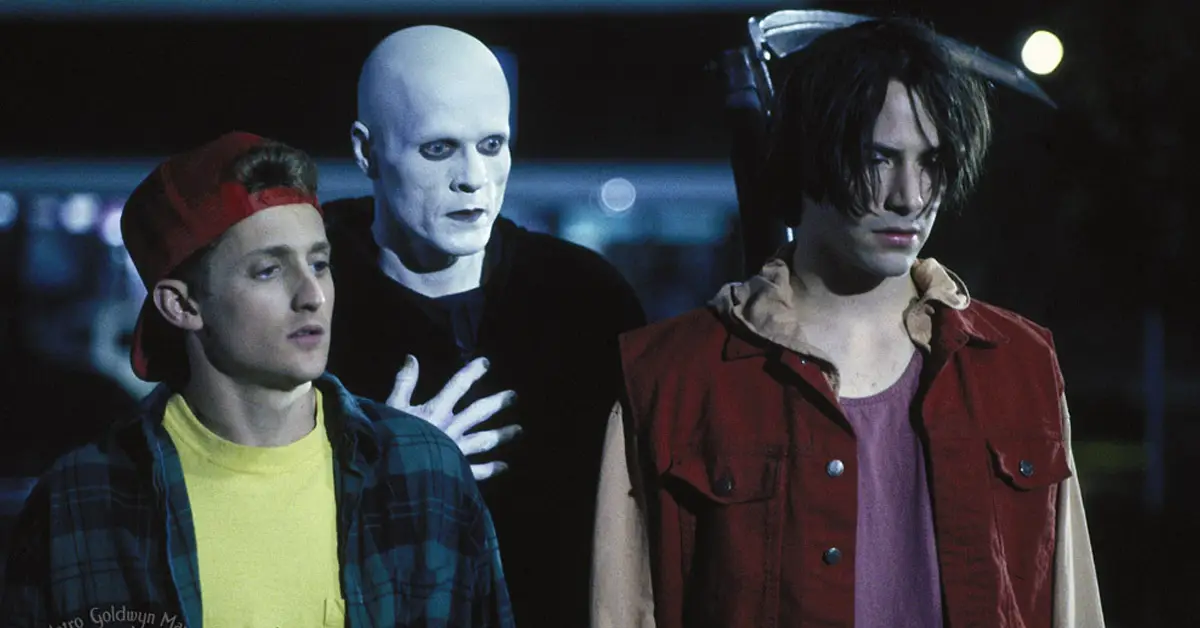
Bill & Ted’s Bogus Journey, 1991, film
William Sadler plays the Grim Reaper as a comic adversary who challenges Bill and Ted after death, then becomes their ally, parodying the solemn traditional image of Death memorably onscreen.
Link: IMDb
The Grim Adventures of Billy & Mandy, Maxwell Atoms, 2001, animated television series
Cartoon Network makes Grim a central character forced into friendship with Billy and Mandy, transforming the scythe-carrying Reaper into an irritable, comedic companion with supernatural powers and responsibilities for years.
Link: IMDb
Monty Python’s The Meaning of Life, Terry Jones, 1983, film
John Cleese appears as the Grim Reaper at a dinner party, announcing that every guest has died and leading them onward, turning Death into a famously absurd comic visitor onscreen.
Link: IMDb
Family Guy, Seth MacFarlane, 1999, animated television series
Family Guy repeatedly uses Death as a hooded, scythe-bearing recurring character whose ordinary personal problems contrast with his supernatural job of collecting souls, making the Reaper a sitcom personality too.
Link: IMDb
The Sims, Maxis, 2000, video game series
The Sims turns the Grim Reaper into a recurring non-player character who arrives after deaths, collects souls, and can sometimes be bargained with, making mortality an interactive mechanic for players.
Link: Electronic Arts
Castlevania, Konami, 1986, video game series
Konami’s Castlevania series features Death as Dracula’s recurring lieutenant, usually depicted as a skeletal, scythe-wielding boss who summons sickles and embodies the classic video-game version of the Reaper for generations.
Link: Castlevania Wiki
Grim Fandango, Tim Schafer, 1998, video game
Tim Schafer’s adventure game follows Manny Calavera, a skeletal Department of Death travel agent who guides souls through the afterlife, humorously reworking the professional role of a reaper through bureaucracy.
Link: Double Fine Productions
Mort, Terry Pratchett, 1987, novel
Terry Pratchett’s Mort centers on Discworld’s Death, a black-robed skeleton with a scythe who hires an apprentice, using the Grim Reaper archetype for comedy, philosophy, and empathy through fantasy storytelling.
Link: Official Terry Pratchett website
“(Don’t Fear) The Reaper,” Blue Öyster Cult / Donald Roeser, 1976, song
Blue Öyster Cult’s “(Don’t Fear) The Reaper” uses the Reaper as a metaphor for mortality and inevitable death, turning the figure into one of rock music’s most recognizable death references.
Link: Official recording on YouTube
Conclusion
The Grim Reaper is best understood as a personification of death, not an ancient named god or a creature with one authoritative biography. Its familiar skeleton, cloak, and scythe bring mortality into a recognizable human-shaped image.
That image belongs to a long European artistic tradition, while the English name is documented much later, in the nineteenth century. Keeping those histories separate preserves the figure’s significance without turning varied representations of Death into a single, supposedly unchanged medieval character.
The Reaper’s lasting importance lies in how readily this symbolism accommodates different treatments of mortality. Historical death imagery confronts the limits of human life, while modern adaptations can make its personification frightening, bureaucratic, morally conflicted, or romantic.
These fictional personalities are reinterpretations, not evidence of a lost canonical life story. Across such variations, the harvesting metaphor remains intelligible: death takes lives as a reaper cuts a crop.
The figure’s recognizable form therefore endures without requiring one fixed narrative or religious identity.
Further Reading
The Grim Reaper, Oxford Advanced Learner’s Dictionary
Provides a concise lexicographic definition and the conventional skeleton, cloak, and scythe description.
(oxfordlearnersdictionaries.com)
Grim Reaper
Wikipedia provides a broad overview and a useful reference trail for Grim Reaper, but it works best as a starting point rather than a final authority.
(en.wikipedia.org)
Grim Fandango, lucasfilm.com
video game 1998 The game uses a comic underworld bureaucracy in which Grim Reapers guide newly deceased souls; Lucasfilm’s anniversary feature describes the premise and protagonist Manny Calavera.
(lucasfilm.com)
A Date with Death, simonandschuster.com
novel 2026 A published paranormal romance featuring Grim, the literal Grim Reaper, as a central character.
The publisher lists July 14, 2026, and describes him as the Reaper.
(simonandschuster.com)
I’m the Grim Reaper, Vol. 1, viz.com
comic 2024 A published graphic novel collecting episodes of the WEBTOON series.
Scarlet becomes Satan’s grim reaper and collects the souls of marked sinners.
(viz.com)
Grim #1, penguinrandomhouse.com
comic 2022 The publisher’s description explicitly asks where the actual Grim Reaper is, within a story about Reapers ferrying souls in the afterlife.
(penguinrandomhouse.com)
Death & Sparkles, chroniclebooks.com
comic 2021 This published graphic novel centers on Death, described by its publisher as a grim reaper, and his friendship with a unicorn.
(chroniclebooks.com)
Collective: Unconscious, netflix.com
film 2016 Netflix describes this released anthology film as including a stylized dramatization featuring a suicidal Grim Reaper.
(netflix.com)