Introduction
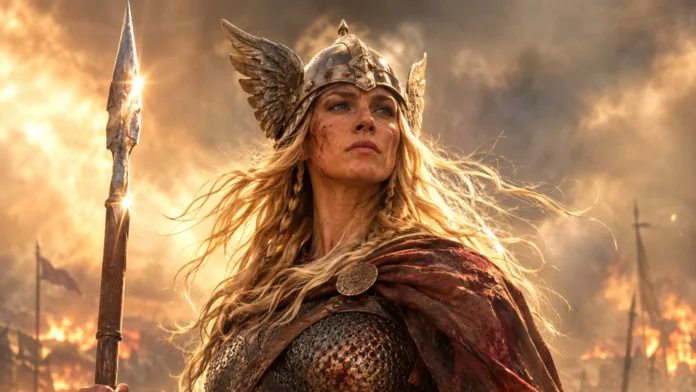
A valkyrie is a supernatural woman in Norse mythology, often pictured riding in a helmet and mail. Valkyries choose the battle slain for Odin and sometimes decide who wins. In Valhalla, Odin’s hall, they serve drink to the warriors who join him there.
The name describes a kind of being, not one individual. Norse poets could send valkyries out as a company or single out one woman with loyalties of her own. To a warrior, her arrival could mean rescue, victory, or the end of his life.
History/Origin
Among the earliest Norse witnesses is Haraldskvæði, also called Hrafnsmál, a fragmentary poem traditionally attributed to Þorbjǫrn hornklofi and associated with the age of Harald Fairhair around 900. An unnamed valkyrie who understands birds questions a raven about the king and his retinue.
In the tenth century, Eyvindr skáldaspillir commemorated the Norwegian king Hákon the Good in Hákonarmál. Odin sends Göndul and Skögul to choose a king for Valhalla. The dying Hákon questions their decision, and Skögul makes clear that his victory and his death can coexist.
‘We were the cause,’ said Skogul, ‘that you won the field, and your foemen fled.’
Eyvindr skáldaspillir, Hákonarmál, stanza 12, tenth century; translated by Alison Finlay and Anthony Faulkes, 2011.
Medieval Iceland preserved these traditions in different forms. In the early thirteenth century, Snorri Sturluson incorporated verse into his account of the gods in the Prose Edda. The Codex Regius of the Poetic Edda, copied around 1270, preserves valkyries in both mythological and heroic poems.
The dates of the surviving books tell us when scribes recorded particular versions, not when people first told stories about valkyries. The early Norwegian court poems show that poets already found the figure useful in royal praise, but they do not identify its birthplace.
Other Norse writing placed valkyries well beyond Norway and Iceland. Njáls saga frames the poem Darraðarljóð as a vision in Caithness connected with the Battle of Clontarf near Dublin in 1014. Thomas Gray later adapted the poem for English readers as The Fatal Sisters, published in 1768.
Name Meaning
The Old Norse singular is valkyrja, and the plural is valkyrjur. The first element, valr, means those slain in battle. The second relates to kjósa, meaning to choose. Together they give the familiar translation chooser of the slain, a name that identifies the figure by her work.
Old English had a related word, wælcyrge. Medieval glossators used it to explain names or terms for figures such as Furies and Gorgons. Those glosses establish a linguistic relationship, but they do not give us an English account of Odin’s riders or their duties.
The Norse poems also describe the company without using its usual name. In Völuspá, the seeress calls the riders nönnur Herjans, the women of Herjan. Herjan is a name of Odin, so the phrase identifies whose company they belong to rather than what they do.
Appearance
The familiar Norse form is a woman equipped for battle. In the First Lay of Helgi Hundingsbani, helmeted women appear amid a blaze of light, their mail spattered with blood and their spears giving off flashes. Völuspá gives two of its riders shields.
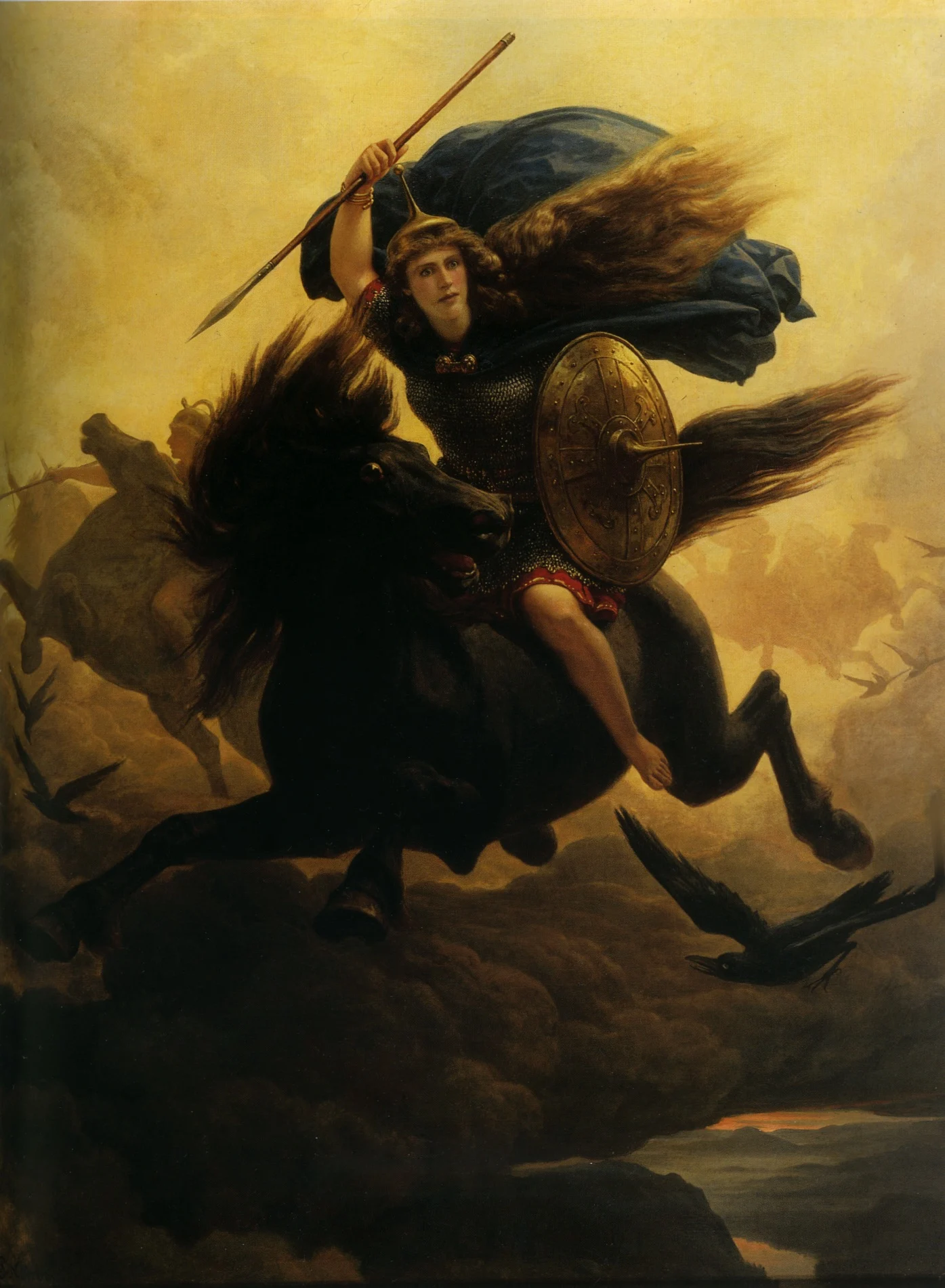
Their byrnies all with blood were red,
And from their spears the sparks flew forth.Anonymous, Helgakviða Hundingsbana I, preserved in the thirteenth-century Codex Regius, stanza 16 in Henry Adams Bellows’s 1923 translation.
The Lay of Helgi Hjörvarðsson opens a different view of the riders. Helgi sees nine valkyries, and the prose singles out one, later named Sváva, as the fairest. It compares her with her companions rather than specifying a height, build, or set of facial features.
In the prose introduction to Völundarkviða, three women spin flax beside a lake with their swan garments lying nearby. The prose calls them valkyries, and the verse describes one wearing swan plumage. The passage gives these women a distinctive dress, not every valkyrie a pair of wings.
Viking Age art offers a different kind of evidence. A small silver figure from Hårby in Denmark carries a sword and shield, and the National Museum of Denmark identifies it as a valkyrie. The identification interprets the image; it does not supply a name for the figure.
Winged helmets belong to a different visual tradition. Nineteenth-century costume studies for Wagner’s Ring and surviving images of the Bayreuth production show how stage designers dressed a valkyrie. The medieval Helgi poem describes helmets without specifying wings, even when the women descend from the sky.
Background Story
Snorri gives the valkyries authority over who dies and which side wins. They do not simply arrive after combat to gather bodies. He also places the youngest norn, Skuld, among those who ride out to choose the slain, bringing a figure associated with fate into the company.
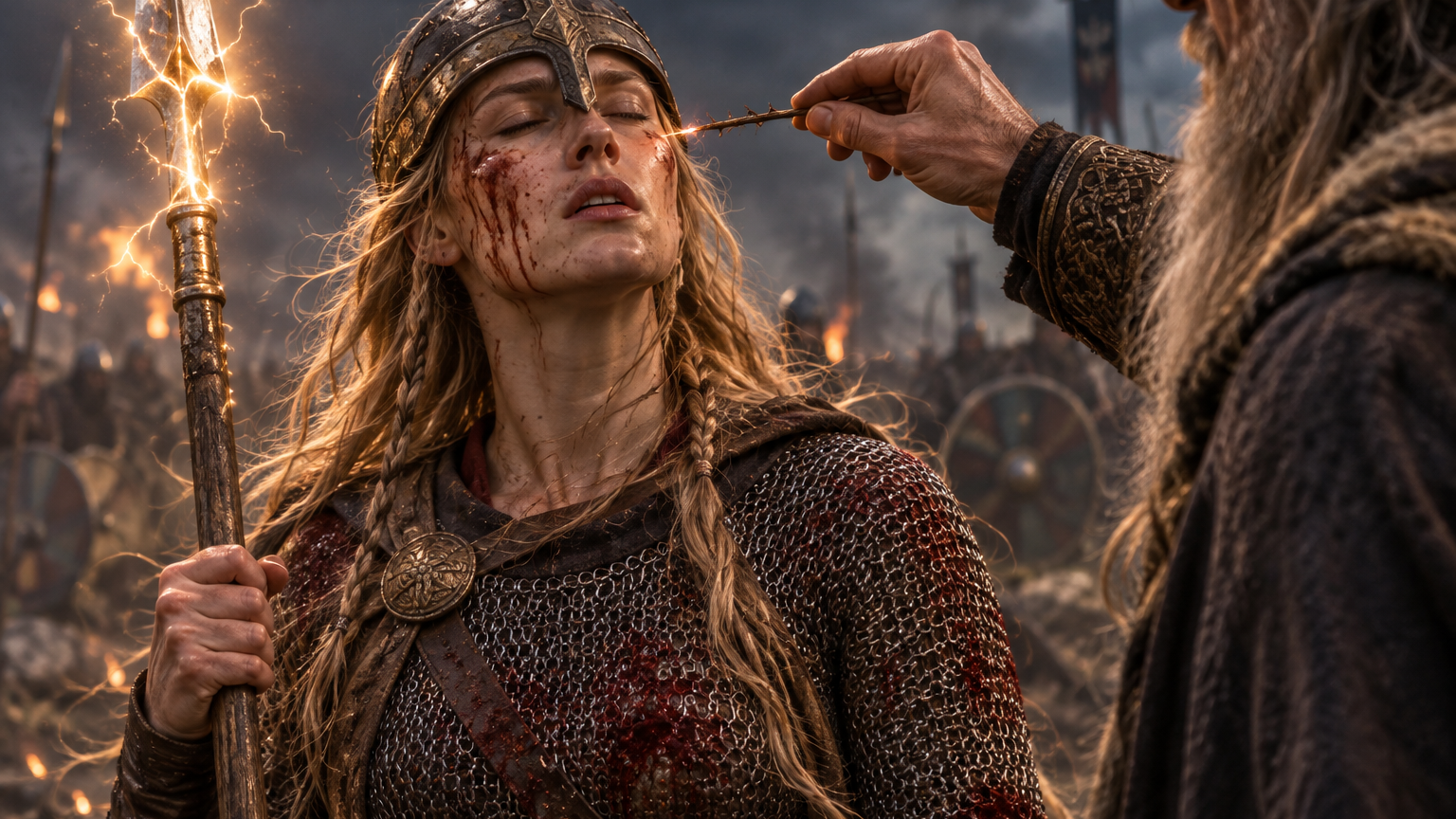
Odin sends them to all battles, where they choose those who are to be slain, and rule over the victory.
Snorri Sturluson, Prose Edda, Gylfaginning, chapter 36, early thirteenth century; translated by Rasmus B. Anderson, 1880.
In Grímnismál, Odin names Hrist and Mist as the women he wants to bring him a drinking horn. The stanza also names women who carry ale to the einherjar, the dead warriors of Valhalla. Snorri adds that valkyries attend to the table and drinking vessels.
Odin does not receive every fallen warrior. In Grímnismál, Freyja rules over the seats in her hall at Fólkvangr and chooses half the slain, while Odin has the other half. The stanza does not say that valkyries work for Freyja or deliver her share.
The heroic lays give some valkyries human family ties. Sváva is the daughter of King Eylimi; Sigrún is the daughter of King Högni. The prose introducing Sigrún in the Second Lay of Helgi Hundingsbani also calls her Sváva reborn, giving the two figures a shared history.
A valkyrie’s protection can reach beyond the battlefield. Sváva gives Helgi Hjörvarðsson his name and repeatedly shields him in combat. In the first lay about the other Helgi, Sigrún saves his men and ships from above as the storm threatens to give the fleet to Rán.
Sigrdrífumál shows what can happen when a valkyrie defies Odin. Sigrdrífa kills Hjálmgunnarr despite Odin’s promise of victory to him. Odin pricks her with a sleep thorn and declares that she will never again win victory in battle and must marry.
Odin’s punishment does not take away Sigrdrífa’s knowledge. When Sigurðr asks her for wisdom, she teaches him several kinds of runes, including victory runes to cut on a sword. The poem makes her the source of knowledge a human hero hopes to use for himself.
Famous Folklore Stories
Sigrún at Helgi’s Burial Mound
Sigrún and Helgi marry and have sons, but their household does not outlast the feud that brought them together. Her brother Dagr sacrifices to Odin to avenge their father. Odin lends him a spear, and Dagr kills Helgi with it before bringing Sigrún the news.
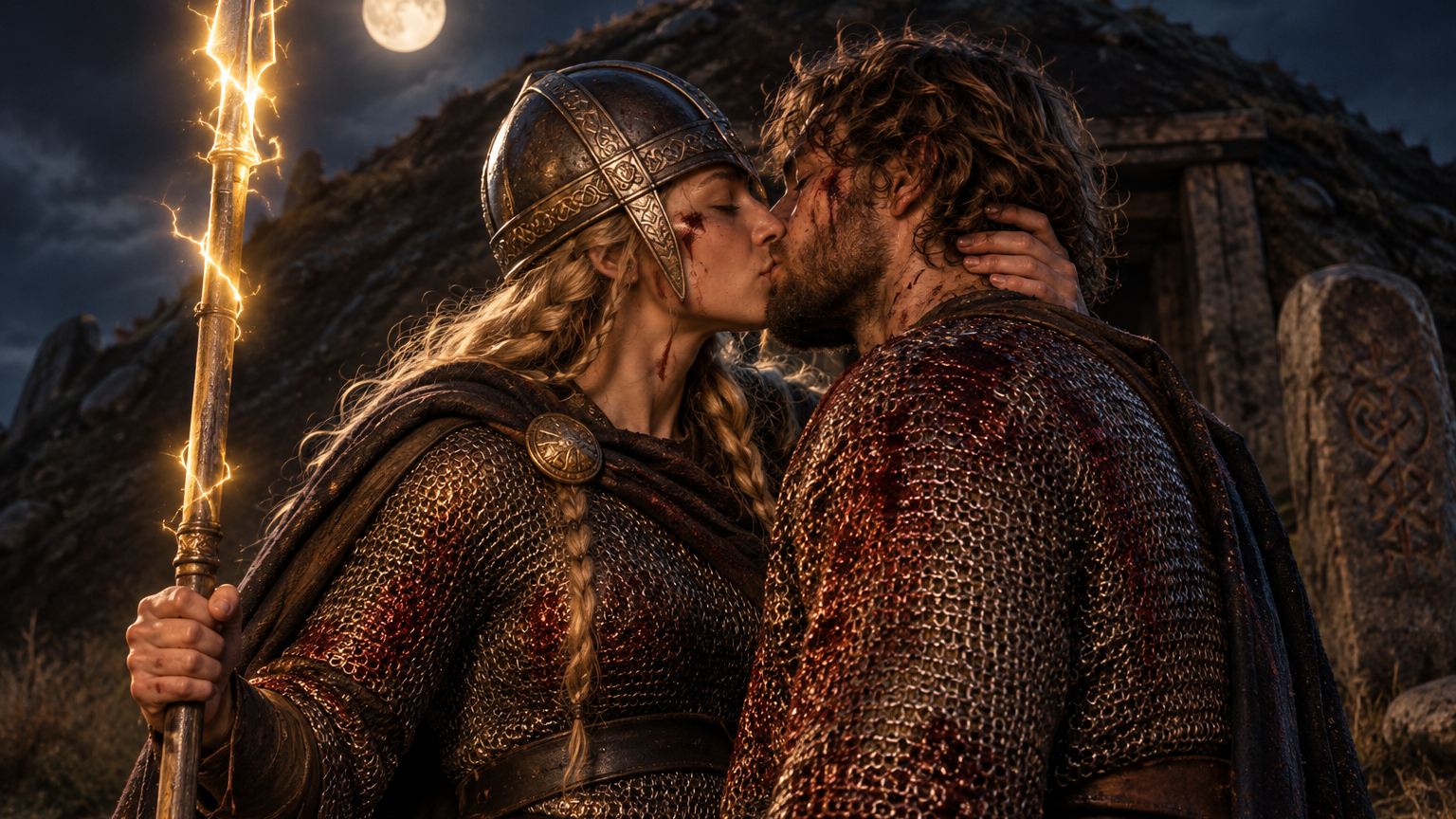
Sigrún curses Dagr for breaking his oaths and refuses the compensation he offers. Later, her serving woman sees Helgi ride to his burial mound with a company of men. The woman fetches Sigrún, who goes to the mound to see him for herself.
Sigrún greets Helgi with a kiss before he takes off his bloodied mail. She asks why he is wet and cold. Helgi tells her that her tears fall on him like blood. Rather than leave him to the mound, she makes a bed there.
Here I have made you a bed, Helgi, free from sorrow, descendant of the Ylfings. I want to sleep in your arms, prince, as I would have done when you were alive.
Anonymous, Helgakviða Hundingsbana II, stanza 47 in Open Edda, preserved in the thirteenth-century Codex Regius; own translation.
Sigrún spends the night beside Helgi. Before the cock wakes the warriors, he must ride away with his men. The following evening, she sets her serving woman to watch the mound again. Sigrún goes there at sunset, still hoping that he will come back.
As night falls, Sigrún realizes that Helgi would already have come if he meant to return. Her serving woman urges her to leave rather than stay alone among the dead. Helgi does not come back to the mound, and Sigrún soon dies of grief.
The Valkyries Who Left Völundr
Three brothers make a home in Úlfdalir, where they meet three women by the lake. Each pair sets up house together: Egill with Ölrún, Slagfiðr with Hlaðguðr, and the smith Völundr with Hervör. For seven winters, the six of them share a home.
In the eighth winter, the women grow restless. The verse lets their longing explain the separation, while the prose introduction identifies them as valkyries and gives their flight a destination: they leave to seek battles. None of the three returns to the brothers’ home.
The young women longed to go into the dark wood, to fulfill their fate.
Anonymous, Völundarkviða, stanza 3 in Open Edda, stanza 5 in Bellows, preserved in the thirteenth-century Codex Regius; own translation.
Egill and Slagfiðr set out in search of their partners, but Völundr stays behind. He works gold into rings while he waits for Hervör. The poem follows the brother who remains at home, not the women who have gone or the men who pursue them.
King Níðuðr’s men enter the house while Völundr is out hunting and take one of his rings. When he comes back and counts them, he notices what is missing. He takes it as a sign that Hervör has returned, but the empty house tells him nothing.
Völundr falls asleep waiting and wakes in bonds. Níðuðr takes the smith captive, setting in motion the revenge that occupies the rest of the lay. The valkyries never rejoin the action. Their departure has already scattered the household and left Völundr alone when his enemies arrive.
Cultural Impact
Medieval Norse poets could invoke a valkyrie without telling a story about one. Arnórr jarlaskáld used the name Hlǫkk in a kenning, an indirect poetic expression, for ravens. He called the birds her hawks, borrowing a familiar figure from battle lore to describe the scavengers.
Another poet called a sea battle the judgment of Göndul. The phrase borrows from a different part of social life: rather than likening battle to an animal hunt, it pictures the opposing sides as parties to a dispute and gives the valkyrie the judge’s authority.
Such expressions worked in part because names like Hlǫkk and Hildr could also mean battle. A listener might hear both meanings without having to picture a woman on the field. The valkyrie belonged to the working vocabulary of verse as well as its cast of characters.
Similar Beasts
The Morrígan
In the Irish Cath Maige Tuired, the Morrígan strengthens the Túatha Dé in battle and proclaims their victory afterward. Like a valkyrie, she can intervene on one side, but announcing victory is not the same as selecting the slain.
The Keres
These Greek spirits of violent death crowd the battlefield depicted in the Shield of Heracles. Like the more frightening valkyries, they close in on fallen fighters, but the scene shows them feeding on blood rather than receiving honored dead.
Apsaras
In some Indian accounts, these celestial women welcome warriors who reach heaven after dying in battle. That reception resembles a valkyrie’s welcome in Odin’s hall, but the comparison concerns what happens after death, not who decides the outcome of combat.
Religion/Ritual
On Gotland, people raised carved picture stones to remember the dead. The surviving runes on the Tjängvide stone record that it was raised in memory of a brother. The same stone shows a woman holding out a drinking horn to a rider on an eight-legged horse.
The Swedish History Museum notes a common reading of the woman as a valkyrie welcoming a fallen warrior. The horse’s eight legs also recall Sleipnir, so the rider could be Odin himself. The runes name neither figure. They record whom the stone was raised for without saying that the brother is the rider or that he was welcomed into Valhalla.
In the royal praise poem Eiríksmál, the welcome is explicit. Odin prepares Valhalla for the dead king Eiríkr and calls for the valkyries to bring wine. The dialogue lets a reciter voice the welcome rather than simply recount it. Simon Nygaard suggests that these shifts between speakers may have given the performance a ritual role in commemorating the king.
Scientific or Rational Explanations
Historian of religion Declan Taggart asks what the warrior afterlife might have offered people who had lost someone. He suggests that hearing a familiar person placed among the dead in Valhalla could make the afterlife easier to imagine and give mourners a way to think about loss.
On this reading, the welcome matters because it gives the dead a place among others. The valkyries help supply that image: someone expects the newcomer and makes room for him. A death in battle can then mark entry into another community rather than separation alone.
Taggart also suggests that the selection of kings in Eiríksmál may have been flexible enough for performers to adapt the poem to different losses. That is a hypothesis about how the tradition could serve its listeners, not an account of how the valkyrie figure originated.
Modern Cultural References
Die Walküre, Richard Wagner, 1870; Bayreuther Festspiele synopsis
Brünnhilde defies Wotan over Siegmund’s fate and helps the pregnant Sieglinde escape. The opera makes a valkyrie’s decision to disobey the central conflict between father and daughter.
(www.bayreuther-festspiele.de)
Valkyrie Profile: Lenneth, tri-Ace and Square Enix, 2006; Square Enix Blog, 2022
Players control Lenneth, whom Odin sends to gather worthy souls before Ragnarök. Some of the dead become einherjar who can join her in battle.
(www.square-enix-games.com)
Magnus Chase and the Gods of Asgard: The Sword of Summer, Rick Riordan, Disney-Hyperion, 2015; Read Riordan
Samirah al-Abbas carries Magnus from a fatal encounter in Boston to Hotel Valhalla, where Odin’s chosen warriors prepare for Ragnarök. The novel gives the mythic escort a contemporary setting.
(www.readriordan.com)
Thor: Ragnarok, Taika Waititi, Marvel Studios, 2017; D23
Tessa Thompson’s Valkyrie joins Thor and his allies against Hela. The film gives the Asgardian warrior an active role in saving her people as their home is destroyed.
(d23.com)
God of War, Santa Monica Studio and Sony Interactive Entertainment, 2018; PlayStation.Blog, 2019
The game makes valkyries a series of boss encounters. Their queen, Sigrun, combines attacks from earlier fights, testing what players learned from facing the other valkyries.
(blog.playstation.com)
God of War – All Valkyrie Boss Fights (Chooser of the Slain Trophy) [PS4 Pro]
Conclusion
What distinguishes the valkyrie is that she can stand on both sides of a warrior’s death. She can take part in deciding his fate and still have a place in the world that receives him. That makes her presence welcome and frightening for the same reason.
Sigrún brings that tension into a single room. The woman who can cross the distance between the living and the dead still cannot make Helgi stay. The Norse stories give the valkyrie unusual power, but they do not let her escape the cost of loss.
Further Reading
The Second Lay of Helgi Hundingsbani, anonymous, Poetic Edda, thirteenth-century Codex Regius; Open Edda
The Old Norse poem and its linking prose recount Sigrún’s marriage, her brother’s betrayal, and her final night with Helgi in the burial mound.
(openedda.is)
The Lay of Völundr, anonymous, Poetic Edda, thirteenth-century Codex Regius; Open Edda
The prose names the three valkyries and describes their departure for battle; the verse gives their longing and shows what happens to Völundr after they leave.
(openedda.is)
Heimskringla, Volume I, Snorri Sturluson, translated by Alison Finlay and Anthony Faulkes, Viking Society for Northern Research, 2011; second edition 2016
This translation preserves Eyvindr skáldaspillir’s Hákonarmál within the saga of Hákon the Good, including the king’s exchange with Skögul near the end of his final battle.
(vsnr.org)
The First Lay of Helgi Hundingsbani, anonymous, translated by Henry Adams Bellows, 1923; Open Edda
The parallel text presents the riders’ arrival in bloodied mail and preserves an episode in which Sigrún protects Helgi’s fleet from a dangerous sea.
(openedda.is)
Gylfaginning, chapter 36: Of the Valkyries, Snorri Sturluson, translated by Rasmus B. Anderson, 1880; Open Edda
Snorri’s account assigns the valkyries work on battlefields and in Valhalla. The parallel edition pairs the Old Norse passage with Anderson’s historical English translation.
(openedda.is)
New Electronic Edition of the Codex Regius of the Poetic Edda, Árni Magnússon Institute for Icelandic Studies, 2024
The institute dates the manuscript to around 1270 and introduces an edition with page images and transcriptions of the medieval witness to the heroic lays.
(arnastofnun.is)
Valkyrie: The Women of the Viking World, Jóhanna Katrín Friðriksdóttir, Bloomsbury Academic, 2020
The opening chapter examines the imagery of valkyries in skaldic poetry, including the comparison of a sea battle to a judgment handed down by Göndul.
(api.pageplace.de)
Saga-Book, Volume XXI, Viking Society for Northern Research
The study of Arnórr’s verse examines the expression for ravens that calls them Hlǫkk’s hawks, and discusses the double meanings of several valkyrie names.
(vsnr.org)
Tjängvide Memorial Stone, Swedish History Museum object record, Nara to Norwich
The exhibition record describes the surviving dedication to a brother and explains why the woman offering a horn is often identified as a valkyrie.
(naratonorwich.org)
Exploring Religious Ritual Frameworks in the Oral Performance of the Old Norse, Eddic-Style Praise Poems Hákonarmál, Eiríksmál, and Hrafnsmál, Simon Nygaard, Scripta Islandica 73, 2022
Nygaard examines how dialogue, speaker changes, and other features of three praise poems might have shaped their performance in settings with a religious or ritual dimension.
(pure.au.dk)
Life, Death and a Warrior’s Morality, Declan Taggart, Trivent Publishing
Taggart considers how audiences might have used the warrior afterlife to imagine reunion, cope with grief, and make sense of losses within a ruler’s following.
(trivent-publishing.eu)
Cath Maige Tuired: The Second Battle of Mag Tuired, anonymous, translated by Elizabeth A. Gray, Irish Texts Society, 1982; CELT, University College Cork
This edition and translation show the Morrígan urging the Túatha Dé to fight resolutely and later proclaiming the outcome after their victory over the Fomoire.
(celt.ucc.ie)
Shield of Heracles, attributed to Hesiod, translated by Hugh G. Evelyn-White, 1914; Theoi Classical Texts Library
The description of the shield’s battle scene places the Keres among dying fighters and depicts their thirst for blood, a contrast with the Norse welcome for the slain.
(www.theoi.com)
Apotheosis and Afterlife of the Indo-European Hero, Harvard Divinity School, Center for the Study of World Religions, 2026
This comparative study discusses Indian accounts of apsaras and slain warriors alongside Norse accounts of valkyries, with particular attention to the reception of the dead.
(cswr.hds.harvard.edu)
Hrafnsmál, My Norse Digital Image Repository, University of Victoria
University catalogue identifies the fragmentary poem, its attribution, royal subject, and early date.
(myndir.uvic.ca)
How Can His Word Be Trusted?
Research on skaldic poetry discusses the attribution, early dating, and framing of the valkyrie’s conversation in Haraldskvæði.
(api.repository.cam.ac.uk)
Birds and Bird-Lore in the Literature of Anglo-Saxon England
The discussion of Haraldskvæði identifies the valkyrie’s knowledge of bird speech and her dialogue with a raven.
(discovery.ucl.ac.uk)
Hákonarmál
Old Norse text of Eyvindr’s poem, including Odin’s commission and the exchange between Skögul and Hákon.
(heimskringla.no)
A Handbook to Eddic Poetry
Scholarly introduction distinguishes the Icelandic manuscript from the earlier circulation of eddic material.
(api.pageplace.de)
Darraðarljóð, from Njáls saga
Text of the battle poem with an account of its saga setting and connection to Clontarf.
(www.heimskringla.no)
The Fatal Sisters. An Ode
The Thomas Gray Archive presents the 1768 text and traces its relationship to the poem in Njáls saga.
(thomasgray.org)
An Icelandic-English Dictionary, page 676
Cleasby and Vigfusson define valr and cite Snorri’s use of the phrase kjósa val.
(www.germanic-lexicon-project.org)
Bosworth-Toller Anglo-Saxon Dictionary: wæl-cyrge
Historical dictionary entry records Old English glosses and compares their headword with Old Norse valkyrja.
(bosworthtoller.com)
Völuspá
Stanza 30 names the riders as Herjan’s women and gives shields to Skuld and Skögul.
(openedda.is)
Helgakviða Hjörvarðssonar
The prose passages describe the nine riders and identify Sváva as the king’s daughter who names and protects Helgi.
(openedda.is)
Valkyriefigur fra Tjørnehøj, Hårby s.
National Museum of Denmark catalogue and object photograph document the Hårby silver figure and its weapons.
(samlinger.natmus.dk)
Valkyrie (Costume Study for Bayreuth) Head with Helmet
Städel Museum catalogue records a nineteenth-century valkyrie helmet design for Wagner’s Ring.
(sammlung.staedelmuseum.de)
Lindsey K. Williams, Ex Historia, pp. 111–148
Discusses Bayreuth costume designs and reproduces an 1876 photograph of Amalie Materna as Brünnhilde.
(sites.exeter.ac.uk)
Edda: Prologue and Gylfaginning
Anthony Faulkes’s critical edition provides the Old Norse text and historical context for Snorri’s Edda.
(vsnr.org)
Grímnismál
Stanza 14 allocates the slain between Freyja and Odin; stanza 36 lists the women serving drink.
(openedda.is)
Sigrdrífumál
The prose recounts Odin’s punishment; the following verse preserves Sigrdrífa’s instruction in runes.
(openedda.is)