
Introduction
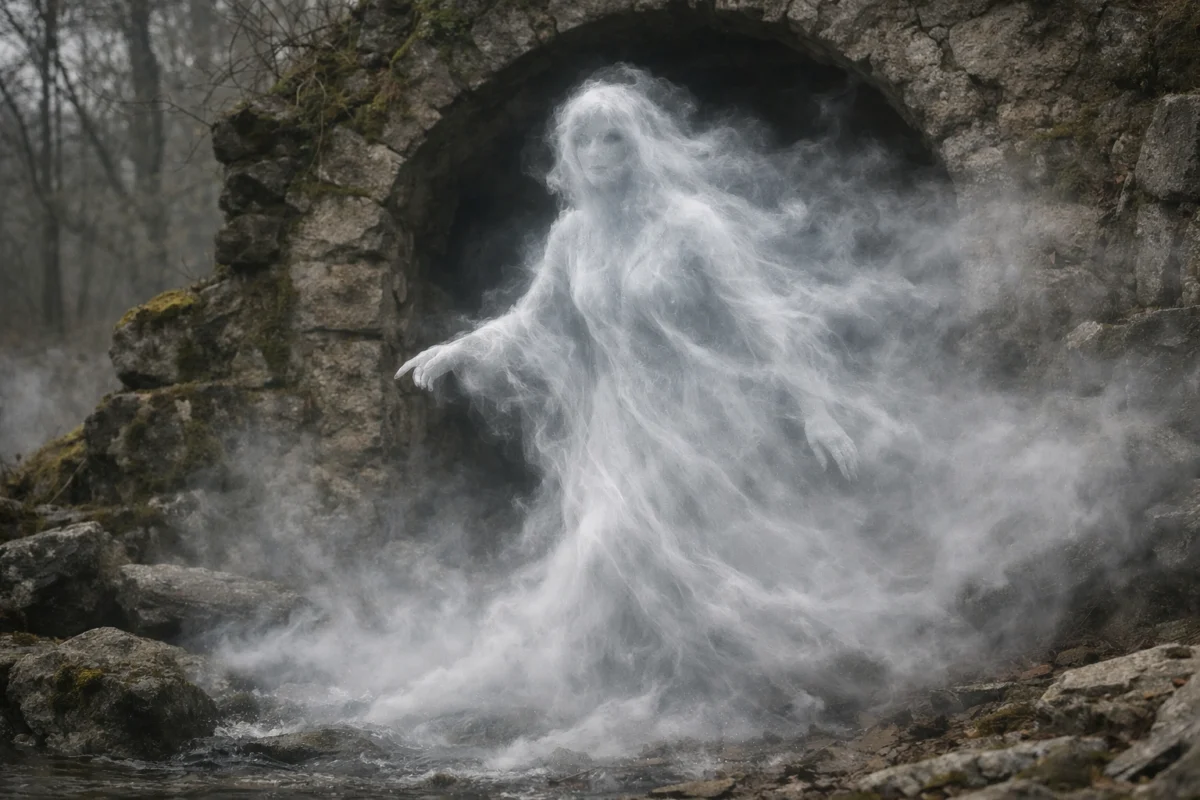
The Sandman is a figure in European bedtime folklore who gives a familiar sensation an imaginary cause. When children’s eyes grow heavy and they start to rub them, someone can say that a visitor has sprinkled sand into their eyes and brought on sleep.
That simple explanation leaves room for very different kinds of visitor. A cradle rhyme can welcome him, a parent can invoke him without expecting anyone to believe in him, and a storyteller can make the prospect of his arrival genuinely frightening.
History/Origin
One early record comes from Amsterdam. A verse addressed to sleepy young readers opens the 1651 Dutch collection De nieuwe vaakverdryver, of Neederlandze verteller by invoking Klaasvaak. The line connects him with yawning but does not describe him scattering sand.
A Dutch lullaby printed in Johannes Buma’s Boere Bruiloft in 1767 announces the arrival of the little Sandman. Folklore researchers Janneke van der Veer and John Helsloot distinguish this early record of the Dutch sand name from the much earlier appearance of Klaasvaak.
In 1777 the German lexicographer Johann Christoph Adelung recorded a joke adults told children who rubbed their eyes as if someone had thrown sand into them. His entry documents a household expression already in use, not a date or place for the figure’s invention.
The Berlin State Library dates the first appearance of E. T. A. Hoffmann’s Der Sandmann to autumn 1816, although the volume of Nachtstücke carries the date 1817. A Dutch translation followed in 1826, bringing his unsettling literary version into a language that already had its own bedtime visitor.
In Different Cultures
Germany
Hoffmann puts two accounts of the visitor in the same German household. Nathanael’s mother uses his arrival to mean that the children cannot keep their eyes open. In her explanation, the gritty feeling belongs to drowsiness, not to a being who visits the house.
An older woman who looks after Nathanael’s little sister tells him something quite different. Her Sandman comes for children who refuse to go to bed and takes their eyes. The threat belongs to the tale she tells, not to every German use of the name.
The Netherlands
In a Dutch rhyme collected by Johannes van Vloten, the visitor enters through the chimney. The rhyme calls him Klaas Vakeling and brings him straight from the hearth to the children’s eyes. It gives the visitor a route into the house as well as a destination.
The variants printed with that rhyme do not agree about his intentions. One gives him a wicked disposition, another a kindly one. The change is small enough to fit the same rhyme, but it makes the difference between a visitor to welcome and one to fear.
Denmark
Danish folklore gives Ole Lukøje a different way of bringing on sleep. Folklorist Else Marie Kofod notes that he takes children along with him. She distinguishes that account from the western European tradition of a visitor who throws sand or dust into children’s eyes.
Hans Christian Andersen changes the means again in his fairy tale. His Ole squirts sweet milk into children’s eyes and blows softly on the backs of their necks. Kofod distinguishes the milk from the Danish folk account rather than treating it as a traditional detail.
Name Meaning
German Sandmann combines Sand, meaning sand, and Mann, meaning man. The diminutive Sandmännchen means little Sandman. Adelung also records the plain occupational sense, a seller of sand, but that shared name does not establish that a real trade inspired the bedtime character.
Dutch Zandman names the figure for the same material, while Zandmannetje is its diminutive. Klaas Vaak works differently: it pairs the familiar given name Klaas with vaak in its sense of drowsiness. The early form Klaasvaak writes the two elements together.
Danish Ole Lukøje pairs a given name with a byname that means roughly “shut-eye.” Andersen spells it Lukøie in his title. Where the German and Dutch sand names identify what the visitor carries, the Danish name describes what happens to the child.
Appearance
The early references do not give the Sandman a fixed face or height. One specific portrait comes from the 1893 opera Hänsel und Gretel, for which Adelheid Wette’s stage directions call for a small gray man with a little sack on his back.

Andersen’s Ole wears a silk coat and walks upstairs in his stockings. The narrator tries to describe the coat but cannot assign it a single color. Rather than fixing the costume for the reader, Andersen lets the fabric change as the visitor moves.
“For it shines green, red, and blue, depending on how he turns.”
Ole Lukøie, Hans Christian Andersen, 1841 with title-page date 1842, opening passage before “Mandag,” own English translation from Danish
Background Story
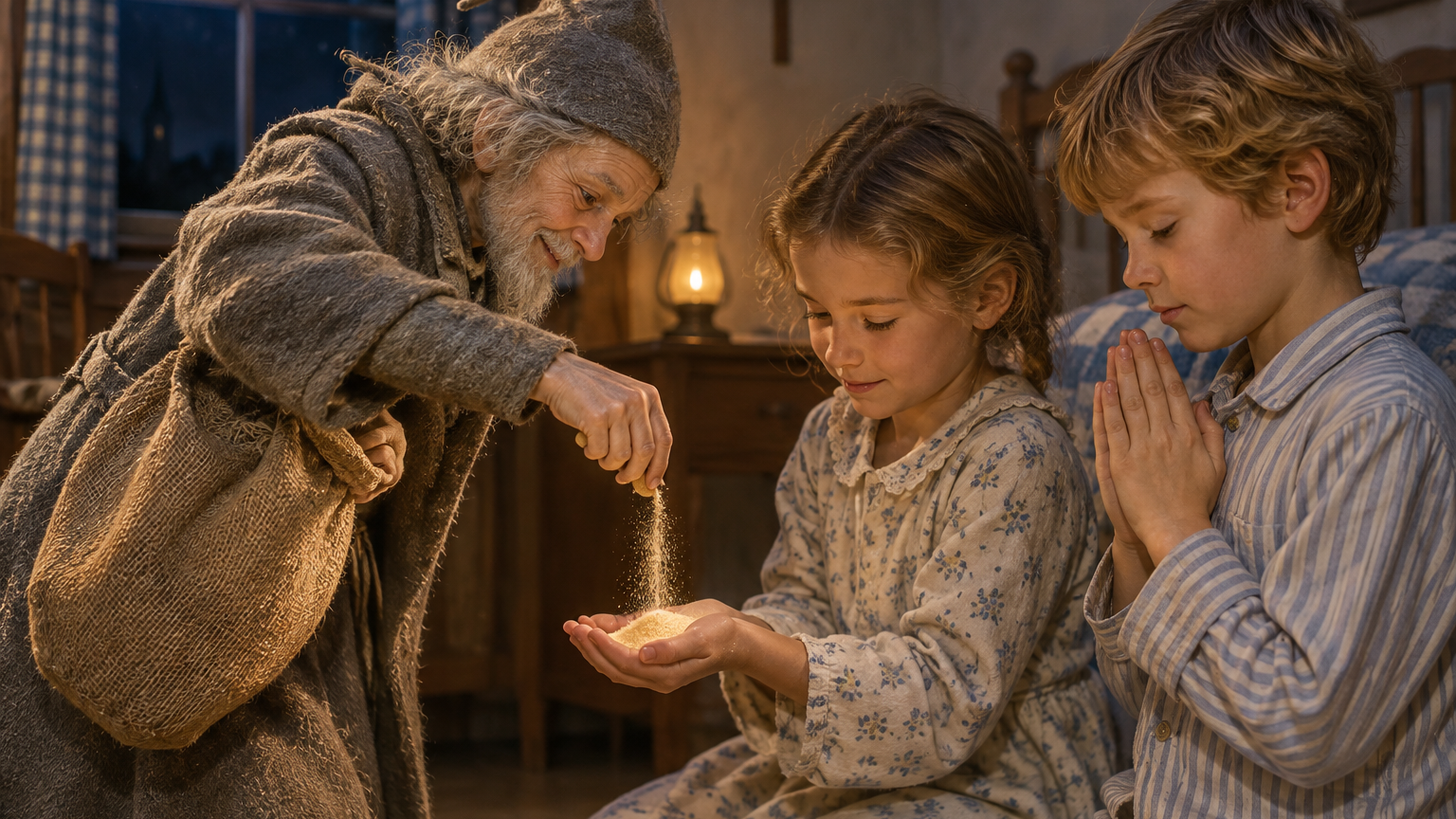
In a Dutch verse by J. J. A. Goeverneur, the visitor gives sand generously to children who behave and remember their prayers. The verse ties his favor to habits children can practice for themselves, making him part of bedtime instruction rather than an unpredictable intrusion.
Andersen makes dreaming a gift distinct from sleep. Ole opens an illustrated umbrella over well-behaved children so they dream stories through the night. Over naughty children he opens a plain umbrella. They still sleep, but when they wake they have no dreams to remember.
Andersen also lets Ole claim that the Greeks and Romans knew him as a god of dreams. This is the character speaking about himself inside a fairy tale. It gives Andersen’s visitor a past without supplying historical evidence that European Sandman lore began in antiquity.
Famous Folklore Stories
The Sandman
As a boy, Nathanael hides in his father’s room to discover who visits the house at night. He recognizes the lawyer Coppelius and watches the two men work over a fire. Coppelius discovers him, and his father pleads for the boy’s eyes.

About a year later, Coppelius returns. An explosion shakes the house, and Nathanael finds his father dead. Years afterward, as a student, he encounters a traveling dealer named Coppola and suspects that the man is the same visitor under another name.
“I’ve got pretty eyes, too, pretty eyes!”
Der Sandmann, E. T. A. Hoffmann, published 1816 with title-page date 1817, Coppola’s visit to Nathanael’s rooms, own English translation from German
Coppola means spectacles, but Nathanael buys a small spyglass instead. Through it he watches Olimpia, Professor Spallanzani’s supposed daughter, and falls in love with her. Her silence leaves him free to imagine that she understands him better than his fiancée, Klara.
When Nathanael finds Coppola and Spallanzani fighting over Olimpia, he discovers that she is a mechanical doll. Coppola carries her off, and Spallanzani flings a pair of bloody eyes at Nathanael. He attacks the professor, and the people who restrain him take him away.
After his apparent recovery, Nathanael climbs a tower with Klara. He looks at her through the spyglass and tries to throw her over the railing. Her brother rescues her. Nathanael sees Coppelius in the crowd, leaps to his death, and Coppelius disappears.
Ole Lukøie and Hjalmar’s Seven Nights
Ole Lukøie visits young Hjalmar for seven evenings, and familiar things become places the boy can enter. One night he sails through the world inside a picture. His boat passes the town where his old nurse lives, and she sings as he goes by.
On another night a mouse invites Hjalmar to a wedding beneath the pantry floor. Ole shrinks him to less than the size of a finger and outfits him like a tin soldier. The mouse pulls him there in his mother’s thimble.
The next night Ole borrows Grandmother’s black skirt to marry two dolls. The furniture sings a wedding song written by the pencil. By Sunday Hjalmar is asking for more stories, but Ole has something different to show him: a brother who shares his name.
Ole lifts Hjalmar to the window. Below, his brother rides past in a silver embroidered uniform, taking young and old alike onto his horse. He examines their report books before deciding which riders will hear a beautiful story and which will hear a dreadful one.
The riders who hear the dreadful story weep and try to jump off, but they find themselves stuck fast. Hjalmar, however, sees nothing frightening in the horseman himself. Ole tells him to keep a good report book, advice that even Hjalmar’s great grandfather’s portrait approves.
Cultural Impact
Johannes van Vloten’s nursery collection preserves the Sandman in a form meant to be spoken or sung. Repeated lines announce his arrival, and the short verses give a caregiver something to say at bedtime without the need to tell an entire tale.
Illustration gave the visitor a life beyond the nursery book. The German Institute for Animated Film documents a picture postcard mailed in 1899 from Auerbach. Its caption calls the figure Sandmann, while the umbrella and milk sprayer identify Andersen’s Danish character.
On the operatic stage, Jacques Offenbach and librettist Jules Barbier made the Olimpia episode one of the loves recalled by a fictional Hoffmann. Their adaptation brought the deception into musical comedy, giving the mechanical doll an aria through which to demonstrate her supposed accomplishments.
Similar Beasts
Morpheus
In Ovid’s Metamorphoses, Morpheus can imitate human forms. He appears to the sleeping Alcyone as her drowned husband, Ceyx, bringing news through a dream rather than merely causing sleep. He resembles the Sandman chiefly as a dream visitor.
Hypnos
In Homer’s Iliad, Hera persuades Hypnos, the Greek personification of sleep, to lull Zeus. Like the Sandman, he can make another being fall asleep, but here that power intervenes in a war rather than a household routine.
Mara
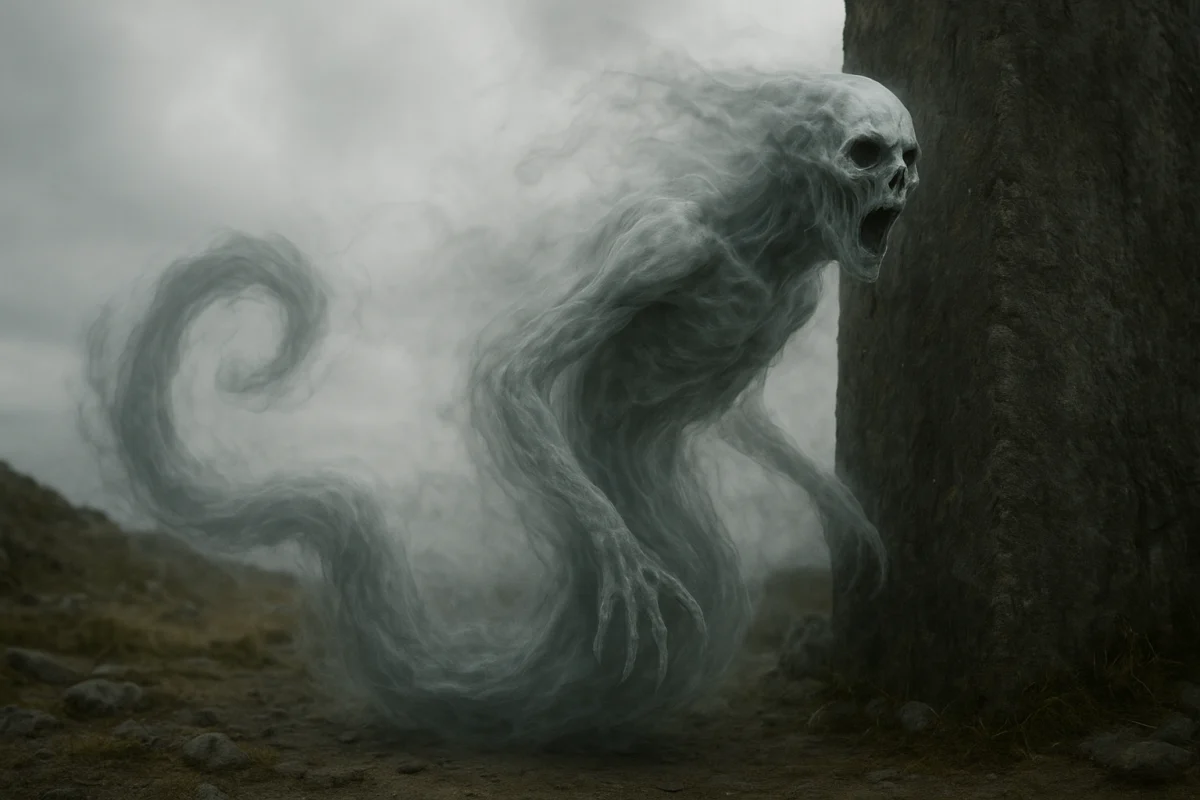
In Swedish folklore, the mara enters rooms at night and may press on a sleeper’s chest, leaving the person unable to move or cry out. It resembles the frightening Sandman as a nighttime intruder, not as a giver of sleep.
Religion/Ritual
In the Dutch Puk en Muk books, Klaas Vaak looks after two young sand gnomes and makes sure they remember their evening prayers. Helsloot and Van der Veer identify a Catholic coloring in this portrayal, placing prayer within the household routine of fictional characters.
In Hänsel und Gretel, Gretel remembers the evening blessing just as sleep comes over the children in the forest. The siblings call on fourteen angels, and the ensuing dream scene places those guardians around them in the order named in the prayer.
Andersen gives the night before Sunday its own work. Ole checks whether little church sprites have polished the bells while he prepares to clean the stars. The scene extends a Christian distinction between ordinary days and the holy day into the fairy tale’s imagined world.
Scientific or Rational Explanations
The grit found at the corners of the eyes after sleep consists of material that accumulates when blinking stops. Cleveland Clinic describes a mixture that includes mucus, oil, skin cells and debris. Its texture makes the comparison with sand easy to understand.
Hoffmann gives a rational reading of Nathanael’s fears to Klara herself. In her reply to his letter, she suggests that the threatening power he describes comes from within him. Her explanation matters because the story allows readers to consider it alongside his account.
In his 1919 essay Das Unheimliche, Sigmund Freud made fear of losing the eyes central to his reading of Hoffmann and interpreted it as displaced castration anxiety. This is a psychoanalytic interpretation of one literary work, not a demonstrated explanation for the folklore.
Modern Cultural References
Unser Sandmännchen, Gerhard Behrendt, Deutscher Fernsehfunk, 1959
Behrendt’s animated puppet brings a bedtime greeting to young viewers, arriving in an assortment of vehicles and visiting settings that range from fairyland to outer space.
(www.rbb-online.de)
Metallica – Enter Sandman (1991), Music song & Music Video
Metallica’s 1991 “Enter Sandman” video intercuts the band’s performance with a child’s unsettling bedtime imagery, translating the song’s Sandman and nightmare themes into a dark music-video dreamscape.
The Sandman, Neil Gaiman, Sam Kieth and Mike Dringenberg, DC Comics, 1989 cover date
The comic recasts the Sandman as Dream of the Endless, a personification who rules over dreams and stories and carries a bag of sand among his symbols of power.
(www.dc.com)
The Sandman, Paul Berry, Batty Berry Mackinnon Productions, 1992
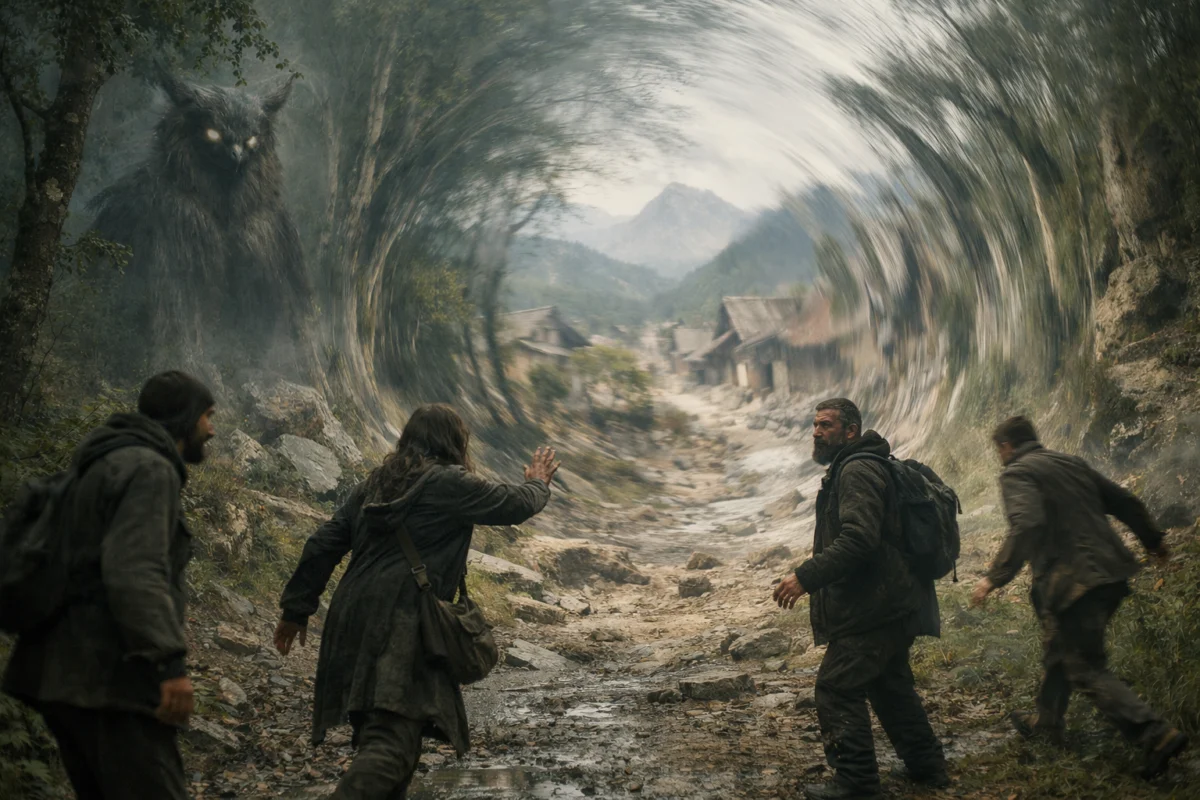
Berry’s stop motion short turns the visitor into a beak-nosed creature of nightmare. The British Film Institute presents the film as a dark interpretation of the European bedtime figure.
(www.bfi.org.uk)
Der Sandmann, Eckhart Schmidt, Raphaela Film and Provobis, 1993
Schmidt relocates Hoffmann’s story to contemporary Italy, where Daniel encounters the man he knows as the Sandman and becomes obsessed with the mysterious Olimpia.
(www.filmportal.de)
The Sandman and the War of Dreams, William Joyce, Atheneum Books for Young Readers, 2013
The Guardians recruit Sanderson ManSnoozy to help rescue a missing girl. In Joyce’s book, the sand on his island holds good dreams powerful enough to fight nightmares.
(www.simonandschuster.com)
Klaas Vaak, Efteling Theaterproducties, 2013
In this Dutch stage musical, Klaas Vaak and his owl investigate why his sleep sand no longer brings pleasant dreams and where a mysterious black sand comes from.
(www.efteling.com)
Conclusion
The Sandman gives adults and children a shared character for a moment they experience differently. For an adult, bedtime can be a routine to guide a child through. For a child, it can be the beginning of an adventure or the prospect of a threat.
That difference helps explain why no single telling exhausts the figure. A nursery verse can make his coming predictable, while a longer story can leave his intentions in doubt. Both uses give shape to experiences that are hard to describe directly.
Further Reading
De nieuwe vaakverdryver, of Ne(e)derlandze verteller, entry by P. P. Schmidt, Zeventiende-eeuwse kluchtboeken uit de Nederlanden, 1986, DBNL
Schmidt catalogs the seventeenth century Amsterdam printing and transcribes its opening address to sleepy readers, which pairs the name Klaasvaak with yawning.
(www.dbnl.org)
Zoete melk, zand en mooie dromen: Klaas Vaak en de Nederlandse kinder- en jeugdliteratuur, John Helsloot and Janneke van der Veer, KNAW, 2008
The academy provides access to a folklore study tracing Klaas Vaak through Dutch nursery verses, translated literature and children’s books, including the Catholic inflection of Puk en Muk.
(pure.knaw.nl)
Nederlandsche baker- en kinderrijmen, collected by Johannes van Vloten, third edition, Sijthoff, 1874, DBNL
The digitized third edition preserves the Klaas Vakeling rhyme quoted in Phase 1 alongside related cradle verses that show how variations traveled in nursery tradition.
(www.dbnl.org)
Sandmann-Ausgaben, E. T. A. Hoffmann Portal, Berlin State Library
The library compares textual witnesses and describes the publication history of Hoffmann’s tale, distinguishing its actual appearance in 1816 from the date printed in the volume.
(etahoffmann.staatsbibliothek-berlin.de)
Der Sandmann, E. T. A. Hoffmann, Nachtstücke, 1816 with title-page date 1817, Wikisource transcription
The German text contains Nathanael’s opening account, Klara’s reply, the encounter with the dealer Coppola, and the tower scene that ends the story.
(de.wikisource.org)
Ole Lukøje, Else Marie Kofod, Lex
Kofod distinguishes the Danish folk figure who takes children along with him from Andersen’s visitor and from the western European motif of throwing sand or dust.
(lex.dk)
Ole Lukøie, Hans Christian Andersen, 1841 with title-page date 1842, Tekstnet, Danish Society for Language and Literature
The original Danish text preserves Ole’s introduction and all seven visits, including the pantry wedding, preparations for Sunday and the revelation about his brother.
(tekstnet.dk)
Hänsel und Gretel, Engelbert Humperdinck and Adelheid Wette, 1893, libretto reproduced by Brilliant Classics
The libretto records the Sandman’s appearance in the forest and lets readers follow the transition from his song to the evening blessing and guardian angels.
(www.brilliantclassics.com)
Der Sandmann und Sachsen: 60 Jahre Fernsehstar, Deutsches Institut für Animationsfilm, exhibition catalog, 2019–2020
The exhibition catalog connects the figure’s print and screen histories, reproducing a postcard that uses the German Sandmann name for imagery drawn from Andersen’s tale.
(www.diaf.de)
Opera Essentials: The Tales of Hoffmann, Royal Ballet and Opera
The Royal Opera identifies Der Sandmann as one of the opera’s literary sources and describes how the Olympia episode turns Hoffmann’s deceived lover into an operatic protagonist.
(www.rbo.org.uk)
Metamorphoses, Book XI, Ovid, translated by A. S. Kline, University of Virginia Library
Ovid’s account of Ceyx and Alcyone explains Morpheus’s gift for imitating human beings and shows him using it to deliver news to a dreamer.
(ovid.lib.virginia.edu)
Iliad, Book XIV, Homer, translated by A. T. Murray, Theoi Classical Texts Library
Book XIV follows Hera’s negotiations with Sleep and his intervention against Zeus, supplying a classical example of sleep’s personification exercising power over a god.
(ftp.theoi.com)
Mara, Institutet för språk och folkminnen
Sweden’s folklore institute draws on archival accounts to describe the mara’s entry into bedrooms and the sensations sleepers attributed to its presence.
(www.isof.se)
Das Unheimliche, Sigmund Freud, Imago, 1919, Freud Edition
Freud’s original essay presents his psychoanalytic reading of Hoffmann’s story, focusing on the threat to Nathanael’s eyes and the recurring figure of the Sandman.
(www.freudedition.net)
Why Your Eyes Are Crusty, Cleveland Clinic, 2022
A Cleveland Clinic ophthalmologist explains what accumulates around closed eyes overnight, providing a physiological comparison for the familiar idea of waking with sand in them.
(health.clevelandclinic.org)
Zoete melk, zand en mooie dromen: Klaas Vaak en de Nederlandse kinder- en jeugdliteratuur, Janneke van der Veer and John Helsloot, 2008
This folklore study documents early Dutch and German references, the Dutch Hoffmann translation, and printed nursery verses by or collected by Goeverneur and van Vloten.
(pure.knaw.nl)