Introduction
Basan is a Japanese bird yōkai associated with Iyo, the historical province corresponding to present-day Ehime Prefecture on Shikoku. Its best-supported form is a large, chicken-like phantom with a conspicuous comb, nocturnal habits, and a strange flame that does not burn what it touches.
The clearest surviving account appears in Ehon Hyaku Monogatari, an illustrated collection published in 1841. There, the bird belongs to deep brush and nighttime encounters rather than a developed heroic mythology.
Its presence is conveyed through fire, movement, and disturbing sounds outside a mountain home.
Its flame resembles foxfire, placing Basan closer to the world of uncanny lights than to an ordinary fire-breathing animal. The distinction matters: the recorded fire does not set objects alight, and the accompanying encounter concerns an unexplained disturbance rather than a destructive attack.
Basan is also associated with the sound-name Basabasa. Its compact tradition brings together the familiar shape of a domestic fowl and the uncertainty of something heard but not seen.
Later descriptions expand that image, sometimes adding details that the early account does not establish.
History/Origin
The firmest historical starting point is the Basan entry in Ehon Hyaku Monogatari, published during the late Edo period in 1841. The entry connects the creature with Iyo and combines a brief description of a strange bird with an anecdote about a nighttime disturbance.
This publication date establishes a documented appearance, not the moment when the belief began. The account presents a regional association and a name reportedly used to frighten children, but it does not provide enough evidence to reconstruct how long those ideas had circulated beforehand.
The entry preserves different kinds of material together: a description of the bird, a claim about its mountainous habitat, a local frightening name, and a short household encounter. These elements support a regional setting without establishing that every detail came from an independently recorded eyewitness report.
The collection is a literary witness to the tradition, not a field survey of its distribution.
Some modern summaries assign Basan an earlier appearance in Toriyama Sekien’s Gazu Hyakki Yagyō, published in 1776. That attribution is not established by the stronger historical evidence.
The 1841 collection therefore remains the appropriate baseline, rather than an assumed eighteenth-century illustration.
A separate proposal concerns the bird’s possible literary model. Folklorist Tada Katsumi has been credited with suggesting an influence from the fire-eating fowl described in Wakan Sansai Zue, an earlier illustrated compilation.
This is a proposed connection, not an origin stated in Basan’s own account.
The proposed model is associated with the cassowary and a claim about eating partly burned wood. That detail suggests a possible route by which exotic natural history could influence a supernatural bird.
It does not establish ember-eating as part of the recorded Basan tradition.
The hypothesis concerns the formation of an image rather than a real cassowary living in Iyo. It allows for the possibility that descriptions or illustrations of an unfamiliar bird supplied material for a supernatural reinterpretation.
Even so, resemblance and a shared association with fire do not demonstrate direct borrowing.
Modern retellings have continued to reshape this small body of material. Some turn the bird into a more fully specified creature with fixed colors and diet.
YOKAI.JP explicitly distinguishes some creative profile content from historical material, a useful boundary when considering such later elaborations.
Name Meaning
Basan is written 波山. Although these characters individually mean “wave” and “mountain,” their combination does not establish a secure explanation of the creature’s name.
Reading the characters literally is not the same as demonstrating why this particular bird received that designation.
Basabasa has a clearer connection to the recorded encounter. It evokes the rustling or flapping associated with the bird’s presence.
The sound-name links the imagined creature to an audible disturbance, especially important in an episode where opening the door reveals no visible visitor.
The form Basabasa no bake, approximately “Basabasa monster,” is reported as a name used to frighten children in the Iyo mountains. This preserves a local social use of the figure, although it does not establish a detailed warning tale or a particular punishment.
Another possible name is Inuhōō, written 犬鳳凰 and literally meaning “dog phoenix.” The relationship is uncertain even in discussion of the historical account.
It should therefore remain a possible association, not a secure synonym or evidence that Basan possessed canine features.
Appearance
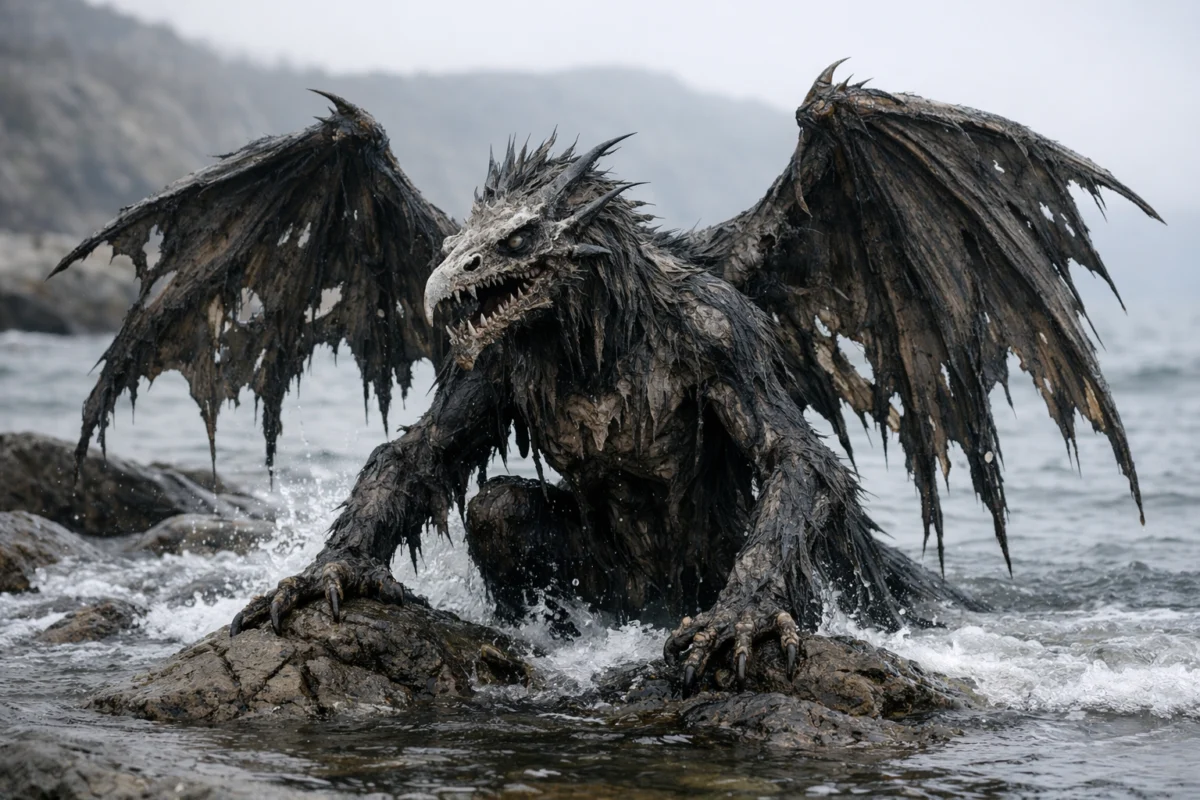
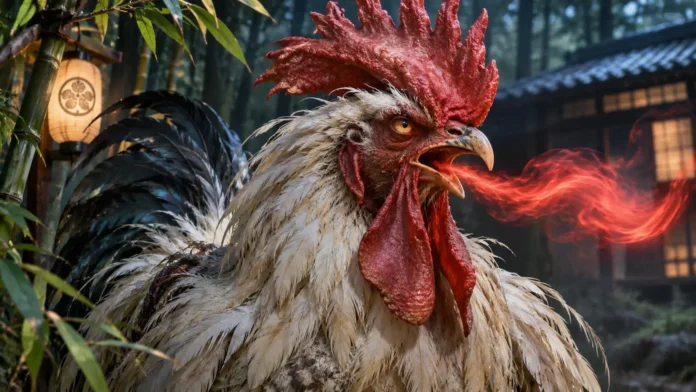
Basan’s basic outline is that of a large domestic fowl. A conspicuously developed comb gives its head a recognizable feature, making an enlarged chicken-like bird the safest description.
The early material offers a compact image rather than a detailed inventory of supernatural anatomy.
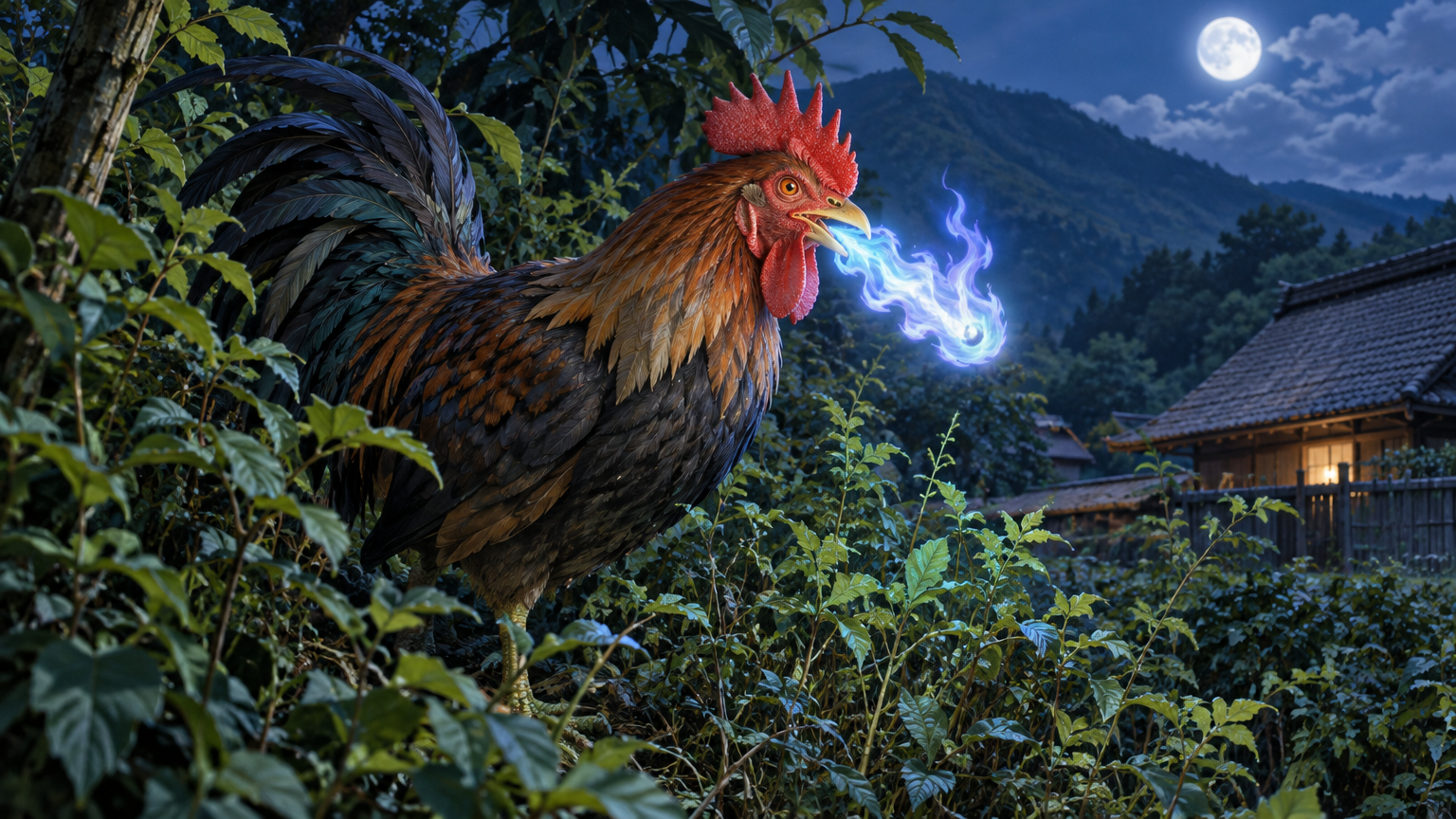
The comparison establishes general form more securely than dimensions. “Large” should not become a precise height or wingspan, and the bird need not be imagined as a towering monster.
Its strangeness rests on the combination of familiar avian features with nocturnal activity and ghostly fire.
This domestic-fowl resemblance is important to its character. Basan does not require a hybrid body to become uncanny: a recognizable bird is placed in deep brush, made active at night, and associated with an impossible flame.
The supernatural effect comes from altered behavior and surroundings as much as from physical exaggeration.
The comb is better supported than a complete color scheme. Later summaries often make it red, but elaborate plumage colors are not securely established by the early account.
A brightly colored modern depiction may be an interpretation without representing a historically fixed appearance.
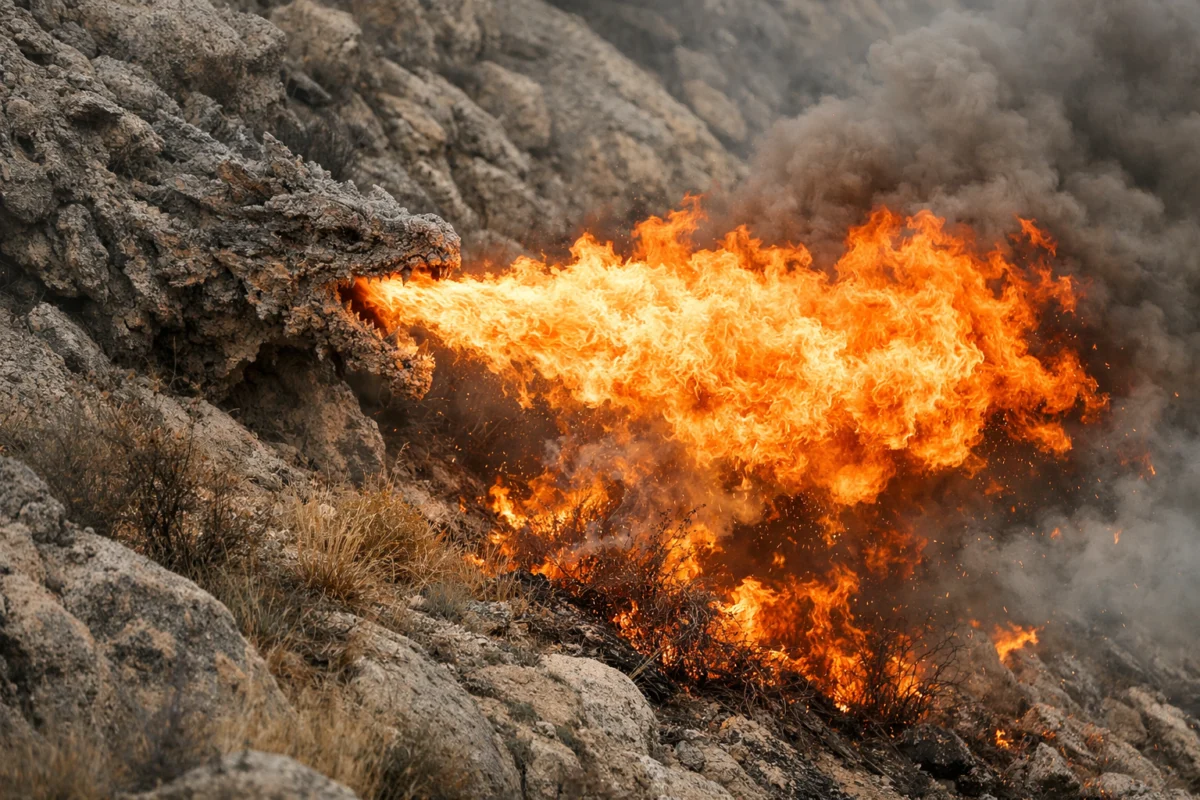
Fire-breathing is the defining supernatural feature, but the flame behaves unlike ordinary combustion. It is compared with foxfire and does not ignite things.
“Cold fire” is therefore a useful descriptive shorthand for its non-burning character, not evidence that the account measured or explained its temperature.
The distinction also changes how the bird should be imagined in a scene. A glow or flame at the beak can express its reported power without requiring scorched vegetation, smoke damage, or a burning house.
Destructive surroundings would imply an effect that the account specifically withholds.
Setting also shapes the image: deep brush conceals the bird, while nighttime flight supplies movement and rustling. Yet the gate anecdote does not provide a full-body sighting.
The creature’s general description and the household’s limited experience belong to different parts of the account.
Background Story
Basan’s background brings together mountain-household storytelling, uncanny nighttime sounds, and the illustrated yōkai literature of Edo Japan. The account preserved in the 1841 Ehon Hyaku Monogatari associates the bird with Iyo, now Ehime Prefecture.
This literary record preserves a regional association, but does not establish how widely the belief circulated or how long it existed before publication.
Its reported use in frightening children gives Basan a specific place in everyday storytelling. In the Iyo mountains, the name Basabasa no bake, roughly “Basabasa monster,” could invoke a threatening presence without an elaborate tale.
The surviving account does not attach that name to a particular rule about obedience, wandering, or punishment.
The mountain setting also connects the creature with the uncertain space beyond the home. Deep brush conceals the bird, while a late-night rustling or knocking draws attention to the gate.
When the occupants open the door, nobody is there. The episode makes sound, rather than a witnessed attack, the source of unease: an apparently nearby presence remains unseen.
Basan’s foxfire-like flame places its familiar fowl-shaped body within a wider world of uncanny lights. The flame does not burn what it touches, distinguishing its supernatural character from ordinary destructive fire.
This detail belongs to the recorded creature, not merely to a later explanation of its origins.
A possible literary influence belongs to a different layer. Folklorist Tada Katsumi has been credited with proposing a connection to the fire-eating fowl in Wakan Sansai Zue, associated with the cassowary and a reported diet of partly burned wood.
That proposal suggests how exotic natural-history imagery might have helped shape Basan, but it does not demonstrate direct borrowing or establish ember-eating as part of Basan’s own tradition.
Famous Folklore Stories
Basan’s surviving narrative material includes a brief encounter at a mountain house and a report of its name being used to frighten children. These are preserved in the 1841 Ehon Hyaku Monogatari account, rather than a substantial cycle of independently named folktales.
The unseen visitor at the gate
This encounter account, presented here under a descriptive rather than traditional title, concerns a disturbance late at night. A loud rustling or knocking comes from the gate of a mountain home.
When the occupants open the door to investigate, they find nobody there.
The episode offers no clearly witnessed bird, attack, or confrontation. Its unsettling effect rests on the mismatch between an audible presence and an empty entrance.
The sound suggests a visitor, but opening the door produces neither an explanation nor a visible creature.
The general description of a fire-breathing bird should not be inserted into the scene as something the household actually sees. The recorded incident is chiefly an experience of unexplained sound, associated with the name Basabasa.
A frightening name in the Iyo mountains
A second documented motif concerns the expression Basabasa no bake, roughly “Basabasa monster,” used to frighten children in the mountains of Iyo. This is a reported storytelling practice, not a separate named tale with an identifiable protagonist or a developed plot.
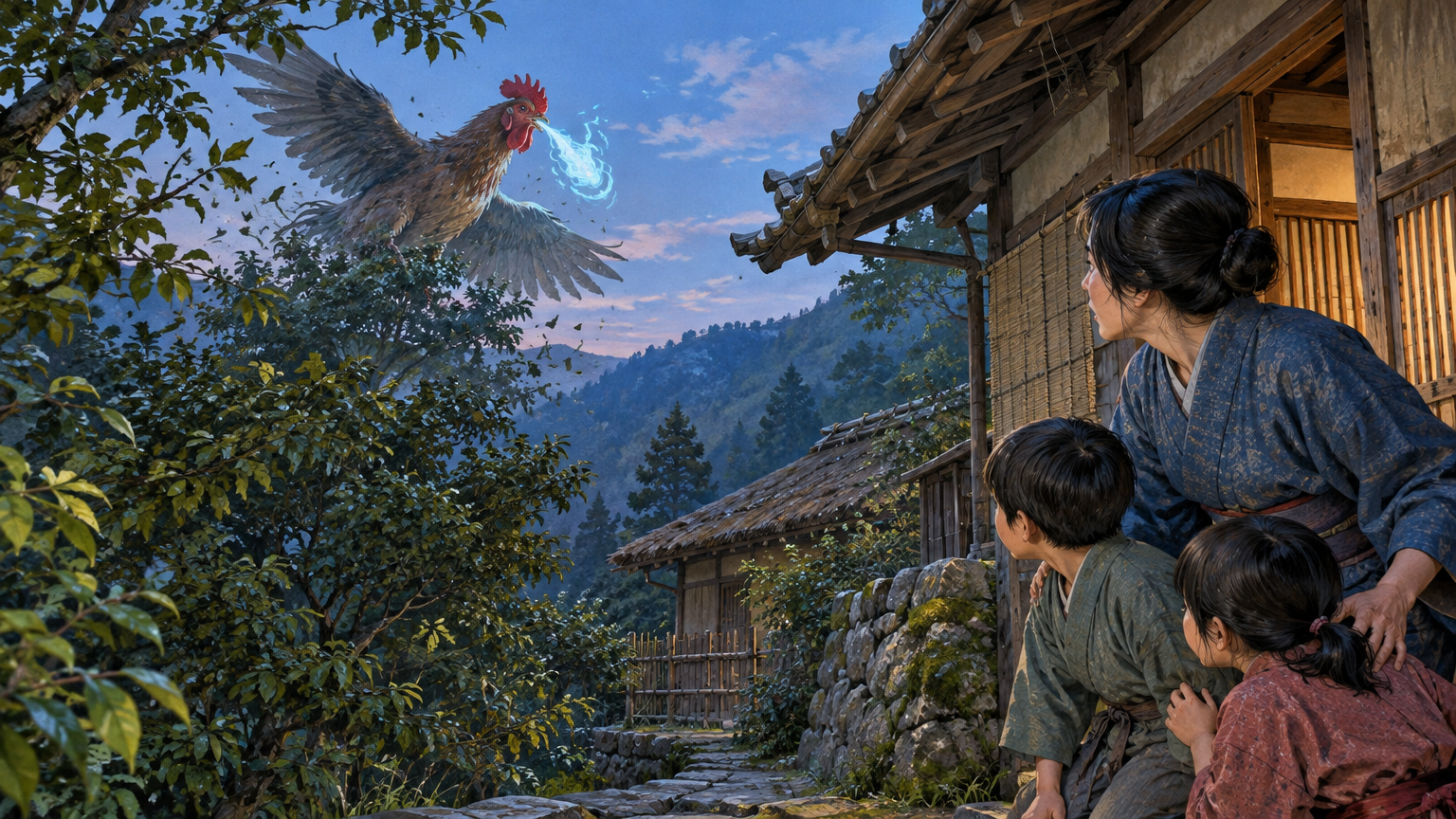
The sound-name connects the frightening presence with rustling or flapping. It makes the creature recognizable through something heard rather than through detailed anatomy.
The record does not establish a particular warning formula, punishment, or prohibition attached to invoking its name.
Cultural Impact
Basan’s clearest historical cultural role is modest but distinctive: it gives a name and animal form to an unsettling nighttime presence. Its recorded use in frightening children places it within household storytelling, rather than demonstrating an organized cult or a major regional ceremonial tradition.
Preservation in an illustrated tale collection also matters. The literary record brings together a recognizable fowl-like shape, uncanny flame, and an encounter dominated by sound.
These elements allow a brief account to remain memorable without supplying an extensive mythology or heroic narrative.
The contrast between description and encounter gives Basan two complementary forms of appeal. As an illustrated creature, it has a clear visual identity: a large-combed bird associated with flame.
As a story, it depends on concealment and absence. Neither mode needs to be expanded into a violent monster encounter to remain effective.
Modern Japanese yōkai references continue to preserve the bird’s association with Iyo and ghost fire. Their entries make an otherwise short historical account accessible to new readers, but the number of modern summaries should not be mistaken for evidence of numerous independent local traditions.
Modern interpretation has also broadened the creature’s profile. Ember-eating and increasingly specific visual details sometimes accompany retellings, although they are not equally secure features of the early account.
Such additions can make the bird seem more like a fully catalogued fantasy species than the elusive presence preserved in the older narrative.
Contemporary entertainment can change the frame again. The Spirits Podcast’s monster-comparison bracket treats Basan as a candidate for playful comparison with other extraordinary creatures.
That use demonstrates a modern audience for its memorable traits, while the historical account remains a much quieter story about sound, uncertainty, and non-burning fire.
Similar Beasts
Thunderbird

Thunderbird figures belong to several North American Indigenous traditions and are associated with thunder, lightning, and powerful supernatural agency. Their meanings differ among the cultures that preserve them.
The comparison is structural: both connect a bird form with extraordinary phenomena. Thunderbird’s storm powers and protective or punitive roles should not be transferred to Basan.
Kasa-obake
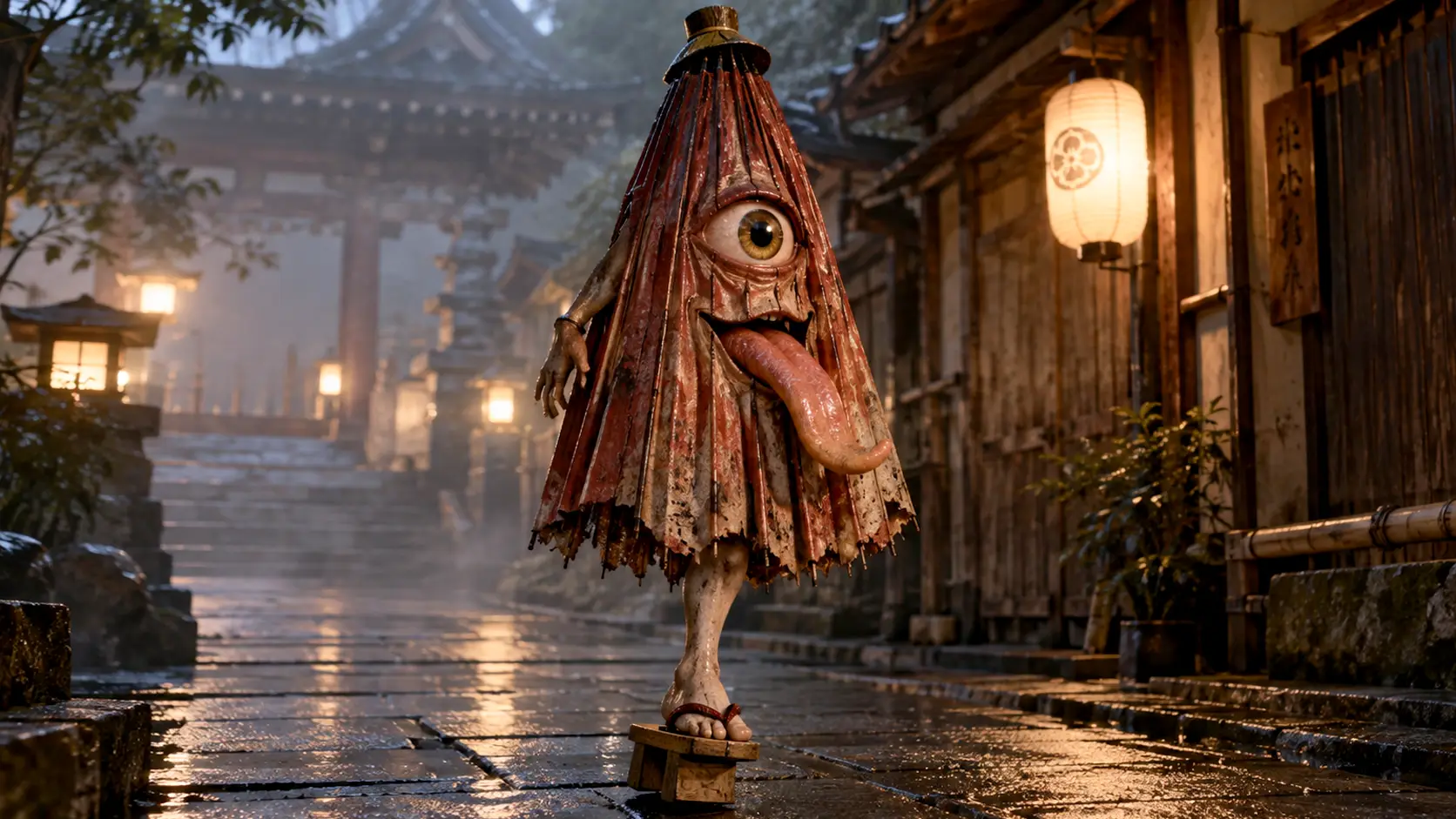
Kasa-obake is the familiar Japanese umbrella yōkai, commonly pictured with one eye, a long tongue, and a single hopping leg. Its identity owes much to visual entertainment.
Its strongest parallel with Basan is the importance of illustrated yōkai culture. Both remain recognizable without requiring a large body of named traditional adventures.
Onibi
Onibi refers to uncanny ghost fire in Japanese folklore, rather than to a single bird-shaped creature. It provides a useful comparison for supernatural light treated as something other than everyday flame.
Basan’s non-burning fire belongs in this comparative setting, although its account specifically invokes foxfire. The comparison does not make Onibi another name for the bird.
Tsurube-bi
Tsurube-bi is a distinct Japanese uncanny-light yōkai. It belongs among supernatural fire phenomena, making it a closer elemental comparison than creatures connected with ordinary, destructive fire-breathing alone.
The shared feature is ghostly illumination, not anatomy or a demonstrated common origin. Tsurube-bi remains separate from Basan’s fowl-like form and gate-side encounter.
Scientific or Rational Explanations
The most concrete explanatory proposal concerns literary influence from historical natural history. Folklorist Tada Katsumi’s proposed connection, reported in modern discussion, links Basan with the fire-eating fowl described in Wakan Sansai Zue.
This is a hypothesis about the image’s formation, not a demonstrated origin.
That proposed model is a cassowary-like bird called shokkakei, or “fire-eating fowl,” described as consuming partly burned wood. Such material could help explain how an unfamiliar bird and an extraordinary relationship with fire became associated in later interpretation.
However, eating charred material and breathing non-burning flame are different claims. The early Basan account does not establish ember-eating as its behavior.
Even if the proposed natural-history influence is accepted, the model’s reported diet cannot simply be added to the yōkai’s description.
A historical natural-history entry is also evidence of what a compilation transmitted, not automatic confirmation that every reported animal behavior was accurate. The hypothesis can be considered as an explanation of literary imagery without accepting the fire-eating claim as established zoology.
The gate episode presents a different problem: its evidence is auditory, not a detailed visual identification. Rustling or knocking without a visible source leaves room for ordinary explanations, but the account provides too little information to identify an animal, weather event, or other specific cause.
Likewise, the foxfire comparison identifies the flame as uncanny and non-burning within the story; it does not supply a physical observation that can be tested. Assigning a particular chemical or biological mechanism would go beyond the evidence preserved in this brief literary account.
A restrained reading therefore separates three questions: what the historical text records, what earlier imagery might have influenced it, and what could cause a similar real-world experience. The first concerns the documented narrative; the others remain interpretive possibilities rather than established explanations.
Modern Cultural References
A confirmed modern use brings Basan into monster-themed entertainment through a live podcast discussion. Rather than adapting the gate encounter into a new fictional narrative, the episode treats the bird’s recognizable traits as material for humorous comparison.
Episode 169: Coolest Cryptid (Live from Los Angeles, CA), podcast episode (2019)
This live episode of Spirits Podcast stages a humorous cryptid-versus-cryptid bracket.
Basan enters the discussion through its rooster-like appearance, fire-spitting ability, and alternative name Basabasa, explicitly connecting the segment to the Japanese bird. The bracket’s “cryptid” framing belongs to the contemporary performance rather than establishing a historical classification for Basan.
(spirits-podcast.squarespace.com)
Conclusion
Basan is best understood through the brief account preserved in Ehon Hyaku Monogatari in 1841: a large, fowl-like phantom associated with Iyo, nocturnal rustling, and flame that does not burn. Its distinctive character lies in this combination of familiar bird imagery and uncanny effects.
The mountain-house encounter reinforces that ambiguity, offering a disturbing sound and an empty doorway rather than a witnessed attack.
The surviving evidence also sets limits on how confidently its story can be told. Elaborate plumage, ember-eating habits, and uncertain alternative names should not outweigh the better-supported account.
Its narrative force rests instead on ordinary surroundings becoming briefly inexplicable: brush conceals a strange bird, flame leaves things unburned, and a visitor leaves no visible trace. Modern references keep that combination in circulation, while careful retelling preserves the difference between the historical yōkai and later embellishments.
Further Reading
Ehon Hyaku Monogatari account as transcribed and discussed by TYZ Yokai Encyclopedia, Tyz Yokai.blog
In the account discussed with Ehon Hyaku Monogatari, a loud Basabasa-like knocking or rustling comes from a mountain home’s gate late at night.
The occupants open the door but find no one; the episode does not describe an attack or a witnessed confrontation.
(tyz-yokai.blog.jp)
波山, 神魔精妖名辞典
Japanese-language reference summarizing the bird, its Iyo setting, ghost fire, and the conjectural connection to Wakan Sansai Zue.
(shimma.info)