Introduction
Almas is a humanlike wild being in Mongolian folklore, particularly associated with western Mongolia and the Mongolian Altai. Reference works generally describe an upright, hair-covered figure resembling a person more closely than a conventional monster, although its appearance and interpretation vary between accounts.
Nathan Wenzel’s 2009 study, The Legend of the Almas: A Comparative and Critical Analysis, identifies western Mongolian aimags, or provinces, as the principal setting of the stories he examined. This regional emphasis matters: the tradition should not automatically be treated as uniform throughout Mongolia.
Almas also belongs to the history of cryptozoology, where writers have interpreted reported encounters as possible evidence of a surviving ancient human relative. That biological hypothesis is distinct from the documented folklore.
The consulted sources do not establish Almas as a zoologically verified species.
Its interest lies partly in this overlap between legend and purported observation. Mongolian understandings, travelers’ reports, and later searches have contributed different layers to its reputation.
Understanding the figure requires distinguishing those layers rather than treating every description as part of one unchanged ancient tradition.
History/Origin
The origins of Almas folklore cannot be assigned a secure founding date. The available material preserves reports and later studies rather than a clearly identifiable first tale.
Its historical record therefore needs to be separated from claims about how long the underlying oral tradition existed.
A nineteenth-century reference appears in an account relayed by the Russian traveler Nikolai Przhevalsky in 1876. As reproduced in the Almas encyclopedia entry, it describes a flat-faced, black-haired being with large claws.
This records a reported description, not a specimen or independently authenticated encounter.
The episode most frequently presented as the beginning of modern Almas investigation is an alleged Gobi encounter in 1906. It is attributed to Badzar Baradiin and commonly described as an occasion when he and a companion saw and pursued the mysterious being.
Michael Heaney’s 2016 study, The Mongolian Almas: A Historical Reevaluation of the Sighting by Baradiin, substantially challenges that familiar account. His examination of Baradiin’s diary and related archival material found the published encounter unreliable and likely fictionalized, undermining its standing as straightforward eyewitness evidence.
The 2017 anthropological article Wildmen in Central Asia, by Ståhlberg and Svanberg, incorporates this reassessment into a broader discussion of regional wild-person traditions. Its treatment shows why the history of Almas research cannot simply be assembled as a chronological list of supposedly reliable sightings.
By the time of Wenzel’s 2009 study, Almas could be approached both as a Mongolian legend and as a claimed living creature. These overlapping interpretations represent an important historical development: modern research and popular retelling have helped reshape how an existing folklore figure is understood.
Name Meaning
The Mongolian name is written Алмас and commonly rendered Almas in English. Alma also appears as an alternative form in reference material.
These spellings identify the figure, but they do not by themselves explain the word’s historical derivation or establish its original meaning.
Modern summaries often gloss Almas as “wild man.” This is useful as a brief description of the being’s place in folklore, and Wenzel likewise discusses a Mongolian wildman.
It should not, however, be mistaken for a securely demonstrated word-for-word etymology.
The Mongolian scholar Byambyn Rinchen explicitly resisted a confident translation. In a 1964 statement quoted in the Almas reference entry, he described the origin of the old name as unknown.
His assessment is a reason to preserve uncertainty rather than repeat an attractive but unproven explanation.
Similar-looking names also require caution. Cryptozoological writing frequently groups Mongolian Almas with the Caucasian almasty and other regional wild beings.
Such comparison does not establish that all these names share an origin, or that their associated traditions describe precisely the same figure.
Appearance
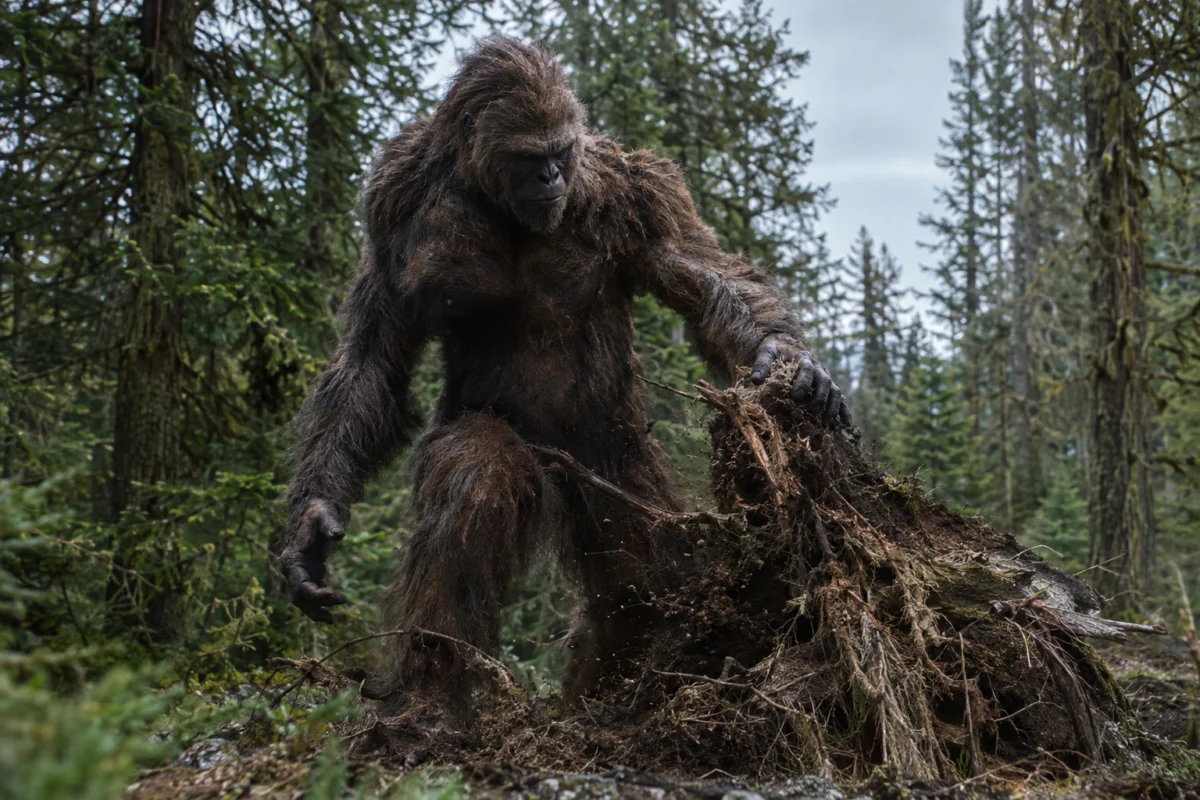
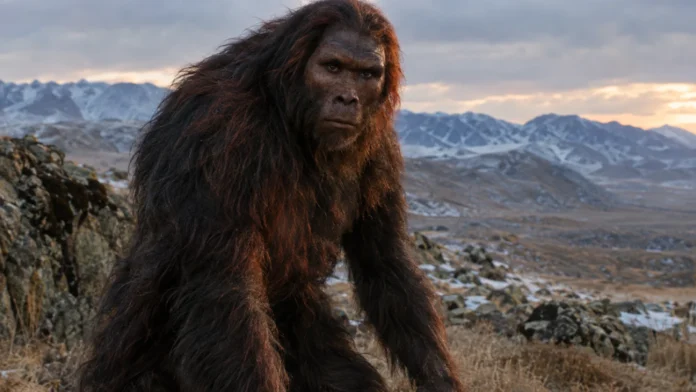
The most consistent outline in reference descriptions is an upright, bipedal being of approximately human stature, with a humanlike face and thick hair covering much of its body. This combination places Almas within wild-person imagery rather than giving it the body plan of a quadrupedal beast.
Dark coloration recurs, but descriptions are not identical. The account relayed by Przhevalsky in 1876 specifies black hair and a flat face.
It also mentions large claws, a distinctive feature that belongs to that particular reported description and should not be treated as universally characteristic.
The encyclopedia entry also summarizes later witness-based descriptions featuring reddish-black body hair and a relatively hairless face. Broad shoulders and long arms contribute to a powerful, humanlike silhouette.
These details are reported characteristics, not measurements derived from an examined animal or authenticated physical remains.
A flattened or receding forehead and a pronounced brow appear in some summarized accounts. Later cryptozoological interpretations can make such features seem suggestive of an ancient hominin, but resemblance is not identification.
The descriptions do not establish a particular extinct human species as their source.
Reported behavior sometimes supplements the physical portrait: later witness summaries describe a cautious being, often active at night. This gives the figure an elusive quality without requiring supernatural powers.
A faithful description should preserve the variation between accounts rather than combine every feature into one supposedly definitive anatomical design.
Background Story
Almas is better understood through the cultural background of wild-person traditions than through an invented individual biography. The sources present a kind of being encountered or discussed in particular places, not a single character with a universally accepted birth, ancestry, or sequence of adventures.
Western Mongolia provides the strongest regional focus in Wenzel’s study, while the Mongolian Altai and the Gobi appear in descriptions and modern reports. These settings should remain attached to their respective accounts.
They do not establish one fixed habitat shared by every version of the tradition.
The humanlike appearance creates a suggestive boundary between familiar people and unfamiliar life outside ordinary social experience. As an interpretation of the figure, this helps explain its classification as a wild person.
It does not establish a specific Mongolian doctrine about its ancestry or spiritual status.
Wenzel examines how people understand Almas both as legend and as a possible living creature, including the stories’ social meanings and uses. These approaches can coexist: a narrative may matter within a community regardless of whether a listener regards the encounter it describes as literal.
Later cryptozoological writing changes the emphasis by asking whether Almas could be a surviving hominin. Anthropological comparison instead places it among Central Asian wild-person traditions.
Together, these approaches explain its layered modern identity: a regionally rooted folklore figure whose descriptions have also been reorganized around questions of biological survival.
Famous Folklore Stories
The best-documented Almas narrative in the supplied research is a disputed encounter account, not a folktale with an authenticated traditional title. Alongside it, reported encounters preserve recurring descriptions of an elusive wild person.
These materials differ in origin and reliability and should not be combined into one canonical story.
Baradiin’s Alleged Gobi Encounter
A frequently repeated account places Badzar Baradiin and a companion in the Gobi in 1906, where they supposedly encountered and pursued an Almas. This is an encounter narrative attributed to a historical traveler, rather than a named traditional tale passed down in an established storytelling cycle.
Its apparent historical specificity helped make the episode important to later Almas investigations. However, Michael Heaney’s 2016 archival reassessment examined Baradiin’s diary and related material and found the familiar version unreliable and likely fictionalized.
The published narrative therefore cannot safely be treated as direct eyewitness testimony.
The episode remains relevant as an example of how an account can acquire authority through repetition. The anthropological discussion in Wildmen in Central Asia also acknowledges the archival challenge.
Its significance now lies partly in its reception and transformation, rather than in establishing what Baradiin actually saw.
Encounters with an Elusive Wild Person
Other accounts are better approached as a cluster of encounter motifs than as individual famous tales. They describe a humanlike, hair-covered figure whose appearance places it between familiar humanity and unfamiliar wildlife.
The sources do not establish a single plot, named protagonist, or traditional ending for this material.
Descriptions vary within that cluster. An account relayed by Przhevalsky in 1876 mentions black hair, a flat face, and large claws.
Later witness-based descriptions emphasize long arms, broad shoulders, and a relatively bare face. These differences belong to the reported tradition, not to a verified anatomical profile.
Some later descriptions also portray the being as cautious or active at night, reinforcing the motif of an elusive presence. Such details help explain the form of encounter narratives, but they do not justify adding unsupported episodes of capture, marriage, abduction, or conflict to the Mongolian record.
Cultural Impact
The Almas is culturally significant as a Mongolian wild-person figure, especially in the western regions emphasized by Nathan Wenzel’s 2009 study. Its humanlike character makes it more than a generic monster: the legend concerns a being recognizable as personlike while remaining outside ordinary human society.
That contrast allows an anthropological reading concerned with the distinction between the familiar human world and the unfamiliar. This is an interpretation of the figure’s cultural position, not evidence that all storytellers assign it the same symbolic meaning or understand it through one shared system of belief.
Wenzel’s study examines regional distribution and asks whether Almas stories extend beyond western Mongolia into central and eastern areas. That approach treats geographical variation as a research question.
It does not assume that the legend has identical prominence, content, or meaning throughout the country.
The study also considers understandings of Almas as both legend and possible living creature. These perspectives need not produce the same kinds of discussion: one concerns storytelling and social meaning, while the other treats reported encounters as claims about the natural world that could potentially be investigated.
Modern cryptozoological writing shifts the emphasis toward a hypothetical surviving hominin. Reference summaries and cryptid catalogues consequently place Almas beside other alleged wild people.
This expands its international visibility, but can obscure the regional distinctions emphasized by specialist studies, particularly between Mongolian Almas and Caucasian almasty traditions.
Similar Beasts
Yeti

The Yeti belongs to a separate Himalayan wild-being tradition. It is also the subject of modern searches and cryptozoological speculation, including the investigations discussed in the PBS material supplied for comparison.
Its resemblance to Almas lies in the elusive wild-being theme. The Himalayan association remains distinct, and Yeti is not another name for the Mongolian figure.
Yeren
The Yeren is a Chinese wild-person figure associated in the supplied research with central China. Reports and claimed footprint evidence have brought it into discussions of unidentified humanlike beings.
Like Almas, Yeren is interpreted through both wild-person narratives and creature claims. Their comparable descriptions do not establish a common species or an identical folklore tradition.
Chuchuna
Chuchuna belongs to wild-person traditions associated with Yakut and Evenk folklore in northeastern Siberia. The supplied comparative source identifies it as a separate regional figure rather than a Mongolian Almas variant.
The useful comparison is between distinct northern and Central Asian wild-person traditions. Shared personlike qualities should not erase differences in cultural setting or authorize borrowing narrative details.
Sasquatch
Sasquatch is a distinct North American wildman figure, widely discussed under the name Bigfoot. Its modern reception combines encounter claims, popular storytelling, and attempts to demonstrate the existence of an unidentified creature.
It offers a cross-cultural parallel to Almas, particularly in modern cryptozoological interpretation. It is neither a regional Almas name nor evidence of a shared historical origin.
Religion/Ritual
The consulted sources do not establish a specific Almas ritual, offering tradition, festival, or organized religious role. Wenzel’s discussion of the legend’s social meanings should therefore not be converted into claims about worship or ceremonial practice.
Cultural significance and ritual observance are different kinds of evidence.
Likewise, similarities with other wild-person figures cannot supply missing ritual details. A practice documented for a different regional being would require independent evidence before being attributed to Mongolian Almas tradition.
The available record supports discussing legend and belief, rather than reconstructing a ceremonial system.
Scientific or Rational Explanations
The biological interpretation proposes that Almas reports concern an undiscovered or surviving hominin. This belongs to modern cryptozoological speculation.
The consulted materials provide no verified specimen establishing such a species, and reported humanlike features alone cannot identify an animal or place it within human evolutionary history.
Historical source criticism offers a more directly supported explanation for at least one influential account. Heaney’s examination of the Baradiin material shows that a familiar encounter narrative can be undermined when checked against diaries and archives.
A report’s frequent repetition is not a substitute for a reliable documentary origin.
This finding applies specifically to the disputed Baradiin episode. It does not establish that every Almas account was invented, nor does it erase the existence of the folklore.
Instead, it removes an apparently important piece of eyewitness evidence from the position later writers had assigned it.
Anthropological interpretation asks a different question: how do wild-person accounts function within the communities and publications that circulate them? Wenzel’s comparative study and Ståhlberg and Svanberg’s Central Asian discussion provide a framework for examining regional traditions without first accepting the creature as a zoological reality.
Variation in reported appearance also limits biological conclusions. Details such as claws, facial hair, and body proportions cannot simply be assembled into one consistent organism.
They may reflect different accounts or stages of retelling; the supplied evidence does not determine a single explanation for those differences.
The strongest conclusion separates established tradition from unverified creature claims. Almas is documented as a subject of Mongolian legend, scholarly investigation, and later cryptozoological interpretation.
Determining whether any particular encounter concerned an actual unidentified being would require evidence beyond the narrative descriptions currently available.
Modern Cultural References
The confirmed examples below show how wild-person traditions reach audiences through illustrated books, audio storytelling, and adventure films. Their connections are not identical: some explicitly name the Mongolian Almas, while the film draws on the related but distinct Caucasian almasty tradition.
Almasty, la dernière expédition, French television adventure film (2008)
Jacques Mitsch’s adventure film follows characters pursuing the Caucasian almasty.
It represents a related regional wild-person tradition, rather than a confirmed portrayal of the Mongolian Almas.
(allocine.fr)
The Explorer’s Guide to Mysterious Cryptid Animals of the World: An Illustrated Guide to Intriguing and Lesser-Known Cryptid Creatures, book (2023)
Vlad Stankovic’s published illustrated guide presents cryptids from around the world.
His accompanying project page explicitly includes Almas, placing the figure within contemporary international cryptid illustration.
(behance.net)
168: The Almas – The Wild People of the Mountains, podcast episode (2026)
The Mystery Kids Podcast released this dedicated episode on March 26, 2026.
Its description connects Almas with Mongolia and Russia, demonstrating the tradition’s continued circulation through audio storytelling.
(podcasts.apple.com)
Conclusion
Almas is best understood first as a figure of Mongolian wild-person folklore, particularly associated with western Mongolia, rather than as an established zoological species. Its humanlike appearance places it near the boundary between the familiar and the unfamiliar, making it a useful subject for exploring how communities describe wilderness and beings outside ordinary society.
That symbolic reading should remain an interpretation, not a universal explanation imposed on every account. The tradition’s significance lies in its regional meanings as much as its unusual descriptions.
Later cryptozoological writing and popular media have given Almas an international audience, but wider recognition can obscure differences between regional traditions and levels of evidence. The challenged Baradiin encounter illustrates why repetition alone cannot authenticate a report, while comparisons with other wild beings need not make them interchangeable.
A responsible account therefore preserves both the folklore and the uncertainty: Almas remains culturally meaningful without a verified specimen, a settled etymology, or a single authoritative version of its appearance and history.
Further Reading
9781454951926, hachettebookgroup.com
hachettebookgroup.com provides additional contextual reading relevant to Almas.
(hachettebookgroup.com)
Michael Heaney, The Mongolian Almas: A Historical Reevaluation of the Sighting by Baradiin, Ora.ox
A frequently repeated account says Badzar Baradiin encountered and pursued an Almas with a companion during an expedition.
Archival reassessment found the familiar episode doubtful and likely fictionalized;.
(ora.ox.ac.uk)
Almasty, la dernière expédition, allocine.fr
French television adventure film 2008 The film’s plot explicitly features the Caucasian almasty as the creature pursued by its characters.
It is an adaptation using the related Caucasian.
(allocine.fr)
168: The Almas – The Wild People of the Mountains, podcasts.apple.com
podcast episode 2026 A dedicated episode about the Almas, identified as the wild people of Mongolia and Russia; the episode listing gives its March 26, 2026 release date.
(podcasts.apple.com)
The Legend of the Almas: A Comparative and Critical Analysis, SIT Digital Collections
A study focused on the Mongolian legend, its regional distribution, social meanings, and competing legendary and creature-based interpretations.
(digitalcollections.sit.edu)
Wildmen in Central Asia, Anthropos
Anthropological discussion placing Almas claims within Central Asian wild-person traditions and examining the Baradiin story’s history.
(researchgate.net)
Index, thelegendsofcryptides.com
thelegendsofcryptides.com provides additional contextual reading relevant to Almas.
(thelegendsofcryptides.com)
Almas, cryptidatlas.com
cryptidatlas.com provides additional contextual reading relevant to Almas.
(cryptidatlas.com)