Introduction
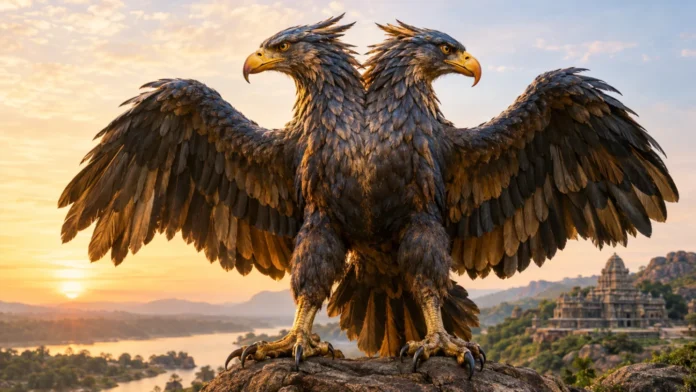
Gandaberunda is a mythical bird and heraldic figure of South India, especially associated with Karnataka. Its best-known form has one bird body and two heads facing outward in opposite directions.
It appears in temple art, royal insignia, and Karnataka’s modern state emblem.
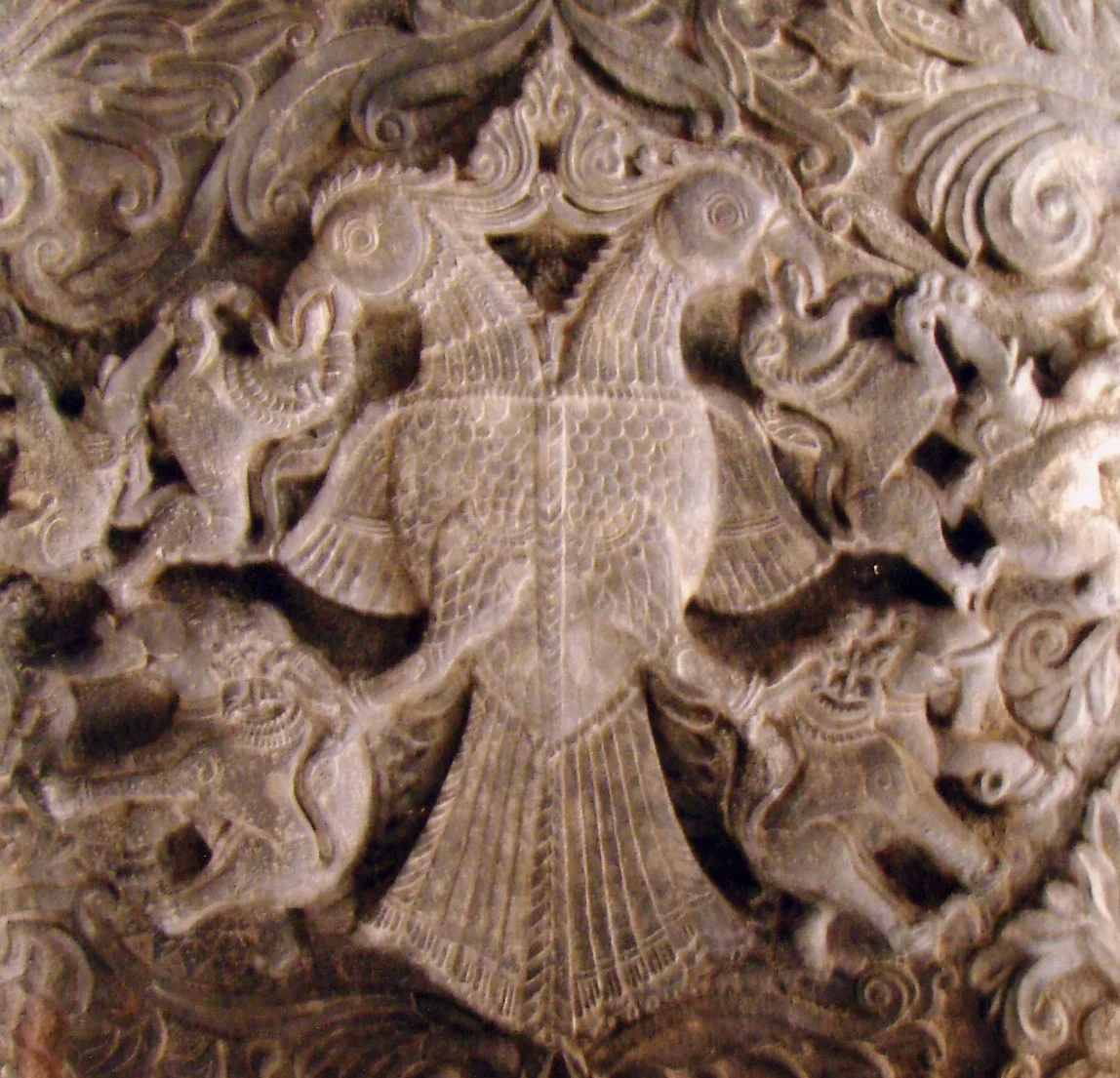
The creature’s extraordinary strength is central to its identity. Some images show it grasping elephants or lions, making its power visible through animals already associated with formidable force.
These accompanying creatures belong to particular representations, rather than appearing in every depiction.
Its history is broader than a single religious story. Alongside the familiar double-headed bird, historical South Indian art includes human-bodied figures with two bird heads.
Religious explanations also vary, associating Gandaberunda with Vishnu alone or with the union of Vishnu and Shiva.
Another distinction concerns the Bhāruṇḍa of the Pañcatantra, a bird with two necks and one stomach. Although the resemblance invites comparison, that fable does not establish the origin of Karnataka’s emblematic creature.
Their separate narrative and artistic settings remain important.
History/Origin
Gandaberunda has a documented place in medieval South Indian art, but its beginnings cannot be reduced to one securely identified founding story. Its historical record includes sculptural forms and dynastic emblems, while collected folk narratives offer differing explanations of its divine identity.
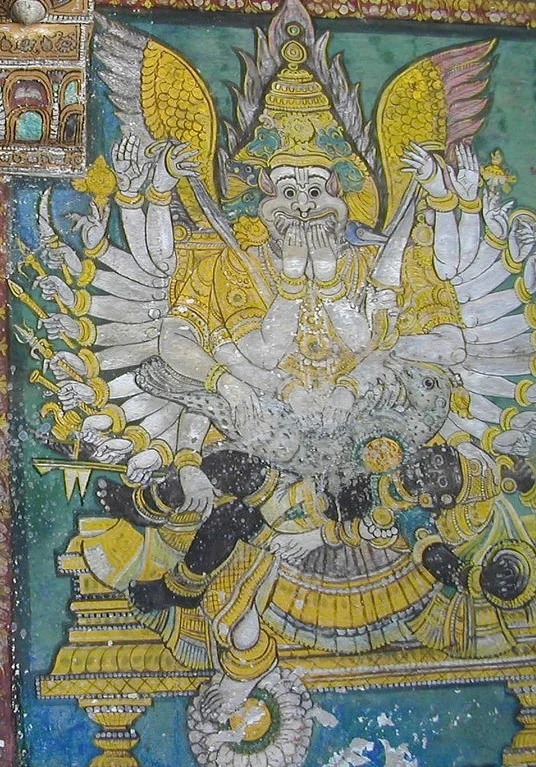
Vijayanagara rulers adopted the creature as an emblem. Its use in this setting placed the double-headed bird within the visual language of sovereignty, where exceptional bodily form and overwhelming strength could express royal power.
This political role forms an important part of its history.
The surviving imagery was not uniform. Bird-man figures and wholly avian representations belong to the documented tradition, showing that the familiar heraldic silhouette was not its only historical form.
Temple sculpture and royal imagery therefore provide complementary evidence, rather than illustrations of one fixed description.
A specific institutional milestone came in 1881, when Gandaberunda was officially adopted as the crest of Mysore State, as recorded in Valentina Stache-Rosen’s specialist study. That date concerns formal adoption of the crest, not the invention of the creature or its first appearance in regional art.
The Mysore royal insignia included a double-headed bird holding elephants, a rendering documented in the historical account Mysore City. Karnataka’s present state emblem continues the regional association.
This sequence demonstrates enduring public significance without requiring an unproven continuous lineage from distant ancient civilizations.
Name Meaning
The name appears in English as Gandaberunda, Gandabherunda, and the hyphenated Ganda-bherunda. Gaṇḍabheruṇḍa is another scholarly rendering. These spellings occur around the same South Indian legendary figure, although related shorter bird names in literary texts require more careful treatment.
The clearest documented meaning comes from Kannada lexicography. The Alar Kannada-English entry, reproduced in Wisdomlib’s dictionary collection, defines the word as a fabulous two-headed bird believed to be stronger than lions and elephants.
This establishes its conventional sense rather than a word-by-word derivation.
The dictionary material also records its former use as a title for a valiant man. That secondary sense connects the creature’s name with human courage and prowess.
It complements the imagery of a bird overpowering powerful animals, without proving how the name was originally formed.
A secure component-by-component etymology is not established by this evidence. Nor should Bhāruṇḍa, the name used in the Pañcatantra fable, simply replace Gandabherunda.
Similar names and shared double-headed anatomy are grounds for comparison, but not sufficient proof that the literary bird and heraldic figure are identical.
Appearance
The representative heraldic Gandaberunda is a bird viewed from the front, with two heads turning outward to opposite sides. A single body and wings unite the composition.
Its paired heads provide the most immediately recognizable feature, distinguishing the legendary creature from an ordinary bird.
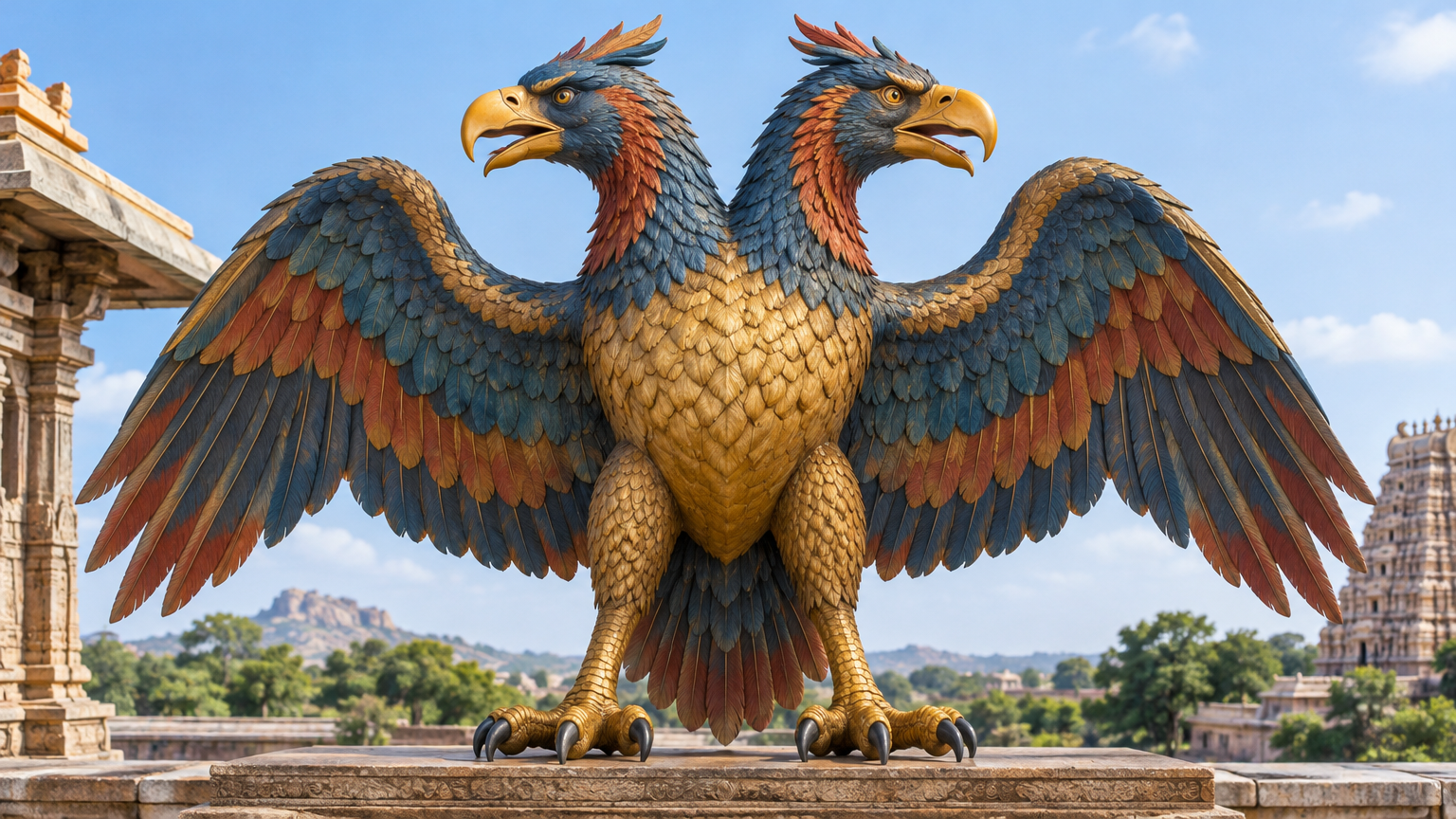
The frontal arrangement makes both heads clearly visible while presenting the body as one coherent figure. In this form, Gandaberunda is especially suited to an emblematic setting: its unusual anatomy remains legible as a single design rather than requiring a surrounding narrative scene.
Historical sculpture also includes a substantially different body plan: a human body surmounted by two bird heads. These composite figures belong to the documented South Indian visual tradition.
They should not be dismissed as inaccurate versions merely because the fully avian heraldic form is more familiar today.
Other depictions emphasize strength through captured animals. The Mysore insignia description specifies elephants held in the bird’s beaks and claws, while documented shadow-puppet imagery includes Gandaberunda grasping lions or elephants.
Such arrangements communicate dominance through the contrast between the creature and its powerful captives.
Neither elephants nor lions are compulsory identifying features, however. The two-headed bird can stand as an emblem without them.
Likewise, the Pañcatantra bird’s explicitly shared stomach belongs to the anatomy of its particular fable; it should not automatically become an anatomical rule for Gandaberunda’s sculptural and heraldic representations.
Background Story
Gandaberunda developed within overlapping artistic, royal, and religious settings. Its extraordinary strength made it useful as an emblem of authority, while its composite form allowed different religious explanations.
The resulting tradition preserves several interpretations rather than a universally accepted account of the creature’s birth.
A Karnataka folk account recorded by Stache-Rosen from Miss Kamalakshi of Karnataka Chitrakala Parishat begins with Narasimha remaining violent after killing Hiranyakashipu. Shiva fights him, and afterward the two gods unite in the form of Gandabherunda.
Here the creature represents their eventual union.
A separate version recorded in the same study identifies Gandabherunda with Vishnu alone after his conflict with Shiva. The difference is substantive: one account joins the gods, while the other assigns the form to one deity.
Neither should silently displace the other as the definitive explanation.
The Narasimha conflict also appears in a modern Amar Chitra Katha retelling involving Sharabha. Its eighteen-day battle ends with the bird splitting and Vishnu emerging.
Those precise details belong to that published version and should not be projected backward as an authenticated early origin story.
A separate literary comparison comes from the Pañcatantra’s Bhāruṇḍa. Its two necks share one stomach, yet quarrel over food; retaliation leads one to eat poison, killing both.
The shared body makes mutual dependence central to the fable, rather than the overwhelming strength emphasized in royal imagery.
These differences help explain why Gandaberunda should not be assigned one exclusive religious identity. Unlike a figure consistently attached to a particular god, it appears across varied emblematic and narrative contexts.
Its history brings together royal power, composite imagery, and competing explanations of divine conflict and reconciliation.
Famous Folklore Stories
Gandaberunda’s narrative traditions include different explanations of divine conflict, alongside a two-necked bird fable often associated with its name. These accounts should remain distinct: neither the fable nor any single religious version supplies an uncontested origin for the South Indian emblem.
Narasimha and Shiva in a Karnataka folk account
In a Karnataka folk account recorded by Valentina Stache-Rosen, Narasimha remains violent after killing Hiranyakashipu. Shiva fights him, but the encounter ends in union rather than the permanent defeat of either deity: both gods unite in the form of Gandabherunda.
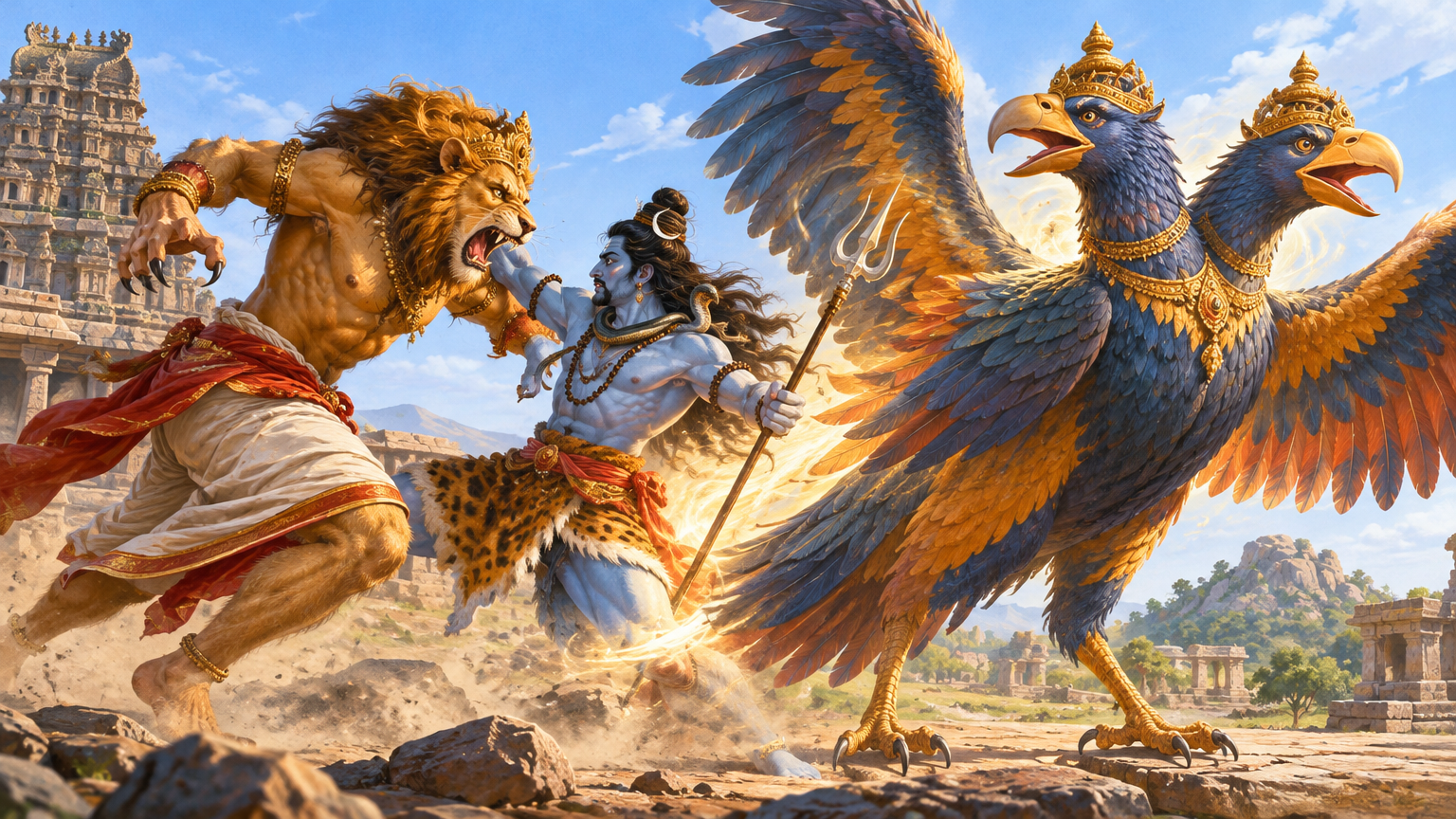
The account came from Kamalakshi of Karnataka Chitrakala Parishat, making its local provenance important. Stache-Rosen also records a different version in which Vishnu alone becomes Gandabherunda after fighting Shiva.
The distinction changes the bird from a shared divine form into Vishnu’s particular manifestation.
Gandaberunda and Sharabha’s eighteen-day battle
A modern Amar Chitra Katha retelling develops the encounter into an extended battle. Sharabha approaches Narasimha and attempts to calm him.
Instead, Narasimha becomes furious, Gandaberunda emerges, and the two extraordinary beings fight for eighteen days, leaving destruction in their wake.
The fighting ends when Gandaberunda recognizes the devastation. The bird splits, Vishnu emerges, and Vishnu and Shiva resume their forms.
This precise sequence belongs to the documented modern retelling; its eighteen-day duration and dramatic ending should not be presented as an authenticated early scriptural account.
The Bhāruṇḍa bird and the poisonous fruit
The Pañcatantra’s Bhāruṇḍa has two necks but one stomach. One neck enjoys a delicious fruit and refuses the other a share, reserving the remainder for his wife.
Humiliated, the second neck later finds poisonous fruit and announces that he will eat it in revenge.
The first neck warns that their shared body means both will die. The second ignores him, eats the poison, and kills them both. Arthur W.
Ryder’s translation gives a shorter nectar-and-poison version of the same fatal quarrel, emphasizing the danger of division.
This is a securely documented literary episode, but its bird is not automatically identical to Karnataka’s heraldic Gandaberunda. Their related names and doubled anatomy make comparison reasonable; they do not establish that the emblem originated as an illustration of the fable.
Cultural Impact
Gandaberunda became a public image of power through royal insignia and monumental art. Its formal adoption as Mysore State’s crest in 1881 gave an established artistic motif an official heraldic role.
Karnataka’s present state emblem continues that public visibility through its central two-headed bird.
At Bengaluru’s Ulsoor Someshwara Temple, a pillar sculpture presents a particularly forceful composition. The anthropomorphic, two-headed figure tramples two elephants, grasps two more by their trunks, and holds another pair in its beaks.
The repeated elephants visually magnify the creature’s extraordinary strength.
The image also appears on Deccan fort gateways, extending its architectural presence beyond temples. Jewellery and shadow-puppet representations demonstrate its movement across different materials and settings.
In some puppet imagery, lions or elephants accompany the bird, preserving the contrast between familiar powerful animals and their supernatural captor.
The Order of the Gandaberunda, instituted in Mysore in 1892, connected the creature with courtly honour. Awards were conferred during Dasara festivities under Krishnaraja Wadiyar IV; between 1942 and 1949, Jayachamaraja Wadiyar instead conferred them during his birthday festivities.
These were royal award ceremonies, not evidence of bird worship.
Later creative reception extends beyond heraldry. Aaron Taylor Kuffner’s 2017 Gamelatron Gandaberunda represents the two-headed creature through kinetic sound sculpture.
The tabletop expansion Kamigami Battles: Avatars of Cosmic Fire includes Gandaberunda as a named warrior card, translating the figure into a modern game character.
Similar Beasts
Śarabha
Śarabha, commonly written Sharabha, is a composite supernatural being associated with Shiva in versions of the conflict following Narasimha’s killing of Hiranyakashipu. Its narrative identity remains distinct.
Its connection to Gandaberunda is direct and narrative: the beings confront one another in certain retellings. Their rivalry should not be generalized into one universally accepted account.
Garuḍa
Garuḍa is the bird-associated divine figure closely connected with Vishnu. That established relationship makes him an important comparison when distinguishing Gandaberunda’s religious associations from its broader emblematic identity.
Both belong to South Asian supernatural bird imagery, but Gandaberunda does not consistently belong to one deity in the same way. Their identities are not interchangeable.
Roc
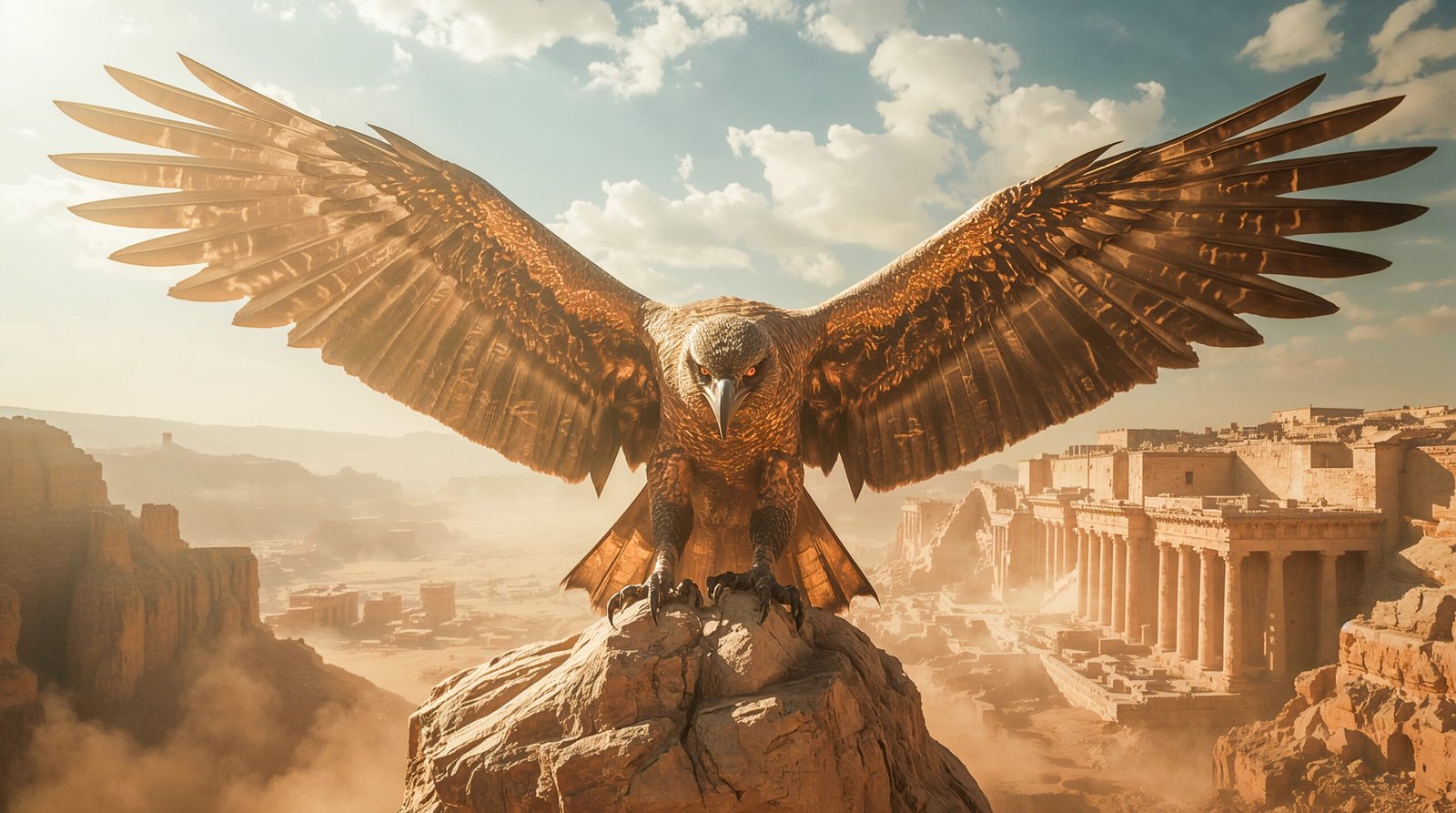
The Roc is a colossal bird of Persian and Arabian storytelling, especially familiar from Sinbad’s voyages. Its remarkable strength includes lifting elephants and threatening ships in these tales.
Elephant-bearing imagery offers a close comparison with particular Gandaberunda depictions. The resemblance concerns extraordinary avian strength, however, rather than a demonstrated shared origin or identical anatomy.
Turul
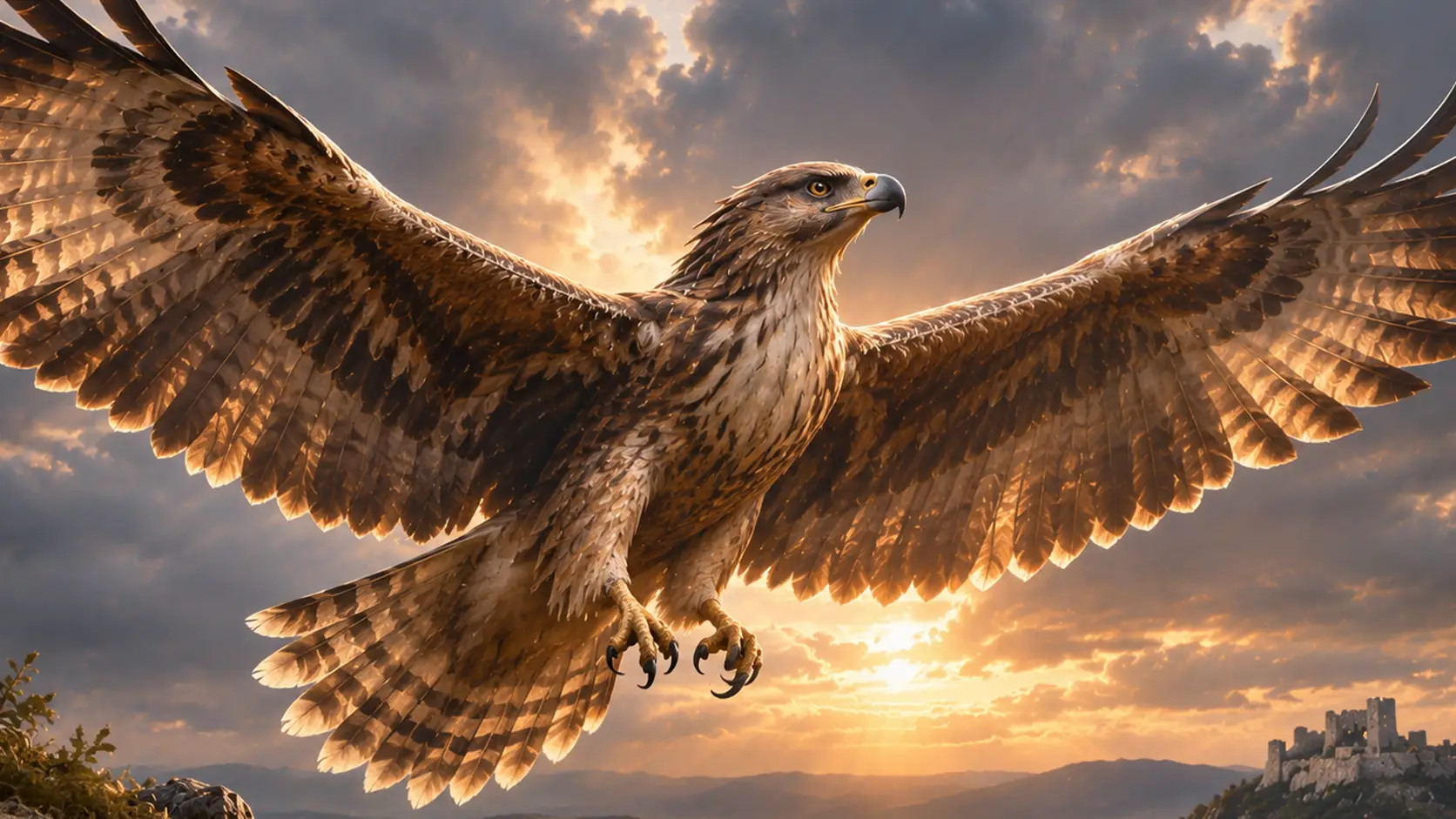
The Turul is a legendary bird of prey associated with Hungarian dynastic tradition, origin mythology, and national symbolism. Its significance reaches beyond the role of an extraordinary animal.
Like Gandaberunda, it connects bird imagery with collective and political identity. This is a comparison of symbolic function, not evidence of historical transmission between the traditions.
Religion/Ritual
Gandaberunda’s religious significance depends on context. The Karnataka union narrative accommodates both Shiva and Vishnu, whereas another recorded version identifies the bird with Vishnu alone.
Neither interpretation justifies assigning every temple sculpture or royal emblem to a single theological position.
Temple imagery establishes a place within sacred art, but does not by itself demonstrate a separate cult. The documented material does not establish a recurring Gandaberunda-specific ritual, offering, or observance.
Its use in court ceremonies likewise needs to be distinguished from direct worship.
Scientific or Rational Explanations
The strongest explanatory approach is historical and artistic rather than zoological. Gandaberunda is documented through sculpture, heraldry, ornament, and storytelling.
These records show how people represented and interpreted a supernatural bird, rather than documenting observations of an unidentified natural species.
Its handling of elephants lends itself to an interpretation based on amplified strength. A creature that grasps animals already associated with great physical power exceeds ordinary animal limits.
This reading follows the composition, but does not establish every sculptor’s intention.
The different bodily forms also favour an iconographic approach over a fixed biological description. A human-bodied figure with bird heads and a fully avian heraldic creature can serve related visual purposes without requiring one supposedly original anatomy to explain every representation.
The Bhāruṇḍa fable uses doubled anatomy differently. Two competing appetites share a single vulnerable body, making mutual dependence unavoidable.
Its fatal ending explains the moral force of that literary device, but cannot independently explain the origin or meaning of Gandaberunda’s royal imagery.
Finally, the competing divine narratives show that an image can support more than one religious explanation. A union of gods and a manifestation of Vishnu convey different meanings.
Their coexistence is historically more informative than forcing them into a single supposedly original story.
Modern Cultural References
Gandaberunda and Sharabha (in Divine Beings), comic
Amar Chitra Katha’s illustrated adaptation presents a destructive confrontation between divine beings.
Gandaberunda fights Sharabha for eighteen days before splitting open to reveal Vishnu in this modern retelling.
(assets.jeyamohan.in)
Gamelatron Gandaberunda, kinetic sound sculpture (2017)
Aaron Taylor Kuffner’s artwork combines kinetic sculpture and sound within the Gamelatron project.
Its title and documented concept explicitly represent Gandaberunda as a mythical two-headed bird.
(gamelatron.com)
Kamigami Battles: Avatars of Cosmic Fire, tabletop game expansion (2021)
This Japanime Games expansion brings mythological figures into a competitive deck-building game.
Gandaberunda appears as a named warrior card whose ability modifies the game’s normal chaining rules.
(sequentialplanet.com)
Conclusion
Gandaberunda is best understood as a South Indian mythical bird whose identity extends across sculpture, heraldry, religious storytelling, and public symbolism. Its familiar two-headed form provides a recognizable emblem, especially in Karnataka, but historical images do not follow one unchanging design.
Bird-bodied and human-bodied representations belong to that wider visual history. The creature’s significance therefore rests not on a single definitive origin story, but on the different ways artists, rulers, and storytellers have represented extraordinary power.
Keeping those traditions distinct makes the figure clearer rather than less compelling. The Pañcatantra’s Bhāruṇḍa illustrates the destruction caused by conflict within a shared body; its resemblance does not establish identity with the heraldic bird.
Accounts involving Narasimha, Shiva, and Sharabha offer differing religious explanations rather than one universal doctrine. Together with its continuing emblematic role and specific modern adaptations, these traditions show how Gandaberunda can carry meanings of strength and divine power without being reduced to one narrative.
Further Reading
“Gandabherunda,” Valentina Stache-Rosen, Quarterly Journal of the Mythic Society
This specialist essay survives in a digitized collection of Stache-Rosen’s writings.
It examines varied bodily forms, historical imagery, and competing folk explanations essential to understanding Gandaberunda.
(lippisches-landesmuseum.de)
“Animals in Archaeology: Integrating Landscapes, Environment and Humans in South Asia,” Darsana, Heritage University of Kerala, 2023
This archaeological publication discusses mythical animal imagery on Deccan fort gateways.
Its Gandabherunda examples help connect the creature’s heraldic appearance with specific architectural and material contexts.
(heritageuniversityofkerala.com)
Mysore City, Indira Gandhi National Centre for the Arts
This digitized historical account includes a description of Mysore’s royal insignia.
It documents the double-headed Ganda-bherunda holding elephants, making it useful for studying the emblem’s royal setting.
(ignca.gov.in)
“The Bharunda Birds,” The Panchatantra, Arthur W. Ryder, Wikisource, 1925
This scanned-page transcription presents Ryder’s translation of the two-necked bird fable.
It supplies a literary comparison without independently establishing that Bhāruṇḍa and the heraldic Gandaberunda are identical.
(en.wikisource.org)
Pañcatantra, Aparīkṣitakāraka, “The Story of the Bhāruṇḍa Bird,” Narayanalakshmi
This Sanskrit-English presentation contains the story of a bird with one stomach and two necks.
It clarifies the fable’s anatomy, quarrel, and fatal act of retaliation.
(narayanalakshmi.com)
“Gandabherunda,” Wisdomlib
This dictionary aggregation includes a definition attributed to the Alar Kannada-English corpus. It supports the documented Kannada meaning while requiring caution about a definitive Sanskrit compound derivation.
(wisdomlib.org)
Amar Chitra Katha
A modern Amar Chitra Katha retelling says Gandaberunda and Sharabha battle for eighteen days, after which Gandaberunda recognizes the destruction, splits, and Vishnu emerges.
This is evidence for a modern retelling, not an authenticated early textual version.
(amarchitrakatha.com)
The Panchatantra, Book II, “The Bharunda Birds”, Swaveda
Primary literary evidence for the two-necked bird’s role in the fable: one neck refuses to share nectar, the other eats poison in retaliation, and the shared body dies.
This supports a chapter on early literary reception and helps distinguish the fable’s action from the later Vishnu–Sharabha tradition.
(swaveda.com)