Introduction
The Jersey Devil is the legendary monster of southern New Jersey’s Pine Barrens. In the best-known telling, it begins as the thirteenth child of a woman called Mother Leeds. It takes flight from her home and becomes the terror of the surrounding country.
The New Jersey Pinelands Commission places the Devil in misty wetlands, from which it ventures into the woods at night. What gives it away is often not a glimpse of its body but a scream, a sound that carries beyond the trees.
History/Origin
The earliest printed account historian Brian Regal identified appeared in The Atlantic Monthly in May 1859. The travel sketch, titled In the Pines, sets the creature’s birth in Burlington Township in 1735. That is the story’s setting, not its date of documentation.
The sketch names Hannah Butler as the person who said she saw the Devil on a stormy night, but the narrator’s host supplies the detailed account of its birth. The distinction matters: an early printed version preserves the legend without giving every teller an equal voice.
By September 1905, the Washington Evening Star was carrying the legend beyond New Jersey in an article titled Demon of the Pines. Regal traces part of Henry Charlton Beck’s 1945 book Jersey Genesis back to that article, rather than to an independent oral account.
In January 1909, newspapers turned scattered reports into a story that crossed state lines. Trenton councilman E. P. Weeden said flapping wings woke him before he found cloven prints in the snow. Other reports put the creature in Pennsylvania and Delaware.
It is believed the monster came from Philadelphia, where it has been scaring people for several nights.
Unsigned report, The Evening Journal (Wilmington, Delaware), January 22, 1909, as transcribed by the Library of Congress.
The newspaper excitement also made the Devil a commercial attraction. In Philadelphia, dime museum owner Charles A. Bradenburgh and press agent Norman Jeffries staged a supposed capture. Their exhibit shows how promoters exploited the scare, not that they invented every report.
Regal proposes a much earlier source for the family’s sinister reputation. Daniel Leeds, a colonial almanac publisher, fell out with other Quakers over his writings. In 1700, his opponent Caleb Pusey published a polemic whose title cast Leeds as a herald of Satan.
The next generation supplied another printed quarrel. Benjamin Franklin predicted the death of Daniel’s son Titan in Poor Richard’s Almanack, then joked that his rival’s ghost was still publishing. The feud is documented, but it does not establish when people began telling the monster story.
Name Meaning
The 1859 sketch calls the creature Leeds’s devil, a possessive English name that attaches it to the woman and family in the story. Leeds Devil drops the possessive ending without changing that association. Neither form tells us which historical Leeds, if any, inspired Mother Leeds.
In Jersey Devil, the place takes the family’s place in the name. Jersey refers here to New Jersey, not directly to the Channel Island. The state’s name does go back to that island, which the 1664 colonial grant honored as Sir George Carteret’s native home.
Some names were much less durable. Wilmington’s Evening Journal listed air hoss, Jabbernosk, and Grosswauk alongside Leeds devil in January 1909. The paper used them for the same reported creature, not for three separate beings with stories or traditions of their own.
Appearance
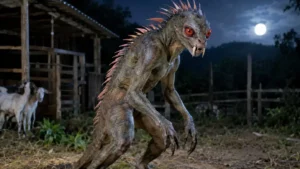
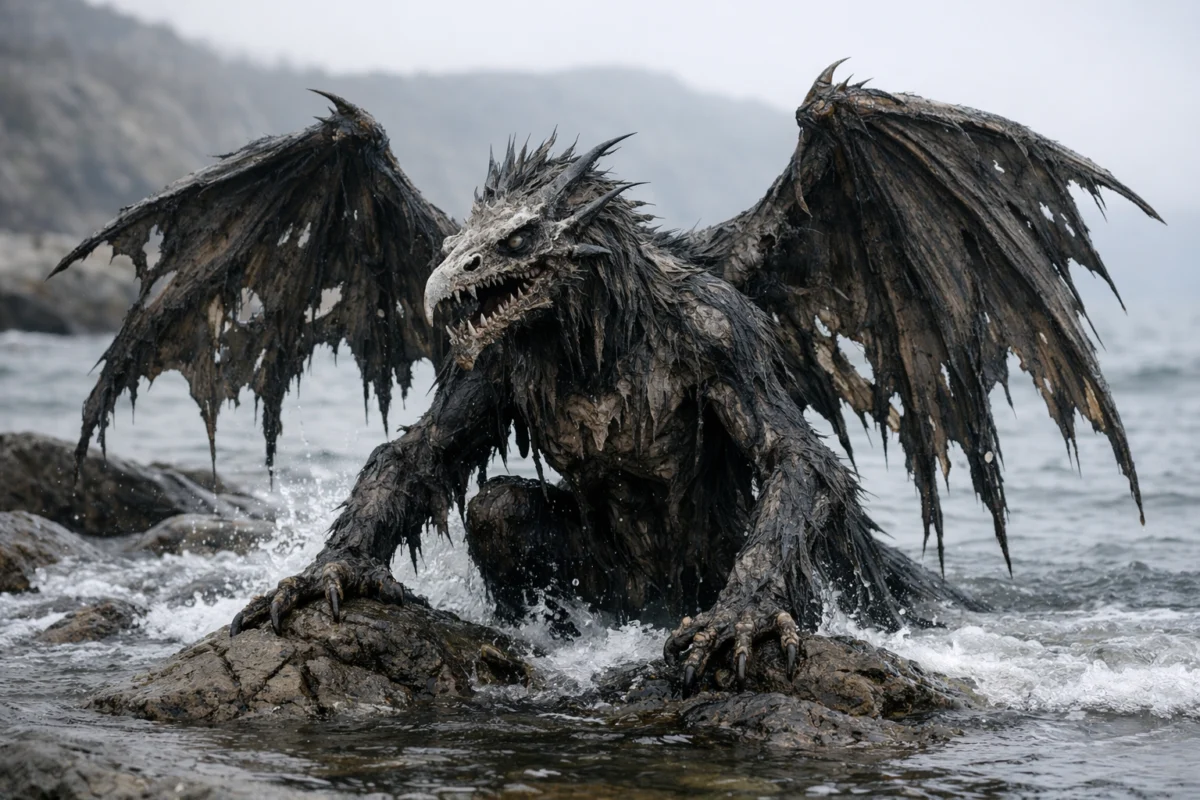
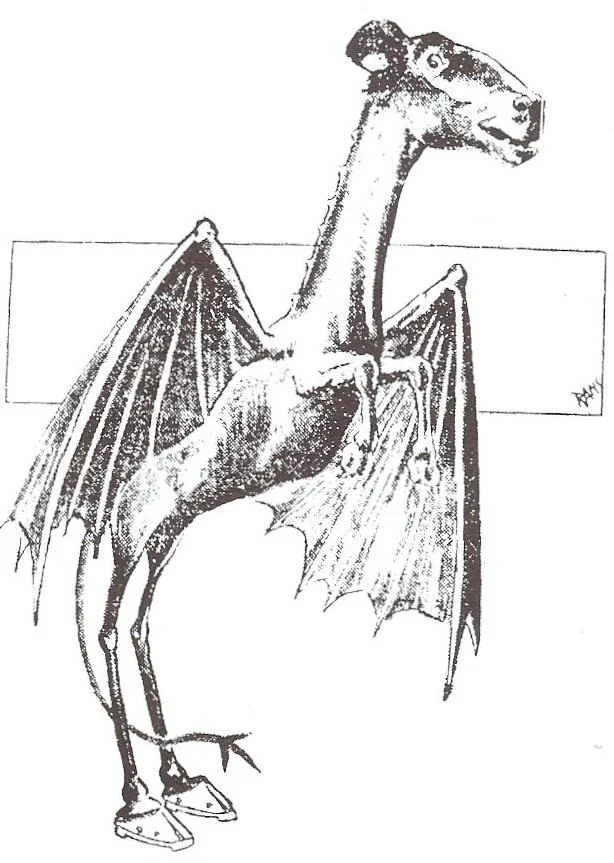
The 1859 version gives the newborn monster three recognizable animal features. It does not give the creature a height or describe its feet, and it likens the tail to a snake rather than giving it the fork familiar from many later pictures.
with a horse’s head, wings of bat, and a serpent’s tail.
In the Pines, published unsigned and attributed to William S. Frederick Mayers, The Atlantic Monthly, May 1859, vol. 3, no. 19, p. 566.
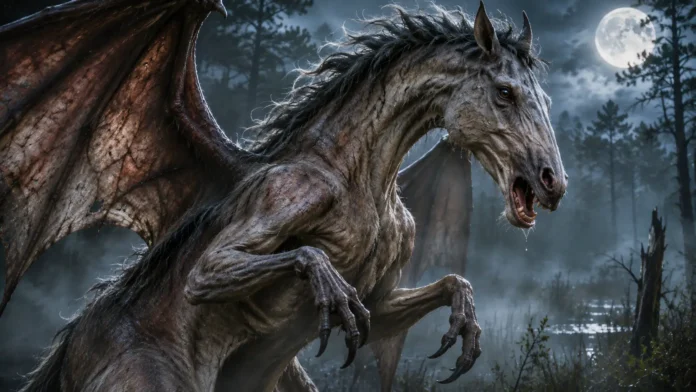
New Jersey’s state overview describes a horse’s head and bat wings, but it also gives the Devil long legs with hooves and two short forelegs. That version supplies a clear difference between the front and rear limbs that the early sketch leaves unspecified.
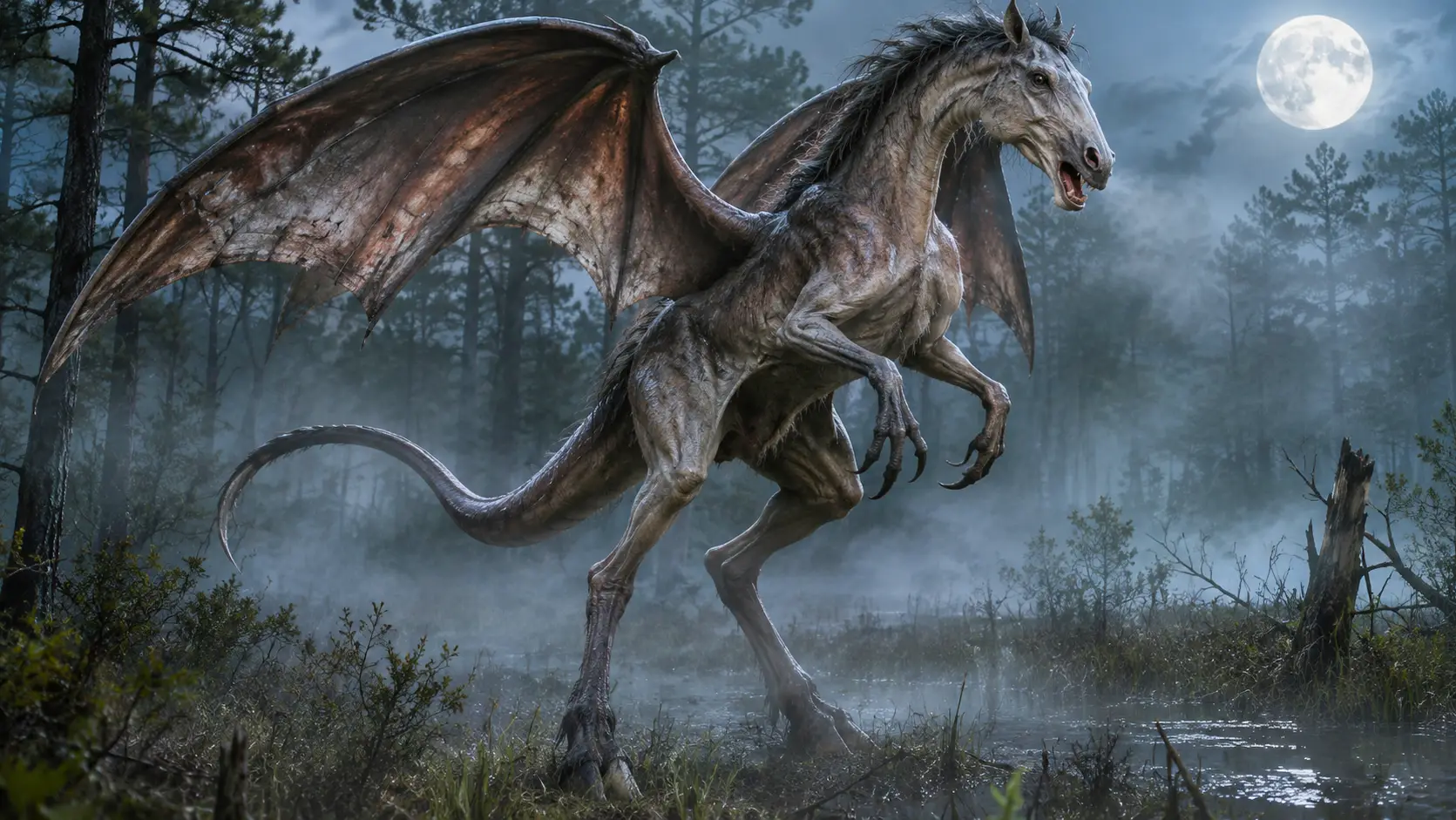
The Rutgers University Libraries exhibit describes a taller, more elaborate figure, over six feet high, with a horse’s face, a dog’s head, deer antlers, and a kangaroo’s body. That height belongs to the exhibit’s account, not to a measurement across the tradition.
The Pinelands Commission distinguishes another convention in drawings: horns, a forked tail, and a body that looks partly human. These are ways artists have pictured the Devil. They need not all belong to the same creature as described in any one telling.
Background Story
Mother Leeds does not always bear the same responsibility for the child’s fate. In versions collected by the New Jersey Historical Society, she invokes the Devil herself, inherits a family curse, or faces a clergyman who condemns her next child after she refuses to convert.
Another version in the Historical Society’s account makes her the monster’s caretaker. The child already has its strange form at birth, but she raises it, and it remains with her until she dies. Only then does it fly off into the swamps.
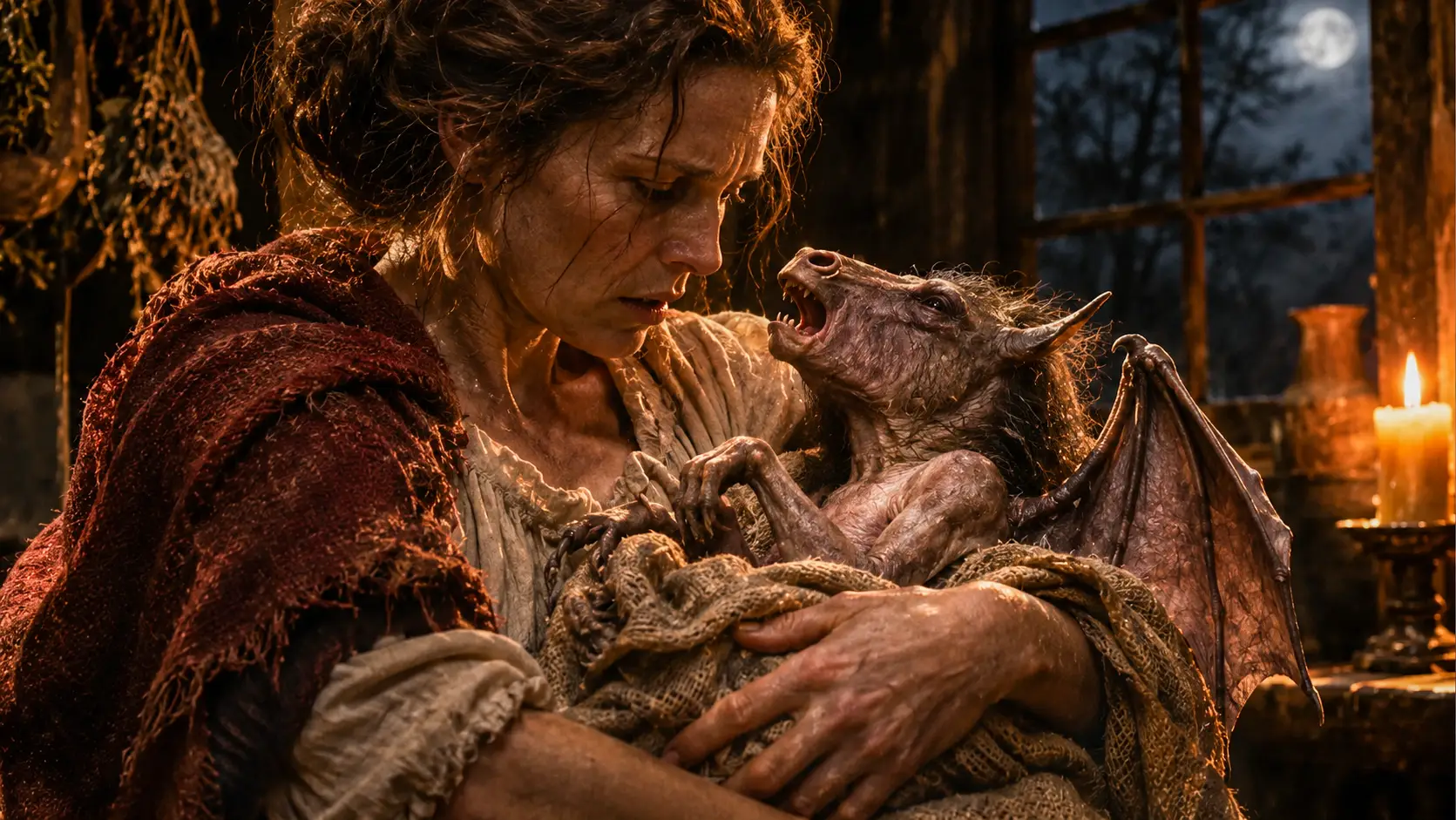
The 1859 story gives a holy man the power to banish the Devil, but only for a century. His success imposes a limit on the monster without destroying it. Regal notes that historical records do not substantiate an eighteenth-century attempt to exorcise the creature.
The Devil could also shape children’s behavior without ever appearing. In Mary Hufford’s field notes for the Library of Congress’s Pinelands Folklife Project, a woman identified in the exchange as “Gram” recalled it as one of the childhood scares that kept her close to home.
we didn’t go away from home on account of the Jersey Devil.
“Gram,” as recorded in Mary Hufford’s 1983 audiocassette logs, Pinelands Folklife Project, American Folklife Center, p. 52.
Not every account casts the Devil as a threat. The Pinelands Commission notes that some New Jersey residents see it as a protector of the Pinelands that spares people who care for the region. In that telling, it guards the woods rather than merely haunting them.
Famous Folklore Stories
The Devil at the Cab Window
In a story printed in 1905, an engineer and a fireman on the Southern Railroad are traveling at their usual speed when something flies straight at their cab. The two men find themselves looking at a creature that has attached itself to the locomotive.
Honestus Arminius Alba tells the story as something the railwaymen reportedly witnessed, not as an adventure of his own. The creature does not block the tracks or bring the train to a halt. Instead, it stays alongside the men while the locomotive keeps moving.
It flew against the cab window, and clung like a bat to the projection.
Honestus Arminius Alba, passage on the Southern Railroad, Camden Post-Telegram, May 5, 1905, p. 5, as transcribed by Dan Aubrey in Princeton Info.
After about a mile, the creature lets out a screech and disappears into the scrub. The railwaymen report their encounter when the train reaches Toms River. Their story circulates until it reaches an older resident who has an encounter of his own to relate.
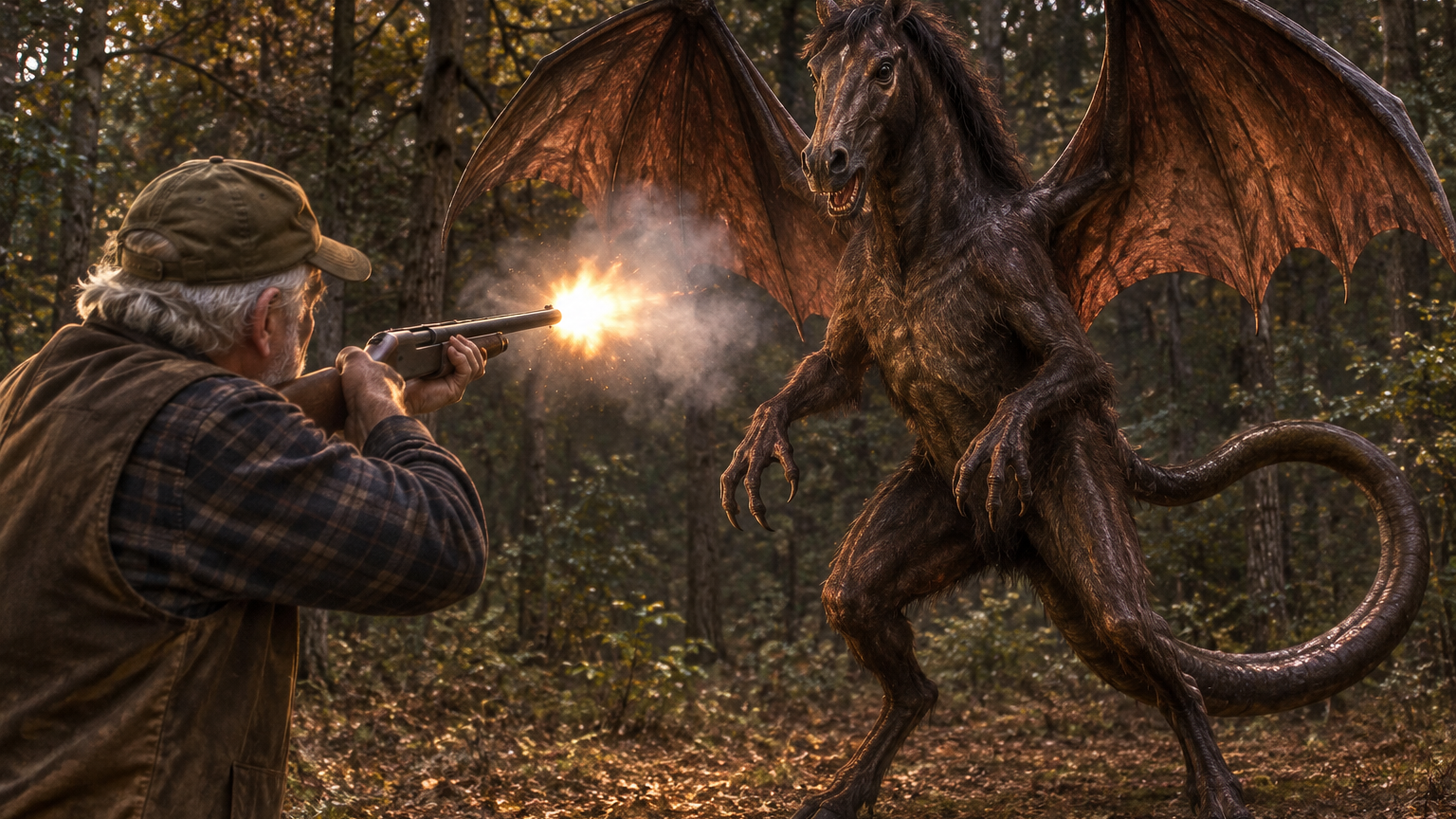
The resident says he once shot at the creature without harming it. That outcome convinced him that he had met either the Devil or one of his imps. Alba’s account ends this episode with the hunter learning the local name for the thing he encountered.
Bill Wasovwich’s Night in the Swamp
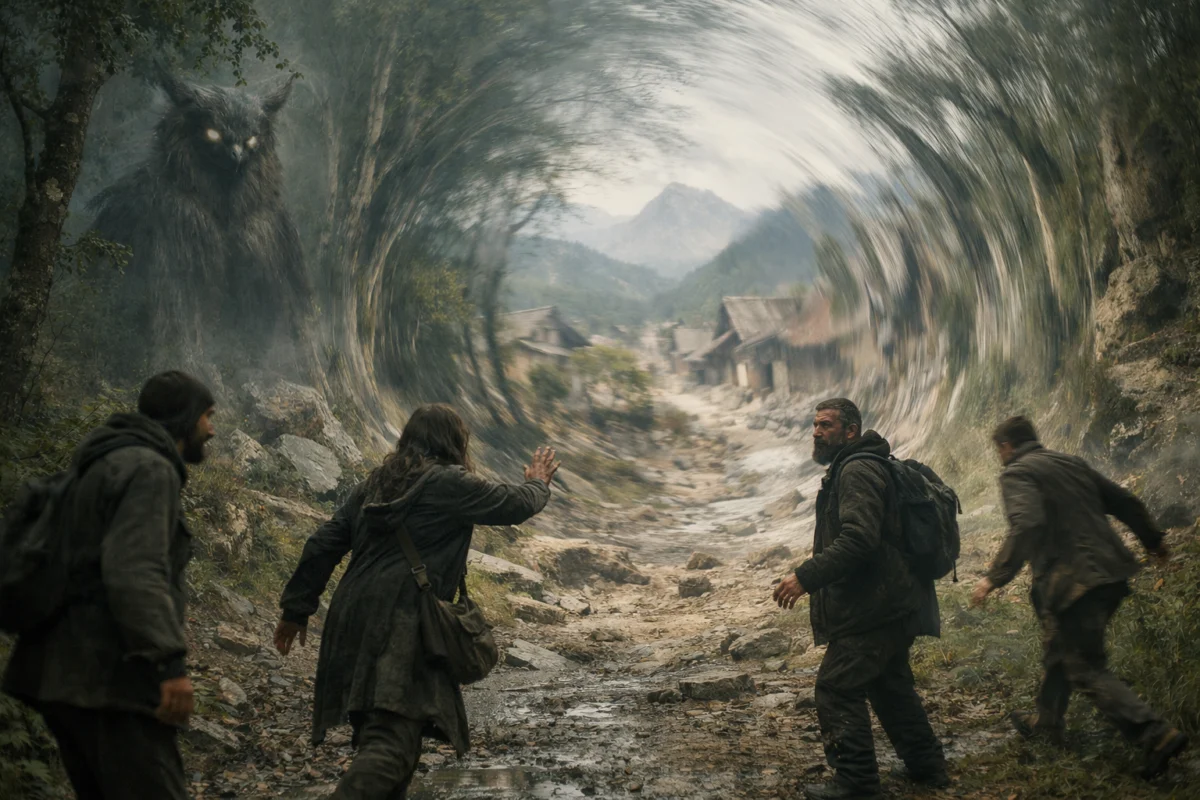
In John McPhee’s 1967 reporting on the Pine Barrens, Bill Wasovwich recalls a moonlit night in a swamp. Mist rises around him, and he reaches for familiar images to describe the sight: first a blanket, then something emerging from the water in front of him.
McPhee records the account in a discussion of the Jersey Devil, but Wasovwich never claims to see the creature clearly. The encounter turns on what he hears as the fog rises and what happens to his hat in the same moment.
Something screamed. My hat flew off my head.
Bill Wasovwich, interviewed by John McPhee, The Pine Barrens-I, The New Yorker, November 25, 1967 print issue.
Wasovwich runs home through briars and finds his arms cut up from the flight. He reports no pursuit and makes no claim to have identified whatever screamed. His injuries give the episode a definite ending, but they come from the briars, not the creature.
McPhee places the account beside the testimony of Fred Brown, who has no such doubts about the Devil’s existence. The contrast preserves something a more polished monster story might lose: a teller can remember being frightened without being certain what frightened him.
Cultural Impact
In Mary Hufford’s Pinelands fieldwork, Ann Davis recalled that her grandchildren asked for Jersey Devil stories at night. She made up stories for them and also remembered tales she had heard from others. Her husband, Jack, doubted that anyone had ever seen the creature.
Hufford also recorded a forest superintendent’s account of a Cub Scout campout tradition. The group listened to stories, then a costumed Jersey Devil appeared and vanished. The superintendent remembered the performance as an initiation and, for a time, a recurring Memorial Day event.
In 1982, a naming contest gave New Jersey’s new National Hockey League franchise the name Devils. The team’s account acknowledges objections to the word’s religious associations. The local legend gave the name another meaning, one that tied the franchise to New Jersey itself.
Similar Beasts
Snallygaster
Maryland’s Snallygaster is a flying creature with birdlike and reptilian features. Like the Jersey Devil, it combines traits that do not fit a single animal, and historic newspaper coverage helped carry its reputation beyond individual encounters.
Mothman
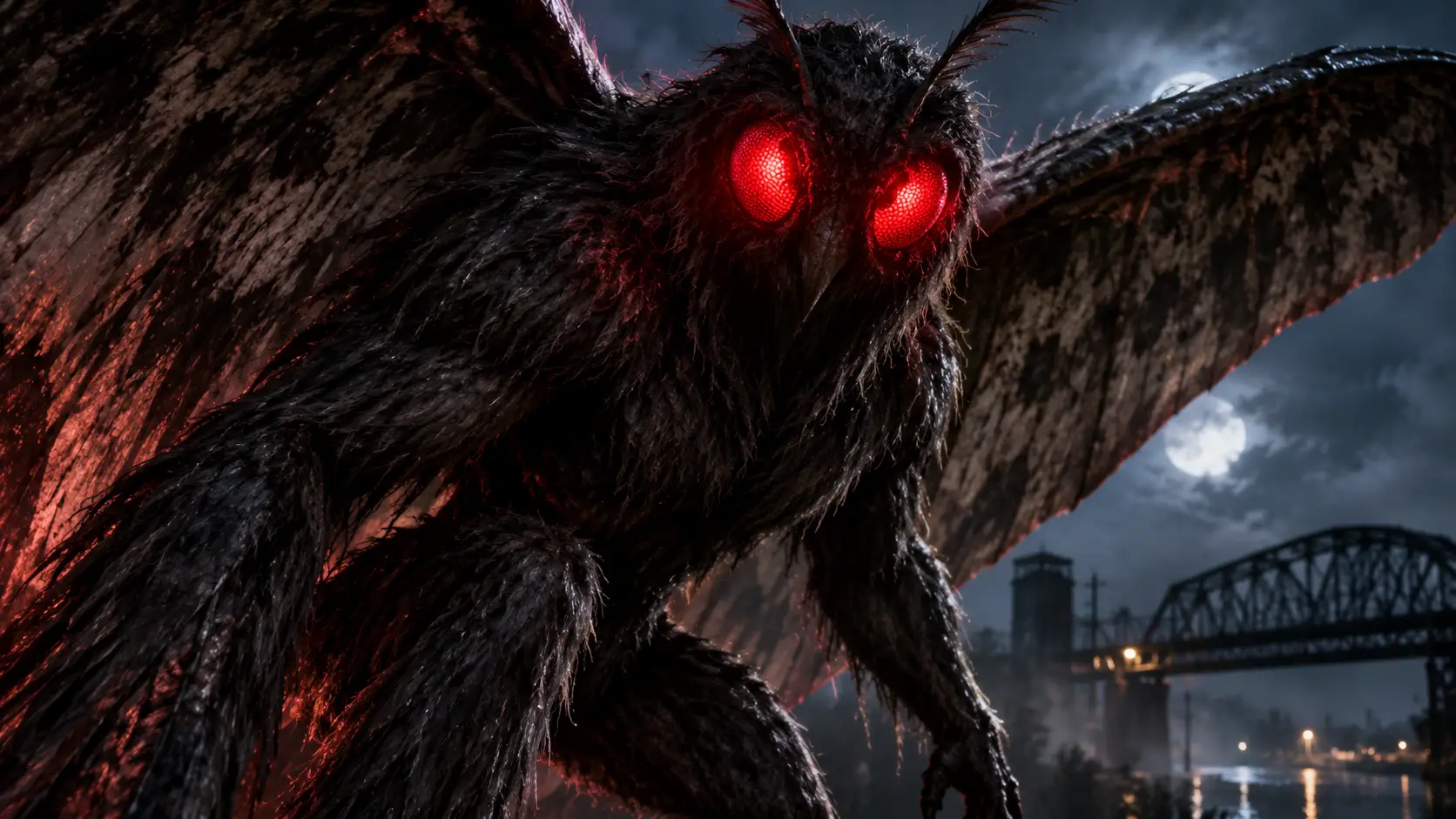
West Virginia’s Mothman emerged from reports of a winged figure near Point Pleasant. The closest parallel is not its shape but its local identity: both creatures became closely associated with the places where people said they saw them.
Flatwoods Monster
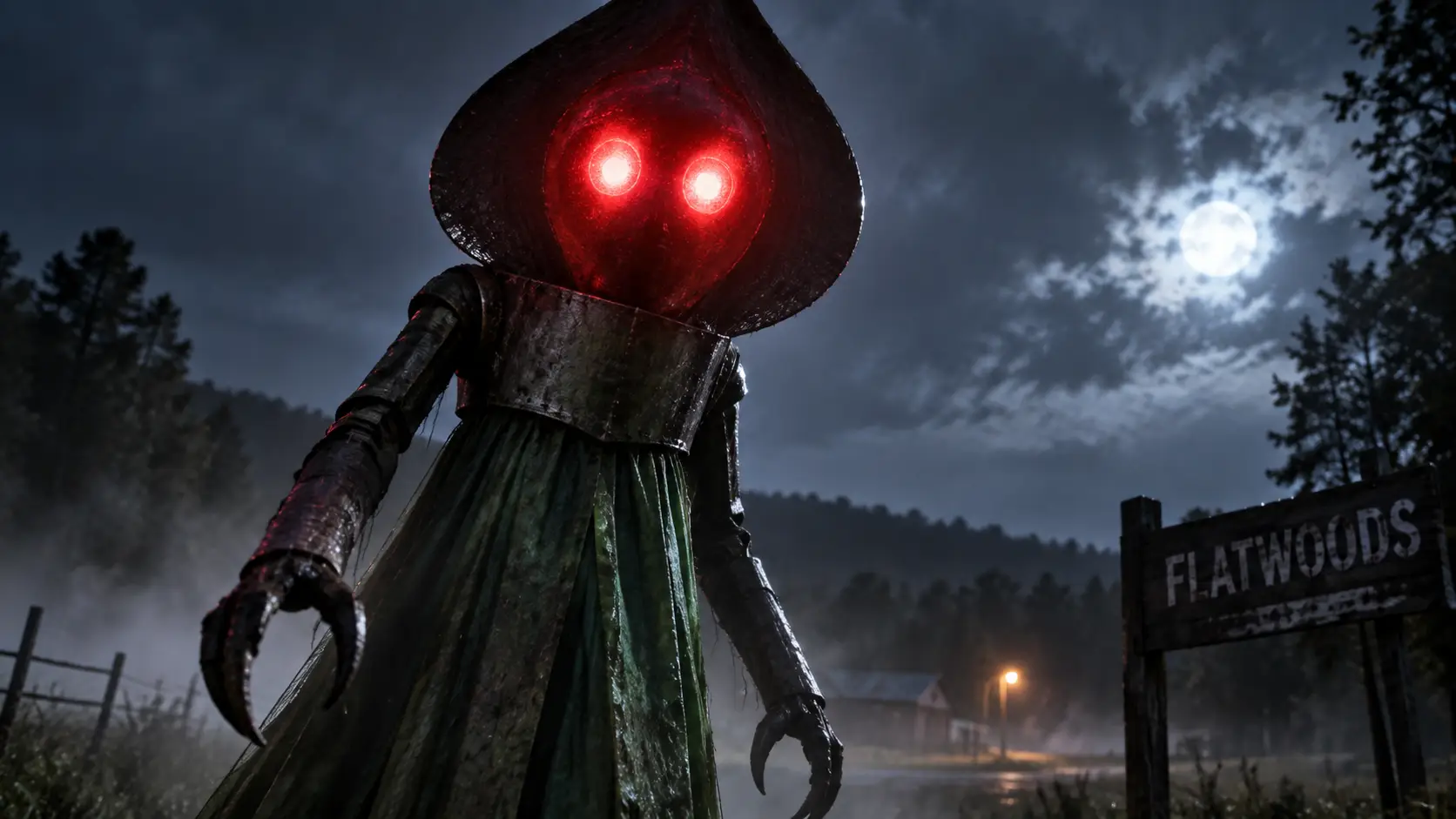
The Flatwoods Monster entered West Virginia folklore after witnesses investigated a fireball in 1952 and reported an alarming figure. Its story, like many Jersey Devil encounters, shows how a brief and puzzling observation can become a lasting local legend.
Religion/Ritual
McPhee records a practical defense against the Jersey Devil: people once hung lanterns to scare it away. He gives no prescribed prayer, blessing, or ceremony for the custom. The account documents a protective use of an ordinary object, not a formal religious rite.
Atlantic County’s folklore account records a different supernatural belief. Some tellers regarded the Devil as a warning of war or disaster, while others said it appeared every seven years. Those traditions give its appearances meaning beyond the immediate danger of meeting the creature.
These accounts tell us what people could do about the Devil or what they thought an appearance might mean. Neither source establishes an organized religious practice devoted to it. A local protective custom and a story about an omen are evidence of different beliefs.
Scientific or Rational Explanations
In January 1909, the Bridgeton Evening News offered a comic example of how the scare could shape perception. A shirt factory engineer hears a hiss and briefly imagines the Devil. Once the fright passes, he starts looking for the source of escaping steam.
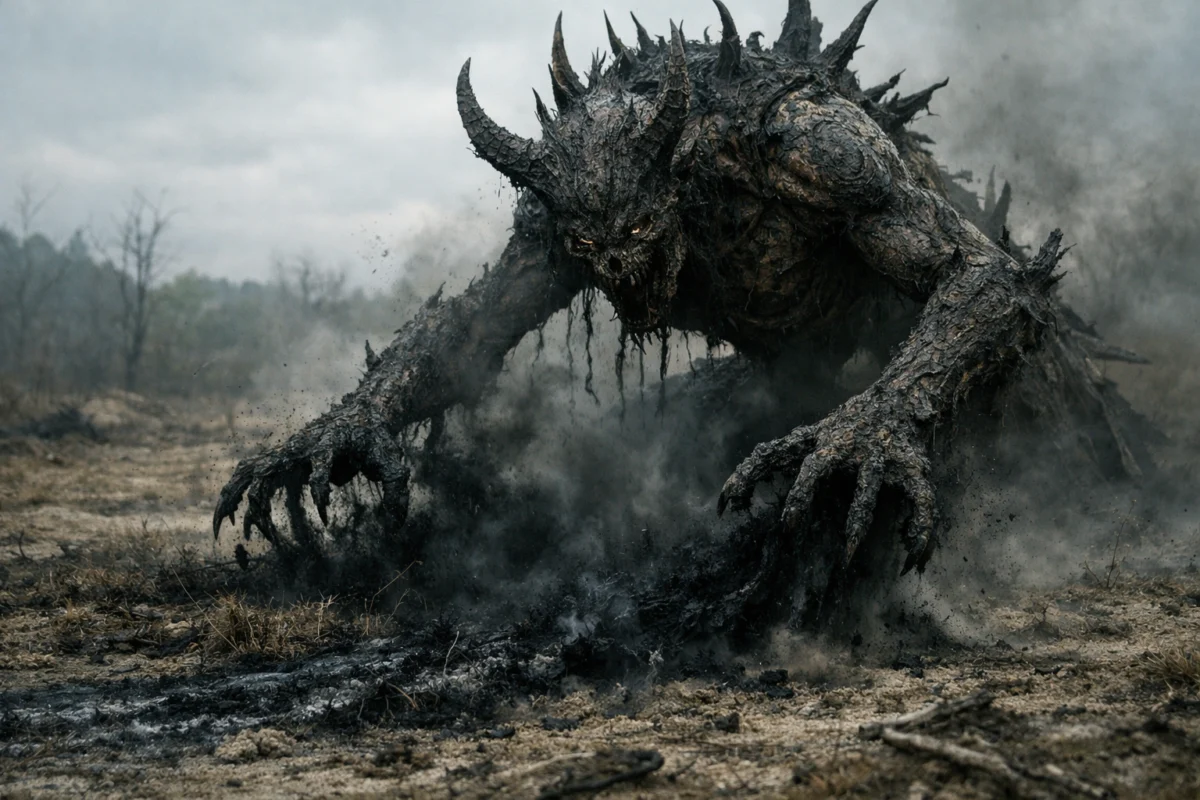
Hufford’s fieldwork preserves a visual example. Some viewers made out the Devil’s shoulders, horns, and face in a photograph of smoke above a fatal forest fire. George Heinrichs, who pointed out the features to a fieldworker, regarded the shape as an effect of smoke.
Neither example supplies a single natural explanation for the legend. They show something narrower: once a community knows a monster’s story, a hiss or the outline of smoke can call it to mind. That can happen even when the person describing it remains skeptical.
Modern Cultural References
Jersey Devil, The X-Files, Twentieth Century Fox, 1993
Mulder and Scully investigate a creature said to have roamed New Jersey for decades. The episode casts Claire Stansfield as its humanlike version of the Devil.
(tv.apple.com)

A Night with the Jersey Devil, Bruce Springsteen, official artist website
Springsteen gives the Devil a voice of its own. The creature sings about being born thirteenth, surviving its family’s attempts to kill it, and returning to take revenge.
(brucespringsteen.net)
The Barrens, Darren Lynn Bousman, 2012
A father begins seeing the Jersey Devil on a family outing in the Pine Barrens. Bousman uses those appearances to make the father’s judgment as frightening as the creature.
(www.darrenlynnbousman.com)
The Legend of the Jersey Devil, Trinka Hakes Noble and Gerald Kelley, Sleeping Bear Press, 2013
Noble and illustrator Gerald Kelley turn the New Jersey legend into a picture book, introducing young readers to the creature through a spooky account of its origins.
(www.trinkahakesnoble.com)
Fallout 76: Atlantic City, America’s Playground, Bethesda Game Studios, 2024
The Atlantic City update brings the Jersey Devil into Fallout’s postapocalyptic New Jersey. The accompanying season also makes the creature the opponent of fictional adventurer Rip Daring.
(fallout.bethesda.net)
Conclusion
The Jersey Devil endures because people can tell very different stories about it without losing their sense of where it belongs. A railwayman’s tale, an uncertain memory, and a campfire performance all make room for the same creature without asking everyone to believe in it.
That freedom to doubt, embellish, or play along is part of the legend’s appeal. The Jersey Devil gives the Pine Barrens a story that residents can make their own. What matters is not settling every encounter, but noticing what each teller chooses to remember.
Further Reading
Southern Railroad account by Honestus Arminius Alba, Camden Post-Telegram, 1905, transcribed by Dan Aubrey, Princeton Info, 2021
Aubrey reproduces Alba’s account from a newspaper photocopy, including the encounter at the locomotive window and the story an older resident tells after hearing the railwaymen’s report.
(princetoninfo.com)
The Pine Barrens-I, John McPhee, The New Yorker, 1967
McPhee records Bill Wasovwich’s swamp encounter and Fred Brown’s more certain testimony. He also describes the custom of hanging lanterns to keep the Jersey Devil away.
(www.newyorker.com)
In the Pines, attributed to William S. Frederick Mayers, The Atlantic Monthly, 1859
This transcription preserves an early printed account of the Leeds Devil, including Hannah Butler’s reported sighting, the monster’s appearance at birth, and the story of its temporary banishment.
(www.bookrags.com)
Snallygasters and Cadborosauruses: Exploring American Cryptids with Chronicling America, Library of Congress, 2022
The Library of Congress reproduces wording from Wilmington’s Evening Journal during the 1909 scare and examines historic press coverage of Maryland’s winged Snallygaster in the same feature.
(blogs.loc.gov)
Pinelands Folklife Project: Mary Hufford Audiocassette Logs, American Folklife Center, 1983 to 1985
Page 52 of the Library of Congress field logs records the speaker identified as Gram, who remembers the Devil as a reason children stayed close to home.
(tile.loc.gov)
One Space, Many Places, Mary Hufford, American Folklife Center, 1986
The report’s Story and Legend section records family storytelling, a staged Jersey Devil appearance at a Cub Scout campout, and conflicting readings of a photograph of smoke.
(www.npshistory.com)
This Day in Devils History: June 30, Catherine Bogart, New Jersey Devils, 2020
The franchise’s account explains how a public naming contest turned a South Jersey legend into a statewide team identity despite objections to the name’s religious associations.
(www.nhl.com)
Jersey Devil: Fact or Fiction?, Carol Johnson and David Munn, Atlantic County
This county folklore survey records beliefs about the Devil as an omen, including a reported seven year cycle, alongside stories of its encounters with famous historical figures.
(www.atlanticcountynj.gov)
The Legend of the Jersey Devil, Cumberland County Historical Society
The society reproduces an excerpt from the January 25, 1909 Bridgeton Evening News in which a factory hiss briefly calls the Jersey Devil to an engineer’s mind.
(cchistsoc.org)
The Jersey Devil: A Political Animal, Brian Regal, New Jersey Studies, 2015
Regal traces the legend’s print history and the Leeds family’s publishing disputes, examines the 1909 exhibition, and flags the uncertain provenance of a purported eighteenth century diary.
(njs.libraries.rutgers.edu)
Legend of the New Jersey Devil, New Jersey Historical Society
The society collects differing Mother Leeds accounts and situates the Jersey Devil in regional folklore, preserving details that distinguish the birth legends from the later newspaper reports.
(jerseyhistory.org)
The Legend of the Jersey Devil, New Jersey Pinelands Commission
The commission outlines the Devil’s association with the Pinelands landscape and describes both the familiar threat and a local interpretation of the creature as the region’s protector.
(www.nj.gov)
An Ode to a Hometown Creature: Mothman of Point Pleasant, West Virginia, Gwen Mallow, Smithsonian Center for Folklife and Cultural Heritage, 2021
Mallow examines how Point Pleasant’s winged creature became an emblem of local identity and explicitly places Mothman and the Jersey Devil in a broader American storytelling tradition.
(folklife.si.edu)
Flatwoods Monster, e-WV: The West Virginia Encyclopedia
This reference traces the Flatwoods Monster to the September 1952 fireball and the subsequent encounter, providing a documented comparison with New Jersey’s tradition of puzzling local sightings.
(www.wvencyclopedia.org)
Ciberletras, Issue 14
The article on the authorship of The Gaucho, p. 212, identifies William S. Frederick Mayers as the author of In the Pines. ([lehman.edu](https://www.lehman.edu/media/Ciberletras/documents/ISSUE-14.pdf?utm_source=openai))
(www.lehman.edu)
The Works of Benjamin Franklin, Vol. II: Letters and Misc. Writings 1735-1753
The edited Franklin collection reproduces passages from the Poor Richard prefaces in which Franklin jokes about the survival of Titan Leeds and his almanac. ([staging.oll.libertyfund.org](https://staging.oll.libertyfund.org/titles/bigelow-the-works-of-benjamin-franklin-vol-ii-letters-and-misc-writings-1735-1753/read?utm_source=openai))
(staging.oll.libertyfund.org)
Release of James, Duke of York, to John Lord Berkeley, and Sir George Carteret, June 24, 1664
The New Jersey State Archives presents the 1664 grant and explains the name’s connection to Carteret’s native island. ([nj.gov](https://nj.gov/state/archives/documentary-treasures-release-james-1664.shtml?utm_source=openai))
(nj.gov)
New Jersey Devil
The state’s folklore overview gives the horse head, bat wings, long hoofed legs, and short forelegs. ([nj.gov](https://www.nj.gov/nj/about/famous/nj_devil.shtml?utm_source=openai))
(www.nj.gov)
Running With The Jersey Devil
The Rutgers University Libraries exhibit describes a version with antlers, a kangaroo-like body, and a height of more than six feet. ([libraries.rutgers.edu](https://www.libraries.rutgers.edu/exhibits/running-jersey-devil-1?utm_source=openai))
(www.libraries.rutgers.edu)