Introduction
The Simurgh is a colossal supernatural bird from Iranian mythology. In Ferdowsi’s Shahnameh, she takes a white-haired infant named Zāl to her mountain nest and raises him among her own young. The child grows up to become the father of Rostam, the epic’s greatest warrior.
Older Zoroastrian texts know the bird’s predecessor as Saēna and place it beside a tree that holds the seeds of the world’s plants. Persian poets gave the Simurgh very different roles: she could intervene in a family’s fortunes or embody the goal of a spiritual quest.
History/Origin
The earliest surviving textual evidence comes from the Avesta, the sacred literature of Zoroastrianism. In Yašt 12, an invocation to Rashnu names Saēna’s tree among the places where the deity might be found. The tree stands in the sea Vourukaša and possesses healing powers.
In Yašt 14, the god of victory envelops a worshipper’s house in good fortune, and the hymn compares that protection to the great bird Saēna and rain clouds covering mountains. The hymns preserve ancient Iranian tradition, but their long oral transmission makes the bird’s origin impossible to date.
The Middle Persian Mēnōg ī Xrad gives the tree a cycle of growth and renewal. The bird shakes loose its seeds, and a second bird, Chamrosh, gathers them where Tištar draws water. The seeds then fall across the world with Tištar’s rain.
Whenever he rises aloft a thousand twigs will shoot out from that tree,
Mēnōg ī Xrad, anonymous Middle Persian Zoroastrian text, 62.38, E. W. West’s English translation, 1885.
The Greater Bundahishn, a Middle Persian account of creation, gives this process a yearly rhythm. Its Sēn bird puts the seeds into the water, and Sirius carries them onward with the rain. This version does not assign Chamrosh a part in that sequence.
Ferdowsi completed the Shahnameh in 1010. His epic gives the bird a place in the legendary history of Iran without making Zāl’s foster mother a caretaker of the seed tree. In the twelfth century, Farid al-Din Attar made the Simurgh the sovereign of birds in a Sufi poem.
Name Meaning
The Persian name Sīmorḡ goes back through Middle Persian Sēnmurw to the Avestan expression mərəγō saēnō, meaning ‘the bird Saēna.’ The related Sanskrit word śyená points to a bird of prey, such as an eagle or falcon, but does not establish an exact species.
The spelling Simorḡ uses the letter ḡ where the familiar English spelling Simurgh uses gh. Simorgh is another rendering of the Persian name. Older forms, such as Pahlavi Sēnmurw and Pazand Sīna-Mrū, belong to different stages or traditions of writing, not to separate legendary species.
In The Conference of the Birds, Attar makes the name sound like the Persian phrase sī morḡ, ‘thirty birds.’ The number matters because thirty seekers reach the court. The resemblance is a deliberate pun, not the historical derivation of the bird’s name.
His name is Simurgh, sovereign of the birds; he is near to us, and we are far, far from him.
Farid al-Din Attar, The Conference of the Birds (Manṭeq al-ṭayr), twelfth century, ‘The Assembly of the Birds,’ own translation from Persian.
Appearance
Ferdowsi’s Simurgh is an immense feathered bird with powerful wings, a working beak and talons strong enough to lift a child. When she answers Zāl’s summons at Rudāba’s bedside, the sky darkens and the poet compares her arrival to a cloud raining coral.
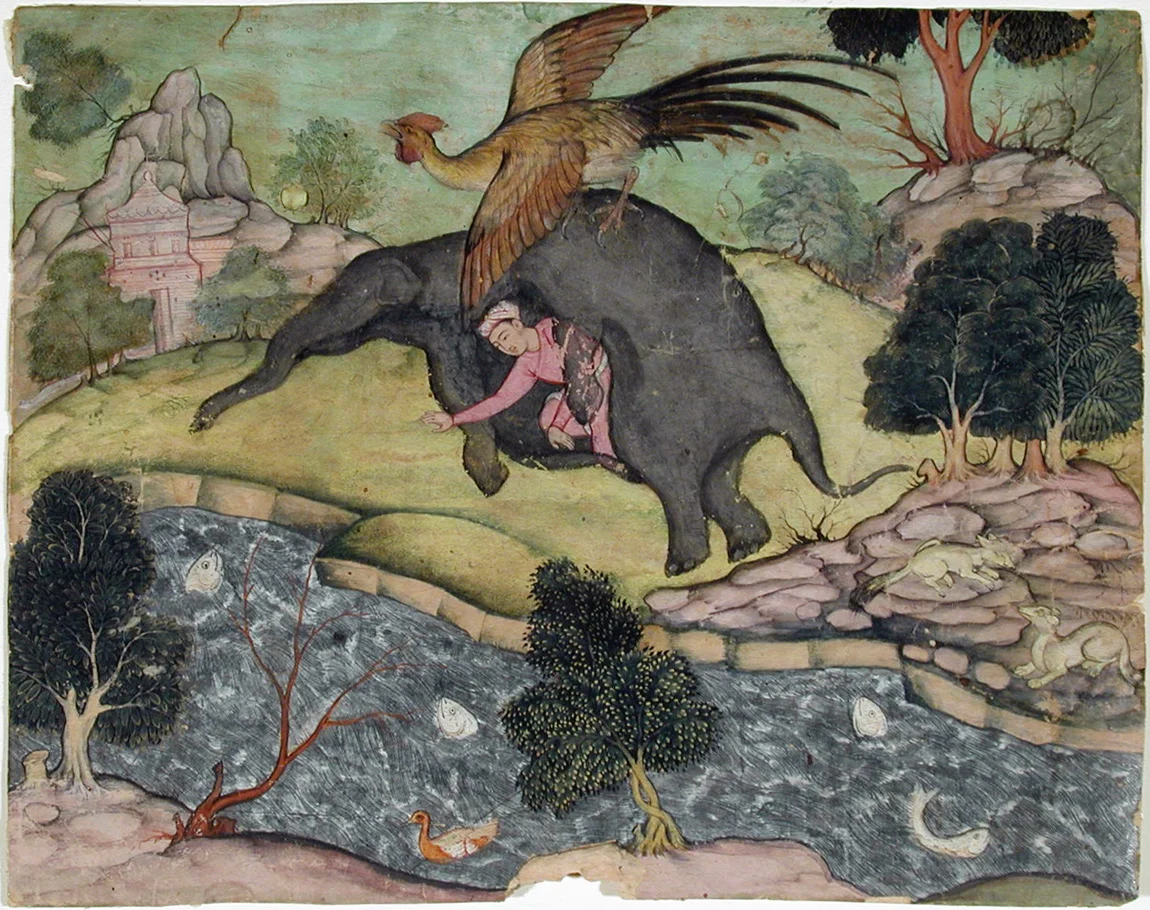
A different Simurgh confronts Esfandiyār during the fifth of his seven trials. Ferdowsi likens this bird to a mountain or a black cloud and credits her with the strength to carry off elephants. Even her two young match their mother in size.
The Greater Bundahishn preserves descriptions that are hard to reconcile. One passage ranks the three-clawed Sēn among the largest birds, and another includes it among birds that hatch from eggs. Elsewhere the text groups Saēna with the bat: both fly at night and nurse their young.
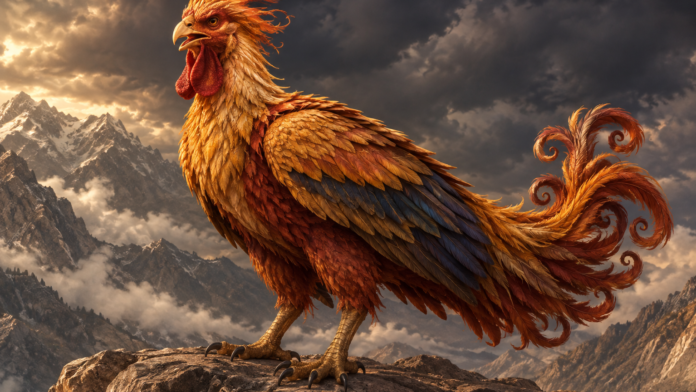
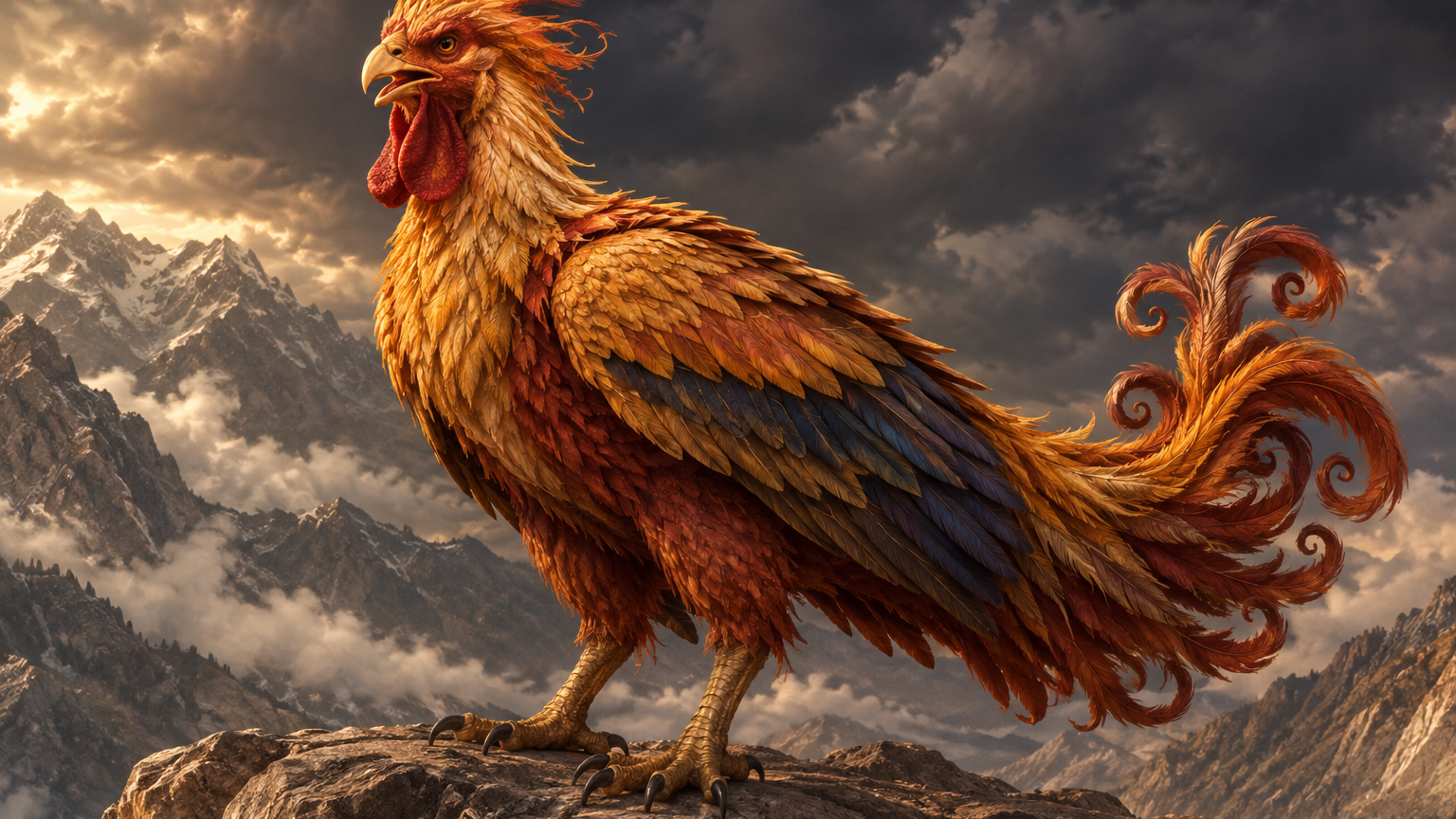
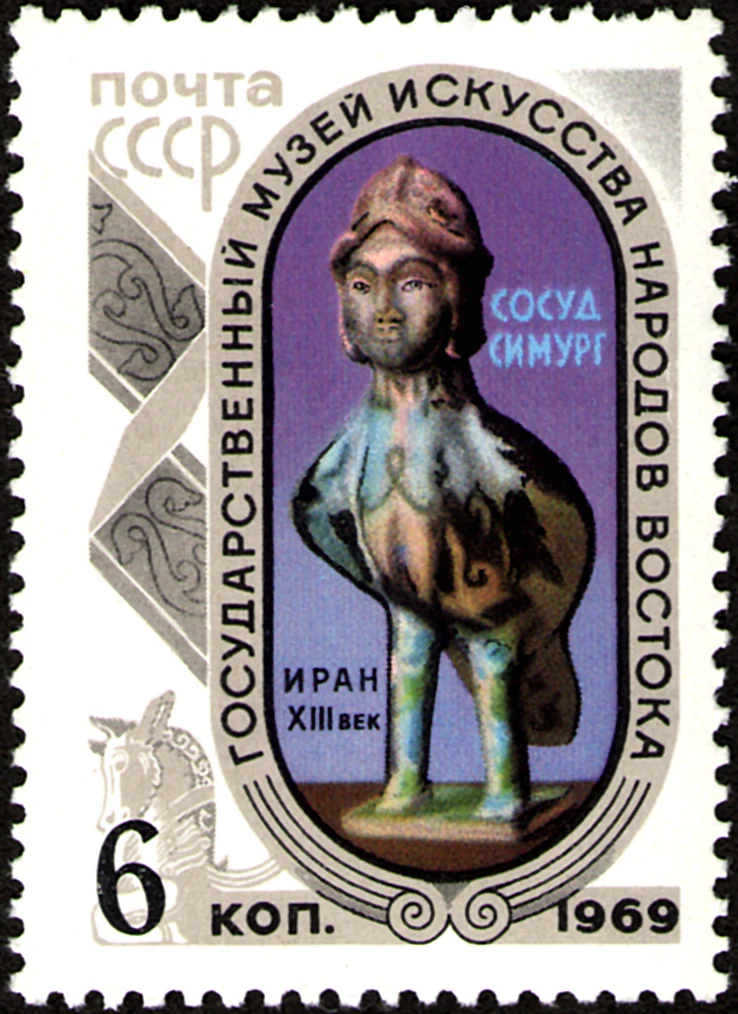
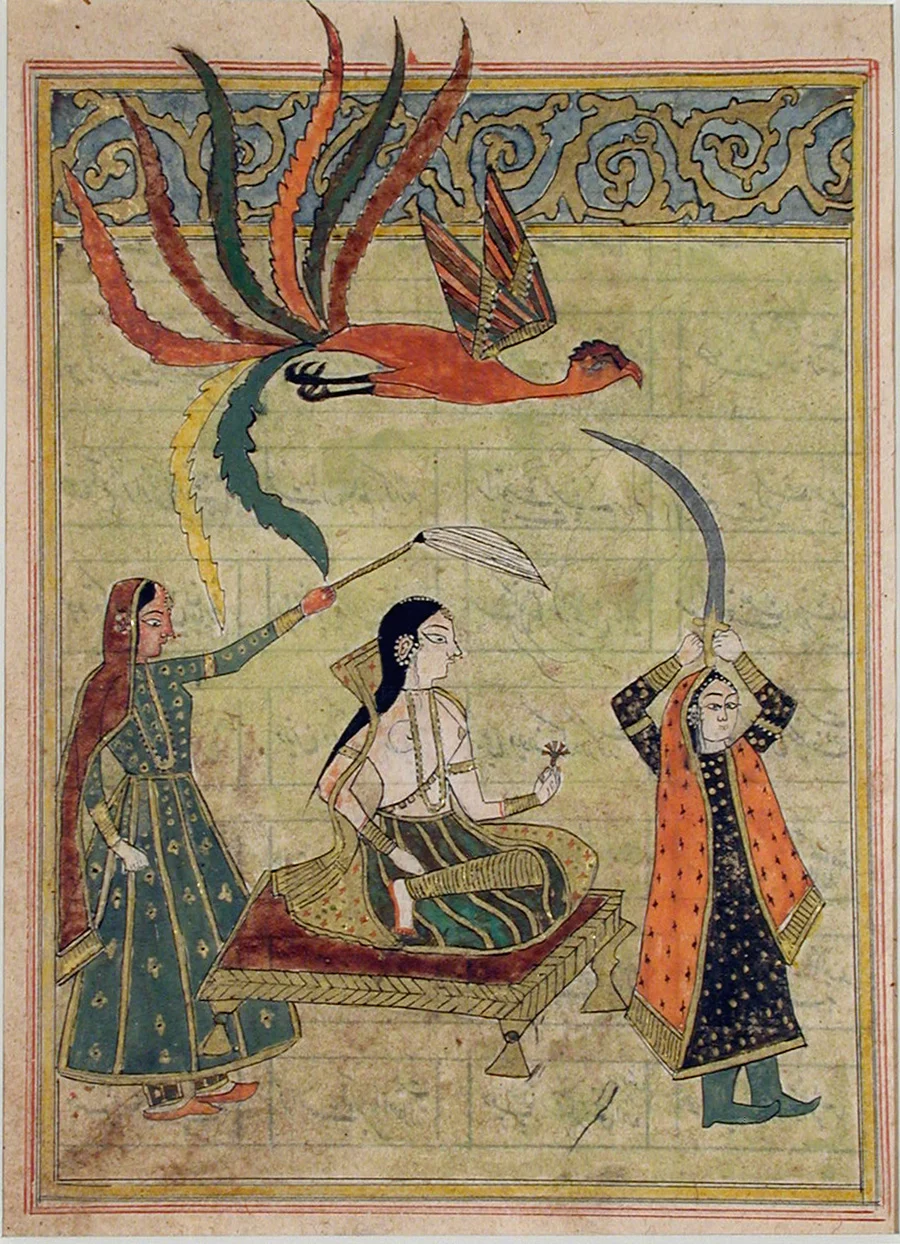
Medieval painters did not settle on one design. In a Shahnameh folio from about 1330 to 1340, now at the Metropolitan Museum of Art, the bird facing Zāl has rooster-like wattles and a long tail ending in tight curls. Other early manuscripts use the form of the Chinese fenghuang.
The dog-headed, winged creature on royal garments carved at Ṭāq-e Bustān belongs to a separate debate. Camilla Trever identified this Sasanian hybrid as the Sēnmurw. Art historian Matteo Compareti instead distinguishes that composite from the mythic bird and links the motif to divine glory.
Background Story
Ferdowsi does not portray the foster mother as tame. She first carries Zāl away as prey for her chicks, and the poet credits God with sparing him. She and her brood then show the child affection, and she sets aside tender meat to feed him.
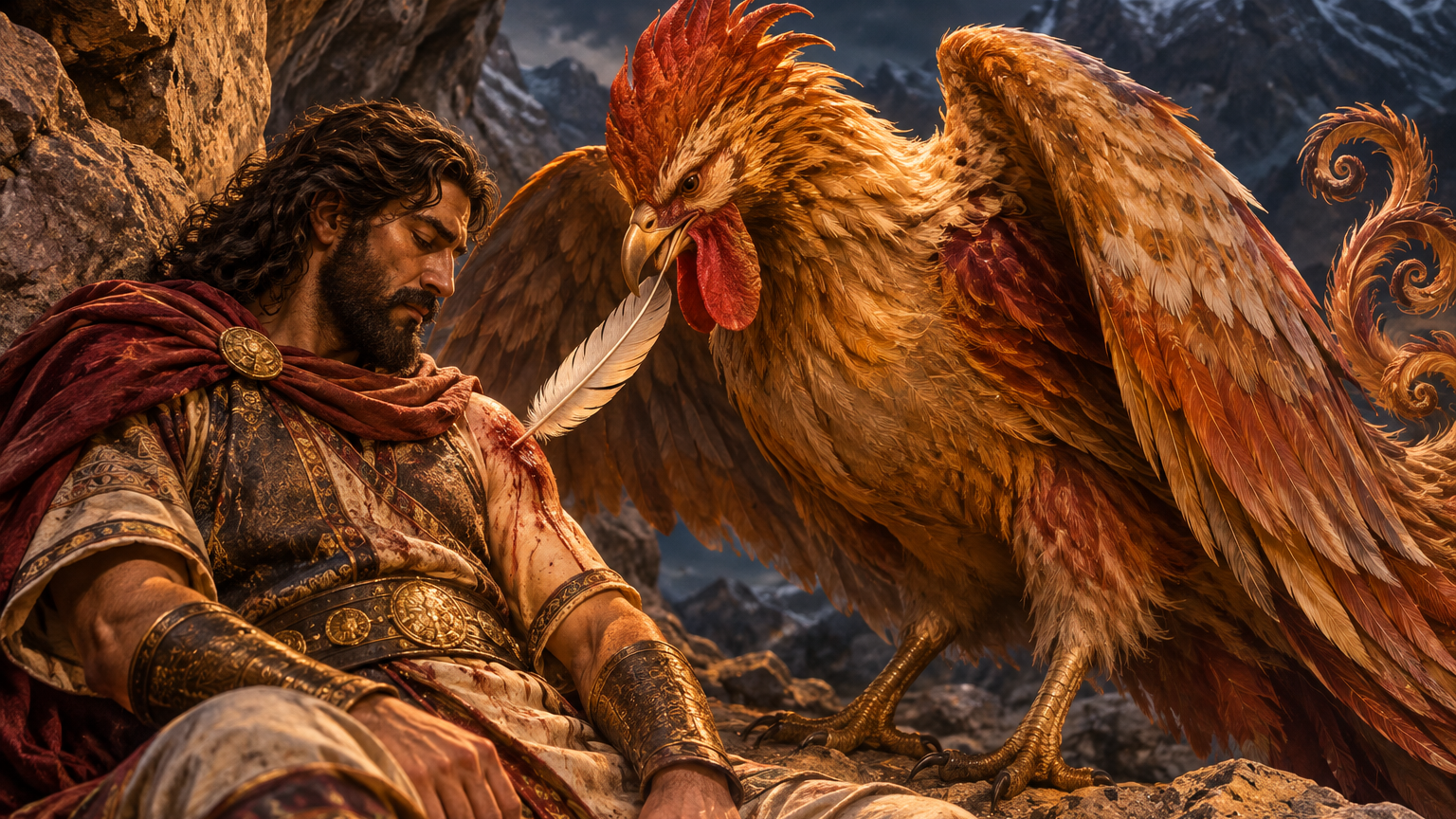
The bird’s care does not end when Sām comes to reclaim his son. She speaks directly to Zāl and offers him a feather as a pledge of protection. Her promise invokes farr, a word for glory or good fortune that lends weight to the gift.
Cast one of my feathers into the fire, and at once you will see my glory.
Ferdowsi, Shahnameh, completed 1010, ‘Manuchehr,’ section 2, own translation from Persian.
The feather serves as more than a signal. When Rudāba cannot deliver Rostam, the bird tells Zāl how to arrange the child’s birth and tend the incision. She pulls a fresh feather from her own wing for use on the wound before she flies away.
The Simurgh can also treat injuries herself. When Esfandiyār’s arrows wound Rostam and his horse Rakhsh, she removes arrowheads from them both. She draws blood from Rostam’s wounds with her beak, brushes the injuries with a feather and tells him to dress them and rest.
Her knowledge of fate does not make every danger avoidable. She urges Rostam to seek peace with Esfandiyār before giving him the means to prevail, and warns that whoever kills the prince will suffer for it. The bird can save Rostam’s life without shielding him from the consequences.
The bird also has a stake in the conflict. In speaking to Rostam, she calls the great bird Esfandiyār killed her mate and remembers that he killed it through cunning and force. That detail connects the two Simurghs in the epic without making them a single creature.
Famous Folklore Stories
Esfandiyār’s Fifth Trial
Esfandiyār is on his way to Arjāsp’s fortress to rescue his sisters when his guide, Gorgsār, warns him against taking the mountain route. A Simurgh rules the heights, and Gorgsār tells the prince that he cannot count on surviving another fight.
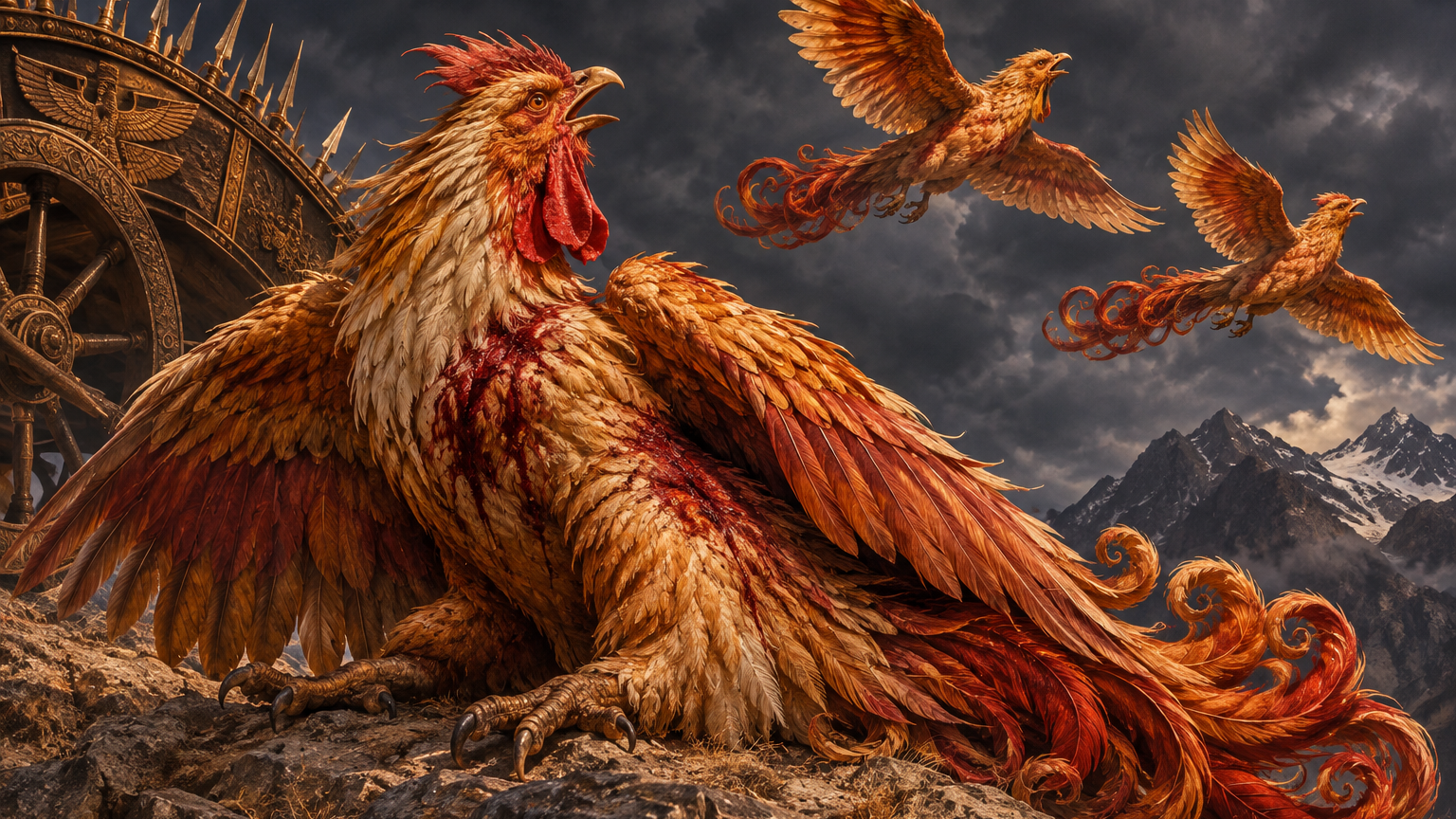
Esfandiyār has a chest fitted to a wheeled carriage and bristling with blades. He takes his place inside it and sends the army on behind him. The bird sees the carriage, hears the army’s horns, and swoops down from the mountain.
She meant to seize the carriage in her claws, as a leopard seizes its prey.
Ferdowsi, Shahnameh, completed 1010, ‘The Seven Trials of Esfandiyār,’ section 6, own translation from Persian.
The Simurgh strikes the blades with her feet and wings. She struggles with beak and talons until she can move no more. Her two young see her bleeding and fly away in terror, leaving Esfandiyār alone with the wounded bird.
Only then does the prince leave the chest. He finishes the fight with his sword and thanks God for guiding him. Horns sound again as his brother Pashotan comes up with the army, and the company celebrates the end of the trial.
The Birds at the Simurgh’s Court
In Farid al-Din Attar’s Conference of the Birds, the hoopoe leads a flock in search of a sovereign. Some birds drown, others die of thirst, and still others fall to predators. The few that reach the Simurgh’s court arrive exhausted.
At the court, a herald asks the birds who they are and what they want. They say they have come to make the Simurgh their king. The herald tells them that the Simurgh is already sovereign, whether or not they acknowledge him.
The birds eventually receive a written account of their own deeds. They find themselves in the position of Joseph’s brothers, forced to confront what they have done. Then light shines upon them, and they see the Simurgh and themselves in one another.
This court is a mirror, bright as the sun. Whoever comes sees themselves in it.
Farid al-Din Attar, The Conference of the Birds (Manṭeq al-ṭayr), twelfth century, ‘Thirty Birds in the Presence of the Simurgh,’ section 4, own translation from Persian.
The Simurgh answers their bewilderment without speaking aloud. Had forty or fifty birds arrived, he tells them, they too would have seen themselves. The seekers can no longer separate what they see from who they are, and Attar likens their disappearance to shadow vanishing in sunlight.
Cultural Impact
A Safavid painter could shift a reader’s sympathies without changing Ferdowsi’s words. In a folio attributed to Siyavush, Esfandiyār sits almost motionless as the Simurgh dominates the page. The Aga Khan Museum’s catalogue calls attention to the frightened chicks in the nest above.
Another royal manuscript, the Shahnameh made for Shah Tahmasp, uses the bird in a very different scene. Its painting of Sām’s reunion with Zāl makes the mountain a setting for reconciliation. The two commissions show how court painters gave the bird different emotional weight.
The bird also had a life outside royal books. Kurdish tales discussed by Hanns-Peter Schmidt feature Sīmīr, a bird whose name preserves a Kurdish form of Simurgh. In these stories, she transports people who could not otherwise reach their destinations.
Similar Beasts
Anzud

In a Sumerian poem, Anzud rewards Lugalbanda for tending its chick. Like the Simurgh, the bird can give a human hero help beyond ordinary reach, but its gift is extraordinary speed rather than healing.
Garuda
Garuda, the mighty bird of Hindu tradition, takes the gods’ nectar to free his mother, Vinatā. Like Ferdowsi’s protective Simurgh, he uses his power on behalf of family, but here the child comes to the parent’s rescue.
Roc
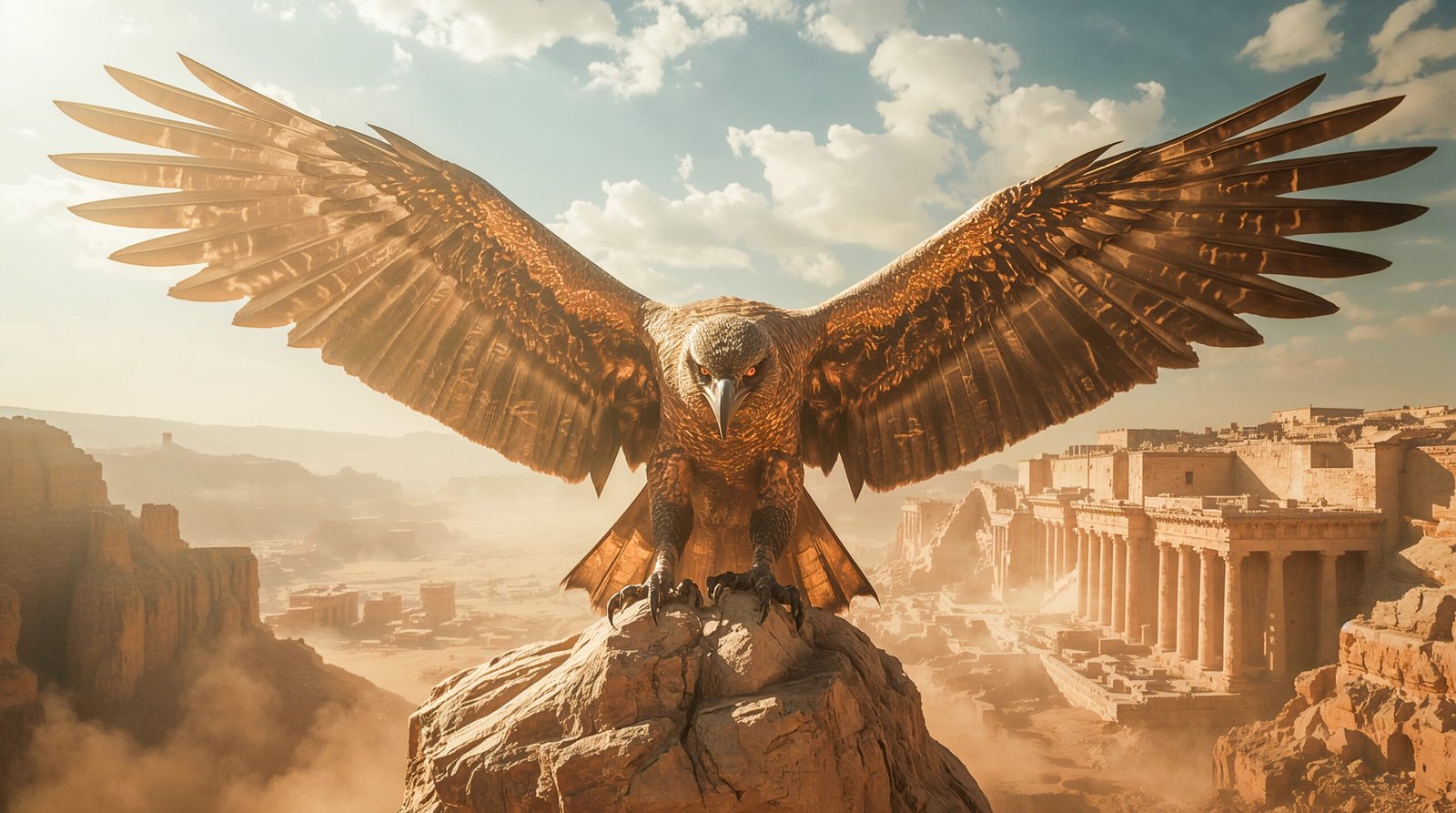
The roc of Sindbad’s voyages can carry a person through the air, recalling the strength of the Iranian bird. Sindbad, however, ties himself to the roc without its knowledge. His escape depends on improvisation, not the creature’s goodwill.
Religion/Ritual
The hymn to Rashnu places Saēna’s tree within a series of calls to the deity of justice. Earlier verses invoke Rashnu in connection with an ordeal and name fire and the sacred bundle of twigs. The speaker seeks Rashnu’s presence wherever he may be.
The hymn to the god of victory prescribes rubbing a bird’s feather against the body to ward off a curse, and credits carrying a feather or bone with protective power. It names a different bird, making this a parallel to the epic feather rather than a Simurgh rite.
In his twelfth-century treatise The Note of Simurgh, Suhrawardi makes the bird’s call a figure for spiritual awakening. The call reaches everyone, but few hear it. He introduces this image before discussing the stages of the mystical path, from beginnings to ends.
Scientific or Rational Explanations
One narrative comparison predates Ferdowsi by centuries. The Greek writer Aelian says an eagle reared Achaemenes, the ancestral figure of the Persian royal house. Schmidt notes the parallel with Zāl. It shows an older instance of the motif, not that Ferdowsi borrowed Aelian’s story.
Other scholars read the epic against the history of medicine. A letter in Archives of Iranian Medicine compares the Simurgh’s treatment of battle wounds with removing embedded objects and damaged tissue. That comparison identifies practical elements in the scene without authenticating its supernatural cure.
A separate medical essay proposes the Simurgh as an Iranian emblem of medicine. Its argument turns on what the bird does in the poem, not whether it existed. The distinction matters: a story can preserve recognizable ideas about care without documenting a particular operation.
Modern Cultural References
Zāl and Simorgh, Ali Akbar Sadeghi, Kanoon, 1977
Sadeghi’s illustrated Iranian short adapts Zāl’s childhood from Ferdowsi, casting the Simurgh as the mountain foster parent of the infant his father abandons.
(www.kanoonarchive.org)
The Conference of the Birds, Peter Brook and Jean-Claude Carrière, Dramatic Publishing, 1982
The stage adaptation makes the Simorgh the object of the flock’s search, letting the birds voice their doubts about the sovereign before they reach the court.
(media.dramaticpublishing.com)
The Conference of the Birds, Peter Sís, Penguin Books, 2013 paperback edition
In Sís’s illustrated retelling, the flock seeks the Simorgh on Mount Kaf and learns that the king they imagined apart from themselves is also their collective identity.
(www.penguinrandomhouse.com)
Vogelgespräche, adapted by Marjan Fouladvand, illustrated by Mohammad Barrangi, Edition Orient, 2022
This Persian and German illustrated adaptation presents the Simurgh as the enigmatic king whom the hoopoe persuades the flock to seek at the world’s end.
(www.edition-orient.de)
Prince of Persia: The Lost Crown, Ubisoft Montpellier, Ubisoft, 2024
The action game reimagines the Simurgh as a birdlike deity whose vast wings and claws become visible features of the landscape as Sargon explores Mount Qaf.
(news.ubisoft.com)
Conclusion
What makes the Simurgh distinctive is not simply that a bird can do what humans cannot. Ferdowsi gives the bird a part in decisions that carry lasting costs, while Attar makes meeting the Simurgh a test of what the seekers can bear to recognize.
Further Reading
Shahnameh: The Seven Trials of Esfandiyār, section 6, Ferdowsi, Ganjoor, completed 1010
The Persian verse follows Gorgsār’s warning, the Simurgh’s attack on the carriage, the flight of her young, and Esfandiyār’s actions after the encounter.
(ganjoor.net)
The Conference of the Birds: Thirty Birds in the Presence of the Simurgh, section 4, Farid al-Din Attar, Ganjoor, twelfth century
This passage connects the birds’ encounter to Joseph and his brothers, then gives the Simurgh’s answer through the image of a sunlit mirror.
(ganjoor.net)
Mēnōg ī Xrad, translated by E. W. West, Sacred Books of the East, 1885
Chapter 62 of West’s English translation describes the relationship between the Sēn bird, the many-seeded tree, Chamrosh, and the rain that distributes seeds.
(www.avesta.org)
The Conference of the Birds: The Assembly of the Birds, Farid al-Din Attar, Ganjoor, twelfth century
In the opening assembly, the hoopoe names the Simurgh and draws a distinction between the sovereign’s nearness and the distance the birds must overcome.
(ganjoor.net)
Shahnameh: Manuchehr, section 2, Ferdowsi, Ganjoor, completed 1010
The Persian account of Zāl’s abandonment and upbringing includes the Simurgh’s farewell and her instructions for summoning her by putting a feather into the fire.
(ganjoor.net)
The Conference of the Birds: Thirty Birds in the Presence of the Simurgh, section 1, Farid al-Din Attar, Ganjoor, twelfth century
Attar’s Persian verse describes the flock’s losses on the journey and the surviving birds’ first exchange with the herald at the Simurgh’s court.
(ganjoor.net)
Isfandiyar Kills the Simurgh, attributed to Siyavush, Aga Khan Museum, 1576–1577
Charles Melville’s catalogue entry examines how a Safavid painter used the landscape and the frightened chicks to draw sympathy toward the dying Simurgh.
(collections.agakhanmuseum.org)
A Painting from the Shahnameh: The Persian Book of Kings, Museum for Islamic Art, Berlin
This illustrated museum essay presents the reunion of Sām and Zāl from Shah Tahmasp’s royal manuscript and explains the Simurgh’s place in the scene.
(islamic-art.smb.museum)
SIMORḠ, Hanns-Peter Schmidt, Encyclopaedia Iranica, 2002
Schmidt traces the bird across Iranian religious texts, Ferdowsi’s epic, Kurdish folktales, and Sufi literature, and compares Zāl’s upbringing with Aelian’s tale of Achaemenes.
(www.iranicaonline.org)
Yashts, translated by K. E. Kanga, Avesta: Zoroastrian Archives
The Rashne and Bahram hymns place Saēna within prayers and protective imagery while distinguishing its appearances from the separate passage about a protective feather.
(www.avesta.org)
The Note of Simurgh, Shihab al-Din Suhrawardi, translated by Otto Spies and S. K. Khatak, Three Treatises on Mysticism, 1935
This English translation opens with Suhrawardi’s account of the Simurgh’s awakening call and proceeds to his treatment of the beginnings and ends of mystical practice.
(www.platonic-philosophy.org)
Magic i. Magical Elements in the Avesta and Nērang Literature, Encyclopaedia Iranica
The discussion of Yašt 14 identifies the protective feather’s bird and explains how carrying a feather or bone functions as an amulet in the hymn.
(www.iranicaonline.org)
Simurgh as a Medical Symbol for Iran, Touraj Nayernouri, Archives of Iranian Medicine, 2010
Nayernouri proposes the Simurgh as a medical emblem for Iran, drawing on the bird’s aid during Rudāba’s difficult labor and its treatment of battle wounds.
(pmc.ncbi.nlm.nih.gov)
Archives of Iranian Medicine, volume 20, issue 4, pages 261–262, 2017
This letter reads episodes of Ferdowsi’s epic in light of medical concepts, comparing the Simurgh’s work on battle wounds to removal of foreign bodies and damaged tissue.
(applications.emro.who.int)
Greater Bundahishn, chapters 12–26, translated by Behramgore Tehmuras Anklesaria, Avesta: Zoroastrian Archives, digital edition 2002
This Middle Persian creation account gives the Sēn bird a role in dispersing seeds and preserves descriptions that place it in different groupings of animals.
(avesta.org)
Shahnameh: Manuchehr, section 25, Ferdowsi, Ganjoor, completed 1010
The Persian birth episode describes the Simurgh’s arrival during Rudāba’s labor and preserves the bird’s instructions for delivering Rostam and tending his mother’s wound.
(ganjoor.net)
Shahnameh: Rostam and Esfandiyār, section 26, Ferdowsi, Ganjoor, completed 1010
This episode recounts the Simurgh’s treatment of Rostam and Rakhsh, her warning about Esfandiyār, and her identification of the bird the prince killed as her mate.
(ganjoor.net)
Lugalbanda and the Anzud Bird, Electronic Text Corpus of Sumerian Literature, University of Oxford
The English translation describes Lugalbanda’s care for the Anzud bird’s chick and his request for extraordinary speed in return for that act of kindness.
(etcsl.orinst.ox.ac.uk)
The Devī Bhāgavatam, book 2, chapter 12, translated by Swami Vijñanananda, Internet Sacred Text Archive
The chapter recounts Garuda’s seizure of the gods’ nectar and his agreement with Kadru to free his mother Vinatā from servitude in exchange.
(original.sacred-texts.com)
The Arabian Nights Entertainments: The Second Voyage of Sindbad the Sailor, Project Gutenberg
In the second voyage, Sindbad discovers the roc’s egg and escapes an island by fastening himself to the leg of the enormous bird.
(www.gutenberg.org)
YAŠTS
Specialist account of the hymns’ composition and oral transmission in Old Iranian priestly culture.
(www.iranicaonline.org)
FERDOWSI, ABU’L-QĀSEM i. Life
Biographical study documenting the completion of Ferdowsi’s epic in 1010.
(www.iranicaonline.org)
The Mantiq al-tair (Language of the Birds) of 1487
Museum study of Attar’s allegory and its manuscript tradition, with an account of the thirty surviving pilgrims and the Simurgh’s role.
(www.metmuseum.org)
Illustrated Poetry and Epic Images: Persian Painting of the 1330s and 1340s
Metropolitan Museum catalogue comparing the Simurgh in several illustrated manuscripts, including the distinct treatment of the bird in folio 1974.290.2.
(resources.metmuseum.org)
Composite Creatures in Sasanian Art According to Some Numismatic and Sphragistic Evidence
Matteo Compareti’s research distinguishing the composite pseudo-Sēnmurw from the legendary bird.
(journals.ub.uni-heidelberg.de)
MIRACLES i. In Ancient Iranian Tradition
Scholarly account confirming the encounter with the hostile Simurgh as Esfandiyār’s fifth trial.
(www.iranicaonline.org)