
Introduction
Unwabu is the Zulu word for chameleon and the animal messenger in a recorded Zulu explanation of human mortality. Its importance comes from carrying a message that people should not die, then arriving too late for that message to be accepted.
In the version recorded by Henry Callaway, Unkulunkulu sends the chameleon first. It travels slowly and pauses to eat fruit.
A lizard dispatched afterward carries the opposite message, reaches the people sooner, and announces that they will die.
The figure is therefore a chameleon participating in a cosmological narrative, rather than a separate monster or humanlike deity. Its ordinary animal identity remains central: the contrast between its slow journey and the competing messenger’s speed gives the story its decisive movement.
Nineteenth-century records agree on the chameleon’s identity but differ in spelling and in their descriptions of its rival. These differences matter when reconstructing the tradition.
Unwabu’s enduring significance lies in the failed delivery of life-preserving news, not in an extraordinary physical form.
History/Origin
The tradition was already in print in 1857, when J. L. Döhne’s dictionary recorded the spelling Unwabo, identified the animal as a chameleon, and summarized the competing messages concerning death.
This establishes an early written witness, not the date when the oral narrative began.
A fuller record appears in Henry Callaway’s The Religious System of the Amazulu, published in parts between 1868 and 1870. Its presentation of Zulu text alongside an English translation preserves the narrative in a different form from a brief dictionary explanation.
Callaway’s account names Unkulunkulu as the sender and makes the sequence explicit: the chameleon receives the first commission, but the lizard delivers its contrary message first. The people subsequently refuse the chameleon’s announcement because they have already heard and accepted the other one.
David Leslie’s 1871 account preserves the spelling Unwabo and names the competing messenger Entulo, describing it as a little stone-lizard. Döhne instead calls Intulo a quick-running salamander.
These historical animal labels should remain attached to their respective versions rather than being treated as interchangeable zoological identifications.
Leslie also acknowledges uncertainty in parts of the surrounding tradition. The early records consequently preserve related tellings, not a single fixed text.
Their shared foundation is nevertheless clear: a chameleon’s delayed journey allows the message of human death to arrive first.
The narrative also circulated in later education. A scholarly discussion of J. L. S. Nyembezi’s language-teaching material identifies Unwabu nentulo, the chameleon and the lizard, as a folktale explaining death’s origin.
This documents continued transmission without establishing how far back the story extends.
Name Meaning
Unwabu means “chameleon” in Zulu. The name identifies the animal itself, rather than translating a special title such as “messenger of immortality.”
The messenger function belongs to the narrative in which the chameleon appears, not to an independently established meaning of the word.
Unwabo is an attested historical spelling in both Döhne’s 1857 dictionary and Leslie’s 1871 account. In those records, it denotes the same animal character.
The spelling difference is not evidence for another creature or a separate branch of mythology.
The early lexical evidence supports the animal gloss but does not establish a further derivation. Neither the chameleon’s delay nor its eating of fruit explains the word’s linguistic origin.
Those are story details and should not be converted into an etymology.
The distinction between the two messengers is equally important. Intulo, rendered Entulo in Leslie’s account, names the competing animal rather than providing another name for Unwabu.
Keeping these identities separate preserves the central opposition between the first messenger sent and the first messenger heard.
Appearance
Unwabu’s supported form is that of a chameleon. The early accounts do not give it supernatural anatomy, an exceptional size, or a distinctive mythic color scheme.
Its identity rests on a recognizable animal form carrying an extraordinary responsibility within the story.

Movement receives more attention than bodily description. Döhne calls the chameleon slow, while Callaway’s narrative describes its leisurely progress and loitering.
This emphasis makes pace, rather than a special physical attribute, the feature that distinguishes it from the faster messenger.
The journey also includes vegetation and feeding. In Callaway’s version, the chameleon eats fruit from a tree while traveling.
This is a specific narrative action, not evidence for a sacred plant emblem, an unusual diet, or a fixed landscape surrounding the figure.
Some colorful descriptions belong to the rival messenger and must not be transferred to Unwabu. Leslie describes Entulo as a little stone-lizard and mentions blue and flame-colored forms.
Those details characterize the second animal in that account, not the chameleon.
The rival’s identification also varies: Döhne uses “salamander,” Leslie uses “stone-lizard,” and Callaway’s translated passage uses “lizard.” Against these differences, the chameleon remains the stable visual identity of Unwabu.
A naturalistic representation therefore fits the evidence better than a hybrid or monstrous reconstruction.
Background Story
Unwabu belongs to a narrative concerned with why people die. Its background is cosmological rather than biographical: the surviving episode explains a condition of human existence through the dispatch, delay, and reception of two opposing messages.
The chameleon matters because communication has irreversible consequences.
In Callaway’s recorded version, the first instruction offers a different human future: people should not die. The chameleon’s assignment therefore begins with a life-preserving message.
Its failure is not that it changes those words, but that it does not deliver them before the competing announcement.
The second message comes from the same sender in this telling. That detail makes the episode more complex than a contest between a benevolent animal and an independently malicious opponent.
Both messengers carry instructions; their order of arrival determines which announcement the people accept.
The people’s response completes the explanation. When the chameleon finally arrives, they say that they have already heard the lizard’s message and will not accept the contrary one.
The story thus connects mortality not merely with slowness, but with the finality of an announcement already received.
The fruit-eating delay gives this enormous consequence an ordinary cause. A small interruption during an animal’s journey becomes decisive for humankind.
The narrative’s force comes from that disproportion: the chameleon does not need monstrous powers to occupy a consequential place in the account.
Later specialist discussion in Metaphor in Zulu associates the chameleon with unreliability in this mythic context. That interpretation fits its failure to complete an urgent task promptly, but it should not replace the episode’s larger concern: the loss of a message that would have spared people death.
Famous Folklore Stories
Unwabu’s principal documented narrative concerns the origin of human death. It survives in several recorded versions rather than a securely established cycle of separate adventures.
The descriptive headings below distinguish the central messenger episode from a related regional version; they are not traditional story titles.
The chameleon’s message arrives too late
In the Zulu account recorded by Henry Callaway, Unkulunkulu sends the chameleon to tell people that they should not die. Unwabu sets out slowly, loiters along the route, and eats fruit from a tree.
Meanwhile, Unkulunkulu dispatches a lizard carrying the opposite announcement.

The lizard reaches the people first and tells them that they will die. When the chameleon finally arrives with its promise of life, the people refuse it.
They have already heard the lizard’s announcement and will not accept the contradictory message delivered afterward.
The decisive ending is therefore not a battle between the animals, but the rejection of a message received too late. Unwabu does eventually complete its task.
Its failure lies in timing, which makes an ordinary delay carry an irreversible consequence for humanity.
Competing messengers in related versions
A related Xhosa version discussed in the scholarly study Ntsikana: history and symbol names the chameleon Unwabi. The creator sends it to promise everlasting life, then changes intention and sends Intulo with the death message.
The faster messenger overtakes the bearer of life.
This version explicitly supplies a change of intention behind the second dispatch. That detail should not automatically be inserted into every Zulu telling.
The shared narrative structure is firmer: two animals carry incompatible announcements, and the messenger dispatched first fails to arrive first.
The rival’s zoological description also varies. Döhne’s 1857 dictionary calls Intulo a quick-running salamander, while Leslie’s 1871 retelling describes Entulo as a little stone-lizard.
These descriptions belong to particular records; they do not change Unwabu’s consistent identification as the chameleon.
Cultural Impact
The story gives the chameleon a significance beyond its appearance or movement. A small animal becomes associated with the loss of humanity’s chance to escape death.
Its failure is consequential without requiring it to be a malicious creature or an intentional enemy of people.
Later scholarship on Zulu metaphor connects the chameleon with unreliability in the context of this narrative. This is a moral interpretation of its failed delivery, not proof that every reference to a chameleon carries the same judgment.
The messenger’s responsibility matters more here than deliberate deception.
The tale also entered language education. A scholarly discussion of J. L. S. Nyembezi’s teaching material identifies Unwabu nentulo, meaning the chameleon and the lizard, as a folktale explaining death’s origin.
Its inclusion documents circulation through instructional reading as well as recorded traditional narrative.
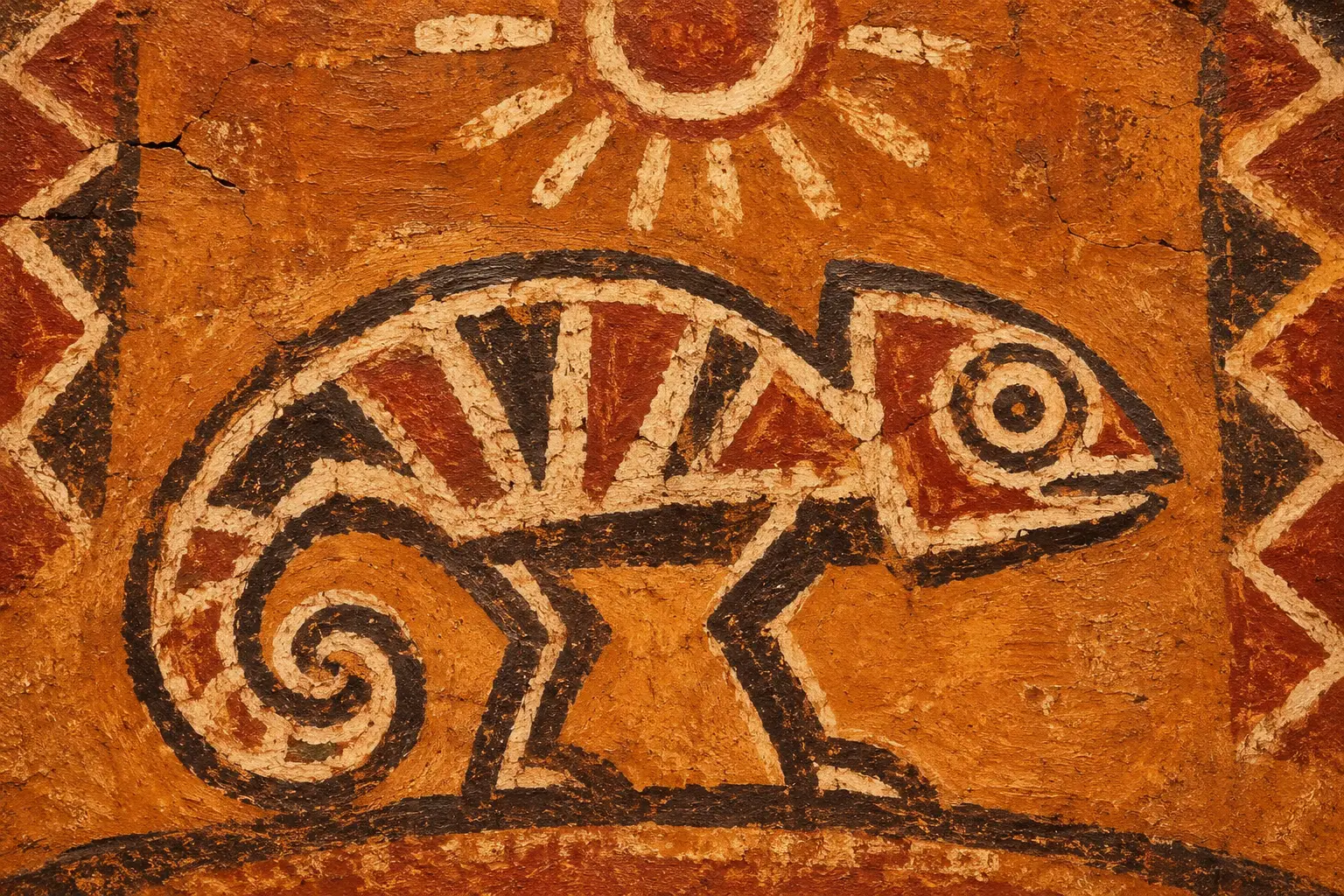
Other verbal imagery draws on different qualities of the animal. An isiZulu riddle reproduced in A Survey of Xhosa Riddles compares the chameleon to a bride changing her clothes repeatedly during one day.
Here changing appearance, rather than delayed arrival, supplies the recognizable image.
Contemporary reinterpretation includes Alain Carpentier’s painting Unwabu, documented as an acrylic-and-pencil portrayal of the mythological chameleon. It shifts the animal into an individual visual artwork.
That modern representation should be distinguished from evidence for a historical sacred image or established ceremonial artistic tradition.
Similar Beasts
Intulo
Intulo is the competing reptile messenger in versions of the death-origin narrative. Early records describe this character differently, including as a salamander or a small stone-lizard.
Its connection to Unwabu is direct: it delivers the contrary announcement first. The two are distinct characters whose contrasting journeys determine the story’s outcome.
Uhlakanyana
Uhlakanyana is a separate figure in Zulu trickster storytelling. Specialist discussion of Zulu metaphor associates the character with a cunning weasel and the narrative expression of cleverness.
Both figures connect animal identity with human judgments about conduct. Unlike Unwabu’s delayed messenger role, Uhlakanyana’s comparison rests on cunning within trickster tales.
Anansi

Anansi is the Akan spider trickster whose stories circulated from West Africa to the Caribbean. Cleverness, greed, invention, and schemes that backfire are central to the character.
Like Unwabu, Anansi makes an animal’s conduct meaningful for human listeners. The resemblance is literary, not genealogical: Unwabu’s documented episode does not establish a trickster identity.
Tiddalik

Tiddalik is a giant frog in Aboriginal Australian Dreaming stories. After drinking all the world’s water, he releases it when other animals succeed in making him laugh.
The useful parallel is narrative scale: an animal’s behavior affects the wider world. Tiddalik’s water story and Unwabu’s mortality story nevertheless belong to distinct traditions.
Religion/Ritual
Unwabu’s messenger role belongs to a religious explanation of human mortality involving Unkulunkulu. The recorded episode concerns the relationship between a creator’s announcement and humanity’s condition.
It does not describe worship, offerings, or a ceremony devoted specifically to the chameleon messenger.
Broader beliefs about living chameleons are more varied. Field scholarship among Xhosa and Zulu communities reports associations including ancestors, good fortune, and agents of traditional practitioners.
These reported beliefs should not be combined into a universal doctrine or treated as rituals arising directly from Unwabu’s story.
Scientific or Rational Explanations
The narrative is best understood as an origin-of-death account, not an attempted description of an unknown species. Its central animal is an identifiable chameleon.
The question for interpretation is why this familiar creature carries the promise of life, rather than whether a separate monster existed.
The contrast between slow and fast travel provides an observable foundation for the plot. Early tellings emphasize the chameleon’s slowness and the competing messenger’s speed.
This helps make the outcome intelligible, although it cannot establish exactly when or why the narrative first developed.
Structurally, the story turns mortality into the outcome of a missed opportunity. Life without death is announced but never effectively received.
Reading the episode this way highlights its treatment of irreversible loss without claiming that all narrators or listeners understood its religious meaning identically.
The people’s response is as important as the animals’ movement. They accept the first announcement and reject the later contradiction.
One possible reading therefore concerns the authority of a message once received, rather than simply a warning against laziness. This remains interpretation, not an additional documented episode.
Historical animal labels also require restraint. “Salamander,” “stone-lizard,” and other descriptions of the rival messenger cannot automatically be reconciled as one scientifically identified species.
Their variation illustrates the limits of mapping recorded vernacular narratives onto modern zoological categories without more precise linguistic and biological evidence.
Finally, the story does not explain every cultural response to chameleons. Riddles emphasize changing appearance, metaphor can emphasize unreliability, and field reports record spiritual associations.
Keeping these contexts distinct avoids reducing a living animal’s diverse cultural meanings to a single explanation based on the death-message tale.
Modern Cultural References
Unwabu, The Chameleon of Zulu Mythology, artwork
Alain Carpentier’s painting depicts a monumental chameleon in acrylic and pencil on canvas.
Its documented presentation explicitly connects the animal to Unwabu’s place in Zulu mythology.
(theauctionlab.com)
Conclusion
Unwabu is best understood as a chameleon whose messenger role gives an ordinary animal extraordinary narrative importance. In the recorded Zulu account, the promise that people should not die arrives too late, overtaken by the contrary message that establishes mortality.
The story’s force lies not in monstrous anatomy or supernatural combat, but in the irreversible consequences of delay. Its contrast between slow and swift messengers makes an immense human question intelligible through familiar animal behavior.
The tradition is well documented, although its recorded versions do not agree on every detail. Historical spellings, the creator’s name, and descriptions of the rival messenger require attention rather than consolidation into one supposedly definitive account.
Across these differences, the chameleon remains the bearer of the lost possibility of life without death. Educational retellings, linguistic imagery, and a contemporary artistic portrayal show different ways this figure can retain meaning without becoming a separate deity, monster, or cryptid.
Further Reading
The Religious System of the Amazulu, Henry Callaway, 1868–1870
This online transcription presents Callaway’s collected Zulu text alongside English translation.
It preserves the chameleon’s delayed journey and the competing messages at the heart of the mortality narrative.
(tianmu.org)
Kaffir Character and Customs, Darwin Online, 1871
Darwin Online hosts this nineteenth-century collection under its original colonial-era title.
Its account records Unwabo and Entulo, providing an early comparison for messenger identities and narrative details.
(darwin-online.org.uk)
Recognition of reptiles by Xhosa and Zulu communities in South Africa, with notes on traditional beliefs and uses, African Journal of Herpetology, 1997
This specialist study examines reptile recognition, beliefs, and uses among Xhosa and Zulu communities.
It documents unwabu as a chameleon name and distinguishes broader beliefs from the messenger story.
(researchgate.net)
A Survey of Xhosa Riddles, University of South Africa Institutional Repository, 2012
This university dissertation examines riddling and includes an isiZulu chameleon example.
Its clothing-change imagery helps distinguish everyday animal symbolism from Unwabu’s particular role in the origin-of-death narrative.
(ir.unisa.ac.za)
Ntsikana: history and symbol studies in a process of religious change among Xhosa-speaking people, University of Cape Town Open Access Repository
This university study discusses religious change and records a related Xhosa messenger narrative.
Its Unwabi episode supports comparison while preserving the distinction between Xhosa and Zulu testimony.
(open.uct.ac.za)
Zulu-English Dictionary, Five Hundred Year Archive / EMANDULO, 1972
This archive record describes the Doke and Vilakazi dictionary edition rather than reproducing a folklore collection.
It provides bibliographic guidance for checking Zulu vocabulary and lexical forms.
(emandulo.apc.uct.ac.za)
A Zulu-Kafir Dictionary: Etymologically Explained, with Copious Illustrations and Examples, Google Books (1857)
Early lexicographic entry identifies Unwabo as the chameleon and preserves an early account of the death-origin tradition.
(books.google.kg)
Environment, world-view and healing among the Zulu Christians (19th and 20th centuries), Studia Historiae Ecclesiasticae / SciELO South Africa (2013)
Historical scholarship contextualizes Callaway’s recorded account and explains its role as an origin-of-death story.
Useful for a reception and interpretation chapter, while noting the article’s paraphrase reverses the messenger assignments in its summary and should be checked against primary texts.
(scielo.org.za)