Introduction
The lobisomem is a human shapeshifter in Portuguese folklore, compelled by fate or enchantment to take animal form and wander at night. Although its name carries a familiar wolf association, Portuguese traditions preserve a broader and less uniform being than a single wolf-man image suggests.
The central idea is a person subject to an extraordinary condition, sometimes described as a fado, or fate. Transformation is not necessarily a chosen power. In some accounts, a supernatural force drives the afflicted person into nocturnal wandering and determines the change of shape.
Regional versions give that condition different outward forms. Alongside the conventional wolf association, recorded Portuguese beliefs include a donkey in the Algarve and a duck in Serra da Estrela. These are localized alternatives, not successive stages in one standard transformation.
The figure therefore belongs to a varied body of local belief rather than one fixed story. Its distinctive character emerges from the relationship between human identity, involuntary animal transformation, and particular landscapes, including roads, crossroads, mountain lagoons, and inhabited places.
History/Origin
The beginnings of the Portuguese lobisomem tradition cannot be securely dated from the surviving material considered here. Nineteenth-century collections provide firm historical witnesses, but their publication dates mark the recording of beliefs already circulating orally, not the moment those beliefs first appeared.
José Leite de Vasconcellos included the figure, spelled lobishomem, in his 1882 collection Tradições populares de Portugal. His work gathered popular traditions from local communities. It preserves regional differences that a short dictionary definition cannot adequately represent, including a striking account from Serra da Estrela.
In that mountain tradition, the lobisomem takes duck form, inhabits lagoons, and steals irrigation water. The notice is brief, but historically significant: an early collected Portuguese example already departs from a strictly wolf-shaped identity and connects the being with a specific local environment.
Consiglieri Pedroso’s nineteenth-century Contribuições para uma Mythologia Popular Portugueza preserves another configuration through a quoted account from São Miguel in the Azores. At fateful nights and hours, magical power compels the person to wander through public places until encountering a quadruped, whose form the person then assumes.
Algarve oral accounts examined by Maria Manuela Neves Casinha Nova add donkey transformations and differing local conditions. Together, these records establish a geographically varied tradition. They do not supply a single line of descent explaining how every island and mainland version developed from a common original narrative.
Name Meaning
The standard Portuguese name is lobisomem. Infopédia derives it from the Latin words lupus, meaning “wolf,” and homine-, meaning “man.” This lexical explanation supports the broad conventional rendering “wolf-man,” while leaving the history of particular regional beliefs a separate question.
The wolf association is therefore genuinely present in the name, not merely imposed by translation. Nevertheless, the meaning of a compound word does not necessarily define every being called by it. Portuguese folklore records apply this name to transformations into other animals as well.
Recorded forms of the name include lobishomem, lobis-homem, and lobisome. The spelling lobishomem appears in Vasconcellos’s nineteenth-century collection. These forms belong to the figure’s naming history; the evidence does not justify treating each spelling as the label for a distinct supernatural species.
Two kinds of explanation must consequently remain separate. Etymology explains the word’s wolf-and-human association, while local accounts explain what a lobisomem does or becomes in a particular community. Neither the Latin derivation nor the modern dictionary definition establishes a Roman origin for the Portuguese belief.
Appearance
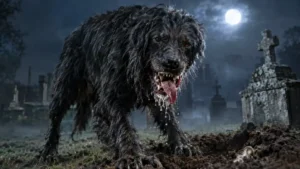
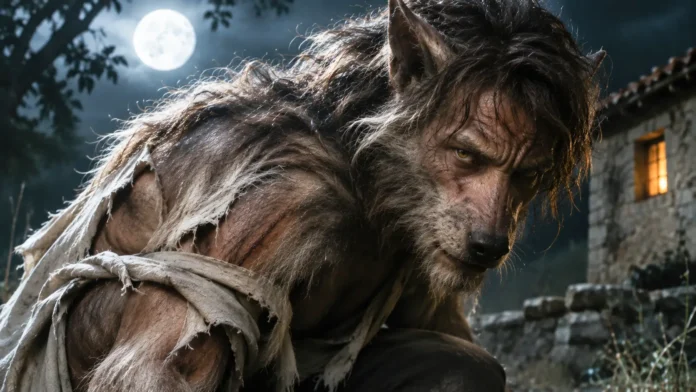
The lobisomem has no single anatomical description across the Portuguese material. Its most consistent feature is a change from human identity into animal form. A permanently upright creature combining a human torso with a wolf’s head is not an adequate description of all these traditions.
The wolf remains the conventional association, reflected in both the name and the dictionary definition of a person becoming a wolf or similar animal. That association provides a recognizable general image, but it should not displace the different forms explicitly preserved in regional accounts.
In some Algarve accounts, the transformed person becomes a donkey. Rolling at a crossroads belongs to the transformation sequence in reported versions. The animal is thus embedded in a particular nocturnal episode, rather than presented merely as an alternative face attached to a standard wolf-like body.
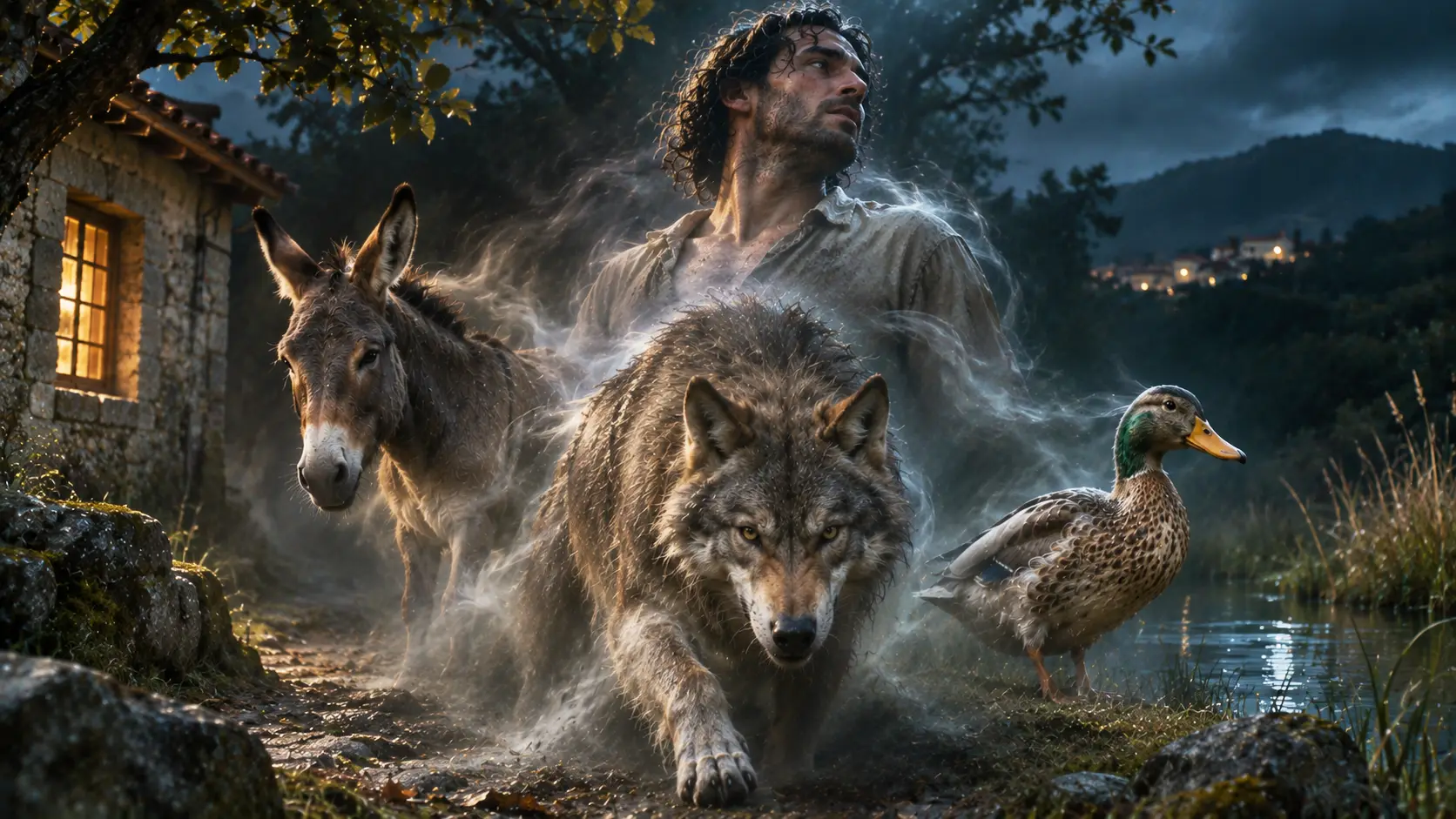
The Serra da Estrela report gives an even more pronounced contrast: a duck associated with mountain lagoons. Its defining details are its animal form, watery habitat, and theft of irrigation water. The short account does not supply an elaborate description of plumage, size, or monstrous bodily features.
The São Miguel account allows transformation into the quadruped encountered during compelled wandering. Here, the animal appearance depends on an encounter rather than one predetermined species. This differs substantively from both the conventional wolf definition and the specifically localized donkey and duck forms.
What unites these appearances is their supernatural human background, not a shared set of claws, teeth, or proportions. Night provides an important setting, but a compulsory full moon, silver vulnerability, and one fixed hybrid anatomy should not be imported into these accounts as universal Portuguese characteristics.
Background Story
The lobisomem’s background is a network of beliefs about fate, transformation, and involuntary movement rather than the biography of one monster. Different people can bear the condition, and local accounts vary in explaining its circumstances, outward form, and possible release.
Compulsion is especially clear in the São Miguel material: magical power forces the afflicted person to wander at appointed nights and hours. The person’s subsequent animal form follows an encounter with a quadruped. The sequence emphasizes submission to supernatural necessity rather than deliberate mastery of shapeshifting.
The Algarve accounts place transformation within a recognizable landscape of roads and crossroads. Rolling in crossroads dust gives the change a physical action and location. These details make the condition part of a narrated journey through familiar surroundings, although the precise circumstances differ between local versions.
One Algarve version also allows the transformed being to enter houses through a keyhole. This detail complicates any reading of its animal shape as ordinary anatomy: the supernatural condition permits movement beyond an animal’s natural capabilities. It belongs to that reported version, not to every lobisomem.
The Serra da Estrela tradition connects the being with a different concern: irrigation water. A lagoon-dwelling animal that steals water threatens something materially important to cultivated land. This supports reading the account in relation to its local environment, without assuming that water theft defines the figure elsewhere.
Taken together, these settings show how the same name could accommodate different supernatural problems. Public wandering, crossroads transformation, household intrusion, and interference with water each place the extraordinary within familiar life. The resulting figure is coherent as a fated shapeshifter, but deliberately variable in its local expression.
Famous Folklore Stories
Portuguese lobisomem traditions survive in brief regional reports as well as longer narratives. The following examples are documented belief motifs, not tales with authenticated traditional titles. Their differences matter: each preserves a local understanding of transformation, compulsion, or supernatural harm.
Transformation at the crossroads
In accounts from Reguengos de Monsaraz discussed in a 2019 oral-literature study, transformation occurs at midnight at a crossroads. The person rolls on the ground, becomes a donkey or dog, and departs to run the course imposed by his fate.
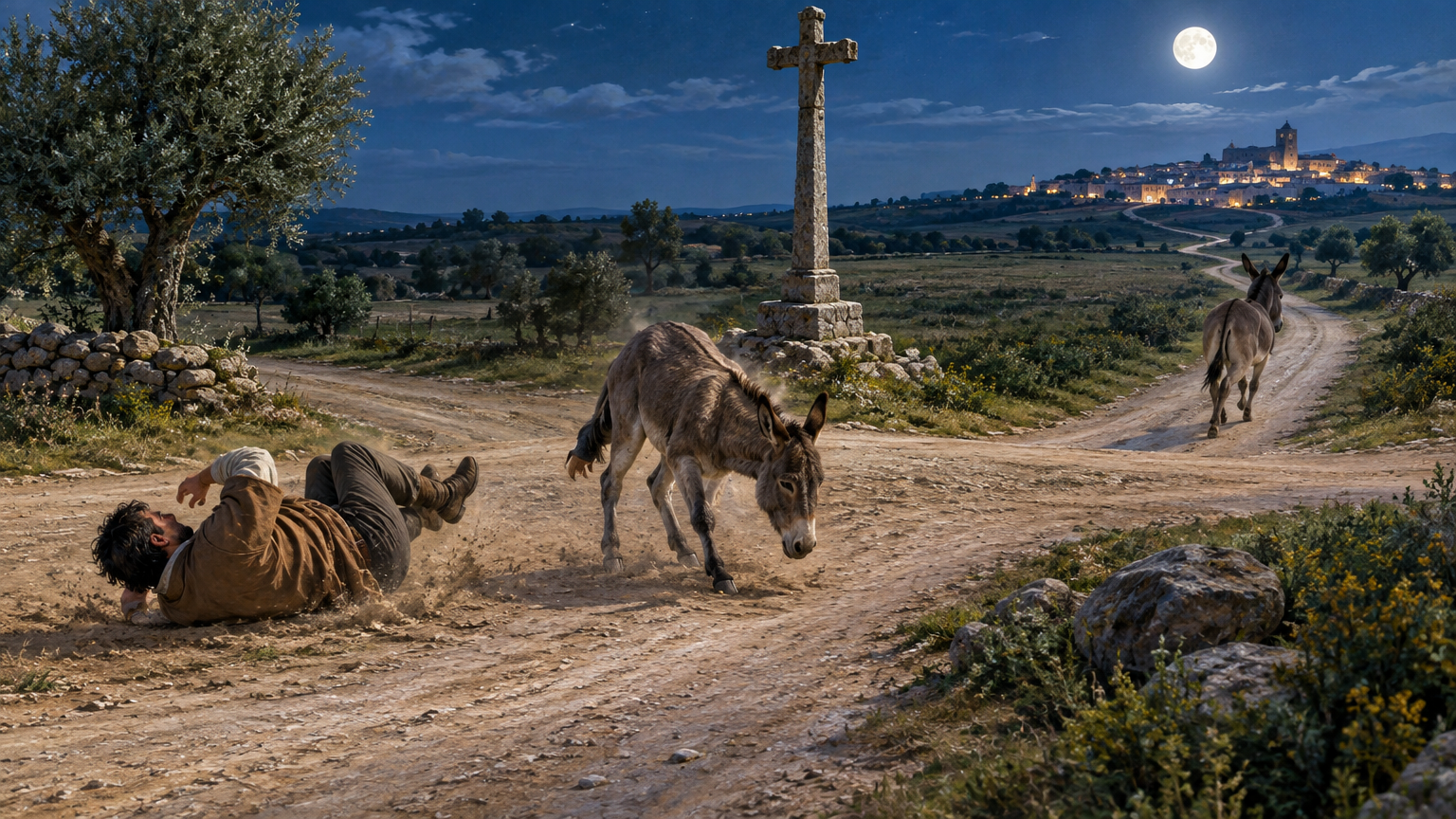
The reported sequence gives the episode its distinctive structure: arrival at a particular place and hour, rolling, metamorphosis, and compulsory roaming. Algarve accounts also connect crossroads rolling with donkey transformation, but their timing and conditions vary. These are related regional motifs, not identical versions of one fixed story.
The Serra da Estrela lagoon-dweller
A brief Serra da Estrela belief recorded in José Leite de Vasconcellos’s 1882 collection gives the lobisomem an unexpected form. It becomes a duck, inhabits the mountain lagoons, and steals irrigation water. The report contains no developed encounter or named human witness.
Here, the supernatural danger concerns water rather than an attack by a wolf. That association distinguishes this local report from the crossroads traditions. No confrontation, punishment, or restoration follows in the recorded passage, so those events cannot responsibly be supplied as an ending.
Compelled wandering in São Miguel
A São Miguel account reproduced by Consiglieri Pedroso describes a person driven into public places by magical compulsion at fateful nights and hours. On encountering a four-footed animal, he transforms into it. The animal encountered therefore determines the shape in this version.
The episode presents transformation as something suffered, not simply a power exercised at will. Unlike the Serra da Estrela report, its central action is enforced wandering followed by metamorphosis. It also differs from versions that specify a donkey or dog before the nocturnal journey begins.
Cultural Impact
The lobisomem could carry social force beyond supernatural storytelling. In some Portuguese places, calling someone a lobisomem was an insult, a usage recorded by Consiglieri Pedroso. This establishes that the name could stigmatize a living person, although it does not reveal every local implication.
Folklore collection also preserved strikingly different local versions under the same name. The mountain water-thief, the crossroads shapeshifter, and the compelled nocturnal wanderer remained available in print. Their coexistence is an important part of the figure’s cultural record, rather than a problem requiring one authoritative version.
In Egas Moniz’s 1936 children’s play Lobisome, reports of a creature prowling a village frighten two sisters, who debate whether it exists. The supernatural figure thus generates both communal alarm and comic uncertainty. A 2025 museum announcement documents its adaptation into a book and theatrical production.
Brazilian theatrical reception offers a separate example in A Viúva e o Lobisomem, associated with Geraldo Jorge and Grupo Tenda de Teatro in 1973. Rumors of a werewolf’s appearance unsettle a small inland town, providing the documented premise for a mixture of comedy and suspense.
These stage works make belief itself dramatically useful: characters react to reports, uncertainty, and fear. They are later creative treatments, not straightforward records of Portuguese custom. Their narrative choices should therefore remain distinct from the locally collected transformation accounts and their particular rules.
Similar Beasts
Boto Cor-de-Rosa

The Boto Cor-de-Rosa of Amazonian folklore is a dolphin shapeshifter associated with taking human form and acting as a seducer. Its stories connect animal identity with human relationships.
Both figures cross the human-animal boundary, but the direction and purpose differ: the boto’s human appearance contrasts with the lobisomem’s frequently compulsory animal transformation.
Read more about Boto Cor-de-Rosa
Kitsune

Kitsune are fox spirits in Japanese folklore, recognized for supernatural abilities that include shapeshifting. Their animal identity provides a useful contrast with traditions centered on a transformed human.
The comparison concerns changing form, not shared ancestry. A Portuguese person burdened by a fado should not be equated with a Japanese fox spirit.
Bisclavret
Bisclavret is the werewolf baron in Marie de France’s medieval lai. He becomes a wolf while retaining intelligence; his wife’s theft of his clothes prevents his return to humanity.
Like the lobisomem, he remains a person beneath animal form. His clothing-dependent restoration belongs to this particular literary narrative, not to every Portuguese transformation account.
Religion/Ritual
An Azorean belief reproduced by Consiglieri Pedroso offers a specific safeguard against the fate associated with a seventh son. The child should receive the baptismal name Bento, with his eldest brother serving as godfather. Both conditions belong to that reported local prescription.
This combines a Christian sacrament with a supernatural interpretation of birth order and family relationships. It is evidence of a reported protective belief, not proof that the arrangement was routinely performed, nor that it formed part of an official church teaching about shapeshifters.
A different release motif appears in the Reguengos de Monsaraz material: burning the afflicted person’s clothes can break the spell. That is a narrated remedy within a regional tradition. It should not be combined with the Azorean baptismal prescription into a single supposed Portuguese ritual.
Scientific or Rational Explanations
The available material documents beliefs and narratives, not medically investigated transformations. It supplies no basis for diagnosing particular storytellers or alleged shapeshifters. The strongest rational approach here is historical and folkloristic: examine how the accounts organize misfortune, identity, and explanations of unusual events.
Regional variation is especially informative. Wolf, donkey, dog, and duck forms do not describe one consistent animal. They suggest that the enduring narrative element is the person’s altered condition or imposed fate, while the outward form can change between communities and individual accounts.
The irrigation-water episode also permits a limited environmental reading. Its stated harm concerns a resource used in cultivation, connecting supernatural danger with practical rural concerns. That connection does not establish whether the report arose from water scarcity, a dispute, an observation, or an inherited story.
A social interpretation is supported more directly by the recorded insulting use of the name. Supernatural language could be applied to real people as an affront. However, this evidence alone cannot establish a particular accusation, persecution, or historical victim, and none should be invented.
Birth-order prescriptions and protective naming make family circumstances central to some versions. These can be studied as cultural explanations of vulnerability and protection rather than biological causes. Likewise, theatrical portrayals of spreading rumors illuminate a later artistic interest in belief, not a scientific explanation for every earlier account.
Modern Cultural References
The lobisomem also belongs to Brazilian creative storytelling, where theatrical and cinematic adaptations place supernatural encounters within community life. These works represent particular artistic treatments, not authoritative descriptions of Portuguese belief, and should remain distinct from the regional traditions preserved by collectors.
A Viúva e o Lobisomem, stage production (1973)
This Brazilian comedy and suspense production is associated with Geraldo Jorge and Grupo Tenda de Teatro. Rumors of a lobisomem’s appearance spread fear through a small inland town.
(paraibacriativa.com.br)
O Coronel e o Lobisomem, film (2005)
Directed by Maurício Farias, this Brazilian film adapts the novel of the same name. Its narrative places Ponciano’s supernatural encounters within a literary adaptation associated with the lobisomem.
(gshow.globo.com)
Conclusion
The lobisomem is best understood as a person compelled by fate to cross the boundary between human and animal, rather than as one uniformly shaped monster. The wolf remains its conventional association, but Portuguese records preserve other forms, including the donkey and a localized duck-form report. These differences are not details to discard in pursuit of a single definitive creature. They show how a shared name could accommodate distinct local understandings of transformation, nocturnal wandering, and the burden of an unwanted condition.
Its symbolic force lies in the uncertainty surrounding a familiar person who becomes something unfamiliar. Birth, family relationships, religious protection, and release from enchantment give particular accounts their meaning, without establishing rules for every community. Later stage and screen treatments continue to use the figure within stories of fear, rumor, and supernatural encounters. Reading these adaptations alongside collected folklore preserves an important distinction: the lobisomem has a recognizable place in Portuguese-language culture, but its documented traditions remain plural rather than canonical.
Further Reading
Tradições populares de Portugal, José Leite de Vasconcellos, 1882
This early collection preserves Portuguese popular traditions, including the Serra da Estrela duck-form report. It provides historical evidence for regional variation beyond the conventional wolf association.
(upload.wikimedia.org)
Contribuições para uma Mythologia Popular Portugueza, Consiglieri Pedroso, Universidade NOVA de Lisboa repository
This nineteenth-century comparative folklore study reproduces Portuguese and Azorean beliefs about the lobisomem. Its localized accounts illuminate transformation, protective baptismal arrangements, and the name’s insulting use.
(research.unl.pt)
APL 1891 O Lobisomem, Lendarium
Lendarium presents a collected Portuguese narrative about Valério and his supernatural fate. The account illustrates a particular birth-order belief, nocturnal suffering, and release through a priest’s intervention.
(lendarium.org)
“Requengos de Monsaraz, terra de seres encantados que se revelam em noites de luar”, Estudis de Literatura Oral Popular, 2019
This specialist journal study examines recorded oral traditions and their variants. Its discussion of donkey or dog transformations helps readers distinguish local accounts from standardized werewolf imagery.
(revistes.urv.cat)
Lobisomem, Dicionário Infopédia da Língua Portuguesa, Porto Editora
This Portuguese dictionary entry supplies the conventional definition and Latin-based etymology of lobisomem. It clarifies the word’s wolf association without replacing the broader evidence of folklore collections.
(infopedia.pt)
Marie de France, Bisclavret, Cambridge University Press, Primary Sources on Monsters (2018)
Specialist critical introduction to the same primary work, identifying “bisclavret” as Breton for werewolf and explaining that the baron becomes a wolf—not a hybrid—and retains intelligence and control. Supports a chapter on medieval literary reception and how this specific work differs from modern werewolf conventions.
(cambridge.org)
Algarve folklore thesis, Universidade de Lisboa repository
Discusses Algarve oral accounts, including donkey transformations and variation in timing and conditions.
(repositorio.ulisboa.pt)
Marie de France, “Bisclavret” (The Lay of the Werewolf), University of Pennsylvania, The Lais of Marie de France (1982)
Primary literary text for early werewolf reception (a medieval lai, originally composed in Old French). The named werewolf Bisclavret tells his wife that he changes into a wolf and hunts in the forest; after she steals the clothes he needs to return to human form, he begs the king for mercy, later attacks the knight who married his wife, and tears off her nose.
(web.english.upenn.edu)