Introduction
Hecate is a goddess of ancient Greek religion, not a mythological beast. Associated with crossroads, doorways, torches, and eventually magic and restless spirits, she belongs to the divine world rather than to a separate species of supernatural creatures.
Her earliest surviving literary portrait is considerably broader than the familiar image of a goddess of witchcraft. In Hesiod’s Theogony, she grants prosperity, supports success in public affairs and competition, and helps those whose livelihoods depend on the sea or livestock.
Other traditions place her beside Demeter and Persephone, connecting her with the passage between the living world and the underworld. Her presence at entrances and road junctions similarly associates her with boundaries: places where movement requires protection, guidance, or negotiation with uncertain powers.
Hecate’s identity developed across many centuries and settings. Early poetry, civic worship, household observances, and magical literature emphasize different aspects of her power.
Understanding those differences prevents the later, predominantly sinister image from obscuring a goddess who could also protect, nourish, and bestow good fortune.
History/Origin
Hecate’s ultimate origins remain disputed. Anatolia, particularly Caria in southwestern Asia Minor, has often been proposed as an important background to her worship.
Nevertheless, the evidence does not establish a simple migration story in which a fully formed foreign goddess entered Greece at a known date.
Her earliest substantial surviving literary treatment appears in Hesiod’s Theogony, generally dated around 700 BCE. There she is the daughter of Perses and Asteria.
Zeus preserves her honors, and her influence extends across earth, sea, and heaven rather than being restricted to darkness or the dead.
This unusually expansive passage makes her a benefactor of kings, warriors, athletes, horsemen, fishers, and herders. It also calls her a nurturer of the young.
These functions are essential evidence for early Hecate, although they do not demonstrate that every Greek community worshipped her in precisely the same way.
The Homeric Hymn to Demeter, usually dated to the seventh or sixth century BCE, gives her a different emphasis. She hears Persephone’s cry during the abduction, assists Demeter’s search, and ultimately becomes Persephone’s attendant and companion, establishing an enduring relationship with the underworld.
By the Classical period, Hecate was conspicuous in Athenian religious life and imagery, particularly around entrances and crossroads. In Hellenistic Caria, her sanctuary at Lagina became a major civic religious center associated with Stratonikeia, demonstrating her importance beyond the narrower category of private magic.
Hellenistic and Roman literature increasingly foregrounded her connections with sorcery, nocturnal rites, and frightening supernatural appearances. These developments did not simply replace protective worship.
Public cult, household religion, poetry, and magical practice continued to produce overlapping but sometimes sharply different understandings of the goddess.
Name Meaning
The Greek name Hekatē, conventionally written Hecate in English through its Latinized spelling, has no universally accepted etymology. Its resemblance to other Greek words has encouraged several explanations, but none securely establishes either the goddess’s original identity or the geographical source of her worship.
One longstanding proposal connects her name with hekatos, an epithet associated with Apollo and commonly understood as “far-shooting” or “far-reaching.” Under this interpretation, Hecate’s name might suggest power operating at a distance.
The linguistic relationship remains a proposal rather than an established translation.
Another possibility is that the name has a non-Greek background, consistent with arguments for Anatolian connections. Yet a proposed foreign origin for the goddess does not itself explain the name.
Religious history and linguistic derivation require separate evidence, even when they appear compatible.
Her cult titles provide clearer information about particular functions than the disputed name does. Enodia associates her with roads, while Propylaia places her before gateways.
Such titles identify settings in which worshippers encountered her power; they should not be mistaken for literal translations of “Hecate.”
Appearance
Hecate has no single appearance shared by every period of Greek religion. In early surviving representations she can appear as an ordinary, single-bodied goddess, clothed in a long garment.
Neither monstrous anatomy nor a triple body is necessary to identify her earliest visual forms.
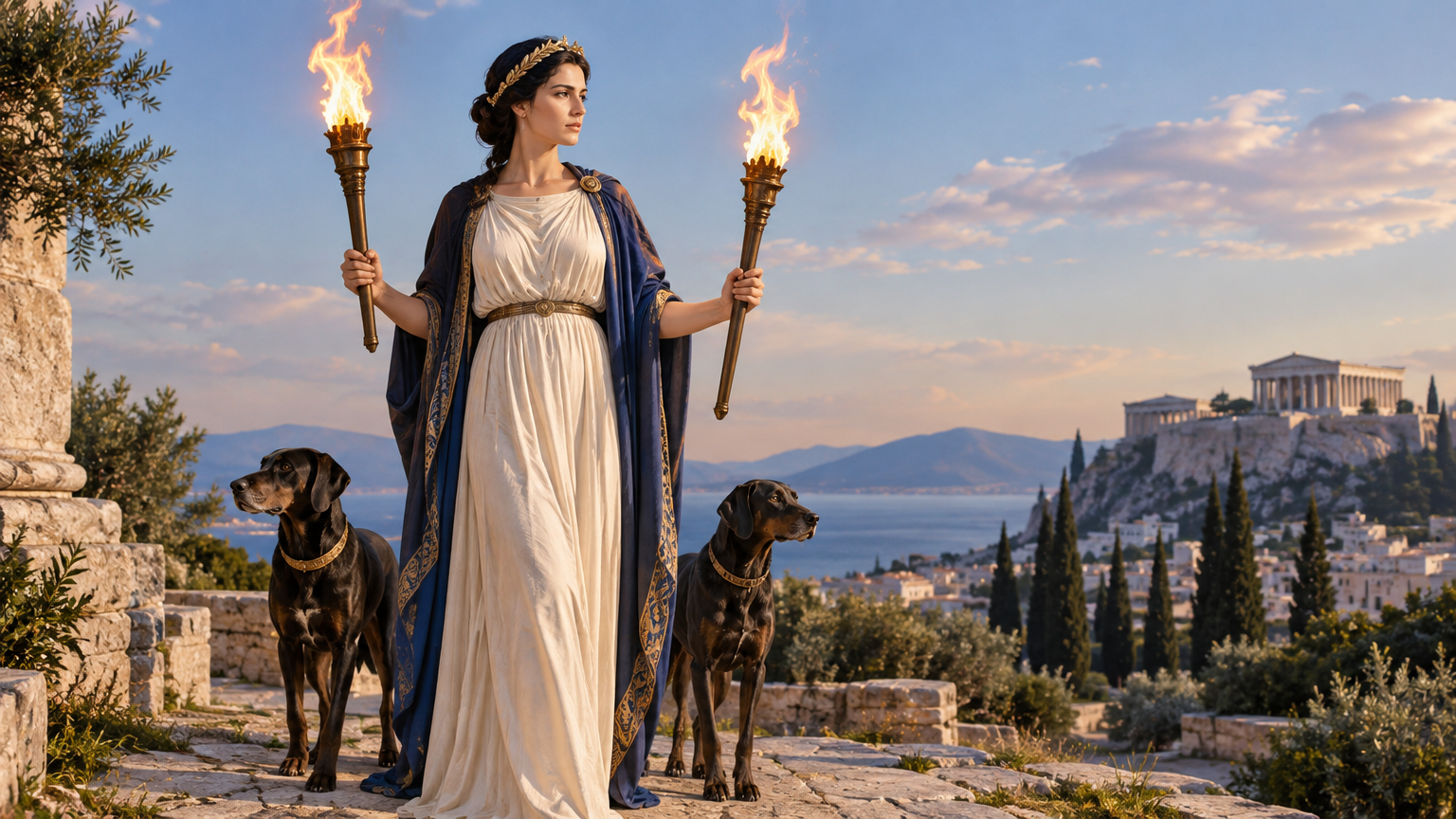
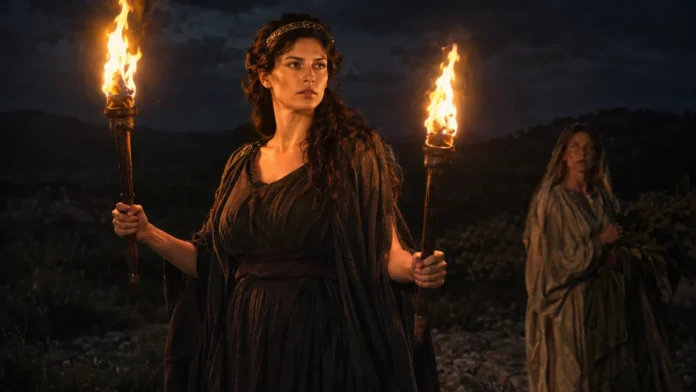
Torches are among her most recognizable attributes. Their association with her is already present in the Homeric Hymn to Demeter, where she approaches Demeter carrying light.
In art, torches suit both the search for Persephone and Hecate’s broader role in guiding movement through darkness.
The familiar triple image belongs to a particular development in her iconography. Writing in the second century CE, Pausanias credited the fifth-century BCE sculptor Alcamenes with first making three Hecate figures joined together.
He located this image beside the temple of Athena Nike at Athens.
Triple statues commonly arrange three female bodies around a central support, facing outward in different directions. This form is especially appropriate to entrances and intersecting routes, although a practical correspondence with crossroads does not explain every religious meaning that worshippers might have attached to it.
Dogs are closely associated with Hecate in ritual and literature and sometimes accompany her images. Keys also occur among her attributes, expressing authority over access and passage.
These details vary between objects and periods; they should not be assembled into a mandatory costume for every depiction.
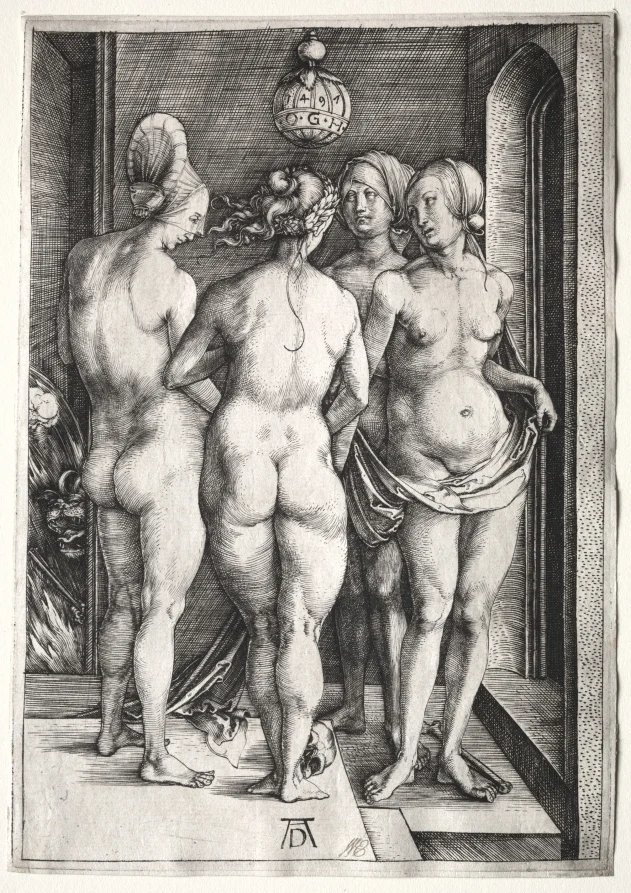
Some later magical texts give her more startling, animal-associated or multiple-headed forms. Such descriptions belong to particular ritual and literary settings, not to a universal ancient portrait.
Likewise, interpreting her threefold image as maiden, mother, and crone is not the standard explanation supplied by ancient evidence.
Background Story
Hecate’s background is best understood through the religious situations she occupied rather than through a continuous divine biography. Greek gods could exercise several kinds of power at once, and her early association with prosperity is not incompatible with later authority at dangerous boundaries.
Hesiod places her within the older divine generations while emphasizing that Zeus honors her after establishing his own supremacy. This arrangement integrates inherited power into the Olympian order.
Hecate is not presented as an enemy defeated and excluded by the younger gods.
Her relationship with Demeter and Persephone provides another foundation. She participates in a story about separation, searching, and return, but she neither causes the abduction nor replaces its central figures.
Her eventual companionship with Persephone gives her an established position beside the ruler of the underworld.
Doorways and crossroads brought these wider divine relationships into everyday space. A doorway separates household security from the outside world; a junction opens several possible routes.
Hecate’s protective presence at such places connects ordinary movement with concern about unseen danger and uncertain encounters.
Her role in magical literature develops from this wider network rather than from a wholly separate identity. In Apollonius of Rhodes’ Argonautica, Medea’s relationship with Hecate supports her ritual expertise.
The goddess’s nocturnal and unsettling aspects become especially prominent within that particular narrative setting.
Identification with Artemis and, in later contexts, Selene further complicated her character, bringing overlapping associations with torches, female divine power, and the moon. These connections did not erase the distinctions between the goddesses.
Hecate’s history reflects accumulated relationships and local emphases rather than one fixed theological system.
Famous Folklore Stories
Hecate’s narrative presence is best approached through episodes and recurring roles rather than a single, continuous cycle of adventures. Ancient poetry presents her as a witness, helper, and source of magical authority.
These roles belong to different literary settings and should not be combined into one supposedly original story.
The Torch-Bearing Helper
In the Homeric Hymn to Demeter, Hecate hears Persephone’s cry during her abduction but does not see the abductor. Carrying torches, she meets the searching Demeter and explains the limits of her knowledge.
Together they approach Helios, whose testimony supplies what Hecate cannot.
After Persephone’s return, Hecate welcomes her and becomes her attendant and companion. This episode establishes a relationship with the underworld without making Hecate its ruler.
Her role is supportive: she helps bridge separation and reunion, rather than causing the disappearance or independently securing the release.
Divine Authority Behind Magic
Another recurring pattern connects Hecate with the exceptional knowledge of human practitioners. In Euripides’ Medea, the heroine invokes Hecate as the mistress she especially honors.
The connection gives Medea’s magical identity a religious foundation, but it does not make the goddess responsible for every action Medea takes.

In Apollonius’ Argonautica, Medea’s knowledge of Hecate’s worship belongs to the larger story of Jason’s dangerous tasks. Here magical assistance, secret knowledge, and divine power intersect.
The poem’s ritual scenes are literary representations within an epic, not instructions that can automatically be treated as ordinary Greek practice.
Cultural Impact
Hecate brought divine protection into spaces where ordinary boundaries could feel vulnerable. Doorways and crossroads connected familiar territory with uncertain surroundings.
Her presence in such places made her relevant to daily movement and household security, not simply to exceptional acts of sorcery or encounters with the dead.
Her imagery also gave artists a recognizable way to represent watchfulness. Multiple figures arranged around a central support could face different directions, making the goddess particularly suited to boundary settings.
This visual tradition expressed protective presence as well as supernatural power; it was not necessarily an image of monstrosity.
Literary associations with Medea helped strengthen Hecate’s reputation as a patron of magic. Yet tragedy and epic selected aspects of the goddess for particular dramatic purposes.
Their dangerous or secretive settings should not eclipse the protective functions that made her meaningful within household and community religion.
Modern interpretations often emphasize female autonomy, transformation, and spiritual authority. These readings can be significant within contemporary religious and artistic communities, but they are modern selections from a varied ancient inheritance.
They should not be mistaken for a single doctrine shared by all ancient worshippers.
Similar Beasts
Medea

Medea is a princess and sorceress in Greek mythology, remembered for helping Jason obtain the Golden Fleece and for later narratives of betrayal, exile, and revenge.
Her comparison with Hecate is especially close because ancient literature explicitly connects them. Nevertheless, Medea remains a human mythic practitioner, while Hecate is a goddess.
Hel

Hel is a Norse ruler of a realm of the dead. Her best-known narrative connections include Baldr’s continued confinement after the attempt to obtain universal mourning fails.
Both figures have associations with death, but their authority differs. Hel governs a destination of the dead; Hecate’s underworld connections do not establish an equivalent sovereignty.
Morgan le Fay

Morgan le Fay is a changing figure in Arthurian literature, appearing as an enchantress, healer, otherworldly ruler, and sometimes antagonist. Her character varies substantially between individual texts.
Like Hecate, she combines magical authority with potentially helpful or threatening roles. The comparison concerns narrative function, not evidence that the two share an origin.
Religion/Ritual
Hecate was worshipped as a goddess, not merely feared as a supernatural threat. Small images or shrines associated with entrances and crossroads expressed her protective role.
Such settings placed divine guardianship at the boundary between household space and the wider world.
Food offerings known as Hecate’s suppers are documented in ancient Greek evidence, particularly in connection with the close of the lunar month. Aristophanes’ Wealth jokes about poorer people taking this food, revealing that the offerings were recognizable enough to support a public comic reference.
The joke is useful evidence for familiarity with the custom, but it does not establish a universal menu or a standardized ceremony. Specific offerings and explanations must be considered individually.
Modern lists that combine every reported ingredient can create a misleading impression of uniform ancient practice.
Literary rites require a separate category. The nocturnal ceremony associated with Hecate in the Argonautica contributes to the epic’s atmosphere of danger and extraordinary assistance.
Although it draws on recognizable religious ideas, its narrative details cannot simply be generalized to every sanctuary, household, or historical period.
Scientific or Rational Explanations
Hecate is better studied through the history of religion than through attempts to identify an unknown animal or explain a physical sighting. The evidence concerns worship, images, poetry, and social practice.
These materials illuminate how people understood divine power, rather than documenting a biological creature.
One useful interpretive approach is liminality, meaning the significance of boundaries and transitions. Entrances and crossroads separate spaces while also connecting them.
A goddess associated with such settings could represent both protection against unwanted passage and assistance when movement between different conditions became necessary.
This interpretation helps explain the coexistence of reassuring and frightening characteristics. The power believed capable of guarding a boundary might also control what crossed it.
Protection and danger therefore need not represent contradictory identities, although this analytical model cannot explain every local tradition or literary development.
Genre is another important consideration. A hymn can emphasize divine assistance, a tragedy can heighten a sorceress’s threatening authority, and comedy can turn an offering into a joke about hunger.
These differences reflect literary purposes as well as religious beliefs, so no single passage supplies a complete portrait.
Likewise, an association with magic should not automatically be read as evidence of a separate, uniformly forbidden religion. Ancient boundaries between accepted worship and suspect ritual were contested.
Descriptions of secrecy or danger reveal the viewpoint of a particular text, not necessarily the everyday experience of every worshipper.
A restrained explanation therefore preserves historical variation instead of reducing Hecate to one psychological fear or one symbolic formula. Her protective, magical, and underworld associations could overlap without becoming identical.
Understanding that overlap is more productive than treating every development as the survival of one unchanged prehistoric belief.
Modern Cultural References
Hercules, “Hercules and the Disappearing Heroes”, episode
In the animated Hercules episode “Hercules and the Disappearing Heroes,” Hecate kidnaps the great heroes and plans to transfer their greatness into a newly created monster.
Source
Jason and the Argonauts (1963), Hecate, film
In Jason and the Argonauts (1963), Medea is the high priestess of the goddess Hecate.
Source
Midnight Offerings (1981), Hecate, film
In Midnight Offerings (1981), a spell invokes Hecate as a moon goddess associated with magic, witchcraft, and necromancy.
The ritual involves chanting over a man’s photograph before placing it in a metal bowl that bursts into flame.
Source
Hecate (2021), Hecate, film
The short film Hecate (2021) reinterprets William Shakespeare’s Macbeth in a graphic novel-like style, telling the story from the perspective of Hecate, the goddess of witchcraft.
Source
Hecate, Queen of Witches (2012), Hecate, animated film
In the animated short Hecate, Queen of Witches (2012), a neglected and conflicted suburban Goth girl named Ally encounters Hecate.
Presented as the Dark Mother Goddess, Hecate calls Ally her divine daughter and goddess apprentice.
Source
Hades II, Hecate, goddess and Melinoë’s mentor, video game
In Hades II, Hecate is the goddess of magic, witchcraft, and crossroads.
She mentors Melinoë, the immortal witch protagonist, in the game’s retelling of Greek Underworld myth.
Source · More info
Conclusion
Hecate is a goddess of Greek religion, not a mythological beast, and her significance extends beyond the familiar image of a mysterious patron of witchcraft. Her associations with thresholds, crossroads, torches, and the dead connect protection with uncertainty and passage between different realms.
Understanding her requires keeping those roles together without assuming that every period or community understood them identically. Her varied representations belong to a developing religious tradition, rather than a single fixed description.
Her lasting symbolic force rests in that combination of guidance and danger. The same boundary that exposes someone to uncertainty can also become a place of protection, while darkness can make a guiding light especially meaningful.
Hecate’s connection with such encounters helps explain why her imagery remains compelling. A careful account nevertheless distinguishes ancient worship, literary portrayals, and later reinterpretations, allowing her importance to emerge without reducing a complex deity to either a frightening monster or an exclusively benevolent guardian.
Further Reading
Theogony, Hesiod
Lines 411–452 present Hecate’s parentage, the honors preserved by Zeus, and her broad influence over prosperity, competition, fishing, herding, and the nurture of children.
Source
Homeric Hymn to Demeter, Homeric Hymns
An early account of Persephone’s abduction and return. Hecate hears her cry, assists Demeter’s search with torches, and eventually becomes Persephone’s attendant and companion.
Source
Argonautica, Book 3, Apollonius of Rhodes
Medea’s assistance to Jason connects Hecate with magical knowledge and nocturnal ritual.
These scenes belong to a literary epic rather than a universal description of Greek worship.
Source
Hecate, Theoi Greek Mythology
A compilation of translated ancient passages and information about Hecate’s genealogy, attributes, cult, and imagery. Individual extracts retain their distinct literary and historical contexts.
Source
Hecate, Magic, and the Path of Devotion with Jack Grayle, The Witching Hour with Patti Negri
A February 10, 2025 podcast conversation about Hecate, magic, ghosts, and contemporary devotion.
Useful for modern religious reception, not as primary evidence for ancient practice.
Source
Hellboy: Hecate Monster Booster, Mantic Games
The product listing documents a Hecate miniature and game cards for Hellboy: The Board Game, illustrating a modern fictional reinterpretation rather than the goddess’s ancient identity.
Source