Introduction
The bunyip is an Australian English name applied to varied Aboriginal water spirit-beings, especially those associated with inland waterways of southeastern Australia. It is better understood through regional traditions and particular places than as a single monster with an agreed appearance.
Rivers, lakes, swamps, billabongs, and deep waterholes form its characteristic setting. Within the traditions grouped under this name, the presence in the water can be dangerous and feared, but its identity and significance depend on the community and location concerned.
The familiar idea of an undiscovered Australian animal developed through a different process. Nineteenth-century settlers collected descriptions, publicized alleged encounters, and examined supposed remains, translating accounts of water beings into questions about anatomy, natural history, and the discovery of new species.
These histories overlap without being interchangeable. Early printed descriptions include birdlike, reptilian, and mammalian features, but none establishes a universal traditional form.
The bunyip’s importance lies partly in this meeting, and frequent misunderstanding, between place-based Indigenous knowledge and colonial storytelling.
History/Origin
The Aboriginal traditions underlying the English name precede their appearance in colonial newspapers, although the surviving written evidence cannot establish a single beginning. Different peoples maintained their own accounts of water beings, rather than participating in one standardized mythology with a shared origin story.
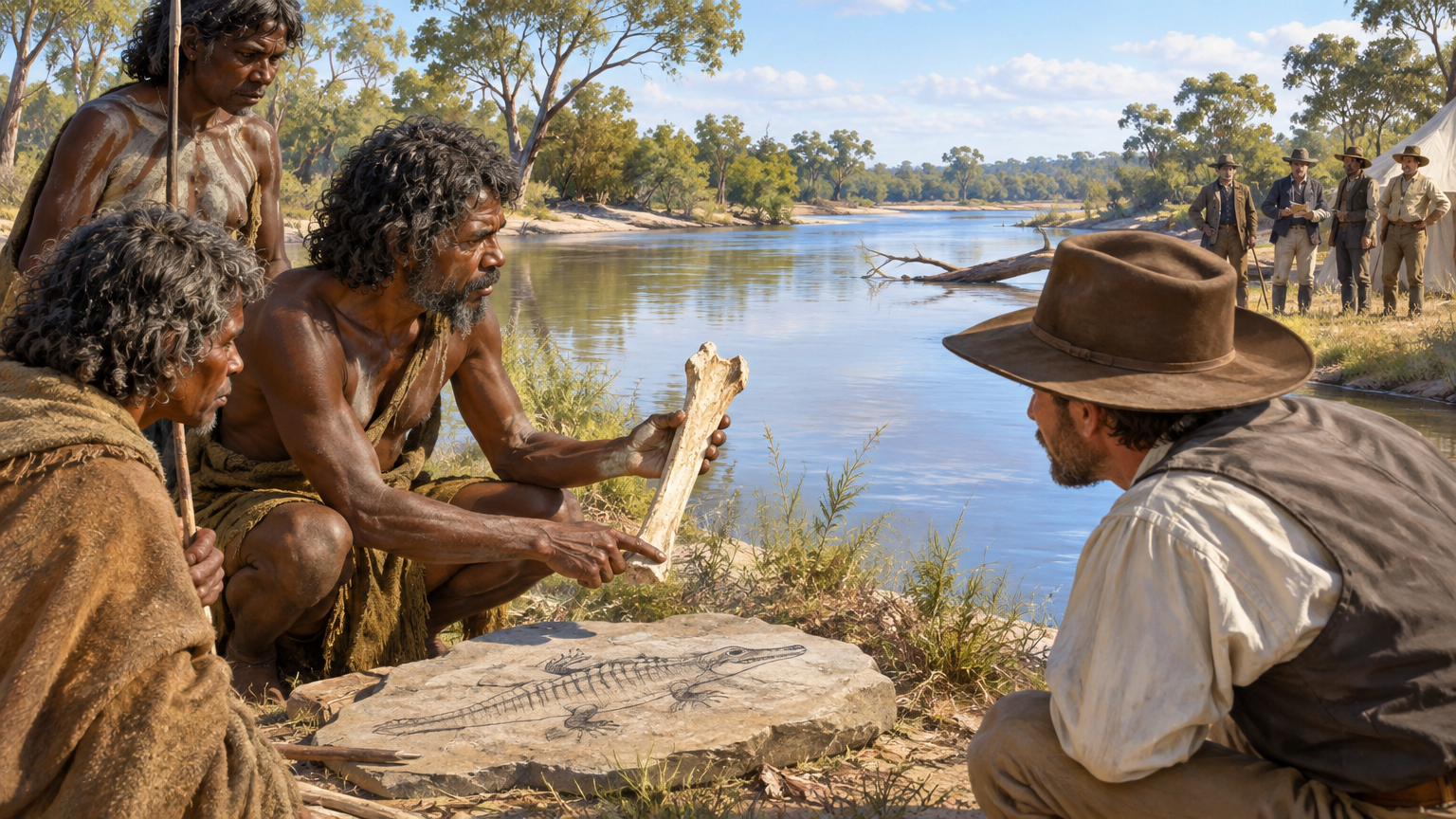
The earliest printed English use identified in the research is the Geelong Advertiser and Squatters’ Advocate of 2 July 1845. Its article, titled “Wonderful Discovery of a new Animal,” concerned a bone reportedly recognized by an Aboriginal man as belonging to a bunyip.
The man reportedly drew the being, and other Aboriginal people were said to confirm the identification. Preserved in a transcription presented by Djilang, the article is important evidence of early colonial circulation, but its language and arrangement remain those of a newspaper account.
A further episode followed the discovery of an unusual skull near the Murrumbidgee in 1846. Identified locally as a bunyip’s, it became an object of public and scientific curiosity.
Examination by naturalists instead suggested a young herbivorous animal, not a demonstrated new species.
Ronald C. Gunn’s 1849 paper, “On the ‘Bunyip’ of Australia Felix,” brought together reported names, descriptions, and discussion of supposed physical evidence. It records the diversity already present in colonial accounts, while also showing the effort to organize that diversity into a natural-history problem.
The resulting print tradition made the bunyip increasingly portable: a being associated with particular waters could become a newspaper sensation far away. Later popular storytelling inherited this generalized monster, often obscuring the distinctions between the regional traditions that colonial writers had brought together.
Name Meaning
The English word “bunyip” is commonly traced to Wemba Wemba banib. This linguistic connection is more precise than calling it simply an “Aboriginal word,” since Aboriginal Australia contains many distinct languages, and the English label eventually circulated beyond its language of origin.
Historical spellings include Bunyep and Bunyup. Such forms record the word’s passage into English spelling conventions, but they should not be confused with the separate regional names collected alongside it.
A spelling variant and the name of another community’s water being are different kinds of evidence.
Names such as Kian-prati and Katenpai occur in the historical record, while Ngarrindjeri beings including Mulgewongk have sometimes been grouped under the bunyip label. That grouping does not establish identical meanings, appearances, or cultural roles across the traditions concerned.
The specialist study “From Banib to Bunyip” treats this naming history as part of a transformation between Indigenous and colonial knowledge systems. Consequently, the English word’s familiar sense of “water monster” should not be mistaken for a complete translation of its original cultural meaning.
Appearance
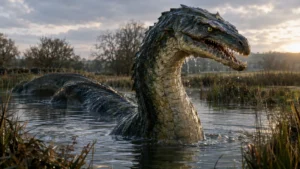
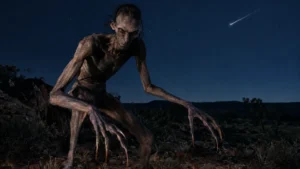
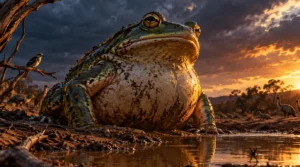
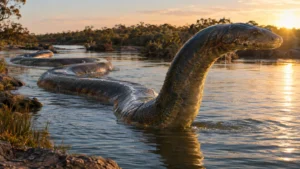
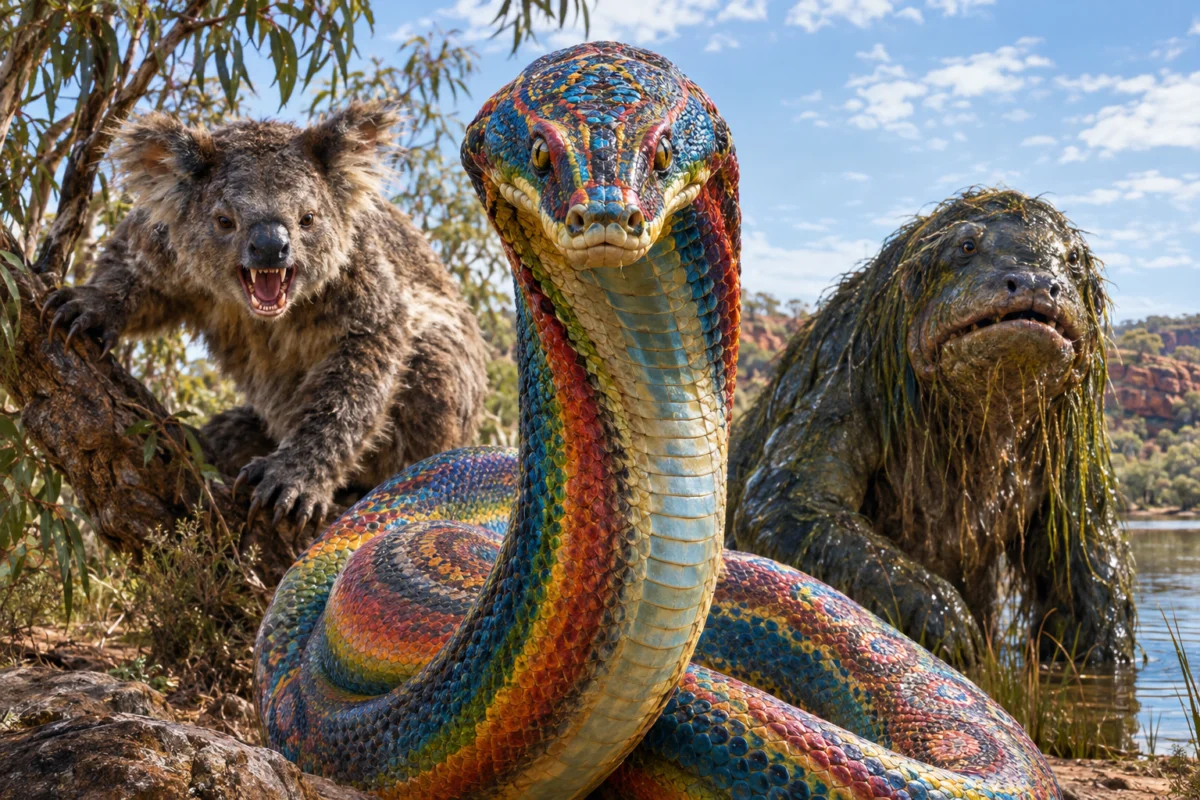
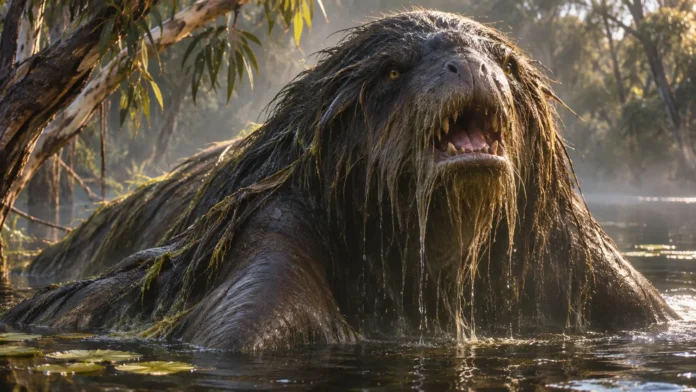
No single body plan defines the bunyip across the recorded traditions. Its association with inland water is more consistent than its anatomy.
Descriptions that resemble different animals belong to particular historical accounts, not to a composite design accepted throughout Aboriginal Australia.
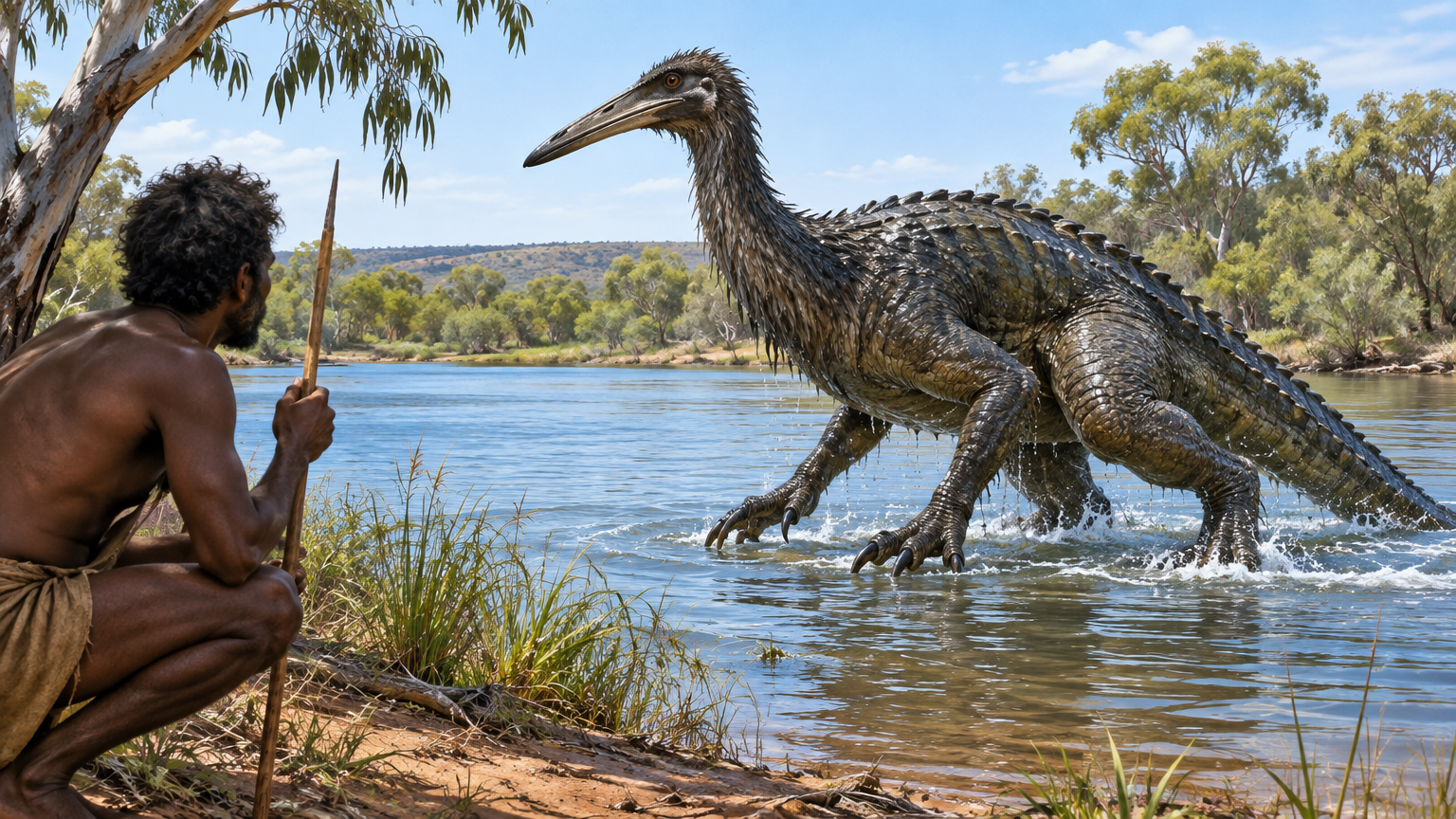
In the 1845 Geelong newspaper version, the being combined features of a bird and an alligator. Its head resembled an emu’s and carried a long bill, while its body and legs were compared to an alligator’s.
Long claws and powerful hind legs completed the reported image.
That description should retain its historical boundaries. “Alligator” was the newspaper’s comparison, not proof that the being was understood everywhere as a crocodilian.
Likewise, the emu resemblance belongs to this account rather than establishing a necessary feature of every water spirit called a bunyip.
Gunn’s 1849 compilation preserves a different combination: a being the size of a bullock, with an emu-like head and neck and a horse-like mane and tail. Reported drawings also supplied downward-curving tusks and seal-like feet, producing a substantially different outline from the earlier newspaper description.
These versions share some comparisons but differ in others. Combining the 1845 claws and reptilian body with the 1849 mane, tusks, and seal-like feet would create a new synthesis rather than faithfully reproduce either account.
Each description is most informative when kept attached to its recorded context.
The contrast also concerns identity, not merely artistic detail. An animal-like description in a settler’s report does not establish that the underlying tradition concerned an ordinary biological species.
Water-spirit identity and the colonial search for an unknown animal must remain distinguishable.
Background Story
The bunyip has no single recoverable biography that explains its birth, ancestry, and later adventures across all traditions. Its background instead lies in relationships between communities and particular waters, followed by the colonial circulation of selected names, descriptions, and encounter reports.
Place is therefore more than scenery. A water being associated with a particular river or waterhole belongs within local knowledge of that place.
Recasting it as a creature that might inhabit any Australian swamp removes the geographical and cultural specificity that helped give it meaning.
The 1845 bone episode illustrates the encounter between different frameworks of knowledge. An identification attributed to an Aboriginal man became, in print, the announcement of a possible new animal.
The newspaper’s discovery narrative shifted attention toward material remains and the possibility of zoological confirmation.
The same report included alleged attacks and a man displaying wounds on his chest. These details contributed to its threatening portrayal, but they survive as newspaper-reported claims.
They do not independently establish either the attacks or a general belief shared by all Aboriginal communities.
Allison Craven’s study “An Uncommon Ancestor” distinguishes regional water-spirit traditions from the generalized bunyip developed through colonial and popular representation. This distinction explains why later monster stories can descend from Indigenous material while substantially changing its setting, identity, and significance.
The figure’s historical background is thus layered: locally grounded water beings, colonial testimony filtered through newspapers and collectors, and subsequent popular retellings. Understanding those layers preserves the documented differences instead of forcing every name, frightening encounter, or unusual specimen into one continuous monster story.
Famous Folklore Stories
The surviving record includes encounter accounts as well as broader water-spirit traditions. Two widely circulated episodes concern objects identified as bunyip remains.
The headings below are descriptive editorial labels, not authenticated traditional tale titles, and both episodes survive through colonial reporting.
The Bone Identified as a Bunyip
In the Geelong Advertiser account of 2 July 1845, an Aboriginal man reportedly recognized a discovered bone as belonging to a bunyip. He drew the being, and other Aboriginal people were reported to have supported his identification.
This is an encounter account rather than a named traditional folktale.
The narrative also connected the being with bodily danger. It recounted alleged attacks and described a man displaying wounds on his chest as evidence of an encounter.
These details establish what the newspaper circulated, not independent confirmation of either the injuries’ cause or the creature’s existence.
The episode brought local knowledge into a colonial story about discovering an unknown animal. That framing matters: the drawing and reported testimony reached readers through newspaper interpretation.
The account therefore preserves an early narrative while also showing how a water-being could become a proposed zoological discovery.
The Murrumbidgee Skull
A second episode began with a skull found near the Murrumbidgee in 1846. Local Aboriginal people reportedly identified it as a bunyip’s.
During the ensuing investigation and display, the object became a focus of colonial curiosity about whether an unfamiliar creature inhabited inland waters.
Unlike an account based only on a fleeting sighting, this episode offered an object that could be inspected. Its apparent promise encouraged examination, but naturalists judged the skull to belong to a young herbivorous animal.
It did not establish the existence of a new species.
Julian Holland’s historical reconstruction in Australian Natural History follows the specimen’s passage into scientific discussion. The episode illustrates a recurring tension in bunyip history: an identification carrying cultural meaning was treated by settlers as a claim that comparative anatomy might prove or disprove.
Cultural Impact
Colonial newspapers helped move the bunyip from particular waterways into a shared settler imagination. Reports of bones, drawings, injuries, and sightings made the name recognizable beyond its local settings.
Readers increasingly encountered an Australian monster rather than the distinct water-being traditions behind the reports.
This circulation encouraged descriptions from different communities and places to be assembled as though they concerned one creature. Differences then appeared to be conflicting eyewitness reports about a single animal, rather than possible signs of separate traditions, meanings, or relationships with particular waters.
The word also acquired a figurative life in Australian English. By the late nineteenth century, Edward E. Morris’s A Dictionary of Austral English recorded uses associated with unreality and imposture.
Such meanings show how the name could circulate independently of its original spiritual associations.
Later children’s folklore further generalized the figure, making it available for imaginative retelling outside community-specific contexts. This popular bunyip belongs to a different cultural setting from a feared presence connected with a particular waterhole.
Shared naming does not make those representations interchangeable.
Modern specialist scholarship examines this transformation as a history of appropriation and recombination, not simply the spread of an unchanged legend. Studies of colonial knowledge systems distinguish between learning about Aboriginal water-beings and reshaping them to fit settler expectations about monsters, animals, and national folklore.
Similar Beasts
Kappa

The kappa is a Japanese river being associated with mischief and deadly tricks. Its familiar features include a turtle-like shell, webbed limbs, and a water-filled bowl on its head.
Its strongest parallel with the bunyip is dangerous freshwater habitation. Its recognizable anatomy contrasts with the bunyip’s varied descriptions; the comparison does not imply shared origins.
Kelpie

The kelpie is a shape-shifting water spirit in Scottish folklore, commonly appearing as a horse and luring people into water. Its narrative role connects an alluring encounter with danger.
Both traditions place threatening supernatural presences in inland waters. However, the kelpie’s characteristic horse disguise and shapeshifting should not be transferred to bunyip traditions without specific evidence.
Wagyl
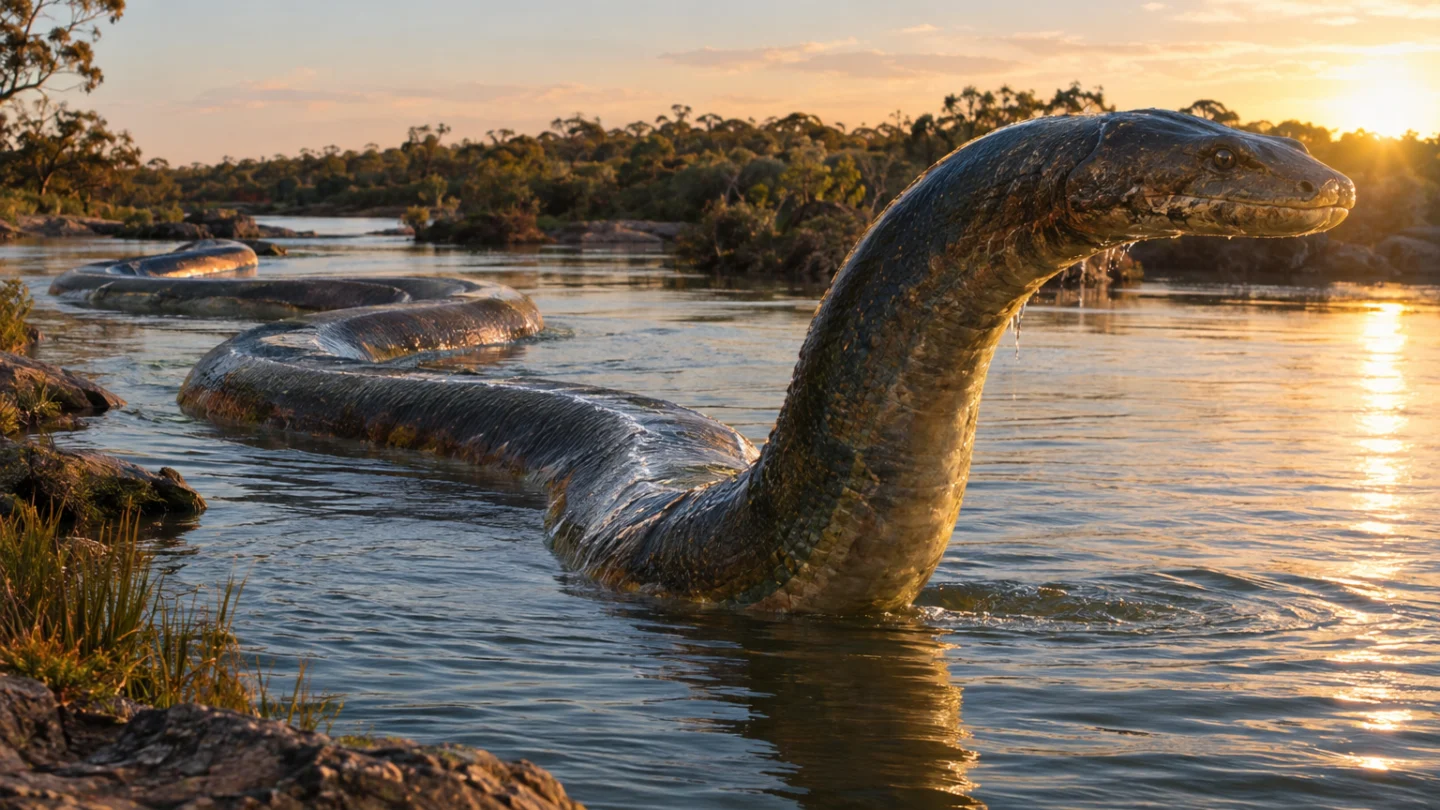
Wagyl is a great serpent spirit in Noongar tradition, associated with waterways and the shaping of the land. Its movement is described as forming rivers and other landscape features.
The comparison highlights relationships between spiritual beings, water, and place. Wagyl’s landscape-forming role remains distinct from the feared water-presences broadly grouped under the English label bunyip.
Nargun
Nargun belongs to Gunai/Kurnai tradition in Victoria and is associated with a particular place. It is a distinct being within its own cultural setting, not a regional bunyip spelling.
The useful parallel is place-specific supernatural presence. Keeping Nargun separate demonstrates why a broad monster category cannot substitute for the identities preserved within individual Aboriginal traditions.
Religion/Ritual
Bunyip traditions concern spiritual relationships with water-places, not merely reports of unusual wildlife. Their significance varies between communities, and the broad English name should not imply a single deity, shared theology, or uniform religious institution extending across Aboriginal Australia.
The reviewed evidence does not establish a bunyip-wide system of ceremonies, offerings, or observances. It therefore cannot support instructions for appeasing the being or lists of universal taboos.
Specific practices would require evidence from the relevant community and tradition.
Scientific or Rational Explanations
Scientific explanations address particular reports, sounds, or specimens, rather than settling the meaning of every water-spirit tradition. A proposed animal identification may explain an observation without explaining why a place matters spiritually or why its associated narratives have endured.
The Murrumbidgee skull provides the clearest specimen-based example. Naturalists interpreted it as the remains of a young herbivorous animal, not demonstrated evidence of a bunyip species.
Its history shows why an unusual-looking object requires anatomical examination before becoming evidence for an unknown animal.
Seals have been suggested as explanations for some animal-like reports. This is a hypothesis about possible misidentification, not a general solution.
It would need to fit the circumstances of each observation, and it cannot account automatically for every form recorded under the bunyip name.
The booming call of the bittern has likewise been proposed as a source of mysterious wetland sounds. It offers a possible explanation for some acoustic reports, but a bird call does not by itself explain visual encounters, alleged remains, or the cultural significance of water-beings.
Historical descriptions also passed through several stages of interpretation: reported testimony, drawings, newspaper accounts, and later compilations. Ronald C. Gunn’s 1849 compilation preserves differing names and forms.
Such variation makes it unsafe to treat the records as a consistent anatomical description awaiting identification.
A complementary historical explanation concerns the making of the generalized monster itself. Colonial collectors and popular retellings brought diverse material under one label.
Recognizing that process separates three questions: what someone observed, how an account was transmitted, and what a water-being meant within its own tradition.
Modern Cultural References
Hector’s Bunyip, film 1985
Screen Australia catalogs this completed narrative telemovie; its synopsis describes Hector’s Bunyip as spirits him to safety, while leaving open whether it really exists.
(screenaustralia.gov.au)
The Bunyip, book 2015
published fiction 2015 A published Australian fairy tale in which a young hunter captures a bunyip cub and its mother takes revenge; the listing identifies it as fiction.
(books.apple.com)
S3 Episode 1, The Bunyip, 2023
podcast episode 2023 A dedicated podcast episode about the Bunyip, described by the hosts as an Australian cryptid.
(buzzsprout.com)
Dot and the Smugglers, film 1984
ACMI’s collection record describes a plot in which a circus owner tries to capture a mysterious Bunyip and Dot and her friends try to stop him.
(acmi.net.au)
Conclusion
The bunyip is best understood not as one consistently described monster, but as an English-language label applied across culturally and regionally varied Aboriginal water-spirit traditions. Its strongest connections are to particular waterways, communities, and accounts, rather than a universal anatomy or shared biography.
Colonial descriptions preserve important historical evidence, yet they also reveal translation, selective reporting, and attempts to turn spiritual beings into discoverable animals. Keeping those layers separate allows the traditions to retain their differences instead of becoming one simplified national legend.
The bunyip’s lasting cultural significance lies partly in this movement between local meaning and wider reinvention. Water-spirit traditions, colonial specimen controversies, and modern entertainment belong to connected but distinct histories.
Neither an alleged skull nor a fictional screen appearance establishes what every community believed, and a proposed animal explanation cannot settle the cultural meaning of a spirit-being. Read with that distinction in mind, the bunyip remains an important example of how Australian storytelling has been transmitted, reshaped, and sometimes detached from its original settings.
Further Reading
“An Uncommon Ancestor: Monstrous Emanations and Australian Tales of the Bunyip”, Cambridge Core / Amsterdam University Press
Explains regional water-spirit traditions and distinguishes them from generalized colonial and popular representations.
(cambridge.org)
Geelong Advertiser and Squatters’ Advocate, reported by Djilang, Djillong.net
A 1845 newspaper report says an Aboriginal man recognized a found bone as belonging to a bunyip, drew the creature, and that others confirmed the identification; it also recounts alleged attacks and a man displaying chest wounds.
(djillong.net.au)
Julian Holland, Australian Natural History, Museum Publications.australian.museum
A skull found near the Murrumbidgee was identified by local Aboriginal people as a bunyip’s and displayed for examination; colonial naturalists concluded it belonged to a young herbivorous animal, not a demonstrated new species.
(museum-publications.australian.museum)
“From Banib to Bunyip: Tracking Bricolage and Knowledge Systems in Colonized Aboriginal Spirituality”, Folklore / Taylor & Francis
Specialist study of how the being and its name were transformed across Indigenous and colonial knowledge systems.
(tandfonline.com)
“On the ‘Bunyip’ of Australia Felix”, AIATSIS digital book collection
Readable contemporary compilation of reported names, descriptions and discussion of an alleged skull.
(aiatsis.gov.au)